ISSN 2286-4822 www.euacademic.org
Vol. I, Issue 11/ February 2014
Impact Factor: 3.1 (UIF) DRJI Value: 5.9 (B+)
Construction of Situational Tests for the Value
Clarification Model
ROLI RAI N.I.E.C., B.B.D.G.E.I.
Lucknow India
Abstract:
In the present day scenario, values are starting to drift to the back of the mind. Crime, violence, intolerance, insensitivity and apathy to human suffering are on a rise. Fear and insecurity of tomorrow makes the man cruel and greedy, selfish and intolerant, dishonest and untrustworthy, immoral and inhuman - so much so that conflicts arise in society and hence need adequate planning to ensure that the world and every man’s world is at peace. Various Value Development Models have emphasized the need to inculcate desirable values among individuals. The Value Clarification Model attempts to help people reduce value confusion and promotes a consistent set of values through an evaluative process. Herein, the students are pitted against a hypothetical situation involving decisions which enable them to introspect, thereby clarifying for themselves what they value. After gathering feedback from experts from various fields, values considered as most relevant for primary school children were identified. After this, the investigator endeavoured to construct scenarios wherein the participants would face moral dilemmas. By their decisions we would be able to guess the driving value at work. An analysis of the findings in this research should help us deduce the current trends of values present in school children and allow us to devise a strategy to remedy the situation if necessary.
The destiny of the individual as well as of the society depends on the values held and developed in them. As a rule, every educated man is a man of values. However, it does not mean that every literate is. Nowadays we observe that man is running after gathering college degrees but is unable to attain values which could lead him to a desirable direction worthy of pursuit in his thoughts, feelings and actions. We see a dichotomy staring at us in life. We have outstanding doctors who take away the kidneys of their patients without even telling them, brilliant engineers whose bridges collapse as soon as their bills are paid, accountants whose intelligent manipulations rob millions and politicians that promise the sky itself but can’t even produce a roof. Though all of them have received, perhaps the best education and are trained in the best institutions.
All the education these people received was used to make way for personal gains. Education to them has and will be been a tool for prosperity at the cost of happiness of many others. The yawning gap between thought and action is shocking. This is the reason that these days we talk of value based societies, politics and education. All of us feel that the values are falling steeply and nobody is respecting them. In our eagerness to point fingers at others we fail to realize that we too have contributed to this decline.
Need and Significance of the Study
objectives. There is an urgent need to review our present system of education in the light of present day demands so that it can become a powerful instrument in developing the desirable values and help in moulding future leaders of tomorrow.
Objectives of the Study
1. Identification of Values for Primary School Children 2. Construction Of Situational Tests of the Value
Clarification Model
Identification of values
The most relevant values identified for primary school children from the opinion of 32 experts from various fields were sought. They were asked to write ten values which were most relevant in the present Indian context for primary school children. After considering the feedback the most desired values were ranked in order of preference. Out of these10 values, 6 top ranking values were included in the study and were identified as most relevant were- Patriotism, Compassion, Truthfulness, Punctuality, Honesty and Bravery. Since the basic purpose of this tool was to inculcate the six identified values, situations were made based on these values.
Construction of Situational Tests
It was after taking the above values into account that the investigator constructed some hypothetical situations. Opinions of colleagues and also of the participants were taken into account during the planning stage. The situations were developed in such a way that the responses from the participants would give a clear picture of their bent of mind and help in analysing the current trends in values.
Almost all the policy makers and planners have emphasized the need to inculcate desirable values among the individuals. In this regard, various value development models have been suggested.
An education setting model of value education, for instance, includes a theory or a point of view about how people develop morally and develop a set of strategies for fostering moral development. The models of value education provide a broad based pedagogy to mobilize feeling, guide thinking and sustain action.
Value Clarification Models
Value clarification involves a clarifying response and is a way of responding to things that the students say or do to help them reflect on what they have chosen or what they value. The basic purpose here is to get the students to look more closely at their behaviour and ideas and thus ‘clarify’ for themselves what they really value.
Value Education based on Value clarification approach originated in 1960 's by Rath et al (1966) and Oliver and Shaver (1966) Here the role of a teacher is said basically to help the child to clarify his/her values. The purpose of this whole exercise was to help students to use rational thinking and become aware of not only their personal but also social values. Value Clarification does not aim at telling a person what his values should be, or what values he should live by; but it simply provides the means to discover what values to live by. This model analyses the relationship between values and behaviour. This model points out how we see ourselves in relation to the society. Believers of this theory further state that those who are clear about their relationship with society exhibit qualities of being positive, purposeful, enthusiastic, and consistent. But those who are confused exhibit tendency of negativity, uncertainty, inconsistency, drifting and over-dissenting (Hersh 1982). The result of this is clearly visible in society today.
approach that utilizes questions and activities designed to teach valuing process and that helps people skilfully to apply the Valuing processes to value-rich areas in their lives."
We find that Raths is not the least concerned with the content of people's values, but the process of valuing. Value Clarification attempts to help people, decrease value confusion and promote a consistent set of values through a valuing process. The valuing process is defined as a process by which we increase the likelihood that our living in general or a decision in a particular, will first have positive value for us, and secondly be constructive in the social context (Kirschenbaum 1973) This valuing process increases the likelihood of a good decision for ourselves and society.
In the book "Values and Teaching" Raths, Harmin and
Simon (1966) have explained the seven valuing processes
which lead towards value clarity. The Value Clarification process is designed by Raths to promote intelligent value choices through a process of choosing, prizing and behaving, which are given as under:
1 Choosing
(i) A value is freely chosen.
(ii) A value is chosen from alternatives.
(iii) A value is chosen after careful thought of the consequences of each alternative and not impulsively. 2. Prizing
(i) A value is cherished and is an integral part .One is happy and proud of the choice.
(ii) A value is prized enough to be publicity affirmed, and one should be willing to share them when occasion arises.
3. Acting
(i) A value is acted upon not just talked about. Ones activities should reflect the values one cherishes.
(ii) A value is acted upon repeatedly in a consistent manner, and should become a pattern of life.
techniques and activities may be used by teachers under Value Clarification approach. This approach uses inquiry and critical thinking as opposed to indoctrination. The basic key technique involved in Value Clarification is what Rath et at (1966) calls a clarifying response - a way of responding to things that students say or do to help them reflect on what they have chosen or what they value or on the kind of things they do in life.
The aim of a clarifying response is to let the students look closely at their behaviour and ideas, thereby 'clarifying’ for themselves what they really value in the process of helping choose, prize and act on a value. Kirschenbaum has pointed out that the values clarifying process involves social discourse, communication, sharing of thoughts and feelings with others which is a critical demand of the model. The students must become skilled in listening and resolution-skills. An individual, according to him, may be engaged in all five dimensions or some of them at the same time. They are Thinking, Felling, Choosing, Communicating and Acting. The Value Clarification does not aim to instil any particular set of values but rather the ultimate aim of this is to help students utilize the valuing processes in their own lives.
Identification of Values
Since the basic purpose of this tool was to inculcate the six identified values viz. Honesty Patriotism, Compassion, Truthfulness, Punctuality and Bravery, situations were made based on these values.
S.No Values No. of Initial situations made
1 Honesty 6
2 Patriotism 6
3 Compassion 6
4 Truthfulness 6
5 Punctuality 6
Table no T-1:- showing the initial number of situations.
After each situation, some problem questions were made which were to be discussed with students. This preliminary draft was given to 30 experts who were mainly from the field of value education for appropriateness of situations, language and to know whether the situations were appropriate enough to inculcate desired values. Experts pointed out some of the difficult words and also suggested changes in the situation. After considering the opinions of all the experts, the situations and probing questions were further revised.
When this draft was ready, it was given to 5 students of class V to assess their reactions and again to find out the difficulties in understanding the situations and decision making. Certain students took the situation at their face value. They thought that they were too young to take the decision on their own. The draft was re-revised in the light of difficulties faced by the students. Thus the final draft was made.
S.No Values No. of Situations finally included
1 Honesty 3
2 Patriotism 2
3 Compassion 2
4 Truthfulness 3
5 Punctuality 1
6 Bravery 4
Table no T-2:- showing the final number of situations
Construction of Situations in Value Clarification
The constructed tool based on the identified values was administered on one group of students. This was completed in one month.
When the students completed the task, verbal discussions were done with them in order to ensure that they had deeply imbibed the value inherent in a particular situation.
Value 1: Honesty - Situation nos. - 1, 2 & 3 Situation-1
David while playing in the park found a 1000 Rupee note, he decides to give it to the nearest police station. His friend Raj suggests lets have fun, it’s a lost thing.
Questions
(a) Was David correct?
(b) Was Raj's suggestion right?
(c) What would you have done if you were in David's place?
The responses and frequencies of each response are given in the
Table no.T-3:-
S.No. Number of Students
Responses Frequencies
1 30 - Yes, David was correct to
give the found Rs.1000 to the Police Station
30
2 30 - No Raj's suggestion was
wrong that they should keep the money.
30
3 30 - Same as David, given to
police.
- Tried to locate the owner. - Given to the poor and needy. -Given to recent natural disasters’ victims.
- Ask their parents.
18
4 5 2
1
Situation2
The teacher was punishing the children who had not done the home work. Ayan knew that Harry had copied the home work from another boy. He decided to keep quiet because Harry’s friendship was very important for him and moreover, he thought that it was just a home work and not a test.
(a) Was Harry's decision to keep quiet justified?
(b) Do you feel that you too would have reacted in the same manner?
The responses and frequencies of each response is given in the
Table no. T-4:-
S.No. Number of Students
Responses Frequencies
1 30 - No Ayan’s decision to keep quiet was
not right.
- Friendship is more important than Honesty.
23
7
2 30 - Yes, would have reacted like Ayan. - No, would not have reacted like Ayan.
7 23
Situation 3
A patient was suffering from cancer and was in the last stage. His son met with an accident but the doctor did not tell the dying man that his son had expired. He said that there was no use of giving him more pain when he was dying.
Questions
(a) Did the doctor do right by not telling his patient the truth about his son?
(b) What would you have done if you were in the place of the Doctor?
(c) As it is, he was about to die, so sooner or later it would not have mattered. He should have spoken the truth. What do you say?
(d) If it had been the doctor's wife suffering from this disease and his son had died, would he have reacted in the similar manner?
The responses and frequencies of each response is given in the
Table no.T-5:-
S.No. Number of Students
Responses Frequencies
not telling the patient. - No, the doctor was wrong in not telling.
8
2. 30 - Yes, would have done the
same if were in doctor’s place. - No, would not do so if were in the doctor’s place.
18
12
3. 30 - Yes, he should have spoken
the truth even if the patient would have died.
- No, he should not have spoken the truth; it would have killed the patient.
12
18
4. 30 - Yes, if the doctor's wife had
been suffering from this disease and his son had died still he should have spoken the truth.
- No, if the doctor’s wife was suffering and the son had died he would still have told his wife.
17
13
Results
The students had been given questions on various situations on honesty. On analysis it was found that all 30 students agreed that if they found Rs. 1000, they would give it to the police and not keep it for themselves. They all were of the opinion that the suggestion to keep the money for them was wrong. It was also found that some wanted to locate the owner, some wished to give the money to natural disasters’ victims and some wanted to give the money to the poor.
Where money was concerned there was cent percent honesty but, where friendship was concerned 7 students said that friendship was more important than honesty. At the same time 23 agreed that, not to let the teacher know and to keep quiet was wrong.
arose, 22 students felt that they would have told a lie rather than risk a patient’s life. Many also agreed that if they had been in the doctor’s place they too would have done the same, as life is more important than honesty. Their approach was a pragmatic one.
Value 2: Bravery – Situation nos. - 1, 2, 3 and 4
Situation 1
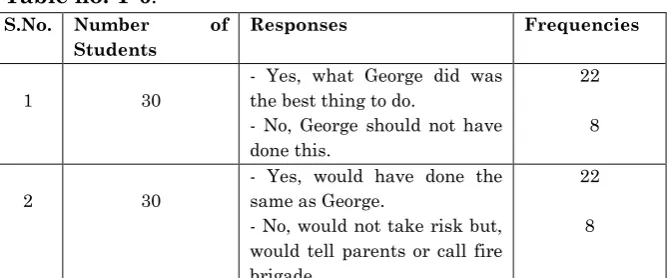
George, while playing outside his house saw that their neighbourhood had caught fire. He ran and helped the people but in turn gets hurt and his mother scolds him for the risk. He even misses school for 15 days.
Questions
(a) In your opinion - Was it the best thing what George did? (b) What would you do, if you happened to be in George’s place?
The responses and frequencies of each response is given in the
Table no. T-6:-
S.No. Number of Students
Responses Frequencies
1 30
- Yes, what George did was the best thing to do.
- No, George should not have done this.
22
8
2 30
- Yes, would have done the same as George.
- No, would not take risk but, would tell parents or call fire brigade.
22
8
Situation 2
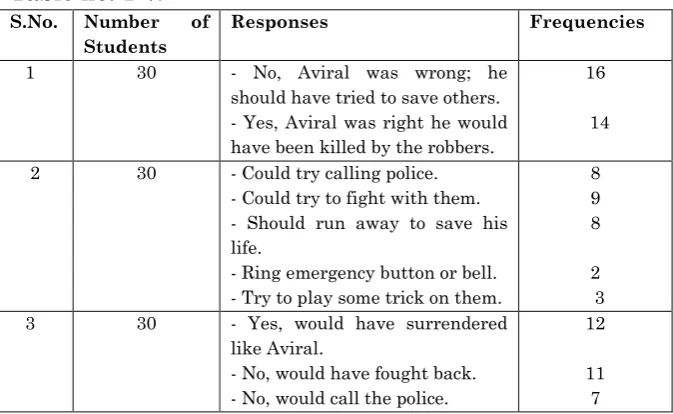
A boy named Aviral was considered to be very brave. Yet, one fine day when the robbers attacked in the bank with guns, he simply surrendered. Aviral said that had he tried to revolt he would not have been alive to tell the story. Moreover, that would have been suicide and not bravery.
(a) Did Aviral do right?
(b) What other option did Aviral have?
(c) Would you have done the same thing if you had been in Aviral's place?
The responses and frequencies of each response is given in the
Table no. T-7:-
S.No. Number of Students
Responses Frequencies
1 30 - No, Aviral was wrong; he
should have tried to save others. - Yes, Aviral was right he would have been killed by the robbers.
16
14
2 30 - Could try calling police.
- Could try to fight with them. - Should run away to save his life.
- Ring emergency button or bell. - Try to play some trick on them.
8 9 8
2 3
3 30 - Yes, would have surrendered
like Aviral.
- No, would have fought back. - No, would call the police.
12
11 7
Situation3
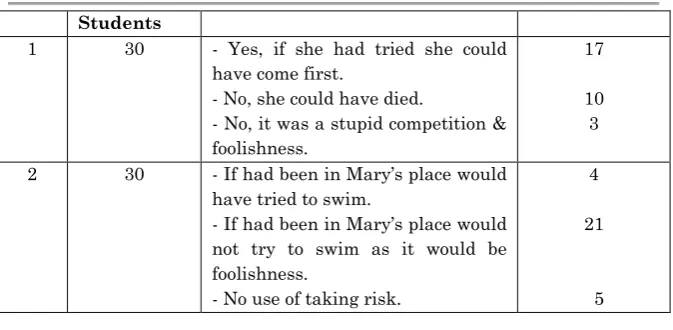
Mary and her friends went for a picnic by the riverside. There was a great current. All the girls took a bet as to who could cross the river, fastest. Mary also knew swimming but she did not agree to the proposal. She said it was foolishness and not bravery.
Questions
(a) Who knows, if Mary had swam she could have come first. Don't you think so?
(b) What would you have done, had you been in Mary's place?
The responses and frequencies of each response is given in the
Table no. T-8:-
Students
1 30 - Yes, if she had tried she could have come first.
- No, she could have died.
- No, it was a stupid competition & foolishness.
17
10 3
2 30 - If had been in Mary’s place would
have tried to swim.
- If had been in Mary’s place would not try to swim as it would be foolishness.
- No use of taking risk.
4
21
5
Situation4
The Railway line was closed and Ankur had to go to office. In order to prove to his friends that he was brave he crossed the Railway line and was proud of his deed.
Questions
(a) Was Ankur's action right?
(b) Would you do the same thing if you were in his place?
The responses and frequencies of each response is given in the
Table no. T-9:-
S.No. Number of Students
Responses Frequencies
1 30 - Yes, Ankur was right in
crossing the closed Railway line, took the risk so was brave.
- No, Ankur was wrong in crossing the Railway line.
2
28
2 30 - Yes, would do the same
thing if were in place of Ankur.
- No, would not do as Ankur.
2
28
Results
save those caught in fire and also agreed that if caught in a similar situation they too would have done the same thing. On further questioning, it was found that 16 students agreed that Aviral should have taken the risk to try and fight with the bank robbers, whereas the rest considered it a suicidal attempt and foolishness. Few said that they would have tried calling the police; some would have tried to ring the emergency bell. Few even said that they would have fought back.
Students responded that they value bravery and so 17 said that they would have tried to swim and win but at the same time 10 said that it was not worth taking the risk just to prove that they were brave. Overall it was visible that students have the value of bravery. But do not believe in following it blindly and thus risking their lives for it, they seem to have a balanced approach to life.
Value 3: Compassion – Situation nos. - 1 & 2
Situation 1
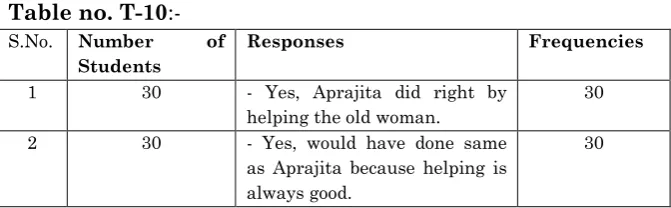
Aparajita was playing with her friends when she saw a blind woman who had fallen down. She ran and helped the woman, who was crying for help. Her friends laughed at her, for slow-walking with the old woman and called her a tortoise.
Questions
(a) Did Aparajita do the right thing?
(b) What would you have done, if you had been in the place of Aparajita?
The responses and frequencies of each response is given in the
Table no. T-10:-
S.No. Number of
Students
Responses Frequencies
1 30 - Yes, Aprajita did right by
helping the old woman.
30
2 30 - Yes, would have done same
as Aprajita because helping is always good.
Situation 2
Two friends Lily and Reva had gone to the temple when the beggars surrounded them. Lily started giving alms but Reva said that this was not compassion but encouraging beggary.
Questions
(a) Was Lily doing the correct thing?
(b) Was Lily right in discouraging Lily from giving alms? (c) What would you do if you were in Lily's place?
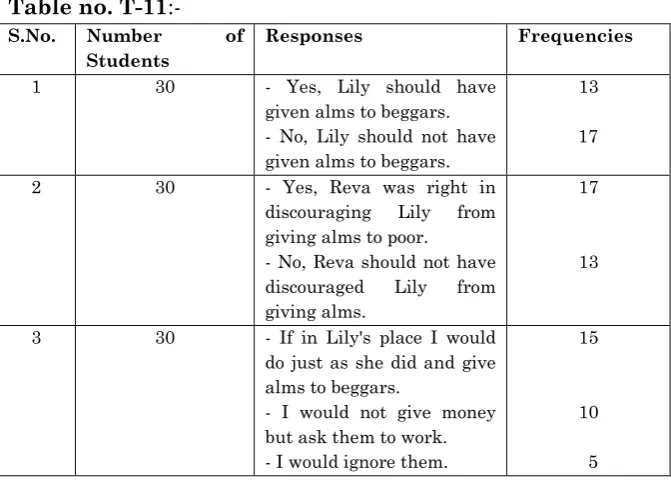
The responses and frequencies of each response is given in the
Table no. T-11:-
S.No. Number of Students
Responses Frequencies
1 30 - Yes, Lily should have
given alms to beggars. - No, Lily should not have given alms to beggars.
13
17
2 30 - Yes, Reva was right in
discouraging Lily from giving alms to poor. - No, Reva should not have discouraged Lily from giving alms.
17
13
3 30 - If in Lily's place I would
do just as she did and give alms to beggars.
- I would not give money but ask them to work. - I would ignore them.
15
10
5
Results
students said that they would try to motivate them to work for their living and not to beg.
It was found that the students have the value of compassion but at the same time are equally aware about beggary and do not believe in encouraging them.
Value 4: Patriotism - Situation nos. - 1 & 2
Situation 1
When Ayan reached school late, the National Anthem was being sung. He stood erect and thus gave respect to the Nation. All his friends who were late started making fun of him.
Questions
(a) You too must have faced a similar situation some time. What did you do?
(b) Did Ayan react in the right way?
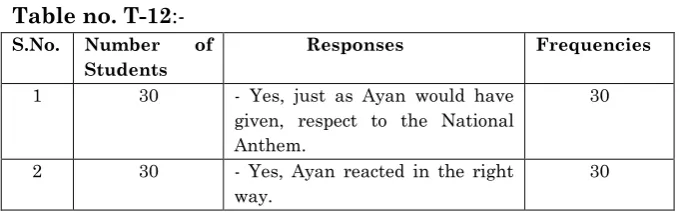
The responses and frequencies of each response is given in the
Table no. T-12:-
S.No. Number of Students
Responses Frequencies
1 30 - Yes, just as Ayan would have
given, respect to the National Anthem.
30
2 30 - Yes, Ayan reacted in the right
way.
30
Situation 2
Pankhuri saw a group of youngsters, laughing at the statue of Mahatma Gandhi. She could not resist herself and defended him in front of some 20 odd people. She also told them about his achievements and contribution to the freedom movement.
Questions
(a) Would you have defended Mahatma Gandhi like Pankhuri did ?
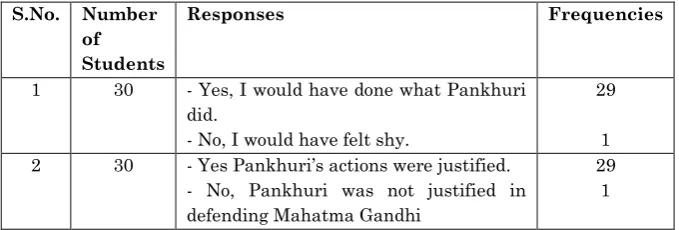
The responses and frequencies of each response is given in the
Table no. T-13:-
S.No. Number of Students
Responses Frequencies
1 30 - Yes, I would have done what Pankhuri
did.
- No, I would have felt shy.
29
1 2 30 - Yes Pankhuri’s actions were justified.
- No, Pankhuri was not justified in defending Mahatma Gandhi
29 1
Results
The responses of the students showed that all the 30 students believed in giving respect to the Nation, and the National Anthem. All but one said that they would defend Gandhiji and not let anyone make fun of their country. Though, one student did say that in order to prevent others from laughing at his country he could not let others make fun of him. It would be seen that the students sincerely value Patriotism.
Value 5: Punctuality – Situation No.s 1 & 2
Situation 1
Jack had to reach for his cricket match sharp at 9.00 AM to play for his team, as opening batsman. He started from home on time but on the way he met an old man who requested him to take him to the nearest hospital on his scooter and help him in making the admission slip. In the process he got late, the team captain got annoyed and replaced Jack with another boy.
Questions
(a) Could there be another alternative to what Jack did? (b) Would you too have done the same thing?
The responses and frequencies of each response is given in the
S.No. Number of Students
Responses Frequencies
1 30 - No, Jack should have helped
the man.
- Yes, he could have called the ambulance.
- Yes, could have asked someone else to help the old man.
18
9
3
2. 30 - Yes, would have done the
same as Jack. It is always good to help others.
- No, would not miss my cricket match.
26
4
Results
When assessed, the responses of students showed that about 18 students said that they would have helped the old man. Only 3 said that they would have asked someone else to help the old man and they would have gone to play the match as they believe in fulfilling a commitment and being punctual, 9 were practical and remarked that they would have asked for an ambulance and would have gone ahead with their match. Some said that match was more important but some others said that compassion for the elderly was of greater importance than punctuality. It was found that inculcation of value of punctuality was much required.
Value 6: Truthfulness – Situation nos. – 1, 2 & 3
Situation 1
Michael was attacked by robbers and he gave whatever valuables he had and on his person. After being asked by the robbers he admitted that he had a 500 Rupee note in his socks. This too he handed over. When he was questioned, he answered that he had been told by his mother to always speak the truth.
Questions
(b) Had you been in Michael's place what would you have done?
The responses and frequencies of each response is given in the
Table no. T-15:-
S.No. Number of Students
Responses Frequencies
1 30 - Yes, Michael was right in
handing over the money to the robber and telling them the truth. - No, Michael was wrong. Speak truth at right place, and not in all conditions.
- No, father's hard earned money, why waste it.
17
9
4
2 30 - If in Michael place, would not
have told the robber but the police. - If in Michael's place would have done the same and told the robbers.
15
15
Situation 2
Parth's father gave him Rs. 1000 for his pocket money and told him to spend it only on himself. His father was a very strict man. On the way to the market, Parth met his friend, who was weeping because his mother had met with an accident and he needed money immediately. Parth gave him his Rs. 1000. But when he came back home he told his father that he had bought books with the money, as he dared not tell his father the truth.
Questions
(a) Was Parth right in giving his money to his friend?
(b) Would you have done the same thing to help your friend?
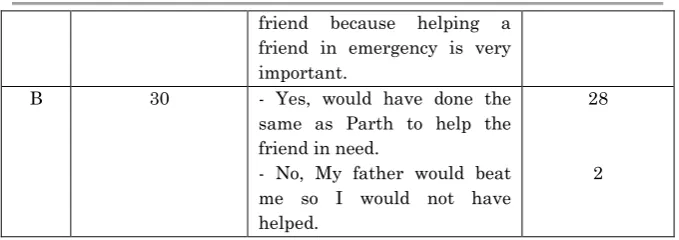
The responses and frequencies of each response is given in the
Table no. T-16:-
S.No. Number of Students
Responses Frequencies
A 30 - Yes, Parth was right in
giving his pocket money to his
friend because helping a friend in emergency is very important.
B 30 - Yes, would have done the
same as Parth to help the friend in need.
- No, My father would beat me so I would not have helped.
28
2
Situation 3
Lucy knew that her father was not supposed to eat sweets because the doctor had strictly prohibited him. At night, Lucy saw her father eating sweets and complained to her mother and thus told the truth.
Questions
(a)Was Lucy right in telling the truth?
(b)Would you too have behaved in a similar way?
The responses and frequencies of each response is given in the
Table no. T-17:-
S.No. Number of Students
Responses Frequencies
A 30 - Yes, Lucy was right in telling
the truth that her father was eating sweets, which were prohibited by the doctor.
30
B 30 - Yes, would have behaved in a
similar manner.
- No, mother would have got annoyed and at home problems would start.
28
2
Results
the robbers about it. A few said that speaking the truth at right places was more important than speaking truth always. Though all the students were of the opinion that if need arose they would lie to their parents but would help their friends in need. Only 2 responded that they dare not lie to their parents as they were very strict. All the students agreed that for the sake of their father's health they would tell the truth to their mothers. A few said that parents might start a fight so they would not tell the truth. It was found that the student's value truthfulness but they need to inculcate this particular value more.
Value Clarification
1. Value - Honesty
It was found that where the value 'honesty' was concerned the children were quite positive. They all agreed that honesty was very important. Most believed that if a question arose where they had to be honest regarding money, they would never take someone else’s money. Yet, if someone's life was at stake then of course they would not hesitate to tell a lie. Otherwise, they would make an effort to locate the owner of the lost money rather than to keep it for them. They would prefer to let their friend get into trouble rather than tell a lie and save him or her. So it is clearly visible that they do possess this value honesty. The Value Clarification was able to imbibe the value ‘Honesty’.
2. Value - Bravery
3. Value – Compassion
From the earlier pages it is clearly visible that the children have inculcated the value 'Compassion' .Most of them agreed that they would help rather a blind woman than bother about their work or play getting disrupted for a while. Though at the same time it can also be seen that majority of the children said that they would not give alms to beggars as it would only encourage them to become idle. Value Clarification helped the children to imbibe this value.
4. Value – Patriotism
The researcher found that to an extent the students possessed the value 'Patriotism' but Value Clarification helped in enhancing this value further. This value was imbibed in the students about cent percent. They all agreed to give respect to National Anthem and all but one said that they would have defended Mahatma Gandhi. It was exhilarating to find the children so conscious about their patriotic feelings. They all responded enthusiastically to show their love for their country, National song and their great leaders.
5. Value - Punctuality
The investigator felt that the value 'Punctuality' was much more required in the students in comparison to other values. About 40% of the students said that they would have gone for the cricket match since it was their responsibility and they should be punctual. It could clearly be seen that Value Clarification did help the students in inculcating this value but it should have yielded better result, which it could not, since most of the students were too closely linked with cricket match.
6. Value - Truthfulness
contribute in the students this value. The majority of students were agreeable to go along with telling the truth, even at the cost of avoiding helping the friend or even informing the mother about the prohibited sweets the father was eating, though some students even agreed to tell the truth to robbers.
Conclusion
There are innumerable areas of conflict and confusion in human life today. It starts from one’s adolescent age but ends nowhere. All around us, in every sphere of society viz. family, friends, school, college, love, marriage, caste, religion and politics, youth is suffering from what is known as conflict. People in disgust adopt an escapist attitude in the form of drug addiction and alcoholism. Others fall prey to mental imbalance and develop psychiatric problems. Acquisition of material wealth and political power has aggravated conflicts many folds.
Before we provide any guidance and direction, we must appreciate that every individual is contributing towards miseries and conflicts existing today in society. Hence, in dealing with the malady of conflicts, social organizations along with the government agencies have to instil confidence in society to remain insured for future. It is only then, that the feeling of dissatisfaction and oppression can be minimized. Economic disparity, too, is an important cause of social conflicts. A Need is urgently felt to rectify the wrong done or which is being done and humanize science education by cultivating values through a new order based on scientific and technological training. The students need to abandon their obviously unsuccessful customs and to handle the problems and live more productive lives. Science may be used as a tool for the welfare of human race and technology can affect the domains of intellectual, aesthetic and moral value.
holistic education is the need for resolution of conflicts. In this, knowledge includes self-knowledge at all levels of our existence. We should put our knowledge to a creative living together and build a cohesive, caring and sharing society.
BIBLIOGRAPHY:
Agarwal, V. 1988. “Inculcating moral values in children.” Indian Psychological Abstracts 26(1): 50 [Full article in Parents and Children. 1987. 15(4): 18-19]
Allport, G.W., P.E. Vernon and G. Lindzy. 1960. A study of Values. Boston: Haughton Miffilin.
Bajpai, A. 1990. “An experimental study of an Educational Intervention”
Curriculum for Value Development and its facilitative effect upon the level of moral judgement of children. Unpublished doctoral dissertation (Education). University of Lucknow, India.
Barman, C.R. 1974. The Influence of Value Clarification Techniques on Achievement, Attitudes and Affective Behavior in High School Biology. Unpublished Doctoral Dissertation. University of Northern Colorado.
Buch, M.B. 1974. “A survey of Research in Education.” Centre of Advance study in Education, NCERT, New Delhi. Covault, T. 1973. The Application of Value Clarification
Teaching Strategies with Fifth Grade Students to Investigate their Influence on Students. Self-concept and related class-room copying and Interacting Behaviors. Unpublished Doctoral Dissertation. Ohio State University.
Dhar, T.N. 2000. “Value education.” Journal of value education November Issue: 87-102
Gray, R.D. III. 1975. The influence of Value Clarification Strategies on Student Self-concept and Sociometric Structures in Selected Elementary School Class-room. Unpublished Doctoral Dissertation. University of California.
Guziak, S.J. 1974. The Use of Value Clarification Strategies with Fifth Grade Students to Investigate influence on Self-concept and Values. Unpublished Doctoral Dissertation. Ohio State University.
Joyce, B., M. Weil, and B. Showers. 1992. Models of Teaching. New Delhi: Prentice Hall of India.
Kelley, F.W. 1976. Selected Values Clarification Strategies and Elementary school pupils Self-concept, School sentiment
and Reading Achievement. Unpublished Doctoral Dissertation. Fordham University.
Kirschenbaum, H. et al. 1970. Value Clarification, A Handbook of Practical Strategies for Teachers and Students. New-York: Hart Publishing Company, Inc.
Kirschenbaum, H. and S.B. Simon. (Eds.) 1973. Readings in Value Clarification. Minneapolis: Winston Press.
Raths et al. 1966. Values and Teaching. Columbus. Ohio: Charies E. Merrill.
Rokeach, M. 1973. The Nature of Human Values. New York: The Free Press. A Division of MacMillan Pub.co.
Smith, M. 1977. A Practical Guide to Value Clarification. California: University Associates, Inc.