
i
A STUDY OF THE RELATIONSHIP BET\fEEN THE ACQUISITION OF SCIENCE PROCESS SKILLS AND PROBLEM SOLVING ABILITY Al"10HGPRIMARY SCHOOL PUPILS IN URBAN AND RURAL
SET'rING IN KENYA.
A RESEARCH PROJECT SUBIvUTr.rEDIN PARTIAL FULFILLMENT FOR
THE DEGREE OF MASTER OF EDUCATION, IN KENYATTA UNVERSITY.
BY
GRACE OBODO OGONDA
SEP'rEMBER, 1988. ~uraceosoooog-onall~
A study of the relationship between
DECLARATION
"This Research Project is my original work
and has not been presented for a degree
in
any other University".GRACE OSODO OGONDA
"This Research Project has been submitted for examination with my approval as University Supervisor".
;
DR. JOHN N. MAUNDU SCIENCE EDUGA'l'ION TUTOR
iii
DEDICATION
To my husband Henry, my best friend and roomate,
To my daughters and son
Truphena, Agnetta, Nereah and John Reuben the delights of my life
and
ACKNO':1LEDGEMEl-TT
No such work can be produced entirely by anyone person. I am therefore indebted to a number of people whose assistance, support and cooperation made the production offuis work possible.
I am grateful to my supervisor and tutor Dr. John Maundu for his kind advice, tolerance, and precious time given at every stage of this work. Hithout his valuable help and constructiye criticisms this work would have been incomplete.
I am equally grateful to the District Education Officer - Kisumu, in particular Mr. F. Oketch for his timely assistance; and to the Nairobi City Education Office through f1rs. Koinange for granting me permission to carry out the study in a number of Nairobi Schools.
I am deeply indebted to the head teachers, standard seven science teachers, and the pupils of Nairobi and "Nyakach for ~paring tHeir time for me and cooperating
with me during the study.
v
Phillemon, Sham, Japheth, John and Dan who willingly accepted to assist me and even walk long distances with me during the research.
My sincere ~ratitude is expressed to my husband Henry, who unselfishly gave me moral and physical
support and encouragement necessary for the production of this work.
CONTENTS
Page
TITLE OF THE PROJECT --- i
DECLARATION --- ii
DEDICATION --- iii
ACKNOvlLEDGEMENT --- iv
LIST OF TABLES ix ABSTRACT --- xi
Chapter 1 - Introduction Background to the problem --- 1
Rationa~for the problem --- 6
Statement of the problem ----~--- 8
; / Objectives of the study ----~---
9
Hypotheses --- 10
Significance of the study --- 11
Limitations of the study --- 12
Definitions of key terms ---
13
Organization of the project --- 16
References and foOtnotes ---
17
'.~hapter 2 - Literature Review Theoretical framework --- 20
Meaning of science Process Skills ---
27
Meaning of Problem solving --- 30
vii
process skills, problem solving and
achievement in other areas --- 35 Summary --- 42 References --- 43
Chapter
3 -
MethodologyIntroduction --- 52 Subjects --- 53 Sampling procedure
---Measuring Instruments
---"1 " .
Pl otlng ---Hai,n study
Time of data collection
---Administration of the instrument
---Variables
---·..
··Summary---References
---56 56 59
60
60
60
62 _..
_.-62
Chapter 4 - Data presentation, Analysis and Interpretation Introduction ---
63
Pupils performance in the science process
skill and problem solving tests --- 64 The relationship between the acquisition of
science process 'skills and problem
The relationship of sex to performance in science process skill and problem
solving test --- 70 Performance of urban and rural pupil
in the SPST and PST --- 71 Parents level of Education ---
73
Mastery of the three science process skillstested --- 77 The acquisition of the three science process
skills tested ---
78
Chapter
5 -
Discussion ~nd RecommendationsDiscussion of findings --- 80 Recommendation for further study ---__
90
APPENDICES ---
93
Appendix A: Questionnaire seekinginformation about the pupils ---
93
Appendix B: Scienc.e process skill test ----94
Appendix C: Problem solving test --- 101 Appendix D': Names of schoo.1s .covened
in the study ---______ 106
ix
LIST OF TABLES
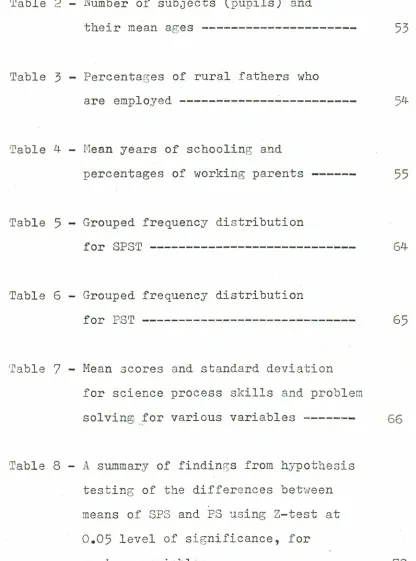
Table 1 - 1985 and 1986 mean standard scores
for subjects done in KCPE ---
7
Table 2 - Number of subjects (pupils) and
their mean ages --- 53
Table
3 -
Percentages of rural fathers whoare employed ---~--- 54
Table 4 - Mean years of schooling and
percentages of working parents --- 55
Table
5 -
Grouped frequency distributionfor SPST --- 64
Table 6 - Grouped frequency distribution
for PST --- 65
Table
7 -
Mean scores and standard deviationfor science process skills and problem
solving for various variables --- 66
Table 8 - A summary of findings from h~~othesis
testing of the differences between
means of SPS and PS using z-test at
0.05 level of significance, for
Table
9 -
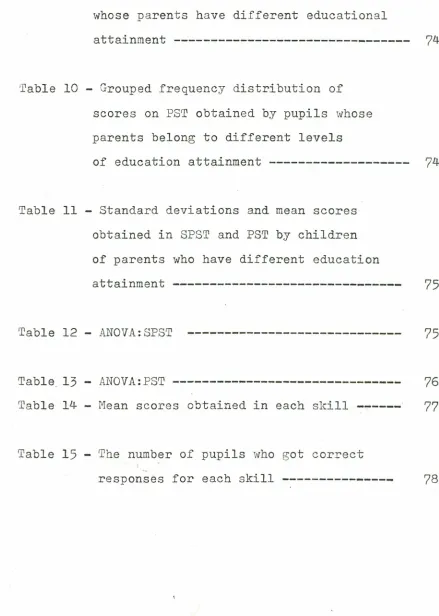
Grouped frequency distributionof scores on SFST obtained by pupils whose parents have different educational
attainment --- 74
Table 10 - Grouped frequency distribution of scores on PST obtained by pupils whose parents belong to different levels
of education attainment --- 74
Table 11 - Standard deviations and mean scores obtained in SPST and PST by children of parents who have different education
attainment --- 75
Table 12 - ANOVA:SPST
75
Table
13 -
ANOVA:PST ---76
Table 14 - Mean scores obtained in each skill --- 77Table
15 -
The number of pupils who got correctxi
ABSTRACT
This study viaS designed to investigate the relationship betwe en the acquisition of science process skills and
problem solving ability among standard seven pupils in a rural and an urban environ~t(Nyakach division of Kisumu
district and Nairobi Province).
The subjects involved in the study were 528 pupils _
279 boys and 249 girls. A science process skill teat and a
problem solving test designed to measure the acquisi~ion of science process skills and problem solving ability
respectively, were administered to these subjects.
It was found that a high and positive relationship (r=O.89)
existed between the acquisition of science process skills
and problem solving ability. It was also observed that urban
.?upils performed better than rural pupils in both tests.
Another observation made was that boys did better than r.irls~
in both tests. It was interesting to note that pupils of
relatively better educated parents obtained si.gn.if'Lcarrt Ly higher scores in both tests thsn those from less educated
parents.
The findings of this study indicate the ,need for more
use of inquiry method of teaching , especially in the rural areas, and an improved professional input from the area
1feaeher, '1.dvi'$oryCentre (TAC) Tutors in order to improve
the quality of science instruction and have better development of science process skills and problem solving ability among
INTRODUCTION
1.1 Background to the Problem
"Without education, development will not occur. Only an educated people can command the skills necessary for sustainable economic growth and for a better quality of life".
World Bank, 1988 The importance placedon education in general as a tool for economic growth and specifically in skill development as a means for sustaining economic growth has been seen in the trend education has taken since the late 1950s. The trend worldwide has been to improve the quality of education. This trend whith gained prominence in America and Europe in 1957 -after the Russians had launched Sputnik I, cailed for a new direction in science education in Western
Countries in general and in North America in particular. The launching of Sputnik I was a great challenge to the Americans; consequently they responded by
channelling large sums of money and talents into
efforts to upgrade all aspects of scientific enterprise (Lee, 1967 1). This scientific effort was put on
historical record. by Husen Tors en (1979) in the following words: -"
"The late 1960s and early 1970s marked a turning point with regard to exp-ectations about formal education as an instrument of economic growth and development". 2
In Britain too, similar progress as was going
2
in curriculum development. A great deal of time,
effort and money was expended in the largest cooperative venture ever, to upgrade education, especially science education (Ingle and Jennings,
1981)3
Thus allover the world, it was a period of active development of scienctific knowledge. This was evident in the development of varied types of school curricula at the time. In America such programmes as elementary science study (ESS) Under Educational Services Incorporated (ESI);Science
Curriculum Improvement Study (SCIS); Science: A Process Approach (SAPA) among others were launched. In
Britain there was the Nuffield Programme among others. In these programmes there was a deliberate effort
to move away from the traditional content based
programmes encouraging rote learning to the discovery/ enquiry/activity approach in which the development
of the process skills were encoura~ed. In this context Eugenia Poporad Variek and John Montean
(1977)
noted that ::
These changes in Science Education which were
taking place in America and Europe, where the acquisition of process skills 'were being stressed other than the acquisition of knowledge, were soon taken up in Africa and other developing countries where parallel developments soon began. Professor Oke
(1977)
thusnoted:-tIThepattern of education' established
in
,
.
Afrioa
follow$d
'the
':$nglish
system',, science teac~ing wasbased on the general assumption that science is science in Africa and in
Europe. Science is the same ever-ywher-e II
5
Corresponding to 'the science in Europe and in America' such programmes as the African Primary Science
Programmme (APSP) and its successor, the Science
Education Programme for Africa (SEPA), as well as the New Primary Approach (NPA) among others came up in Africa and Kenya in particular. The major aim of these changes was to introduce the science process skill (SPS) approach in our educational system. The approach which these new programmes were to'take was expressed at a SEPA meeting at Njala University in
1978.
It was 'Deported that science educationshould take the view that science is a medium through which a child might develop his natural curiosity,
his powers of observation and enquiry and 'constructive attitudes to problem solving and decision making
(SEPA,
1978
6).Some of the programmes emphasizing the use of
4
the NPA was operative in Kenya as early as in the
late 1950s, first in special schools in Nairobi, and was
later extended to the African sahools7 by the early
1960s (Waidmngo, 1978 8)
In these new programmes, the child was to be
responsible for his own learning by actively parti-cipating in the learning process through various
activi ties organized by the teacher. lilaichungo(1978) while ~<lritine;about the NPA, noted
that:-!tInall lessons, the child will not just
sit and receive information from the teachers, but he or she will actively take part.
The child will be given a chance to find out for himself rather than getti~g the teacher to tell him all the answers!t. 9
It is worth noting that, in the quest to upgrade
education for economic development, the Kenyan government has been engaged in a long term project
which reached a climax in 1984 with the launching of
the 8-4-4 system of education. In this system, the
emphasis is on the development of practical skills
( 10
and indipendent learning Dr. Oluoch, 1984 ; Kenya
National Examination Council, 1987 11)
What the 8-4-4,s7stem of education emphasizes and that which is relevant to this study is the
acquisition of practical skills which can be used
in solving practical problems. The definition
of science process skills (SPS) shows that practical
is the acquisition of the science process skills.
The 8-4--4 document released in 1984 by the Ministry
of Education Science and Technology stated
that:-"The 8-4-4 system will ensure that students graduating at every level have some
scientific and practical knowledge that can be utilized for either self employment, salaried employment or further training". 12
In this respect, the practical scientific
knowledge offered in the 8-4--4 programme should
enhance national development by equipping the youth
with the essential knowledge and skills necessary
for development. Thus, broadly speaking science
education is being seen as a tool for national
development; but specifically how does the acquisition
of the science process skills come into this argument?
The 1984-88 Development plan has the answer to this
question. It
says:-"Development demands people trained in Science and --Maths· occupation and manual skills much more than arts based occupation, hence more effort wi.Ll, be put in teachinz science and. maths so as ·tograduate adequate numbers and to making syllabus provide more functional , skills to assist the majority of school
leavers obtain self employment in the economy".'13
Again, the functional skills and manual skills in
science and mathematics mentioned here, as the ones
which will aid development in general are non other
than the science process skills. It is not surprising
then, that one of the aims of science educa~ion in
primary schools points directly at the deve~opment
6
is
to:-"enable children acquire certain manual and thinking skills which are useful in solvin;; practical problems". 14
1.2 Rational@ for the Problem
It is evident that the development and acquisition
of the science process skills is a ver,y crucial issue
in the educational system. But what is surprising
is that, despite all these emphases on the development
of science process skills, researches on skill
acquisition in the Kenyan Schools and elsewhere are
very few. Alvin Pettus (1980) commented
that:-"with the recent emphasis on development of science process skills in science education, it is surprising that
assessing performance levels relative to these skills has not received more attention ~han it has to date". 15
The researcher therefore intends to look into this
area and try to find out how weLl.. some of these skills which are very much emphasized in our educational
system are acquired by pupils. Secondly, since our
primary school syllabus and other authors (see literature
review) maintain that the skills acquired should help'
pupils to deal \Adth problems effectively/or be usef'uL in
solving practical problems ,the ~esearcher intends
to investigate if there is actually any relationship
between the acquisition of science process skills and
is
to:-"enable children acquire certain manual and thinking skills which are useful in solvinr; practical problems II.
14-1.2 Rationale for the Problem
It is evident that the development and acquisition
of the science process skills is a ver,y crucial issue
in the educational system. But what is surprising
is that, despite all these emphases on the development
of science process skills, researches on skill
acquisition in the Kenyan Schools and elsewhere are
very few. Alvin Pettus (1980) commented
that:-"with the recent emphasis on development of science process skills in science education, it is surprising that
assessing performance levels relative to these skills has not received more attention ~han it has to datell•
15
The researcher therefore intends to look into this
area and try to find out how well.some of these skills
which are very much emphasized in our educational
system are acquired by pupils. Secondly, since our
primary school syllabus and other authors (see literature
review) maintain t~at the skills acquired should help'
pupils to deal ltTith problems effectively/or be use'i;,ulin solving practical problems ,the researcher intends
to investigate if there is actually any relationship
between the acquisition of science process skills and
7
Thirdly, apart from the emphasis placed on
science education vis-a-vis process skills acquisition
in our education system, the researcher has been
greatly perturbed by the low rank science as a
subject has continued to o~cupy as compared with
other subjects done in the Kenya Certificate of
Primary Education (KCPE) since the inception of
the 8-4-4 system. The new trend in science education
emphasizing the acquisition of practical skills has
demanded a paraliel change in the setting of science
examinations. A shift from items testing recall to
items testing application of knowledge, problem solving
and a wide range of skills has been realized (KCPE
Newsletter, 1986) 16
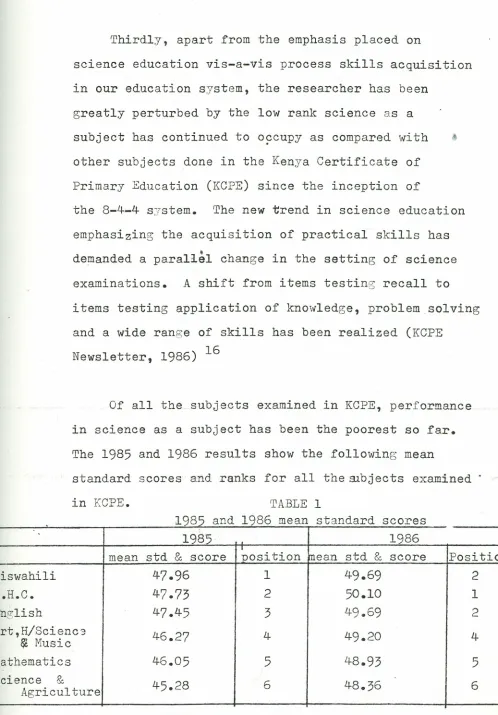
Of all the..subjects examined in KCPE, performance
in science as a subject has been the poorest so far.
The 1985 and 1986 results show the following mean
standard scores and ranks for all thembjects examined
in KCPE. TABLE 1
, 1985 and 1986 mean standard scores
1985 1986
I
mean std
&
score position mean std&
score PositionKiswahili 47.96 1 49.69 2
G.H.C. 47.73 2 50.10 1
English 47.45 3 49.69 2
Art,H/Scienc3
46.27 4 49.20 4
~ Music
Mathematics 46.05 5 48.93 5
Science &
45.28 6 48.36 6
Agriculture
It is also gathered from the same source that, the
performance on science questions as compared to the
sister-subject Agriculture has continued to be relatively
poor(KCPE Newsletter,
1987) 17
The general poor performance in science coupled
with the fact that the science paper now stresses
and tests science process skills problem solving
and other higher capabilities like application of
scientific knowledge, is really disturbing. An
anyalysis of the questions appearing in KCPE
1985
reveals that one third
(1/3)
of all the questionsout of sixty (60) were on SPS and nine
(9)
otherquestions-were on problem solving.
The disturbing question in the mind of the
researcher was, could it be that the pupils in primary
schools are not exposea to enough practical work based
on SPS and problem solving that makes performance
in science to be that poor? This question can only
be answered by setting a separate test that measures
the acquisition of science process skills ·and problem
solving ability in pupils. Hence the need to carry
out this research.
1.3 Statement of the problem
This study sought to find out whether there
was any relationship between the acquisition of the
science process skills and problem solving ability
9
Hore specifically the study tried to
answer-the following
questions:-i) Does the acquisition of the science process
skills necessar~ly presuppose a higher level
of performance in wob1.em '15D']~vi:.byngstanrl~
seven pupils?
ii) Is sex related to performance in the science
process skill test and problem solving activities?
ii~) Is there any significant difference in performance
in science process skills and pnob.lem s-01v.i ng
ability among urban and rural pupils?
iv) Are there skills at which girls are better
than boys?
v) Are there skills at which boys are better
than girls?
vi) Does the education of the parents have any
bearing on pupil performance in the science
process skill test and problem solving activities?
1.4 Objectives of the study.
In order to be able to fulfill the aim of
the study in tr7ing to find a relationship if any,
between the acquisition of the science process skills
and problem solving, the following objectives guided
the
researcher:-i) To find out whether the acquisition of
science process skills leads to a higher
attainment in problem solving ability
ii) To determine the type of skills best
acquired by pupils in class seven in both
an urban and a rural envir{ment.
iii) To find out if there is any significa~t
difference in the acquisition of SPS
and problem solving on the basis
of:-(a) Sex
(b) rural and urban envir~ments
(c) parental level of education.
Hypotheses
The following null hypotheses were tested
in the study. In this connection the alpha level
ahosen was 0.05.
i) Nain hyPothesis
HOl: There is no significant difference in pupil
performance in SPS and problem solving tests.
ii) Sub hypotheses
H02: There is no significant difference between
boys' and girls' performance in SPS and problem
solving tests.
H0
3:
There is no significant difference betweenrural and urban pupils in their performance in
both SPS and problem solving tests.
H04: There is no significant difference in performance
in the SPS and problem solving tests among children
12
that they can develop materials that will emphasize both SPS and problem solving skills.
1.7
Limitations of the studlThe following are some of the limitations of the study
:-i) The main limiting factor in this study was time. Due to insufficient time, the researcher could not
a) administer the instrument to the pupils on an individual basis, even though that could have been the best way to do it.
b) cover a bigger population than five hundred pupils.
c) test all the science process skills. The researcher concentrated only on three of
the basic skills, namely classification, quantification and prediction. Hence the results are generalized to the acquisition· of thes~ three basic science process skills. ii) External validity or the generalizability of
the results from this study is limited only to
the standard seven pupils of Nairobi as an
. n N
iii) The funds available for this research was
only Shs. 3,000/=. This was a bit on the
lower, side and could therefore not allow
the researcher to cover a more representative
population for the whole country.
1.8 Definitions of Key terms.
Science; Science may be defined as follows:
a) an organized body of information about
natural phenomena and the generalizations
that grow from this information.
b) specialized methods used to acquire this
information which are often referred to as
processes of science/scientific method/science
process skills.
Science Process Skills
These are mental and motor manipulative operations
used for obtaining information (or investigating the physical world), as is done by scientists or students
of science. There are two categories of Science Process
Skills. These
are:-i) Basic Science Frocess Skills. These include
such activities as - obervation, classification,
measuring quantification, using numbers. Using spatial and temporal relations, predicting
14
ii) ~Integrated Science Process Skills: It includes activities like experimenting, controlling
variables, using operational definitions,
hypothesizing, formulating and using models
and interpreting data.
The Skill of Classification
This is the ability to form groups having some
common specified observable properties. Vlhen objects,
events, people, are put together because they are
alike, they are being classified. It is a very
important skill especially in this era of knowledge
explosion, especially since facts, concepts and
generalizations become vague and excessive unless
order is brought out of them. We can say that one is able to classify if he/she can carry out the
follwoing activities:- sorting out; serializing
according to type or properties like colour, size
or number, if he/she can use given properties tv
to group objects or observe groups of objects then
identify the characteristicCs) used to classify them.
The Skill of predicting.
This is an acquired ability to use one or more rules from the same or different rule classes to
determine the outcome of an event or series of events
without prior observation of that event or series of
events. It involves fore-telling of events in the
-:There are three kinds of predictions • These a
re:-i) pattern prediction - whereby a known set of
relations is extended to include new ones.
ii) Extrapolation - as a special case of
pattern prediction.
iii) Hypdthesizing - as a process of stating
relationship between dependent and
indipendent variables.
Indicators of the presence of the skill include
inter-polation and extrapolation in graphic data, foretellin~
future events from observable data.
The skill of Quantification.
Quantification is the presentation of infor~aticn
to other people using quantitative data. Indicators
for quantification is when a pupil can: count, order
information, add, multiply, divide, use decimals use
powers of ten, show position of positive and negative
intersers on a number ~ine, name natural numbers in
an exponential form using base 10 and show how to
find products of two neutral numbers.
Science nrocess skill test
+
This is a test w~ich measures the acquisition
of the science process skills. It is composed of
items'based on science process skills - like
classi-fication, quantification and prediction. In this
study, the score on this test is used as an indicator
16
Problem solving
A situation where pupils apply previously learnt knowledge/skill and manipulate various cues in order to arrive at a given goal which is often obscured by the cues, is problem solving in nature.
Problem solving test
This is a test which measures problem solving ability. It is composed of items which require manipulation of several cues in order to arrive at a solution to the problem presented. In this
study, the score on this test is used as an indicator of problem solving ability.
Syllabus.
An outline of course of study.
Science curriculum.
Is a programme or a series of courses in science, offered by the school system.
1.9 Organization of the Project.
The presentation of this work has been organized into five chapters~ Chapter one is the introductory chapter while the second chapter deals with the literature
review. Methodology of the survey forms the content of the third chapter and the fourth chapter is concerned with
data presentation, analysis and interpretation.
The last chapter (five) summarizes the findings of the
References and footnotes.
1. E.C. Lee(1967} New Developments in Science Teaching
Belmont; Wardsworth publishing company Inc.
2. Husen Torsen.(1979~ IIPatterns and Structures for
"
~eacher Education. Teacher Education for developin~
countries. Prospects for the eighties. R. Gardener
Ed. London: University of London Institute of
Education pp. 23 - 24.
3.
Richard Ingle and Arthur Jennings. (1981l Sciencein Schools:which way now? London. University
of London Institute of Education p.21.
4.·Eugenia Poporad and John Monteen.(1977). "The
effect of two science proe;rammes - ESS and Laidaw
on students classification skil~; science
achivements and attitude". Journal of Research
in science teaching Vol. l~No. 1 1977 p.57
5. Pro. O.C. Oke.l1974l "What kind of Science should
be taught in Africa?" Bulletin of Regional Office
of Science and Technqlogy for Africa Vol. IV
No.2. Nairobi, Unesco p.22
6. SEPA.(1978} A report of Intergrated follow up and
Training Workshop for ex-participants
of Science Education Course (University of Siera~~eone)
18
Ibadan). Njala University. P.l.
7. In the colonial era, there were schools exclusively
for white childre-n-these were the schedule C schools,
there were also schools for the Asian children
schedule B and schools for the Bla~~ children
schedule A.
8. C.W. WaiChungo.(1978) NPA: Games, activities and
apparatus. Nairobi. O~fortt University p. 1
9. Ibid.
10. Dr. 01uoch.C1984~ "Foreword." Syllabus for Kenya
Primary SCh00ls Vol. 1. Nairobi •• Jomo Kenyatta
Foundation p.
v
11. Kenya National Examination Council. (1987}
Newsletter 1987 Nairobi~ KNEC p.64
KCPE
12. The Republic of Kenya. Ministry of Education
Science and Technology. (19841 8-4-4 System of
Education. Nairobi •.p.1
13. The Republic of Kenya. (1983)Kenya Government Plan
1984 - 1988. Nairobi~Government Printers~ p. 147.
14. fvlinistryof Education Science and Technology.( 1986)
Syllabuses for Kenya Primary Schools Vol. 1 ~ 2.
15. Alvin Pettus et al.(1980) "Identifying factors
related to Science Process Skill performance
level." School Science and Mathematics
Vol. LXXX No.4 1980. p. 272.
16. Kenya National Examination Council. (1986)
KCPE Newsletter 1986 Nairobi. KNEC p. V
17. Kenya National Examination Council.(1987)
CHAPTER 2
LITERATURE REVIEW
2.1 Theoretical framework
The education of an individual includes his
becoming familiar with skills ~n addition to his
knowing how to solve problems using these skills.
Educators have noted that an educated or a learned
person is one who "knows how" (Gar:;ne,1975 1).
That is, one who is skillful in carrying out certain
activities and can command these skills in solving
practical problems and thus enhance economic
development in the quest for a better quality of
life. Without education in ~eneral and in the
absence of these learned/sk~lful people, development
will not occur (World Bank, 1988 2). Therefore, for
some years, science educators (Gagne, 1975; 3
Piaget 1971; 4 Henson and Janke, 1984,5 Alan
Ward, 1983,6 Jegede and Brown, 1984'7)have come to
agree that the acquisition of science process skills
should be a major goal of science instruction.
Fitzpatrick, (1960) also observed this to be so~
he wrote
that:-"a school system would be neglecting the chief contribution of science if it did not designate as a primary purpose the development of skills and methods of enquiry by which verifiable knowledge about the world is obtai.ned "; 8
Thus, a lot of emphasis has been placed on the teaching
and use of science process skills in various educational
emphasizing the acquisition of the science process skills reflected in the curriculum developments which have occurred in recent years. As a result of this, programmes such as.S:ience:·A Process Approach (SAPA), Science Curriculum Improvement Study (SCIS), Intermediate Science Curriculum Study (I8CS) and in Kenya, the 8-4-4 Programme, have come up.
The educational emphasis on Science Process Skills has gained prominence on every level of education
from Primary to the University (l.'lilliamBl.uhn, 1979) 10 Unesco (1980) has also put it using the following
words:-liThemain purpose in teaching science to young children should not be the provision of knowledge---whilewe have asserted that the body of Scientific Knowledge must be a secondary concern for teachers of young children,
Scientific Process although neglected in the older curricula makes a vital
contribution to the education of students of any ageII. 11
The new cour-ses co.ai.ng up, especially in primary
Schools, have been found to be organized around
n~~~~~~~~ ~f ~~ip.ntifi~ p.nnu-rv( Bloom. 19?1)12§ processes of scient~fic enquiry (B. Bloom, 1971)12, of which our 8-4-4 programme is not an exception.
•
22
primary science is now seen, above all as an approach
to problem solving and involves practising the skills
of observing, classifying, investigating throUGh experiments, appreciation of va riab Le factors wlri ch
affect a problem and forming conclusion based on
evidence (Alan Ward, 1983 15).
The shifting of emphasis from science content
based programm~to processes of science and problem
solving in the elementary science courses has come about through a number of reasons; these are:
-(i) There was a realization that the traditional
approach to teaching of science as a body of organized knowledge learned by acquisition of predetermined
facts was no longer seen as a logical basis on which
to or~anize the curriculum. This is because traditional
science courses were found to be outdated, organized
in a particular patchwork manner, too massive and too
technical and also beause they failed to involve the
students in the real activities of science
Programmes which fail to involve pupils in
16" (Bloom, 1971 /.
the learnino;
activities are often seen to lean towards passivity,
leading pupils to engage in rote learnin~ and mere acquisi tion of inert ideas. f.n education programme
which provides pupils with inert ideas has been
criticized for not only bein~ useless but above all harmful (Whitehead, 1967 l7)~ha:r"lllful.becauseit deprives
Piaget (1971) observed this to be the case:
"If the aim of intellectual training is to form the intelligence rather than mere erudition, then traditional education
is manifestly guilty of a grave deficiency". 18
Those pupils who have been exclusively exposed to
traditional science courses are denied the experience
of real science and most of them leave primary
schools when "science is still abs'ent-from their lives (savory, 1972 19). In support of practical
science Jagede and Brown (1984) have categorically
pointed out
that:-"Science unlike some other subjects
will demand much more than memorization of facts in order to pass them to
children. The teacher must know how to apply the teaching o{ skills of observation, classification, inference and prediction
to appropriate lesson situatioySlI. 20
(ii) Traditional science courses based on content,
have not only been found to encourage passi~ity,
rote learning and acquisition of inert ideas on
the part of the pupils, but also, the content
or the scientific knowledge
oa
which these coursesare based have been found to be tentative and fallible.
In the light of new findings, what is true today may
not be so tomorrow. Hence emphasis should not be
placed on the content or subject matter which can
become outdated or in need of modification in the
light of new disco~eries (Romolla Showell, 1983) 21
With these criticisms, suggestions have come
24
and problem solving as an area on which to base primary
school science education (Piaget, 1971 22)~ Henson
and Janke (1984)23 have recommended that educators
should place special emphasis upon the processes
of science such as observation, measurements and
classifying, as being skillful in these processes
will help the pupils better understand their natural
enviroment. Thus, the new idea about prima~y school
teaching should be to focus less on facts or concepts
for their own sake and more on the activities of
scientific finding out, decision "making, problem
solving and logical thinking (Alan Ward, 1983 24).
This does not mean that we should concentrate on
the science process skills or the processes of
science at the expense
of
knowledge, as it is believed that processes without knowled-ge becomes acquisition of skills with no apparent purpose while knowledgewithout processes often become memorization of
information which will soon be forgotten. It means
we should concentrate on processes of science to arrive
at knowledge. Henson and Jenke (1984) have put it as follows
:-"Using processes which generate meaningful and related knowledge - concepts meaningful to the students, should be an important
goal of the elementary science curriculum".
25
In that way the two dimensions of science-- which are,
the body of knowledge that has been accumulated by
scientists (content) and the methods used to generate
this knowledge (processes/science process skills)
(iii) The work done by founders of childhood education like J.A. Comenius
(1592 - 1670),
JohnLocke
(1632 - 1704),
Rousseau(1712 - 1778),
Pestalozzi(1746 - 1827),
Froebel, Dewey and Montessori(1870 -1952)
and Psychologists cum educators, like Eiaget and Ihelder, Gagne R. and Brunner among othe~have helped to shed light on the direction to which c~ildhood education should take. They have proposed that learning should emanate from the child's own interests. It should spring from within and not be imposed on him by his superiors. Thus knowledge in science canbecome worthwhile and can be genuinely learnt only when it is presented in some way which is meaningful to the student. An attempt should therefore be made to allow science to spring naturally from the interests and the background of the beginning
student. So that the study of science should
provide him with an understanding of the enviroment, how to control it and use it for national
26
In support of the foregoing discussion is the
realization that most pupils in Primary school are
at Piaget's concrete operational stage of mental
development where learning become meaningful only
when concrete objects are used. At this st3ge pupils
are generally interested in manipulatinG things,
explorin~ their enviroment, asking questions, playing,
finding out things for themselves, and constructing
things but are incapable, of concentrating for long
periods and of making reasoned conclusions (Romolla
Showell,
1983 28).
Nevertheless science cannot failto appeal to them if only it could be introduced in
the right way by making them observe things and do
experiments for themselves. Some of the things
listed above as would be interesting to pupils are
actually part of the science process skills - for
exampf.e
.!,
experimenting, observation, askingquestions and manipulating things. What this discussion
implies, is that primary science is best learnt by
pupils if it is introduced as science process skills.
In other words,
lithegreat need, is to reveal the physical world throu~h a scientific approach without destroying a child's sense bf mystery
and wonder ••••••• So primary school teachers cannot avoid making the whole field of science a potential source ' for activities". (Alan Ward,
1
9
8
3
)
2
9
It is therefore evident from this discussion
that scholars and educators agree that science at
processes of science. Processes that will logically
enable the learner to arrive at meaningful knowledge
about the world by engaging in problem solving activities.
2.3
The meanin~ of science process skillsThe next question would therefore be as to what
exactly are the science process skills (SPS) which are ~0 much emphasized in our educational systems.
Skil~s in general according to Gagne
(1975) 30,
constitute 'lknowinghow" as contrasted with T!knowing that"of information.
They are the highest capability that can be
learnt by man. And in both informal/nonformal
and formal education the aim is to carry the learners
through to attain skill level where they can operate
without any supervision. Romiszowski
(1970)31
has given a learning hierarchy whereby starting
with the lowest level of learning there is the
learning of facts and procedure, followed by concepts, rules and principles then reproductive skill and finally productive skill as the highest
level of learning that can be a~tained. Ga0ne
(1977)
has put it specificallyas:-flskills are in may ways the most
important types of capability learned by human beings and theeasenee .§)~ WPl9.t is meant by "being educated".
32
Thus, skill acquisition forms a very crucial
28
general and of science education specifically as
seen in our primary syllabi. Skill acquisition
implies doing something with increased refinement
•
as indicated in the stated goals of education
(Dr. Marlow,
1986)33
In terms of science education, various authors
and educators use vsrLcus words to describe the
science process skills. Some educators see it as
the behaviour science studeLts engage in during
their enquiry and such behaviour are -similar to the
processes the scientists employ in ivesti-gating" the real world in order to construct new ideas
(Benjamin Bloom,
1971)3~.
According to RichardCampbell
(1979)35
Science process skills are methodsof investigations used for solving problems.
Futting the above definitions together, science
process skills can be looked at as being mental
and manipulative operations used in obtaining
information similar to mental and manipulative
operations used by scientists.
Thus a scientist searching for n ew knowledge
about the world and a student involved in the learning
activities in the classroom, both engage in several
activities. These activities are what is broadly
defines science as Jlwhat scientists doll. They are
actually looking at science in terms, .or science
process skills. That is, what scientists do are the
scientific processes (Henson
&
Janke,1984)37.
There are two kinds of science process
skills (Campbell,
19
7
9)3
8• 'rhese are the basicProcess Skills and the inte grated process skills •
Basic skills are the simpler skills which are acquired
as a pre~equisite for the "integrated process skills
discussed herein after. ~asic skills
include:-Observing, measuring, communication, classification
inferring, using space/time relations,
using number~predicting, and quantification.
Integrated skills are more complex and are
designed to promote the retention and refinement
of the basic skills. They
include:-identifying variables, formulating hypothesis
interpreting data, controlling variables,
operationally defining v~riables and
designing investigations or experimenting.
The above discussion suggests that science
process skills have been a maj0r theoretical force
in science education. That is why the researcher
decided to investigate how well some of these skills
30
urban and a rural enviroment because this is a
critical foundational level for science education.
The researcher concentrated on three of the basic science skills namely, Classification, quantification
and prediction.
2.4 ~eaning of Problem Solving
The other part of the study focused on problem
solving ability among the same pupils. Problem
solving is an area of prime importance in science
education. The use of problem solving capabilities
has '.come about through a realization of the complex
world in which we live and the many problems that human beings encounter whose solution are crucial
for the survival of mankind. Hence the need to cultivate this ability among the youth.
Thus, developing pupils problem solving ability has long been an objective of science instruction
(Champagne and KloPfer; '1981 39), and the current
emphasis in science curriculum development is the process oriented problem solving skills.
Therefore,the most critical education task of
current society must be to develop with Ln the learner
the ability to think and solve problems (Mike Smith
According to Rappaport
(1966)
a prblem is "a particular situation in whicha per30n enCQunters a blocking
{)f mental and/or physical action in reaching a desired goal." 41
A learner encounters a problem in learning when his
action to reach a desired goal is blocked. In order
to reach the desired goal, the relevant cues have
to be intentionally selected and manipulated by
the learner himself. While the whole process of
problem solving as Gagne
(1977)
observed is a "process by which the learner .discovers.a combination of previously learned rules which can be applied to achieve a solution for a novel sittiation". 42
In other words problem solving is a set of
events in which human beings apply previously
learned rules to reach a desired end (goal). It is
not ohly reaching this desired goal that makes
problem solving important but also the fact that
it yields new learning (Gagne,
1977 43).
That iswhen a learner discovers a combination of rules
that fit a given problem situation, they \rillhave
not only solved the problem at hand but will have
.also leant something new. 'rhis "something new"
is a higher order rule which will enable the learner
to solve"problems of a similar type( (Gagne,
1977 44).
Thus problem solvinS is a form of learning, andlearning is regarded as Rroblem solving if it is
32
However, other scholars have a different view
about problem soLvLng from that of Gagne (1977) and Rappaport (1966) .'. For example Eniaiyegu (1983)45
has identified problem solving with Bloom's last
;three cognitive Objectives namely analysis, .synthesis
and evaluation. He notes that these three
cognitive objectives can be grouped as"highest abilities"
or problem solving. To Eniaiyegu, problem solving
skill~ include the ability to apply complex information,
critical ap~~aisal of procedures and measurements,
the designing of experiments and the recognition
of assumption relationships.
Terry Shaw (1983 46) has selected four of the
i n tegrated science process skills excluding experimenting,
as problem solving skills.
Smith and Good (1984)47 talks of problem solving simply as skills needed by pupils to understand
and apply knowledge which has not yet been discovered
and solve problems which have not yet been identified.
Russel and Chiappet'ta (1981 48) identify problem
solving with the higher thinking abilities such as
analytical, criticalgproductive, rational or reflective
thin~ing. To them problem solving include the skills
of interpretation of knowledge, a use of reason and
Despite the differences cited in the vie~s
above, the key issue in all of them about problem
solving, is'reachipg a desired goar using either
Bloom's last three cognitive objectiv~or higher
thinking abilities or inte grated process skills
or subordinate (previously leanned rules) skills.
Problem solving is therefore an integral part
of learning. It is an area of learning which is
becomin~ more and more important esp-eciallyin
these days of explosion of knowledge. In his
search for more knowledge, man encounters new
problems and these problems have to be solved before
reaching the next stage of therearch. Even a review
of the staterrgoals of education in Kenya (primary
syllabi, 1984,49 sessional paper No.5 50) reveals , C
~
!
a consistont emphasis on problem solving. t~2.5 Theoretical Relationship bet~een SPS and Problem solving.
The study at hand SQught to establish a relationship
bet~2en problem solving and science process skills ~mong
Primary School Pupils. A relationship between
problem solving and science process skills has been
hypothesized by several authors. Many authors
and scholars contend that pupils acquire process
skills which enable them to solve practical problems
more effectively. Even one of the aims of science
34
useful in solving practical problems.
In other words, process skills are methods of
investigation used for solving practical problems
(Campbell,
1979;51
Fi~Patrick,1960 5
2).Peacok(1986)53
observed that the purpose of learningscience these days is much more about solving
practical problems by doing investigations.
Maureen Dietz
(1975)
is also in agreement:"The basic rationale of skill oriented
science programme, is that one must
learn to utilize skills such as
observing,comparing, classifying,
predicting, which will enable the
individual to deal with problems
effectively. II
54
Theoretically, this implies that those pupils
who have acquired some of the science process skills
will be better able to solve problems. Jegede
&
D.P. Brown
(1984)
also addthat:-"In the process approach to the
teaching of sciences, the emphasis is
on teaching children to develop process
skills which can be used in solving
problems .~.-.-.-• Situations and
activities are devised by the teacher
in which the children will be given
an opportunity to use questions and
to practise scientific skills to
solve problems".
55
There seem to be strong logical theoritical similarities
between the two abilities - science process skills
and problem solving and the philosophical importance
of both science process skills and problem solving can
therefore not be doubted. However, there is lack of
researcniin· primary schools to indicate the relationship
2.~~ndings of other researches on Science process skills,
problem solving and achievement in other areas.
Science process skills and problem solvinG
abilities are not only being emphasized in our
education system because of their philosphical
importance but also because of their practical
usefulness and applicability. Researches have
shown that pupils who acquire science process
skills and probl~solving abilities do achieve
higher in other areas. For example Riley and
T/lestmeyer
(1972 56)
found out that students whocompleted a programme that taught science process
skills achieved higher comprehension scores than
students who were taught using a traditional
textbook approach. J.P. Williams
(1973 57)
alsofound out that some of the requisite skills for
reading relate to the acquisition of science process
skills.
Padilla J., Okey J.and Garrad
K
.(1984)58
studiedthe effect of instruction on integrated science
process skills achievem2nts on ~rades six and eight
pupils. They found that those students who were
exposed to an int~nsive programme based on integrated
science process skill, achieved hi~herscores than_pupils
who received content oriented instruction in the
two grades.
w.
Toili(1985) 59
also studied the relationship be36
achievement in science among standard seven pupils in Bungoma district. He used ~annenbaum's science process skill,test to measure the acquisition of science process skills, and an achievement test
to measure the general achievement in science content.
He found a positive correlation between performance
in science process skill test and science achievement test, Showing that the science taught in primary
schools helps in acquiring the SPS.
To investigate the relationship between science process skills and formal thinking abilities, N.
Padilla, J.Okey and G. Dillashaw (1983)60 used 500 pupils of grades 7 - 12. They found a significant relationship between integrated science process skills and formal operational abilities. Thus teachin7, science process skills might not only
affect science process skill abilities but also enhance pupils thinking abilities.
Hussel J.H. and Chiappatta (1981)61 studied the effect of a problem solving strat,egy on the achievement
of earth science student~. Their sample consisted of 287 8th grade pupils assigned to fourteen' .
(14)groups, of which seven were control and 7 groups were for experimental purposes. Experimental groups
who were exnosed to nr-obLem solving activi ties
-" J.
Volk and Hungerford (1981)62 also reported
useful application for teaching problem solving.
They trained junior high school pupils in
investigative enviromental skills and found that
they out-performed students in general science
courses on measures of skills in problem identification.
Kirkland (1981) 63 found that high school physics
students who used a problem solving pr-oco.dur-e known as dimensional analysis out-performed control
pupils in an achievement test.
Among studies undertaken to develop.instruments
for assessin~ ~upils performance relative to
specific science process sk~lls are those by
Ta'nnenbaum (1971)
64
;Molitor and George (1976)65•Some pf these tests, especially Tannenbaum's' have
been used w~dely by different researchers to measure
the acquisition of science process skills. For
Example Alvin Pettus (1980)66, Munyiri (1981)67,
Toili,(1985)68, j~st to mention a few,have used
Tannenbaums test in "their researches.
Alvin Pettus (1980) used the test to investigate
if there is any relationship between the a~quisition
of sc~ence process skill - classification, and the
sex, grade level, nu mber of courses completed and
interest in science careers among the high school
students. He found that the acquisition of'science
38
number of courses completed and interest in science
careers. The number of courses completed showed
the strongest relationship to the overall pupils
performance. Grade level and age ranges showed
li~tle relationship.
f1un:dri (1981) also used Tannenbaum Is test
of science process skills in a small sC31e study
(survey) and found a significant difference in
performance based on school cateGories, aGe, sex
and class level. However, she failed to find any
siznificant difference between schools in the same
category for all variables.
For studies done to determine the factors which are associated with the development of and use of
science process skills, Maureen Dietz and Barufaldi
.
(1975) used a sample of pupils from grades I-vi to
study the effect of solid objects and two dimensional
representations of objects on visual observation
and domp.ir-Lson among urban children. 'I'hey failed
to find si~nificant differences between the skill
of comparison and the grade level of pupils.
They found out that pupils in grade one, four and
six c.i::emonstrateda t-endency to perform more efficiently on observation and comparison tasks emplo7ing solid
objects than on tasks utilizing photographs of objects.
Tasks employing photo~raphs were relatively well done
Among studies undertaken to relate problem
solving and other areas are those by Terry Shaw (1983),
Ronning and McCurdy (1982), Klopffer and Champagne (1981)
Terry Shaw (1983) 70 investigated the effect of
a process oriented science curriculum upon problem
solving ability among high school students. She
found that a relationship existed between students
being involved in the SAPA curriculum and their
ability to apply ~roblem solving skills to content
not covered-in the programme. The students who
had the process oriented science curriculum (SAPA)
thus, scored significantly higher on the test than
those students who received science programmes
emphasizing content •
This finding suggests that a teacher who wishes
to teach problem solving processes in science should
select a curriculum that has a strong and consistent
emphasis on processes involved in problem solving.
Ronning and Mc~~dy (1982)71, investigated
the role of instruction in the development of
problem solving skills in science. They.found that
many junior high school students were unable to
use process skills necessary to attack problems
in science. They sug~ested that the teachers should
40
Klopfer and Champagne (198l)72studied the
structuring process skills and the solution of verbal
problems involving science concepts. Thev used only
a sample of 27 grade eight pupils from urban middle
;lass homes. They found that sem~ntic knowledge
and process skills contributed to the successful.
solution of set membership problems but not of problems
inv~lving analogies.
;villiam Bl.uhn (1979) 73 on a study to determi.ne
the effect of science process skill instruction
on preservice elementary school teachers' knowledge
of ability to use and ability to sequence science
process skills found out that preservice elementary
school·.teachers exposed to activity based instruction
in which they design, carry out an experiment to
solve an observed problem)significantly had their
ability to sequence science process skills as used
in scientific problem solving improved greatly.
Leititia Graybill (1975) 74 undertook a study
to determine the existence of gender differences in
intellectual development and problem solving abilities.
Although she did not try to control other intervening
variables, she found that boys were more successful
than girls in solving science problems selected for
the study. She also found that girls differ from
boys at the point in which they develop logical
Despite the strong logical theoretical similarities
between the acquisition of science process skills -and
problem solving ability, the literature ci~ed above
reveals a deficiency in studies attempting to relate
the two abilities in pupils. It can be noted that
little research has been done in primary or elementary
schools to investigate this relationship. Of the
literature reviewed, it is only Terry Shaw's
(1
9
83)
-even though her sample was made up of hi~h school
students, and Klopfer and Champagne's
(1981)
studieswhich are closely related to the study at hand.
Furthermore, the few stUdies which have been
done in this area, have been undertaken in the developed
countries, hence cannot so easily be ~pplied wholesale
to a developing country like Kenya. Thus the ~eed
to carry out this study in our own enviroment - Kenya.
The purpose of this research was to examine,
the acquisition of some of the basic science process
skills namely clas3ification, quantification and
prediction, and problem solving ability of standard
seven pupils in both urban and rural setting, and
to determine the relationship if any, between the
two abilities (Science Pro~ess Skills and Problem
Solving). In other words, the study's main ~oncern
was to determine whether the acquisition of -science
process skills helped pupils to solve problems
effectively.
42
2.7
SummaryIt has been widely accepted that science is
an active process, not facts but processes of science;
process that will logically allow the learner to
arrive at meaningful knowledge about the world by
engaging in problem solving activites. Hence more and more emphasis is being placedon the acquisition
of science process skills and problem solving ability,
especially at the early a~e of primary school education.
The literature reveals that the philosophical
and practical importance of the two abilities
(science process skills and problem solving), cannot
be doubted or chal1enged.~
Theoretically, there seem: to be strong logical similarities between science process skill acquisition and problem.solving ability. However, completed
researches that relate them are few and these few
ones have been done in the ~eveloped world; the
third world countries such as ours cannot appLy
them wholesale. Hence the researcher's aim of
trying to find out if there is actually any pract~cal
relationship or not between sci~nce process skills and problem solving ability among a Kenyan
2.8 References
1. Robert Gegne (1975). Essentials of learning for
instructions New York: Holt Rinehart and Winston p. 55
2. World Bank{J988) Education in Sub-Saharan Africa:
Policies for adjustment, revitalization and
expansion. l:lashingtonDC: World Bank
3.
Gagne (1977)The conditions of learning. New York:Holt Rinehart p. 29
4. Jean Piaget (1971) Science of Education and the
Psychology of the Child London: Longman pp.50-53
5. Kenneth T. Henson and Delmar Janke. (1984)
Elementary Science Methods. NewYork: McGraw-Hill
Book company p. 9
6. Alan Ward. (1983). A source book for primary
school education London; Sydney, Auckland,
Toronto: Hodder and Stoughton p. 2
7. Jegede and D.P. Brown. (1984) Primary science
teaching: London and Basin~stoke: MacMillan Ltd p.21
8. F.L. FitzPatrick (1960) Policies for Science
Education. ed. New York: Bureau of of publications,
44
9. Benjamin Bloom et al (1971) Handbook of formative
and summative evaluation of students learning) .(
New York: McGraw-Hill Book Co. pp. 564-565.
10. 1iJilliamBluhn. (1979). "The effects of science
process skill instruction on prese~vice elementary
teachers knowledge of ability to use and ability
to sequence science process skills." Journal of
research in science teaching Vol. 16 No. 2
pp. 427-432.
11. Unesco. (1980) Unesco handbook for science teachers
Unesco, Paris:. Hi.eriemann p. 20
12. Benjamin Bloom et al (1971) Op Sit. p. 565.
J ( 13. David Symington. (1979). "Improving the 8hility
of student elementary teachers to propose
investigable scientific problems". Journal of
research in science teaching Vol. 16 No.5 1979 p.453
14. Henson and Janke. (1984) Op Sit. p 47
15. Alan Ward (1983) Op Sit. p. 89
16. Benjamin Bloom et ale (1971) Op Sit. V.564.
17. A.N. Whitehead (1967) The aims of education and
18. Jean Fiaget (1971) Op Sit. p. 51.
19. J. Savory (1972) "The use of local enviroment in the teaching of Biology.1I Science Education
in Africa. ed P.G.S. Gilbert and M.N. Lovegrove. London; Nairobi, Ibadan: Heinemann. p. 119-135.
20. O.J. Jegede and D.P. Brovm (1984-) Op Sit p. 21.
21. Romolla Showell (1983) Practical Primary Science:
A source book for primary teachers. London;
Wardlock educational Ltd. p. 30.
22. Jean Piaget (1971) Op Sit p. 51
23. Henson and Janke (1984-) Op Sit p. 9
24-.Alan Ward (1983) Op Sit p. '89.
25. Henson and Janke (1984-) Op Sit p. 13
36. Unesco (1980) Op Sit p. 25
27. Prof.O.C. Oke (1974-) "Hhat kind of science should be taught in Africa?1I Bulletin of Reginal Office
4-6
28. Romolla Showell (1983) Op sit p. 1.
29. Alan Ward. (1983) Op sit p. 2.
30. Robert Gagne (1975) Op sit p. 55
31. Homizowski,(1970)A system approach to education and
-crainin;. London Kogan Page
32. Robert Gagne (19;]) The conditions of learning.
New York: Holt Rinehart and \1inston. p. 29.
33. Dr. I'.larlow(1986) "Science and the learner."
Journal of the school Natural Science Society
vol. 4-No. 2 p. 8
34-. Benjamin Bloom at ale (1971) Op sit p. 568.
35. Richard Campbell (1979) "A comparative study of
the effectiveness of process skill instruction
on reading comprehension of preservice and
inservice elementary teachers". Journal of
Research in science teaching Vol. 16 No. 2 fP. 123 - \ d..-S
36. Unesco (1980) Op sit p. 17
37. Henson and Janke. (1984) Op sit p. 12
38. R. Campbell. (1979) Op sit. p. 123.
skills and solutions of verbal problems involving
science concepts". Science education vol. 65
No. 5 1983. pp. 4-93-510.
4-0'.pUke Smith and Ron Good. 1984-. "Problem solving
and classical genetics: successful versus
unsuccessful performance." Journal of Research
in science teaching vol. 21. No.
9
p. 895.4-1. D. Rappartport. 1966. Understanding and teaching
elementaryrschool mathematics. New York, London,
Sydney: John Wiley and son Inc. p. 203
?
~
'
2
.
R
.
G
a
:
gne(1
9
77)
Op sit p. 155.4-3.Ipid
4
-
4
-
.
Ibid45. P• .snia7egu. 1983. liThe comparative effects of t~acher demonstration '_and self paced instruction
on concept acquisition and problem solving
vo. 20. No. 8 1983 . Pf, '7~5- ~ol
skills of colleze level chemistry students ".
Journal of research in science teaching.
46. Terry Shaw. 1983. flffheeffects of a process
oriented science curriculum upon problem solving
4-8
4-7. Mike Smith and Ron Good. (1984) Op sit p. 895.
48. Michael Russel and Eugene Chiappetta (1981).
"The effects of a problem solving strategy on
the achievement of earth science students."
Journal of Research in Science teaching
vol. 18 pp. 295-301.
49. Ministry of Education Science and Technology
(1986) Syllabuses for Ken~fa primary schools
vol. 1. Nairobi: Jomo Kenyatta Foundations p. 281
50.-Republic of Kenya (1978) Sessional paper No.5 of 1978.
pp. 3-6.
51.Richard Campbell (1979) Op sit p. 123.
52. FitzPartrick (1960) Op sit p. 92.
53. Alan Peacock (1986). Science skills: A problem
~2lving activities book. RoundMill, Basingstoke,
Hemphshire
&
London: MacMillan publishers. p.554-.Naur-een Dietz & James Barafaldi (1975) "Observation and comparison tasks using ordinary and novel
objects." Journal of Research in science
teaching. vol. 12 No. 2 1975 pp 193-198
56. Riley and :iestmeyer (1972) "Seience process skills
and comprehension". Journal of Research in
science Teaching. vol. 16 No. 2 1972. p. 123.
57. J.P. Williams (1973) "learning to read: A r-eview of theories and mooels". Reading Research
guarterly. vol. 8. pp. 121-146.
58. J. Padilla et al (1984). "The effects of
instruction on integrated science process skill
achievement". Journal of Research in science
teaching. vol. 21. No. 3 1984. p. 277
59. William Toili (1985) A stfidy of science process
skill acguisition through the science curriculum
by primary school children in Bungoma district
Unpublished M.Ed (P.T.E.) thesis. University
of Nairobi.
60. J.M. Padilla, J. Okey and Dillashaw. (1983)
IIRelationship between science process skills
and formal thinking abilities.1I Journal of
Research in science teaching. vol. 20 No.3 1983.
Pp.
2.3':l-2.
~b61. J.Russel and Eugene Chiappatta (1981) Op sit
pp. 295-231.
62. Volk and Hungerford. 1981. "A survey of research
in science education 1981. cicience education
![[−2]proPSA versus ultrasensitive PSA fluctuations over time in the first year from radical prostatectomy, in an high-risk prostate cancer population: A first report](data:image/gif;base64,R0lGODlhAQABAIAAAP///wAAACH5BAEAAAAALAAAAAABAAEAAAICRAEAOw==)