International Journal of Research (IJR)
e-ISSN: 2348-6848, p- ISSN: 2348-795X Volume 2, Issue 10, October 2015Available at http://internationaljournalofresearch.org
A Quality Representation Intended for Cloud
Administrations
Sriharinaidu Baddipudi #1 & Syed Baji #2
#1Student of M.Tech (SE) and Department of Software Engineering, SKR College of engineering and technology ,AP.
#2 Assoc.Prof, Department of Computer Science and Engineering, SKR College of engineering and technology, AP
Abstract—
A standout amongst the most critical current examinations in the Cloud computing provisioning is the Service Level Agreement and its application in guaranteeing the supplied distributed computing administrations. The method for giving dispersed administrations has been re-imagined as an outcome of utilizing distributed computing which as a part of turn has acquainted new difficulties with both suppliers and shoppers. Measuring the nature of distributed computing procurement from the customer's perspective is imperative so as to guarantee that the administration fits in with the level determined in the understanding; this is generally alluded to as Quality of Experience. There has been some exertion in measuring the Quality of Service as a strategy for guaranteeing the administration level in distributed computing. One of the difficulties with measuring the Quality of Experience parameters is that huge numbers of the parameters are subjective, and consequently makes it hard to characterize a measured metric to be utilized for incrementing the supplied administration. This paper portrays a work in-advancement explore that endeavours to characterize an evaluated metric that can be utilized as an execution measure to benchmark SaaS applications in distributed computing. Such a metric will be valuable to cloud suppliers and also purchasers for guaranteeing
that the conveyed administrations meet the client needs.
The distributed computing applications bring another arrangement of data security issues. The cloud security model in view of SLA (Service Level Agreement) was concentrated on. From the security difficulties of distributed computing , distributed computing security dangers was dissected extensively, the administration level understandings was extended, the CSLA (Cloud Service Level Agreement) structure was proposed, the cloud security reference system was planned, the cloud security level structural engineering and cloud administrations estimating and charging models was proposed.
I. INTRODUCTION:
Because of the essential pretended by distributed computing as the predominant
model for the procurement of IT
administrations later on, it has been regularly alluded to as the 5th utility alongside power, gas, water and telephony. Buyers of the cloud look for routes for guaranteeing that the cloud
gives a consistent and dependable
International Journal of Research (IJR)
e-ISSN: 2348-6848, p- ISSN: 2348-795X Volume 2, Issue 10, October 2015Available at http://internationaljournalofresearch.org
agreement [1]. Distributed computing can be
characterized as the procurement of
administrations by preparing the assets of the data innovation through the web [2]. It is a gigantic total of possible assets, for example, equipment or stages, which may be considered as an other to established assets, since they are supplied on solicitation, at the end of the day pay as you go assets [3]. Distributed computing advantages both the clients and engineers. From the point of view of the designer, it enlarges the registering power and also
stockpiling ability to deal with their
applications, while for the clients it guarantees the accessibility of their curios paying little mind to the status of their machines [4].
Distributed computing is a developing
innovation that disentangles the entrance to the registering assets which are extensively disseminated over the Internet. Distributed
computing permits calculations to be
performed through shared assets as opposed to utilizing assets accessible on one site. This implies for a distributed computing application, there will be one introduced and kept up occurrence for the entire cloud as opposed to introducing the product for every buyer [5]. Three principle administrations have been
utilized to characterize the distributed
computing, these administrations are: firstly, Software as a Service (SaaS), which alludes to the applications gave on the cloud to the end client liberating the purchaser from the weight of keeping up these applications, these applications taking into account the web programs; also, Platform as a Service (PaaS), which is typically utilized by the engineers to assemble and run their applications; and thirdly, Infrastructure as a Service (IaaS), which supplies the base assets as an administration like capacity and processing to guarantee the versatility of the assets as indicated by the shopper's necessities [6-8].
The distributed computing model for giving IT administrations implies that buyers have
fractional control over the working
environment of the administration. In light of this, it is not adequate to focus the obliged administrations and conceivable suppliers. It is additionally imperative to determine and survey cloud benefits; this is ordinarily stipulated in the administration level assention (SLA). SLA can be characterized as the nature of administrations supplied by the supplier [6]. Nature of Service (QoS) generally alludes to parameters that focus the nature of the system
utilized for exchanging the transmitted
information, and don't think seriously about the buyer. Conversely, Quality of Experience (QoE) is utilized to portray the execution of the system from the viewpoint of the purchaser. As it were, it is the thorough acknowledgement of the administrations from the customer's perspective. The thought of (QoE) can turn into
the controlling ideal model in the
administration of value in distributed
computing [7, 8]. Because of the logarithmic and exponential connection between QoS and QoE, MOS (Mean Opinion Score) can't be only used to gauge QoE. Notwithstanding the system condition spoke to by QoS, SLA ought to be mulled over in measuring QoE [7].
International Journal of Research (IJR)
e-ISSN: 2348-6848, p- ISSN: 2348-795X Volume 2, Issue 10, October 2015Available at http://internationaljournalofresearch.org
been conveyed. As such it can be utilized for securing the privileges of both the cloud purchaser and supplier. For instance, when the cloud supplier is not in charge of the system procurement, it will be out of line to punish the cloud supplier for SLA infringement because of corruption in the system's QoS. The exploration to date has had a tendency to concentrate on relationship in the middle of QoS and SLA or QoE and QoS as opposed to QoE and SLA. Too little consideration has been paid to discovering a metric to quantify QoE in SaaS to demonstrate the client's general
involvement with the administration
provisioning in light of the QoS and SLA parameters. In this paper, we allude to QoE as the aggregate client's experience as portrayed by the Service Measurement Index (SMI) model. In this paper, we first audit the fundamental Key Performance Indicators (KPIs) used to assess distributed computing administrations as a rule and SaaS benefits in particular. At that point in view of this study we propose a metric as per the KPIs for the SaaS in distributed computing.
Because of such business advantages offered by Cloud registering, numerous associations have begun building applications on the Cloud foundation and making their organizations spry by utilizing adaptable and versatile Cloud administrations. Anyhow, moving applications and/or information into the Cloud is not direct. Various difficulties exist to influence the
maximum capacity that Cloud figuring
guarantees. These difficulties are frequently
identified with the way that current
applications have particular prerequisites and attributes that should be met by Cloud suppliers.
II. RELATED WORK:
This section reviews previous work related to the use of metrics and Key Performance Indicators (KPI) to measure the quality of cloud computing services. The review is divided into a number of sections. We first review research related to general KPIs and then we focus on to QoS and QoE specific metrics. A. Quality Models Quality models have been in use to measure quality of a service for sometimes well before the inception
of the cloud environments. In 1988
Parasuraman, et. al. [9] presented SERVQUAL as a quality model to measure the quality of traditional services to enable the retail businesses evaluate users‘ perceptions of the services. This model defined five quality dimensions which are: reliability, assurance, responsiveness, tangibles, and empathy. More recently, such models started to be used for measuring QoS in the cloud. For example, Zheng, et el [10] proposed CloudQual which is a quality model specified for cloud services, the model handled six dimensions which are:
usability, availability, reliability,
responsiveness, security, and elasticity. In this model usability considered as subjective metric, whereas the others were objective. Although this research submitted a quality model, however this model considered for cloud storage service whereas our system will consider the SaaS. Quality models have begun to take different forms and methods to measure the users‘ perception of the cloud services. Some are known as KPIs while others are referred to as QoS parameters or QoE metrics. The following sections describe the use of some of these. B. KPIs in cloud computing Many researches have been submitted to define
measurements for the KPIs in cloud
International Journal of Research (IJR)
e-ISSN: 2348-6848, p- ISSN: 2348-795X Volume 2, Issue 10, October 2015Available at http://internationaljournalofresearch.org
produced measurements of SLA metrics with respect to QoS [10-17], most of the researches concentrated on measuring the performance of
cloud computing through measuring
parameters such as availability, reliability, scalability, response time, learn ability and easiness. In terms of measuring availability, many researchers used a brief formula for the measurement of availability like [11-13] ,
while those researches proposed using
availability in IaaS, [14] handled this metric in PaaS. The reliability has been addressed by [11, 13]. While [13] submitted a framework to rank the services in cloud computing taking into consideration the QoS attributes, the researchers dealt with IaaS environment. On the other hand, the a work in [11] suggested a technique to measure the quality of the services in the cloud. The work used SMI Cloud
framework that calculates the Service
Measurement Index (SMI) through measuring the quality of services. Defining a formula to measure the elasticity was studied by many researchers. Surveys such that [15, 16] studied this parameter in the IaaS environment, [15] submitted a method to measure the elasticity of IaaS in cloud computing, the definition of elasticity derived from the definition of elasticity used in physics, [16] Presented a method to determine the value of the elasticity, they set a measure that reflects the financial penalty for a specific consumer. As a complementary to their work, researchers in [17] proposed many metrics to measure the elasticity in the PaaS. Scalability studied in [11] in the IaaS environment, while [18] concentrated on the SaaS through proposing a metric to test scalability of SaaS applications in the cloud computing. Several attempts have been made to define a metric for the response time in cloud computing. For example [11, 13] submitted their studies in IaaS, while [14] submitted a framework to measure the
performance in PaaS applications taking into consideration the response time and [19] measured the response time in cloud gaming which considered as SaaS application. Both learn ability and Easiness as measurements for the usability were studied by [13] , these metrics were defined for the case of IaaS. It is obvious that most of these parameters defined in the previous surveys were considered for IaaS, so an attention should be paid to use these metrics in PaaS or SaaS environment.
III. Cloud Services :
Types of Cloud Services
There are three basic tiers of cloud services, each tier consisting of technologies which provide support for the tiers laying above [HZ13, 578] and can be provided ―as a Service‖ separately or in combination:
• Infrastructure as a Service (IaaS) offers ―processing, storage, networks, and other fundamental computing resources where the consumer is able to deploy and run arbitrary software [including] operating systems and applications. The consumer does not manage or control the underlying cloud infrastructure but has control over operating systems, storage, and deployed applications‖ [MG12, 3]. Popular examples of IaaS are Amazon EC2 [Zhu10, 21] or the open-source Eucalyptus [Sos11].
• Platform as a Service (PaaS) offers ―[t]he capability [...] to deploy onto the cloud infrastructure consumer-created or acquired
applications created using programming
International Journal of Research (IJR)
e-ISSN: 2348-6848, p- ISSN: 2348-795X Volume 2, Issue 10, October 2015Available at http://internationaljournalofresearch.org
AppEngine or Microsoft Azure [JASZ11, 3][Zhu10, 22].
• Software as a Service (SaaS) offers ―[t]he capability [...] to use the [service] provider‘s applications running on a cloud infrastructure. [...] The consumer does not manage or control the underlying cloud infrastructure including network, servers, operating systems, storage, or even individual application capabilities, with the possible exception of limited user-specific application configuration settings‖ [MG12, 2]. Popular examples of SaaS are Google Apps [JASZ11, 3] such as Google Docs or Salesforce [LKN+09, 31].
Fig2: Cloud Service Tiers [HZ13, JASZ11].
IV. Cloud Service Quality:
In the following section various methods of
measuring cloud service quality or
performance are discussed. Different sets of performance metrics, both from the provider‘s and consumer‘s perspective, are introduced.
Service Level Agreement
Typically, cloud service consumers and providers compose a contract detailing the service to be delivered and its acceptance criteria. This contract, or Service Level Agreement (SLA), commonly specifies at least the following parameters: availability of the service (uptime), response times (latency),
reliability of the service components,
responsibilities of each party involved, delivery mode, service cost and warranties to be issued [Sos11, 39-40], [JFY09, 3]. Nowadays, most cloud service SLAs are standardized as often (nearly) identical services are being provided by a single company for many different
customers; only in cases of (heavily)
customized services or a single client becoming a large consumer of services [Sos11, 39] custom SLAs are negotiated between consumer and service provider. Additionally, in the case of the primary service provider planning on integrating services from secondary service providers as components in a bundled service, Quality of Service agreements between the primary and secondary providers are negotiated in order to warrant the primary provider‘s capability to ful fill the Service Level Agreement. Quality of Service, or QoS, is a collection of technical properties of a service, including availability, security, response time and throughput [Men02, 1], mainly focusing on network performance. As apparent from the SLA parameters above and Sosinsky‘s definition of an SLA as a ―contract for
performance negotiated between [the
International Journal of Research (IJR)
e-ISSN: 2348-6848, p- ISSN: 2348-795X Volume 2, Issue 10, October 2015Available at http://internationaljournalofresearch.org
punished by having to offer the client a credit or pay a penalty‖ [Sos11, 40].
Cloud Service Quality Attributes
In the following section, sets of attributes indicative of cloud service quality from various sources are accumulated and documented. The resulting quality attributes will be used to examine which aspects of cloud service quality influence consumer satisfaction in later chapters.
Fig 2: Qu4DS Process / Architecture [Fre12, 64].
V. SMI Cloud architecture:
We propose the Service Measurement Index Cloud framework— SMICloud—which helps Cloud customers to find the most suitable Cloud provider and therefore can initiate SLAs. The SMICloud framework provides features such as service selection based on QoS requirements and ranking of services based on previous user experiences and performance of services. It is a decision making tool, designed to provide assessment of Cloud services in terms of KPIs and user requirements.
Customers provide two categories of
application requirements: essential and non-essential. Essential requirements allow the customer to specify ‗deal-breakers‘, i.e. if a certain SMI attribute does not meet the required level, then the service is unacceptable,
regardless of how all the other attributes are
scored. The essential and non-essential
requirements depend both on customers and their application needs. For example, for an academic user, the security level may not be an ‗essential‘ requirement if their project is of no commercial significance. Based on these requirements, SMICloud gives as an output a sorted list of Cloud services which the customer can use to deploy their application. Below Fig. shows the key elements of the framework:
VI. Quality model for IaaS provider :
International Journal of Research (IJR)
e-ISSN: 2348-6848, p- ISSN: 2348-795X Volume 2, Issue 10, October 2015Available at http://internationaljournalofresearch.org
example, suitability is dependent on the customer while flexibility is determined by the provider. Therefore, it is complex to define precisely the SMI values for a provider, particularly when there are many parameters involved and parameter definitions also depend on many sub-attributes. Here we give some example definitions for the most important quantifiable KPIs, particularly in the context of IaaS. However, most of these proposed metrics are valid for other types of services. The modeling of qualitative attributes is beyond the scope of this paper.
Proposed metrics for cloud KPIs
Service response time
The efficiency of a service availability can be measured in terms of the response time, i.e. in the case of IaaS, how fast the service can be made available for usage. For example, if a user requests a virtual machine from a Cloud provider, then the service response time will represent the time taken by the Cloud provider
to serve this request. This includes
provisioning the VM, booting the VM, assigning an IP address and starting application deployment. The service response time depends on various sub-factors such as average response time, maximum response time promised by the service provider, and the percentage of time this response time level is missed.
• Average Response Time is given by i Ti/n where Ti is time between when user i requested for an IaaS service and when it is actually available and n is the total number of IaaS service requests.
• Maximum Response Time is the maximum promised response time by the Cloud provider for the service. • Response Time Failure is given by the percentage of occasions when the
response time was higher than the promised maximum response time. Therefore, it is given by 100(n ′ /n), where n ′ is the number of occasions when the service provider was not able to fulfil their promise.
VII.Cloud service ranking
Ranking of Cloud services is one of the most
important features of the SMICloud
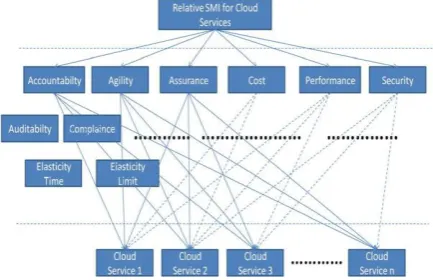
framework. The Ranking System computes the relative ranking values of various Cloud services based on the QoS requirements of the customer and features of the Cloud services. The ranking system takes into account two things before deciding from where to lease Cloud resources: (a) the service quality ranking based on AHP and (b) the final ranking based on the cost and quality ranking. Service quality ranking using AHP As discussed previously, Cloud services have many KPIs with many attributes and sub-attributes which makes the ranking
Fig. AHP hierarchy for cloud computing
VIII. CONCLUSION:
International Journal of Research (IJR)
e-ISSN: 2348-6848, p- ISSN: 2348-795X Volume 2, Issue 10, October 2015Available at http://internationaljournalofresearch.org
surveyed current approaches in workload and system modeling and early applications to cloud QoS management.
• If we consider the resource management mechanisms for applications QoS enforcement provided by public clouds, they are quite simplistic if compared to current research proposals. Indeed, such mechanisms are mainly reactive and are triggered by thresholds violations (related to response times, as in Google App Engine, or CPU utilization or other low level infrastructure metrics, as in
Amazon EC2.) Vice versa, integrating
workload characterisation, system models and resource management solutions, pro-active systems, may help to prevent QoS degradation. The development of research prototypes that are transferable in commercial solutions seems to remain an open point.
• Finally, in cloud systems an important role is played by resource pricing models. There is a growing interest towards understanding better cloud spot markets, where bidding strategies are developed for procuring computing resources. Approaches are currently being proposed to automate dynamic pricing and cloud resources selection. We expect that, in upcoming years, these models will play a bigger role than today in capacity allocation frameworks.
IX. References :
[1] R. Buyya, C. Yeo, S. Venugopal, J. Broberg, I. Brandic, Cloud computing and emerging IT platforms: vision, hype, and reality for delivering computing as the 5th utility, Future Generation Computer Systems 25 (6) (2009) 599– 616.
[2] M. Cusumano, Cloud computing and SaaS as new computing platforms, Communications of the ACM 53 (4) (2010) 27–29.
[3] E. Ciurana, Developing with Google App Engine, Apress, Berkeley, CA, USA, 2009.
[4] J. Varia, Best practices in architecting cloud applications in the AWS cloud, in: Cloud Computing: Principles and Paradigms, Wiley Press, 2011, pp. 459–490. (Chapter 18).
[5] Cloud Service Measurement Index
Consortium (CSMIC), SMI framework. URL:
http://beta-www.cloudcommons.com/servicemeasurement index.
[6] J. Cochrane, M. Zeleny, Multiple Criteria Decision Making, Univ. of South Carolina Pr., 1973.
[7] H. Pan, Green Data Centers monthly
newsletter February 2010, Information
Gatekeepers Inc.
[8] Rackspace, Cloud servers, URL:
http://www.rackspace.com.
[9] IEEE Standards Association and Others, IEEE STD 1061-1998, IEEE standard for a software quality metrics methodology, 1998.
[10] W. Sobel, S. Subramanyam, A.
Sucharitakul, J. Nguyen, H. Wong, S. Patil, A. Fox, D. Patterson, Cloudstone: multi-platform, multi-language benchmark and measurement tools for web 2.0, in: Proceedings of Cloud Computing and its Application, Chicago, USA, 2008.
[11] C. Harmony, Cloudharmony.com,
February 2012., http://cloudharmony.com/.
[12] A. Li, X. Yang, S. Kandula, M. Zhang, CloudCmp: comparing public cloud providers, in: Proceedings of the 10th Annual Conference
on Internet Measurement, Melbourne,
International Journal of Research (IJR)
e-ISSN: 2348-6848, p- ISSN: 2348-795X Volume 2, Issue 10, October 2015Available at http://internationaljournalofresearch.org
[13] M. Zeleny, Multiple Criteria Decision Making, vol. 25, McGraw-Hill, New York, 1982.
Student profile:
Mr. SrihariNaidu Baddipudi Was Born In Andhra Pradesh,India. He Received B.Tech Degree From JNTU Ananthapur, vinjamur, Nellore (DT). I Am Pursuing PG In SE From
JNTU Ananthapur.
Guide Profile:
Mr. Syed Baji Was Born In Andhra Pradesh,
India. He is Working as
Asso.Prof.,M.Tech(p.hd) Department of CSE,
SKR College Of Engineering and
![Fig 2: Qu4DS Process / Architecture [Fre12, 64].](https://thumb-us.123doks.com/thumbv2/123dok_us/7794821.1292843/6.595.342.496.282.425/fig-qu-ds-process-architecture-fre.webp)