ISSN 2286-4822 www.euacademic.org
Impact Factor: 3.4546 (UIF) DRJI Value: 5.9 (B+)
The Use of Role-Play Activity in Developing
Classroom Oral Communication at Sudanese
Secondary Classes
AMIR ABDALLA MINALLA Department of English Language, Faculty of Education
Blue Nile University, Damazin, Sudan MAHMOUD ALI AHMED College of Languages Sudan University of Science & Technology, Khartoum,Sudan
Abstract:
the results mentioned above, the study recommends that, roles should be carefully developed (i.e. with regard to learners` ages, levels, interests, backgrounds, needs) and connected with everyday learners` situations. Interesting learning material should be carefully designed to match daily students` situations. Learners should be encouraged and helped to play the roles they like best and opportunities (i.e. for performing different roles per student) should be maximized as much as possible.
Key words: role-play, oral/verbal communication, interaction, classroom
INTRODUCTION
STATEMENT OF THE PROBLEM
EFL learners usually express their inability of expressing themselves orally. And EFL teachers express ineffectiveness of drills in developing oral classroom interaction. So, this study is conducted to investigate utilizing role-play in practicing English language orally at secondary schools classes.
OBJECTIVE OF THE STUDY
The primary goal of this study is to enhance verbal communication at secondary schools English language classes through utilizing role-play in classroom interaction.
QUESTIONS OF THE STUDY
The study attempts to answer the following questions:
1- To what extent can role-play activity be an effective learning strategy in developing spoken skills at students?
2. What are the appropriate teaching and learning techniques that can be employed for using role-play in classroom interaction?
SIGNIFICANCE OF THE STUDY
LITERATURE REVIEW
Hornby (2010) defines role-play as a learning activity in which you behave in the way somebody else would behave in a particular situation. And Doff (1990) also defines role-play as it is a way of bringing situations from real life into the classroom.
COMMUNICATIVE APPROACH AS A MEANS OF ACQUIRING COMMUNICATIVE COMPETENCE
Littlewood (1994) claims that one of the most characteristic features of communicative language teaching is the systematic attention to functional as well as structural aspects of language. He underlines that learners need to acquire a general communicative ability which enables them to cope with everyday situations and lead a normal life when they visit another country. “The foreign language learner needs more than a „fixed repertoire‟ of linguistic forms. The learner must be given opportunities to develop strategies for interpreting language in actual use.”
TYPES OF ROLE-PLAY
Role play is a speaking activity where learners participate either as themselves or as somebody else in a specific situation. In this way they can act in various interaction patterns. According to Ladousse (1989) the situation can correspond to: - a real need in the learners‟ lives (at the doctor, at the station), the learners may or may not have the direct experience;
- the events that few learners will ever experience but which are easy to play (the journalist);
Teachers who use role plays in their lessons should be aware of different types of this process and estimate which one is the most suitable for their learners. Littlewood (1981) divides role plays according to the nature of information that is given to learners:
1- Role-playing controlled through cued dialogues 2- Role-playing controlled through cues and information 3- Role-playing controlled through situation and goals 4- Role-playing in the form of debate or discussion 5- Large-scale simulation activities
6- Improvisation
SOME REASONS FOR USING ROLE-PLAY IN ENGLISH CLASSES
Budden (2006) says that when role play is included in the lessons regularly, the learners “are given a chance to rehearse their English in a safe environment. Real situations can be created and students can benefit from the practice. Mistakes can be made with no drastic consequences.”
According to Ladousse (1987), role play also supports the confidence of shy learners because here they are provided with a mask and they can learn the structures and use them in the familiar setting of their classroom. They learn how to interact with other people without being afraid that their mistakes might cause some misunderstanding.
METHODOLOGY OF THE STUDY
The researcher adopts descriptive analytical method in order to investigate utilizing role-play as a learning strategy for developing oral classroom interaction.
Population of the Study
The population of study consists of three groups. The first group is secondary school English language teachers (SSELT). The second group is the secondary school students. Both groups are intended to answer two different questionnaires. The third group is English language classes which use role-play as a learning strategy. The study takes place in Damazeen city, Blue Nile State.
Sample of the Study
The first group of sample is composed of thirty (30) male and female secondary school English language teachers. The second group of sample consists of fifty (50) secondary school students. The third one is composed of twenty (20) male and female English language classes. The samples of the three groups are chosen from six secondary schools all in Damazeen city. The sample total is hundred.
Groups Male Female Total
Teachers 23 17 30
Students 29 21 50
Classes 12 8 20
Tools of Data Collection
Design of Data Collection Tools
The study designs two tools (a questionnaire and an observation check list) for data collection in three forms. The first questionnaire, intended for secondary school English language teachers, is designed to investigate English language teachers` attitudes toward utilizing role-play. The second questionnaire, intended for secondary school students, is designed to identify to what extent learners are satisfied with role-play as a learning strategy for classroom interaction. In other words, it investigates learners` attitudes toward role-play as a strategy for classroom interaction. The observation check list, intended for secondary school English language classes, is essentially designed to capture role-play at work.
Procedures of Data Collection
In practice two different questionnaires and an observation check list are carried out in six secondary schools that intentionally use role-play activity for three weeks successively in response to this study. The questionnaires were distributed by the end of the three weeks. The students receive some help from the researcher in filling out their questionnaire. As for the observation check list, the researcher attended twenty periods of an English language class and ticked the list of items .
RESULTS AND DISCUSSION
English Language Teacher`s Questionnaire
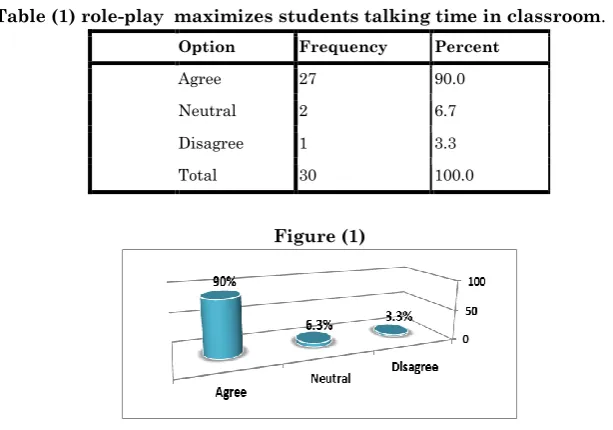
Table (1) role-play maximizes students talking time in classroom.
Option Frequency Percent
Agree 27 90.0
Neutral 2 6.7
Disagree 1 3.3
Total 30 100.0
Figure (1)
According to the above table (1) the statistical results show that the majority (90%) of the responses support the claim that role-play activity maximizes students talking time in the classroom. So, utilizing role-play for developing oral communication is an appropriate strategy. The finding of this statement is in agreement with Awad (2011) who states that role-play is effective for classroom interaction.
Table (2) role-play helps learners personalize the information and learning experience.
Option Frequency Percent Agree 25 83.3 Neutral 5 16.7 Disagree 0 00.0
Figure (2)
From the above table (2), the obtained result illustrates that (83.3%) of the responses agree that role-play activity is appropriate for helping learners to make information and learning experiences their own. So, it gradually enables them to express their own thoughts.
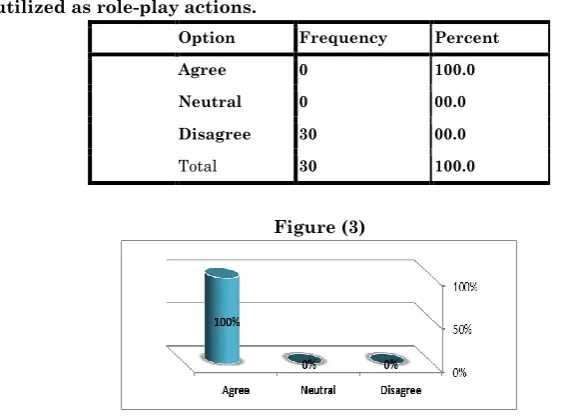
Table (3) Current English language content is inappropriate to be utilized as role-play actions.
Option Frequency Percent Agree 0 100.0 Neutral 0 00.0 Disagree 30 00.0
Total 30 100.0
Figure (3)
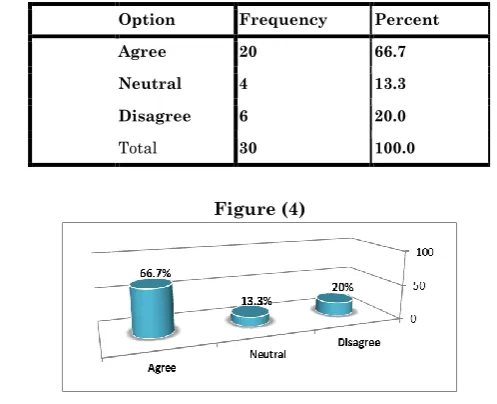
Table (4) Role-play requires that teachers act as co-communicators and role models.
Option Frequency Percent Agree 20 66.7 Neutral 4 13.3 Disagree 6 20.0
Total 30 100.0
Figure (4)
From the above table (4), it is clear that the majority (66.7 %) of the responses support the statement that role-play requires teachers to master the role of co-communicators and role models. So, this means that role-play requires teacher to rehearse and practice learning materials beforehand.
Table (5) Role-play offers opportunity to connect learners with their everyday situations.
Option Frequency Percent Agree 25 83.4 Neutral 4 13.3 Disagree 1 3.3
Total 30 100.0
The above table shows that (83.4%) of the responses support the above statement which claims that role-play offers opportunity to connect learners with their everyday situations. So, role-play is appropriate to help learners to practice language outside classroom context.
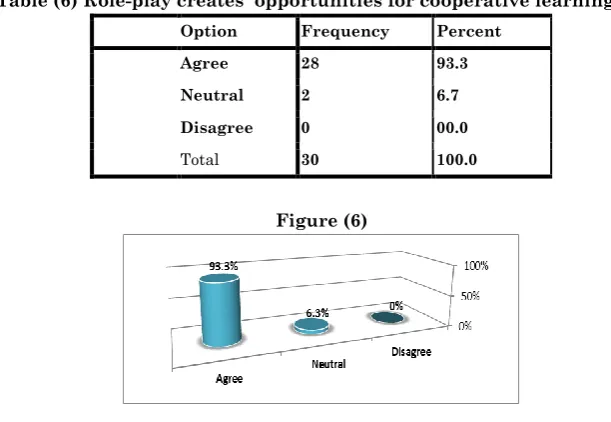
Table (6) Role-play creates opportunities for cooperative learning.
Option Frequency Percent Agree 28 93.3 Neutral 2 6.7 Disagree 0 00.0
Total 30 100.0
Figure (6)
The above table shows that the majority (93.3%) of the responses support the suggestion that role-plat is appropriate to help students to carry out their learning cooperatively. Most modern trends in learning a language tend to utilize cooperative learning and avoid competitive learning.
EFL Secondary Students` Questionnaire
Statement
Frequency Percentage Agree Neutral Disagree Agree Neutral Disagree
1 Role-play is interesting. 42 8 - 84% 16.% -
2 Role-play motivates me to involve
speaking in English.
45 1 4 90%- 2% 8%
3 Role-play helps me in developing
many other skills i.e. using body language.
34 9 7 68% 18% 14%
Statement 1 It is clear that the majority (84%) of the responses agree that the role-play is interesting enough for the learners to get involved in role-play.
Statement 2 Obviously (90%) of the responses support the claim that role play activity stimulates learners to initiate speaking in English.
Statement 3 It is clear that (90%) of responses support the claim that role-play, beside its effectiveness in learning language, also helps learners to acquire many others important skills i.e. body language and facial expressions. The finding is in agreement with Omer (2004) who states that role-play develops skills such as body language and facial expressions.
English Language Class Check List
The observation check list, intended for English language class that used role-play for three weeks successively, is made up of three (3) items which are designed to check out on role-play at work. By attending twenty periods for these classes, the researcher administers the process of ticking items.
Items Frequency Percentage Yes No Yes No 1 Most of the students take part in classroom
interaction by using role-play activity.
6 14 30% 70%
2 Classrooms are in face-to-face arrangement. - 20 0% 100%
3 Teachers provide help when needed. 15 5 75% 25%
when using role-play. Temporary studies reveal that the majority of the students are communicatively incompetent, the allotted time for classroom interaction is insufficient and that most of the classes are overcrowded. So, this tripartite revelation explains learners` inability to get involved in classroom interaction.
Item 2: the statistical treatment of this item displays that most secondary school classes are not organized in the arrangement that serves the purpose of classroom interaction. The researcher observed that the only way teachers adopt for their classroom arrangement is the traditional "teacher desk up front facing rows of students desks" model. Also, physical classroom design and overcrowding impede face-to-face arrangement in classroom interaction.
Item 3: the result of this item shows that teachers help their students when help is needed. However, the researcher observed that teachers interrupt interlocutors while they are carrying out the role-play tasks. Thus, this interruption breaks down the interaction between the interlocutors and impacts negatively on the interaction process.
CONCLUSION
The study is conducted to investigate whether utilizing role-play as a learning activity develops learners to communicate verbally well. In general, it is worth mentioning that teachers and students alike express their satisfaction about the experience of using role-play as a learning strategy for classroom interaction. The findings of this study can be summarized as follow:
2. Role-play helps learners personalize information and learning experiences. So, this enables them to express their thoughts depending on the roles they perform. 3. Current English language content (present curricula) is
not appropriate to help learners to communicate verbally well in terms of role-play activity.
4. Through the roles they perform in the classroom, role-play is effective in connecting learners with their everyday actions.
5. Role-play also creates opportunities for the students to work cooperatively through sharing roles.
6. Physical classroom design impedes role-play application. Most Sudanese classes are arranged and designed in a way that teacher desk up front facing rows of students desks.
7. Role-play requires teachers play roles of co-communicator and role model.
8. Role-play develops other communicative skills at students such as using body language.
RECOMMENDATIONS
In the light of the findings, the researcher recommends the following:
1. The teacher should develop roles that connect learners with their everyday situations.
2. Roles should be carefully developed with regard to learners` ages, levels, interests, backgrounds and needs. 3. Current English language content should be adapted or
even changed in accordance with learners` interests. 4. Opportunities of verbal English language practices
should be maximized.
6. Teachers should encourage and help learners to play the roles they like best.
7. Teachers should vary their roles in classroom with emphasis to role model and co-communicator.
REFERENCES
Awad, N. (2011). The Role of Pair and Group Work in
Classroom Interaction, unpublished M.A. thesis,
University of Gezira.
Budden, J., Role-play, Available from: <
https://www.teachingenglish.org.uk/
article/role-play>,[Accessed 2 May 2015].
Doff, A. (1990:232), Teach English: A Training Course for
Teachers, Cambridge University Press.
Hornby, A. (2010), Advanced Learner` Dictionary, CD-ROM first, Oxford University Press.
Littlewood, W. (1994) & (1981), Communicative Language
Teaching, Cambridge: Cambridge University Press.
Ladousse, G. (1987), Role-play, Oxford University Press.
Omer, M (2004), Using Role Play in EFL, unpublished M.A. thesis, University of Gezira.
Watcyn-Jones, P., Howard-Williams, D., Pair Work 1, Longman,
Available from:
<