International Journal of Research (IJR) Vol-1, Issue-10 November 2014 ISSN 2348-6848
Review on Different Multiple Access Technique
Used in Wireless Communication
Rakesh Rajan1; Ravi Baweja2; Ravi Kumar3
1(student, Dept. of Electronics and Communication Engg, DCE Gurgaon, Haryana, India, [email protected])
2(student, Dept. of Electronics and Communication Engg, DCE Gurgaon, Haryana, India, [email protected])
3(student, Dept. of Electronics and Communication Engg, DCE Gurgaon, Haryana, India, [email protected])
ABSTRACT
In this research paper I am trying to discuss
different multiple access techniques used in
wireless communication. Multiple Access
Techniques are ways to access a single
channel by multiple users. They provide
multiple access to the channel. For any
communication like satellite, wireless and
mobile etc. these multiple access techniques
are very important, so study of multiple access
techniques are basic for any communication
engineer. In this paper firstly we are
discussing about narrowband system and
wideband system and then discussing about
various multiple access techniques with their
examples.
Key words:
Multiple access; time;frequency; code space; packet
1. INTRODUCTION
In telecommunication and computer networks achannel access method or multiple accessmethod allows several terminals connected to the same multi-point transmission medium to transmit over it and to share its capacity. Examples of shared physical media are wireless networks, bus networks, ring networks and half-duplex point-to-point links. A channel-access scheme is based on a
multiplexing method that allows several data streams or signals to share the same communication channel or physical medium. Multiplexing is in this context provided by the physical layer. Note that multiplexing also may be used in full-duplex point-to-pointcommunication between nodes in a switched network, which should not be considered as multiple access. A “channel” refers to a system resource allocated to a given mobile user enabling the user to establish communication with the network (other users). Multiple access schemes are used to allow many mobile users to share simultaneously a finite amount of radio spectrum.
In wireless communication systems it is often desirable to allow the subscriber tosend simultaneously information to the base station while receiving information fromthe base station. A cellular system divides any given area into cells where a mobile unit in eachcell communicates with a base station. The main aim in the cellular system designis to be able to increase the capacity of the channel i.e. to handle as many callsas possible in a given bandwidth with a sufficient level of quality of service. Thereare several different ways to allow access to the channel.
Three major multiple access techniques used in wireless communication:
1. FDMA (Frequency Division Multiple Access)
2. TDMA (Time Division Multiple Access)
3. CDMA (Code Division Multiple Access)
Others:
International Journal of Research (IJR) Vol-1, Issue-10 November 2014 ISSN 2348-6848 2. SDMA (Space Division Multiple Access)
Depending on how the available bandwidth is allocated to the users these techniquescan be classified as narrowband and wideband systems.
1.1 Narrowband Systems
The term narrowband is used to relate the bandwidth of the single channel to theexpected coherence bandwidth of the channel. The available spectrum is divided in to a large number of narrowband channels. The channels are operated using FDD. In narrow band FDMA, a user is assigned a particular channel which is not shared by other users in the vicinity and if FDD is used then the system is called FDMA/FDD. Narrow band TDMA allows users to use the same channel but allocated a unique time slot to each user on the channel, thus separating a small number of users in time on a single channel. For narrow band TDMA, there generally are a large number of channels allocated using either FDD or TDD, each channel is shared using TDMA. Such systems are called TDMA/FDD and TDMA/TDD access systems.
1.2 Wideband Systems
In wideband systems, the transmission bandwidth of a single channel is much larger than the coherence bandwidth of the channel. Thus, multipath fading does not greatly vary the received signal power within a wideband channel, and frequency selective fades occur in only a small fraction of the signal bandwidth at any instance of time. In wideband multiple access systems a large number of transmitters are allowed to transmit on the same channel. TDMA allocates time slots to the many transmitters on the same channel and allows only one transmitter to access the channel at any instant of time, whereas spread spectrum CDMA allows all of the transmitters to access the channel at the same time. TDMA and CDMA systems may use either FDD or TDD multiplexing techniques.
2. FREQUENCY DIVISION MULTIPLE ACCESS
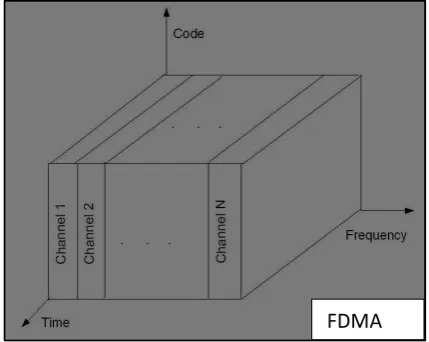
This was the initial multiple-access technique for cellular systems in which each individual user is assigned a pair of frequencies while making or receiving a call as shown in above figure. One frequency is used for downlink and one pair for uplink. This is called frequency division duplexing (FDD).
That allocated frequency pair is not used in the same cell or adjacent cells during the call so as to reduce the co channel interference. Even though the user may not be talking, the spectrum cannot be reassigned as long as a call is in place. Different users can use the same frequency in the same cell except that they must transmit at different times. The features of FDMA are as follows: The FDMA channel carries only one phone circuit at a time. If an FDMA channel is not in use, then it sits idle and it cannot be used by other users to increase share capacity. After the assignment of the voice channel the BS and the MS transmit simultaneously and continuously. The bandwidths of FDMA systems are generally narrow i.e. FDMA is usually implemented in a narrow band system .The symbol time is large compared to the average delay spread. The complexity of the FDMA mobile systems is lower than that of TDMA mobile systems. FDMA requires tight filtering to minimize the adjacent channel interference.
2.1 FDMA/FDD in AMPS
The first U.S. analog cellular system, AMPS (Advanced Mobile Phone System) is based on FDMA/FDD. A single user occupies a single channel while the call is in progress, and the single channel is actually two simplex channels which are frequency duplexed with a
International Journal of Research (IJR) Vol-1, Issue-10 November 2014 ISSN 2348-6848 45 MHz split. When a call is completed or
when a handoff occurs the channel is vacated so that another mobile subscriber may use it. Multiple or simultaneous users are accommodated in AMPS by giving each user a unique signal. Voice signals are sent on the forward channel from the base station to the mobile unit, and on the reverse channel from the mobile unit to the base station. In AMPS, analog narrowband frequency modulation (NBFM) is used to modulate the carrier.
2.2 FDMA/TDD in CT2
Using FDMA, CT2 system splits the available bandwidth into radio channels in the assigned frequency domain. In the initial call setup, the handset scans the available channels and locks on to an unoccupied channel for the duration of the call. Using TDD (Time Division Duplexing), the call is split into time blocks that alternate between transmitting and receiving.
3.TIME DIVISION MULTIPLE ACCESS
(TDMA)
In digital systems, continuous transmission is not required because users do notuse the allotted bandwidth all the time. In such cases, TDMA is a complimentary access technique to FDMA. Global Systems for Mobile communications (GSM) uses the TDMA technique. In TDMA, the entire bandwidth is available to the user but only for a finite period of time. In most cases the available bandwidth is divided into fewer channels compared to FDMA and the users are allotted time slots during which they have the entire channel
bandwidth at their disposal, as shown in above second figure. TDMA requires careful time synchronization since users share the bandwidth in the frequency domain. The number of channels are less, inter channel interference is almost negligible. TDMA uses different time slots for transmission and reception. This type of duplexing is referred to as Time division duplexing (TDD). The features of TDMA include the following: TDMA shares a single carrier frequency with several users where each user makes use of non-overlapping time slots. The number of time slots per frame depends on several factors such as modulation technique, available bandwidth etc. Data transmission in TDMA is not continuous but occurs in bursts. This results in low battery consumption since the subscriber transmitter can be turned OFF when not in use. Because of a discontinuous transmission in TDMA the handoff process is much simpler for a subscriber unit, since it is able to listen to other base stations during idle time slots. TDMA uses different time slots for transmission and reception thus duplexers are not required. TDMA has an advantage that is possible to allocate different numbers of time slots per frame to different users. Thus bandwidth can be supplied on demand to different users by concatenating or reassigning time slot based on priority.
3.1 TDMA/FDD in GSM
As discussed earlier, GSM is widely used in Europe and other parts of the world. GSM uses a variation of TDMA along with FDD. GSM digitizes and compresses data, then sends it down a channel with two other streams of user data, each in its figure. The basic concept of TDMA own time slot. It operates at either the 900 MHz or 1800 MHz frequency band. Since many GSM network operators have roaming agreements with foreign operators, users can often continue to use their mobile phones when they travel to other countries.
3.2 TDMA/TDD in DECT
International Journal of Research (IJR) Vol-1, Issue-10 November 2014 ISSN 2348-6848 cell to cell as long as they remain within the
range of the system. DECT antenna can be equipped with optional spatial diversity to deal with multipath fading.
4. CODE DIVISION MULTIPLE ACCESS
In Code Division Multiple Access systems, the narrowband messagesignal is multiplied by a very large bandwidth signal called the spreading signal. The spreading signal is a pseudo- noise code sequence that has a chip rate which is orders of magnitudes greaterthanthe data rate of the message. All users in a CDMA system, as seen from figure
use the same carrier frequency and may transmit simultaneously.
Each user has its own pseudorandom code word which s approximately orthogonal to all other code words. The receiver performs a time correlation operation to detect only the specific desired codeword. All other code words appear as noise due to decorrelation. For detection of the message signal, the receiver needs to know the code word used by the transmitter. Each user operates independently with no knowledge of the other users. In CDMA, the power of multiple users at a receiver determines the noise floor after decor- relation. If the power of each user within a cell is not controlled such that they do not appear equal at the base station receiver, then the near—far problem occurs.
The near—far problem occurs when many mobile users share the same channel. In
generafor the strongest received mobile signal will
capture the demodulator at a base station. In CDMA, stronger received signal levels raise the noise floor at the base station demodulators for the weaker signals, thereby decreasing the probability that weaker signals will be received. To combat t near—fax problem, power control is used in most CDMA implementations. Power control is provided by each base station in a cellular system and assures that each mobile within the base station coverage area provides the same signal level to the base station receiver. This solves the problem of a nearby subscriber overpowering the base station receiver and drowning out the signals of faraway subscribers. Power control is implemented at the base station by rapidly sampling the radio signal strength indicator (RSSI) levels of each mobile and then sending a power change command over the forward radio link. Despite the use of power control within each cell, out-of-cell mobiles provide interference which is not under the control of the receiving base station. The features of CDMA including the following:
Many users of a CDMA system share
the same frequency. EitherTDD or
FDD may be used.
Multipath fading may be substantially
reduced because the signalis spread
over a large spectrum.
Channel data rates are very high in
CDMA systems.
Some other access technique:
5.PACKET RADIO:
International Journal of Research (IJR) Vol-1, Issue-10 November 2014 ISSN 2348-6848 and a NACK (negative acknowledgment)
indicates that the previous burst was not received correctly by the base station. By using ACK and NACK signals, a PR system employs perfect feedback, even though traffic delay due to collisions may be high.
6. SPACE DIVISION MULTIPLE ACCESS
SDMA utilizes the spatial separation of the users in order to optimize the use of the frequency spectrum. A primitive form of SDMA is when the same frequency is reused in different cells in a cellular wireless network. The radiated power of each user is controlled by Space division multiple access. SDMA serves different users by using spot beam antenna. These areas may be served by the same frequency or different frequencies. However for limited co-channel interference it is required that the cells to be sufficiently separated. This limits the number of cells a region can be divided into and hence limits the frequency re-use factor. A more advanced approach can further increase the capacity of the network. This technique would enable frequency re-use within the cell. In a practical cellular environment it is improbable to have just one transmitter fall within the receiver beam width. Therefore it becomes imperative to use other multiple access techniques in conjunction with SDMA. When different areas are covered by the antenna beam, frequency can be re-used, in which case TDMA or CDMA is employed, for different frequencies FDMA can be used.
7. CONCLUSION:
We have concluded from whole research paper that multiple access technique is very important for proper wireless or mobile communication. We have described previously used technology used in wireless communication as well as latest technology used in wireless communication that is CDMA. We have also discussed about narrowband and wideband system which is the basic for studying multiple access techniques.
8. REFERENCES
1. T. S. Rappaport, Wireless Communications: Principles and Practice, 2nd ed. Singapore: Pearson Education, Inc., 2002.
2. K. Feher, Wireless Digital Communications: Modulation and Spread Spectrum Applications. Upper Saddle River, NJ: Prentice Hall, 1995.
3. J. G. Proakis, Digital Communications, 4th ed. NY: McGraw Hill, 2000.
4. G. R. Cooper and C. D. McGillem, Modern Communications and Spread Spectrum, NY: McGraw Hill, 1986.