Multi-Objective Particle Swarm Optimization for
Multicast Load Balancing in Wireless Mesh
Networks
Mijahed Nasser Aljober, R.C.Thool Department of Information Technology, SGGS IE & T, Swami Ramanand Teerth Marathwada University, Nanded,
Maharashtra, India
Abstract— In Wireless Mesh Network (WMN), load balancing is an important factor to build a multicast routing protocol. In this paper, we propose a new Multi-Objective model for multicast load balancing optimization in wireless mesh network. This model called Path-MeshRouter-Gateway load balancing (PMRGLB), which aims to achieve four objectives, i.e. minimizing the total cost of the network, minimizing path length, minimizing gateway load balancing, and minimizing path interference. This optimization problem is solved simultaneously by using a meta-heuristic method. Simulation result shows the effective of this model compare with others.
Index Terms: Multicast, Load Balancing Optimization, Multi-Objective, Particle Swarm Optimization.
1. INTRODUCTION
wireless mesh network is one such upcoming technology with a low cost, easy deployment, and easy configuration, WMN is formed by a set of mesh clients (MC) and Mesh Routers (MR) which act the connectivity in the backhaul of WMN via Internet through Mesh Gateway (MG). Multicasting is a method that transfers information from a sender to group of destinations simultaneously. Designing a multicast routing protocol in WMN is difficult, since it must consider several factors. One of those factors is load balancing [1]. Load balancing is the technique of balance the load over different links and resources to avoid congestion at a lower level backbone of WMN (Mesh Clients), medium level backbone of WMN (Mesh routers) and upper level backbone of WMN (gateways) also paths between them. In WMN, a set of nodes acts as the central point of connectivity to Internet called IGW. The traffic in WMN is routed to and from the IGW. Because of the huge increase in the traffic in WMN and also due to the limited link capacity, the gateway is likely to be a potential bottleneck. Thus load balancing has become an important issue in WMN. Saturation at gateways due to the high traffic can lead to packet loss, which in turn affects the system performance. Thus it is necessary to balance the traffic load over all GWs in order to alleviate the congestion. This is possible by switching the point of attachment of an active source serviced congested gateway to under-utilized gateways. An efficient load balancing mechanism helps in avoiding network congestion and also increases the efficiency of network
resource utilization[2]. In multicasting, expansion is happening because of the increasing in traffic demand, for most of the time, network can be designed to support the original traffic without considering the expansion. Expansion can be in many schemes, traffic expansion due to mesh clients’ mobility, so in this case traffic demands change because of users’ mobility. Traffic expansion due to joining/leaving users in multicast session, in this case users ask for more bandwidth. Particle Swarm Optimization (PSO) is a heuristic search technique that simulates the movements of ant which aim to find food. The relative simplicity of PCO and the fact that is a population-based technique have made it a natural candidate to be extended for multi-objective optimization [3]. Multi-objective optimization is an optimization problem involves more than one objective function, the task of finding more than one optimal solution[11]. Our goal is to propose a model for the Multicast Load Balancing problem taking into account all the parameters that have an impact in WMNs, such Interference, capacity cost due to expansion, path load balancing, gateway load balancing.
CONTRIBUTION
We propose a new and model that combines four conflicted objectives for Multicast Load Balancing problem in wireless mesh networks including:
1.Cost minimization which is the important objective to be optimized in this work. As we know in multicast session, new users join or leave, which causes demand high traffic and more bandwidth. As a result of that, we take into account new capacity cost function that allows maximizing the usage capacity of WMN without increasing the cost.
2.We create a new function that minimizing path length to load the balance in the whole backbone. Almost the previous studies the consideration on load balancing in the gateway only. In this work we create a function that consider into account the movement of multicast session which lead to unbalance load. So this function solve the problem of load balancing by minimizing the path from client nodes to the mesh routers then gateways.
section 2, describe PMRGLB problem in section 3, PMRGLB Heuristic in section 4, results and analysis in section 5 and finally conclusion and overview to future works in section 6.
2. RELATED WORKS
Deepti Nandiraju et al [4], proposed a novel scheme which balances the load among different IGWs in WMNs, depending on the average queue length at the IGW they switch source serviced gateway. The proposed scheme is classified into two phases, gateway discovery protocol, and load migration procedure. Gateway discovery protocol works as: periodically gateway broadcast beacons to announce their presences node registers itself to the gateway while receiving a beacon signal with conditions that node has not selected a gateway and if there is a gateway is nearer than the already selected. In the second phase each MR announces the list of GW IDs it knows through hello packets. Each IGW continuously monitors its queue length during a time window. In the time period if the average queue length rises above a certain threshold value, it is indicative of a possible impending congestion at the IGW. In such case IGW identifies a set of active sources received by it to reduce the load and sends a notification to those nodes to look for an alternative gateway. Mohammad Shahverdy et al [5], they consider a Cluster Based Wireless Mesh Architecture in which the WMN is divided into clusters that could minimize the updating overhead during topology change due to mobility of mesh nodes or congestion of load on a cluster. Each cluster contains a gateway that has complete knowledge about group memberships and link state information in the cluster. The gateway is often elected in the cluster formation process. They consider load of gateways and try to reduce it. As a matter of fact when a gateway undertakes to be an interface for connecting nodes of a wireless mesh network to other networks or internet, there would be some problems such as congestion and bottleneck, so they introduce a new paradigm for these problems. For solving bottleneck we use clustering to reduce load of gateways and after that by use of dividing cluster they prevent from bottleneck on gateways. They study how to detect congestion on a gateway and how can reduce loads of it that preventing from bottleneck on gateway and therefore increasing throughput of network to encountering many loads. So we propose an algorithm to detect bottleneck and remedies for load balancing in Wireless Mesh Networks. Junzhou Luo et al [6], they study the Load-balancing and Interference-minimization Gateway Deployment Problem (LIGDP), which aims to achieve four objectives, i.e. minimizing deployment cost, minimizing MR-GW path length, balancing gateway load and minimizing link interference. They formulate it as a multi-objective integer linear program (ILP) issue first, and then propose an efficient gateway deployment approach, called LIGDP Heuristic. The approach joints two heuristic algorithms, i.e., MSC-based location algorithm (MLA) and load-aware and interference-aware association algorithm (LIAA), to determine gateway positions and construct GW-rooted
his requirements. Additionally, they compared the performance of their proposed model with other previous models by comparing the algorithm solutions in term of deployment cost expressed as access Points, Relays and gateways number. Juan J. Galvez et al [10]. In this paper they have proposed GWLB, a highly responsive online protocol which dynamically adapts to network conditions, balancing the load of gateways. It achieves improvements over shortest path routing in both throughput and fairness in scenarios with load imbalance. Importantly, because it is TCP flow-aware, balances traffic at the TCP flow level, and takes into account the effects of interference of flows when switching between domains, it is suitable for implementation in realistic scenarios. The simulations conducted in ns-3 prove its effectiveness, and its advantage over previously proposed schemes. It outperforms all the alternatives tested. In particular, it achieves an average flow throughput gain of 128% over the nearest gateway strategy. GWLB specially distances itself from other solutions when congestion or load imbalance between domains increases, showing that the protocol can cope more effectively in these situations.
3.PATH-MESHROUTER-GATEWAY LOAD BALANCING
(PMRGLB)PROBLEM
3.1 Assumptions, notifications and Network model First, we explain and describe the assumptions and notifications, then we describe in details PMRGLB problem. Table 1 summarizes the notations used in the following analysis.
We plan to address the PMRGLB problem. It is a multi-objective optimization problem, which has multiple optimization objectives and several constraints. Based on the network model, four Objectives are considered, i.e. minimizing the total cost of the network minimizing path length, minimizing gateway load balancing, and minimizing path interference.
3.2 Objective Functions
The four optimization objectives are defined as follows: Minimizing the Total Cost of Network:
We propose a new cost function, this function maximize the capacity of WMN as a result of a multicast session which caused traffic expansion and minimize the number of gateways and routers which are expensive, while satisfying the performance requirements.
Minimizing Path length :
Minimize the path length for the maximum number of links which has the minimum congestion.
Minimizing gateway Load Balancing:
Minimize the congestion around the gateways by balancing the load among different gateways. Minimizing Path Interference:
Minimize the Interference among the Paths.
Symbol Definition G(N,L) WMN backbone
N Set of Nodes L Set of Links Ms Set of Gateways
G Number of gateways M Set of MRs
n Number of MRs
di,j Distance between 2 MRs rd Radio of transmission range Ti,j Transmission Path
P Maximum Path length mi,mj MR node
Li,j Link between 2 MRs
Rki,j Radio Communication between 2 MR.
mi,mj using channel k fi Traffic by MR mi
Ii,j,p,q Interference between 2 Links rs Radius of interface
Ns(mi) Interference neighborhood hi,j Path length
Cm MR throughput Capacity Cg Gateway throughput Capacity NR(mi) R-hop MRs neighborhood
k Number of channels per radio interface Q All frequency channels Q={1,…,k} Cmax Maximum capacity of radio interface
Cki,j Capacity of link (i,j) using channel k
AL Active link
Table1: List of Variables
These objectives have to be satisfy the following constraints:
Throughput:
The local traffic and relaying traffic which is going through MR cannot exceed the maximum throughput capacity denoted as Cm, same with gateway throughput which denoted as Cg cannot exceed the maximum throughput capacity.
Flow-capacity:
The flow on node must not exceed the capacity of radio interface, also the flow on link must not exceed the capacity of link.
Robustnees:
At least two nodes in disjoint paths to avoid disconnecting of network.
Path-Interference:
3.3 Problem Formulations
In this section, we formulate PMRGLB problem as an Integer Linear Programming (ILP) optimization objectives and constraints,
(1)
(2)
(3)
(4)
(5)
Functions are defined for all i,j=1,2,….n. Our objective functions are defined as the following: (6)
(7)
(8)
(9)
Subject to (10)
(11)
(12)
(13)
Formula (6) represent the minimum cost function, formula (7) represent minimizing path length, formula (8) represent minimizing gateway load balancing, formula (9) represent minimizing Path interference. The four objective functions are subjected to the constraints in formula (10,11,12,13) are explained above. 4.PMRGLB HEURISTIC In this paper, we propose an efficient approach called Path MeshRouter Gateway Load Balancing (PMRGLB) heuristic, to achieve that we use Multi-objective Particle Swarm Optimization (MOPSO) [3], which is built based on the behavior of flocks of birds that imitate successful actions they see around them, a swarm represent (population) consist of several particles (individuals). We model WMN backbone by an undirected fully graph G(N,L). In this method algorithm 1, we generate a matrix that expresses the allocation of all nodes, and other matrix for all connectivity between each mi & mj these are contribute for initial feasible solutions, the archive will contain the representation of placement of MRs, APs, MGs. The variables of the problems ai, bi, ci, Rki,j , Fi, represented by a set of binary to represent the Particle. grid topology is considered for planning of the network , at every generation of the swarm we check for constraints satisfaction and evaluate the objective functions. In algorithm 2 we propose heuristic algorithm to select gateway which has the maximum weight, we use NR(mi) which means we are searching for gateway within the R-hop, the range of GW mi. we do that iteratively until we got the gateway with maximum weight. The weight calculation in algorithm 2 of MR mi is defined already in [6] as the following: (14)
Where
Algorithm 1: WMN Topology Input: mut: mutation factor, gmax
Output: Archive
Begin
Initialize swarm //Construct initial feasible solutions
Evaluate all particles in swarm // Compute Objectives
Store all non-dominated solutions into the Archive
Quality(leader) g=0
Repeat (g < gmax)
For each particle in the archive Select leader
Update position (flight) Mutation (mut)
Selection gateway // invoke Algorithm 2 Update(pbest)
EndFor
Check for constraints satisfaction Quality(leader)
Evaluation // Compute Objective functions Update Archive
g++
Until ( g >= gmax )
5.NUMERICAL RESULTS AND ANALYSIS
We implement PMRGLB using Glomosim[12,13]. We evaluate the performance of the network through experiment simulation.
5.1 Performance Metrics
We measure the performance of the four objectives, minimizing the cost, minimizing path length, minimizing path gateway load balancing, minimizing path interference in terms of the following:
Number of gateways:
We use the number of gateways to measure the cost of the network, as the gateway number increased as the cost is increased.
Average length path:
We use average length path to measure the high bandwidth and low latency which is indicated by shortest path.
Standard derivation of gateway load:
We use standard derivation to measure gateway throughput using the following function which used in [3]:
(15)
A low standard derivation indicates that the balance of gateway load.
Average Interference of active link:
We use the following function which used in [6]:
(16) To measure link interference in the network, where I(li,j) is the set of links interfered by link li,j.
5.2 Parameters Configuration
Our simulations model a large-size network of 600 mesh routers placed in a 6000m × 6000m terrain. We use the terms “router” and “node” interchangeably. The nodes are
distributed uniformly over the sub-areas within a terrain, and the nodes within a sub-area are randomly placed in that sub-area. There are no network partitions throughout the simulation. Each simulation executes for 600s of simulation time. Multiple runs with different seed numbers are conducted for each experiment and collected data are averaged over those runs. All nodes are equipped with an 802.11b radio with a bandwidth of 11 Mbps and a nominal range of 250 meters. As MAC layer protocol we use the 802.11. Traffic model is constant bit rate (CBR). The data packet size is 512 bytes. The size of the queue at every node is 50 Kbytes. All senders and receivers (unicast and multicast) are randomly selected.
5.3 Result Analysis, Compare with other existing Approaches
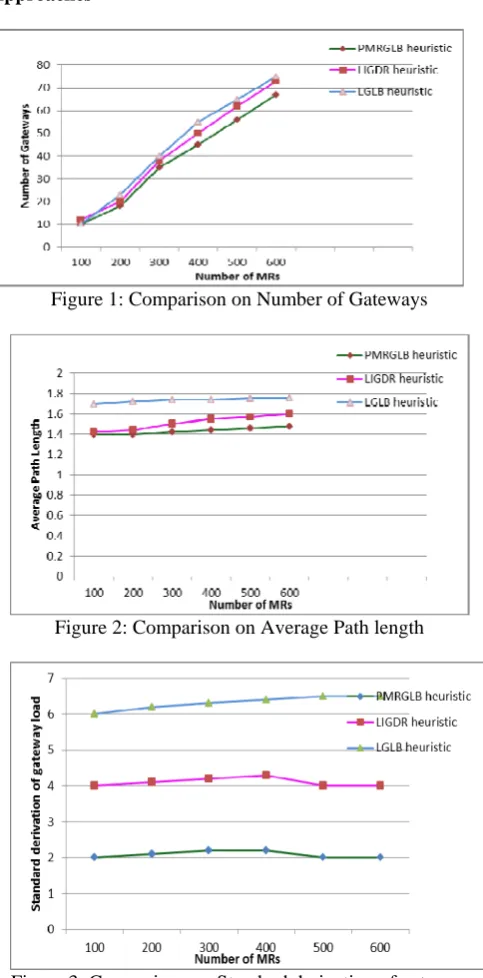
Figure 1: Comparison on Number of Gateways
Figure 2: Comparison on Average Path length
Figure 3: Comparison on Standard derivation of gateway load
Algorithm 2 selection gateway Input: a set of MR
Output: a set of MG
Begin
Initialize Max=0 , MG =0
Repeat
For each MR mi € NR(mi)
If ( MR mj is a parent of with MR mi)
Calculate Max(weight of MR)
Enf if
Max = Max(weight of MR)
End for
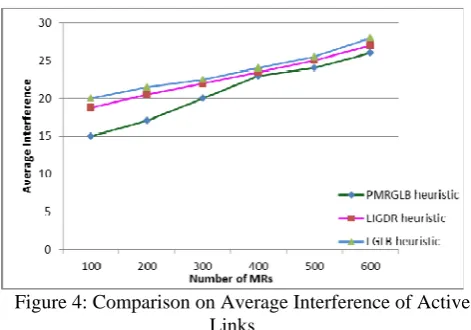
Figure 4: Comparison on Average Interference of Active Links
We compare our approach PMRGLB with two existing works, LIGDP proposed by [6] and other one IGLB proposed by by [3]. We fix some parameters in the experiment and vary network size from 100 MRs to 600 MRs and for every size we run the three algorithms 20 times and use the average results as the final result. We propose that our approach perform better solutions in term of number of gateways as shown in figure [1]. In figure [2] our result is the lowest as comparison on average length path. In figure [3] our result also the lowest as comparison on standard derivation of gateway load. In figure [4] show our approach result is less interference than the others.
CONCLUSION
In this paper, we propose multi-objective Particle swarm optimization PMRGLB Heuristic approach that minimizes the load balancing for multicast in WMNs. PMRGLB combines two algorithms, WMN backbone based on Multi-Objective Particle Swarm Optimization MOPSO, and the selection gateway algorithm that selects the gateway which has the maximum weight to balance the load through gateways. We evaluate the performance of our approach. We demonstrate that PMRGLB Heuristic perform better solution on path length, load balancing through gatewayss without extra gateway.
REFERENCES
[1] Ajish Kumar K.S, Saumya Hegde, “Multicasting in Wireless Mesh Networks: Challenges and Opportunities”. 2009 International Conference on Information Management and Engineering.
[2] Jasmine Joseph, M. Princy, “Analysis on Scheduling and Load Balancing Techniques in Wireless Mesh Networks”. International Journal of Computer Applications (0975 – 8887) Volume 42– No.12, March 2012
[3] Margarita Reyes-Sierra and Carlos A. Coello Coello: “Multi-Objective Particle Swarm Optimizers: A Survey of the State-of-the-Art”. International Journal of Computational Intelligence Research. ISSN 0973-1873 Vol.2, No.3 (2006), pp. 287–308.
[4] Deepti Nandiraju, Lakshmi Santhanam, Nagesh Nandiraju, and Dharma P. Agrawal: Achieving Load Balancing in Wireless Mesh Networks Through Multiple Gateways. 2006 IEEE.
[5] Mohammad Shahverdy, Misagh Behnami, Mahmood Fathy: “A New Paradigm for Load Balancing in WMNs”, International Journal of Computer Networks (IJCN), Volume (3) : Issue (4) : 2011.
[6] Junzhou Luo, Wenjia Wu, Ming Yang : “Optimization of Gateway Deployment with Load Balancing and Interference Minimization in Wireless Mesh Networks”, Journal of Universal Computer Science, vol. 17, no. 14 (2011), 2064-2083.
[7] Katerina Papadaki , Vasilis Friderikos : “Gateway selection and routing in wireless mesh networks” , Computer Networks 54 (2010) 319–329.
[8] Zhaolong Ning , Lei Guo , Yuhuai Peng , Xiaojie Wang : “Joint scheduling and routing algorithm with load balancing in wireless mesh network”. Computers and Electrical Engineering Volume 38, Issue 3, May 2012, Pages 533–550.
[9] Tarik Mountassir, Bouchaib Nassereddine, Abdelkrim Haqiq, and Samir Bennani : “ Multi-Objective Particle Swarm Optimization for Facility Location Problem in Wireless Mesh Networks” International Journal of Computer Science Issues, March 2013, Volume 10, Number 2.
[10] Juan J. Galvez , Pedro M. Ruiz, Antonio F.G. Skarmeta : “ Responsive on-line gateway load-balancing for wireless mesh networks”. Ad Hoc Networks 10 (2012) 46–61.
[11] Nor Azlina Ab. Aziz et al. “Particle Swarm Optimization for Constrained and Multiobjective Problems: A Brief Review”. 2011 International Conference on Management and Artificial Intelligence IPEDR vol.6 (2011) © (2011) IACSIT Press, Bali, Indonesia. [12] Jorge Nuevo, INRS, Universite du Quebec “A Comprehensible
GloMoSim Tutorial “. [email protected] March 4, 2004