MANAGEMENT OF ORPHANAGES AND ITS IMPLICATION
ON THE EDUCATIONAL PERFORMANCE OF ORPHANED
LEARNERS IN KISAUNI SUB-COUNTY, MOMBASA COUNTY
(KENYA)
SAID MATARIMO NURU
E55/MSA/CE/24743/12
A RESEARCH REPORT SUBMITTED TO THE DEPARTMENT
OF EDUCATIONAL MANAGEMENT, POLICY AND
CURRICULUM STUDIES, KENYATTA UNIVERSITY, IN
PARTIAL FULFILLMENT OF THE DEGREE OF MASTER OF
EDUCATION
ii
DECLARATION
I declare that this project is my original work and has not been presented in any other university/ institution for consideration of any certification. This research
project has been complemented by referenced sources duly acknowledged. Where text, data, graphic or tables have been borrowed from other sources, including the
internet, these are specifically accredited and references cited using current APA system and in accordance with anti-plagiarism regulations.
Said Matarimo Nuru Date
E55/MSA/CE/24743/2012
Supervisors’ Declaration
This project has been submitted with our approval as university supervisors.
Dr. Daniel Mange Date
Lecturer,
Department of Educational Management, Policy and Curriculum Studies
Kenyatta University
Dr. Charity Limboro Date
Lecturer,
Department of Educational Management, Policy and Curriculum Studies
iii
DEDICATION
This research is dedicated to my mother, Zena Saidi, who instilled in me the value of hard work and for her continuous support throughout my journey in the quest for
education. I also dedicate it to all the people working with orphans under difficult and challenging circumstances despite little support from the society, and the
iv
ACKNOWLEDGEMENT
I wish to express my sincere gratitude to the following individuals without whom this project would not have been possible. First and foremost, I thank the Almight y
God who has given me the courage, determination and the willpower to succeed and who has been my source of strength and motivation throughout my life. My
gratitude also goes to my supervisors, Dr. Daniel Mange and Dr. Charity Limboro, for their advice, motivation and guidance throughout the development of this study, who dedicated their time in reading, analyzing and correcting my work despite their
busy schedules. Then, I thank my classmates for their support in various ways throughout the degree programme, my family and friends for their understanding
when I could not make time for them and finally my colleagues at work for helping me conduct this study and taking various duties off my hands so that I could
v
TABLE OF CONTENTS
DECLARATION ... ii
DEDICATION ... iii
ACKNOWLEDGEMENT ... iv
TABLE OF CONTENTS ... v
LIST OF TABLES ... viii
LIST OF FIGURES ... ix
ACRONYMS AND ABBREVIATIONS ... x
ABSTRACT ... xi
CHAPTER ONE:INTRODUCTION ... 1
1.1 Introduction ... 1
1.2 Background to the Study ... 1
1.3 Statement of the Problem ... 5
1.4 Purpose of the Study ... 5
1.5 Objectives ... 6
1.5.1 Research Questions ... 6
1.6 Significance of the Study ... 7
1.7 Limitations ... 8
1.8 Delimitations ... 8
1.9 Assumptions ... 8
1.10 Theoretical Framework ... 9
1.11 Conceptual Framework ... 12
1.12 Operational Definition of Terms... 14
CHAPTER TWO:LITERATURE REVIEW ... 15
2.1 Introduction ... 15
2.2 The Role of Managers in the Management of Orphanages ... 15
2.3 Implication of Provision of Needs on the Educational Performance of Orphaned Learners ... 17
vi
2.5 The Role Played by Teachers in the Educational Performance of Orphaned
Learners ... 22
CHAPTER THREE:RESEARCH METHODOLOGY ... 24
3.1 Introduction ... 24
3.2 Research Design ... 24
3.2.1 Variables ... 24
3.3 Location of the study ... 25
3.4 Target Population ... 25
3.5 Sampling Techniques and Sample Size ... 26
3.5.1 Sampling Techniques ... 26
3.5.2 Sample Size ... 26
3.6 Research Instruments ... 27
3.7 Pilot Study ... 27
3.7.1 Validity of the Research Instrument ... 27
3.7.2 Reliability of the Research Instrument ... 28
3.8 Data collection Procedures ... 29
3.9 Data Analysis ... 29
3.10 Logistical and Ethical Considerations ... 30
CHAPTER FOUR:DATA ANALYSIS, INTERPRETATION AND DISCUSSION OF FINDINGS ... 31
4.1 Introduction ... 31
4.2 Demographic Characteristics of Respondents ... 32
4.3 The Role of the Manager in the Orphanage ... 35
4.4 The implication Provision of Needs has on the Educational Performance of Orphaned Learners ... 41
4.5 Behaviors Exhibited by Orphaned Learners (as a Result of Living in an Orphanage) and their Implication on the Orphaned Learners' Educational Performance ... 51
vii
CHAPTER FIVE:SUMMARY, CONCLUSIONS AND
RECOMMENDATIONS ... 63
5.1 Introduction ... 63
5.2 Summary ... 63
5.2.1 The Role of the Manager play in the Orphanage ... 63
5.2.2 The Implication Provision of Needs has on the Educational Performance of the Orphaned Learners ... 65
5.2.3 Behaviors Exhibited by Orphaned Leaner’s (as a Result of Living in an Orphanage) and their Implication on the Orphaned Learners’ Educational Performance ... 65
5.2.4 The Role Played by Teachers in the Educational Performance of Orphaned Learners ... 66
5.3 Conclusions ... 67
5.4 Recommendations ... 69
5.5 Areas for Further Research ... 69
REFERENCES ... 70
APPENDICE ... 74
APPENDIX I: TEACHER’S QUESTIONNAIRE ... 74
APPENDIX II: LEARNER’S QUESTIONNAIRE ... 77
APPENDIX III: MANAGER’S INTERVIEW SCHEDULE ... 80
APPENDIX IV: COVER LETTER ... 84
viii
LIST OF TABLES
Table 3.1: Sample Size... 26
Table 4.1: Demographic Characteristics of Learners ... 32
Table 4.2: Demographic Characteristics of Teachers ... 33
Table 4.3: Academic Qualifications of Orphanage Managers ... 33
Table 4.4: Experience as Orphanage Manager ... 34
Table 4.5: Roles of the Manager in the Orphanage ... 35
Table 4.6: Reasons as to why Teachers consider the Orphanages to be well Managed ... 37
Table 4.7: Managers’ Responses to Provision of needs in the orphanage ... 38
Table 4.8: Security Measures in the Orphanages as reported by the Managers ... 39
Table 4.9: Learners’ Responses to Provision of needs in the home ... 40
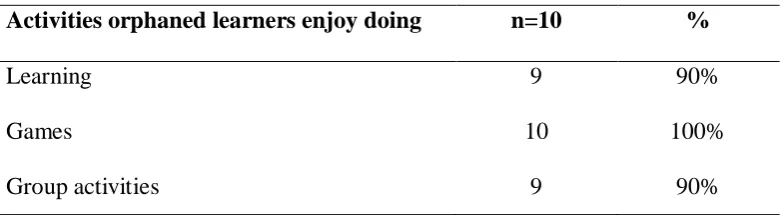
Table 4.10: Activities which learners enjoy doing ... 42
Table 4.11: Teachers’ ratings of the orphaned learners’ academic performance ... 43
Table 4.12: Learners’ Previous Term’s Performances ... 45
Table 4.12: Learners’ aspirations for the next exam and K.C.P.E results ... 46
Table 4.14: Learners’ rating of their performance ... 47
Table 4.15: Number of Times Learners go for Games in a Week... 49
Table 4.16: Types of Games Played ... 49
Table 4.17: Learners’ Favorite Games... 50
Table 4.18 Leaner’s’ Reasons for Liking their Favorite Games ... 51
Table 4.19: Teachers’ Responses to Examples of Orphaned Learners’ different needs ... 52
Table 4.20: Orphaned Learners’ Behaviors in Class ... 53
Table 4.21: Reasons for Enjoying spending time with other Children ... 55
Table 4.22: Learners’ Attitude ... 56
Table 4.23: Reasons as to why living in the Orphanage has a Positive Influence on the Educational Performance of Orphaned Learners ... 57
Table 4.24: Teachers’ ways of handling Orphaned Learners’ different Instructional and Emotional needs ... 58
Table 4.25: Initiatives taken by Teachers to enhance the Academic Performance of Orphaned Learners. ... 59
Table 4.26: Teachers’ Efforts to be Surrogate Parents to Orphaned Learners ... 60
ix
LIST OF FIGURES
x
ACRONYMS AND ABBREVIATIONS
AIDS Acquired Immune Deficiency SyndromeCBOs Community Based Organizations
EFA Education For All
FBOs Foreign Based Organizations
FPE Free Primary Education
HIV Human Immunodeficiency Virus K.C.P.E Kenya Certificate of Primary Education
MDGs Millennium Development Goals NGOs Non- Governmental Organizations
TSC Teachers Service Commission UN United Nations
UNAIDS United Nations Program on HIV and AIDS UNICEF United Nations Children’s Fund
xi
ABSTRACT
1
CHAPTER ONE
INTRODUCTION AND BACKGROUND TO THE STUDY
1.1 Introduction
This chapter entails background to the study, statement of the problem, purpose of the study, objectives of the study, research questions, significance of the study, limitations and delimitations, assumptions, theoretical framework, a conceptual
framework and finally operational definition of terms.
1.2 Background to the Study
The history of orphanages in the world, according to Whitney (2014), dates back to as early as the fourteenth century where orphanages and foundling hospitals were
established in European countries by religious orders, confraternities and municipalities as a response to the plague and increasing poverty at that time to care for abandoned or orphaned children while In America, few orphanages existed
before the 19th Century where also religious groups founded orphanages as a response to wars and epidemics.
Whitney (2014) further adds that from 1920s on, charities in most Western countries started to close their institutions because of protests that orphanages created
institutionalization as they were established based on religious, cultural or racial lines and so governments (American and European) have since then taken control
over the welfare of orphans and other vulnerable children through the creation of social services where such children are placed under the foster care system or are adopted into families. (Whitney, 2014) also adds that according to UNICEF, there
2
in institutional care or orphanages (Orphanages can also be referred to as group homes or children’s homes).The goal of these institutions is to create a safe and
beneficial environment for children to grow in and it is an alternative to the foster care system or private adoption (Whitney, 2014).
Africa is a home to many orphans. Ombuya, Yambo and Omolo (2012) explain that
according to a joint report by UNAIDS, UNICEF and USAID (2004), at least 12.3% of all children in sub-Saharan Africa or 43 million children, are orphans (who have
lost one or both parents). Ombuya et.al (2012) also quote Crawley (2001) and Wax (2003) that in traditional African culture, there were no orphans as parentless children were cared for within kin systems but due to poverty and other strains,
families are less willing or able to take care of orphans and some even take advantage of them. Ombuya et.al (2012) further explain that researchers indicated
that HIV/AIDS and wars added to the devastation of African families; hence creating the necessity for orphanages and national and international adoptions in the 20th century. However, most of these orphanages are privately sponsored by various
local and foreign organizations as Ombuya et.al (2012) report that contrary to what happens in European countries, most orphanages in African countries receive little
support from governments and mostly depend on support from multinational organizations, international agencies, NGOs and CBOs.
Every child, orphaned or not, has a right to education as stated by Bagunywa (2006)
that education is a human right. Parag (2009) also adds on the same note that, education as a basic human right is an essential asset in confronting the many
3
be understood in terms of a family of processes through which people become committed to what is valuable in a way that is illuminated by some breadth and
depth of understanding.
Education is critical to the future of all children, but especially to those who are orphaned or vulnerable. According to UNICEF (2009), provision of basic education
in Sub-Saharan Africa has shown remarkable improvements since 164 governments met in Dakar, Senegal in 2000 and committed to the goal of Education For All
(EFA) and since then, enrolment has increased by 36%. This implies that orphans are among those children in such countries whose enrolment has also increased due to the Dakar forum despite lacking parents to cater for their education needs.
Good management of orphanages can ensure maximum educational achievement for the orphans especially with the involvement of the entire staff (teaching and
non-teaching) in supervising of orphaned learners’ education as stipulated by the UK Department for Education (2011) that in order to achieve education, children in the homes should be helped by the staff to achieve their educational or training goals
which includes providing support, facilities and opportunities as needed to maximize each child’s achievement and to minimize underachievement. On the other hand, if orphanages are poorly managed, the orphaned learners’ education may be negatively
affected especially if the homes allow duties within the institution to take precedence over schoolwork (Care Reform Initiative, 2015). Therefore, good management of the orphans’ welfare can lead to maximization of their educational
4
Kenya is a home to 3 million orphans (UNICEF, 2009). Some of these orphans live with relatives while others live in different orphanages distributed throughout the
country. Kenya is also a signatory to EFA and UN MDGs and has been trying to achieve both EFA goals and MDGs especially through the introduction of FPE in 2003. However, EFA goals have not been entirely achieved because of the hidden
costs of education, more so, for orphans who lack parents to meet the costs. To make matters worse, the government does not have a national policy for the welfare of
orphans including that of their education. Therefore, most orphanages in Kenya are privately sponsored by various charity organizations and consequently the management of the education of the orphaned learners is left in the hands of such
organizations.
Kisauni sub-county in Mombasa County hosts twenty four registered orphanages
which are all managed either by National Board of Trustees, Local Board of Trustees, NGOs, CBOs, FBOs or Management committees which all depend on local or foreign donations and charities from well-wishers. Some of these
orphanages provide both a home and a school for the many orphans and other vulnerable children under their care.
Given the number of orphans in Kenya (three million) as stated by (UNICEF, 2009), it is therefore necessary to investigate how these orphans live as well as their performance in education and since Kisauni sub-county is in Kenya, it also has a
share in the three million orphans, some of whom live in the twenty-four orphanages. An opportunity therefore exists, by conducting this research to find out
5
implication that this management has on the educational performance of the orphans under their care.
1.3 Statement of the Problem
Orphans are among the vulnerable groups of people in any society. In America and European countries, raising children in orphanages has been highly discouraged and
their governments prefer the adoption system where orphans are adopted into families. This means that their adopting families meet all the needs of the orphans
including their education needs. In Africa however, the situation is different for orphans; the number of orphans is increasing while the kinship system is dying and there are no adoption policies in some countries. Orphanages have thus been
established over time by private organizations, albeit with little support from governments, to assist such destitute children to live comfortable lives as well as
access education so as to elevate their socio-economic statuses. Little research has been done on how orphanages are managed and especially in terms of meeting the education needs of orphans. This study thus sought to determine how orphanages are
managed (based on four orphanages in Kisauni sub-county, Mombasa County, Kenya) both as homes and schools in terms of meeting the different needs of
orphans including their education needs and the implication that this management has on the educational performance of orphaned learners.
1.4 Purpose of the Study
The purpose of this study was to determine how orphanages are managed both as homes and schools in terms of meeting the different needs of orphans (including
6
educational performance of orphans based on four orphanages in Kisauni sub-county.
1.5 Objectives
The specific objectives of the study were:
i. To find out the role of the manager in the management of the orphanage.
ii. To determine the implication that provision of needs has on the educational
performance of orphaned learners.
iii. To find out the behaviors exhibited by orphaned learners as a result of living in
an orphanage and the implication of these behaviors on their educational performance.
iv. To determine the role played by the teachers in the educational performance of
orphaned learners.
1.5.1 Research Questions
The following research questions guided the study: i. What role does the manager play in the orphanage?
ii. What implication does the provision of needs have on the educational
performance of orphaned learners?
iii. What are the behaviors exhibited by orphaned learners (as a result of living in an
orphanage) and their implication on the orphaned learners’ educational performance?
iv. What role do teachers play in the educational performance of the orphaned
7
1.6 Significance of the Study
It was assumed that the findings of the study may be beneficial to the following
stakeholders:
a) Administrators of Orphanages and Teachers
The findings of this research may assist the orphanage managers in enhancing their
managerial skills both as education managers and managers of children centers. The findings might also enable the teachers to strengthen and perform effectively the
roles they play in providing education to orphans and influencing their behavior positively.
b) Academic Fraternity
The study may contribute to the general body of knowledge by shedding light on the
implication of orphanage management on the educational performance of orphaned learners. The researchers may thus, use the findings from this study, to conduct
further research on management of orphanages and its implication on the educational performance of orphans. Future researchers and scholars may also use this study for reference when they undertake their studies.
c) Organizations in Mombasa County
The findings from this study may also assist the various CBOs, NGOs and FBOs
within Mombasa County which work with orphans in various ways by helping them (organizations) understand how the orphans’ environment affect their education as
well as understand their education needs and try to come up with ways to assist them
8
1.7 Limitations
The study was limited by time and financial constraints. The feasibility of the study
proved that it was not practical for the researcher to administer data collection instruments to all the stakeholders involved in the running of orphanages and provision of education to orphaned learners. Data was therefore collected from a
selected sample size from children centers in Kisauni sub- County which is a place that the researcher is familiar with.
1.8 Delimitations
This study focused on the implication that orphanage management has on the educational performance of orphans only; not any other vulnerable children. It also
did not involve all the orphanages in Kisauni Sub-county; it specifically targeted orphanages that operate both as children centers and schools and are registered under the Children’s Department in the Ministry of Labor, Social Security and
Services.
1.9 Assumptions
The researcher conducted the research with the following assumptions:
i. The appropriate authorities (Orphanage Manager/ Management Board) for the
orphanages selected for the study would grant permission for the collection of
data by the researcher.
ii. Orphanage management has an implication on the educational performance of
orphaned learners.
iii. The respondents would be mature enough to form concrete opinions about their
9
iv. The information provided by the respondents would be accurate and not affected
by their working relationship with the researcher.
1.10 Theoretical Framework
The theory used to support the study was Abraham Maslow’s hierarchy of needs
theory. The hierarchy of needs theory is one of the best-known theories of motivation. Created by psychologist Abraham Maslow, the hierarchy is often
displayed as a pyramid, with the most basic needs at the bottom and more complex needs at the peak. The four lowest level needs are what Maslow referred to as D-needs (or deficiency D-needs). These D-needs are due to lack of something and need to
be satisfied in order to avoid unpleasant feelings and to move on to higher level needs. The uppermost needs in the hierarchy are referred to as B-needs (being needs
or growth needs) and involve the desire to grow as an individual and fulfill one’s own potential (Cherry, 2014).
Mc.Leod (2007) points out that Maslow (1943) stated that people are motivated to achieve certain needs where once one need is fulfilled; a person seeks to fulfill the
next one, and so on. The five stage model can be divided into basic (or deficiency) needs (e.g. physiological, safety, love, and esteem) and growth needs
10
Figure 1.1: Maslow’s Hierarchy of needs Source: (Mc. Leod, 2007)
On physiological needs, Nyongesa (2007) states that these are the lowest order of
human needs and consist of basic physiological necessities such as food, water, shelter, etc. When the basic physiological needs are satisfied, a new level of need
(safety and security) which is one step higher in the hierarchy of needs arises. Mc. Leod (2007) adds that after safety and security needs have been fulfilled, another
level of need that arises is the social affiliation where a sense of belonging together with approval from peers becomes an important motivating factor. On satisfying the needs of acceptance and affiliation, people feel a desire for prestige and status. This implies recognition, consequently a confidence in oneself (Nyongesa, 2007). On the
11
developing your personal potential. Nyongesa (2007) points out that this category of need according to Maslow is the highest level of need. A person who is
self-actualized is motivated by inner values and beliefs.
In describing orphans’ needs, Musisi, Kinyanda, Nakasujja and Nakigudde (2007)
identified orphans’ needs as the need for love and protection, identity, security, play,
schooling, food and shelter. This implies that every orphanage must strive to provide these needs for the orphans to live comfortably without any feelings of deprivation.
The Hierarchy of Needs theory can be applied in the management of orphanages and its implication on the educational performance of orphaned learners. An orphanage should therefore take care of the physiological needs of the orphans by providing
them with food, water, clothes and a shelter free from any internal or external threats. It also ought to employ staff that would provide pastoral care to the orphans
and the management should endeavour to create an environment where the orphans feel that they are a family as this feeling has an effect on their educational performance as explained by Makhonza (2006) that the custody, per se does not
matter most, what matters most is the availability of family factors in any available custody: like assistance with homework, to have food for breakfast and supper at
home, love, acceptance and belonging.
Once these needs have been achieved, it is believed that the orphaned learners will
achieve self-esteem which is defined as a person’s sense of their own worthiness and competence (London Borough of Bexley, 2013). It is necessary to an orphaned
12
the trauma of being parentless. Self-esteem thus has a major implication on the educational performance of orphaned learners.
Once an orphaned pupil achieves self-esteem, it is easier for him/her to set goals for his/her future. They may develop dreams of proceeding to secondary education and higher learning to pursue different careers. A self-actualized orphaned learner will
therefore work hard to achieve his/her goals.
The theory was thus relevant in the study as it guided in describing how orphanages
in Kisauni sub-county ought to be managed in ensuring provision of physiological, security and belonging needs to orphans, how provision of those needs impacts on the self-esteem of the orphaned learners and establish whether learners, due to
achievement of self-esteem, strive for self-actualization by working hard to pursue their inner talents and fulfillment and the implication that this need has on their
educational performance.
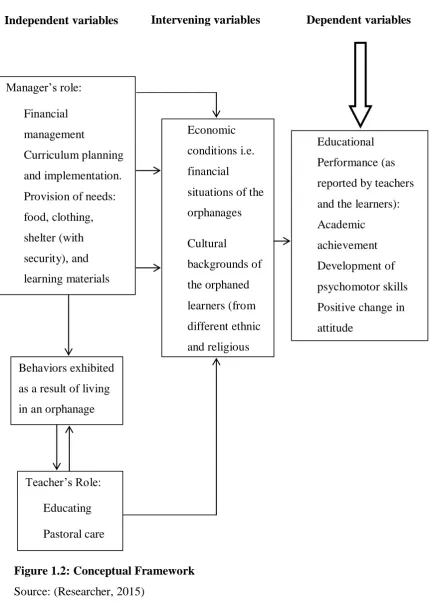
1.11 Conceptual Framework
The independent variables in the study were: the manager’s role, behaviors exhibited by orphaned learners as a result of living in an orphanage and the teachers’ role
while the dependent variable was educational performance which is in terms of academic achievement, development of psychomotor skills and positive change in attitude. The interaction of the independent variables may have an impact on the
outcome of the dependent variable despite the intervening variables. The study therefore sought to find out how the manager’s role, behavior exhibited as a result of living in an orphanage and the teacher’s role in orphanages affect the educational
13
Figure 1.2: Conceptual Framework Source: (Researcher, 2015)
Manager’s role:
- Financial management
- Curriculum planning and implementation.
- Provision of needs: food, clothing, shelter (with security), and learning materials - Economic conditions i.e. financial
situations of the orphanages - Cultural backgrounds of the orphaned learners (from different ethnic and religious communities) Behaviors exhibited
as a result of living in an orphanage
- Educational Performance (as reported by teachers and the learners):
- Academic achievement
- Development of psychomotor skills
- Positive change in attitude
Teacher’s Role:
- Educating
- Pastoral care
14
1.12 Operational Definition of Terms
Educational performance- the extent to which an orphaned learner performs
academically, develops psychomotor skills and has a positive attitude towards life despite losing parents
Management- the act of running an orphanage by taking part in decision making,
planning, supervising and ensuring provision of all orphans’ needs
Needs- all the things provided to orphans to enable them live and learn in an
orphanage comfortably. They include: food, water, clothes, care takers, security as well as learning materials like books and pens.
Orphan- any child who has lost one or both parents to death and lives in an
orphanage
Orphanage- any institution that shelters orphans by providing them with moral and
15
CHAPTER TWO
LITERATURE REVIEW
2.1 Introduction
Literature review is important in research as Koshy (2005) states that it can enhance one’s understanding of the issues associated with the topic and it can also help one
sharpen the focus of his/her study as such efforts will help one gain insights into the
topic as well as guide him/her in the pursuit of fruitful activities. In this chapter, the literature reviewed on orphanage management and its implication on the educational
performance of orphans is presented. It also presents the source material used by the researcher: journal articles, books and internet information which the researcher
retrieved using search engines like Google, google scholar and Bing. The keywords used in the search include: orphan, orphanage management, orphans in Kenya, teaching or educating orphans, behavior of orphans in orphanages, performance of
orphans in schools and provision of basic needs to orphans.
The chapter also gives a review of literature concerning the role of orphanage
managers in management of orphanages, effects of provision of needs on the educational performance of orphaned learners, behaviors exhibited by orphaned learners resulting from living in orphanages and the role played by teachers in the
educational performance of the orphaned learners.
2.2 The Role of Managers in the Management of Orphanages
Since this study focused on orphanages as both children’s homes and education institutions, the role of managers in the management of orphanages is also discussed
16
Many orphanages are run by non-profit organizations whose directors do not receive extensive benefits or high salaries (Whitney, n.d). When asked about his job
as the supervisor of Oxford Masonic Home for Children, Grisson (2014) explains that:
Being administrator is like being a big father. We’re one big family. Just like in any household, you’ve gotta have a daddy, you’ve gotta have a mom, you gotta have somebody who can take the lead and run with it, and not be afraid to take some chances. (p.1)
A career as an administrator or manager of an orphanage is generally more rewarding in terms of personal satisfaction than monetary benefit. The administrator is the point person who manages all administrative, funding, marketing and
management operations for the orphanage. The administrator is responsible for maintaining the books of accounts, liaising with partners who fund the orphanage
and marketing the orphanage to source funding. The administrator should have a Bachelor’s degree, organizational skills, communication skills, financial expertise
and problem-solving skills (Willis, 2014)
In an advertisement for an orphanage director, Coptic Orphans (2014) specifies that the program’s director designs, plans, develops, coordinates and implements new
and existing programs, direct necessary focus, resources and efforts to substantially promote education initiatives and seek funding opportunities that can be used to further the mission and the goals of the organization.
In presenting her findings on her research on Toward a Grounded Theory on the
17
degree in social work or managerial leadership and have experience in accounting and handling budgets because of the potential for mishandling funds. Other
participants, however, were more focused on personal qualities such as caring, love, honesty, compassion, patience, warmth and having the heart to work with children and believed that the leader should be well versed in issues affecting children and
their care and have a heart to work with children in difficult circumstances.
Education administrators organize and manage the administration, support systems
and activities that enable the effective running of an educational institution. Administrators work in areas such as admissions, quality assurance, data management and exams or in a specialist department such as finance, careers or
human resources (AGCAS, 2014).
One main duty of school administrators is helping teachers plan the curricula for their classes. School administrators are responsible for overseeing their school’s
budget. School administrators usually make rules and procedures that cover the entire school as well as behaviour plans for individual students who regularly cause
trouble. Administrators also help design programs to keep schools safe and free of drugs and alcohol (Degree directory, 2014).
2.3 Implication of Provision of Needs on the Educational Performance of
Orphaned Learners
In explaining Abraham Maslow’s hierarchy of needs theory, Mc. Leod (2007) states
that this five stage model can be divided into five basic (or deficiency) needs (e.g.
18
including, shelter, food, and clothing is necessary to the development of a strong community and a necessary precursor to individual self-sufficiency (Community
Action Network, 2014).
Children need various types of support ranging from those things necessary for survival, such as food and health care, to those interventions that will provide a
better quality of life in the future such as education, psychosocial support and economic self-sufficiency. In an ideal world, all children, orphaned or not, are not
supposed to be malnourished, sick and without shelter. Some argue that a comprehensive programme to support children should include all essential elements including food, health care, education, clothes, shoes, bedding, psychosocial
support, economic self-sufficiency etc. (Stover, Bohlinger, Walker & Monasch, 2007).
An orphaned child is usually an already traumatized child, psychologically due to the loss of parents and needs to be handled with care. One way of helping this child to live for a better normal life, is by ensuring he gets the basic things like food,
shelter, clothing then followed by the vital education (Guut, 2014). Extending the reach of school feeding to orphans and vulnerable children can provide a social
safety net that helps address issues of inequity and gender imbalance and so keeping these children in school, especially girls, can reduce their vulnerability, including to HIV and provide educational access of value such as through vocational training in
agricultural practices, entrepreneurship and life skills in education (HGSF, 2014).
19
children being assisted: physical infrastructure should be adapted to the socio-cultural environment, but at the same time model higher standards of hygiene and
ecological friendliness; all buildings and facilities should accommodate and cater for a number of children that does not exceed its capacity (an adequate number of premises that are in good condition and that meet the children’s living, educational,
social-interactional and recreational needs are called for); attention should be paid in particular, to the sanitary facilities with respect to their hygienic condition and
degree of privacy including respect for gender; all buildings should allow adequate natural light and sufficient circulation of fresh air; water and electricity services should be availed or planned for; outdoor facilities should be spacious and safe, with
adequate play-and-sports-equipment and the organization should ideally be located in a community where sufficient educational and medical facilities are also
available.
It has been established that needs of orphaned learners- such as food, peer acceptance and overcoming grief, among other needs-if not fulfilled, may interfere
with the teaching and learning process. Ogina (2007) reports on a study on educator’s role in identifying the needs of orphans conducted by De Wit & Lessing
which showed that lack of food and clothing were identified as the most prominent needs, while important psychological needs were a desire for acceptance, dealing
with stress, security and managing fear.
For orphaned learners to thrive well emotionally, their physical needs should be addressed first. This is also applicable in terms of safety as well as social needs. The
20
attention, a sense of personal identity and social connections that families and communities can provide. Furthermore, orphaned children need more emotional
support than children who have not gone through the painful process of losing one or both parents because they may experience trauma when their parents die (Ogina, 2007).
2.4 Behaviors Exhibited by Orphaned Learners as a Result of Living in
Orphanages and their Implication on their Educational Performance
Children living in orphanages come from adverse backgrounds after facing a diversity of experiences due to loss of one parent or both. Siyavora (2010) argues that numerous physical, psychological and economic issues surround children in
Africa orphaned because of any cause. They face isolation, prejudice, crime, abuse, neglect, child labor, prostitution, and HIV infection. Psychological effects include
depression, guilt, fear, and possible long-term mental health problems (Siyavora, 2010). This suggests that orphans are traumatized due to their orphanhood even before they are taken in orphanages. Such psychological traumas manifest
themselves in an array of social behaviors presented in orphanages.
Nalven (2014) points out that certain situations can increase a child’s risk of
developmental and behavioral problems. Malnutrition, neglect, and abuse, for instance, can all incur long-lasting effects. For these reasons, children who are raised in privation (such as in poor foster care, orphanages, or neglectful primary care)
suffer increased risk for a variety of developmental and behavioral issues, particularly if they have lived in an adverse environment during the first three years
21
developmental delays or concerning behaviors. The delays can affect cognitive, language, gross and fine motor, personal and social skills.
Browne (2009) suggests that young children are frequently placed in institutional care throughout the world. This occurs despite wide recognition that institutional care is associated with negative consequences for children’s development. For
example, young children in institutional care are more likely to suffer from poor health, physical underdevelopment and deterioration in brain growth, developmental
delay and emotional attachment disorders. Consequently, these children have reduced intellectual, social and behavioral abilities compared with those growing up in a family home. In explaining their findings, Fawzy and Fouad (2010) state that
they found that although the basic material needs could be met, orphans in orphanages were almost totally separated from the outside world and could not
access normal families and society relations. These results show distinct association between less self-esteem and depression were certain consequences of orphanhood and played a significant role in lowering the children’s life quality.
All these arguments seem to suggest that living in orphanages has negative impacts on the lives of orphans as their cognitive, psychomotor and affective skills are affected. This therefore affects the orphans’ learning in a formal education system.
However, Siyavora (2010) points out that when these orphans are placed into
institutional care, it is important that the orphanage provides a nurturing and stable environment free of the stigma often associated with an institutional upbringing.
22
orphans and where children without parents were cared for within extended families. Extending the concept of the kin system in orphanages and creating a community for
these children can increase the quality of their individual lives by saving them from a tragic cycle of poverty, ignorance, risky behavior, infection and death, which in turn, reduces the short and long-term economic and social costs to society at large.
2.5 The Role Played by Teachers in the Educational Performance of
Orphaned Learners
Parag (2009) defines an educator as a person who teaches in a classroom and systematically works to improve the learners’ understanding of a topic. Therefore, a
teacher is an educator.
Educators are the main adults other than family members with whom young people
interact on a daily basis. Ogina (2007) states that it has been established that the care, support and encouragement that children receive from their parents have the positive effects on their achievement in school. When a learner is orphaned, it seems
that a gap is created between the support structure and the learning experiences of the child. Educators, being the adults in the lives of orphans, are expected to fill this gap on a daily basis. Teachers who are caring will always be in ‘loco parentis’ (in
the place of a parent) trying to address the emotional needs of learners who are
orphaned. If parents have passed on teachers who are in the meso system should play a significant role in the lives of learners (Magano & Rambado, 2012).
Ombuya et.al (2012) state that it has long been internationally recognized that
23
learning is as important as the ability to teach. This implies that the teaching and learning role of an educator and the role of caring are inseparable and there is need
for balancing those roles of caring and teaching, especially in the case of orphaned learners. The educator can safely coax the child on to be pro-active in class and also gently advise other learners to be helpful and supportive to these children. Giving all
learners incentives for participating in creating a safe environment in which all can learn is a good way of inspiring all learners, specifically the orphaned and less
confident learners. (Magano & Rambado, 2012).
Ogina, (2007) points out that given the emerging situational role of the educators in providing needs to the learners; it would imply that the educators take up pastoral
care alongside pedagogical responsibilities. Teaching vulnerable children also calls for a good understanding of how to boost self-esteem and help them to development
24
CHAPTER THREE
RESEARCH METHODOLOGY
3.1 Introduction
This chapter describes the methods and procedures that guided the research. It includes: the research design, the variables in the study, data collection methods, location of the study, the target population, sampling techniques and sample size,
research instruments, pilot study, validity and reliability of the research instruments, data collection procedures, data analysis and logistical and ethical considerations.
3.2 Research Design
The researcher used a descriptive design that (Mugenda & Mugenda, 2003) describe as a method of describing existing phenomenon by asking individuals about their perceptions, attitudes and values. Descriptive survey was used in the study because
it allows for the collection of quantifiable data and data can be gathered from a relatively large number of cases at a particular time. The design was convenient for
the study as it aimed at gathering information on management of orphanages and its effects on the educational performance of orphaned learners.
3.2.1 Variables
The independent variable: management of orphanages that function as both child care centers and schools. The dependent variable: educational performance which is
25
3.3 Location of the study
The study was carried out in Kisauni sub-county, Mombasa County, Coast region in Kenya. It is found to the North of Mombasa’s Central Business District and covers
an area of approximately 88.7 square kilometers with a population of 194,065 people (Soft Kenya, 2012). Kisauni was selected for the study because it has more or
less twenty four registered orphanages compared to other counties. The orphans also come from diverse family, ethnic, religious and socio-economic backgrounds. These
variations made orphaned learners in Kisauni to be a heterogeneous group. It was thought that a heterogeneous group has a high probability of being a representative sample of the population of orphans in Mombasa County (which was selected for the
study because the researcher comes from the area and is familiar with the environment).
3.4 Target Population
Kisauni Sub-county has ten registered orphanages out of which four were used for the purpose of this study because they are the only ones that operate both as children centers and schools and are registered under the Children’s Department in the
Ministry of Labor, Social Security and Services, Mombasa County. The population
of the study was therefore 555 individuals (consisting of orphaned learners, orphanage managers and teachers) from the four orphanages. The target population
included: 432 upper primary orphaned pupils (class seven and eight) - 177 boys and 255 girls, 115 teachers and 4 orphanage managers (3 male and 1 female) from the four orphanages. The pupils were selected because they are the direct beneficiaries
26
selected because they are responsible for running the day to day activities in the orphanages.
3.5 Sampling Techniques and Sample Size
3.5.1 Sampling Techniques
Purposive sampling was used in the selection of the orphanages because its main
goal is to focus on particular characteristics of a population that are of interest, which will best enable one to answer his/her research questions (Laerd Dissertation,
2012) . Since the study focused on orphanages that are both homes and schools for orphans and are registered under the Children’s Department, the four orphanages
were therefore selected purposively out of the 24 orphanages in Kisauni. Simple
random sampling was then used in selecting respondents to be included in the sample size such that characteristics within the population had an equal chance of
being drawn.
3.5.2 Sample Size
The sample included: 4 orphanage managers, 10 teachers and 42 orphaned learners
from upper primary classes. The sample was 56 in total as shown in the Table 3.1.
Table 3.1: Sample Size
Selected orphanages Managers Teachers Boys Girls Total Orphanage A (mixed) 1/1 3/30 10/91 6/94 20/ 225 Orphanage B (mixed) 1/1 3/35 8/74 6/58 18/ 168 Orphanage C (mixed) 1/1 1/10 3/12 2/7 7/ 23 Orphanage D (girls) 1/1 3/40 - 7/96 11/ 139
27
3.6 Research Instruments
Questionnaires: the study was conducted using two types of questionnaires- teacher’s and pupil’s questionnaires. Questionnaires were used because according to
Burton &Bartlett (2009) they make it possible to gather large amounts of data relatively quickly. The researcher developed each of the items in the questionnaires
based on the study objectives and research questions. They consisted of both open and close ended questions to help the researcher find out the implication that
orphanage management has on the educational performance of orphans.
Interview schedule: a structured interview schedule was used to solicit more information from the managers as they are the ones who are directly responsible for
the management of the institutions. The structured interview schedule consisted of both open and close ended questions.
3.7 Pilot Study
The pilot study was done on a random sample of 1 orphanage manager, 1 teacher
and 4 pupils in one of the orphanages in Kisauni sub-county. The orphanage was then excluded from the final study. That was done to pre-test the relevance of the
items of the instruments, feasibility of the study techniques and the concept and wording of the questionnaires and the interview schedule.
3.7.1 Validity of the Research Instrument
Validity refers to the degree to which evidence supports any inferences the
28
instrument itself where the inferences should be appropriate, meaningful, correct and useful (Fraenkel and Wallen, 2009). The researcher sought to determine the validity
of the instruments using a sample size of 1 manager, 1 teacher and 4 pupils to assess the concept and wording of the research instruments. The data was then analyzed to check whether the results actually represented the variables under study.
3.7.2 Reliability of the Research Instrument
Reliability refers to the consistency of the scores obtained- how consistent they are for each individual from one administration of an instrument to another and from one set of items to another (Fraenkel and Wallen, 2009). The researcher used
Test-retest method where a sample size of 1 manager, 1 teacher and 4 pupils were used. The teacher and students were randomly selected to fill the questionnaires while the
interview schedule was used to solicit information from the manager of the institution. The same research instruments were then post tested after two weeks. The responses were scored using an electronic calculator. A comparison between
answers obtained in the two items was made so as to ascertain for consistency in the answers given in the two periods. Karl Pearson’s Moment of Correlation was used to
calculate the coefficient of correlation where a value of +1 was deemed acceptable in establishing the consistency of the research instruments in eliciting the same
29
3.8 Data collection Procedures
The researcher first sought permission to collect data from Kenyatta University’s
Graduate School and from the Children’s Department under the Ministry of Labour, Social Security and Services. The adjusted questionnaires after piloting were personally administered to the teachers and orphaned pupils by the researcher in the
selected orphanages in the sub-county. The researcher made prior arrangements with the authorities so that the instruments were administered and filled in her presence to
enable her assist the respondents in case of any problem in understanding the questions then she interviewed the manager using a structured interview schedule prepared beforehand.
3.9 Data Analysis
The data was grouped according to the research questions. The process of data
analysis involved scrutinizing the data to construct a description of the roles played by orphanage managers, teachers and the implication provision of basic needs has on the educational performance of the orphaned learners as well as the behaviours
exhibited by the orphaned learners as a result of living in orphanages and their implication on the educational performance of the orphaned learners. Data from the
questionnaires and interview schedules was then coded using the Statistical Package for Social Sciences (SPSS) to create frequency and percentage tables to analyse and
30
3.10 Logistical and Ethical Considerations
The researcher obtained a letter from the Children’s Department to assure the
orphanage managers that the orphaned learners would not be harmed in any way. She also visited the selected orphanages two weeks prior to the actual data collection date so as to establish a rapport with the managers of the selected orphanages and
the instruments were later administered and filled as she waited for them.
The researcher also sought verbal consent of all the respondents before requesting them to fill in the questionnaires or conducting the interviews. She also assured them that the information they provided would be treated confidentially and will only be
used for the purpose of the study. To ensure anonymity and secure the participants, the researcher did not require names or other means of identifying participants
31
CHAPTER FOUR
DATA ANALYSIS, INTERPRETATION AND DISCUSSION OF
FINDINGS
4.1 IntroductionThis chapter presents the analysis of the data collected from the orphanage managers, teachers and the orphaned learners from the four orphanages under study
in Kisauni sub-county, Mombasa County. The data was collected using questionnaires (given to 42 orphaned learners and 10 teachers) and an interview
schedule was used to interview 4 managers from the 4 institutions.
The data collected was coded using the Statistical Package for Social Sciences
(SPSS) and report of findings was done using frequency distributions and percentage tables as well as bar graphs.
Data analysis and interpretation and presentation are done as per the four research
objectives:
i. To find out the role of the manager in the management of the orphanage.
ii. To determine the implication provision of needs has on the educational
performance of orphaned learners.
iii. To find out the behaviors exhibited by orphaned learners as a result of living in
an orphanage and the implication of these behaviors on their educational performance.
iv. To determine the role played by teachers in the educational performance of
32
4.2 Demographic Characteristics of Respondents
This section gives the demographic data about the 42 orphaned learners and 10
teachers that were given questionnaires to fill in as well as the 4 managers who were interviewed using a structured interview schedule.
Table 4.1: Demographic Characteristics of Learners
f %
Gender
Male Female
21 21
50% 50%
Age
10-11 12-14
15 and above
4 29
9
9.5% 68.1%
21.4%
According to Table 4.1, 21(50%) were male and 21(50%) female. This was intentionally done so, so as to give both genders an equal chance in order to
determine the implication that orphanage management has on the educational performance of orphaned learners. Also, 68.1% of the learner respondents fall in the age bracket of 12-14 years which is the recommended age of pupils in class seven
33
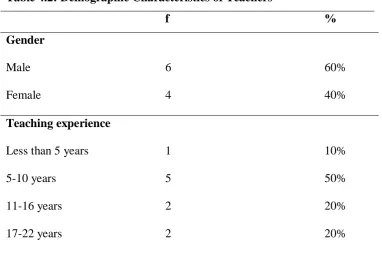
Table 4.2: Demographic Characteristics of Teachers
f %
Gender Male Female 6 4 60% 40% Teaching experience
Less than 5 years 5-10 years 11-16 years 17-22 years 1 5 2 2 10% 50% 20% 20%
It can be observed from Table 4.2 that 60% of the teachers were male while 40%
were female. This was so because in 2 of the institutions there were more male teachers teaching upper primary classes than female and the learner respondents were selected from upper primary classes (classes 7&8) and only teachers from
these classes needed to be selected as they are in direct contact with the orphaned learners in those classes. Further, 90% of the teachers have teaching experience of
more than 5 years. This indicates that majority of the teachers are highly experienced and can thus give accurate data on how the orphanages they work in, are managed (including their roles as teachers) and the implication that the
management has on the educational performance of orphaned learners.
Table 4.3: Academic Qualifications of Orphanage Managers
Qualification n=4 %
Certificate 1 25%
Diploma 1 25%
34
From Table 4.3, it was gathered that 1 (25%) manager has both a certificate from a Catholic mission in Sweden and a Diploma in General Education while 3(75%) managers have Bachelor’s degrees in either Education or Business related courses.
This was significant to establish as stated by Siyavora (2010) that orphanage administrators need to have a degree in social work or managerial leadership.
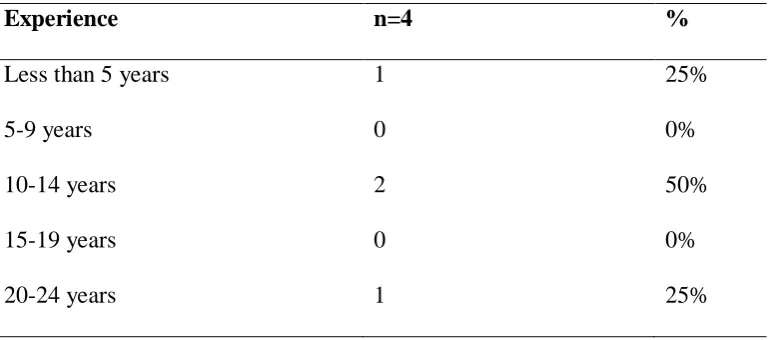
Table 4.4: Experience as Orphanage Manager
Experience n=4 %
Less than 5 years 1 25%
5-9 years 0 0%
10-14 years 2 50%
15-19 years 0 0%
20-24 years 1 25%
From Table 4.4, as far as experience is concerned, 25% of the orphanage managers
have less than 5 years of experience, 25% have more than 20 years of experience while the majority 50% have 10-14 years of experience. The number of years of experience for all the managers is enough for their impact to be felt in the
orphanage- cum -schools they manage.
The managers were also asked to each give a reason for working in an orphanage: 2
stated that working in an orphanage is an opportunity for them to better the lives of orphans; 1 became an orphanage manager as an assignment by a Catholic church and 1 became an orphanage manager because it was a job that needed to be filled
35
4.3 The Role of the Manager in the Orphanage
This research objective is discussed based on responses to questions in the Manager’s interview schedule (Appendix III) under the sub-headings: Planning,
Curriculum Management, Financial Management and Management style and Provision of basic needs, question 1-5. Also, from the Teacher’s questionnaire
(Appendix I): question 2, 3 (a & b) and 4 under the sub-heading General Information and Learner’s questionnaire (appendix II) - Part B: Conditions in the orphanage,
question 1-4.
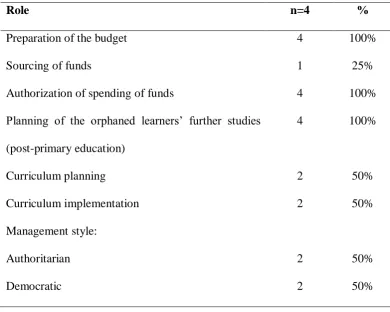
In the interview, the managers were first asked to state their duties as the managers of the orphanages and their responses were as summarized as in Table 4.5
Table 4.5: Roles of the Manager in the Orphanage
Role n=4 %
Preparation of the budget 4 100%
Sourcing of funds 1 25%
Authorization of spending of funds 4 100%
Planning of the orphaned learners’ further studies
(post-primary education)
4 100%
Curriculum planning 2 50%
Curriculum implementation 2 50%
Management style: Authoritarian
Democratic
2
2
50%
36
Table 4.5 presents the roles of the manager as perceived by the managers themselves. All the 4(100%) managers take part in the preparation of the budget, authorizing the spending of their institutions’ funds by signing for all expenditures
and purchases and keeping records of such transactions. Only 1(25%) manager sources for funds for the institution from donors and well-wishers, the other 3 (75%)
have Boards of Management to take care of sourcing for funds. The duties that the managers carry out are as what Willis (2014) describes as being the point person
who manages all administrative, funding, marketing and management operations for the orphanage.
To take care of the orphaned learners’ education needs, all the 4(100%) managers also plan the orphaned learners’ further studies i.e. post primary education. They do
this by ensuring sponsorship of their secondary and university education.
It was also found out that curriculum planning and implementation is determined by the style of management of the manager (either as orphanage administrator only or both administrator and head teacher). So, out of the 4 managers, 2(50%) prefer to
use authoritarian style of management because to them it gets things done faster and ensures proper management of the institution’s activities. They therefore, participate
in curriculum planning and implementation by taking part in staff meetings, planning of the school calendar, supervision of teachers and providing the teachers with teaching and learning materials. The other 2(50%) prefer to use democratic
style of management because it gives a chance to subordinates to grow professionally and it is easier for them to gauge their subordinates. They therefore,
37
Despite the differences in management styles as stated in Table 4.5, all the 4(100%) managers believe that their styles of management have an implication on the
educational performance of the orphaned learners because:
i. The style of management used (democratic) has led to improved performance in
K.C.P.E results, citing examples that in 2013 (under different management), the
mean mark was 314 and in 2014, the mean mark was 348 (25%)
ii. The style of management used (authoritarian) creates a stable environment
preventing tension and anxiety (25%).
iii. Their styles of management create conducive environment for both living and
studying in (50%).
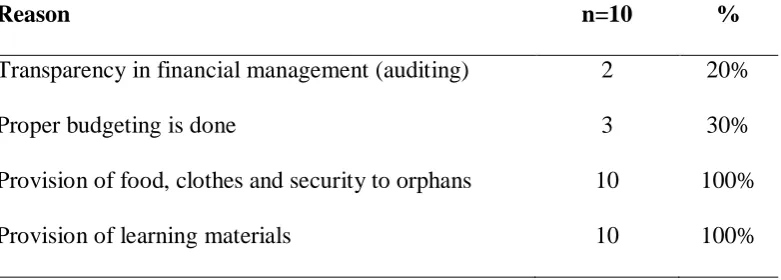
When the teachers were asked if they consider their orphanages to be well managed, 100% responded in the affirmative citing the reasons as indicated in Table 4.6.
Table 4.6: Reasons as to why Teachers consider the Orphanages to be well Managed
Reason n=10 %
Transparency in financial management (auditing) 2 20%
Proper budgeting is done 3 30%
Provision of food, clothes and security to orphans 10 100%
Provision of learning materials 10 100%
Table 4.6 points out that 20% of the respondents stated that they consider the
38
orphans and a further 100% stated it is because of provision of learning materials to the orphaned learners. The teachers’ responses therefore indicate that the managers
ensure that the orphaned learners’ needs (both basic and education) are met as also
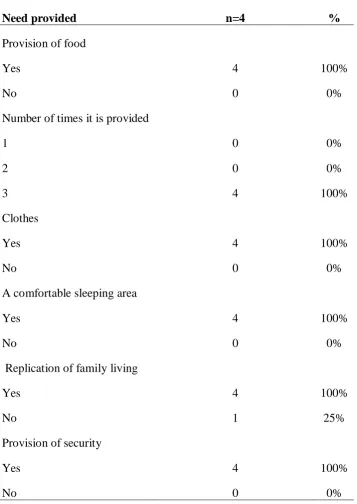
stated by the managers in Table 4.7.
Table 4.7: Managers’ Responses to Provision of needs in the orphanage
Need provided n=4 %
Provision of food Yes
No
Number of times it is provided 1 2 3 4 0 0 0 4 100% 0% 0% 0% 100% Clothes Yes No 4 0 100% 0% A comfortable sleeping area
Yes No 4 0 100% 0% Replication of family living
Yes No 4 1 100% 25% Provision of security
39
According to Table 4.7, all the 4(100%) managers ensure provision of food to the orphaned learners 3 times a day, clothes and a comfortable sleeping area. About the
orphanages being able to replicate family living, the 4(100%) managers agreed that they do, citing good diet, proper hygiene, security and good care from the caretakers as reasons. However, among the 4, 1(25%) manager also said ‘no’ because as much
as the physical needs are catered for in the institution, nothing can replace parental love.
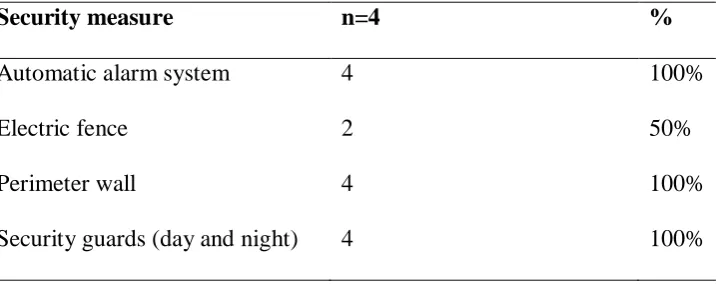
All the 4(100%) managers also stated that they provide adequate security to the orphans under their care as indicated in Table 4.8.
Table 4.8: Security Measures in the Orphanages as reported by the Managers
Security measure n=4 %
Automatic alarm system 4 100%
Electric fence 2 50%
Perimeter wall 4 100%
Security guards (day and night) 4 100%
From Table 4.8, it can be observed that all the 4(100%) orphanages have automatic
alarm systems, day and night security guards guarding their compounds and perimeter walls. 2(50%) of the orphanages apart from having the above stated
security measures, also have electric fences.
Also, all the 10(100%) teachers from the 4 orphanages indicated that their institutions provide: food, clothes, clean water and proper sanitation to the orphaned
40
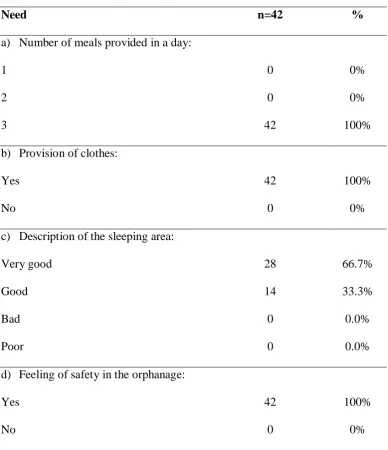
The learners also attested to the provision of needs as stated by the managers and teachers as they gave the responses summarized in Table 4.9.
Table 4.9: Learners’ Responses to Provision of needs in the home
Need n=42 %
a) Number of meals provided in a day:
1 2 3 0 0 42 0% 0% 100% b) Provision of clothes:
Yes No 42 0 100% 0% c) Description of the sleeping area:
Very good Good Bad Poor 28 14 0 0 66.7% 33.3% 0.0% 0.0% d) Feeling of safety in the orphanage:
Yes No 42 0 100% 0%
Table 4.9 indicates that all the 42(100%) orphaned learners stated that their
41
the respondents described their sleeping areas as being ‘good’. Also, all the 42(100%) respondents stated that they feel safe in the homes because:
i. They have care takers to look after them (31.0%) ii. Presence of security guards (47.6%)
iii. Presence of a fence (35.7%)
iv. Presence of a security alarm in the home (23.8%)
Therefore, from the managers’, teachers’ and learners’ responses, it can be gathered
that the managers ensure that the orphaned learners in the four institutions are provided with: food, clothes, maximum security, stationery and care.
4.4 The implication Provision of Needs has on the Educational Performance
of Orphaned Learners
To analyze this research objective, an analysis of the learners’ educational performance had to be carried out. Therefore, the analysis of this research question is based on questions from:
i. Teacher’s questionnaire: Part C –question 5&6
ii. Learner’s questionnaire: Part C-question 1-6 and Part D- question 1-3
A point to note is that educational performance covers three areas: cognitive, psychomotor and affective domains. Cognitive is analyzed through the learners’ academic performance whereas psychomotor and affective skills are analyzed
through sporting activities that the learners engage in as stated by Research in Europe (2014) that sports and games are the ways of enhancing the children’s