Available online: http://edupediapublications.org/journals/index.php/IJR/ P a g e | 595
A Study of Viscous Incompressible Fluid Flow
between Two Parallel Plates
Ahmed Jamal Shakir Almansor
MASTER OF SCINCE (Applied Mathematics), DEPARTMENT OF MATHMATICS
UNIVERSITY COLLEGE OF SCIENCE, OSMANIA UNIVERSITY
ABSTRACT
In this paper an endeavor has been made to discover the arrangement of the Nav ier-Stokes mathematical statements for the stream of a th ick incompressible liquid between two plates and the Navier stokes equations are unable to through light on the flow of Newtonian fluids , in derivation of Neiver stokes equation we regarded fluid as continuum , the Neiver stokes equation non linear in natural and prevent us to get single solution in which convective terms interact in a general manner with viscous term , the solution of these equations are valid only in a particular reg ion in a real situation where the p lates one very still and the other in uniform movement, with little uniform suction at the stationary plate. An answer has been gotten under the supposition that the weight between the two plates is uniform. It has been demonstrated that because of suction a direct transverse speed is superimposed over the longitudinal speed. With suction, the longitudinal speed conveyance between the plates gets to be allegorical and dimin ishes along the length of the plate we will discuss different way for that effect pressure and without effect of pressure also when the two plate as fixed with pressure not zero with some application. in This paper also analysis the Unsteady flow of v iscous incompressible fluid between two plates .
INTRODUCTION:
In physics, a fluid is a substance that continually deforms (flo ws) under an applied shear stress. Flu ids are a subset of the phases of matter and include liquids, gases, plasmas and, to some extent, plastic solids. Fluids can be defined as substances that have zero shear modulus or in simpler terms a flu id is a substance which cannot resist any shear force applied to it. A lthough the term "fluid"
includes both the liquid and gas phases, in co mmon usage, "fluid" is often used as a synonym for "liquid", with no imp lication that gas could also be present. For examp le, "brake fluid" is hydraulic oil and will not perform its required inco mpressible function if there is gas in it. This colloquial usage of the term is also common in medicine and in nutrition.
Liquids form a free surface (that is, a surface not created by the container) while gases do not. The distinction between solids and fluid is not entirely obvious. The distinction is made by evaluating the viscosity of the substance. Silly Putty can be considered to behave like a solid or a fluid, depending on the time period over which it is observed. It is best described as a viscose elastic flu id. There are many examp les of substances proving difficult to classify (White, F. M., & Cornfield, I. (2006)).
Available online: http://edupediapublications.org/journals/index.php/IJR/ P a g e | 596
solving fluid mechanics problems. Particle image velocimetry, an experimental method for visualizing and analyzing fluid flow, also takes advantage of the highly visual nature of fluid flow.
SOME BASIC PROPERTIES OF THE FLUID
Fluids ( liquids or gases)
Properties of fluids determine how fluids can be used in engineering and technology. They also determine the behavior of flu ids in fluid mechanics. The following are some of the important basic properties of fluids.
Density:
Density is the mass per unit volume of a fluid. In other words, it is the ratio between mass (m) and volume (V) of a fluid.
Density is denoted by the symbol ‘ρ’. Its unit is kg/m3.
In general, density of a fluid decreases with increase in temperature. It increases with increase in pressure (Hirt, C. W., & Nichols, B. D. (1981)).
The ideal gas equation is given by:
The above equation is used to find the density of any flu id, if the pressure (P) and temperature (T) are known.
The density of standard liquid (water) is 1000 kg/m3.
Viscosity
Viscosity is the flu id property that determines the amount of resistance of the flu id to shear stress. It is the property of the flu id due to which the fluid offers resistance to flo w of one layer of the fluid over another adjacent layer.
In a liquid, v iscosity decreases with increase in temperature. In a gas, viscosity increases with increase in temperature.
Temperature:
It is the property that determines the degree of hotness or coldness or the level of heat intensity of a flu id. Temperature is measured by using temperature scales There are 3 co mmonly used temperature scales. They are
1. Celsius (or centigrade) scale 2. Fahrenheit scale
Available online: http://edupediapublications.org/journals/index.php/IJR/ P a g e | 597
Kelv in scale is widely used in engineering. This is because, this scale is independent of properties of a substance.
Pressure:
Pressure of a flu id is the force per unit area of the flu id. In other wo rds, it is the ratio of force on a flu id to the area of the fluid held perpendicular to the direction of the force.
Pressure is denoted by the letter ‘P’. Its unit is N/m2.
Specific Volume:
Specific volu me is the volu me of a fluid (V) occupied per unit mass (m). It is the reciprocal of density.
Specific volu me is denoted by the symbol ‘v’. Its unit is m3/kg.
Specific Weight:
Specific weight is the weight possessed by unit volume of a flu id. It is denoted by ‘w’. Its unit is N/m3.
Specific weight varies fro m p lace to place due to the change of acceleration due to gravity (g).
LAMINAR FLOW OF VIS COUS INCOMPRESSIBLE FLUID
The main limitations of the Navier-Stokes equations :
The limitations are unable to throw light on flow of non-Newtonian fluids. Derivation of the Navier-Stokes equations is based on stokes of viscosity which holds for most common fluids (known as the Newtonian flu ids). Since Stokes’ law
is not applicable to non Newtonian fluids (such as slurries, drilling muds, oil paints, tooth paste, sewage .s1udge, pitch, coal-tar, flour doughs, high polymer solutions, colloidal suspensions, clay in water, paper pulp in water, lime in water etc.), the Navier-Stokes equations cannot be applied to study non-Newtonian fluids.
In derivation of the Nav ier-Stokes equations we regarded flu id as a continuum. The continuum hypothesis though simp lifies mathematical work, but it is unable to exp lain the inner structure of the flu id. Hence for the concept of viscosity, we have to depend on the empirica1 formulation.
These equations are non-linear in nature and hence prevent us fro m getting a single solution in wh ich connective terms interact in a general manner with viscous terms.
Due to presence of terms in these equations, they are non-linear in nature. Hence the solutions of these equations even in the restricted case of flow which is inco mpressible and steady, is extremely difficult.
Due to idealizations such as infinite plates, fu lly developed parallel flo w in a p ipe, even limited number of exact solutions of these equations are valid only in particular region in a real situation.
COUTTE FLOW
Available online: http://edupediapublications.org/journals/index.php/IJR/ P a g e | 598 Mathematical description
Couette flow is frequently used in undergraduate physics and engineering courses to illustrate shear-driven fluid motion. The simplest conceptual configuration finds two infinite, parallel plates separated by a distance h. One plate, say the top one, translates with a constant velocity u0 in its own plane. Neglecting pressure gradients, the Navier– Stokes equations simplify to
where y is a spatial coordinate normal to the plates and u(y) is the velocity d istribution. This equation reflects the assumption that the flow
is uni-directional. That is, only one of the three
velocity components is non-trivial. If y originates at the lower plate, the boundary conditions are u(0) = 0 and u(h) = u0. The exact solution
can be found by integrating twice and solving for the constants using the boundary conditions.
Constant shear
A notable aspect of this model is that shear stress is constant throughout the flow do main. In particular, the first derivative of the velocity, u0/h, is constant. (This is imp lied by the straight-line profile in the figure.) According to Newton's Law of Viscosity (Newtonian fluid), the shear stress is the
product of this expression and the (constant)
fluid viscosity.
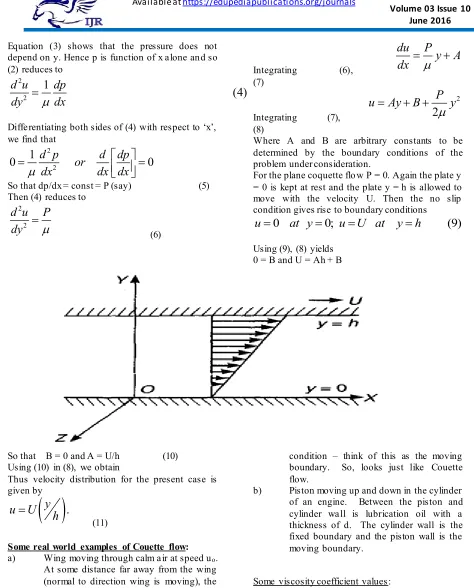
Flow between two parallel plate (Plane coutte flow)
Consider the steady laminar flo w of viscous incompressible fluid between two infinite parallel plates separated by a distance h. Let x be the direction of flow, y the direction perpendicular to the flow, and the width of the plates parallel to the z-direction.
Figre 1
Here the word ‘infin ite’ imp lies that the width of the
plates is large compared with h and hence the flow may be treated has two-dimensional (i.e..,
0
z
).Let the plates be long enough in the x-direction for the flow to be parallel. Here we take the velocity components v and w to be zero
every where. Moreover the flow being steady, the
flow variables are independent of time (
t
0
). Furthermore, the equation of continuity [namely,0,
0,
0
u x
v y
w z
] reduces to0
u x
so thatu u y
( )
. Thus for the present problem.( ),
0,
0,
0,
0
(1)
u u y v
w
z
t
For the present two dimensional flow in absence of body forces, the Navier-Sto kes equations for x and y-directions
2
2
0
(2)
0
(3)
p
d u
x
dx
p y
Available online: http://edupediapublications.org/journals/index.php/IJR/ P a g e | 599
Equation (3) shows that the pressure does not depend on y. Hence p is function of x alone and so (2) reduces to
2
2
1
(4)
d u
dp
dy
dx
Differentiating both sides of (4) with respect to ‘x’, we find that
2
2
1
0
d p
or
d dp
0
dx
dx dx
So that dp/dx = const = P (say) (5) Then (4) reduces to
2
2
d u
P
dy
(6)Integrating (6),
du
P
y A
dx
(7)Integrating (7),
2
2
P
u Ay B
y
(8)
Where A and B are arbitrary constants to be determined by the boundary conditions of the problem under consideration.
For the plane coquette flo w P = 0. Again the plate y = 0 is kept at rest and the plate y = h is allowed to move with the velocity U. Then the no slip condition gives rise to boundary conditions
0
0;
(9)
u
at y
u U at y h
Using (9), (8) yields 0 = B and U = Ah + B
Figure (2)
So that B = 0 and A = U/h (10) Using (10) in (8), we obtain
Thus velocity distribution for the present case is given by
y
.
u U
h
(11)
Some real world examples of Couette flow:
a) Wing moving through calm air at speed uo. At some distance far away from the wing (normal to direction wing is moving), the air is motionless – think of this point as a fixed boundary where the fluid velocity is zero. At the surface of the wing, the fluid velocity is uo if we assume a no-slip
condition – think of this as the moving boundary. So, looks just like Couette flow.
b) Piston moving up and down in the cylinder of an engine. Between the piston and cylinder wall is lubrication oil with a thickness of d. The cylinder wall is the fixed boundary and the piston wall is the moving boundary.
Some viscosity coefficient values:
Available online: http://edupediapublications.org/journals/index.php/IJR/ P a g e | 600
Water: = 1.005 x 10⁻³ kg/(m s) at 20C
Motor oil: = 1.07 kg/(m s) at 20C
Note: 1 centipoises = 10-3 kg/(m s) = 6.72 x 10⁻⁴ lbm/(ft s)
Flow between two parallel plate ( Generlized plane cutte flow)
Consider the steady laminar flo w of viscous incompressible fluid between two infinite parallel plates separated by a distance h. Let x be the erection of the flo w, and the width of the plates parallel to the z-direction Here the wo rd ‘infinite’ implies that the width of the plates is
large compared with h and hence the flow may
be treated as two-dimensional (i.e.
z
0
).Let the plates be long enough in the x-direction
for the flow to be parallel. Here we take the velocity components v and w to be zero everywhere. Moreover the flow being steady, the flow variables are independent of time (
t
0
). Further-more, the equation of continuity0
u x
v y
w z
reduces to
u x
= 0 so that
u u y
( )
. Thus for the present problem( ),
0,
0,
0,
0
u u v v
w
z
t
(1)
For the present two-dimensional flow in absence of body forces, the Navier-Stokes equations for x and
y-directions take the form:
2
2
0
(2)
0
(3)
p
d u
x
y
p y
Eq. (3) shows that the pressure does not, depend on
y. Hence p is function of x alone and so (2) reducesto
2 2
(1 )(
)
d u y
dp dx
…(4)
Differentiating both sides of (4) w.r.t. ‘x’we find
2
2
1
0
d p
or
d dp
0
x
dx dx
Available online: http://edupediapublications.org/journals/index.php/IJR/ P a g e | 601
So that dp/dx=const. = P(say). …(5)
Then (4) reduces to
d u dy
2 2
P
…(6)Integrating (6),
du dy
/
P
A
…(7)Integrating (7),
u Ay B
Py
2/ 2
…(8)Where A and B are arbitrary constants to be determined by the boundary conditions of the flow problem under consideration.
For the so called generalized plane Couette flow, the plate
y
0
are kept at rest and the platey h
is allowed to move with velocity U. Then the no slip condition, gives rise to the following boundary conditions:u = 0 at y = 0; u =U at y = h …(9)
Using these, (8) gives
O = B and U =
Ah
+ B + 22
Ph
So that
B
0
and2
U
Ph
A
h
Using (9) in (8), we get
2
2
2
Uy Phy Py
u
h
Or
2
.
1
2
y h P y
y
u U
h
h
h
Or
u
y
.
y
1
y
U
h
h
h
Where
2
2
h P
U
Available online: http://edupediapublications.org/journals/index.php/IJR/ P a g e | 602
.
1
u
y
y
y
U
h
h
h
………(11)Where
2
2
h P
U
To determine average and maximum velocities
The average velocity distribution for the present flow is given by
2 2
0
1
1
(
,
h
y
u
dy
U
U y h y h dy
h
h
h
Using (11)=
(1 2
6) ,
U
on simplificationThus,
u
(1 6) (
3) .
U
(13)
The volumetric flowQ
per unit time per unit width of the channel is given by(1 6) (
3) .
Q hu
hu
From (11),
du U
U
1
2
y
(14)
dy
h
h
h
For the maximu m or minimum velocity,
du dy
0
That is
U
U
1
2
y
0
h
h
h
giving1
1
1
.
(15)
2
y
h
From (15), it follows that the maximu m velocity for
1
occurs aty h
1
(that isy h
)
and the minimum velocity for
1
aty h
0
(that isy
0).
This further shows that for
1
the velocity gradient at the stationary wall is zero and it becomes negative for some value of
1.
Thus the reverse flow takes place when
1.
Equation (15)breaks down when
1
1
because the maximu m and minimum values ofy h
have already been reached at
1
and
1
respectively. Using (15) in (14), the maximu m and minimum velocities are given by
2
max
2 min
(1
)
4 ,
1
{ (1
) } 4 ,
1
U
U
when
U
U
when
(16)To determine shearing stress, skin friction and the coefficient of friction.
Using (14), the shearing stress distribution in the flow is given by
2
1
1
yx
du
U
y
dy
h
h
Available online: http://edupediapublications.org/journals/index.php/IJR/ P a g e | 603
Using (13) and (17), the skin frictions at the plates
y
0
andy h
are given by0
6 (1
)
(1
)
(18)
(3
)
6 (1
)
(1
)
(19)
(3
)
yx y
yx y h
U
u
h
h
U
u
h
h
The coefficient of friction (or the drag coefficient) corresponding to
(
yx y)
0 is given by0 2
12 (1
)
(
) 2
(
3)
yx y f
C
u
h
u
Using (18)If Reynold’s number
Re
hu
hu
,
v
then12(1
)
(20)
Re(
3)
f
C
Similarly, the coefficient of friction corresponding to
(
yx y h)
is given by'
f12(1
) Re(
3).
C
(21)In practical applications, the mean of
C
f andC
'
f is employed to estimate the energy losses in channels.Flow between two parallel plate ( plane poiseuille flow)
Consider the steady laminar flow of viscous incompressible fluid between two infinite parallel plates separated by a distance h. Let axis of x taken in the middle of the channel parallel to the direction of flow, y the direction perpendicular to the flow, and the width of the plates parallel to the z-direction. Here the word ‘infinite’ implies that the width of the plates is large compared with h and hence the flow may be treated as
two-dimensional (i.e.
z
0
). Let the plates be long enough in the x-direction for the flow to be parallel. Here we take the velocity components v and w to be zero everywhere. Moreover the flow being steady, the flow variables are independent of time (
t
0
). Furthermore, the equation of continuity
u x
v y
w z
0
; reduces to
u x
=0 so thatu u y
( )
. Thus for the present problem( ),
0,
0,
0,
0
u u y
v
w
z
t
(1)For the present two-dimensional flow in absence of body forces, the Navier-Stokes equations for x and y -directions take the form:
2
2
0
(2)
0
(3)
p
d u
x
y
p y
Equation (3) shows that the pressure does not, depend on y. Hence p is function of x alone and so (2) reduces to
2 2
(1 )(
)
d u y
dp dx
… (4)Available online: http://edupediapublications.org/journals/index.php/IJR/ P a g e | 604
2
2
1
0
d p
or
d dp
0
x
dx dx
So that dp/dx = const. = P (say). … (5)
Then (4) reduces to
d u dy
2 2
P
… (6)Integrating (6),
du dy
/
P
A
… (7)Integrating (7),
u Ay B
Py
2/ 2
… (8)Where A and B are arbitrary constants to be determined by the boundary conditions of the flow problem under consideration.
For the so called plane Poiseuille flow the plates are kept at rest and the fluid is kept in motion by a pressure gradient P. Let the two plates lie situated at y = - h/2 and y = h/2 as shown in the adjoining figure. The axis of x is along the centre between two plates.
Using the no-slip condition, the boundary conditions for the problem are:
u = 0 at y = -h/2; u = 0 at y = h/2 … (9)
Using (9), (8) yields
2 2
0
,0
2
8
2
8
Ah
Ph
Ah
Ph
B
B
So that
A
0
and2
8
h P
B
With these values, (8) reduces to
Available online: http://edupediapublications.org/journals/index.php/IJR/ P a g e | 605
2 2
1 4
8
h P
y
u
h
… (10)
Showing that the velocity distribution for the flow is parabolic as shown in the figure 4
To determine the maximum and average velocities and shearing stress.
Eqn. (10) shows that the maximu m velocity, umax, for the plane Poiseuille flow can be obtained by writing y = 0. Thus
2
8
maxu
h P
… (11)Using (10), the average velocity distribution for the present flow is given by
2
2 2 3
2 2
max
2 2
2 2
2
1
1
4
1
4
1
8
2 3
h
h h
h h
h
h p
y
y
y
u
u dy
dy
u
h
h
h
h
h
, using (11)Thus,
u
(2 3)
u
umax on simplification … (12)Combining (11) and (12), we have
P
12
(
u h
2)
… (13)Using (10), the shearing stress distribution in the flow is given by
2
2
4
2
8
yx
du
h P
y
yP
dy
h
… (14)Then using (11), (12) and (14), the skin frictions at
y h
2
is given bymax 2
6
4
.
2
yx y h
u
u
hP
h
h
… (15)Hence using (15), the frictional coefficient for laminar flow between two stationary plates is given by
2
2 2
6
2
12
12
(1 2)
Re
yx y h f
u
C
u
h
u
hu
… (16)Where Reynold’s number = Re =
hu
hu
v
Available online: http://edupediapublications.org/journals/index.php/IJR/ P a g e | 606 The Navier-Stokes equations, it was observed that a
complete solution of these equations has not been accomplished to date. This is particularly true when friction and inertia forces are of the same order of magnitude in the entire flow system, so that neither can be neglected, we discussed some very special cases of flow problems for wh ich exact solutions of the Navier-Stokes equations are possible. In those cases, the equations were made linear by taking a simp le geo metry of flow and assuming the flu id to be incompressible. We dealt with a case of the approximate solutions of the Navier-Stokes equations for very small Reynold’s number. In that chapter the friction forces far over-shadowed the inertia forces, and the equations became linear by omitting the convective acceleration. The present chapter discusses the opposite, i.e., flow characterized by very large Reynold’s numbers.
Prandtl’s boundary layer theory.
For convenience, consider laminar two-dimensional flow of fluid of small viscosity (large Reynold’s number) over a fixed semi-infinite plate. It is observed that, unlike an ideal (non-viscous) fluid flow, the fluid does not slide over the plate, but “sticks” to it. Since the plate is at rest, the fluid in contact with it will also be at rest. As we move outwards along the normal, the velocity of the fluid will gradually increase and at a d istance far fro m the plate the full stream velocity U is attained. Strictly speaking this is approached asymptotically. However, it will be assumed that the transition fro m zero velocity at the p late to the full magnitude U
takes place within a thin layer of fluid in contact with the plate. This is known as the boundary layer.
There is no definite line between the potential flow region where friction is negligib le and the boundary layer. Therefore, in practice, we define the boundary layer as that region where the fluid velocity, parallel to the surface, is less than 99% of the free stream velocity which is described by potential flow theory. The thickness of the
boundary layer,
, grows along a surface (overwhich fluid is flowing) from the leading edge.
The shape of the velocity profile and the rate of increase of the boundary layer thickness, depend on
the pressure gradient,
p x
. Thus, if the pressureincreases in the direction of flo w, the boundary layer thickness increases rapidly and the velocity' profiles will take the fo rm as shown in Fig. (ii). When this adverse pressure gradient is large, then separation will occur fo llo wed by a region of
reversed flow. The separation point S is defined as the point where
0
(
u y
)
y
0
(Separation)Where u is the velocity parallel to the wall in the x direction and y is the coordinate normal to the wall. Due to the reversal of flow there is a considerable thickening of the boundary layer, and associated with it, there is a flo w of boundary layer fluid into
Available online: http://edupediapublications.org/journals/index.php/IJR/ P a g e | 607 the outside region. The exact location of the point
of separation can be determined only with the help of integration of the boundary layer equations. The method of dividing the fluid in two regions was first proposed by Prandtl in 1904. He suggested that the entire field of flo w can be divided, for the sake of mathematical analysis, into the following regions:
(i) A very thin layer (boundary layer) in the v icin ity of the plate in wh ich the velocity grad ient normal to
the wall (i.e.
u y
) is very large. Accordingly the viscous stress
(
u y
)
beco mes important evenwhen
is small. Thus the viscous and inertialforces are of the same order within the boundary layer.
(ii) In the remaining region (i.e. outside the boundary layer)
u y
is very small and so theviscous forces may be ignored co mpletely. Outside the boundary layer, the flow can be regarded non-viscous and hence the theory of non-non-viscous fluids offers a very good approximation there.
Remark 1: The above discussion equally holds even if a blunt body (i.e., a body with large radius of curvature such as aero foil etc.) is considered in place of a flat plate.
Remark 2: The fo llowing three conditions must be satisfied by any velocity distribution if boundary
layer: (i) At
v
0,
u
0
and du/dy has some finite value(ii) At
y
,
u U
(iii) At
y
, du/dy = 0.Some basic definitions Boundary layer thicknes:
In a qualitative manner, the boundary layer thickness is defined as the elevation above the boundary which covers a region of flow where there is a large velocity gradient and consequently non-negligible v iscous effects. Since transition fro m velocity in the boundary to that outside it takes place asymptotically, there is no obvious demarcation for permitting the measurement of a boundary layer thickness in a simple quantitative manner. For mathematical convenience, the thickness of the boundary layer is generally defined as that distance fro m the solid boundary where the velocity differs by 1 per cent fro m the external velocity U (i.e. free-flo w velocity). It is easily seen that the above definition of the boundary layer is to a certain extent arbitrary. Because of this arbitrary
and somewhat amb iguous definition of
, weemp loy following three other types of thicknesses which are based on physically meaningful measurements.
Displacement thickness :
Because of viscosity the velocity on the vicinity of the plate is smaller than in the free -flow region. The reduction in total flow rate caused by this action is
0
(
U u dy
)
.If this integral is equated to a quantity
U
1,
1 canbe considered as the amount by which the potential flow has been displaced fro m the p late. Thus, for
displacement thickness
1 , we have the definition1 0
(
)
U
U u dy
… (1)Available online: http://edupediapublications.org/journals/index.php/IJR/ P a g e | 608
1 0
(1
u U dy
/ )
…(2)
Momentum thickness :
It is denned by comparing the loss of mo mentu m due to wall-friction in the boundary to the mo mentu m in the free flow region. Thus, for the
momentum thickness
2, we have the definition
U
2 2 =0
u U u dy
(
)
…(3)
2 0
1
u
u
dy
U
U
…(4)CONCLUSION
This study evaluates the flow of typical fluid between parallel plates driven by capillary action. An exact model was developed to understand the functional relationship between flow d istance, flow time, separation distance, surface tension, and viscosity for quasi steady laminar flow between parallel plates. The model was verified experimentally with a typical material. The measured values of flo w d istance agreed well with the exact model. A new material parameter, the coefficient of p lanar penetrating, is introduced. This parameter measures the penetrating power of a liquid between parallel plates driven by capillary action. The effectiveness of gravity and vacuum as flow rate enhancements is explored. Th is study has analyzed and presents the flow of viscous incompressible flu id between two parallel p lates. It has steady, unsteady flow and we have evaluated some examp les of p lan coutte flow is induced either by pressure gradient along the plate or by motion of plate walls relatives to one another we observe that when the pressure is effect on fluid flow the velocity distribution depends on both U and P and
when without effect of pressure only moving upper plate we see that the velocity distribution as linear also in plane poiscuille flow we exp lained that flow viscous incompressible flow between two fixed plate where the velocity distribution as parabolic and we calculate of them, we explained some application on flow like temperature distribution , This study is and overall analysis of inco mpressible viscous fluid flow.
REFERENCES:
1. White, F. M., & Corfield, I. (2006). Viscous fluid flow (Vol. 3). New York: McGraw-Hill. 2. Hirt, C. W., & Nichols, B. D. (1981). Vo lu me
of fluid (VOF) method for the dynamics of free boundaries. Journal of computational physics, 3. Munson, B. R., Young, D. F., & Okiishi, T. H.
(1990). Fundamentals of flu id mechanics. New York .
4. Singer, S. J., & Nicolson, G. L. (1972). The flu id mosaic model of the structure of cell membranes. Science,
5. Batchelor, G. K. (2000). An introduction to fluid dynamics.
6. Auton, T. R., Hunt, J. C. R., & Prud'Ho mme, M. (1988). The force exerted on a body in inviscid unsteady non-uniform rotational flo w. Journal of Fluid Mechanics,
7. Argentina, M., & Mahadevan, L. (2005). Fluid-flow-induced flutter of a flag. Proceedings of the National academy of Sciences of the United States of America,
8. Qian, Y. H., d'Hu mières, D., & Lallemand, P. (1992). Lattice BGK models for Nav ier-Stokes equation.
9. Eggers, J. & Dupont, T. F. (1994). Drop formation in a one-dimensional approximation of the Navier–Stokes equation. Journal of fluid mechanics,
10. D. J. Acheson, Elementary Flu id Dynamics, Clarendon Press, Oxford, 1990.
11. G. I. Barenblatt, Scaling, Self-similarity, and Intermediate Asymptotics, Cambridge University