Volume 3, No. 3, May-June 2012
International Journal of Advanced Research in Computer Science
RESEARCH PAPER
Available Online at www.ijarcs.info
ISSN No. 0976-5697
An Alternative approach to Temporary Memory Management in Databases using Object
Oriented Systems
Sunil Kr Pandey* Research Scholar, Dept of CSE CMJ University Shillong (Meghalaya)
Dr. Sanjiv Kumar Shriwastava Principal, SBITM, Betul, Madhya Pradesh, INDIA [email protected]
Amit Kumar Shrivastava Research Scholar, Dept of CSE CMJ University Shillong (Meghalaya)
Abstract: Regardless of the supremacy of relational database management systems (RDBMS) in the databases, object-oriented database management systems (OODBMS) continue to play crucial role in the management of data. Generally, the complex data are often found in telecommunications, business, engineering and web based applications. The most common approach of accessing such data is navigation. However, the approach of navigational access of data has the potential of generating excessive disk IO because objects in the path of navigation may be placed in different disk pages. Excessive disk IO is becoming increasingly undesirable because disk IO performance improves at only 5-8% per year whereas CPU performance doubles approximately every 18 months. Thus disk IO is likely to be a bottleneck in an increasing number of OODB applications. This paper focuses on reducing disk IO effects to improve OODBMS performance. In database environment effective buffer management of the main memory is the key in increasing efficiency through reducing the disk IO bottleneck in OODBMSs. There has been much existing work, namely in the areas of: static clustering; dynamic clustering; buffer replacement; and pre-fetching. All of these techniques can be used together in a complimentary manner. Most existing research has focused on finding the best solution for each area with little regard on how solutions from the different areas affect each other. We believe synergy exists between the areas, and that exploiting the synergy leads to the best overall solution. This paper focuses on exploring whether synergistic techniques are both feasible to implement and outperform their non-synergistic counterparts.
Keywords: Object Oriented Systems, Clustering, Partition based Clustering
I. INTRRODUCTION
Continuous growth in the size of the databases and requirement of accessing data residing at different places in different tables, one of the most effective techniques for performance enhancement is considered to be clustering [Gerlhof et al. 1996]. The reason behind this is the navigational object accesses in an object oriented database. Consequently, related objects are often accessed consecutively. By grouping related objects onto the same disk page in an object oriented database environment disk IOs can be reduced. In addition to reduced IO, clustering also uses cache space more efficiently by reducing the number of unused objects that occupy the cache. Periodical re-clustering allows the physical organization of objects on disk to more closely reflect the prevailing pattern of object access.
The majority of existing clustering algorithms are static [Tsangaris 1992; Banerjeeet al. 1988; Gerlhof et al. 1993; Drew et al. 1990]. Static clustering algorithms require that re-clustering take place when the database is not in operation, thus prohibiting seamless and uninterrupted accessibility of databases. In contrast, dynamic clustering algorithms re-cluster the database while database applications are in operation. Applications that require round the clock access of Object oriented database and involve frequent updates in data
access patterns may benefit from the use of dynamic clustering.
Generally from the study it is revealed that, following three properties are generally missing from most existing dynamic clustering algorithms. These properties include:
a. The re-use of existing work on static clustering algorithms;
b. The use of opportunism to minimize the IO path for re-organization; and
c. A prioritization of re-clustering so the worst clustered pages are re-clustered first.
eliminates clustering read IO by choosing in-memory pages for re-clustering.
II. RELATED WORKS
The re-organization phase of dynamic clustering can incur considerable operating cost. Two of the key overheads are increased write contention and IO. To reduce write contention, most dynamic clustering algorithms are designed to be incremental and thus limit the scope of re-organization. However, DROD [Wietrzyk and Orgun 1999] is the only algorithm that we are aware of that limits the scopes of reorganization so that only in-memory objects are re-clustered. Wietrzyk and Orgun [1999] accomplish this by calculating a new placement when the object graph is modified, either by a link (reference) modification or object insertion. The algorithm then re-clusters the objects that are affected by the modification or insertion. Once the new placement is determined, only the objects in memory are re-organized and the remaining objects are only re-arranged as they are loaded into memory. However, the statistical data required by DROD has global scope (statistics about any object in the store may be needed). In contrast, OPCF has local scope in terms of statistical requirements (only statistics of in-memory objects are required).
The incremental nature of dynamic clustering requires that only a small portion of the entire database be re-clustered after each iteration. However, the choice as to which portion to re-cluster is where many existing algorithms differ. McIver and King [1994] suggest targeting the portion that was accessed after the previous re-organization. However, this may involve a very large portion of the database if the re-clustering is not triggered frequently. Wietrzyk and Orgun [1999] re-cluster affected objects as soon as an object graph modification occurs. They use a threshold mechanism2
The dynamic clustering algorithms StatClust [Gay and Gruenwald 1997] and DRO [Darmont et al. 2000] identify and re-cluster all pages containing objects that have a quality of clustering lower than a threshold amount. If the number of poorly clustered pages (pages below clustering quality threshold) is very high, then these approaches would re-cluster a large number of pages within the same re-organization iteration. In contrast, OPCF ranks pages in terms of quality of clustering and then only re-clusters a bounded number of the worst clustered pages. This allows OPCF to bound the number of pages involved in each re-organization iteration to a user
defined number of pages (the user can decide the maximum amount of interruption he or she tolerates).
to determine when re-clustering is worthwhile. However, this approach may still be too disruptive. An example of when its disruptiveness is likely to be felt is when the system is in peak usage and frequent object graph modifications are occurring. In such a scenario the object graph would be continuously re-clustered during peak database usage. The algorithm thus lacks a means of controlling when the re-clustering takes place. In contrast, the dynamic algorithms developed with OPCF can be easily made adaptive to changing system loads. This is due to the fact that re-clustering can be triggered by an asynchronous dynamic load-balancing thread rather than an object graph modification.
The DSTC dynamic clustering algorithm identifies and re-clusters all pages that can be improved by clustering [Bullat and Schneider 1996]. Therefore, even if the improvement is very small, a re-clustering of those pages that can be improved is triggered. This leads to over vigorous re-clustering which produces poor overall performance. However, DSTC does take care to limit the number of pages involved in each re-organization iteration, by breaking the re-re-organization workload into re-clustering units and only re-organization one unit in each iteration.
A large body of work exists on static clustering algorithms [Tsangaris 1992; Banerjee et al. 1988; Gerlhof et al. 1993; Drew et al. 1990]. However, only relatively few static algorithms have been transformed into dynamic algorithms. McIver and King [1994] combined the existing static clustering algorithms, Cactis [Hudson and King 1989] and DAG [Banerjee et al. 1988], to create a new dynamic clustering algorithm. However Cactis and DAG are only sequence-based clustering algorithms which have been found to be inferior when compared to graph partitioning algorithms [Tsangaris 1992]. Wietrzyk and Orgun [1999] develop a new dynamic graph partitioning clustering algorithm. However, they do not compare their dynamic graph partitioning algorithm with any existing dynamic clustering algorithm.
III. PRELIMINARIES
In this section we first provide a formal definition of the problem we are attempting to explore, then outline the problem constraints and possible assumptions.
A. Problem Definition:
Using the integrated cost model we now formally define the problem. The threads that we have are:
a) This client thread (TC) b) Other client threads (OC) c) Dynamic clustering thread (DC)
Given a trace ti, an initial object to page mapping (initial clustering), a buffer replacement algorithm and an interleaving xi(Tn) , we seek the dynamic clustering algorithm that minimizes the execution time ET(xi (Tn) ti ) of of ti under xi (Tn). This is formulated as:
Eq. - 1
Dynamic clustering has negligible effect on the amount of CPU time used by the client threads. The dynamic clustering thread is able to change the object-to-page mapping and thus has the potential to reduce the number of future read and write IOs. In addition, the dynamic clustering algorithm may slow down the system by generating read and write IO and consuming CPU resources. Equation 1 can be further decomposed into:
We do not aim to produce dynamic clustering algorithms that reduce IOBW(r) by re-organizing objects in such a way that dirty objects are likely to be placed into the same page. This is because our focus is on read IO. However, we do aim to produce dynamic clustering algorithms that impose a small write IO footprint.
B. Constraints:
This section lists two constraints placed on the dynamic clustering thread. The constraints limit the duration and frequency of re-clustering.
a. Limited Duration:
This constraint limits the duration of each re-clustering iteration. A re-clustering iteration is defined as a period of continuous re-clustering activity. This is done by limiting continuous re clustering time to be shorter than a user defined Tc threshold of time units as follows:
Let CCR(i,j) be a period of time with continuous clustering related requests, where ith and jth
references delimit the start and end of a clustering iteration.
Eq. - 3
b. Limited Frequency:
This constraint ensures a minimum time for a client thread to work before it is interrupted by limiting the frequency of re-clustering. This is done by ensuring that client threads are not interrupted for at least a user defined threshold of Tt time units as follows:
Let CTR(i, j) be the time between successive re-clustering iterations, the ith and jth references delimit the start and end of a session which is not interrupted by clustering.
Eq. - 4
Constraints 3 and 4 combine to limit the frequency and duration of re-clustering iterations.
C. Assumptions:
The work in this paper makes the following assumptions: a. The object to page mapping can be changed from one
consistent state to another without ever exposing client threads to inconsistent mappings.
b. All objects are smaller than one page in size. Since large objects3
c. The patterns of object access, after and before each re-organizing iteration, bare some degree of similarity.
do not benefit from clustering, we choose to focus our study on objects smaller than a page in size.
IV. OPPORTUNISTIC PRIORITIZED CLUSTETING FRAMEWORK
In this section we outline in detail the possible framework to solve the above problems, the Opportunistic Prioritized
Clustering Framework (OPCF) (Zhen He, 2003); OPCF transforms static clustering algorithms into dynamic algorithms and provides them with the attributes of opportunism, incrementality, and prioritization. We begin by describing how OPCF achieves these attributes. We then define the steps of the OPCF framework.
A. Opportunism:
OPCF introduces the opportunism property to minimize read IO overheads caused by the dynamic clustering thread. Thus opportunism attempts to achieve the following minimization:
Eq. - 5
OPCF achieves opportunism by restricting clustering to in-memory pages only.
B. Incrementality:
OPCF limits the disruption caused by the dynamic clustering thread by incrementally re-organizing the database. This property of OPCF allows the dynamic clustering algorithm to meet the constraints of equations 3 and 4. OPCF achieves constraint 3 by placing a fixed bound on the number of pages re-clustered in each re-clustering iteration. Constraint 4 is accomplished by allowing users to control the frequency with which re-clustering is triggered.
C. Prioritization:
Incrementality specifies that re-organization should be partitioned and only one portion of the database should be re-organized in each iteration. Prioritization specifies that the worst clustered portion should be targeted for re-organization in each iteration. We now explain the aim of prioritization by using equation-1. Prioritization aims to achieve large reductions of IOTCR(r) and IOOCR(r)costs while incurring only small IODCR(r) and CPUDC(r) costs. OPCF performs Prioritization by ranking pages in terms of quality of clustering and then limiting re-organization to a user-specified set of the worst clustered pages.
D. Framework Definition:
OPCF works at the page grain, instead of cluster grain. This means all objects in pages selected for re-clustering are re-clustered. In contrast, cluster grain algorithms like DSTC [Bullat and Schneider 1996] remove selected objects that are determined to need re-clustering from existing pages and place them into new pages. In order to create OPCF algorithms, a series of steps must be applied.
badness is to be defined for a particular static clustering algorithm depends on the goal of the clustering algorithm.
For instance, the PRP clustering algorithm has the goal of grouping hot4 objects together and therefore it may have a clustering badness metric that includes a measure of the concentration of cold objects in pages that contain hot objects. At each clustering analysis iteration,5 a user-defined number of pages (NPA) have their clustering badness calculated. Once a page's clustering badness is calculated, it is compared against a user-defined clustering badness threshold (CBT). If the page has a higher clustering badness value than the threshold, then the page is placed in a priority queue sorted on clustering badness. At each, reorganization iteration a page is removed from the top of the priority queue and used to determine the scope of re-organization for that re-organization iteration. A user-defined number (NRI) of reorganization iterations are performed at the end of each clustering analysis iteration.
c. Define Scope of Re-organization: To limit the work done in each re-organization iteration of the dynamic clustering algorithm, a limited number of pages must be chosen to form the scope of re-organization. The scope of re-organization should be chosen in such a way that re organization of those pages will produce the maximum amount of improvement in clustering quality while preserving the property of incrementality.
The way the scope of re-organization is chosen dictates whether the clustering algorithm is opportunistic or non-opportunistic. To achieve opportunism, only in-memory pages are included in the scope of re-organization. Define Cluster Placement Policy: Because OPCF works at a page rather than cluster grain, the initial stages of each re-organization iteration target a limited number of pages and so will, in general, identify multiple clusters, some of which may be small.6 The existence of clusters which are smaller than a page size raises the important issue of how best to pack clusters into pages. A simple way in which cluster analysis can be triggered in OPCF is by triggering cluster analysis when a user-specified number of objects (N) has been accessed. This is similar to the technique used in DSTC [Bullat and Schneider 1996]. However, any other triggering method may be used, including triggering via an asynchronous thread (eg. for load balancing reasons).
V. ALGORITHMS GENERATED USING OPCF
In this section we present two dynamic clustering algorithms generated using OPCF. We first describe two existing metrics that can be used to measure the quality of clustering. We then describe the static clustering algorithms from which our dynamic clustering algorithms are derived.
Lastly, we describe in detail how OPCF is used to transform the static clustering algorithms into dynamic algorithms.
A. Two Metrics Used to Measure Quality of
Clustering:
Tsangaris and Naughton [1991, 1992] proposed two metrics for measuring the quality of an object clustering. working set size and long term expansion factor. Working set size (WSS(M)) [Tsangaris and Naughton 1991] is a metric for locality that is cache replacement policy independent. WSS(M) is evaluated by taking Mframe requests, eliminating duplicates and computing the cardinality of the resulting set. Therefore, the larger the cardinality, the fewer the duplicates and hence the lower the locality. A clustering algorithm that achieves a lower value for this metric will perform well on workloads that traverse a small portion of the database starting with a cold cache.
Long term expansion factor EF[Tsangaris and Naughton 1992] is an indicator of the steady state performance of an object clustering algorithm when the cache size is large. EFis the ratio of pages accessed in the steady state (N) to the number of pages that would be required ideally to pack all active objects (n). It is important to remember that these metrics are independent of buffer replacement algorithms and thus do not accurately predict algorithm performance. They are included in this paper to serve as a tool for discussing the relative merits of existing static clustering algorithms.
B. Static Probability Ranking Principle:
The static probability ranking principle (PRP) algorithm [Tsangaris 1992] is the simplest sequence-based clustering algorithm. Sequence-based clustering [Banerjee et al. 1988; Drew et al. 1990; Tsangaris 1992] algorithms have two phases: presort; and traversal. In the presort phase objects are sorted and placed in a sorted list. Some examples of sorting order are: by class; by decreasing heat (where `heat' is simply a measure of access frequency), etc. During the traversal phase the clustering graph7 is traversed according to a traversal method specified by the clustering algorithm. The roots of the traversals are selected in sorted order from the sorted list. This process produces a linear sequence of objects which are then mapped onto pages. In static PRP, the objects are presorted according to decreasing heat. Then the objects are just placed into pages in this presorted order. This surprisingly simple algorithm yields near optimal long term expansion factor.
The reason that PRP achieves a near optimal expansion factor is that it groups together those objects that constitute the active portion of the database. Therefore, when the size of the active portion of the database is small relative to the available cache size and the steady state performance of the database is of interest, this algorithm yields a near optimal solution. However, when a small traversal is conducted on a cold cache, PRP tends to perform poorly for working set size, since it does not take object relationships into consideration [Tsangaris 1992].
our knowledge, no dynamic version of PRP has been suggested before in the literature.
C. Dynamic Probability Ranking Principle:
In this section we describe the application of OPCF to the PRP clustering algorithm to transform it into a dynamic clustering algorithm.
a. Incremental Re-organization Algorithm: In order to make PRP work in an incremental fashion, a logical ordering based on heat is placed on the pages of the store. The clustering algorithm incrementally re-arranges the objects so as to slowly migrate cold objects to cold pages and hot objects to hot pages. At each re-organization iteration, the algorithm reorders the set of objects that lie within the pages targeted for that iteration according to heat order, the hottest objects moving to the hottest page, the coldest to the coldest page, etc.
b. Clustering Badness Metric: The goal of the PRP clustering algorithm is to map the active portion of the database into as few pages as possible. It accomplishes this by migrating hot objects towards one portion of the store while migrating cold objects in the other direction. In order to achieve this objective, we have defined a clustering metric which says a page is worse clustered if it contains both hot objects and waste. We define waste to mean space consumed by cold objects. The intuition behind this definition of clustering badness is that pages which contain hot objects but also a lot of waste are both very likely to be in the cache and also wasting a lot of cache space, and thus unnecessarily displacing other hot objects.
The definition of clustering badness of page p is as follows:
Eq. - 6
The second term in the equation is a measure of the waste in the page. Therefore a larger and colder object in a page will contribute more waste.
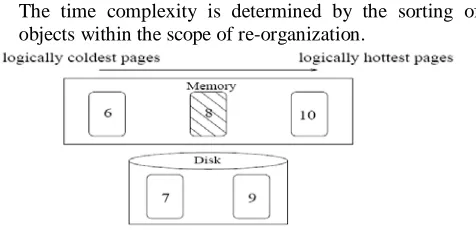
c. Scope of Re-organization: The scope of each re-organization is defined as three pages which are adjacent in heat-order, where the middle page is the target page for that iteration and the target page is chosen to be the page which is currently worst clustered. When opportunism is used, the two in-memory pages closest to the target are selected (as the adjacent pages may be on disk). See following figure-1 for an example.
This definition of scope of re-organization gives the clustering algorithm a high degree of incrementality. In addition, this gives the clustering algorithm an opportunity to improve the quality of clustering by placing the colder objects in the logically colder page and hotter objects in the logically hotter page.
d. Cluster Placement Policy: Since PRP does not produce clusters of objects, it does not have a cluster placement policy. The time complexity of this algorithm per re-organization iteration is O(ns log ns), where ns is the number of objects within the scope of reorganization.
[image:5.612.336.574.54.169.2]The time complexity is determined by the sorting of objects within the scope of re-organization.
Figure 1: In this example the currently worst clustered page is 8, so the scope of reorganization for opportunistic dynamic PRP is pages 6, 8 and 10 (where page numbers reflect heat-order). If opportunism is not used, the scope would
be pages 7, 8 and 9.
D. Static Greedy Graph Partitioning:
Partition-based clustering algorithms consider the object placement problem as a graph partitioning problem in which the min-cut criteria is to be satisfied for page boundaries. The vertices and edges of the graph are labeled with weights. Vertex weights represent object size. Edge weights represent either the frequency of strucutural reference traversal or the transition probabilities (ˆP (x, y)) of the SMC metric.
There are two types of partition-based static clustering algorithms: iterative improvement and constructive partitioning. Iterative improvement algorithms such as the Kernighan-Lin Heuristic (KL) [Kernighan and Lin 1970], iteratively improve partitions by swapping objects between partitions in an attempt to satisfy the min-cut criteria. Since KL swaps objects between partitions it requires objects to be relatively uniform in size which makes it inappropriate for many real world OODBs. Constructive algorithms such as greedy graph partitioning (GGP)[Gerlhof et al. 1993] attempt to satisfy the min-cut criteria by first assigning only one object to a partition and then combining partitions in a greedy manner. GGP does not require objects to be relatively uniform in size and also places no restrictions on the configuration of the clustering graph (eg. graph must be acyclic). The study carried out by Tsangaris and Naughton [Tsangaris 1992] indicates that graph partitioning algorithms perform best for both the working set size metric and long term expansion factor metric. However, they are generally more expensive in terms of CPU usage and statistic collection (tension statistics) than sequence-based algorithms. The time complexity of the KL graph partitioning algorithm is O( n2..4
E. Dynamic Graph Partitioning:
) and O( e log e) for GGP, where n is the number of vertices and e is the number of edges.
This section outlines how we use OPCF to transform static graph partitioning algorithms into dynamic algorithms.
a. Incremental Re-organization Algorithm: At each re-organization iteration, the graph partitioning algorithm is applied to the pages in the scope of re-organization as if these pages represent the entire database.
into our clustering badness metric we have included external tension in the metric. We define external tension as the sum of edge weights of the clustering graph which cross page boundaries. A page with higher external tension is worse clustered.
In addition, heat is included in the metric to give priority for re-organising hotter pages. Below is a definition of clustering badness for page p:
The calculation of external tension differs between the opportunistic version of the dynamic graph partitioning algorithm and the non-opportunistic version. In the opportunistic version, the external tension is calculated from only the weights of edges that cross the boundary of the page under consideration to other in-memory pages. By contrast, the non-opportunistic algorithm also counts edge weights that crosses page boundaries onto disk pages.
c. Scope of Re-organization: The scope of re-organization is the worst clustered page and its related pages. A page is only considered related if it occupies an external tension threshold (ETT) fraction of the worst clustered page's external tension. This reduces the scope of re-organization to the pages that will benefit the most from the re-organization. ETT acts as a means of trading off clustering quality with clustering overhead. If the dynamic clustering algorithm is to be run opportunistically then only in-memory related pages are in the scope of re-organization. See figure 2 for an example.
d. Cluster Placement Policy: For this application of OPCF, we have chosen to place clusters into pages in order of heat. The reason for this choice is that cold clusters will be placed away from hot clusters and thus pages containing hot clusters which are more likely to be in memory will have less wasted space occupied by cold clusters.
Figure 2: In this example the worst clustered page is 5 and the scope of re-organization for opportunistic dynamic graph partitioning are pages 2, 4, 5
and 6. The scope of re-organization for non-opportunistic dynamic graph partitioning are pages 2, 4, 5, 6 and 7.
GGP first places all objects in a separate partition and then iterates through a list of edges in descending edge weight. If the two objects on the ends of the currently selected edge are in different partitions and the total size of the two partitions is smaller than a page, then the partitions are joined. GGP uses sequence tension to model access dependencies between objects. The time complexity of our dynamic GGP algorithm is O(es log es + ps log ps), where es is the number of edges in the scope of re-organization and ps is the average number of initial partitions generated after the first three steps. The time
complexity is determined by the sorting of clustering graph edge weights and the sorting of the initial partitions generated according to heat. In most cases es is much larger than ps and therefore in most cases the time complexity is O(es log es).
VI. EXISTING DYNAMIC CLUSTERING ALGORITHMS
In this section we describe in detail two existing dynamic clustering algorithms that are used in our performance study.
A. Dynamic Statistical and tunable Clustering:
DSTC is an existing dynamic clustering algorithm [Bullat and Schneider 1996] designed to achieve dynamicity without adding high overhead or an excessive volume of statistics. The algorithm is comprised of five phases:
a. Observation Phase: In order to minimize disruptiveness of statistics collection, DSTC only collects statistics at predefined observation periods and the information is stored in a transient observation matrix.
b. Selection Phase: In order to reduce the volume of statistics stored, at the selection phase the transient observation matrix is scanned and only significant statistics are saved.
c. Consolidation Phase: The results of the selection phase are combined with statistics gathered in previous observation phases and saved in a persistent consolidated matrix.
d. Dynamic Cluster Re-organization: Using the information in the updated consolidated matrix, new clusters are discovered or existing ones are updated. In order to achieve incremental result the re-organization work is broken up into small fragments called clustering units.
e. Physical Clustering Organization: The clustering units are finally applied to the database in an incremental way (that is, one clustering unit at a time). This phase is triggered when the system is idle.
DSTC uses sequence tension information to model access dependencies between objects. DSTC is not an opportunistic clustering algorithm since its scope of re-organization can be objects that are currently residing on disk. DSTC exhibits a small degree of Prioritization since it breaks the database into objects that can be improved from clustering (worse clustered) and ones that cannot (better clustered). Even if an object can only potentially get a very small clustering improvement, it is re-clustered. This approach generates a lot of clustering overhead which often cannot be justified by the relatively small clustering quality improvements.
B. Detection & Re-Clustering of Objects:
all objects in pages that are selected for re-clustering. The DRO clustering algorithm is comprised of 4 steps:
a. Determination of Objects to Cluster: In this step various thresholds are used to limit the pages involved in re-clustering to only those pages that are most in need of clustering. For a page to require re-clustering the following conditions need to be met: the fraction of unused objects must be lower than the MinUR threshold; and the amount of IO that the page generated must be greater than theMinLT threshold. To proceed to step 2 the ratio between the number of pages needing re-clustering and number of pages actually used must be greater than a threshold rate PCRate b. Clustering Setup: This step takes the objects in the
pages in need of re-clustering and then generates a new placement order of objects on disk. The placement algorithm runs as follows: objects of similar heat and with structural links are placed closer together in the new placement order. Then the new placement order is compared against the old and the algorithm only proceeds to the next step if there is enough difference MAXRR between the two placement orders.
c. Physical Object Clustering: This operation physically clusters objects identified in the previous steps, but must also re-organise the database in order to free space made available by the deletion or movement of objects.
d. Statistics Update: This step resets clustering statistics. Depending on the update indicator SUInd parameter, all pages or just the pages involved in the re-clustering are reset.
DRO is not opportunistic since disk resident pages can be involved in re-clustering. DRO has only limited incrementality since at each iteration it re-organises all pages that are clustered worse than a threshold amount. If the number of pages in need of clustering is high, DRO will become less incremental. In contrast, in the discussed approach ranks all pages in terms of quality of clustering and then re-clusters only a user-defined number of the worst clustered pages. Our approach allows the user to limit the amount of re-clustering that he or she is willing to accept in each re-organization iteration, whereas DRO has no such limit. DRO Prioritizes clustering by breaking up the database into pages that need re-clustering (according to thresholds) and pages that do not. This method of Prioritization has the benefit that when database clustering quality is very low, fewer pages are re-clustered and the reverse when clustering quality is high. This more flexible behavior of DRO when compared to OPCF is at the cost of good incrementality (the ability to ensure only a bounded portion of database is involved in each re-organization iteration).
VII. EXISTING DYNAMIC CLUSTERING ALOGORITHMS
The main conclusion of this paper is that simple synergistic frameworks can produce algorithms that provide significant performance gains when compared to existing non-synergistic algorithms. Furthermore the performance gains are
across a wide variety of different situations with our guiding principles of synergy; generality; and simplicity. The preliminary results of this paper show that there is much potential in the synergistic approach to buffer management and suggests that perhaps the next big breakthrough in reducing the disk IO bottleneck in OODBMSs lies in synergistic buffer management techniques.
VIII. REFERENCES
[1]. AILAMAKI, A., DEWITT, D. J., HILL, M. D., AND
WOOD, D. A. 1999. DBMSs on a modern processor: Where does time go? In Proceedings of the International Conference on Very Large Databases (VLDB 1999), Edinburgh, Scotland (September 1999), pp. 266. 277. (p. 1)
[2]. ARNOLD, A. O. 1978. Probability, Statistics, and Queuing
Theory, with Computer Scient Application, Academic Press (pp. 21, 22)
[3]. BANERJEE, J., KIM, W., KIM, S. J., AND GARZA, J. F.
1988. Clustering a DAG for CAD databases In IEEE Transactions on Software Engineering, Volume 14 (November 1988), pp. 1684.1699. (pp. 25, 26, 28, 33, 53, 54)
[4]. B. G. LINDSAY, AND D. MAIER Eds., Proceedings of the
International Conference on Management of Data (ACM SIGMOD 1989), Portland, Oregon (1989), pp. 348.357. ACM Press (pp. 70, 71, 72)
[5]. BELADY, L. A. 1966. A study of replacement algorithms for a virtual-storage computer, IBM Systems Journal 5, 2 (pp. 54, 55, 63)
[6]. BENZAKEN, V. AND DELOBEL, C. 1990. Enhancing
performance in a persistent object store: Clustering strategies in o2, Technical Report 50-90 (August), Altair (p. 54)
[7]. BERNSTEIN, P. A., PAL, S., AND SHUTT, D. 1999.
Context-based perfecting for implementing objects on relations In Proceedings of the International Conference on Very Large Databases (VLDB 1999) (Sept 1999), pp. 327.338, Morgan Kaufmann (pp. 70, 71, 72)
[8]. BULLAT, F. AND SCHNEIDER, M. 1996. Dynamic
clustering in object databases exploiting effective use of relationships between objects, Proceedings of the European Conference on Object-Oriented Programming (ECOOP 1996), Linz, Austria (1996), pp. 344.365. Springer. (pp. 3, 27, 28, 31, 32, 37, 44)
[9]. CAO, P., FELTEN, E. W., KARLIN, A. R., AND LI, K.
1995. A study of integrated perfecting and caching strategies, Proceedings of the International Conference on the Measurement and Modeling of Computer Systems, (ACM SIGMETRICS 1995) pp. 188.197, (pp. 3, 72)
[10]. CAREY, M., DEWITT, D., AND NAUGHTON, J. 1993.
The OO7 benchmark Proceedings of the International Conference on the Management of Data (ACM SIGMOD 1993 (p. 12)
[11]. CAREY, M. J., DEWITT, D. J., FRANK, D., GRAEFE, G.,
extensible dbms, In Proceedings of the International Conference on Very Large Databases (VLDB 1986) (1986), (pp. 10, 11, 12)
[12]. CAREY, M. J., DEWITT, D. J., FRANKLIN, M. J., HALL,
N. E., MCAULIFFE, M., NAUGHTON, J. F., SCHUH, D. T., SOLOMON, M. H., TAN, C. K., TSATALOS, O., WHITE, S., AND ZWILLING, M. J. 1994. Shoring up persistent applications, In Proceedings of the International Conference on the Management of Data, (ACM SIGMOD 1994) (Minneapolis, Minn, May 1994). (pp. 10, 12)
[13]. CAREY, M. J., FRANKLIN, M. J., LIVNY, M. AND
SHEKITA, E. J. 1991, Data caching tradeoffs in client-server dbms architectures In J. CLIFFORD AND R. KING Eds. Proceedings of the International conference on the Management of Data (ACM SIGMOD 1991) (1991),pp. 357.366. (p. 43)
[14]. CHANG, E. E. AND KATZ,R.H. 1989, Exploiting
inheritance and structure semantics for effective clustering and buffering in an object-oriented DBMS. In J. CLIFFORD,
[15]. CHEN, S., GIBBONS, P.B., AND MOWRY, T. C. 2001,
Improving index performance through prefetching, In Proceedings of the International Conference on the Management of Data (ACM SIGMOD 2001) (2001), pp. 235.246. (p. 1)
[16]. CUREWITZ, K. M., KRISHNAN, P., AND VITTER, J. S.
1993, Practical prefetching via data compression, In Proceedings of the International Conference on the Management of Data (ACM SIGMOD 1993) (Washington, DC, May 1993), pp. 43.53, (pp. 70, 72, 82)
[17]. DARMONT, J. 2000. Desp-c++: a discrete-event simulation package for c++. Software Practice and Experience 30, 1, 37.60, (p. 40)
[18]. DARMONT, J., FROMANTIN, C., REGNIER, S.,
GRUENWALD, L., AND SCHNEIDER, M. 2000, Dynamic clustering in object-oriented databases: An advocacy for simplicity. In Proceedings of the International Symposium on Object and Databases, Volume 1944 of LNCS (June 2000), pp. 71.85. (pp. 27, 28, 38, 44)
[19]. DARMONT, J., PETIT, B., AND SCHNEIDER, M. 1998,
OCB: A generic benchmark to evaluate the performances of object-oriented database systems. In Proceedings of the International Conference on Extending Database Technology (EDBT 1998)(Valencia Spain, March 1998), pp. 326.340. LNCS Vol. 1377 (Springer) (pp. 41, 42)
[20]. DARMONT,J. AND SCHNEIDER, M. 1999. VOODB: A
generic discrete-event random simulation model to evaluate the performances of OODBs. In Proceedings of the International Conference on Very Large Databases (VLDB 1999), Edinburgh, Scotland (September 1999), pp. 254.265. (pp. 39, 80)
[21]. DENNING,P. J. 1968. The working set model of program
behavior. Communications of ACM 11, 5 (May), 323.333. (p. 56)
[22]. DEUX, O.1991. The O2 System Communications of ACM
34, 10, 34.48 (pp. 10, 11, 12, 40)
[23]. DREW, P. KING, R., AND HUDSON, S. E. 1990, The
performance and utility of the cactis implementation algorithms. In D. MCLEOD, R. SACKS-DAVIS,AND H.-J
[24]. GAY, J.-Y. AND GRUENWALD, L. 1997. A clustering
technique for object oriented databases. In Proceedings of the International Conference on Database and Expert Systems (DEXA 1997), Volume 1308 of Lecture Notes in Computer Science (September 1997), pp. 81.90. Springer, (pp. 27, 38)
[2]. 25. GERLHOF, A., KEMPER, A., AND MOERKOTTE,
1996, On the cost of monitoring and reorganization of object bases for clustering In ACM SIGMOD Record, Volume 25 (1996), pp. 28.33. (p. 25)
[1]. GERLHOF, C., KEMPER, A., KILGER, C., AND
MOERKOTTE, G. 1993. Partition-based clustering in object bases: From theory to practice, Proceedings of the
International Conference on Foundations of Data
Organization and Algorithms (FODO 1993), 301.316. (pp. 25, 26, 28, 35, 36, 53, 54, 55, 60, 61, 81, 85)
[2]. HE, Z. AND DARMONT, J. 2003. Dynamic object
evaluation framework (DOEF), Proceedings of the 14th International Conference on Database and Expert Systems Applications (DEXA 2003) (2003), pp. 662.671, (pp. 6, 41, 43)
[3]. HUDSON, E. AND KING, R. 1989. Cactis: A self-adaptive,
concurrent implementation of an object-oriented database management system. In ACM Transactions on Database Systems (September 1989), pp. 291.321. (p. 28)
[4]. KERNIGHAN, B. AND LIN, S. 1970. An efficient heuristic
procedure for partitioning graphs, Bell System Technical Journal, 291.307. (p. 35)
[5]. MCIVER, W. J. J. AND KING, R. 1994. Self-adaptive,
on-line re-clustering of complex object data, R. T. SNODGRASS AND M. WINSLETT Eds., Proceedings of the International Conference on the Management of Data (ACM SIGMOD 1994), Minneapolis, Minnesota (1994), pp. 407.418. ACM Press, (pp. 27, 28)
[6]. TSANGARIS, M. M. AND NAUGHTON, J. F. 1992. On the
performance of object clustering techniques, In Proceedings of the International Conference on the Management of Data (ACM SIGMOD 1992) (1992), pp. 144.153. (pp. 32, 33, 42)
[7]. WIETRZYK, V. S. AND ORGUN, M. A. 1999. Dynamic