Volume 8, No. 4, May 2017 (Special Issue)
International Journal of Advanced Research in Computer Science REVIEW ARTICLE
Available Online at www.ijarcs.info
Review on Routing Protocols in Mobile Ad Hoc Networks
Madhu Bala
M.Phil Scholar, Department of Computer Science applications, University Institute of Computer Applications
and Information Science, SBBS University, Jalandhar Punjab, INDIA
Harpreet Kaur
Assistant Professor, Department of Computer Science applications, University Institute of Computer Applications and
Information Science, SBBS University, Jalandhar Punjab, INDIA
Abstract: Statistics show that remote innovation is picking up popularity day by day. Today, person sitting at either end of the nation can speak with each other with the aid of wireless technology. Mobile ad hoc Network (MANETs) is a type of wireless ad hoc network which is a collection of mobile devices that creates random topology for communication. The fineness of MANETs is that it not required any central controller or base station. MANETs is only a network in which devices worked as a host as well as router. Routing in ad hoc networks has become a popular research topic. There are several routing protocols have been developed for ad hoc networks. In MANET, it is very stiff task to predict the performance of routing protocol under varying network conditions and scenarios. This review paper is discussing the three approaches of routing protocols such as Reactive (On demand), Proactive (table driven) and Hybrid routing protocols within their advantage and disadvantage.
Keywords: MANETS, Proactive, Reactive, Hybrid.
I.
INTRODUCTIONWireless communication techniques have become popular among network researchers in recent years. Wireless networks allow the components within the network to roam without the constraints of wired connections. People can deploy a wireless network easily and quickly. Hosts and routers in a wireless network can transport all around the network [2]. This kind of networking can be applied to scenarios like conference room, disaster management, battle field communication and places where deployment of infrastructure is either difficult or costly. Wireless networks are split into two kinds: Infrastructure networks and Ad Hoc networks (infrastructure less)
Infrastructure
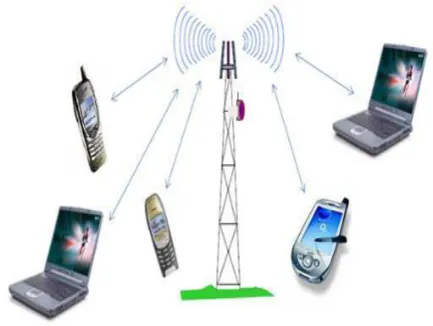
Networks:-This kind of infrastructure wireless network is dependent on fixed equipment such as base stations or access points (AP) to connect all nodes in network. An Access Point (AP) acts as a central coordinator between all nodes. Any node can join the network through AP. Also, AP organizes the connection between the Basic Set Services (BSSs) in order to make the route ready when it is needed. [1] When a source node wants to make a communication with a
destination node, it does not need to know routes between each other for communication only the source node will establish routes with the base station first as illustrated in Figure 1.
Figure 1: Infrastructure Networks
Ad hoc Network/Infrastructure less
[image:1.595.330.547.304.467.2]Networks:-This kind of network is understood as Mobile Ad Hoc Network (MANET) which does not contain any fixed infrastructure. Ad Hoc networks do not have a fixed topology or central coordination point All nodes in a mobile ad hoc network can be dynamically connected to each other and are free to move. All nodes in the network are hosts and routers as well. Therefore, the source node and the destination node can communicate with each other by sending and receiving packets which is more sophisticated than infrastructure network [1].
II.
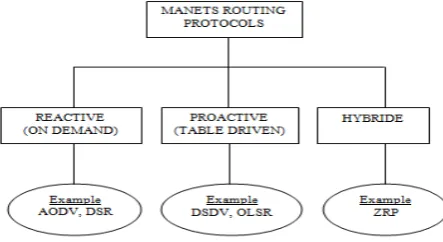
ROUTING PROTOCOLS IN MENETs [image:2.595.48.270.212.333.2]Routing is the process of selecting paths in a network for moving a packet of data from source to destination. A routing protocol composes of a routing algorithm with a set of rules that monitors the operations of the network. The main issue in MANETs is that the routing protocols must be able to respond rapidly to topological changes of the network. Routing protocols are broadly classified into three types, reactive (on demand driven), proactive (table driven) and hybrid protocols [3].
Figure 3: Three approaches of Manets Routing
A.
REACTIVE ROUTING PROTOCOLS: - Therouting protocols that are fall under the category of reactive routing protocol also known as the on-demand routing protocols. The reactive / on-demand routing protocols set up a link between pair of nodes only when it is necessary and only for those nodes that are currently being used to send data packets from source to destination thus reduce the overhead problem as arise with proactive routing protocols [4]. However, Reactive types of protocols reduces the issues of proactive routing protocols but use flooding process for route discovery, which causes more routing overheads, bandwidth consumption, and battery powers.
AODV (Ad hoc on demand distance vector): - Ad hoc On-demand Distance Vector (AODV) is a reactive routing protocol. Reactive routing protocols are also called on-demand routing protocols. AODV is loop-free, self-starting, and scales to large numbers of mobile nodes. AODV allows for the construction of routes to specific destinations and does not require that nodes keep these routes when they are not in active communication. AODV avoids the “counting to infinity” problem by using destination sequence numbers. This property makes AODV loop free[5]. AODV are: • Route Request Message (RREQ)
• Route Reply Message (RREP) • Route Error Message (RERR)
AODV performs two major phases. In AODV, Route discovery phase: RREQ packet is send to all nearby nodes within transmission range in network using the flooding
technique. When the RREQ packet is received by a node; if not the desired destination, then node will rebroadcast the request to all nearby nodes which are within transmission range. This node will take note of the address from which the request was generated resulting in creation of reverse path. This process is known as reverse path setup. Once the RREQ packet reach intended destination, a RREP packet is then send to the node from which the RREQ originated. When an intermediate node receives RREP packet it also takes note of the address of the node from which the RREP packet originated, thereby creating forward path to be used when transmitting data. This is known as forward path setup. A source node can receive multiple RREP packets from different routes; it updates its table by selecting the one with higher sequence number. The route with high sequence number indicates the freshness of that route [4].
AODV route maintenance phase: A route discovered between a source node and destination node is maintained as long as needed by the source node. The destination node or some intermediate node moves, the node upstream of the break initiates Route Error (RERR) message to the affected active upstream neighbors/nodes. Consequently, these nodes propagate the RERR to their predecessor nodes. This process continues until the source node is reached. When RERR is received by the source node, it can either stop sending the data or reinitiate the route discovery mechanism by sending a new RREQ message if the route is still required [6]
Advantage of
AODV:-1) On-demand route establishment
2) Destination sequence numbers to find the latest route to the destination.
3) Less connection setup delay
Disadvantage of AODV:-
1) In order to detect the unidirectional link. Bidirectional link is required.
2) Delay is caused by discovery process.
B.
PROACTIVE ROUTING PROTOCOLS: - Theproactive routing protocols are mostly based on shortest path algorithms and also known as table driven routing protocol because they store the information of all connected nodes in form of tables. These types of routing protocols maintain routes to all destinations, regardless of whether or not these routes are needed. Whenever any change present in network the node shared information with their neighbors. In order to maintain correct route information, a node must periodically send control messages [4].
information must be periodically updated [7]. When network topology changes are detected, each mobile node advertises routing information using broadcasting or multicasting a routing table update packet[8].Each node manages its own sequence number by assigning it two greater than the old one (call an even sequence number) every time. When a route update with a higher sequence number is received, the old route is replaced [9].In a wireless medium broadcasts is limited by the physical characteristic of medium. If a node invalidates its entry to a destination due to loss of next hop node, it increments its sequence number and uses new sequence number in its next advertisement of the route. Data broadcast by each mobile computer will contain new sequence number and
I. Destination IP address
II. Number of hops required to reach the destination. III. Sequence number of the information received
regarding that destination.[10]
Advantage of DSDV:-
1) The availability of path to all destinations in network always shows that less delay is required in the path set up process.
2) Incremental updates with sequence no tag makes existing wired network protocols adaptable to ad hoc networks.
Disadvantage of DSDV:-
1) Generates a lot of control traffic in the network ,rendering an inefficient utilization of network resources
2) DSDV requires a regular update of its routing
tables, which uses up battery power and a small amount of bandwidth even when the network is idle.
C.
HYBRID ROUTING PROTOCOLS: - Thistypes of protocols combine the features of proactive and routing protocols. The routing is initially established with some proactively prospected routes and then serves the demand from additionally activated nodes reactive flooding. Zone routing protocol (ZRP) is an example of hybrid routing protocol.
ZRP Hybrid Routing Protocols: - Zone Routing Protocol (ZRP) is a hybrid protocol which combines the advantages of both proactive and reactive schemes [11].ZRP routing protocols consists of different modules such as: Intrazone routing protocol, Interzone routing protocols.
1) Intrazone routing protocol: - This protocol is adopted from the proactive routing protocols which is used to maintain only the local topology. This protocol works in the within the specified zone only.
2) Interzone routing protocol: This protocol is adopted from the reactive protocol which is used
when the route between the different zones is needed for the communication in between the source and destination [12].
Advantage of ZRP:-
1) This protocol provides the scalability as compared to reactive routing protocols.
2) Congestion is reduced at most due to fact that the hierarchies are not used.
Disadvantage of ZRP:-
1) Realistically has higher overhead than proactive and reactive protocols.
2) If zone greatly overlap redundant route request message are flooded through the network.
3) Optimum zone radius must be determined for each situation.
III.
RELATED WORKThis section gives the overview of related work by various authors in routing protocols:
Farhat Anwar et al. (2007) [13] presented the comparison of three protocols AODV, DSDV, OLSR types of proactive and reactive protocols. The performance of these protocols are compared in term of their average end to end delay ,packet delivery fraction ,normalized routing load ,and routing overhead (packet) using network simulator NS-2. At low network load AODV perform better in case of PDF but it perform badly in term of average E2E delay, routing load and routing packets. At high network load and mobility OLSR performs well with respect to PDF. DSDV performs well in term of E2E delay, NRL and routing overhead, due to less route discovery time in intermediate node. This is clear that no protocol is absolute winner.
Mukesh Kumar et al. (2010) [14] defined the three popular routing algorithms Ad-Hoc on Demand Distance Vector (AODV), Dynamic Source Routing (DSR) both being reactive routing protocols and Cluster Based Routing Protocol (CBRP), a proactive routing protocol. The performance analysis is done with the help of packet delivery ratio (PDR), average end-to-end delay and routing overhead through simulation using GLOMOSIM simulator. CBRP gives slightly better throughput for a larger network size and better scalability. Cluster structure brings scalability and routing efficiency for a MANET as the network traffic load or network size increases. A more stable cluster structure brings efficiency in route discovery and maintenance whereas a less overlapping clusters structure.
Fraction, end to end delay and packet loss. In simulation once they vary pause time at this time speed constant. PDF for AODV is higher than DSDV. Delay of AODV is higher than DSDV, Packet loss of AODV is less than DSDV .Again in simulation, and they vary speed while pausetime is constant. PDF for AODV is higher than DSDV. Packet loss of AODV is less as compare to DSDV. Delay of AODV is higher than DSDV. With variation in speed again performance of AODV is better than DSDV. For large wireless network performance of AODV is much better than DSDV
Tripti Pandey, et al.(July 2014) [16] analyzing the performance of AODV using Travelling Salesman Problem by increasing number of nodes as it is known that routing protocols makes an important task for improving QoS in Mobile Ad hoc Network. The QoS depends upon several parameters like throughput, network load etc. Only throughput parameter has been considered for the simulation. The simulation work has been carried out in Network Simulator (ns-2). Simulation is carried out by increasing the number of nodes in order to analyze the performance of proposed routing protocol but time of simulation kept constant i.e. 400 seconds. The simulation for 50 nodes performs well, here throughput rises at the initial stage and as the time increases throughput also increases and reaches to maximum and it is also observed that packet loss is also minimum in this case while maximum in the case of simulation performed for 30 and 40 nodes. For future work other parameters can be considered such as end to end delay, packet delivery ratio and varying simulation time.
Ayush Pandey et al. (2014) [17] illustrates the performance of three routing protocols AODV, DSR and DSDV using Network Simulator-2 (NS-2) and measure the performance in Packet Delivery Fraction, Throughput and Round Trip Time with constant mobility. The performance of routing protocols AODV and DSR perform better under high mobility simulations than DSDV. In DSR uses source routing and route caches, and does not depend on any periodic or timer based activities. DSR shows higher throughput than DSDV and AODV.
Ritu Parasher et al. (April 2015) [4] Researcher compared the traditional AODV with A_AODV routing protocols. These protocols shrink the active path whenever optimal pathway is available and switches the traffic on it. But traditional AODV does not consider this situation. Simulation studies are conducted using NS2 to prove that proposed approach enhance network performance when network size, load or the mobility increases. The simulation results clearly indicate the efficiency and effectiveness of proposed approach over the traditional AODV routing protocol.
Arma Amir Mehdi (Feb 2016) [18] defined Topology-based routing protocols; both proactive (DSDV) and reactive protocols (AODV, DSR) have been considered for the study. The objective of this work is to assess the capability of these protocols in different mobile traffic scenarios. Performance metrics such as packet delivery ratio, throughput, are simulated through Qualnet 5-0 simulator. AODV has poorest performance amongst the three protocols examined. ZRPwhich is hybrid protocol has moderate performance so it is concluded that OLSR (On Demand Routing Protocol) show high performance than all other type of protocols.
IV.
PROBLEM FORMULATIONAfter the review of several papers this is clear that no protocol is absolute winner. Each protocol in MANET have unique feature and advantage, and depending on the network condition. All existing protocols have major drawback, DSDV protocol is regular updating of its routing tables, which slow down the battery power and some amount of bandwidth, when the network is idle. If the topology of the network changes then a new sequence number is generated which is necessary before the network re-converges. Thus, DSDV is not suitable for highly dynamic networks [19]. AODV belongs to the class of Distance Vector Routing Protocols (DV) type of the reactive protocols which work only on demand. AODV routing protocols use flooding process to setup a link between the pair of nodes thus consumes high bandwidth and generates high end to end delays [4].Also, multiple Route Reply packets in response to a single Route Request packet can lead to heavy control overhead[3].
V.
PROPOSED WORKThe objective is to improve the performance of AODV routing protocol using the new technique for transmission of data packets from source to destination which reduced AODV routing overhead and improve the AODV scalability. For this purpose following are the proposals to implement for improvement.
1) To trim down the average end to end delay of AODV routing protocols.
2) Implementing improved (I_ AODV) routing algorithm with improving drawbacks of traditional (AODV) routing algorithm using ns-2 network simulator tool.
VI.
CONCLUSION AND FUTURE SCOPEadvantage and disadvantage, and their examples: Reactive (AODV), Proactive (DSDV), Hybrid (ZRP) routing protocols. After the review of several papers we found some drawbacks in existing work and it is critical issue to select an efficient and reliable protocol. Each protocol in MANET have unique feature and advantage, and depending on the network conditions. In future if we implement proposed technique the result may be better.
REFERENCES
[1] Abdalftah Kaid Said Ali1, Dr. U. V. Kulkarni, “Characteristics, Applications and Challenges in Mobile Ad-Hoc Networks (MANET): Overview” Volume 3, Issue 12, December 2015, ISSN 2321-5984.
[2] San Naing, Zaw Min Naing, Hla Myo Tun, “Performance Of Routing Protocols For Mobile Ad Hoc Networks” INTERNATIONAL JOURNAL OF SCIENTIFIC & TECHNOLOGY RESEARCH VOLUME 3, ISSUE 5, MAY 2014, ISSN 2277-8616.
[3] E. Edwin Lawrence, Dr.R.Latha, “A Comparative Study of Routing Protocols for Mobile Ad-Hoc Networks” International Journal of Computer Science and Mobile Computing, Vol.3 Issue.11, November- 2014.
[4] Ritu Parasher, Yogesh Rathi, “A_AODV: A Modern Routing Algorithm for Mobile Ad-Hoc Network” International Research Journal of Engineering and Technology (IRJET) e-ISSN: 2395 -0056 Volume: 02 Issue: 01 | Apr -2015
[5] Perkins, “Ad hoc On-Demand Distance Vector (AODV) Routing”, RFC 3561, July 2003
[6] Vinay. P.Viradia, “Improved AODV Routing Protocol for MANET” Int. Journal of Engineering Research and Applications www.ijera.com ISSN: 2248-9622, Vol. 4, Issue 1(Version 3), January 2014, pp.368-374
[7] Prof. B.N. Jagdale, Prof. Pragati Patil , Prof. P. Lahane , Prof. D. Javale, “Analysis and Comparison of Distance Vector, DSDV and AODV Protocol of MANET” International Journal of Distributed and Parallel Systems (IJDPS) Vol.3, No.2, March 2012)”
[8] C. Thanka Saranya1, M.S Sylvia Blossom “Comparison of AODV, OLSR and DSDV Routing Protocol for MANETs” Journal of Recent Research in Engineering and Technology , 2016, pp1-6 Article ID J11601 ISSN (Online): 2349 – 2252, ISSN (Print):2349 –2260.
[9] Abdul Hadi Abd Rahman, Zuriati Ahmad Zukarnain, “Performance Comparison of AODV, DSDV and I-DSDV Routing Protocols in Mobile Ad Hoc Networks” European Journal of Scientific Research ISSN 1450-216X Vol.31 No.4 (2009), pp.566-576).
[10] Akshai Aggarwal, Savita Gandhi2, Nirbhay Chaubey, “Performance Analysis of AODV, DSDV and DSR in Manets” International Journal of Distributed and Parallel Systems (IJDPS), November 2011.
[11] Md. Arafatur Rahman and Farhat Anwar, “A Simulation Based Performance Comparison of Routing Protocol on Mobile Ad-hoc Network (Proactive, Reactive and Hybrid)” International Conference on Computer and Communication Engineering (ICCCE 2010), 11-13 May 2010, Kuala Lumpur, Malaysia.
[12] Pranshu Sakalley, J.Ratnaraja Kumar, “Review and Analysis of Various Mobile Ad Hoc Network Routing Protocols “International Journal of Recent technology and Engineering (IJRTE) ISSN: 2277-3878, Volume-2, Issue-5, November 2013.
[13] Saiful Azadm, Arafatur Rahman ,Farhat Anwar, “A performance comparison of proactive and reactive protocols of MANET” Journal of Engineering and Applied science 2(5):891,896, (2007)
[14] Mukesh Kumar, Rahul Rishi, D.K.madan , “Comparative Analysis of CBRP, DSR, AODV Routing Protocol in MANET” (IJCSE) International Journal on Computer Science and Engineering ;Vol. 02, No. 09. (2010)
[15] Ajay Prakash Rai , Rinkoo Bhatia , “Performance Comparison of AODV & DSDV Ad-Hoc Network Routing Protocols On The Basis Of Variable Speed & Pause Time” International Journal of Engineering and Innovative Technology (IJEIT) Volume 2, Issue 10, (April 2013); [16] Tripti Pandey, Sangeeta Solanki, Ramnesh Dubey,
“Improved Performance of AODV Routing Protocol with Increasing Number of Nodes using Traveling Salesman Problem” International Journal of Computer Applications (0975 – 8887) Volume 98– No.16 (July 2014)
[17] Ayush Pandey, Anuj Srivastava, “Performance Evaluation of MANET through NS2 Simulation” International Journal of Electronic and Electrical Engineering. ISSN 0974-2174, Volume 7, (2014)
[18] Arma Amir Mehdi, “Performance Evaluation with Throughput, Packet Delivery on Routing Protocols in MANETs” International Journal of Advanced Research in Computer Science and Software Engineering, Volume 6, Issue 2; ISSN: 2277 128X. (Feb 2016)