Design And Analysis Of Ultra High Capacity DWDM System With And Without
Square Root Module For Different Modulation Formats
Manpreet Kaur
Department of Electronics and Communication Punjabi University
Patiala, India
Dr. Manjeet Singh Patterh
Department of Electronics and Communication Punjabi University
Patiala, India
Abstract: In this paper, an ultra high capacity Inter satellite Optical Wireless Communication system (IsOWC) is simulated with and without square root module for different advanced modulation formats. The system is proposed by using 64 channels dense wavelength division multiplexing. For various input powers, the inter satellite link has been designed for external modulation of carrier suppressed return-to-zero(CSRZ), duo binary return-to-zero(DRZ), and modified duo binary return-to-zero(MDRZ) at different bit rate. The system is simulated without square root module at 10, 20 and 40Gbps and only at 40Gbps with square root module. The performance parameters Q-factor, eye diagram, received power are obtained for different bit rates to decide which modulation format is best. Results at 10 and 20Gbps shows that the CSRZ modulation performs better than the other two modulations but at 40Gbps MDRZ modulation performs the best. The results of previous system are only compared at 40Gbps with the new system which includes square root module and comparison shows that MDRZ still have the best performance but the performance of DRZ is very much enhanced as compared to without square root at 40Gbps.
Keywords: IsOWC, CSRZ, DRZ, MDRZ, BER, Q-Factor
I. INTRODUCTION
Wireless communication is used for sending the data from satellite to ground and between the satellites. Optical wireless communication is emerged as a promising technology because of high speed and secure communication. Inter satellite optical wireless communication has become an alternate to present microwave satellite systems due to its high bandwidth, small size, and light weight, low cost and low power.
As the space is considered to be vacuum the data can be sent with minimum attenuation and without much delay by using light as the power source. As the optical link is now used over the RF link have led to the biggest advantage is that the data can be sent at very high speed using tiny payloads to a distance of thousands of kilometers. [1] Combination of optical wireless communication system with dense wavelength division multiplexing results in high bandwidth and high speed as well as higher bit rate transmission over long distance The inter satellite link between two satellites at distance 1000km with 2.5Gbps data rate has been designed and simulated with square root module to get better results with respective to their previous design[2] .The square root module was introduced to enhance the system and 48% enhancement was shown at distance 5000km with 1.25Gbps[3]. For different minimum input power system was observed with square root module and 67% enhancement was shown[4].A 32 channel OWC system with two modulation formats RZ and NRZ was designed and simulated at 10Gbps[5]. In [6] the system was designed and simulated with 64 channels with 50 GHz spacing for three different modulation formats CSRZ, MDRZ, DRZ at different data rates and the proposed paper is further extension of the above paper with square root module. The paper is organized as follows. In Section 2, description of different modulation techniques and the model of atmosphere are presented. Proposed system is expressed in Section 3, Simulation description and results are expressed in Section 4 and finally we conclude the paper in Section 5
II. MODULATION TECHNIQUES
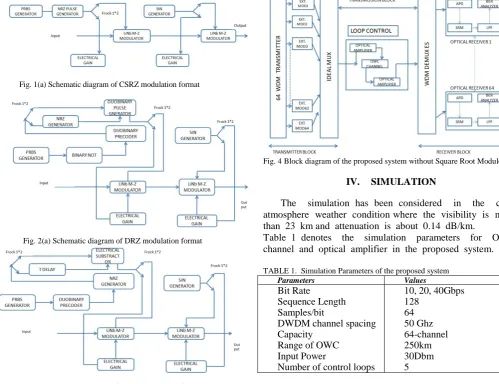
Fig.1(a) shows the schematic of the CSRZ modulation, which is defined by reversing the sign of the optical field at each bit transition[7, 8]. The CSRZ modulation which is pseudo-multilevel modulation format has better tolerance to residual chromatic dispersion (CD) and fiber nonlinearity. Here in this modulation, RZ optical signal after Mach-Zehnder modulator (MZM) goes through phase modulator. The 180 phase shift which is in between the adjacent bits in CSRZ modulation is the main difference between the RZ and CSRZ modulation.
Fig. 2(a) shows the schematic of DRZ modulation is a type of modulation that transmits R bits/s using less than R/2 Hz of bandwidth [7, 8]. This modulation format can increase tolerance to the effects of improved narrowband optical filtering and CD. In the format, first NRZ which is duo-binary signal has been created by a duo-binary pre-binary pulse generator. The generator drives the first LiNb MZM and then the second LiNb MZM which is driven by a sine generator with phase 90◦.
Fig. 1(a) Schematic diagram of CSRZ modulation format
Fig. 2(a) Schematic diagram of DRZ modulation format
Fig. 3(a) Schematic diagram of CSRZ modulation format
III. PROPOSED SYSTEM
[image:2.595.310.552.54.214.2]IN Fig.4 the block diagram of the proposed 64-channel DWDM system with OWC channel for distance of 1250 km with square root module has been shown. The system is simulated with different bit-rates with three modulation formats such as CSRZ, DRZ, and MDRZ with and without the Square root module. The proposed system consists of three main blocks transmitter, wireless transmission and receiver. The transmitter contains a 64-WDM transmitter, different modulation formats, and optical multiplexer. The transmission block has OWC channel and two optical amplifiers. One amplifier has pre OWC channel and the other consists of post OWC channel. Also, the optical receiver comprises a PIN photodiode to detect the signal and its wavelength and after that square root module is attached. The Bit error rate (BER) analyzer is used to measure the Q-factor and Minimum BER after the optical receiver.
Fig. 4 Block diagram of the proposed system without Square Root Module
IV. SIMULATION
The simulation has been considered in the clear atmosphere weather condition where the visibility is more than 23 km and attenuation is about 0.14 dB/km.
[image:2.595.43.543.61.445.2]Table 1 denotes the simulation parameters for OWC channel and optical amplifier in the proposed system.
TABLE 1. Simulation Parameters of the proposed system
Parameters Values
Bit Rate
Sequence Length Samples/bit
DWDM channel spacing Capacity
Range of OWC Input Power
Number of control loops
10, 20, 40Gbps 128
64 50 Ghz 64-channel 250km 30Dbm 5
V. RESULTS
[image:2.595.51.292.61.131.2] [image:2.595.46.290.150.440.2]had Q-factor higher than the DRZ and MDRZ for 10Gbps. And for 20Gbps all the three modulations Q-Factors were reduced and still CSRZ had better results than others. At 40Gbps the MDRZ had the best results although the BER and Q-factor were reduced but were reduced less as compared with DRZ and CSRZ.
Table2. Comparison of modulations at different bit rate
Bit Rate
Analyzed
Parameters CSRZ DRZ MDRZ
10Gbps Q-Factor 178.23 177.64 152.811
BER 0 0 0
20Gbps Q-Factor 93.1002 19.655 27.491
BER 0 2.6*10−86 1.097*10−166
40Gbps Q-Factor 5.859 6.539 8.17
BER 1.84*10−9 4.7*10−11 1.48*10−16
The input power varies from 0 to 30dB to study its effects on Q-Factor for different modulation schemes. The maximum Q factor versus the input power for CSRZ, DRZ and MDRZ modulation for 10, 20 and 40 Gbps bit rates, respectively is shown in Fig8(a)-8(c). As the value of the input power was increased, value of the Q-factor enhanced. And the Q-factor for CSRZ modulation was higher relative to the other two types of modulation. All the above results were performed without the square root module.
Now the proposed system was performed at 40Gbps with the help of square root module because at 10 and 20Gbps the results were almost same for three modulation formats. Fig 9(a)-9(c) shows the eye diagram at 40Gbps with square root module. The Q-factor observed was 7.834, 8.75, and 9.062 for CSRZ, DRZ, and MDRZ. Fig.10 shows the comparison of Q-Factor at 40Gbps. The results showed that the MDRZ had the best performance as its Q-factor was increased and BER was reduced less as compared to other modulations and BER was less than 10−15 and there was improvement in the DRZ performance as its Q-Factor was enhanced more than the CSRZ Q-factor . Table3 shows the comparison of three modulations at 40Gbps.
Table3: Comparison at 40Gbps for three modulations Bit Rate Analyzed
Parameters
CSRZ DRZ MDRZ
40 Gbps
Q-Factor 7.834 8.75 9.062
BER 2.289*10−15 6.3*10−19 6.38*10−20
Fig.5 (a) Eye diagram of CSRZ at 10Gbps
Fig.5 (b) Eye diagram of DRZ at 10Gbps
Fig.6 (a) Eye diagram of CSRZ at 20Gbps
Fig.6 (b) Eye diagram of DRZ at 20Gbps
Fig.6 (c) Eye diagram of MDRZ at 20Gbps
Fig.7 (a) Eye diagram of CSRZ at 40Gbps
Fig.7 (b) Eye diagram of DRZ at 40Gbps
Fig.8 (a) Comparison of Q-Factors of modulations at 10Gbps
Fig.8 (b) Comparison of Q-factors at 20Gbps
Fig.8 (c) Comparison of Q-Factors at 40Gbps
Fig.9 (a) Eye diagram of CSRZ at 40Gbps
Fig.9 (b) Eye diagram of DRZ at 40Gbps
Fig.10 Comparison of Q-Factor at 40Gbps
VI. CONCLUSION
An ultra-high capacity IsOWC with and without Square root module was presented. Taking the atmospheric condition in consideration ,the proposed system was designed and simulated at different bit rates, 10, 20 and 40Gbps by CSRZ, DRZ and MDRZ modulation formats. The proposed system had better quality factor Q and BER at 10 and 20Gbps for all the three modulations. But at 40Gbps the scenario was different as Q-factor was much reduced and BER was increased and at the bit rate MDRZ performed better than the other two modulations. Considering the square root module, at 40Gbps the MDRZ still performed the best and the performance of DRZ was enhanced very much as compared to the upper part without the square root module.
VII. REFERENCES
[1] Sun, Z, “Satellite Networking - Principles and Protocols”. UK: John Wiley & Sons. 2005
[2] Sharma V, Kumar N.” Improved analysis of 2.5 Gbps inter- satellite link (ISL) in inter-satellite optical-wireless communication (IsOWC) system.” Opt. Communications 286 (2013) 99–102
[3] Kumar.N, “Enhanced performance analysis of inter-satellite optical-wireless communication (IsOWC) system.” Opt. Communications 125(2014)1945-1949 [4] S. Sarath Ganga, “Design of a Standardized Inter
Satellite Optical Wireless Communication (IsOWC) System with Minimum Input Power.” Procedia Technology 25(2016) 567-573
[5] P. Kaur, A. Gupta, M. Chaudhary, “Comparative analysis of Inter satellite Optical Wireless Channel for NRZ and RZ modulation formats for different levels of input power.” Procedia Comput. Sci. 58 (2015) 572–577.
[6] A.Alipur et al, “Ultra high capacity inter-satellite optical wireless communication system using different optimized modulation formats.” Opt. Communications 127(2016)8135-8143
[7] B. Patnaik, P.K. Sahu, “ Ultra high capacity 1.28 Tbps DWDM system design and simulation using optimized modulation format.” Optik—Int. J. Light Electron Opt. 124 (2013) 1567–1573