language search engine for Scandinavian languages
Hercules Dalianis Martin Rimka Viggo Kann *
Dept of Computer and System Sciences, School of Computer Science and Communication* KTH and Stockholm University
Forum 100, 164 40 Kista, Sweden
Email: [email protected], [email protected], [email protected]
Abstract
This paper presents how we adapted a website search engine for cross language information retrieval, using the Uplug word alignment tool for parallel corpora. We first studied the monolingual search queries posed by the visitors of the web-site of the Nordic council containing six different languages. In order to compare how well different types of bilingual dic-tionaries covered the most common que-ries and terms on the website we tried a collection of ordinary bilingual diction-aries, a small manually constructed tri-lingual dictionary and an automatically constructed trilingual dictionary, con-structed from the news corpus in the website using Uplug. The precision and recall of the automatically constructed Swedish-English dictionary using Uplug were 71 and 93 percent, respectively. We found that precision and recall increase significantly in samples with high word frequency, but we could not confirm that POS-tags improve precision. The collec-tion of ordinary diccollec-tionaries, consisting of about 200 000 words, only cover half of the top 100 search queries at the web-site. The automatically built trilingual dictionary combined with the small manually built trilingual dictionary con-sists of about 2000 words and covers 27 of the top 100 search queries.
Key words: Cross language information retrieval, parallel corpora, word align-ment, Swedish, Danish, Norwegian.
1
Introduction
Scandinavian languages as Swedish, Norwegian, and Danish are comprehensible for Scandinavi-ans. A typical Swede will for example under-stand written and to a certain degree spoken Da-nish, but is not able to speak DaDa-nish, that is he has a passive understanding of Danish (and vice versa for the other speakers).
The development of Internet has caused a new problem: the Scandinavians have difficulty find-ing information in the other neighborfind-ing lan-guages since they do not have active knowledge in the other languages and therefore cannot write correct search queries.
The Nordic council experiences exactly such a problem on its website http://www.norden.org, since it has information in the main Nordic lan-guages: Swedish, Danish, Norwegian, Icelandic, Finnish as well as English. The three languages Swedish, Danish and Norwegian are by the Nor-dic council considered to be one language – Scandinavian – and intercomprehensible, and are therefore not translated into their counterparts. Both employed and visitors at the website have difficulty finding information since the informa-tion in the Scandinavian languages are not over-lapping and the users are not active users of two or more of the Scandinavian languages. The Nordic council therefore sponsored a research project to construct a Nordic on-line dictionary (Kann & Hollman 2007) and a cross language search engine to make it possible to search in for example Swedish and also find information in Danish and Norwegian. The research presented in this paper was done in this project.
2
Previous research
example Indonesian-English, the MUST sys-tem, (Lin 1999) Amharic-English, CLEF, (Ar-gaw et al 2004), Chinese-Japanese-English-Spanish-German, web search engine, (Zhou et al 2005), French-English, Questioning answer sys-tem (Plamondon & Foster 2003). One interesting approach in cross language information retrieval is the approach in Järvelin et al (2006) using fuzzy matching as the only translation technique for the two closely related languages Swedish and Norwegian.
There is a lack of bilingual dictionaries between small languages. A solution would be to use existing bilingual dictionaries between a small and a large language to create a bilingual dictionary for two small languages. This method is called pivot alignment and is argued for in Borin (2000). Borin writes that “Pivot alignment in-creases word alignment recall, without sacri-ficing precision”, but in Zhou et al (2004) pivot language translation is said to make a 52% drop in performance compared to direct translation.
Charitakis (2007) used Uplug for aligning words in a Greek-English parallel corpus. The corpus was comparably sparse and unannotated, containing 200 000 words from each language downloaded from two different real bilingual websites. A sample of 498 word-pairs from Up-lug were evaluated by expert evaluators and the result was 51 percent correct translated terms (frequency >3). When studying high frequent word pairs (>11), there were 67 percent correct translated terms. Velupillai & Dalianis (2008) showed 94 percent correct translation (in aver-age) on the closely related languages Swedish, Danish and Norwegian using Uplug.
The ITools suite for word alignment was used in Nyström et al (2006) on a medical parallel corpus containing 174 000 Swedish words and 153 000 English words, thereby creating 31 000 terms with 76 percent precision and 77 percent recall.
It is well known that stemming in information retrieval increases precision and recall (e.g. Carlberger et al 2001), therefore one could as-sume that stemming eventually would improve word alignment. However, Strömbäck (2005) has experimented to use lemmatization before executing Uplug on an English-Swedish corpus, and his results do not give any clear indication
Schrader (2004) shows that lemmatization and tagging of English and German parallel text decrease precision but improve recall in word alignment.
Toutanova et al (2002) showed up to 16 per-cent error reduction in word alignment for Eng-lish and French (Hansard parallel corpora) using POS tagging.
Compound splitting, which can be done au-tomatically with high accuracy (Sjöbergh and Kann 2006), is another approach that could give good results before performing word alignment, see Popoviç et al (2006), though they do not write how large the improvement is.
Thus, the previous research raised a number of important research questions and problems: Does POS-tagging improve word alignment quality? What is the optimal size of the parallel corpus to obtain good quality bilingual dictionar-ies? Is lemmatization or stemming before word alignment a good approach to increase preci-sion/recall? How useful is a pivot language in the process of creating bilingual dictionaries, and what is the best pivot language to use in this project? What is the lowest word frequency for a good quality word alignment?
3
Content of website and search
behavior
The website experimented on was the website of the Nordic council containing around 40 000 web pages written in six different languages. To find out the search behavior of the users and also find out what type of information (and in which languages) is available at the website of the Nordic council, we connected the commercial search engine SiteSeeker and its search box to the Nordic council’s web site and let the search engine run for six months. By this experiment we found the most common search queries, the search queries with no answers, in which lan-guages the queries were written, etc.
Around 10 000 search queries are made per month on the website. The queries are in many different languages, most often in Swedish, Eng-lish and Finnish.
cre-ated and customized a Scandinavian dictionary. When we later got better statistics of the search queries we found that this trilingual dictionary in fact only covers 24 of the 100 most common search queries.
From the website we also extracted from each of four languages the 200 words with the highest tf-idf, that is the most significant words in each language on the website. These 800 words hence gave us a picture of the website.
We compared these words with a collection of bi- and trilingual dictionaries that we had access to, to find the coverage of the dictionaries. The dictionaries were the Lexin dictionaries Swed-ish-English, English-Swedish, Danish-Swedish, and Norwegian-Swedish-English, and the Nor-dic council Skandinavisk ordbok which is Swed-ish-Danish-Norwegian. The dictionaries contain altogether about 200 000 unique words. We found that of the 200 most common terms in each language on the website, on average 73 percent were covered by these dictionaries. The manual dictionary of 231 words covered 9 per-cent of the 800 most common search words on the website and 24 percent of the 100 most common search queries.
The collection of dictionaries covered only half (54) of the 100 most common search queries. It was reassuring to see that the entire website covered 98 of the 100 most common search que-ries (in practice 100 percent, since the only un-covered search queries “indtaste søgeord” and “skrifið leitarorð”, meaning “Enter search words”, were predefined queries at the website).
In order to be really useful for cross language searching the bi- and trilingual dictionaries have to be extended to all four languages (Danish, Norwegian, Swedish, and English). Even if this was done the amount of covered most common queries would probably still be about half.
Dalianis (2002) showed that one cannot use ordinary dictionaries for good quality automatic spell checking of queries to search engines. Or-dinary dictionaries do not really match the very domain specific content on a website. Our cover-ing results confirm this.
4
Corpora
The covering analysis motivated us to automati-cally build a trilingual dictionary using parallel news texts from the Nordic council website.
The news texts are mostly written in one guage and then translated to three other lan-guages, so that each article will exist in English, Finnish, Icelandic, and Scandinavian. Swedish, Danish, and Norwegian are thus considered to be one language, and therefore news written in one of these languages is not translated to the other Scandinavian languages. For example, a news text written in Swedish is translated into English, Finnish, and Icelandic, but not to Danish or Norwegian.
The consequence of this is that English, Ice-landic, and Finnish can be considered to be pivot languages for Swedish, Danish, and Norwegian.
We extracted 4 873 news articles in RSS for-mat, written in Swedish, Danish, Norwegian, and English. These articles were comparably short, in average containing 160 words per arti-cle, in total 260 000 words per language, except for English where there were 865 000 words, see table 1. Each English version of a news article had always a parallel version written in either Swedish, Danish, or Norwegian.
Parallel texts
No of news texts
English words
Swe/Dan/Nor words Eng-Swe 1 569 259 364 229 215 Eng-Dan 1 638 299 992 272 516 Eng-Nor 1 666 305 866 278 626 Total 4 873 865 222 780 357
Table 1. Number of news texts and words in different corpora
Apart from the news texts, the Nordic Council website contains other parallel or semi-parallel texts, for example organization, regulations, pro-cedures, fact sheets etc. However, these docu-ments are very few compared to the news texts.
5
Word alignment
Uplug is a word alignment tool for parallel corpora and was developed at Uppsala Univer-sity by Jörg Tiedemann (Tiedemann 2003, Uplug 2008). Uplug works excellent (we have used version 0.1.9d) even though it can be mem-ory consuming, mostly when doing sentence alignment in large corpora. The memory prob-lem, however, can be easily solved with ‘hard delimiter’ tags (Gale and Church 1991).
We executed Uplug on the parallel texts writ-ten in English and Swedish, English and Danish, and English and Norwegian.
The news articles were extracted from the RSS file, language classified with LingPipe (2006), and merged into one corpus file per language. To allow sentence alignment only within article boundaries, we added hard delimiters.
The corpus files were tokenized with built-in Uplug scripts and aligned with a sentence align-er based on the statistical model of sentence length (Gale and Church 1991). The output was then word aligned with Uplug, which uses a combination of statistical and linguistic informa-tion to align single and multi-word units (Tiedemann 2003). The Uplug output was pre-sented both in XML format (with word link cer-tainty and other clues) and in text format, as a frequency table with word frequency, source and target terms (table 2).
40 sustainable hållbar 40 responsibility ansvar 40 proposal förslag
40 increase öka
Table 2. English-Swedish frequency table
According to rough manual estimation, word links with frequency 3 and higher had much bet-ter precision than links with low frequency (1-2).
We also executed Uplug on corpora that were lemmatized with CST Lemmatiser (Jongejan and Haltrup 2005); however, we could not see any
significant improvement in the Uplug output. We attributed this fact to insufficient accuracy in the lemmatization rules, and thus continued to use corpora with inflected forms remaining. The Swedish, Danish, and English-Norwegian frequency tables were used to create a Swedish-Danish-Norwegian dictionary using English as pivot language (Borin 2000, Sjöbergh 2005). The Swedish, Danish, and Norwegian tokens which were linked to the identical Eng-lish tokens were considered to be equivalents. For example, Swedish hållbar, Danish bære-dygtig, and Norwegian bærekraftig were linked in the Uplug output to the English word sustain-able (tsustain-able 3); therefore the three Scandinavian words could be aligned to each other.
This method is rather approximate and may align words which do not have the same mean-ing. Nevertheless, we found it useful in creating multi-lingual dictionaries for expanding search queries. To achieve better precision, we ex-tracted only links with frequency 3 or above.
Frequency table Word link
Eng-Swe sustainable hållbar
Eng-Dan sustainable bæredygtig
Eng-Nor sustainable bærekraftig
Table 3. Example with Swedish, Danish, and Norwe-gian tokens aligned to an English token
One spin-off effect of such pivot alignment me-thod was that we obtained synonym lists in each of the aligned languages. For example, if English production was linked to Swedish produktion and tillverkning, then both Swedish words could be considered synonyms and ob-tained using the same software as for extracting Scandinavian triplets. The same method was used by Kann and Rosell (2005) constructing possible synonym pairs that were later evaluated by Internet users.
Coverage
200 000 words in dictionaries
231 words in manual dic-tionary
1984 words in half-automatic
dictionary Complete website 800 most common words on website 76 % 9% 24% 100%
100 most common search queries 54 % 24% 27% 98%
[image:4.612.74.516.600.676.2]250 most common search queries 36 % 14% 17% 98%
For production purposes, we obtained 805 triplets in Swedish-Danish-Norwegian (1834 unique words), from Uplug results and after pivot alignment that later were manually cor-rected (half-automatic dictionary) and merged with the manually constructed trilingual diction-ary. This merged dictionary containing 1984 unique words was integrated in the SiteSeeker search engine to support the cross-lingual infor-mation retrieval on the Nordic council website. We investigated how this half-automatic dic-tionary covers the common words and queries of the website of the Nordic council. The coverage is about half of that for the 100 times larger collection of dictionaries, and it is more useful for cross-language searching, since it is not just bilingual. Table 4 summarizes the coverage results for evaluation purpose. We aligned the Swedish and English corpus with and without part-of-speech (POS) tags. The corpus was tagged using the TNT tagger (Brants 2000). The English model was trained on the Penn Treebank corpus. The Swedish model was trained on the Stockholm-Umeå Corpus (SUC) annotated with the Parole tagset (Megyesi 2001).
6
Evaluation
To evaluate the Uplug output, we used a prior evaluation method with gold standards (Ahren-berg et al 2000). This evaluation requires addi-tional tailor-made software. However, one can re-use the gold standards for different types of parallel corpora (e.g. with and without POS-tags). In addition, prior evaluation allows for more accurate measurement of the system output because it is based on the corpora used by the system.
The gold standards were built by manually annotating links in the sentence-aligned Swed-ish-English parallel corpora, in accordance to the manual annotation guidelines (Merkel 1999). We omitted, however, the definite articles in the gold standards in order to make them more con-sistent with the bilingual lexicons required for the query expansion. The articles and other stop words are not included in such lexicons because these words have low significance in normal search.
To build the gold standard, we used a sample of the 5 000 most frequent search queries from
the Nordic council website. We chose this type of sample in order to examine how the extracted bilingual lexicon can support the query expan-sion in parallel corpora.
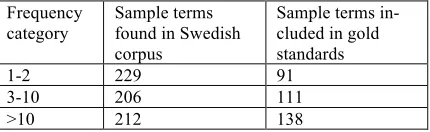
We established that 647 terms (13% of the sample) could be found in the Swedish corpus used by Uplug in word alignment. These terms were divided into three frequency categories (table 5). The terms from each frequency cate-gory were then used to build a separate gold standard. The fourth gold standard was built by merging the first three gold standards, i.e. it con-tained terms from all frequency categories (337 terms).
We intended to make the gold standards as extensive as possible, but we also applied certain limitations on the sample to make it more close to the bilingual dictionary needed to support query expansion. Thus, the gold standards in-cluded only Swedish nouns and adjectives with different spelling than their English equivalents. The words with identical spelling as their trans-lations (most of the proper names and abbrevia-tions) were omitted because they did not require query expansion, and hence, were not important for evaluation. The sample terms with missing or indirect translations were also left out, i.e. only ‘regular’ links were allowed in the gold stan-dards.
Frequency
category Sample terms found in Swedish corpus
Sample terms in-cluded in gold standards
1-2 229 91
3-10 206 111
[image:5.612.326.541.448.514.2]>10 212 138
Table 5. Distribution of sample terms across fre-quency categories
The evaluation was done with the built-in Uplug script evalalign.pl which uses the MWU meas-ures (Tiedemann 2003). These measmeas-ures are tai-lored to produce more reliable values for preci-sion and recall in the system links which contain multi-word units (MWU).
The main purpose of this evaluation was to measure the quality of Uplug used on the Nordic council corpus. We also wanted to examine whether POS-tags can improve word alignment.
Frequency category
Corpora with default pre-processing
Corpora with POS-tags
1-2 54% 54%
3-10 70% 67%
>10 83% 76%
[image:6.612.72.289.131.198.2]all freq 71% 67%
Table 6. Precision in the Swedish-English corpora Several conclusions can be made from this table. First, not surprisingly, words with higher fre-quency are aligned with better precision. For example, rare words which occur only once or twice in Swedish corpus show 54% precision, whereas words with frequency above 10 have 83% precision. These results are also very close to the results of Strömbäck (2005).
Next, the gold standard based on the middle frequency category (3-10) returns similar preci-sion value as the gold standard consisting of terms in all frequency categories. In other words, the middle category is representative of all fre-quency categories together.
These two observations are consistent across both the default and POS-tagged corpora.
Finally, precision of the POS-tagged corpora in all frequencies (67%) is lower than precision of the corpora without POS-tags (71%). We can also observe that the difference between the de-fault and POS-tagged corpus increases in middle and high frequency categories. Thus, the lowest frequency category shows almost identical pre-cision for both types of corpora, whereas the difference between the precision values in the highest frequency category reaches 7%.
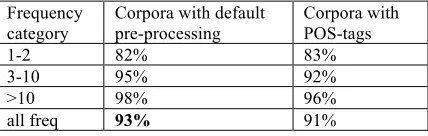
Frequency category
Corpora with default pre-processing
Corpora with POS-tags
1-2 82% 83%
3-10 95% 92%
>10 98% 96%
[image:6.612.74.288.561.629.2]all freq 93% 91%
Table 7. Recall in the Swedish-English corpora
Table 7 presents recall values for the Swedish-English corpora. In this table, we can observe similar tendency across the recall values – the
words with high frequency produce better recall values compared to the words with low fre-quency. Furthermore, the corpus with POS-tags has lower recall value than the corpus without POS-tags, except for the lowest frequency cate-gory.
On the other hand, the difference among the recall values in the default and POS-tagged cor-pus is not as distinct as among the precision val-ues.
7
SiteSeeker uses bilingual dictionaries
The cross language dictionary with the 805 triplets in Swedish, Danish and Norwegian was connected to the SiteSeeker search engine. The search works as a query expansion expanding the original term to terms in the others languages provided the original term has a translation to another term. The interface can filter the hit lists based on language, see figure 1. 30 percent of the top 100 queries used cross-lingual informa-tion retrieval. The top 100 queries compose 8 percent of the total queries, and the top 5 000 queries compose 50 percent of the total queries. Of the top 100 queries 24 percent were proper nouns that of course were not translated.
Figure 1 shows an example of the cross lan-guage search on the Nordic council website. The Swedish word arbetsmarknad in the original search query nordisk arbetsmarknad is expanded to the Danish word arbejdsmarked which allows retrieving the relevant documents in Danish.
During 2006, the search statistics of Site-Seeker showed 36 percent queries with no hits. During 2008, with the cross language dictionary connected to SiteSeeker, we obtained only 19 percent queries with no hits, about half of the 2006 value, even though the site had about the same amount of indexed pages as in 2006.
8
Conclusions
Figure 1. Cross language search on the Nordic council website
In order to improve the coverage a supplementary trilingual dictionary could be manually built using statistics of the top queries.
Word alignment quality using Uplug was high considering the small corpus. Also, we discovered that POS-tagging did not improve word alignment.
Pivot alignment is a useful trick that made our work possible. The similarity between the Scandi-navian languages made the drop in performance due to the pivot alignment too small to be visible.
We post-processed the dictionary removing du-plicate translations and translations that contained words that were shorter than four characters. This increased the quality and usefulness of the trilin-gual dictionary considerably.
The extracted words of the 4 873 news texts did not really cover the words in the 40 000 web pag-es, but when combined with a small hand-made trilingual dictionary they covered the most com-mon search queries reasonably well.
Future work will encompass the impact of lemma-tization in word alignment and as well as the use of other word alignment tools.
References
Ahrenberg, L., M. Merkel, A. Sågvall Hein and J. Tie-demann. 2000. Evaluation of word alignment sys-tems. In Proc. LREC 2000, Athens.
Argaw, A., L. Asker, R. Cöster and J. Karlgren 2004. Dictionary-based Amharic - English Information Re-trieval. In Proc. Cross Language Evaluation Forum (CLEF 2004), Bath, UK.
Borin L. 2000. You'll take the high road and I'll take the low road: Using a third language to improve bilin-gual word alignment. In Proc. 18th International Conference on Computational Linguistics. COLING 2000, Vol. 1. Saarbrücken: Universität des Saarlan-des. 97-103.
Brants, T. 2000. TnT - A Statistical Part-of-Speech Tagger. In Proc. Sixth Applied Natural Language Processing Conference ANLP-2000, Seattle, WA. Carlberger, J., H. Dalianis, M. Hassel, and O. Knutsson
2001. Improving Precision in Information Retrieval for Swedish using Stemming. In Proc. Nodalida 2001, Uppsala, Sweden
Charitakis K. 2007. Using parallel corpora to create a Greek-English dictionary with Uplug. In Proc. Noda-lida 2007, Tartu, Estonia.
Confer-ence on Applications of Natural Language to Infor-mation Systems, NLDB 2002 (Eds.) B. Andersson, M. Bergholtz, P. Johannesson, Stockholm, Sweden, June 27-28, 2002. Lecture Notes in Computer Sci-ence. Vol. 2553. pp. 183-190. Springer Verlag. Gale, W. A. and K. W. Church 1991. A program for
aligning sentences in bilingual corpora. In Proc. 29th annual meeting on Association for Computational Linguistics, p.177-184, 1991, Berkeley, California.
Jongejan, B. and D. Haltrup 2005. The CST Lemma-tiser. Center for Sprogteknologi, University of Co-penhagen, version 2.9 (October 6, 2005), http://cst.dk/download/cstlemma/current/doc/
Järvelin, A., S. Kumpulainen, A. Pirkola and E. Sormu-nen 2006. Dictionary-independent translation in CLIR between closely related languages. In Proc. Dutch-Belgian Information Retrieval Workshop, TNO ICT, Delft, The Netherlands, 2006.
Kann, V. and J. Hollman 2007. Tvärslå – Defining an XML exchange format and then building an on-line Nordic dictionary. In Proc. Automatic Treatment of Multilinguality in Retrieval, Search and Lexicogra-phy, Workshop in Copenhagen 2007.
Kann, V. and M. Rosell 2005. Free construction of a Swedish dictionary of synonyms. In Proc. Nodalida 2005, Joensuu.
Lin, C-Y. 1999. Machine Translation for Information Access across Language Barrier: the MuST System. In Machine Translation Summit VII, Singapore. LingPipe 2006. LingPipe is a suite of Java libraries for
the linguistic analysis of human language, http://www.alias-i.com/lingpipe/
Megyesi, B. 2001. Data-Driven Methods for PoS tag-ging and Chunking of Swedish. In Proc. Nodalida 2001, Uppsala.
Megyesi, B. and B. Dahlqvist 2007. The Swedish-Turkish Parallel Corpus and Tools for its Creation. In Proc. Nodalida 2007, Tartu, Estonia.
Merkel, M. 1999. Annotation Style Guide for the PLUG Link Annotator. Technical report, Linköping Univer-sity.
Nyström, M., M. Merkel, L. Ahrenberg, P. Zweigen-baum, H. Petersson and H. Åhlfeldt. 2006. Creating a medical English-Swedish dictionary using interactive word alignment in BMC medical informatics and de-cision making.
Plamondon, L. and G. Foster. 2003. Quantum, a French/English Cross-language Question Answering System. In Proc. Cross-Language Evaluation Forum (CLEF 2003), Trondheim.
Popović, M., D. Stein and H. Ney 2006. Statistical Ma-chine Translation of German Compound Words. In Proc. FinTAL, 5th International Conference on Natu-ral Language Processing, Springer Verlag, LNCS, pages 616-624, Turku.
Sarr, M. 2003. Improving precision and recall using a spell checker in a search engine. In Proc. Nodalida 2003, Reykjavik.
Schrader, B. 2004. Improving Word Alignment Quality Using Linguistic Knowledge. In Proc. International Conference on Language Re-sources and Evaluation, LREC 2004, Lissabon.
Sjöbergh, J. 2005. Creating a free digital Japanese-Swedish lexicon. In Proc. PACLING 2005, pages 296-300, Tokyo.
Sjöbergh, J. and V. Kann 2006. Vad kan statistik av-slöja om svenska sammansättningar (What can statis-tics reveal about Swedish compounds), Språk och Stil 2006, vol. 16, pages 199-214.
Strömbäck, P. 2005. The Impact of Lemmatization in Word Alignment, Master thesis, Department of Lin-guistics and Philology, Uppsala University.
Tiedemann, J. 2003. Recycling Translations - Extraction of Lexical Data from Parallel Corpora and their Ap-plication in Natural Language Processing, Doctoral Thesis, Studia Linguistica Upsaliensia 1, ISSN 1652-1366, ISBN 91-554-5815-7.
Toutanova, K., H. T. Ilhan and C. D. Manning 2002. Extensions to HMM-based Statistical Word Align-ment Models. In Proc. ACL Language Processing (EMNLP), Philadelphia, 2002, pp. 87-94.
Uplug 2008. Uplug is a collection of tools for linguistic corpus processing, word alignment and term extrac-tion from parallel corpus, http://uplug.sourceforge.net/
Velupillai, S. and Dalianis, H. (2008). Automatic Con-struction of Domain-specific Dictionaries on Sparse Parallel Corpora in the Nordic Languages. In Proc. 2nd MMIES Workshop: Multi-source, Multilingual Information Extraction and Summarization, held in conjunction with COLING-2008, Manchester. Zhou, Y., J. Qin, H. Che and J. F. Nunamaker 2005.