Building a B
IOW
ORDN
ETby Using W
ORDN
ET’s Data Formats
and W
ORDN
ET’s Software Infrastructure — A Failure Story
Michael Poprat Elena Beisswanger
Jena University Language & Information Engineering (JULIE) Lab Friedrich-Schiller-Universit¨at Jena
D-07743 Jena, Germany
{poprat,beisswanger,hahn}@coling-uni-jena.de
Udo Hahn
Abstract
In this paper, we describe our efforts to build on WORDNET resources, using WORDNET lexical data, the data format that it comes with and WORDNET’s software infrastructure in order to generate a biomedical extension of WORDNET, the BIOWORDNET. We began our efforts on the assumption that the soft-ware resources were stable and reliable. In the course of our work, it turned out that this belief was far too optimistic. We discuss the stumbling blocks that we encountered, point out an error in the WORDNET software with implications for research based on it, and con-clude that building on the legacy of WORD -NET data structures and its associated soft-ware might preclude sustainable extensions that go beyond the domain of general English.
1 Introduction
WORDNET(Fellbaum, 1998) is one of the most
au-thoritative lexical resources for the general English language. Due to its coverage – currently more than 150,000 lexical items – and its lexicological rich-ness in terms of definitions (glosses) and semantic relations, synonymy via synsets in particular, it has become a de facto standard for all sorts of research that rely on lexical content for the English language. Besides this perspective on rich lexicological data, over the years a software infrastructure has emerged around WORDNET that was equally ap-proved by the NLP community. This included, e.g., a lexicographic file generator, various editors and visualization tools but also meta tools rely-ing on properly formated WORDNET data such as
a library of similarity measures (Pedersen et al., 2004). In numerous articles the usefulness of this data and software ensemble has been demonstrated (e.g., for word sense disambiguation (Patwardhan et al., 2003), the analysis of noun phrase conjuncts (Hogan, 2007), or the resolution of coreferences (Harabagiu et al., 2001)).
In our research on information extraction and text mining within the field of biomedical NLP, we sim-ilarly recognized an urgent need for a lexical re-source comparable to WORDNET, both in scope and size. However, the direct usability of the original WORDNET for biomedical NLP is severely
ham-pered by a (not so surprising) lack of coverage of the life sciences domain in the general-language English WORDNETas was clearly demonstrated by Burgun
and Bodenreider (2001).
Rather than building a BIOWORDNET by hand, as was done for the general-language English WORDNET, our idea to set up a WORDNET-style
lexical resource for the life sciences was different. We wanted to link the original WORDNET with various biomedical terminological resources vastly available in the life sciences domain. As an obvious candidate for this merger, we chose one of the ma-jor high-coverage umbrella systems for biomedical ontologies, the OPEN BIOMEDICAL ONTOLOGIES
(OBO).1 These (currently) over 60 OBO ontologies provide domain-specific knowledge in terms of hi-erarchies of classes that often come with synonyms and textual definitions for lots of biomedical sub-domains (such as genes, proteins, cells, sequences,
1http://www.bioontology.org/
repositories.html#obo
etc.).2 Given these resources and their software
in-frastructure, our plan was to create a biomedically focused lexicological resource, the BIOWORDNET, whose coverage would exceed that of any of its com-ponent resources in a so far unprecedented man-ner. Only then, given such a huge combined re-source advanced NLP tasks such as anaphora res-olution seem likely to be tackled in a feasible way (Hahn et al., 1999; Casta˜no et al., 2002; Poprat and Hahn, 2007). In particular, we wanted to make
di-rect use of available software infrastructure such as
the library of similarity metrics without the need for re-programming and hence foster the reuse of exist-ing software as is.
We began our efforts on the assumption that the WORDNETsoftware resources were stable and reli-able. In the course of our work, it turned out that this belief was far too optimistic. We discuss the stum-bling blocks that we encountered, point out an er-ror in the WORDNETsoftware with implications for
research based on it, and conclude that building on the legacy of WORDNET data structures and its as-sociated software might preclude sustainable exten-sions that go beyond the domain of general English. Hence, our report contains one of the rare failure sto-ries (not only) in our field.
2 Software Around WORDNETData
While the stock of lexical data assembled in the WORDNETlexicon was continuously growing over time,3its data format and storage structures, the so-called lexicographic file, by and large, remained un-altered (see Section 2.1). In Section 2.2, we will deal with two important software components with which the lexicographic file can be created and browsed. Over the years, together with the continuous exten-sion of the WORDNET lexicon, a lot of software
tools have been developed in various programming languages allowing browsing and accessing WORD -NETas well as calculating semantic similarities on it. We will discuss the most relevant of these tools in Section 2.3.
2Bodenreider and Burgun (2002) point out that the structure
of definitions in WORDNETdiffer to some degree from more
domain-specialized sources such as medical dictionaries.
3
The latest version 3.0 was released in December 2006
2.1 Lexicon Organization of WORDNETand Storage in Lexicographic Files
At the top level, WORDNET is organized accord-ing to four parts of speech, viz. noun, verb, adjec-tive and adverb. The most recent version 3.0 cov-ers more than 117,000 nouns, 11,500 verbs, 21,400 adjectives and 4,400 adverbs, interlinked by lexical
relations, mostly derivations. The basic semantic
unit for all parts of speech are sets of synonymous words, so-called synsets. These are connected by different semantic relations, imposing a thesaurus-like structure on WORDNET. In this paper, we dis-cuss the organization of noun synsets in WORDNET
only, because this is the relevant part of WORD -NETfor our work. There are two important
seman-tic relation types linking noun synsets. The
hyper-nym / hypohyper-nym relation on which the whole WORD
-NET noun sense hierarchy is built links more spe-cific to more general synsets, while the meronym /
holonym relation describes partonomic relations
be-tween synsets, such as part of the whole, member of the whole or substance of the whole.
From its very beginning, WORDNET was built
and curated manually. Lexicon developing experts introduced new lexical entries into WORDNET, grouped them into synsets and defined appropriate semantic and lexical relations. Since WORDNET
was intended to be an electronic lexicon, a data representation format had to be defined as well. When the WORDNETproject started more than two decades ago, markup languages such as SGML or XML were unknown. Because of this reason, a rather idiosyncratic, fully text-based data structure for these lexicographic files was defined in a way to be readable and editable by humans — and survived until to-day. This can really be considered as an outdated legacy given the fact that the WORDNET
community has been so active in the last years in terms of data collection, but has refrained from adapting its data formats in a comparable way to to-day’s specification standards. Very basically,4 each line in the lexicographic file holds one synset that is enclosed by curly brackets. Take as an example the synset for “monkey”:
4A detailed description can be found in the W
ORDNET
manual wninput(5WN), available from http://wordnet.
{ monkey, primate,@ (any of various
long-tailed primates (excluding the
prosimians)) }
Within the brackets at the first position synonyms are listed, separated by commas. In the exam-ple, there is only one synonym, namely “monkey”. The synonyms are followed by semantic relations to other synsets, if available. In the example, there is only one hypernym relation (denoted by “@”) point-ing to the synset “primate”. The final position is reserved for the gloss of the synset encapsulated in round brackets. It is important to notice that there are no identifiers for synsets in the lexicographic file. Rather, the string expressions themselves serve as identifiers. Given the fundamental idea of synsets – all words within a synset mean exactly the same in a certain context – it is sufficient to relate one word in the synset in order to refer to the whole synset. Still, there must be a way to deal with homonyms, i.e., lexical items which share the same string, but have different meanings. WORDNET’s approach to distinguish different senses of a word is to add num-bers from 0 to 15, called lexical identifiers. Hence, in WORDNET, a word cannot be more than 16-fold ambiguous. This must be kept in mind when one wants to build a WORDNET for highly ambiguous
sublanguages such as the biomedical one.
2.2 Software Provided with WORDNET
To guarantee fast access to the entries and their rela-tions, an optimized index file must be created. This is achieved through the easy-to-use GRINDsoftware
which comes with WORDNET. It simply consumes the lexicographic file(s) as input and creates two plain-text index files,5 namely data and index. Furthermore, there is a command line tool,WN, and a graphical browser,WNB, for data visualization that require the specific index created by GRIND (as all
the other tools that query the WORDNETdata do as well). These tools are the most important (and only) means of software support for WORDNETcreation
by checking the syntax as well as allowing the (man-ual) inspection of the newly created index.
5
Its syntax is described in http://wordnet.
princeton.edu/man/wndb.5WN.
2.3 Third-Party WORDNETTools
Due to the tremendous value of WORDNETfor the NLP and IR community and its usefulness as a resource for coping with problems requiring mas-sive amounts of lexico-semantic knowledge, the software-developing community was and continues to be quite active. Hence, in support of WORDNET
several APIs and software tools were released that allow accessing, browsing and visualizing WORD
-NETdata and measuring semantic similarity on the base of the WORDNET’s lexical data structures.6
The majority of these APIs are maintained well and kept up to date, such as JAWS7 and JWNL,8 and enable connecting to the most recent ver-sion of WORDNET. For the calculation of vari-ous similarity measures, the PERL library WORD
-NET::SIMILARITY initiated and maintained by Ted
Pedersen9 can be considered as a de facto stan-dard and has been used in various experimental set-tings and applications. This availability of well-documented and well-maintained software is defi-nitely a strong argument to rely on WORDNET as a powerful lexico-semantic knowledge resource.
3 The BIOWORDNET Initiative
In this section, we describe our approach to extend WORDNET towards the biomedical domain by
in-corporating terminological resources from the OBO collection. The most obvious problems we faced were to define a common data format and to map non-compliant data formats to the chosen one.
3.1 OBO Ontologies
OBO is a collection of publicly accessible biomed-ical ontologies.10 They cover terms from many biomedical subdomains and offer structured, domain-specific knowledge in terms of classes (which often come with synonyms and textual defi-nitions) and class hierarchies. Besides the hierarchy-defining relation is-a, some OBO ontologies provide
6For a comprehensive overview of available W
ORDNET
tools we refer to WORDNET’s ‘related project’ website (http:
//wordnet.princeton.edu/links).
7
http://engr.smu.edu/˜tspell/
8http://jwordnet.sourceforge.net/
9http://wn-similarity.sourceforge.net/
10
WordNet Index { histoblast, simple_col...
{ laborinth_supporting ... { structural_cell, cell_by... { mesangial_phagocyte, ... { ito_cell, perisinusoida_ ... { . . . }
...
OBO ontology in OWL-format
e x t r a c t e d d a t a BioWordNet lexicographic
file S t e p 1 :
d a t a e x t r a c t i o n f r o m O B O
S t e p 2 : c o n v e r s i o n t o W o r d N e t
l e x i c o g r a p h i c f i l e f o r m a t
S t e p 3 : b u i l d i n g W o r d N e t i n d e x
u s i n g ’ g r i n d ’
WordNet Browser WordNet API Information Retrieval
Similarity Measuring Anaphora Resolution
Document Clustering
S t e p 4 : B i o W o r d N e t i n d e x c a n b e u s e d b y v a r i o u s
s o f t w a r e c o m p o n e n t s
a n d A P I s . . .
S t e p 5 :
. . . a n d f u r t h e r b e p r o c e s s e d i n N L P c o m p o n t e n t s
BioWordNet index file
IR and NLP applications
Figure 1: From OBO ontologies to BIOWORDNET— towards a domain-specific WORDNETfor biomedicine
additional semantic relation types such as
sequence-of or develops-from to express even more complex
and finer-grained domain-specific knowledge. The ontologies vary significantly in size (up to 60,000 classes with more than 150,000 synonyms), the number of synonyms per term and the nature of terms.
The OBO ontologies are available in various for-mats including the OBO flat file format, XML and OWL. We chose to work with the OWL version for our purpose,11since for the OWL language also ap-propriate tools are available facilitating the extrac-tion of particular informaextrac-tion from the ontologies, such as taxonomic links, labels, synonyms and tex-tual definitions of classes.
3.2 From OBO to BIOWORDNET
Our plan was to construct a BIOWORDNETby
con-verting, in the first step, the OBO ontologies into a WORDNET hierarchy of synsets, while keeping to the WORDNETlexicographic file format, and
build-ing a WORDNETindex. As a preparatory step, we defined a mapping from the ontology to WORDNET
items as shown in Table 1.
The three-stage conversion approach is depicted in Figure 1. First, domain specific terms and
tax-11
http://www.w3.org/TR/owl-semantics/
OBO ontology BIOWORDNET
ontology class synset class definition synset gloss class name word in synset synonym of class name word in synset
Ciis-aCj Sihyponym ofSj Cjhas-subclassCi Sj hypernym ofSi
Table 1: Mapping between items from OBO and from BIOWORDNET (Ci andCj denote ontology classes,Si
andSjthe corresponding BIOWORDNETsynsets)
onomic links between terms were extracted sepa-rately from each of the OBO ontologies. Then the extracted data was converted according to the syntax specifications of WORDNET’s lexicographic file. Finally for each of the converted ontologies the WORDNET-specific index was built using GRIND.
Following this approach we ran into several prob-lems, both regarding the WORDNET data structure
and the WORDNET-related software that we used for the construction of the BIOWORDNET. Con-verting the OBO ontologies turned out to be cum-bersome, especially the conversion of the CHEBI ontology12 (long class names holding many special characters) and the NCI thesaurus13 (large number
12http://www.ebi.ac.uk/chebi/
13
of classes and some classes that also have a large number of subclasses). These and additional prob-lems will be addressed in more detail in Section 4.
4 Problems with WORDNET’s Data
Format and Software Infrastructure
We here discuss two types of problems we found for the data format underlying the WORDNET
lex-icon and the software that helps building a WORD -NET file and creating an index for this file. First, WORDNET’s data structure puts several restrictions
on what can be expressed in a WORDNETlexicon. For example, it constrains lexical information to a fixed number of homonyms and a fixed set of rela-tions. Second, the data structure imposes a number of restrictions on the string format level. If these restrictions are violated the WORDNET processing software throws error messages which differ consid-erably in terms of informativeness for error tracing and detection or even do not surface at all at the lex-icon builder’s administration level.
4.1 Limitations of Expressiveness
The syntax on which the current WORDNET lex-icographic file is based imposes severe limitations on what can be expressed in WORDNET. Although
these limitations might be irrelevant for representing general-language terms, they do affect the construc-tion of a WORDNET-like resource for biomedicine.
To give some examples, the WORDNET format al-lows a 16-fold lexical ambiguity only (lexical IDs that are assigned to ambiguous words are restricted to the numbers 0-15, see Section 2). This forced us to neglect some of the OBO ontology class names and synonyms that were highly ambiguous.14
Furthermore, the OBO ontologies excel in a richer set of semantic relations than WORDNET can of-fer. Thus, a general problem with the conversion of the OBO ontologies into WORDNET format was
that except from the taxonomic is-a relation (which corresponds to the WORDNET hyponym relation)
and the part-of relation (which corresponds to the
WORDNET meronym relation) all remaining
OBO-specific relations (such as develops-from,
sequence-of, variant-of and position-of ) could not be
rep-14
This is a well-known limitation that is already mentioned
in the WORDNETdocumentation.
resented in the BIOWORDNET. The structure of
WORDNET neither contains such relations nor is it flexible enough to include them so that we face a systematic loss of information in BIOWORDNET
compared to the original OBO ontologies. Al-though these restrictions are well-known, their re-moval would require extending the current WORD
-NET data structure fundamentally. This, in turn, would probably necessitate a full re-programming of all of WORDNET-related software.
4.2 Limitations of Data Format and Software
When we tried to convert data extracted from the OBO ontologies into WORDNET’s lexicographic file format (preserving its syntactic idiosyncrasies for the sake of quick and straightforward reusability of software add-ons), we encountered several intri-cacies that took a lot of time prior to building a valid lexicographic file.
First, we had to replace 31 different charac-ters with unique strings such as “(” with “-LRB-” and “+” with “-PLU-” before GRIND was able to process the lexicographic file. The reason is that many of such special characters occurring in domain specific terms, especially in designa-tors of chemical compounds such as “methyl
es-ter 2,10-dichloro-12H-dibenzo(d,g)(1,3)dioxocin-6-carboxylic acid” (also known as “treloxinate” with
the CAS registry number 30910-27-1), are reserved symbols in the WORDNET data formatting syntax. If these characters are not properly replaced GRIND
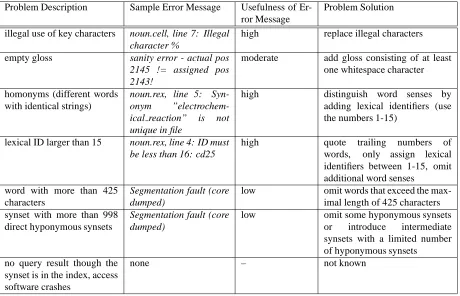
throws an exact and useful error message (see Table 2, first row).
Second, we had to find out that we have to replace all empty glosses by at least one whitespace charac-ter. Otherwise, GRIND informs the user in terms of a rather cryptic error message that mentions the po-sition of the error though not its reason (see Table 2, second row).
Problem Description Sample Error Message Usefulness of Er-ror Message
Problem Solution
illegal use of key characters noun.cell, line 7: Illegal character %
high replace illegal characters
empty gloss sanity error - actual pos 2145 != assigned pos 2143!
moderate add gloss consisting of at least one whitespace character
homonyms (different words with identical strings)
noun.rex, line 5: Syn-onym ”electrochem-ical reaction” is not unique in file
high distinguish word senses by adding lexical identifiers (use the numbers 1-15)
lexical ID larger than 15 noun.rex, line 4: ID must be less than 16: cd25
high quote trailing numbers of words, only assign lexical identifiers between 1-15, omit additional word senses
word with more than 425 characters
Segmentation fault (core dumped)
low omit words that exceed the max-imal length of 425 characters synset with more than 998
direct hyponymous synsets
Segmentation fault (core dumped)
low omit some hyponymous synsets or introduce intermediate synsets with a limited number of hyponymous synsets
no query result though the synset is in the index, access software crashes
none – not known
Table 2: Overview of the different kinds of problems that we encountered when creating a BIOWORDNETkeeping to the WORDNETdata structure and the corresponding software. Each problem description is followed by a sample error message that GRINDhad thrown, a statement about how useful the error message was to detect the source of the error and a possible solution for the problems, if available. The last row documents a special experience with data viewers for data from the NCI thesaurus.
to the end of each homonym. If in a lexicographic file two identical strings occur that have not been as-signed different lexical identifiers (it does not mat-ter whether this happens within or across synsets) GRIND emits an error message that mentions both, the position and the lexical entry which caused this error (cf. Table 2, third row).
Numbers that appear at the end of a lexical item as an integral part of it (such as “2” in “IL2”, a special type of cytokine (protein)) have to be escaped in or-der to avoid their misinterpretation as lexical identi-fiers. This, again, is a well-documented shortcoming of WORDNET’s data specification rules.
In case such numbers are not escaped prior to pre-senting the lexicographic file to GRIND the word closing numbers are always interpreted as lexical identifiers. Closing numbers that exceed the num-ber 15 cause GRIND to throw an informative error message (see Table 2, fourth row).
4.3 Undocumented Restrictions and Insufficient Error Messages
In addition to the more or less documented re-strictions of the WORDNETdata format mentioned above we found additional restrictions that lack doc-umentation up until now, to the best of our knowl-edge.
First, it seems that the length of a word is re-stricted to 425 characters. If a word in the lexico-graphic file exceeds this length, GRINDis not able to create an index and throws an empty error message, namely the memory error “segmentation fault” (cf. Table 2, fifth row). As a consequence of this restric-tion, some very long CHEBI class names could not have been included in the BIOWORDNET.
er-ror message “segmentation fault” (cf. Table 2, sixth row). An NCI thesaurus class that had more than 998 direct subclasses thus could not have been in-cluded in the BIOWORDNET.
Due to insufficient documentation and utterly general error messages the only way to locate the problem causing the “segmentation fault” errors was to examine the lexicographic files manually. We had to reduce the number of synset entries in the lexico-graphic file, step by step, in a kind of trial and error approach until we could resolve the problem. This is, no doubt, a highly inefficient and time consum-ing procedure. More informative error messages of GRINDwould have helped us a lot.
4.4 Deceptive Results from WORDNET Software and Third-Party Components
After getting rid of all previously mentioned errors, valid index files were compiled. It was possible to access these index files using the WORDNET query-ing tools WN and WNB, indicating the index files
were ‘valid’. However, when we tried to query the index file that was generated by GRIND for the NCI thesaurus we got strange results. While WN
did not return any query results, the browser WNB
crashed without any error message (cf. Table 2, sev-enth row). The same holds for the Java APIs JAWS and JWNL.
Since a manual examination of the index file re-vealed that the entries that we were searching for, in fact, were included in the file, some other, up to this step unknown error must have prevented the soft-ware tools from finding the targeted entries. Hence, we want to point out that although we have exam-ined this error for the NCI thesaurus only, the risk is high that this “no show” error is likely to bias any other application as well which makes use of the the same software that we grounded our ex-periments on. Since the NCI thesaurus is a very large resource, even worse, further manual error search is nearly impossible. At this point, we stopped our attempt building a WORDNETresource
for biomedicine based on the WORDNETformatting and software framework.
5 Related Work
In the literature dealing with WORDNET and its structures from a resource perspective (rather than dealing with its applications), two directions can be distinguished. On the one hand, besides the original English WORDNET and the various vari-ant WORDNETs for other languages (Vossen, 1998),
extensions to particular domains have already been proposed (for the medical domain by Buitelaar and Sacaleanu (2002) and Fellbaum et al. (2006); for the architectural domain Bentivogli et al. (2004); and for the technical report domain by Vossen (2001)). However, none of these authors neither mentions im-plementation details of the WORDNETs or perfor-mance pitfalls we have encountered, nor is supple-mentary software pointed out that might be useful for our work.
On the other hand, there are suggestions concern-ing novel representation formats of next-generation WORDNETs. For instance in the BALKANET
project (Tufis¸ et al., 2004), an XML schema plus a DTD was proposed (Smrˇz, 2004) and an editor called CISDIC with basic maintenance functionali-ties and consistency check was released (Hor´ak and Smrˇz, 2004). The availability of APIs or software to measure similarity though remains an open issue.
So, our approach to reuse the structure and the software for building a BIOWORDNET was moti-vated by the fact that we could not find any al-ternatives coming with a software ensemble as de-scribed in Section 2. Against all expectations, we did not manage to reuse the WORDNET data struc-ture. However, there are no publications that report on such difficulties and pitfalls we were confronted with.
6 Discussion and Conclusion
works fine for the official WORDNET release, our
experiences taught us that it fails or gives limited support in case of building and debugging a new WORDNETresource. Even worse, we have evidence
from one large terminological resource (NCI) that WORDNET’s software infrastructure (GRIND) ren-ders deceptive results.
Although WORDNET might no longerbe the one and only lexical resource for NLP each year a con-tinuously strong stream of publications on the use of WORDNET illustrates its importance for the com-munity. On this account we find it remarkable that although improvements in content and structure of WORDNEThave been proposed (e.g., Boyd-Graber et al. (2006) propose to add (weighted) connec-tions between synsets, Oltramari et al. (2002) sug-gest to restructure WORDNET’s taxonomical struc-ture, and Mihalcea and Moldovan (2001) recom-mend to merge synsets that are too fine-grained) to the best of our knowledge, no explicit proposals have been made to improve the representation for-mat of WORDNETin combination with the adaption
of the WORDNET-related software.
According to our experiences the existing WORD
-NETsoftware is hardly (re)usable due to insufficient
error messages that the software throws and limited documentation. From our point of view it would be highly preferable if the software would be improved and made more user-supportive (more meaningful error messages would already improve the useful-ness of the software). In terms of the actual rep-resentation format of WORDNETwe found that us-ing the current format is not only cumbersome and error-prone, but also limits what can be expressed in a WORDNETresource.
From our perspective this indicates the need for a major redesign of WORDNET’s data structure foundations to keep up with the standards of to-day’s meta data specification languages (e.g., based on RFD (Graves and Gutierrez, 2006), XML or OWL (L ¨ungen et al., 2007)). We encourage the re-implementation of WORDNET resources based on such a state-of-the-art markup language (for OWL in particular a representation of WORDNETis already available, cf. van Assem et al. (2006)). Of course, if a new representation format is used for a WORDNET
resource also the software accessing the resource has to be adapted to the new format. This may require
substantial implementation efforts that we think are worth to be spent, if the new format overcomes the major problems that are due to the original WORD -NETformat.
Acknowledgments
This work was funded by the German Ministry of Education and Research within the STEMNET
project (01DS001A-C) and by the EC within the BOOTSTREPproject (FP6-028099).
References
Luisa Bentivogli, Andrea Bocco, and Emanuele Pianta. 2004. ARCHIWORDNET: Integrating WORDNET with domain-specific knowledge. In Petr Sojka, Karel Pala, Christiane Fellbaum, and Piek Vossen, editors,
GWC 2004 – Proceedings of the 2nd International Conference of the Global WordNet Association, pages
39–46. Brno, Czech Republic, January 20-23, 2004. Olivier Bodenreider and Anita Burgun. 2002.
Character-izing the definitions of anatomical concepts in WORD -NETand specialized sources. In Proceedings of the 1st
International Conference of the Global WordNet Asso-ciation, pages 223–230. Mysore, India, January 21-25,
2002.
Jordan Boyd-Graber, Christiane Fellbaum, Daniel Osh-erson, and Robert Schapire. 2006. Adding dense, weighted connections to WORDNET. In Petr Sojka, Key-Sun Choi, Christiane Fellbaum, and Piek Vossen, editors, GWC 2006 – Proceedings of the 3rd
Inter-national WORDNET Conference, pages 29–35. South
Jeju Island, Korea, January 22-26, 2006.
Paul Buitelaar and Bogdan Sacaleanu. 2002. Extend-ing synsets with medical terms WORDNET and spe-cialized sources. In Proceedings of the 1st
Interna-tional Conference of the Global WordNet Association.
Mysore, India, January 21-25, 2002.
Anita Burgun and Olivier Bodenreider. 2001. Compar-ing terms, concepts and semantic classes in WORD -NET and the UNIFIED MEDICAL LANGUAGE SYS -TEM. In Proceedings of the NAACL 2001 Workshop
‘WORDNET and Other Lexical Resources: Applica-tions, Extensions and Customizations’, pages 77–82.
Pittsburgh, PA, June 3-4, 2001. New Brunswick, NJ: Association for Computational Linguistics.
Jos´e Casta˜no, Jason Zhang, and James Pustejovsky. 2002. Anaphora resolution in biomedical literature. In
Proceedings of The International Symposium on Ref-erence Resolution for Natural Language Processing.
Alicante, Spain, June 3-4, 2002.
From WORDNET to MEDICAL WORDNET. Journal
of Biomedical Informatics, 39(3):321–332.
Christiane Fellbaum, editor. 1998. WORDNET: An Elec-tronic Lexical Database. Cambridge, MA: MIT Press.
Alvaro Graves and Caludio Gutierrez. 2006. Data rep-resentations for WORDNET: A case for RDF. In Petr Sojka, Key-Sun Choi, Christiane Fellbaum, and Piek Vossen, editors, GWC 2006 – Proceedings of the 3rd
International WORDNETConference, pages 165–169.
South Jeju Island, Korea, January 22-26, 2006. Udo Hahn, Martin Romacker, and Stefan Schulz. 1999.
Discourse structures in medical reports – watch out! The generation of referentially coherent and valid text knowledge bases in theMEDSYNDIKATEsystem.
In-ternational Journal of Medical Informatics, 53(1):1–
28.
Sanda M. Harabagiu, Rˇazvan C. Bunescu, and Steven J. Maiorano. 2001. Text and knowledge mining for coreference resolution. In NAACL’01, Language
Tech-nologies 2001 – Proceedings of the 2nd Meeting of the North American Chapter of the Association for Computational Linguistics, pages 1–8. Pittsburgh, PA,
USA, June 2-7, 2001. San Francisco, CA: Morgan Kaufmann.
Deirdre Hogan. 2007. Coordinate noun phrase disam-biguation in a generative parsing model. In ACL’07 –
Proceedings of the 45th Annual Meeting of the Asso-ciation of Computational Linguistics, pages 680–687.
Prague, Czech Republic, June 28-29, 2007. Strouds-burg, PA: Association for Computational Linguistics. Ales¸ Hor´ak and Pavel Smrˇz. 2004. New features of
wordnet editor VisDic. Romanian Journal of
Infor-mation Science and Technology (Special Issue),
7(1-2):201–213.
Harald L¨ungen, Claudia Kunze, Lothar Lemnitzer, and Angelika Storrer. 2007. Towards an integrated OWLmodel for domain-specific and general language WordNets. In Attila Tan´acs, Dor´a Csendes, Veronika Vincze, Christiane Fellbaum, and Piek Vossen, editors,
GWC 2008 – Proceedings of the 4th Global WORD -NET Conference, pages 281–296. Szeged, Hungary,
January 22-25, 2008.
Rada Mihalcea and Dan Moldovan. 2001. EZ.WORDNET: Principles for automatic genera-tion of a coarse grained WORDNET. In Proceedings
of the 14th International Florida Artificial Intelli-gence Research Society (FLAIRS) Conference, pages
454–458.
Alessandro Oltramari, Aldo Gangemi, Nicola Guarino, and Claudio Madolo. 2002. Restructuring WORD -NET’s top-level. In Proceedings of ONTOLEX 2002
@ LREC 2002.
Siddharth Patwardhan, Satanjeev Banerjee, and Ted Ped-ersen. 2003. Using measures of semantic related-ness for word sense disambiguation. In Alexander F.
Gelbukh, editor, CICLing 2003 – Computational
Lin-guistics and Intelligent Text Processing. Proceedings of the 4th International Conference, volume 2588 of Lecture Notes in Computer Science, pages 241–257.
Mexico City, Mexico, February 16-22, 2003. Berlin etc.: Springer.
Ted Pedersen, Siddharth Patwardhan, and Jason Miche-lizzi. 2004. WORDNET::Similarity: Measuring the relatedness of concepts. In AAAI’04 – Proceedings
of the 19th National Conference on Artificial Intelli-gence & IAAI’04 – Proceedings of the 16th Innova-tive Applications of Artificial Intelligence Conference,
pages 1024–1025. San Jos´e, CA, USA, July 25-29, 2004. Menlo Park, CA; Cambridge, MA: AAAI Press & MIT Press.
Michael Poprat and Udo Hahn. 2007. Quantitative data on referring expressions in biomedical abstracts. In
BioNLP at ACL 2007 – Proceedings of the Workshop on Biological, Translational, and Clinical Language Processing, pages 193–194. Prague, Czech Republic,
June 29, 2007. Stroudsburg, PA: Association for Com-putational Liguistics.
Pavel Smrˇz. 2004. Quality control and checking for wordnets development: A case study of BALKANET.
Romanian Journal of Information Science and Tech-nology (Special Issue), 7(1-2):173–181.
D. Tufis¸, D. Christea, and S. Stamou. 2004. BALKA -NET: Aims, methods, results and perspectives. a gen-eral overview. Romanian Journal of Information
Sci-ence and Technology (Special Issue), 7(1-2):9–43.
Mark van Assem, Aldo Gangemi, and Guus Schreiber. 2006. Conversion of WORDNET to a standard RDF/OWL representation. In LREC 2006 –
Proceed-ings of the 5th International Conference on Language Resources and Evaluation. Genoa, Italy, May 22-28,
2006. Paris: European Language Resources Associa-tion (ELRA), available on CD.
Piek Vossen, editor. 1998. EUROWORDNET: A Mul-tilingual Database with Lexical Semantic Networks.
Dordrecht: Kluwer Academic Publishers.
Piek Vossen. 2001. Extending, trimming and fusing WORDNET for technical documents. In Proceedings
of the NAACL 2001 Workshop ‘WORDNETand Other Lexical Resources: Applications, Extensions and Cus-tomizations’. Pittsburgh, PA, June 3-4, 2001. New