Arabic Tokenization System
Mohammed A. Attia
School of Informatics / The University of Manchester, PO Box
88, Sackville Street, Manchester M60 1QD, UK
[email protected]
Abstract
Tokenization is a necessary and non-trivial step in natural language processing. In the case of Arabic, where a single word can comprise up to four independent tokens, morphological knowledge needs to be in-corporated into the tokenizer. In this paper we describe a rule-based tokenizer that handles tokenization as a full-rounded process with a preprocessing stage (white space normalizer), and a post-processing stage (token filter). We also show how it handles multiword expressions, and how ambiguity is resolved.
1
Introduction
Tokenization is a non-trivial problem as it is “closely related to the morphological analysis” (Chanod and Tapanainen 1994). This is even more the case with languages with rich and complex morphology such as Arabic. The function of a to-kenizer is to split a running text into tokens, so that they can be fed into a morphological transducer or POS tagger for further processing. The tokenizer is responsible for defining word boundaries, demar-cating clitics, multiword expressions, abbreviations and numbers.
Clitics are syntactic units that do not have free forms but are instead attached to other words. De-ciding whether a morpheme is an affix or a clitic can be confusing. However, we can generally say that affixes carry morpho-syntactic features (such as tense, person, gender or number), while clitics serve syntactic functions (such as negation, defini-tion, conjunction or preposition) that would other-wise be served by an independent lexical item.
Therefore tokenization is a crucial step for a syn-tactic parser that needs to build a tree from syntac-tic units. An example of clisyntac-tics in English is the genitive suffix “’s” in the student’s book.
Arabic clitics, however, are not as easily recog-nizable. Clitics use the same alphabet as that of words with no demarcating mark as the English apostrophe, and they can be concatenated one after the other. Without sufficient morphological knowl-edge, it is impossible to detect and mark clitics. In this paper we will show different levels of imple-mentation of the Arabic tokenizer, according to the levels of linguistic depth involved.
Arabic Tokenization has been described in vari-ous researches and implemented in many solutions as it is a required preliminary stage for further processing. These solutions include morphological analysis (Beesley 2001; Buckwalter 2002), diacri-tization (Nelken and Shieber 2005), Information Retrieval (Larkey and Connell 2002), and POS Tagging (Diab et al 2004; Habash and Rambow 2005). None of these projects, however, show how multiword expressions are treated, or how ambigu-ity is filtered out.
In our research, tokenization is handled in a rule-based system as an independent process. We show how the tokenizer interacts with other trans-ducers, and how multiword expressions are identi-fied and delimited. We also show how incorrect tokenizations are filtered out, and how undesired tokenizations are marked. All tools in this research are developed in Finite State Technology (Beesley and Karttunen 2003). These tools have been devel-oped to serve an Arabic Lexical Functional Gram-mar parser using XLE (Xerox Linguistics Envi-ronment) platform as part of the ParGram Project (Butt et al 2002).
2
Arabic Tokens
A token is the minimal syntactic unit; it can be a word, a part of a word (or a clitic), a multiword expression, or a punctuation mark. A tokenizer needs to know a list of all word boundaries, such as white spaces and punctuation marks, and also information about the token boundaries inside words when a word is composed of a stem and cli-tics. Throughout this research full form words, i.e. stems with or without clitics, as well as numbers will be termed main tokens. All main tokens are delimited either by a white space or a punctuation mark. Full form words can then be divided into sub-tokens, where clitics and stems are separated.
2.1 Main Tokens
A tokenizer relies mainly on white spaces and punctuation marks as delimiters of word bounda-ries (or main tokens). Additional punctuation marks are used in Arabic such as the comma ‘،’, question mark ‘؟’ and semicolon ‘؛’. Numbers are also considered as main tokens. A few Arab coun-tries use the Arabic numerals as in English, while most Arab countries use the Hindi numerals such as ‘2’ (2) and ‘3’ (3). Therefore a list of all punctuation marks and number characters must be fed to the system to allow it to demarcate main tokens in the text.
2.2 Sub-Tokens
[image:2.612.315.523.120.211.2]Arabic morphotactics allow words to be pre-fixed or sufpre-fixed with clitics (Attia 2006b). Clitics themselves can be concatenated one after the other. Furthermore, clitics undergo assimilation with word stems and with each other, which makes them even harder to handle in any superficial way. A verb can comprise up four sub-tokens (a con-junction, a complementizer, a verb stem and an object pronoun) as illustrated by Figure 1.
Figure 1: Possible sub-tokens in Arabic verbs
[image:2.612.71.264.576.673.2]Similarly a noun can comprise up to four sub-tokens. Although Figure 2 shows five sub-tokens but we must note that the definite article and the genitive pronoun are mutually exclusive.
Figure 2: Possible sub-tokens in Arabic nouns
Moreover there are various rules that govern the combination of words with affixes and clitics. These rules are called grammar-lexis specifications (Abbès et al 2004; Dichy 2001; Dichy and Fargaly 2003). An example of these specifications is a rule that states that adjectives and proper nouns do not combine with possessive pronouns.
3
Development in Finite State Technology
Finite state technology has successfully been used in developing morphologies and text process-ing tools for many natural languages, includprocess-ing Semitic languages. We will explain briefly how finite state technology works, then we will proceed into showing how different tokenization models are implemented.
(1) LEXICON Proclitic
[email protected]@ Root;
Root; LEXICON Root
kitab Enclitic;
LEXICON Suffix
an Enclitic;
Enclitic; LEXICON Enclitic
continuation class named Root. This means that the forms in Root will be appended to the right of al. The lexicon Proclitic also has an empty string, which means that Proclitic itself is optional and that the path can proceed without it. The bulk of all lexical entries are presumably listed under Root in the example.
Sometimes an affix or a clitic requires or for-bids the existence of another affix or clitic. This is what is termed “long distance dependencies” (Beesley and Karttunen 2003). So Flag Diacritics are introduced to serve as filters on possible con-catenations to a stem. As we want to prevent Pro-clitic and Enclitic from co-occurring, for the defi-nite article and the possessive pronoun are mutu-ally excusive, we add a Flag Diacritic to each of them with the same feature name “U.Def”, but with different value “On/Off”, as shown in (1) above. At the end we have a transducer with a bi-nary relation between two sets of strings: the lower language that contains the surface forms, and the upper language that contains the analysis, as shown in (2) for the nounنﺎﺑﺎﺘﻛkitaban (two books).
(2) Lower Language: نﺎﺑﺎﺘﻛ
Upper Language: بﺎﺘﻛ+noun+dual+sg
4
Tokenization Solutions
There are different levels at which an Arabic tokenizer can be developed, depending on the depth of the linguistic analysis involved. During our work with the Arabic grammar we developed three different solutions, or three models, for Ara-bic tokenization. These models vary greatly in their robustness, compliance with the concept of modu-larity, and the ability to avoid unnecessary ambi-guities.
The tokenizer relies on white spaces and punc-tuation marks to demarcate main tokens. In demar-cating sub-tokens, however, the tokenizer needs more morphological information. This information is provided either deterministically by a morpho-logical transducer, or indeterministically by a to-ken guesser. Eventually both main toto-kens and sub-tokens are marked by the same token boundary, which is the sign ‘@’ throughout this paper. The classification into main and sub-tokens is a con-ceptual idea that helps in assigning the task of identification to different components.
Identifying main tokens is considered a straight-forward process that looks for white spaces and punctuation marks and divides the text accord-ingly. No further details of main tokens are given beyond this point. The three models described be-low are different ways to identify and divide sub-tokens, or clitics and stems within a full form word.
4.1 Model 1: Tokenization Combined with Morphological Analysis
In this implementation the tokenizer and the morphological analyzer are one and the same. A single transducer provides both morphological analysis and tokenization. Examples of the token-izer/analyser output are shown in (3). The ‘+’ sign precedes morphological features, while the ‘@’ sign indicates token boundaries.
(3) ﺮﻜﺸﯿﻟو (waliyashkur: and to thank)
و+conj@ل+comp@+verb+pres+sgﺮﻜﺷ@
This sort of implementation is the most linguis-tically motivated. This is also the most common form of implementation for Arabic tokenization (Habash and Rambow 2005). However, it violates the design concept of modularity which requires systems to have separate modules for undertaking separate tasks. For a syntactic parser that requires the existence of a tokenizer besides a morphologi-cal analyzer, this implementation is not workable, and either Model 2 or Model 3 is used instead.
4.2 Model 2: Tokenization Guesser
In this model tokenization is separated from morphological analysis. The tokenizer only detects and demarcates clitic boundaries. Yet information on what may constitute a clitic is still needed. This is why two additional components are required: a clitics guesser to be integrated with the tokenizer, and a clitics transducer to be integrated with the morphological transducer.
Clitics Guesser. We developed a guesser for
bounda-ries. Due to the nondeterministic nature of a guesser, there will be increased tokenization ambi-guities.
(4) ﻞﺟﺮﻠﻟو (and to the man)
و @ ل @ لا @ ﻞﺟر @
و @ ل @ ﻞﺟﺮﻟا @
و @ ﻞﺟﺮﻠﻟ @
ﻞﺟﺮﻠﻟو @
Clitics Transducer. We must note that Arabic
clitics do not occur individually in natural texts. They are always attached to words. Therefore a specialized small-scale morphological transducer is needed to handle these newly separated forms. We developed a lexc transducer for clitics only, treat-ing them as separate words. The purpose of this transducer is to provide analysis for morphemes that do not occur independently.
(5) و+conj
ل+prep
لا+art+def
This small-scale specialized transducer is then unioned (or integrated) with the main morphologi-cal transducer. Before making the union it is nec-essary to remove all paths that contain any clitics in the main morphological transducer to eliminate redundancies.
In our opinion this is the best model, the advan-tages are robustness as it is able to deal with any words whether they are known to the morphologi-cal transducer or not, and abiding by the concept of modularity as it separates the process of tokeniza-tion from morphological analysis.
There are disadvantages, however, for this model, and among them is that the morphological analyzer and the syntactic parser have to deal with increased tokenization ambiguities. The tokenizer is highly non-deterministic as it depends on a guesser which, by definition, is non-deterministic. For a simple sentence of three words, we are faced with eight different tokenization solutions. None-theless, this can be handled as explained in subsec-tion 5.1 on discarding spurious ambiguities.
4.3 Model 3: Tokenization Dependent on the Morphological Analyser
In the above solution, the tokenizer defines the possible Arabic stem as any arbitrary sequence of
Arabic letters. In this solution, however, the word stem is not guessed, but taken as a list of actual words. A possible word in the tokenizer in this model is any word found in the morphological transducer. The morphological transducer here is the same as the one described in subsection 4.1 but with one difference, that is the output does not in-clude any morphological features, but only token boundaries between clitics and stems.
This is a relatively deterministic tokenizer that handles clitics properly. The main downfall is that only words found in the morphological transducer are tokenized. It is not robust, yet it may be more convenient during grammar debugging, as it pro-vides much fewer analyses than model 2. Here spurious ambiguities are successfully avoided.
(6) ﻞﺟﺮﻠﻟو (and to the man)
و @ ل @ لا @ ﻞﺟر @
One advantage of this implementation is that the tool becomes more deterministic and more manageable in debugging. Its lack of robustness, however, makes it mostly inapplicable as no single morphological transducer can claim to comprise all the words in a language. In our XLE grammar, this model is only 0.05% faster than Model 2. This is not statistically significant advantage compared to its limitations.
4.4 Tokenizing Multiword Expressions
Multiword Expressions (MWEs) are two or more words that behave like a single word syntac-tically and semansyntac-tically. They are defined, more formally, as “idiosyncratic interpretations that cross word boundaries” (Sag et al 2001). MWEs cover expressions that are traditionally classified as idioms (e.g. down the drain), prepositional verbs (e.g. rely on), verbs with particles (e.g. give up), compound nouns (e.g. traffic lights) and colloca-tions (e.g. do a favour).
With regard to syntactic and morphological flexibility, MWEs are classified into three types: fixed, semi-fixed and syntactically flexible expres-sions (Baldwin 2004; Oflazer et al 2004; Sag et al 2001).
a. Fixed Expressions. These expressions are
spaces), such asﻂﺳوﻷا قﺮﺸﻟا al-sharq al-awsat (the Middle East) andﻢﺤﻟ ﺖﯿﺑbait lahem (Bethlehem).
b. Semi-Fixed Expressions.These expressions
can undergo variations, but still the components of the expression are adjacent. The variations are of two types, morphological variations where lexical items can express person, number, tense, gender, etc., such as the examples in (7), and lexical varia-tions, where one word can be replaced by another as in (8).
(7.a) ﺔﯿﻟﺎﻘﺘﻧا ةﺮﺘﻓ
fatratah intiqaliyyah
translational.sg.fem period.sg.fem (7.b) نﺎﺘﯿﻟﺎﻘﺘﻧا نﺎﺗﺮﺘﻓ
fatratan intiqaliyyatan
translational.dual.fem period.dual.fem (8) ﺔﻄﯿﺴﺒﻟا/ضرﻷا ﮫﺟو/ﺮﮭﻇ ﻰﻠﻋ
ala zahr/wajh al-ard/al-basitah on the face/surface of the land/earth (on the face of the earth)
c. Syntactically Flexible Expressions. These
are the expressions that can either undergo reorder-ing, such as passivization (e.g. the cat was let out of the bag), or allow external elements to intervene between the components such as (9.b), where the adjacency of the MWE is disrupted.
(9.a)ﺔﯾرﺎﻧ ﺔﺟارد
darrajah nariyyah bike fiery (motorbike) (9.b)ﺔﯾرﺎﻨﻟا ﺪﻟﻮﻟا ﺔﺟارد
darrajat al-walad al-nariyyah
the-bike the-boy the-fiery (the boy’s motorbike)
Fixed and semi-fixed expressions are identified and marked by the tokenizer, while syntactically flexible expressions can only be handled by a syn-tactic parser (Attia 2006a).
The tokenizer is responsible for treating MWEs in a special way. They should be marked as single tokens with the inner space(s) preserved. For this purpose, as well as for the purpose of morphologi-cal analysis, a specialized transducer is developed for MWEs that lists all variations of MWEs and provides analyses for them (Attia 2006a).
One way to allow the tokenizer to handle MWEs is to embed the MWEs in the Tokenizer (Beesley and Karttunen 2003). Yet a better ap-proach, described by (Karttunen et al 1996), is to
develop one or several multiword transducers or “staplers” that are composed on the tokenizer. We will explain here how this is implemented in our solution, where the list of MWEs is extracted from the MWE transducer and composed on the token-izer. Let’s look at the composition regular expres-sion:
(10) 1 singleTokens.i
2 .o. ?* 0:"[[[" (MweTokens.l) 0:"]]]" ?* 3 .o. "@" -> " " || "[[[" [Alphabet* | "@"*] _ 4 .o. "[[[" -> [] .o. "]]]" -> []].i;
Single words separated by the ‘@’ sign are defined in the variable singleTokens and the MWE trans-ducer is defined in MweTokens. In the MWE transducer all spaces in the lower language are re-placed by “@” so that the lower language can be matched against singleTokens. In line 1 the single-Tokens is inverted (the upper language is shifted down) by the operator “.i” so that composition goes on the side that contains the relevant strings. From the MWE transducer we take only the lower language (or the surface form) by the operator “.l” in line 2. Single words are searched and if they contain any MWEs, the expressions will (option-ally) be enclosed by three brackets on either side. Line 3 replaces all “@” signs with spaces in side MWEs only. The two compositions in line 4 re-move the intermediary brackets.
Let’s now show this with a working example. For the phrase in (11), the tokenizer first gives the output in (12). Then after the MWEs are composed with the tokenizer, we obtain the result in (13) with the MWE identified as a single token.
(11) ﺎﮭﺘﯿﺟرﺎﺧ ﺮﯾزﻮﻟو
wa-liwazir kharijiyatiha and-to-foreign minister-its (and to its foreign minister) (12)@ﺎھ@ﺔﯿﺟرﺎﺧ@ﺮﯾزو@ل@و
(approx. and@to@foreign@minister@its@) (13) ﺎھ@ﺔﯿﺟرﺎﺧ ﺮﯾزو@ل@و
(approx. and@to@foreign minister@its@)
4.5 Normalizing White Spaces
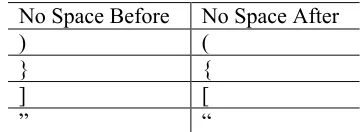
In real-life data spaces may not be as regularly and consistently used as expected. There may be two or more spaces, or even tabs, instead of a single space. Spaces might even be added before or after punctuation marks in the wrong manner. There-fore, there is a need for a tool that eliminates in-consistency in using white spaces, so that when the text is fed into a tokenizer or morphological ana-lyzer, words and expressions can be correctly iden-tified and analyzed. Table 1 shows where spaces are not expected before or after some punctuation marks.
No Space Before No Space After
) (
} {
] [
[image:6.612.77.259.224.290.2]” “
Table 1. Space distribution with some punctuation marks
We have developed a white space normalizer whose function is to go through real-life texts and correct mistakes related to the placement of white spaces. When it is fed an input such as the one in (14.a) in which additional spaces are inserted and some spaces are misplaced, it corrects the errors and gives the output in (14.b):
(14.a) . مﻼﺴﻟا ﻰﻟإ دﻮﻘﯿﺳ( ﺔﯿﻃاﺮﻘﻤﯾﺪﻟا ) ﺮﺸﻧ
(14.b) .مﻼﺴﻟا ﻰﻟإ دﻮﻘﯿﺳ (ﺔﯿﻃاﺮﻘﻤﯾﺪﻟا) ﺮﺸﻧ
5
Resolving Ambiguity
There are different types of ambiguity. There are spurious ambiguities created by the guesser. There are also ambiguities which do not exist in the text before tokenization but are only created during the tokenization process. Finally there are real ambiguities, where a form can be read as a single word or two sub-tokens, or where an MWE has a compositional reading. These three types are treated by the following three subsections respec-tively.
5.1 Discarding Spurious Ambiguities
Tokenization Model 2 discussed above in subsec-tion 4.2 is chosen as the optimal implementasubsec-tion due to its efficiency and robustness, yet it is highly nondeterministic and produces a large number of
spurious ambiguities. Therefore, a morphological transducer is needed to filter out the tokenization paths that contain incorrect sub-tokens. Recall ex-ample (4) which contained the output of the nonde-terministic tokenizer. In (15) below, after the out-put is fed into a morphological transducer, only one solution is accepted and the rest are discarded, as underlined words do not constitute valid stems.
(15) ﻞﺟﺮﻠﻟو (and to the man)
و @ ل @ لا @ ﻞﺟر
@ - Passed.
@ﻞﺟﺮﻟا@ل@و - Discarded.
@ﻞﺟﺮﻠﻟ@و - Discarded.
@ﻞﺟﺮﻠﻟو - Discarded.
5.2 Handling Tokenization Ambiguities
Among the function of a tokenizer is separate clitics from stems. Some clitics, however, when separated, become ambiguous with other clitics and also with other free forms. For example the word ﻢﮭﺑﺎﺘﻛ kitabahum has only one morphological reading (meaning their book), but after tokeniza-tion ﻢھ@بﺎﺘﻛ there are three different readings, as the second token ﻢھ can either be a clitic genitive pronoun (the intended reading) or a free pronoun they (a book, they) or a noun meaning worry (forming the compound book of worry).
This problem is solved by inserting a mark that precedes enclitics and follows proclitics to distin-guish them from each other as well as from free forms (Ron M. Kaplan and Martin Forst, personal communications, Oxford, UK, 20 September 2006). The mark we choose is the Arabic elonga-tion short line called cashida which is originally used for graphical decorative purposes and looks natural with most clitics. To illustrate the usage, a two-word string (16.a) will be rendered without cashidas as in (16.b), and a single-word string that contains clitics (17.a) will be rendered with a dis-tinctive cashida before the enclitic pronoun as in (17.b). This indicates that the pronoun is attached to the preceding word and not standing alone.
(16.a)ﻢھ بﺎﺘﻛ
kitab hum/hamm (book of worry/a book, they) (16.b) ﻢھ@بﺎﺘﻛ
This implementation will also resolve a similar ambiguity, that is ambiguity arising between pro-clitics and enpro-clitics. The proclitic preposition ك ka (as) always occurs initially. There is a homo-graphic enclitic object pronoun ك ka (you) that always occurs in the final position. This can create ambiguity in instances such as the made-up sen-tence in (18.a). The sensen-tence has the initial tokeni-zation of (18.b) without a cashida, and therefore the central token becomes ambiguous as it can now be attached either to the preceding or following word leading either to the readings in (18.a) or (18.c). The cashida placement, however, resolves this ambiguity as in (18.d). The cashida is added after the token, indicating that it is attached to the following word and now only the reading in (18.a) is possible.
(18.a) ﺮﯿﻣﻷﺎﻛ ﺖﯿﻄﻋأ
a’taitu ka-lamir (I gave like a prince) (18.b) ﺮﯿﻣﻷا@ك@ﺖﯿﻄﻋأ
(18.c) ﺮﯿﻣﻷا ﻚﺘﯿﻄﻋأ
a’taitu-ka alamir (I gave you the prince) (18.d) ﺮﯿﻣﻷا@ـﻛ@ﺖﯿﻄﻋأ
5.3 Handling Real Ambiguities
Some tokenization readings are legal, yet highly infrequent and undesired in real-life data. These undesired readings create onerous ambiguities, as they are confused with more common and more acceptable forms. For example the Arabic preposi-tion ﺪﻌﺑ ba’d (after) has the possible remote reading of being split into two tokens ﺪﻋ@ـﺑ, which is made of two elements: ـﺑ bi (with) and ﺪﻋ ‘add (counting). Similarly ﻦﯿﺑ baina (between) has the possible re-mote reading ﻦﯾ@ـﺑ, which is made of two tokens as well: ـﺑ bi (with) and ﻦﯾ yin (Yen).
The same problem occurs with MWEs. The op-timal handling of MWEs is to treat them as single tokens and leave internal spaces intact. Yet a non-deterministic tokenizer allows MWEs to be ana-lysed compositionally as individual words. So the MWE لﻮﺠﺘﻟا ﺮﻈﺣ hazr al-tajawwul (curfew) has two analyses, as in (19), although the composi-tional reading in (19.b) is undesired.
(19.a) @لﻮﺠﺘﻟا ﺮﻈﺣ hazr al-tajawwul (curfew) (19.b) لﻮﺠﺘﻟا@ﺮﻈﺣ
hazr (forbidding) al-tajawwul (walking)
The solution to this problem is to mark the un-desired readings. This is implemented by develop-ing a filter, or a finite state transducer that contains all possible undesired tokenization possibilities and attaches the “+undesired” tag to each one of them. Undesired tokens, such as ﻦﯾ@ـﺑ and ﺪﻋ@ـﺑ, explained above, can be included in a custom list in the token filter. As for MWEs, the token filter imports a list from the MWE transducer and re-places the spaces with the token delimiter ‘@’ to denote the undesired tokenization solutions. The token filter then matches the lists against the output of the tokenizer. If the output contains a matching string a mark is added, giving the output in (20). Notice how (20.b) is marked with the “+undesired” tag.
(20.a) لﻮﺠﺘﻟا ﺮﻈﺣ@ [hazr al-tajawwul (curfew)] (20.b) لﻮﺠﺘﻟا@ﺮﻈﺣ+undesired
[image:7.612.313.522.427.542.2]This transducer or filter is composed on top of the core tokenizer. The overall design of the token-izer and its interaction with other finite state com-ponents is shown in Figure 3. WE must note that the tokenizer, in its interaction with the morpho-logical transducer and the MWE transducer, does not seek morpho-syntactic information, but it que-ries for lists and possible combinations.
Figure 3: Design of the Arabic Tokenizer
6
Conclusion
interacts with other components1, and how it
re-solves complexity and filters ambiguity. By apply-ing token filters we gain control over the tokeniza-tion output.
References
Abbès R, Dichy J, Hassoun M (2004): The Architecture of a Standard Arabic lexical database: some figures, ratios and categories from the DIINAR.1 source pro-gram, The Workshop on Computational Approaches to Arabic Script-based Languages, COLING 2004. Geneva, Switzerland.
Attia M (2006a): Accommodating Multiword Expres-sions in an Arabic LFG Grammar. In Salakoski T, Ginter F, Pyysalo S, Pahikkala T (eds), Advances in Natural Language Processing, 5th International Con-ference on NLP, FinTAL 2006, Turku, Finland, Vol 4139. Turku, Finland: Springer-Verlag Berlin Hei-delberg, pp 87-98.
Attia M (2006b): An Ambiguity-Controlled Morpho-logical Analyzer for Modern Standard Arabic Model-ling Finite State Networks, The Challenge of Arabic for NLP/MT Conference. The British Computer So-ciety, London, UK.
Baldwin T (2004): Multiword Expressions, an Ad-vanced Course, The Australasian Language Technol-ogy Summer School (ALTSS 2004). Sydney, Austra-lia.
Beesley KR (2001): Finite-State Morphological Analy-sis and Generation of Arabic at Xerox Research: Status and Plans in 2001, Proceedings of the Arabic Language Processing: Status and Prospect--39th An-nual Meeting of the Association for Computational Linguistics. Toulouse, France.
Beesley KR, Karttunen L (2003): Finite State Morphol-ogy. Stanford, Calif.: CSLI.
Buckwalter T (2002): Buckwalter Arabic Morphologi-cal Analyzer Version 1.0., Linguistic Data Consor-tium. Catalog number LDC2002L49, and ISBN 1-58563-257-0.
Butt M, Dyvik H, King TH, Masuichi H, Rohrer C (2002): The Parallel Grammar Project, COLING-2002 Workshop on Grammar Engineering and Evaluation. Taipei, Taiwan.
1The tokenizer along with a number of other Arabic
finite state tools are made available for evaluation on the website: www.attiapace.com
Chanod J-P, Tapanainen P (1994): A Non-Deterministic Tokenizer for Finite-State Parsing, ECAI'96. Buda-pest, Hungary.
Diab M, Hacioglu K, Jurafsky D (2004): Automatic Tagging of Arabic Text: From Raw Text to Base Phrase Chunks, Proceedings of NAACL-HLT 2004. Boston.
Dichy J (2001): On lemmatization in Arabic. A formal definition of the Arabic entries of multilingual lexical databases, ACL 39th Annual Meeting. Workshop on Arabic Language Processing; Status and Prospect. Toulouse, pp 23-30.
Dichy J, Fargaly A (2003): Roots & Patterns vs. Stems plus Grammar-Lexis Specifications: on what basis should a multilingual lexical database centred on Arabic be built?, Proceedings of the MT-Summit IX workshop on Machine Translation for Semitic Lan-guages. New-Orleans.
Habash N, Rambow O (2005): Arabic Tokenization, Part-of-Speech Tagging and Morphological Disam-biguation in One Fell Swoop, Proceedings of ACL 2005. Michigan.
Karttunen L, Chanod J-P, Grefenstette G, Schiller A (1996): Regular expressions for language engineer-ing. Natural Language Engineering 2:305-328. Larkey LS, Connell ME (2002): Arabic Information
Retrieval at UMass. In Voorhees EM, Harman DK (eds), The Tenth Text Retrieval Conference, TREC 2001. Maryland: NIST Special Publication, pp 562-570.
Nelken R, Shieber SM (2005): Arabic Diacritization Using Weighted Finite-State Transducers, Proceed-ings of the 2005 ACL Workshop on Computational Approaches to Semitic Languages. Michigan.
Oflazer K, Uglu ÖÇ, Say B (2004): Integrating Mor-phology with Multi-word Expression Processing in Turkish, Second ACL Workshop on Multiword Ex-pressions: Integrating Processing. Spain, pp 64-71. Sag IA, Baldwin T, Bond F, Copestake A, Flickinger D