A novel algorithm for dynamic student profile
adaptation based on learning styles
Shaimaa M. Nafea
School of Business Arab Academy for Science
Technology and Maritime Cairo, Egypt
Email: [email protected]
Franc¸ois Siewe
School of Computer Science and Informatics De Montfort University Leicester, LE1 9BH United Kingdom Email: [email protected]
Ying He
School of Computer Science and Informatics De Montfort University
Leicester, LE1 9BH United Kingdom Email: [email protected]
Abstract—E-learning recommendation systems are used to enhance student performance and knowledge by providing tailor-made services based on the students’ preferences and learning styles, which are typically stored in student profiles. For such systems to remain effective, the profiles need to be able to adapt and reflect the students’ changing behaviour. In this paper, we introduce new algorithms that are designed to track student learning behaviour patterns, capture their learning styles, and maintain dynamic student profiles within a recommendation system (RS). This paper also proposes a new method to extract features that characterise student behaviour to identify students’ learning styles with respect to the Felder-Silverman learning style model (FSLSM). In order to test the efficiency of the proposed algorithm, we present a series of experiments that use a dataset of real students to demonstrate how our proposed algorithm can effectively model a dynamic student profile and adapt to different student learning behaviour. The results revealed that the students could effectively increase their learning efficiency and quality for the courses when the learning styles are identified, and proper recommendations are made by using our method.
Keywords—recommender system; dynamic student profile; stu-dent modelling; adaptation; algorithms; learning style; behaviour patterns; FSLSM model.
I. INTRODUCTION
The dramatic growth of information on the World Wide Web (WWW) has inadvertently led to information overload. Hence, finding a specific piece of information has become difficult and time-consuming [1], [2]. Recommender systems (RSs) are popular personalisation tools to help students find relevant information based on the preferences maintained in their respective profiles. A student profile [3] represents a student’s background, goals, learning styles, interests, and preferences. One of the main components of a student profile is learning styles. A learning style (LS) consists of various factors that describe how a student interacts with his or her learning environment [4]. Learning styles are particularly important in an e-learning environment since they may help the system personalise the learning process according to learners’ personal characteristics. According to several studies, adaptive e-learning environments based on specific learning styles are not only more productive, but also create higher student satisfaction levels, diminish learning times, and increase stu-dents’ academic achievement [5], [6], [7], [6], [8], [7], [9]. Many studies [10], [5], [11] observe that students with a
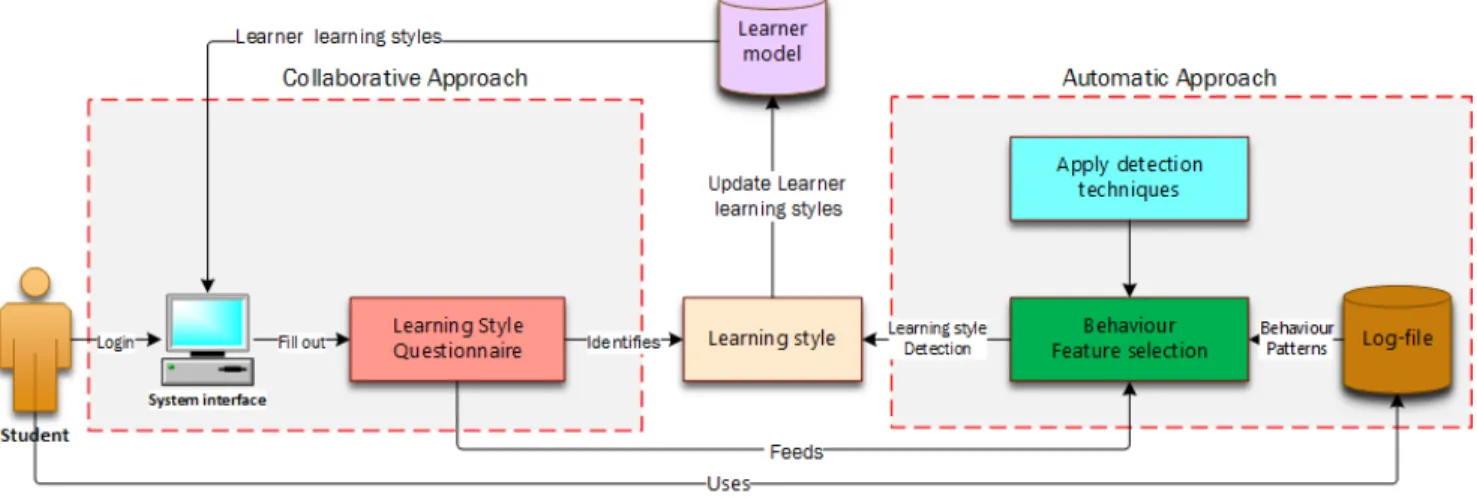
strong preference for a specific learning style have difficulty learning when this learning style is not supported by the teaching environment, such mismatches lead to poor student performance. The challenge of improving adaptive learning processes largely depends on correctly identifying each stu-dent’s learning style. Traditionally, the classical method for detecting learning styles is based on asking students for a test or to fill out a questionnaire (collaborative approach). Despite these traditional techniques’ reliability, they suffer from many limitations that weaken the precision of identifying learning styles. Firstly, student’s boredom to fill out questionnaires, since some of them require extra effort and concentration. Secondly, the questionnaire technique assumes that students are conscious of their learning styles and preferences, which may not always be the case. Two other approaches to identify learning styles automatically are displayed in Fig.1. These automatic approaches include the following:
a) Data-driven approach: This approach is focused on building a model that imitates the Inventory Learning Style questionnaire and uses sample data to develop a model. The common techniques used for the data-driven approach are decision trees, neural networks, fuzzy clustering, and Bayesian networks [12], [13]. b) literature-based approach: This approach uses the
students’ behaviours to identify their learning style preferences. Then, it applies a simple rule-based method to calculate learning styles from behaviours such as the number of matching hints, time spent on learning objects etc. [14], [15], [16], [17].
A. Motivation and problem statement
The motivation for this paper is to build dynamic student profile based on Learning Behaviour Patterns, which is called DPSP (Dynamic Personalised Student Profile) for the purpose of learning style identification. Previous researches on student profile adaptation suffer from many limitations that weaken the precision of identifying learning styles, as follows:
• First, it takes long time in getting the behaviour patterns of students who participate in the online learning and sometimes the patterns of the behaviour obtained from the data are not strong enough [18][19].
Fig. 1. Identification of learning styles and automatic detection of learning styles
• Second, there is uncertainty in student behaviour identification, as well as difficulty and complexity in developing and implementing rules that can infer learning styles effectively from student’s actions.
• Third, current e-learning recommendation systems are not capable of detecting changes in students’ learning styles due to the change in their behaviour patterns. For example CS383 [20], eTeacher [21], and LSAS [5], use questionnaires (a static or collaborative ap-proach). Furthermore, student profiles in these systems are created only once at the course’s beginning without the possibility for later updates [22].
In order to avoid these drawbacks and improve the accuracy of learning styles identification, this research considers student exceptional behaviours and updates student learning styles frequently since they change over time.
B. Expected contributions
This paper makes the following contributions:
• Firstly, a novel algorithm for dynamic student profile adaptation based on the FSLSM learning style model is proposed (Section III).
• Secondly, a new approach is proposed to identify learning behaviour patterns based on the time spent on learning objects, the number of messages exchanged, and the format of the learning objects accessed by the student (Sect. IV).
• Thirdly, a method is proposed to transform learning behaviour patterns into the FSLSM learning style preferences (Sect. V); which are then used to update the student profile dynamically (see Sect. VI). Our algorithm, DPSP, has been implemented in C++ using Visual Studio and Windows Presentation Foundation (WPF) to design the Graphical User Interface (GUI), and evaluated using a real academic case study. The students participated voluntarily in the study from Arab Academy for Science and Technology (AAST) (see Sect. VII).
The rest of this paper is structured as follows. The next sec-tion defines the proposed algorithm’s main concepts. Secsec-tions III and IV describe our proposed algorithm for automatically detecting of learning style through learning behaviour. Sections V and VI describe the student profile adaptation. Section VII presents a case study. Sections VIII and IX present the experimental results and analysis. Related works are discussed in Section X, and Section XI concludes the paper and discusses future directions.
II. BASICCONCEPTS ANDBACKGROUND
In this section, we will introduce concepts that student pro-file construction are based on the Felder-Silverman Learning Style Model (FSLSM) and student modelling.
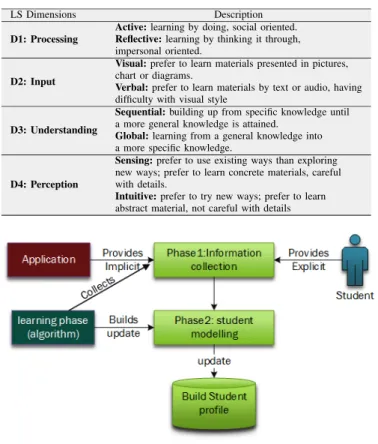
A. Description of the Felder-Silverman learning style model Several authors proposed different definitions for learning style [23], [24], [25]. One study [26] defines learning style as the complex manner in which, and conditions under which, learners most efficiently and most effectively perceive, process, store, and recall what they are attempting to learn. Several learning style theories exist in literature; for example, Kolb [27], Honey and Mumford [28], Dunn and Dunn [29], Myers-Briggs [30], and Felder-Silverman [6]; all have developed learning style models. In our case, we use the Felder and Silverman model [6] for several reasons: First, it is the most widely used in educational systems thanks to its ability to quantify students’ learning styles as displayed in Table II. [31] observes that the FSLSM stands out from other theories by combining the main learning Style (LS) models. Second, it provides comprehensive details of its dimensions (processing, input, understanding, and perception), identifies a teaching style for each dimension, and comes with a reliable and validated learning style assessment tool as shown in Table I. Finally, the FSLSM theory describes students’ learning styles preferences for each dimension that can be strong, moderate, or balanced, based on a scale from +11 to -11 for each dimension. E.g., in visual/verbal dimension, the value +11 means that a learner has a strong preference for visual learning style, whereas the value -11 states that a learner has a strong preference for verbal learning. Felder and A Soloman [32]
TABLE I. FELDER-SILVERMAN’S LEARNING STYLEDIMENSIONS LS Dimensions Description
D1: Processing
Active:learning by doing, social oriented.
Reflective:learning by thinking it through, impersonal oriented.
D2: Input
Visual:prefer to learn materials presented in pictures, chart or diagrams.
Verbal:prefer to learn materials by text or audio, having difficulty with visual style
D3: Understanding
Sequential:building up from specific knowledge until a more general knowledge is attained.
Global:learning from a general knowledge into a more specific knowledge.
D4: Perception
Sensing:prefer to use existing ways than exploring new ways; prefer to learn concrete materials, careful with details.
Intuitive:prefer to try new ways; prefer to learn abstract material, not careful with details
Fig. 2. Student modelling in e-learning systems
developed the Index of Learning Styles (ILS) questionnaire that comprises 44 questions effective in identifying the learning style of each individual student. ILS provides a method of calculating the learning style preferences from the student’s answers to the questionnaire [32], [33].
B. Student modelling
The student model tracks an individual student’s infor-mation in order to adapt itself to the student’s interests and preferences [43]. In this context, [44] states that the student model is considered a critical piece of individualised behaviour in e-learning recommendations, which strongly depend on how the knowledge about the student is modelled internally. The process of building and updating a Student Profile (SP) is called student modelling. Figure 2 highlights the student modelling phases. Student modelling can be classified into static or dynamic modelling as described below:
• Static modelling refers to an approach in which the student model is initialised only once, usually when the student enrols in the system [45].
• Dynamic modellingrefers to an approach that updates the student information, and then allows the system to respond to changes in the student model during the course [45].
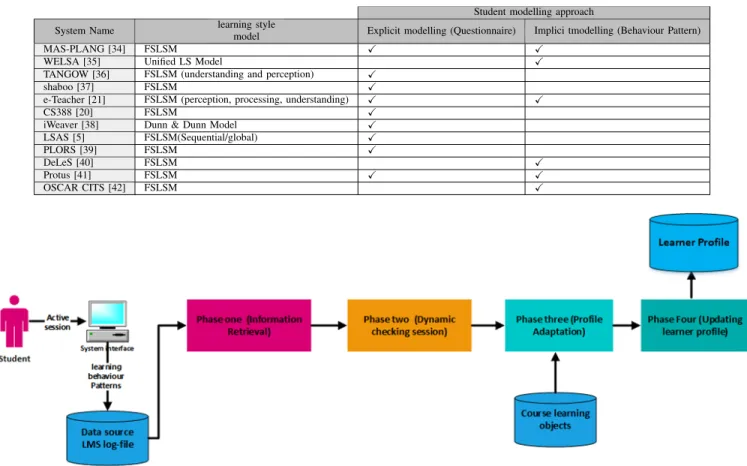
Table II illustrates examples of systems that use an explicit (using questionnaire) or implicit (using behaviour) modelling approach or both. In the next section, the proposed algorithm for the dynamic student profile component is described.
III. CAPTURING ANDMODELLINGDYNAMIC STUDENT
PROFILE
In this section, a study is executed to develop an effective algorithm for building and frequently updating SP learning styles. To achieve this goal, the proposed algorithm observes a student’s behaviour while s/he is taking a course via an e-learning system. The agent records the student’s actions and then it uses these data to build the SP.
Definition 1. (A student profile learning style) is repre-sented by a vector of real values ranging from0to1(or from 0% to 100%) as follows:
LS= [act, ref, vis, ver, seq, glo, sen, int] (1) Example 1: Table III shows some examples of student’s learning style vectors. As stated in Sect. II-A, the SP learning style vector can be calculated using e.g. the learner’s responses to the ILS questionnaire [33].
A. Proposed architecture for dynamic student profile
The proposed model’s overall structure is presented in Fig. 3. The algorithm includes the following basic steps:
• Step 1: Information retrieval. The system log-file is analysed to extract information about the student behaviour such as the time spent by the student on each learning object, the type of learning objects accessed (e.g. video, audio, or text), and the number of messages exchanged (see Sect. IV).
• Step 2: Dynamic checking sessions.In order to build the student profile, we need to observe, process and then learn from student behaviour patterns. Therefore, in this step the student behaviour patterns identified in Step 1 are converted into FSLSM learning style preferences. The result is a feature vector of FSLSM learning style preferences extracted from the student learning behaviour patterns (see Sect. V).
• Step 3: Profile adaptation phase. The student is ob-served over a number of sessions and the correspond-ing feature vectors are aggregated to approximate the student’s current learning style preferences (see Sect. V).
• Step 4: Updating student profile. The current stu-dent’s learning style obtained in Step 3 and the pre-vious student’s learning style are used to calculate a new student learning style which is then stored in the student profile database. The new student learning style will be used to provide students with person-alised course learning objects the next time s/he logs in (see Sect. VI).
The following section describes in detail how the algorithm calculates a student learning style.
IV. STUDENT LEARNING BEHAVIOUR PATTERNS
The algorithm in Fig. 4 calculates a student’s learning style dynamically based on learning behaviour patterns. In order to ensure that the proposed algorithm is general enough to apply to any learning system, it was key to base the approaches
TABLE II. SUMMARY OF STUDENT MODELING APPROACHES IN EXISTING PERSONALISED E-LEANING SYSTEMS CONSIDERING LEARNING STYLES Student modelling approach
System Name learning stylemodel Explicit modelling (Questionnaire) Implici tmodelling (Behaviour Pattern)
MAS-PLANG [34] FSLSM X X
WELSA [35] Unified LS Model X
TANGOW [36] FSLSM (understanding and perception) X
shaboo [37] FSLSM X
e-Teacher [21] FSLSM (perception, processing, understanding) X X
CS388 [20] FSLSM X
iWeaver [38] Dunn & Dunn Model X LSAS [5] FSLSM(Sequential/global) X
PLORS [39] FSLSM X
DeLeS [40] FSLSM X
Protus [41] FSLSM X X
OSCAR CITS [42] FSLSM X
Fig. 3. Architecture for updating student profile dynamically
TABLE III. EXAMPLES OF STUDENT LEARNING STYLE VECTORS
act ref vis ver seq glo sen int Fatima 0.4 0.6 0.35 0.75 0.5 0.5 0.8 0.2
Ali 0.5 0.5 0.6 0.4 0.8 0.2 0.7 0.3
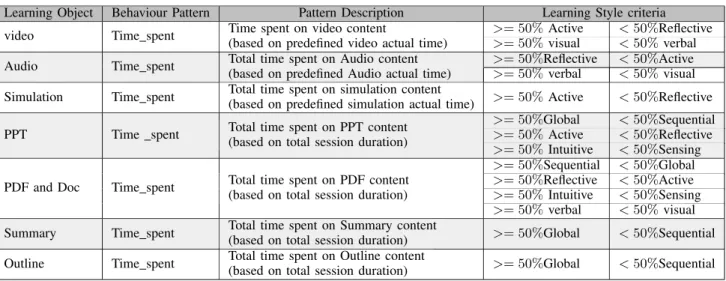
on generic behaviour patterns that can be collected in any learning system. Three variables are used to model the learning behaviour patterns of a student. The first variable is the time spent on each learning object; the second is the number messages sent; and the third is the format of the learning objects accessed during a session. If a student watches more than 50% of a video, then it is more likely that the student is an active learner than a reflective learner. Conversely, if a student spent more than 50% of time on textual documents (e.g. pdf or doc documents), then the student is more likely to be reflective than active. Therefore, the behaviour pattern for time spentWiis calculated as in Eq. (2), for each learning objectLOi. Table IV shows the rules for deciding the learning styles corresponding to a given behaviour pattern.
Wi=
ti
Ti (For Video, Audio, Simulation) ti
T (For PDF, PPT, Doc, Summary, Outline) (2)
Whereti= time spent onLOi,Ti= total duration ofLOi, and
T= total session duration.
Example 2: Table V shows the learning styles of 3 students calculated based on the time they have spent on learning objects.
The number of messages posted in the course discussion forum can indicates a student’s tendency for social orientation, i.e. whether the student is active or reflective. We used the following Eq. (3).
D= Number of messages sent by the student
Average number of messages sent during the sessions (3) The value of D is undefined if no messages have been exchanged during the session. A greater value ofDindicates a stronger positive level of active learning, since active students are likely to post messages more often than passive ones. If the value ofDis greater than or equal1, the student is considered to be active; otherwise the student is reflective.
Example 3: Table VI illustrates the case where 3 students Fatima, Ali, and Clara have exchanged 100 messages through-out the session, i.e. 100/3 = 33.3 messages in average have been sent per student. Fatima is reflective because she has sent less than the average number of messages, while Ali and Clara are active for sending more than the average number of messages during the session.
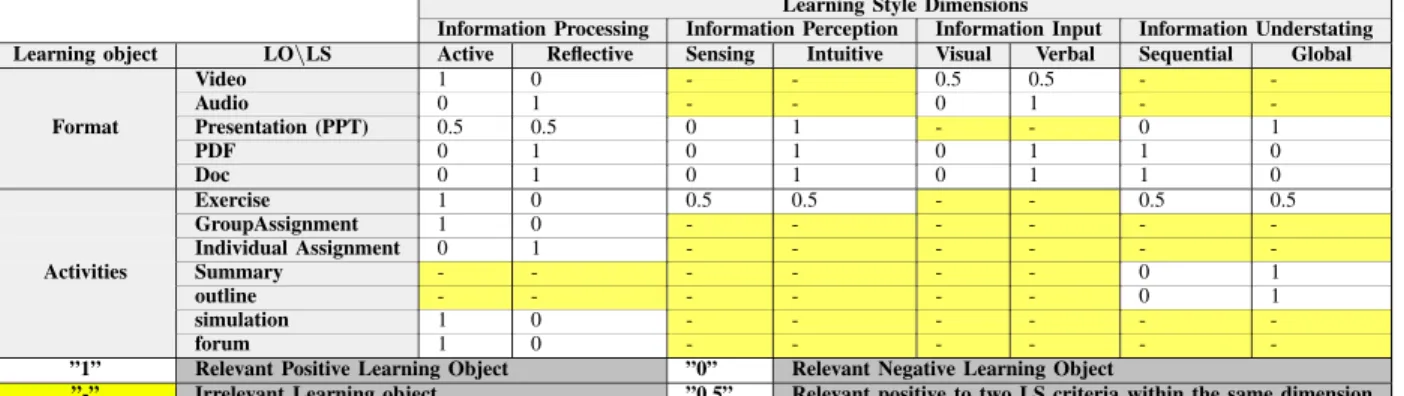
The formats of the learning objects accessed by a student define the learning style of the student as in Table VII. The symbol “-” in yellow cells means that learning objects of that format are irrelevant to the corresponding leaning style attribute. The value 1 indicates the learning style attribute associated to that format in the learning style dimension. The value 0.5 indicates that both learning style attributes of the dimension are associated to that format.
TABLE IV. BEHAVIOURPATTERN BASED ON LEARNING OBJECT TYPE ANDFELDER ANDSILVERMAN Learning Object Behaviour Pattern Pattern Description Learning Style criteria
>= 50%Active <50%Reflective video Time spent Time spent on video content
(based on predefined video actual time) >= 50%visual <50%verbal >= 50%Reflective <50%Active Audio Time spent Total time spent on Audio content
(based on predefined Audio actual time) >= 50%verbal <50%visual Simulation Time spent Total time spent on simulation content
(based on predefined simulation actual time) >= 50%Active <50%Reflective >= 50%Global <50%Sequential >= 50%Active <50%Reflective PPT Time spent Total time spent on PPT content
(based on total session duration)
>= 50%Intuitive <50%Sensing >= 50%Sequential <50%Global >= 50%Reflective <50%Active >= 50%Intuitive <50%Sensing PDF and Doc Time spent Total time spent on PDF content
(based on total session duration)
>= 50%verbal <50%visual Summary Time spent Total time spent on Summary content
(based on total session duration) >= 50%Global <50%Sequential Outline Time spent Total time spent on Outline content
(based on total session duration) >= 50%Global <50%Sequential
TABLE V. ANEXAMPLE OFTIME SPENT
Student (time spent) LO (length) W Learning style
Fatima (30 min) video (40 min) 30/40 = 75% LS = Visual Ali (30 min) PDF (35 min) 30/35 = 85% LS = Verbal Clara (45 min) Audio (60 min) 45/60 = 75% LS = Verbal
TABLE VI. ANEXAMPLE OF FORUMDISCUSSION Student (no. of messages) D Learning style Fatima (25 messages) 25/33.3 = 0.75 LS =Reflective Ali (40 messages) 40/33.3 = 1.20 LS =Active Clara (35 Massages) 35/33.3 = 1.05 LS =Active
Both learning style calculation and student profile adapta-tion are described in the following secadapta-tions.
V. FROM BEHAVIOUR PATTERNS TO LEARNING STYLES
The learning style adaptation algorithm in Fig 4 observes the student behaviours over K sessions and calculates in the vector KSSP the number of hits for each of the 8 learning style attributes according to the student learning behaviour patterns as explained in Sect. IV. For example, KSSP[1] is the number of hits for the learning style “active”, KSSP[2]
is the number of hits for the learning style “reflective”, and KSSP[8] is the number of hits for the learning style “intuitive”, using the same indexing as in Eq. (1).
At the end of the K sessions, the number of hits are normalised in each dimension as in Eq. (4) to obtain the current learning style vectorKSSP N.
fori= 1 : 2 : 8do if (KSSP[i] +KSSP[i+ 1]6= 0) KSSP N[i] = KSSPKSSP[i]+KSSP[i] [i+1] KSSP N[i+ 1] = KSSPKSSP[i]+KSSP[i+1][i+1] else KSSP N[i] = 0 KSSP N[i+ 1] = 0 endif enddo (4)
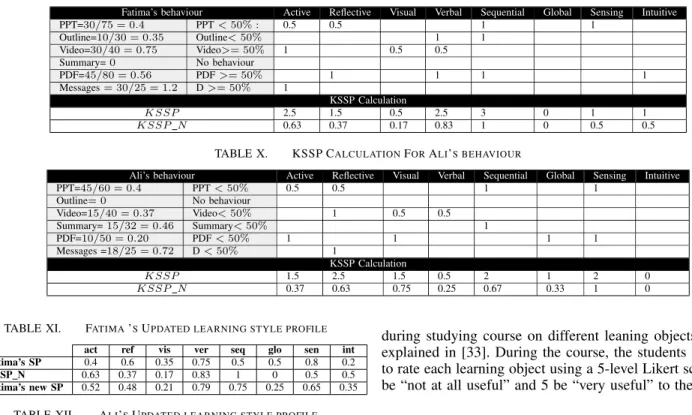
Tables IX and X illustrate how the vectors KSSP and KSSP N are calculated.
VI. UPDATINGSTUDENT PROFILE
The final step is to update dynamically the student profile
SP using the learning style KSSP N calculated during the
K sessions. This is done by calculating the new value of SP
as in Eq. (5). fori= 1 : 8do if (KSSP N[i]6= 0) SP[i] = SP[i]+KSSP N2 [i] endif enddo (5)
That is for each learning style attributei,i= 1,2,· · · ,8, if
KSSP N[i]6= 0, then calculates the new learning style value by taking the average between previous and current learning style values; otherwise keep the previous learning style value. The new student profile SP will be used to recommend personalised learning objects to the student the next time s/he logs in, using the learning style based recommender system proposed in [46].
An important question remains, however: “is the proposed profile adaptation algorithm effective in predicting student learning styles?” The following section illustrates how the algorithm works using a real academic case study.
VII. MODELING A REAL ACADEMIC CASE STUDY
After developing the proposed algorithm, our efforts were focused on modelling a real academic case study to demon-strate how the proposed algorithm works. Participants to the study from AAST were asked to fill out FSLSM questionnaire in order to initialise their profiles as shown in Table III. A. Profile adaptation scenario
The student profile (SP) learning style adaptation algorithm works as follows:
Step 1– Recommend course learning objects according to their similarity to SP learning styles as explained in [46] and in Table VIII.
TABLE VII. MAPPING OFLEARNINGOBJECTS FORMAT AND ACTIVITIES ASFSLSM Learning Style Dimensions
Information Processing Information Perception Information Input Information Understating Learning object LO\LS Active Reflective Sensing Intuitive Visual Verbal Sequential Global
Video 1 0 - - 0.5 0.5 - -Audio 0 1 - - 0 1 - -Presentation (PPT) 0.5 0.5 0 1 - - 0 1 PDF 0 1 0 1 0 1 1 0 Format Doc 0 1 0 1 0 1 1 0 Exercise 1 0 0.5 0.5 - - 0.5 0.5 GroupAssignment 1 0 - - - -Individual Assignment 0 1 - - - -Summary - - - 0 1 outline - - - 0 1 simulation 1 0 - - - -Activities forum 1 0 - - -
-”1” Relevant Positive Learning Object ”0” Relevant Negative Learning Object
”-” Irrelevant Learning object ”0.5” Relevant positive to two LS criteria within the same dimension
T ABLE VIII. E X A M P L E S O F S T U D E N T S ’ B E H A V IO U R P A T T E R N S Learning object F atima’ s Learning beha viour patterns Ali’ s Learning beha viour patterns F ormat LO total time F atima’ s spent time Session Duration Ali’ s spent time Session Duration Session 1 ppt 30 mins 75 mins 45 mins 60 mins Session 2 Outline 10 mins 30 mins 0 0 Session 3 V ideo 40 mins 30 mins 20 mins Session 4 Summary 0 0 15 mins 32 mins Session 5 PDF 45 mins 80 mins 10 mins 50 mins T otal Number of messages during session Messages sent by F atima Messages sent by Ali Discussion F orum Discussion 200 30 18
case K=5). Table VIII depicts a sample from Fatima and Ali learning behaviour patterns.
Step 3– Apply adaptation rules as illustrated in Table IV and Table VII. First, the algorithm calculates the total time spent by Fatima and Ali on Learning objects (see Sect.IV). Second, it calculates the number of messages sent by Fatima and Ali during the sessions as illustrates in Table VIII. The average number of messages is 200/8 = 25, where 8 is the total number of participants during the forum discussion (See Sect. IV). Then,KSSP andKSSP N are calculated as shown in Table IX and Table X, for Fatima and Ali respectively.
Step 4 – Update Fatima’s and Ali’s profiles with the new learning styles as shown in Table XI and Table XII.
In order to evaluate the effectiveness of the proposed algorithm, the updated SPs are used to predict the students’ ratings of the learning objects in the following section.
VIII. STUDENT RATINGS PREDICTION BASED ON STUDENT LEARNING STYLE
This section presents an experimental student rating pre-diction algorithm. We aim to demonstrate that our approach on dynamic student profile adaptation can effectively capture student learning styles from their behaviour pattern and can be used as part of e-learning recommendation system to provide more effective and accurate course learning objects to students. Let LS be the learning style vector of the active student. The recommender algorithm is described in the following four steps:
Step 1 – Calculate C, the nearest learning object cluster to the active student learning style (LS) by using the cosine similarity metric: This result is achieved by calculating the similarity degree between LS and the centroid of each cluster and then choosing the cluster that produces the highest similarity degree using cosine similarity defined in Eq. (6).
c(x, y) = x.y
||x||.||y|| (6)
Step 2 – Calculate the similarity degree between LS and each learning object in C using the Pearson correlation coefficient similarity metric: For all OP ∈ C, calculate
P(LS, OP) using Pearson correlation coefficient in Eq. (7).
P(x, y) = Pn i=1(xi−x) (y¯ i−y)¯ q Pn i=1(xi−x)¯ 2qPn i=1(yi−y)¯ 2 (7)
Step 3– Select the top-n learning objects most similar to LS: The number of selected learning objects can be a chosen constant or determined using a similarity threshold.
Step 4 – Predict the Student’s ratings of the top-n learning objects: A 5-level Likert scale is considered where 1 is the lowest score and 5 is the highest score. The student’s ratings of the learning objects are predicted using Eq. (8).
˜
r(LS, OPi) =int(0.5 +Sim2(LS, OPi)×5), 1≤i≤n (8) wherer(LS, OP˜ i)is the predicted rating of the learning object (Profile) OPi for the active student LS and int(x) denotes the closest integer to the real value x; e.g. int(2.3) = 2
TABLE IX. KSSP CALCULATIONFORFATIMA’S BEHAVIOUR
Fatima’s behaviour Active Reflective Visual Verbal Sequential Global Sensing Intuitive
PPT=30/75 = 0.4 PPT<50% : 0.5 0.5 1 1 Outline=10/30 = 0.35 Outline<50% 1 1 Video=30/40 = 0.75 Video>= 50% 1 0.5 0.5 Summary=0 No behaviour PDF=45/80 = 0.56 PDF>= 50% 1 1 1 1 Messages= 30/25 = 1.2 D>= 50% 1 KSSP Calculation KSSP 2.5 1.5 0.5 2.5 3 0 1 1 KSSP N 0.63 0.37 0.17 0.83 1 0 0.5 0.5
TABLE X. KSSP CALCULATIONFORALI’S BEHAVIOUR
Ali’s behaviour Active Reflective Visual Verbal Sequential Global Sensing Intuitive
PPT=45/60 = 0.4 PPT<50% 0.5 0.5 1 1 Outline= 0 No behaviour Video=15/40 = 0.37 Video<50% 1 0.5 0.5 Summary=15/32 = 0.46 Summary<50% 1 PDF=10/50 = 0.20 PDF<50% 1 1 1 1 Messages =18/25 = 0.72 D<50% 1 KSSP Calculation KSSP 1.5 2.5 1.5 0.5 2 1 2 0 KSSP N 0.37 0.63 0.75 0.25 0.67 0.33 1 0
TABLE XI. FATIMA’SUPDATED LEARNING STYLE PROFILE
act ref vis ver seq glo sen int Fatima’s SP 0.4 0.6 0.35 0.75 0.5 0.5 0.8 0.2
KSSP N 0.63 0.37 0.17 0.83 1 0 0.5 0.5
Fatima’s new SP 0.52 0.48 0.21 0.79 0.75 0.25 0.65 0.35
TABLE XII. ALI’SUPDATED LEARNING STYLE PROFILE
act ref vis ver seq glo sen int Ali’s SP 0.5 0.5 0.6 0.4 0.8 0.2 0.7 0.3
KSSP N 0.37 0.63 0.75 0.25 0.67 0.33 1 0
Ali’s new SP 0.44 0.56 0.68 0.32 0.73 0.27 0.85 0.15
actual ratings of LOs with the predicted ratings based on questionnaire (initial student profile)(SL1s)and the predicted student ratings based on the adapted student profile (LS2s). The next section presents experimental results.
IX. EXPERIMENTATION
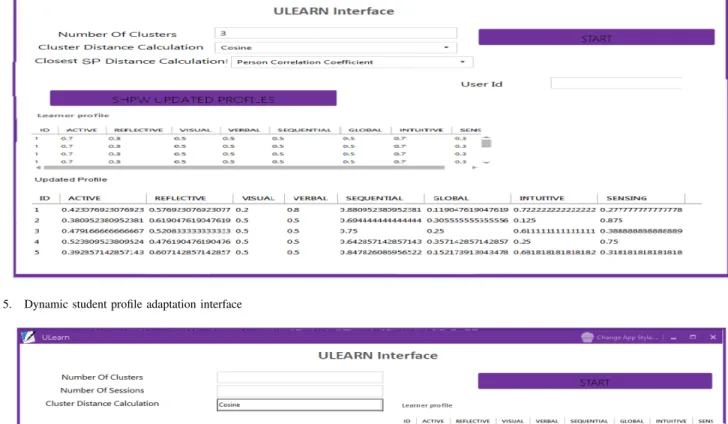
In this section, we have conducted a set of experiments to set the parameters and examine our proposed algorithm’s effectiveness in terms of updated SP accuracy. The profile adaptation algorithm and student ratings prediction algorithm were implemented in C++ using Visual Studio and Windows Presentation Foundation (WPF) to design the graphical user interface (GUI) as displayed in Fig. 5 and Fig. 6. All the experiments are run on a Windows-based PC with an Intel core i5 processor that has a speed of 2.40 GHz and 16GB of RAM.
A. Dataset description
To measure the effectiveness of our proposed algorithm, we conducted an experiment in the school of business at the Arab Academy for Science and Technology (AAST). The learners’ behaviour data were collected from AAST MOODLE log-file. A total of 80 students participated to this study. It should be noted that this dataset is of similar size or larger than those used in related works: [42] used 75-95 students, [16] used 77 students, [47] used 75 students, [48] used 40 students and [18] used 49 students. First, students filled in the ILS questionnaire developed by FSLSM as explained in [33]. Second, we collected students’ behaviour patterns
during studying course on different leaning objects format as explained in [33]. During the course, the students were asked to rate each learning object using a 5-level Likert scale; with 1 be “not at all useful” and 5 be “very useful” to their learning. B. Evaluation metrics
To evaluation the accuracy of the adaptation algorithm, 2 metrics were used to calculate the accuracy of the learning styles detection: the Mean Absolute Error (MAE) and the Root Mean Squared Error (RMSE). Both metrics measure the average magnitude of the errors in a set of predictions, without considering their direction. They range from 0 to∞ and the smaller their value, the greater the accuracy. They are defined by Eq. (9) and Eq. (10), where ri is the actual student rating of the learning object i and˜riis is the predicted student rating for that learning object,1≤i≤n.
MAE= 1 n n X i=1 |ri−r˜i| (9) RMSE= v u u t 1 n n X i=1 (ri−r˜i)2 (10)
RMSE is useful to detect large errors in the prediction that may not be observed through MAE.
C. Experimental result and discussion
It was found that the proposed adaption algorithm improves the learning style prediction results in all learning styles dimensions compared to ILS questionnaire of a random sample of 80 students during studying 3 topics and each topic includes 3 lessons. Based on these findings, it can be concluded that monitoring learners’ behaviour with time spent on different learning objects’ format can improve the accuracy of detecting students’ learning styles in an e-learning recommendation system. Thus, this adaptation algorithm can help an e-learning recommendation system improve student performance by rec-ommending the most suitable course learning objects to match their learning styles. Experimental results show that the student
Fig. 5. Dynamic student profile adaptation interface
Fig. 6. Student Ratings Prediction interface
rating prediction algorithm has the best accuracy when the student profile is adapted through behaviour(LS2s)compared
to ILS questionnaire (SL1s)as it can be seen in Fig. 7 and Fig. 8 according to the evaluation metrics MAE and RMSE respectively.
X. CRITICAL LITERATURE OVERVIEW
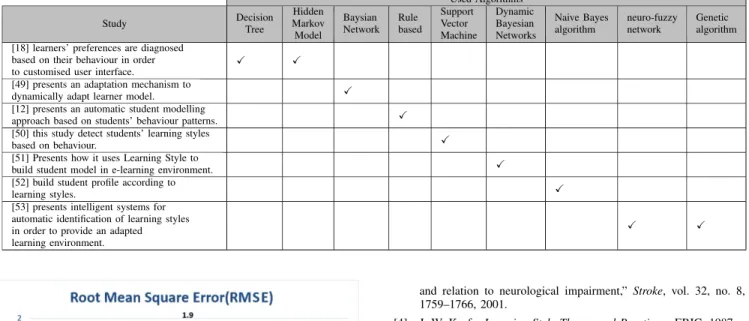
This section presents a review of the existing literature relevant to this study with a focus on a brief overview of common techniques used to automatic students learning styles identification based on their learning behaviour patterns as revealed in Table XIII.
XI. CONCLUSIONS AND FUTURE WORK
Personalised learner profile is increasingly becoming an important area of research in e-learning recommendation systems in which each learner’s preferences, interests and contextual information are studied in details. Characteristics
Fig. 7. Accuracy of the adaptation algorithm using MAE
of learning style play vital role in the identification of the learner’s learning style preferences. This paper introduced an algorithm for a dynamic student profile based on the
Felder-TABLE XIII. ACOMPARISON BETWEEN EXISTING LEARNING STYLES DETECTION APPROACHES Used Algorithms Study Decision Tree Hidden Markov Model Baysian Network Rule based Support Vector Machine Dynamic Bayesian Networks Naive Bayes algorithm neuro-fuzzy network Genetic algorithm [18] learners’ preferences are diagnosed
based on their behaviour in order
to customised user interface. X X [49] presents an adaptation mechanism to
dynamically adapt learner model. X [12] presents an automatic student modelling
approach based on students’ behaviour patterns. X [50] this study detect students’ learning styles
based on behaviour. X
[51] Presents how it uses Learning Style to
build student model in e-learning environment. X
[52] build student profile according to
learning styles. X
[53] presents intelligent systems for automatic identification of learning styles in order to provide an adapted learning environment.
X X
Fig. 8. Accuracy of the adaptation algorithm using RMSE
Silverman learning style model. The algorithm aims at building and frequently updating SPs’ learning styles based on students’ behaviour in an online course. It relies on three major steps: the first step is based on extracting student learning behaviour patterns that reflect learning styles from MOODLE log file; the second step attempts to calculate student learning styles; finally, the third step is to update students’ learning styles dynamically after each topic. Experimental results prove that the proposed algorithm is more accurate than the results obtained using the LS questionnaire. As a future work, we will extend the algorithm to additionally update SPs based on other similar student learning styles and ratings. Furthermore, the collection of patterns is planned to be extended related to additional types of learning objects and activities.
REFERENCES
[1] C. C. Chen, M. C. Chen, and Y. Sun, “Pva: A self-adaptive personal view agent,”Journal of Intelligent Information Systems, vol. 18, no. 2-3, pp. 173–194, 2002.
[2] V. Challam, S. Gauch, and A. Chandramouli, “Contextual search using ontology-based user profiles,” in Large Scale Semantic Access to Content (Text, Image, Video, and Sound). LE CENTRE DE HAUTES ETUDES INTERNATIONALES D’INFORMATIQUE DOC-UMENTAIRE, 2007, pp. 612–617.
[3] J. Montaner, J. Alvarez-Sab´ın, C. Molina, A. Angl´es, S. Abilleira, J. Arenillas, M. A. Gonz´alez, and J. Monasterio, “Matrix metallopro-teinase expression after human cardioembolic stroke: temporal profile
and relation to neurological impairment,” Stroke, vol. 32, no. 8, pp. 1759–1766, 2001.
[4] J. W. Keefe,Learning Style Theory and Practice. ERIC, 1987. [5] N. Bajraktarevic, W. Hall, and P. Fullick, “Incorporating learning styles
in hypermedia environment: Empirical evaluation,” inProceedings of the workshop on adaptive hypermedia and adaptive web-based systems, no. 1999, 2003, pp. 41–52.
[6] R. M. Felder, L. K. Silverman et al., “Learning and teaching styles in engineering education,”Engineering education, vol. 78, no. 7, pp. 674–681, 1988.
[7] S. Graf, C. H. Lan, T.-C. Liuet al., “Investigations about the effects and effectiveness of adaptivity for students with different learning styles,” in Advanced Learning Technologies, 2009. ICALT 2009. Ninth IEEE International Conference on. IEEE, 2009, pp. 415–419.
[8] E. Alfonseca, R. M. Carro, E. Mart´ın, A. Ortigosa, and P. Paredes, “The impact of learning styles on student grouping for collaborative learning: a case study,” User Modeling and User-Adapted Interaction, vol. 16, no. 3-4, pp. 377–401, 2006.
[9] S. Graf, T.-C. Liu, and K. Kinshuk, “Interactions between students learning styles, achievement and behaviour in mismatched courses,” in Proceedings of the international conference on cognition and ex-ploratory learning in digital age (CELDA 2008). IADIS International Conference. Citeseer, 2008, pp. 223–230.
[10] W. A. Taylor, “Computer-mediated knowledge sharing and individual user differences: an exploratory study,”European journal of information systems, vol. 13, no. 1, pp. 52–64, 2004.
[11] S. Grafet al., “Using cognitive traits for improving the detection of learning styles,” inDatabase and Expert Systems Applications (DEXA), 2010 Workshop on. IEEE, 2010, pp. 74–78.
[12] S. Graf and S. Viola, “Automatic student modelling for detecting learning style preferences in learning management systems,” inProc. international conference on cognition and exploratory learning in digital age, 2009, pp. 172–179.
[13] N. Ahmad, Z. Tasir, J. Kasim, and H. Sahat, “Automatic detection of learning styles in learning management systems by using literature-based method,”Procedia-Social and Behavioral Sciences, vol. 103, pp. 181–189, 2013.
[14] P. Q. Dung and A. M. Florea, “A literature-based method to auto-matically detect learning styles in learning management systems,” in
Proceedings of the 2nd International Conference on Web Intelligence, Mining and Semantics. ACM, 2012, p. 46.
[15] S. Graf, T.-C. Liu et al., “Identifying learning styles in learning management systems by using indications from students’ behaviour,” in Advanced Learning Technologies, 2008. ICALT’08. Eighth IEEE International Conference. IEEE, 2008, pp. 482–486.
[16] P. Garc´ıa, A. Amandi, S. Schiaffino, and M. Campo, “Evaluating bayesian networks precision for detecting students learning styles,”
[17] N. Atman, M. M. Inceo˘glu, and B. G. Aslan, “Learning styles diagnosis based on learner behaviors in web based learning,” in International Conference on Computational Science and Its Applications. Springer, 2009, pp. 900–909.
[18] H. J. Cha, Y. S. Kim, S. H. Park, T. B. Yoon, Y. M. Jung, and J.-H. Lee, “Learning styles diagnosis based on user interface behaviors for the customization of learning interfaces in an intelligent tutoring system,” inInternational Conference on Intelligent Tutoring Systems. Springer, 2006, pp. 513–524.
[19] O. S¸ims¸ek, N. Atman, M. M. ˙Inceo˘glu, and Y. D. Arikan, “Diagnosis¨ of learning styles based on active/reflective dimension of felder and silvermans learning style model in a learning management system,” in
International Conference on Computational Science and Its Applica-tions. Springer, 2010, pp. 544–555.
[20] C. A. Carver, R. A. Howard, and W. D. Lane, “Enhancing student learning through hypermedia courseware and incorporation of student learning styles,” IEEE transactions on Education, vol. 42, no. 1, pp. 33–38, 1999.
[21] S. Schiaffino, P. Garcia, and A. Amandi, “eteacher: Providing person-alized assistance to e-learning students,” Computers and Education, vol. 51, no. 4, pp. 1744–1754, 2008.
[22] E. Popescu, “Diagnosing students’ learning style in an educational hypermedia system,” in Cognitive and emotional processes in Web-based education: Integrating human factors and personalization. IGI Global, 2009, pp. 187–208.
[23] Y. Akbulut and C. S. Cardak, “Adaptive educational hypermedia ac-commodating learning styles: A content analysis of publications from 2000 to 2011,”Computers and Education, vol. 58, no. 2, pp. 835–842, 2012.
[24] M. S. Zywno, “A contribution of validation of score meaning for felder-soloman’s,” in Index of Learning Styles, Proc. 2003 Annual ASEE Conference, ASEE. Citeseer, 2003.
[25] R. M. Felder and J. Spurlin, “Applications, reliability and validity of the index of learning styles,”International journal of engineering education, vol. 21, no. 1, pp. 103–112, 2005.
[26] B. L. Brown, “Learning styles and vocational education practice. practice application brief.” 1998.
[27] D. Kolb, “Experiential learning as the science of learning and develop-ment,” 1984.
[28] P. Honey and A. Mumford, “The manual of learning styles (maidenhead, mcgraw-hill),” 1982.
[29] R. Dunn and K. Dunn, “Learning style as a criterion for placement in alternative programs,” The Phi Delta Kappan, vol. 56, no. 4, pp. 275–278, 1974.
[30] I. B. Myers, “The myers-briggs type indicator: Manual,” 1962. [31] T.-C. Liu, S. Grafet al., “Coping with mismatched courses: students
behaviour and performance in courses mismatched to their learning styles,”Educational Technology Research and Development, vol. 57, no. 6, p. 739, 2009.
[32] M. R. Felder and B. A Soloman, “Index of learning styles question-naire,” in https://www.webtools.ncsu.edu/learningstyles/ (accessed 05 October 2018), 1999.
[33] S. Nafea, F. Siewe, and Y. He, “Ulearn: Personalised learners profile based on dynamic learning style questionnaire,” in Proceedings of Intelligent Systems(IntelliSys). IEEE, 2018, pp. 1257–1264. [34] C.-I. Pe˜na, J.-L. Marzo, and J.-L. de la Rosa, “Intelligent agents in a
teaching and learning environment on the web,” inProceedings of the international conference on advanced learning technologies. IEEE Learning Technology Task Force. Palmerston North, NZ, 2002, pp. 21– 27.
[35] E. Popescu, C. Badica, and L. Moraret, “Accommodating learning styles in an adaptive educational system,”Informatica, vol. 34, no. 4, 2010. [36] P. Paredes and P. Rodriguez, “A mixed approach to modelling learning
styles in adaptive educational hypermedia,”Advanced Technology for Learning, vol. 1, no. 4, pp. 210–215, 2004.
[37] S. Baldiris, R. Fabregat, C. Mej´ıa, and S. G´omez, “Adaptation decisions and profiles exchange among open learning management systems based on agent negotiations and machine learning techniques,” inInternational Conference on Human-Computer Interaction. Springer, 2009, pp. 12– 20.
[38] C. Wolf, “iweaver: towards learning style-based e-learning in computer science education,” inProceedings of the fifth Australasian conference on Computing education, vol. 20. Australian Computer Society, Inc., 2003, pp. 273–279.
[39] H. Imran, M. Belghis-Zadeh, T.-W. Chang, S. Grafet al., “Plors: a personalized learning object recommender system,”Vietnam Journal of Computer Science, vol. 3, no. 1, pp. 3–13, 2016.
[40] S. Graf, “Adaptivity in learning management systems focussing on learning styles,” 2007.
[41] A. Klaˇsnja-Mili´cevi´c, B. Vesin, M. Ivanovi´c, and Z. Budimac, “E-learning personalization based on hybrid recommendation strategy and learning style identification,”Computers & Education, vol. 56, no. 3, pp. 885–899, 2011.
[42] A. Latham, K. Crockett, D. McLean, and B. Edmonds, “A conver-sational intelligent tutoring system to automatically predict learning styles,”Computers and Education, vol. 59, no. 1, pp. 95–109, 2012. [43] G. Araniti, P. De Meo, A. Iera, and D. Ursino, “Adaptively controlling
the qos of multimedia wireless applications through” user profiling” techniques,” IEEE Journal on Selected Areas in Communications, vol. 21, no. 10, pp. 1546–1556, 2003.
[44] J. E. Thompson, “Student modeling in an intelligent tutoring system,” AIR FORCE INST OF TECH WRIGHT-PATTERSON AFB OH, Tech. Rep., 1996.
[45] S. Graf, C. Iveset al., “A flexible mechanism for providing adaptivity based on learning styles in learning management systems,” inAdvanced Learning Technologies (ICALT), 2010 IEEE 10th International Confer-ence on. IEEE, 2010, pp. 30–34.
[46] S. Nafea, F. Siewe, and Y. He, “A novel algorithm for course learning object recommendation based on student learning styles,” 2019. [47] J. Bernard, T.-W. Chang, E. Popescu, and S. Graf, “Learning style
identifier: Improving the precision of learning style identification through computational intelligence algorithms,” Expert Systems with Applications, vol. 75, pp. 94–108, 2017.
[48] E. ¨Ozpolat and G. B. Akar, “Automatic detection of learning styles for an e-learning system,”Computers and Education, vol. 53, no. 2, pp. 355–367, 2009.
[49] S. Alkhuraiji, B. Cheetham, and O. Bamasak, “Dynamic adaptive mechanism in learning management system based on learning styles,” inAdvanced Learning Technologies (ICALT), 2011 11th IEEE Interna-tional Conference on. IEEE, 2011, pp. 215–217.
[50] E. S. Amir, M. Sumadyo, D. I. Sensuse, Y. G. Sucahyo, and H. B. San-toso, “Automatic detection of learning styles in learning management system by using literature-based method and support vector machine.” IEEE Press, 2016, pp. (41–144).
[51] D. Kelly and B. Tangney, “’first aid for you’: getting to know your learning style using machine learning,” in Advanced Learning Tech-nologies, 2005. ICALT 2005. Fifth IEEE International Conference on. IEEE, 2005, pp. 1–3.
[52] C. Carmona, G. Castillo, and E. Mill´an, “Designing a dynamic bayesian network for modeling students’ learning styles,” in2008 Eighth IEEE International Conference on Advanced Learning Technologies. IEEE, 2008, pp. 346–350.
[53] R. Zatarain, L. Barr´on-Estrada, C. A. Garc´ıa, and O. F. Reyes-Galaviz, “Applying intelligent systems for modeling students learning styles used for mobile and web-based systems,” inSoft Computing for Intelligent Control and Mobile Robotics. Springer, 2010, pp. 3–22.