The Drosophila
zeste
Locus
Is
Nonessential
Michael L. Goldberg, Richard A. Colvin and Andrew F. Mellin
Section of Genetics and Development, Cornell University, Ithaca, New York 14853-2703
Manuscript received March 13, 1989 Accepted for publication June 5 , 1989
ABSTRACT
Diepoxybutane-induced mutations of the Drosophila zeste locus were generated in an effort to obtain a null allele. Of 33 mutations of this X-linked gene isolated, 16 were associated with multilocus deletions of zeste and adjacent complementation groups, while the remainder were defects restricted to zeste undetectable by Southern blot analysis. Two of these multilocus deletions (Df(l)~~‘*~ and
Of( l)zd”92) were employed in the synthesis of females completely deleted for zeste. Such “zesteless” flies were produced, though at frequencies lower than Mendelian expectations. zeste-deleted females are fertile, and can give rise to zeste-deleted female progeny. These results demonstrate that the
product of the zeste gene is not essential to viability or to female fertility, even if absent both as a maternal contribution and as a product of the zygotic genome. However, the possibility that zeste may influence relative viability cannot be excluded. In spite of previous in vitro indications that the zeste protein may activate transcription of the Ultrabithorax (Ubx) gene, zeste -deleted flies are Ubx+ in phenotype. This suggests that the zeste protein normally is either a very weak transcription factor, or that its function can be substituted by that of other regulatory proteins.
T
HE zeste (z) locus of Drosophila melanogaster reg- ulates the expression of at least three target genes: white (w), decapentaplegic (dpp), and the Ultrabithorax (Ubx) gene of the bithorax complex (BX-C). Activity of the zeste locus product is also intimately involved in the phenomenon of transvec- tion, or pairing-dependent gene expression, which has been observed at each of these three target loci (LEWIS1954;JACK andJuDD 1979; GELBART 1982; GELBART and Wu 1982). Transvection effects are of consider- able interest as their existence implies that regulatory signals can be transmitted in trans between the copies of a gene present on homologous chromosomes in a diploid organism.
T h e relationship between zeste and transvection phenomena is perhaps best illustrated through the interaction of the z’ allele of zeste with the white (w) locus. T h e z J mutation yields aberrant yellow eye color in the presence of two paired copies of the w+ gene, but if synapsis between chromosomal regions contain- ing these w+ genes is prevented, wild-type bright red eye color results (GANS 1953; JACK and JUDD 1979). This difference in pigmentation is associated with reduction in the accumulation of white mRNA mole- cules in the heads of yellow-eyed flies (BINGHAM and
ZACHAR 1985). Furthermore, reactivity of paired white genes to z J depends upon sequences located upstream of the start of white transcription (GREEN 1959; DAVISON et al. 1985; LEVIS, HAZELRIGG and
of page charges. This article must therefore be hereby marked “advertisement”
T h e publication costs of this article were partly defrayed by the payment in accordance with 18 U.S.C. $ 1 7 3 4 solely to indicate this fact.
Genetics 123: 145-155 (September, 1989)
RUBIN 1985; PIRROTTA, STELLAR and BOZETTI 1985). Recent experiments have shown that the protein en- coded by the zeste locus specifically binds to these upstream sequences at white (BENSON and PIRROTTA
1987; MANSUKHANI et al. 1988b). Presumably, bind- ing of the zeste product (or of the mutant
zJ
product) modifies the level of white transcription. At least in vitro, addition of wild-type zeste protein increases the rate of transcription from the Ubx promoter (BIGGIN et al. 1988).The null state of zeste: Further attempts to under- stand the normal function of the zeste gene product have been hampered by uncertainty concerning the null state of zeste. In addition to z J , several different kinds of mutations at zeste have been described. T h e genetic behavior of the za group of alleles displays properties expected for a null mutation (KAUFMAN, TASAKA and SUZUKI 1973). For example, both z“ lesions and deficiencies for the region containing zeste are recessive to z+ and to z’. Thus, in an otherwise normal background, z“/z+ and
Df(z)/z+
flies have wild- type red eyes, while za/zl and Df(z)/ZJ animals have yellow eyes.Other aspects of z“-like mutations are more difficult to reconcile with the view that they are completely deficient for zeste activity. For example, though in vitro experiments indicate that zeste protein may serve as a transcriptional activator of Ubx (BIGGIN et al.
type, instead of mutant, eye color. Finally, recent molecular analyses suggest that za mutations could encode products which potentially retain some activity as a transcriptional regulator (GUNARATNE et al. 1986; PIRROTTA et al. 1987; MANSUKHANI et al. 1988a, b). A domain of t h e zeste protein near the N terminus is necessary and sufficient for its site-specific DNA bind- ing properties; no currently characterized zeste muta- tion would result in alteration of this domain. An adjacent acidic region of the protein, which might
have transcriptional activation function, is similarly unaffected by these mutations (MANSUKHANI et al.
1988a, b).
As it is unclear whether za or other known alleles characterize the null state of zeste, it has been difficult
to determine the i n vivo role of its product. For
example, zeste protein activity might be required for
viability or fertility. Whether or not absence (as op- posed to a mutant form) of t h e zeste product might influence the expression of identified target genes such as white and Ubx has similarly been in question. In this paper, we report experiments designed to generate Drosophila completely deficient for t h e zeste
locus. O u r results indicate that the zeste product is nonessential for viability or female fertility. Flies de-
leted for zeste are Ubx+ in phenotype, in spite of its in vitro activity as a transcriptional enhancer of Ubx
expression.
MATERIALS AND METHODS
Drosophila culture conditions and stocks: Unless indi- cated otherwise, Drosophila cultures were raised at 22" on standard yeast glucose medium (ASHBURNER and THOMPSON
1978).
Visible markers: The cu f and y x' spl sn stocks used in the mutagenesis were from the collection of ROSS MACINTYRE, Cornell University, Ithaca, New York. The strain z'
D p ( l ; l ) w + " , containing a tandem duplication of approxi- mately 80 kb of DNA containing the proximal part of the
white locus, was the gift of M. M. GREEN, University of California, Davis. Because of the duplication, both males and females of this strain display the z' eye color (GREEN
1963; GOLDBERG et al. 1983). Descriptions of all other visible mutations can be found in LINDSLEY and GRELL (1968).
Deficiencies: The previously characterized chromosome deficiencies Df(1)w'J' (breakpoints 3A3,4; 3C1,3) and Df(1)64c4 (breakpoints 3A3,4; 3C3,5) are described in LINDSLEY and GRELL (1968), and were obtained from BURKE JUDD, NIEHS, Research Triangle Park, North Car- olina.
Lethals in the zeste-white region: Alleles of most lethal complementation groups in the zeste-white region
UUDD,
SHEN and KAUFMAN 1972) were also obtained from B. JUDD.l ( l ) z w l 3 was provided by LEONARD ROBBINS, Michigan State University, East Lansing; and l ( l ) g t x l ' was from
MARIANA WOLFNER, Cornell University, Ithaca, New York.
Y chromosome derivatives: The Y chromosome derivatives
w+
.
Y and y+w+B" Y , both of which carry duplications of the zeste-white interval, are described in LINDLEY and GRELL (1968), and were obtained from B. JUDD and M. M. GREEN, respectively.Balancer chromosomes: FM7a = In( 1)sc"
+
15D-E; 20A-E+
dl-49, y3Id sc' w' uU B (MERRIAM 1968).Cy0 = In(2LR)O, Cy dp'"' c14 p r cn2 (KOTARSKI, PICKERT and MACINTYRE 1983).
Gla = Zn(2LR)GEa.
T M 3 = In(3LR) y+ ri P p sep bxJ4' e', Sb Ser.
Complete descriptions of balancer chromosomes are found in LINDSLEY and GRELL (1968) and LINDSLEY and
ZIMM (1987). All balancers were obtained from R. MAC-
INTYRE.
Transposons: Stocks carrying the second chromosome transposon insertions P [ r y + , t k ~ + ] ~ ~ . , and P[ry+,tko+],,,., were obtained from C. ROYDEN, University of California, San Francisco, and are described in ROYDEN, PIRROTTA andJAN (1987). A strain carrying the transposon P[z+Isl, a 5.8-kb EcoRI fragment encompassing the zeste gene inserted into region 63C,D of chromosome 3, was previously described (GUNARATNE et al. 1986).
Isolation of diepoxybutane-induced zeste mutations: co f / Y males less than 2 days old were fed the chemical mutagen
diepoxybutane (DEB; Sigma) at a concentration of 10 mM in a 1 % sucrose solution for 24 hr, according to the protocol of CROSBY and MEYEROWITZ (1986). Treated males were mated with y z' s p l sn virgin females; 30 males and 30 females were added to each bottle, which were brooded 3 times at 3-day intervals. Progeny without lesions induced at
zeste include red-eyed y z' spl sn/Y males and red-eyed y z' spl s n / ( z + ) cuffemales. Female progeny showing some yellow pigmentation in either or both eyes were selected as poten- tial zeste null mutants, as z ' / D f ( l ) z females are yellow-eyed. Females with potential novel zeste mutations were mated with y z' spl sn males to resolve mosaics. Of the 96 strains identified, only 33 were found to transmit the aberrant eye color. All of these 33 mutations were inde endent, with the possible exception of Df( 1)zduby2 and Of( 1 ) ~ ' ~ ~ ' " . Yellow-eyed
y+ spl' females of the second generation were then crossed to FM7a/Y males to establish stocks; strains with male viable zeste mutations were later preserved as homozygotes.
Complementation analysis: Each male inviable novel zeste mutation ( z d r b * ) was tested by complementation crosses to establish whether lethal loci adjacent to zeste ( l ( l ) z w , ) were also affected. Females of genotype zdPb*/FM7a were crossed with I( I)zw,/w+.Y males in vials. The absence of any Bar+ females in more than 50 progeny was used as the criterion for failure to complement the lethal gene tested. The absence of zdeb*/w+.Y males among the progeny sug- gests that zdcb* is either a deletion extending beyond the borders of the w + - Y translocation, or that the X chromosome carries a second lethal hit outside of the zeste region. These possibilities could be distinguished by subsequent crosses of
zdeb*/FM7a females to Df(l)w'J'/y+w+B'. Y males; the eclosion of zdeb*/Df( 1 ) ~ " ' female ro en indicates that no essential genes near zeste on the z chromosome are defective.
Cytology: Temporary larval salivary gland squashes were made by dissecting the glands of zdcb*/w+.Y males or zdeb*/
zdeb* females according to the method of KOTARSKI, PICKERT and MACINTYRE (1983). Prior to squashing, a drop of 2% orcein-0.25% carmine stain in 50% propionic acid was added to the dissected gland. The cytology of mutants was compared to that of cu f parental males and to the map of LEFEVRE (1 976).
Synthesis of zeste-deleted females: The cross scheme used for the construction of flies deficient for the zeste locus in outlined on Figure 1. Starting material included: FM7a/ FM7a females; CyO/Gla (second chromosome balancers used to track the P[ry+,tko+] transposons) males; P[ry+,tko+]2z.1/
Cy0 and P [ r y + , t k ~ + ] ~ ~ ~ . ~ / C y O males and females; zdCb3/FM7a
Drosophila zeste Locus
D f ( l ) w f J 1 . 2
y w B . Y
*
I
d-!-
+\+s '-D f ( l ) z d e b 3 ,
Df(1)w'
7 '
- I
J
Df(l)zdeb3.
x
- I -FM7a " 2
\
I
9
Df(l)zdeb3 P[tko+]
x
- 3 - -:-F M 78 CVO
2 '
FIGURE 1 .-Cross scheme for synthesis of reste-deleted females. Df((l)zdCb3/Fkf7a; P[ry+,tko+]/CyO mothers o f reste-deleted females, as well as ~ f ( l ) r ~ ~ ~ ~ / D f ( l ) d J ' ; P[ry+,tko+]/2 animals lacking zeste are shown in bold type for reference.
dependent experiments using the two zdrb deletions and the two P[ry+,tko+] transposons in all possible combinations were performed to minimize the chance that strain-specific effects would be observed.
Successful construction of zdCbJor y2 /FM7a; P[~y+,tko+]/CyO
females (bold type in Figure 1 ) was checked by mating these flies with tko/w+. Y males. Bar+ female progeny were pro- duced, all of which were Cy', indicating that the unmarked second chromosome indeed contained the tho+ transposon.
zestedeleted females were synthesized both as the progeny
I), and as the progeny of zdcbJory2/FM7u; P[ry+,tko+]/ P[ry+,tko+] females in subsequent crosses (not diagrammed). Both sets of data for all four combinations of the two P[ry+,tko+] transposons and the two zdrb deficiencies tested gave equivalent and consistent results.
Addition of a zeste transposon to zeste-deleted females:
A mixture of phenotypically indistinguishable Df( I/w'J'/ y+w+B\'. V; P [ z + l B I / 3 and Df( I)wrJ'/y+w+B''-~3/3 males was generated from the cross scheme depicted in Figure 2.
Individual males were tested for the presence of the zf transposon by crossing to z' Dp( I ; ~ ) w + ~ females; as expected, one-half of these males (those containing P[z+]B,) gave rise
to red-eyed female progeny (Df(l)w'J'/z' Dp(l;l)w+R; P[z+]B1/2; data not shown). This mixture of males was also mated with z~~~~~~ yz /FM7u; P[7y',tkO+]/p[Ty+,tko+] females (see RESULTS). As an additional check, the same cross was repeated with individual males. Because of their low viabil- ity, zeste-depleted females emerged from only 8/37 crosses, rendering analysis difficult. However, it was apparent that the viability of bright red-eyed reste-deleted progeny was ,,f zdabJ or 92 /FM7u; P[ry+,tko+]/CyO females (bold type in Fig
not improved relative to Df( I)wrf'/FM7a siblings by addition of the z+ transposon (see DISCUSSION).
Nucleic acid procedures: The purification of genomic DNA from adult Drosophila, digestion with restriction en- zymes, transfer to GeneScreen filters (New England Nu- clear), labeling of nucleic acids, and the hybridization of labeled probes to filter blots have been previously described (GUNARATNE et ul. 1986).
RESULTS
Mutagenesis: To generate a mutation which could in theory be unambiguously identified at the DNA level as a null allele of zeste, we chose the mutagen DEB. This agent was previously described to induce the formation of small deletions observable by whole genome Southern analysis (SHUKLA and AUERBACH
1980; OLSEN a n d GREEN 1982; CROSBY a n d MEY-
EROWITZ 1986; REARDON et al. 1987). Limiting the size of resultant deficiencies was also an important consideration, as the zeste gene lies very close to the adjacent lethal complementation group tko. Only dele- tions restricted t o zeste would yield interpretable re- sults.
M. Goldberg, R. Colvin and
Df( l)wrJ I.
y+w+B Y \ $ ’
!
3
- ?
3Df(1)z P[tko
+I
3 Df(1)z deb3 . P[?ko +I.
P[z+]- * - 9 - -,-,-
9
zesre- deleted Zesre-deleted with zeste transposonFIGURE 2.-Cross scheme for addition of the reste+-containing transposon P [ Z + ] ~ ~ to reste-deleted females. Of( I)zdeb3/FM7a; P[tko+]/ P[tko+]; 3/3 females used in the final mating were derived from the series of crosses depicted in Figure 1. This last mating was performed both (1) with a mixture of males either containing or not containing P[r+lB, (data presented in Table 4) or (2) with individual males (see
MATERIALS AND METHODS).
female progeny (F,) will have red eyes. If these daugh- ters received a chromosome with an induced deletion of zeste, they will display aberrant yellow eye color. After an additional round of mating with y z1 spl sn
males to resolve somatic or germline mosaics, muta- genized chromosomes were placed into stock. T h e flanking markers y+ and spl’, closely linked to zeste, tagged the mutagenized chromosome through this procedure.
Ninety-six of approximately 300,000 F1 females displayed some yellow eye pigmentation, partially or completely covering one or both eyes. Thirty-three of these females transmitted a mutation of zeste to sub- sequent generations. These frequencies are similar to those experienced by other investigators using the mutagen DEB (SHUKLA and AUERBACH 1980; OLSEN and GREEN 1982; CROSBY and MEYEROWITZ 1986; REARDON et al. 1987).
Male-viable mutations: Of the 33 zeste alleles ob- tained, 17 were viable both in hemizygous males and homozygous females. Hemizygous males from 16 of these lines were fertile, so homozygous stocks could be established. T h e eye color in both sexes of the homozygous stocks was wild-type or near wild-type. Males from the additional mutant strain were infertile, and were maintained in stock with the X chromosome balancer FM7a. T h e male sterility of this line is un- likely to result from lesions of zeste, as infertility could not be rescued by X ; Y translocations such as w + . Y , which contain the z+ gene.
Certain differences in the phenotypes of flies het- erozygous for the z1 mutation and the treated chro-
mosome (z’/zdeb*) were observed. Some of these het- erozygotes displayed homogeneous bright yellow zeste eye pigmentation, while scattered ommatidia in the remainder were red. These uneven patterns are sim- ilar in appearance to those seen in adults carrying white-spotted (w”) mutations, which disrupt sites at the white locus to which the zeste product can bind. We interpret the homogeneous eye color as a manifesta- tion of the z* allele in zdcb* backgrounds with little or no zeste expression, while the variegated patterns re- sult from weakly hypomorphic zdeb* mutations.
Polytene chromosomes in several of these male- viable strains appear normal near the cytogenetic lo-
cation of zeste. Preliminary analysis by whole genome Southern blotting has revealed no obvious alterations in restriction enzyme fragments from the zeste locus region in any male-viable line (data not shown). These blots could resolve differences in fragment length of approximately 100 bp in the appropriate region; more refined experiments are thus required to determine whether some or all of these male-viable mutations are associated with smaller deletions in or near zeste.
Drosophila
8 4 10 13
000
000
54 31 1ZUI zw ZUI ZUI ZUI ZUI zw
UI
ZUI
2 3 6 1 2 7 5 1 1 9
FIGURE 3.-Extent of DEB-induced multilocus de-
I l l
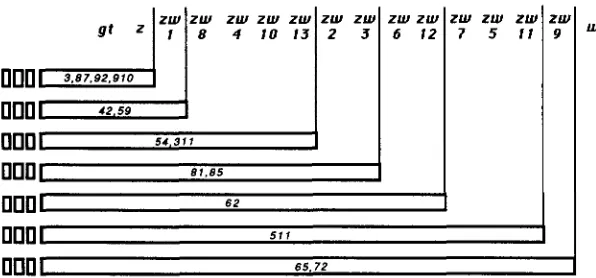
ficiencies. Complementation groups named at the top are deleted when they lie within the open bars. Num- bers within the bars denote particular DEB-induced deletions. All of these rearrangements remove the gene I ( l ) g t ; the distal (leftmost) limit of the deletions have not been determined.000
I
5 1 1000
I
65.72blots; these two strains will not be further considered here.
Complementation analysis shows that all the 14
remaining male lethal mutations are associated with deficiencies including zeste and adjacent complemen- tation groups (Figure 3). This collection includes dele- tions of varying extents. T h e centromere proximal (right) borders of these deletions are found at several locations in the interval between zeste and white. T h e centromere distal (left) borders have not been mapped, though all of these deficiencies remove the locus
Z(
I)gt. Examination of polytene chromosomes reveals associated physical deletions in those stocks analyzed. Relevant to the studies discussed below, bands from 2E,F to 3A3 are missing inDf(l)zdeb3
andDf(
l)zdCb9’ chromosomes.Strategy for construction of a zeste deficiency:
None of the 33 mutations recovered in the screen has yet been demonstrated to be a defect restricted to zeste which completely abolishes function of this gene. T h e male-inviable deficiencies are not useful for inter- pretation of the null phenotype of zeste because adja- cent loci are affected, while the lesions in the male- viable group are subtle and have not yet been char- acterized. However, two of the deficiencies
(Df(l)zdeb3
and
Df(
I)zdeb9’; see Figure 3) could be employed in the synthesis of flies devoid of zeste-coding sequences. Combination of either deletion with the well-charac- terized rearrangementDf(
1 ) ~ ” ’ ( i e . ,Df(
I)zdeb3/Df(I)wrJ’)
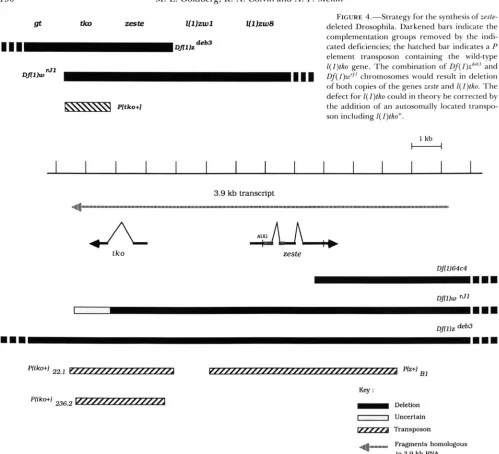
would result in the absence of only two known genes: zeste and the adjacent lethal comple- mentation group tho. T h e lesion for tho could be corrected by an autosomal copy of tko but not zeste (Figure 4); the integration of appropriate tho se- quences into autosomes by P element-mediated trans- formation has previously been reported (ROYDEN,PIRROTTA and JAN 1987).
This approach requires that
Df(l)zdeb3
orDf(
I)zdebY2 should be incapable of encoding functional zeste prod- uct. Blots of restriction enzyme-cutOf(
I)zdeb3/FM7a
and
Df(1)zdeb9’/FM7a
genomic DNAs with probes inthe vicinity of zeste reveals only bands from the
FM7a
balancer chromosome (not shown). Our data indicates
that both DEB-induced deficiencies remove the entire zeste gene and at least 30 kb of sequences further in the centromere-proximal (right) direction. T h e phys- ical extent of these and other deficiencies as well as the transposons used in our experiments are shown in Figure 5. As subsequent experience with
Df(l)zdeb3
and
Df(I)zdeb9’
proved identical, only the former will be discussed for simplicity.It was formally possible that this span of 30 kb or more proximal to zeste contains an essential gene or genes, not identified in previous saturation mutagen- esis of the region, which would complicate the analy- sis. We thus performed the pilot cross shown in Table 1, to establish whether females of genotype
Df(
l)zdeb3/Df(1)64c4
are produced at expected rates. Such het- erozygous females are in fact viable, indicating the absence of novel lethal complementation groups in the region of overlap to the right of zeste between these two deletions. This overlap is identical to that produced by combination ofDf(
l)zdeb3 andDf(
l)wrJ’,with the exception of about 10 kb including the ma- jority of the zeste and tko genes (Figure 5). T h e strategy
outlined in Figure 4 should thus serve to produce animals deleted only for zeste.
Properties of zeste-deleted females: T h e scheme employed for the desired construction is diagrammed in Figure 1. Females of the phenotype anticipated for the combination of chromosomes
Df( I)zdCb3/Df(
Z)wr”;M. A. Colvin and F. Mellin
FIGURE 4.--Strategy for the synthesis of zeste-
deleted Drosophila. Darkened bars indicate the complementation groups removed by the indi- cated deficiencies; the hatched bar indicates a P element transposon containing the wild-type
l ( l ) t k o gene. T h e combination of I)f(l)~~‘~’ and Of( l ) d ’ chromosomes would result in deletion of both copies of the genes zesfe and l ( l ) f k o . T h e defect for I ( l ) t k o could in theory be corrected by the addition of an autosomally located transpo- son including I( I)tko+.
FIGURE 5.-Physical map of the region of the Drosophila X chromosome in the vicinity of zesfe. Data has been collected from GUNARATNE
et al. (1986), PIRROTTA el al. (1987), ROYDEN, PIRROTTA andJAN ( 1 987) and MANSUKHANI et tal. (1988a). T h e telomere-to-centromere (distal- to-proximal) direction proceeds from left to right on the diagram. DNA fragments with homology to a 3.9-kb transcript of unknown function are denoted by the hatched arrow; the organization of introns and exons of the corresponding transcriptional unit is not known. Transcripts for zeste and I( J)fko a r e indicated by darkened arrows, with introns shown by normal conventions. Sequences encoding the DNA binding domain of the zeste protein as defined by MANSUKHANI e f al. (1988b) are portrayed by stippled regions within the zeste mRNA. T h e extent of deficiencies and transposons used in this study a r e indicated as shown in the key.
shown). Third, the kinds of progeny produced by the zeste-deleted females are exactly as predicted (Table
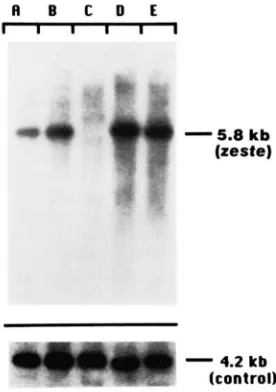
3). Finally, zeste gene sequences are absent in genomic DNA prepared from Of( I)zdeb3/Df( I)wr”; P[ry+,tko+]/
2 animals when analyzed on Southern blots (Figure
Apart from slightly abnormal eye color, zeste-de- leted females appear morphologically normal. These flies do not obviously display the transformation of haltere into wing associated with mutations of Ubx, though subtle defects cannot be excluded. Females without a zeste locus are fertile, and are of normal or near-normal fecundity. When appropriate matings are
6).
conducted, they yield a subsequent generation of zeste- deleted females (Table 3).
Drosophila zeste
TABLE 1
The region near zeste contains no unidentified lethal complementation groups
Cross A Cross B
Progeny class Number Percent Number Percent
Df(I)zdeb*/Df(1)64c4 0” 241 30.8 218 29.0
FM7a/Df(1)64c4 0 118 15.1 77 10.3 Df(I)z”’”’/w+.Y d 290 37.1 197 26.2
FM7a/w+. Y S 133 17.0 259 34.5
Total 782 751
Cross A = Df(l)zdeb3/FM7a 0 X Df(1)64c4/w+.Y d; cross B =
Df(l)zdebYZ/FM7a 0 X Df(1)64c4/w+. Y d.
a Eye color phenotype is dull red. Addition of P[z+IB, to this
genotype results in bright red wild-type eye pigmentation (not shown).
rant dull reddish-brown eye color to wild-type (Table
4). This result suggests, but does not prove, that the relative inviability is not a function of the defect at zeste (see below).
DISCUSSION
Mutagenesis: Investigators using the reagent die- poxybutane as a mutagen for Drosophila have re- ported somewhat conflicting results. In the case most thoroughly studied at the molecular level, of 2 1 DEB- induced mutations at the rosy locus, 9 were caused by deletions ranging in size from 50 bp to 8 kb, 7 were caused by lesions too small to be detected by Southern blot analysis, and only 2 were associated with large multilocus deletions (REARDON et al. 1987). In another study, all 8 DEB-induced mutations in the 68A3- 68C11 region uncovered only a single complementa- tion group (CROSBY and MEYEROWITZ 1986). Other workers have found that large multilocus deficiencies comprise a much higher percentage (30-60%) of
DEB-induced mutations at the y, w, sn, and m loci (SHUKLA and AUERBACH 1980; OLSEN and GREEN
1982). Our experience more closely parallels these latter studies. We have isolated two large classes of DEB-induced mutations at zeste: (1) male viable zeste alleles associated with nucleotide substitutions or dele- tions below the level of detection (<lo0 bp), and (2)
deletions of zeste and adjacent genes. Based upon known physical data, the shortest of these male-invia- ble deletions must be greater than 30 kb in length, while the longest extend over 200 kb.
We do not understand these discrepancies, partic- ularly the lack of deletions in the range of 50 bp to 8
kb in our study, as well as the variability in the frequency of longer deletions obtained by different investigators. These disagreements might be related to peculiarities of DNA sequence in various regions. In this regard, we are currently testing the hypothesis that instability of or recombination between transpos- able elements near zeste may be involved in the gen-
eration of the large, male inviable deletions. Such events might be independent of the application of DEB. Unequal crossing over between transposable elements on homologous chromosomes has been shown to generate deficiencies and reciprocal dupli- cations during meiosis in Drosophila females (GOLD-
BERG et al. 1983), and intrachromosomal interactions
between hobo elements have been shown to yield in- stability (LIM 1988). If similar recombinational mech- anisms created the large deletions near zeste, these events must have occurred as intrachromosomal or interchromatid exchanges on the X chromosome in mutagenized cufmales.
Reduced yield of zeste-deleted females: Adult zeste- deleted females appear at frequencies of 5-10% of expectation (Tables 3 and 4). Changing the tempera- ture at which the flies are raised to 18 O or to 25
’
doesnot affect the yield of these adults (data not shown). T h e developmental stage of lethality is likely to be multiphasic.
Df(
I)zdeb3/Df( 1)wr”; P[ry+,tkof]/2 animals produced in the crosses diagrammed in Figure 1 are easily recognized as late pupae, as eye color and mor- phology is apparent at this stage, and because they are the only red-eyed, non-Bar of Stone (B’) progeny pro- duced in the crosses. Approximately 75-80% of these pupae never eclose (compared with <20% of other genotypes). Assuming random distribution of ga- metes, this suggests that 20-40% of the individuals which do not survive to adulthood die as late pupae, while the remainder die at earlier stages.We have no satisfactory explanation for the relative inviability of zeste-deleted females; four possibilities are suggested here.
1. As described above, the addition of a transposon containing the wild-type zeste gene to zeste-deleted females does not improve their viability (Table 4). It is possible that the transposon employed is defective in some aspect of zeste expression, even though it rescues the zeste eye color phenotype (GUNARATNE et
al. 1986; this article). For example, position effects at the site of P[zeste+IBI transposon integration might disrupt transcription of zeste in particular tissues. Quantitative influences of zeste activity on viability thus cannot be excluded.
2. A similar argument also applies to the tko’ trans- posons used in the construction of zeste-deleted fe- males. These DNA segments complement the lethal point mutation thok’’ (ROYDEN, PIRROTTA and J A N
1987). This allele may exhibit some residual tko activ- ity; the transposons might therefore be incapable of correcting the possibly more severe tko defect in
Of( I)wrJ1. However, as two different P[ry+,tko+] trans- formants were employed, position effects are unlikely to have interfered with tko expression.
3 . Figure 5 illustrates that Df(1)zdpb3 and Of(1)w‘J’
TABLE 2
Yield o f zestedeleted females from representative crosses
C :ross A (:row 1%
I'rogetly (-lass NIIIllIK~r I'rrren1 Nulrlbrr I'rrcellt
Df( I)z"'"/Df(I)w'"; P[/ko']/2 (:este-deIeted) P" 15 I .2 20 3 . 3
FM7a/I)f( I ) w ' ' I ; P [ t k o ' ] / 2 0 345 27.3 236 3x.7
Qf(I)z""'/y'w+R'.v; P[/ko']/Z 6 423 3 3. .5 171 2X.0
Fhf7Q/y'W'R'.t P[tk0+]/2 d 360 28.5 13.5 22.1
Df(I)zd'"/F~C17a/y'w+R'.Y: P [ f k o + ] / 2 9" 121 9.6 4x 7 . 9
l-ot;ll I264 610
~ ~ r o s s A = I ) f ( I ) z d ' h ' / F M 7 a ; P [ / k o ' ] l l , I / P [ / ~ o ' ] l l . I ? X I ) j ( l ) ~ ~ ' ~ ' / ~ + ~ ~ ~ + R ' . Y d : c r o s s l 3 = I ) f ( 1 ) z d ' h V ' / F ~ 7 ~ ; P [ ~ k o + ] Z ~ a . l / P [ t k o + ~ ~ i ~ ~ ~ ~ I ) f ( l ) ~ ~ ' ~ ' /
" I h l l red eye color phenotype.
y'w'R'. Y d.
Based upon ;tdditional evidence (not shown). this class ;I1>I>ears to be the result of maternal nondisjunction. presumably due to the presence of an unmarked Y chronwsonw in sonic maternal genon~es. . .
TABLE 3
Synthesis o f second-generation zestedeleted females
Progeny rhss N u m b e r I'rrcent
D~(I)z""/D~( I)&; ~ [ t k o + ] ~ ~ . ~ / 2 P 4 3.3
(zesfe-deleted)
Dy(1)~~'~'or Df(I)m'"/y'w'R'.Y s" 1 I8 95.9
Df( 1 ) ~ ~ " ' or Df( I)w'/'/Df( I ) w " ' / I 0.8
y'w+R'. Y
Total I23
Df(I)w'l'; This table presents I'[tko']2z.r/2 0 X Df(I)w'l'/y'w'R'.Y 6. Note that under results of the following cross: Df(I):"'"/
Mendelian expectations (ignoring products of nontlisjullction). zest+ deleted f e n x h sl~ould represent spproxin1;ltely 16% o f total prog- eny.
* Due to the markers on the y+w'R'- Y chronlosonle and rccom- bination between m;lternal X chronlosonIes, genotypes containing Df(I)z""D'antl Df((1)w'l'cannot be distinguished. Individuals in these classes rnay or may not contain one copy of the P [ f k o + ] 2 z . l transpo-
son.
'
Product of presumed maternal nondisjunction.encode a 3.9-kb poly(A+) transcript (GUNARATNE et al. 1986; MANSUKHANI et al. 1988a). This transcrip- tional unit is not associated with any known genetic functions, but an effect on viability remains possible. However, it should be remembered that O~(Z)Z"'"~/
Of( 1)64c4 females emerge at expected frequencies, even though
Df(
1)64c4 removes sequences encoding the 5' end of this 3.9-kb transcript (Figure 5).4. Heterozygosity for two different deletions
(Of(
1)~""' and Of( 1)wrl') may result in genetic imbal- ance and thus a decrease in survival of zeste-deleted females. This possibility is unlikely given thatDf(1)64c4 appears to extend further in the centro- mere proximal direction (to bands 3C3-5) than does
Df(
Z)zur/' (to bands 3C 1-3) (LINDSLEY and GRELL1968), even though
Df(
I)z""'/Df(
1)64c4 flies are of normal viability (Table 1). However, such cytological observations could be inaccurate at this level of reso- lution.Do any known alleles correspond to the null state of zeste? T h e results reported here are in accordance
~ E C D E
-
-
5.8 kb (resfe)-
4.2 kb(control)
with the hypothesis that z" mutations represent the inactive state of zeste. T h e eye color of zeste-deleted females is similar to that of
z"/Df(
1)zur/' females. JustDrosophila zeste Locus
TABLE 4
Addition of 42’1 to zeste-deleted females does not improve viability
Progeny class Number Percent
Df(1)zdeb’/Df(1)W‘JJ; P[tko+]zz.l/2; 7 0.6
P[Z+IBI/3 0”
3P
D f ( 1 ) Z d d P / D f ( l ) ~ ‘ J J ; P [ t k o + ] z z . r / 2 ; 3/ 18 1.4
F M 7 u / D f ( l ) w ‘ J 1 ; P [ t k 0 + ] ~ ~ . ~ / 2 P 466 36.7
Df(l)zdCb’/y+w+E’.Y; P[tko+]zz.1/2 d 372 29.2
Df(l)W‘J’/y+W+E“~Y; P[tko+]ZZ.1/2 B 315 24.8
Df(l)rdeb’/Df(l)~‘J1/y+~+Bs.Y; 93 7.3 P[tkO+]ZZ.1/2 P d
Total 1271
Results of a cross between D f ( l ) z d e b 3 / F M 7 u ; P [ t k o + ] z 2 , / P [ t k o + ] ~ ~ I ;
3 / 3 females and an equal mixture of Df(l)wrJ1/y+w+E’.Y; 2/2; P [ z + I B j / 3 and phenotypically indistinguishable Df(l)w‘J’/y+w+E’.Y; 2 / 2 ; 3 / 3 males is tabulated here. The same cross was repeated with individual males, yielding similar results, as discussed in MATERIALS AND METHODS.
Bright red eye pigmentation.
* Dull red eye pigmentation.
‘ Presence or absence of P [ Z + ] ~ ~ cannot be discriminated. Product of maternal nondisjunction, presumably due to pres- ence of unmarked Y chromosome (see Table 2).
dicate that a domain at the C terminus of the zeste product is required for stimulation of Ubx expression in Drosophila tissue culture cell cotransfection exper- iments (A. CRICKMORE and M. L. GOLDBERG, in prep- aration). This region is not synthesized as part of the zeste protein produced by the z”-like allele h ( l ) e ( b x ) (PIRROTTA et al. 1987; MANSUKHANI et al. 1988a), implying that this mutation is associated with an in- active zeste locus.
In contrast with this view, recent observations made in our laboratory during the course of these experi- ments suggest that the zeste allele z”77h, distinguishable by several genetic criteria from za, is an altrrnative candidate for a null mutation. Polymerase chain re- action sequencing shows that the lesion associated with
z”77h is a 3 14-bp deletion which removes the initiation codon as well as a large portion of the untranslated upstream leader in the zeste mRNA (A. GRIMBERG and M. L. GOLDBERG, unpublished data). Previous studies of this mutant were of insufficient resolution to determine whether the initiation codon was in fact deleted (PIRROTTA et al. 1987; MANSUKHANI et al.
1988a). T h e molecular characterization of zV77h re- mains incomplete: the sequence data to date do not rule out the possibility of additional alterations, and it is not clear if this allele produces any type of zeste- related polypeptide. Current information nonetheless indicates that if a protein were encoded by zV77h, it should initiate from an AUG codon internal to the normal coding sequence, resulting in a potentially nonfunctional molecule lacking the N-terminal DNA- binding domain. Interestingly, the eye color pheno- types of z~~~~ hemizygous males or homozygous fe-
males are similar to the dull reddish-brown eye color of zeste-deleted females, though it must be remem- bered that these “zesteless” flies were constructed with only a single dose of w+. T h e results reported here do not establish whether za or z”77h represents the null state; in fact, complete absence of zeste activity might have quantitative effects on Drosophila viability not shared by either allele.
Function of the zeste gene product: T h e results reported here show that the product of the zeste locus is not essential to Drosophila viability or to female fertility. This lack of a requirement for zeste is dem- onstrated even when the zeste product is provided neither as a maternal contribution in the egg nor as a product of the zygotic nucleus. Although we do not understand the relative infrequency at which zeste- deleted flies eclose, the survivors clearly cannot be ascribed as escapers from a “leaky” mutation, given the absence of zeste-coding sequences in these flies. On the other hand, because of the lowered rate of survival, the possibility that zeste expression may have quantitative effects on robustness cannot be ignored. T h e conclusion that zeste is nonessential is surprising in light of evidence that it may participate in the regulation of a wide variety of target genes. Genetic interactions of zeste with at least three unlinked loci of apparently unrelated functions (w, d p p , and Ubx) have been well documented (LEWIS 1954; JACK and
JUDD 1979; GELBART 1982; GELBART and W U 1982).
These genetic effects appear in at least one case to reflect alterations in the transcription of target genes (BINGHAM and ZACHAR 1985), presumably through zeste protein activity as a DNA binding protein and as a transcription factor (BENSON and PIRROTTA 1987; MANSUKHANI et al. 1988b; BIGGIN et al. 1988). Over
60 zeste binding sites on salivary gland polytene chro- mosomes have recently been reported (PIRROTTA, BICKEL and MARIANI 1988). If a substantial fraction of these sites actually corresponded to loci regulated by zeste, the absence of the zeste locus might be ex- pected to lead to more severe defects than those observed.
We suggest that these findings are best explained if, at most loci influenced by zeste, zeste protein is either a weak transcription factor, or that its function can be substituted by that of other regulatory proteins. Such an interpretation is also indicated by the behav- ior of the neomorphic alleles 2’ and zoP6. Extending
A. and Mellin
morphological defects or of obvious effects on viabil- ity.
zeste-deleted females are Ubx+ in phenotype, despite recent reports that zeste protein enhances in vitro transcription of the Ubx gene (BIGGIN et al. 1988). Even moderate alterations in Ubx expression should have been visible, as reduction of Ubx gene dosage from two to one displays a dominant partial transfor- mation of haltere toward wing. To explain this dis- crepancy, we propose either that zeste normally influ- ences Ubx expression only very weakly if at all, at least during haltere development. Alternatively, the lack of zeste activity can be compensated by other gene products, perhaps reflecting some type of autoregu- lation at Ubx. T h e transvection-sensitive interactions between zeste and certain combinations of mutant alleles of the BX-C (LEWIS 1954) may reflect an ab- normally sensitized state. In any event, it is clear that biochemical tests of transcription using extracts or purified components must be interpreted with cau- tion. Though such experiments do suggest whether particular molecules might serve as transcription fac- tors, additional genetic evidence is required to estab- lish the physiological importance of the implied reg- ulation.
T h e a u t h o r s wish to thank BURKE JUDD, MEL GREEN, LEONARD ROBBINS, MARIANA WOLFNER, Ross MACINTYRE, and CONSTANCE ROYDEN for gifts of Drosophila strains used in this work. We also thank ROSS MACINTYRE for helpful comments on the manuscript. This research was supported by U. S. Public Health Service grant GM31935 to M.L.G.
LITERATURE CITED
ASHBURNER, M., and J. N. THOMPSON, JR., 1978 The laboratory culture of Drosophila, pp. 1-109 in The Genetics and Biology of
Drosophila, Vol. 2a, edited by M. ASHBURNER a n d T . R. WRIGHT. Academic Press, New York.
BENSON, M., and V. PIRROTTA, 1987 The product of the Drosoph- ila zeste gene binds to specific DNA sequences in white and Ubx.
EMBO J. 6 1387-1 392.
BIGGIN, M. D., S. BICKEL, M. BENSON, V. PIRROTTA and R. TJIAN, 1988 Zeste encodes a sequence-specific transcription factor
that activates the Ultrabithorax promoter in vitro. Cell 53: 7 13- 722.
BINGHAM, P. M., and Z. ZACHAR, 1985 Evidence that two muta- tions wDzL and z’ affecting synapsis-dependent genetic behavior of white a r e transcriptional regulatory mutations. Cell 40: 8 19- 825.
CROSBY, M. A , , and E. M. MEYEROWITZ, 1986 Lethal mutations flanking the 68C glue gene cluster on chromosome 3 of Dro-
sophila melanogaster. Genetics 112: 785-802.
DAVISON, D., C. H. CHAPMAN, C. WEDEEN and P. M. BINGHAM, 1985 Genetic and physical studies of a portion of the white
locus participating in transcriptional regulation and in synapsis- dependent interactions in Drosophila adult tissues. Genetics
110: 479-494.
CANS, M., 1953 Etude gCnCtique et physiologique du mutant z d e
Drosophila melanogaster. Bull. Biol. Fr. Belg. Suppl. 38: 1-90. GELBART, W. M., 1982 Synapsis-dependent allelic complementa-
tion at the decapentaplegic gene complex in Drosophila melano- gaster. Proc. Natl. Acad. Sci. USA 7 9 2636-2640.
GELBART, W. M., and C.-T. Wu, 1982 Interactions of zeste mu- tations with loci exhibiting transvection effects in Drosophila melanogaster. Genetics 102: 179-1 89.
GOLDBERG, M. L., J.-Y. SHEEN, W. J. GEHRING and M. M. GREEN, 1983 Unequal crossing-over associated with asymmetrical
synapsis between nomadic elements in the Drosophila melano- gaster genome. Proc. Natl. Acad. Sci. USA 8 0 501 7-502 1.
GREEN, M. M., 1959 Spatial and functional properties of pseu- doalleles at the white locus in Drosophila melanogaster. Heredity
13: 303-315.
GREEN, M. M., 1963 Unequal crossing over and the genetical
organization of the white locus of Drosophila melanogaster. Z. Vererbungsl. 94: 200-214.
GUNARATNE, P. H . , 1987 Ph.D. thesis, Cornell University, Ithaca, N.Y.
GUNARATNE, P. H., A. MANSUKHANI, S. E. LIPARI, H.-C. LIOU, D. W. MARTINDALE and M. L. GOLDBERG, 1986 Molecular clon- ing, germline transformation, and transcriptional analysis of the zeste locus of Drosophila melanogaster. Proc. Natl. Acad. Sci. USA 83: 701-705.
JACK, J. W., and B. H . JUDD, 1979 Allelic pairing and gene regulation: a model for the zeste-white interaction in Drosophila melanogaster. Proc. Natl. Acad. Sci. USA 7 6 1368-1372. JUDD, B. H., M. W. S H E N ~ ~ ~ T . C . KAUFMAN, 1972 Theanatomy
and function of a segment of the X chromosome of Drosophila melanogaster. Genetics 71: 139-156.
KAUFMAN, T . C., S. E. TASAKA and D. T . SUZUKI, 1973 T h e interaction of two complex loci zeste and Bithorax in Drosophila melanogaster. Genetics 75: 299-321.
KOTARSKI, M. A,, S. PICKERT and R. J. MACINTYRE, 1983 A cytogenetic analysis of the chromosomal region surrounding the a-glycerophosphate dehydrogenase locus of Drosophila mel- anogaster. Genetics 105: 371-386.
LEFEVRE, G., JR., 1976 A photographic representation and inter- pretation of the polytene chromosomes of Drosophila melano- gaster salivary glands, pp. 3 1-66 in The Genetics and Biology of
Drosophila, Vol. la, edited by M . ASHBURNER and E. NOVITSKI. Academic Press, New York.
LEVIS, R., T . HAZELRIGG and G. M. RUBIN, 1985 Separable cis-
acting control elements for expression of the white gene of
Drosophila. EMBO J. 4: 3489-3500.
Lewis, E. B., 1954 The theory and application of a new method of detecting chromosomal rearrangements in Drosophila mela- nogaster. Am. Nat. 88: 225-239.
LIM, J. K . , 1988 lntrachromosomal rearrangements mediated by
hobo transposons in Drosophila melanogaster. Proc. Natl. Acad. Sci. USA 85: 9153-9157.
LINDSLEY, D. L., and E. H. GRELL, 1968 Genetic Variations of
Drosophila melanogaster. Carnegie Inst. Wash. Publ. 627. LINDSLEY, D. L., and G. ZIMM, 1987 The genome of Drosophila
melanogaster. Part 3: Rearrangements. Drosophila Inform. Serv. 65: 1-203.
MANSUKHANI, A,, P. H. GUNARATNE, P. W. SHERWOOD, B. J.
SNEATH and M. L. GOLDBERG, 1988a Nucleotide sequence and structural analysis of the zeste locus of Drosophila melano- gaster. Mol. Gen. Genet. 211: 121-128.
MANSUKHANI, A . , A. CRICKMORE, P. W. SHERWOOD and M. L. GOLDBERG, 1988b DNA-binding properties of the Drosophila melanogaster zeste gene product. Mol. Cell. Biol. 8: 61 5-623. MERRIAM, J. R., 1968 F M 7 : first multiple seven. Drosophila In-
form. Serv. 43: 64.
OLSEN, 0.-A,, and M. M. GREEN, 1982 The mutagenic effects of diepoxybutane in wild-type and mutagen-sensitive mutants of
Drosophila melanogaster. Mutat. Res. 92: 107-1 15. PIRROTTA, V . , S. BICKEL and C. MARIANI, 1988 Developmental
expression of the Drosophila zeste gene and localization of zeste
upstream regulatory elements control the expression of the
Drosophila white gene. EMBO J. 4: 3501-3508.
PIRROTTA, V., E. MANET, E. HARDON, S. E. B I C K E L ~ ~ ~ M. BENSON,
1987 Structure and sequence of the Drosophila zeste gene. EMBO J. 6 791-799.
REARWN, J. T., C. A. LILJESTRAND-GOLDEN, R. L. DUSENBERY and P. D. SMITH, 1987 Molecular analysis of diepoxybutane-in- duced mutations and the rosy locus of Drosophila melanogaster.
Genetics 115 323-331.
ROYDEN, C. S., V. PIRROTTA and L. Y. J A N , 1987 The tho locus, site of a behavioral mutation in D. melanogaster, codes for a protein homologous to prokaryotic ribosomal protein S I 2. Cell
51: 165-173.
SHUKLA, P. J., and C. AUERBACH, 1980 Genetic tests for the detection of chemically induced small deletions in Drosophila
chromosomes. Mutat. Res. 72: 231-243.
![FIGURE 1 as .-Cross scheme for synthesis of reste-deleted females. Df((l)zdCb3/Fkf7a; P[ry+,tko+]/CyO mothers of reste-deleted females, as well ~ f ( l ) r ~ ~ ~ ~ / D f ( l ) d J ' ; P[ry+,tko+]/2 animals lacking zeste are shown in bold type for r](https://thumb-us.123doks.com/thumbv2/123dok_us/1735996.1221965/3.592.96.503.55.399/figure-synthesis-deleted-mothers-deleted-females-animals-lacking.webp)
![FIGURE 2.-Cross both P[tko+]; MATERIALS scheme for addition of the reste+-containing transposon P [ Z + ] ~ ~ to reste-deleted females](https://thumb-us.123doks.com/thumbv2/123dok_us/1735996.1221965/4.590.72.526.65.299/figure-cross-materials-addition-containing-transposon-deleted-females.webp)