Den-Service d’études mécaniques et thermiques (SEMT), CEA, Université Paris-Saclay, F-91191 Gif-sur-Yvette, France
2 Areva NP, Lyon, France
3 EDF R&D, Moret sur Loing, France 4 TechnicAtome, Aix en Provence, France
ABSTRACT
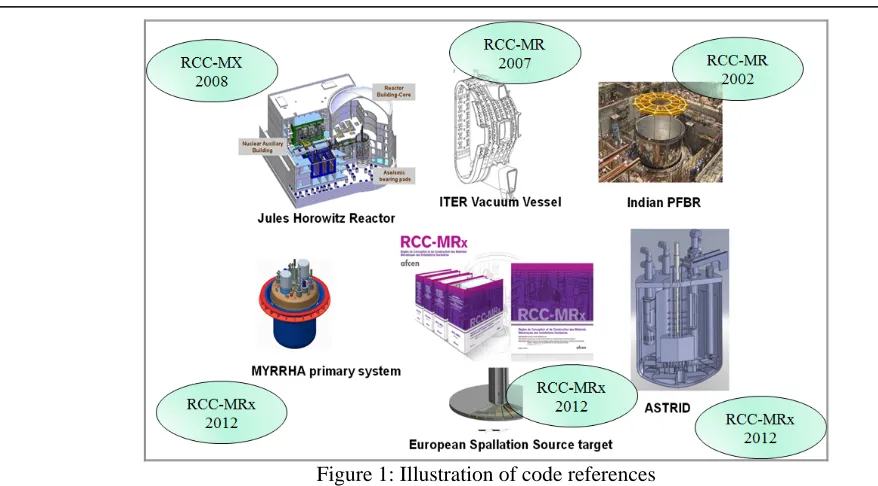
RCC-MRx Code is the result of the merger of the RCC-MX 2008 developed in the context of the research reactor Jules Horowitz Reactor project, in the RCC-MR 2007 which set up rules applicable to the design of components operating at high temperature and to the Vacuum Vessel of ITER.
This code has been issued in French and English versions by AFCEN (Association Française pour les Règles de Conception, de Construction et de Surveillance en Exploitation des Matériels des Chaudières Electro-Nucléaires) in 2012, and a new edition has been published at the end of 2015.
A significant work has been performed for this edition to improve the code in order to facilitate its use and understandability, and also to have a better fit with the feedbacks of the users.
In parallel, in compliance with the EC’s objectives and its own policy of openness, AFCEN proposes to make its codes evolve, taking into account the needs and expectations of European stakeholders (operators, designers, constructors, suppliers…) threw a workshop called CWA phase 2.
This paper gives an overview of the realized work and also will identify the work to be done for an opening of a standard such as RCC-MRx code.
INTRODUCTION
The design and construction rules for mechanical components of nuclear installations (RCC Codes) published by AFCEN primarily apply to safety class components. These Codes are used as a basis for contractual relations between Client and Supplier, in which case they shall be accompanied by a list of components to which they shall be applied.
24th Conference on Structural Mechanics in Reactor Technology
BEXCO, Busan, Korea - August 20-25, 2017 Division 10-02-03
Figure 1: Illustration of code references
The scope of application of this Code exclusively covers mechanical components of a Nuclear Installation:
- important from a safety or availability point of view,
- having a leaktightness, partitioning, guidance and retaining or supporting role,
- classified as vessels, pumps, valves, piping, bellows, box structures, heat exchangers, irradiation devices and their supports, handling or drive mechanisms.
The design rules for components which are subject to irradiation were drawn up on the basis of standard nuclear installations [1]. The use of these rules for other types of irradiation (e.g. proton irradiation, irradiation producing large amounts of helium, etc.) is not covered by the Code.
The first edition of the code has been published in 2012, in French and English, by AFCEN under the name RCC-MRx. A new edition has been published at the end of 2015 [2], including the intermediate addenda of 2013 and additional modifications accepted since this addenda.
The next edition is now planed in 2018. The main objectives for the next edition are always to integrate the feedback of users, but also to develop other types of publication such as backgrounds of the rules or guidelines, for instance on the integration of a new material in the standard [3]. This paper sums up the main evolutions of the 2015 edition, and gives an overview of the next on-going developments.
NOMENCLATURE
AFCEN French Association for NPP Design and Construction ASN French Nuclear Safety Authority.
ASTRID Advanced Sodium Technological Reactor for Industrial Demonstration CEN European Committee for Standardization
CENELEC European Committee for Electrotechnical Standardization COLEN Comité de Liaison des Equipements sous pression Nucléaies CWA CEN Workshop Agreement
ETSON European Technical Safety Organisation Network JHR Jules Horowitz Reactor
MDEP Multinational Design Evaluation Programme
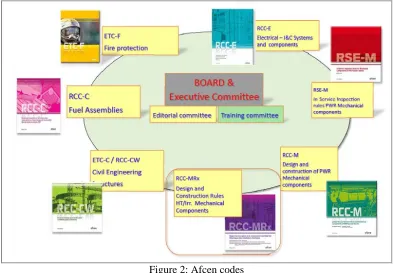
RCC-MRx is one of the seven codes published by Afcen (see figure 2).
Figure 2: Afcen codes
During the last years, Afcen has diversified its offer and it includes now not only codes but also technical publications such as backgrounds of the codes (so called “criteria”), guidelines etc…It corresponds to the needs highlighted with the opening of the association to international members.
24th Conference on Structural Mechanics in Reactor Technology
BEXCO, Busan, Korea - August 20-25, 2017 Division 10-02-03
Figure 3: Evolution process of Afcen codes
The 2015 edition of the RCC-MRx reflects this context. The new edition includes more than 65 modifications (compared to the 2013 addenda, more than 110 modifications compared to the 2012 previous edition).
These modifications have two major roots: - 67% are directly issued from users feedback,
- 21% are coming from the actions of harmonisation with other sets of rules. These two points are developed later.
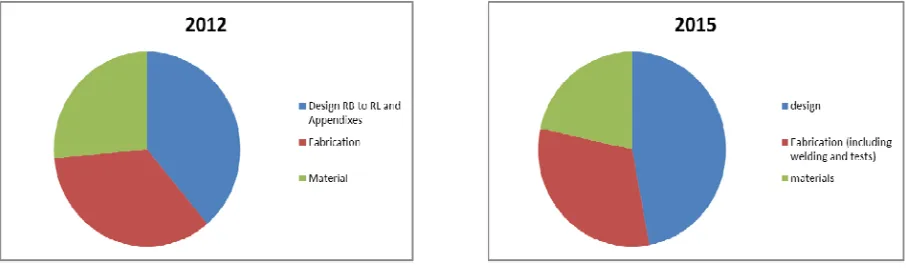
If we look know the repartition of the modifications in the different technical fields (see figure 4):
Figure 4: 2012-2015 repartition of Code Modifications
We can see that the majority of the modifications are on the design, and this trend is increasing through the past three years. The following paragraphs provides some example of code evolutions.
Users feedback: essential element of the code evolution
As said before, the main part of the code modifications is the result of the code application in a frame of a project.
The French projects JHR and ASTRID [4] through dedicated organizations have chosen to propose code evolutions in parallel with the progress of the project.
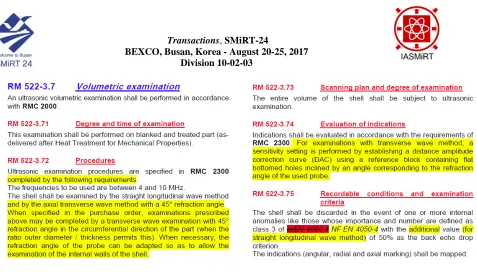
Figure 5: illustration of code modification
Such complements have been added for examinations, welding but also procurements (exchangers). In a similar way, the work on Eurofer material [5] continues and the set of material characteristics (in PPR, A3.19AS) has been completed with the creep data, the work is nevertheless still on-going for the irradiated data.
The following table gives an illustration of the possible panel of modifications issued from users’ requests:
Modified part Topic
RS 8241 Introduction of Ni Gr6 and Inconel 625 coatings.
RS, RM Addition of an alternative rule for temporary attachments on thick stainless steel plates.
A3.5SA.2 Additional physical properties for A3.5SA (800SPH).
RPP 4 RM 243.3 Integration of Eurofer feedback of thick plates procurement.
RPP4 A3.19AS Additional creep characteristics for Eurofer.
RD RK RL 2220 Clarification of the procurement rules for boltings according standards in D, K and L volumes.
RB 4231.4 RC 4230 RS Improvement of the understanding of the high temperature weld assemblies requirements.
RB 3200 Introduction of a temporal partitioning in the ratchetting rule in significant creep.
RB 3251 Limitation of membrane plus bending stresses for negligible creep rule.
A3.1S.83 Update of the minimal flux dependant toughness curves for 316L(N) including new ITER (SDC-IC) data.
RB 3500 Introduction of finite element calculation for primary stresses in RB 3500.
RS 2600 JHR feedback: integration of the use of filler metal with automatic metal inert gas welding used for 6061 T6 housing.
RB 3282 Following DIRx 15-032, modification of RB 3282.12 for text clarification.
A3.2A.69 Modification of A3.2A.69 on 6061-T6 swelling.
A3.7S Mechanical properties Rp0.2%min, Rm min, and Sm above 450°C. 7S limitation use for negligible creep damage.
RM 522-3 RM 522-7 JHR feedback for ultrasonic examination.
RB 2210 RD 2223 JHR feedback for exchanger procurement.
A3.xx.54 Precision on creep strain data.
Table 1: Modifications list, feedback roots
Harmonization actions
The other source of modifications included in the 2015 edition is the actions performed to maintain the consistency of the RCC-MRx with other sets of rules linked with it.
First, the code includes references to other systems (identified for instance in table RA 1300): - Regulations texts,
24th Conference on Structural Mechanics in Reactor Technology
BEXCO, Busan, Korea - August 20-25, 2017 Division 10-02-03
- ASME/ASTM/AWS texts, - technical publications.
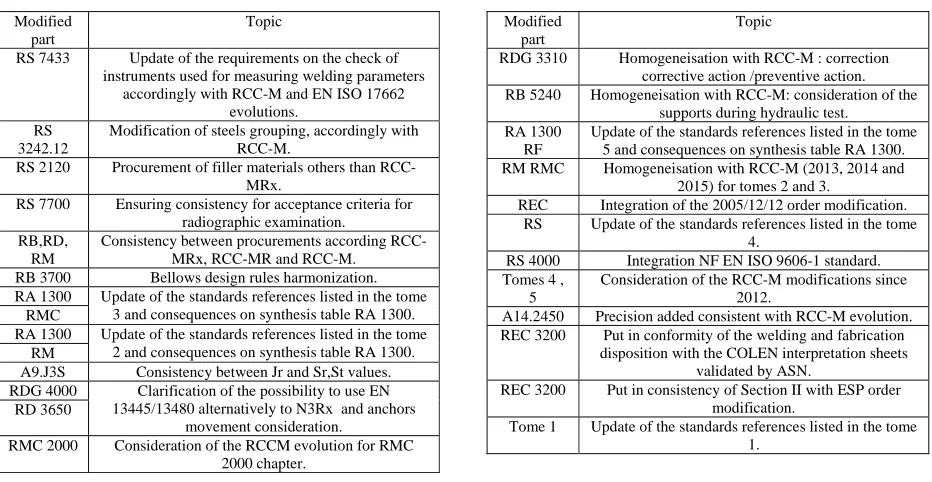
The RCC-MRx refers to more than 200 standards and publications. We can see in table 2 that the modifications could come from an evolution of the reference standard (one third of the European standards are reviewed each year) or of the regulation text, or it could come also from the working group and sub-committee decision to ensure consistency or pathway with other set of rules (as for instance with RCC-M [6] or EN 13445 [7], EN 13480 [8]).
Modified part
Topic
RS 7433 Update of the requirements on the check of
instruments used for measuring welding parameters accordingly with RCC-M and EN ISO 17662
evolutions. RS
3242.12
Modification of steels grouping, accordingly with RCC-M.
RS 2120 Procurement of filler materials others than RCC-MRx.
RS 7700 Ensuring consistency for acceptance criteria for radiographic examination. RB,RD,
RM
Consistency between procurements according RCC-MRx, RCC-MR and RCC-M.
RB 3700 Bellows design rules harmonization.
RA 1300 Update of the standards references listed in the tome 3 and consequences on synthesis table RA 1300. RMC
RA 1300 Update of the standards references listed in the tome 2 and consequences on synthesis table RA 1300. RM
A9.J3S Consistency between Jr and Sr,St values.
RDG 4000 Clarification of the possibility to use EN
13445/13480 alternatively to N3Rx and anchors movement consideration.
RD 3650
RMC 2000 Consideration of the RCCM evolution for RMC
2000 chapter.
Modified part
Topic
RDG 3310 Homogeneisation with RCC-M : correction
corrective action /preventive action. RB 5240 Homogeneisation with RCC-M: consideration of the
supports during hydraulic test. RA 1300
RF
Update of the standards references listed in the tome 5 and consequences on synthesis table RA 1300.
RM RMC Homogeneisation with RCC-M (2013, 2014 and
2015) for tomes 2 and 3.
REC Integration of the 2005/12/12 order modification. RS Update of the standards references listed in the tome
4.
RS 4000 Integration NF EN ISO 9606-1 standard.
Tomes 4 , 5
Consideration of the RCC-M modifications since 2012.
A14.2450 Precision added consistent with RCC-M evolution. REC 3200 Put in conformity of the welding and fabrication
disposition with the COLEN interpretation sheets validated by ASN.
REC 3200 Put in consistency of Section II with ESP order modification.
Tome 1 Update of the standards references listed in the tome 1.
Table 2: Modifications list, harmonization roots
The update of references include to follow the evolution of material or process (welding..) standards, but also more complex structures when it deals with references such as RCC-M or EN 13445 for instance. In these cases, specific benchmarks may be needed to evaluate the consistency of two standards, but also to have the possibility for the experts to share their knowledges. We can quote OECD or CORDEL initiatives as examples ([9] and [10]).
In a similar way, an action of comparison of EN 13445 and RCC-MRx rules concerning creep rules has been engaged ([11], [12]).
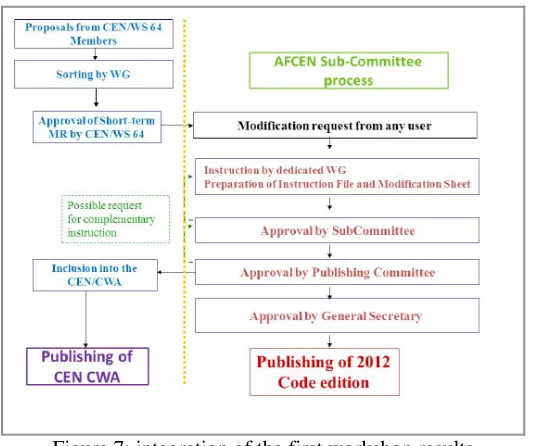
mechanical equipment of innovative nuclear installations” (CEN/WS 64, [13]) proposed by the European Sustainable Nuclear Industrial Initiative (ESNII) and AFCEN.
This Workshop, in which participated a wide range of organizations among nuclear development stakeholders, aimed at investigating the Europeanization potential of an existing code (AFCEN RCC-MRx Code).
The result of the CEN/WS 64 was short term modifications of the Code required by partners involved in concrete design and/or construction projects, these requests have been introduced through the existing dedicated AFCEN subcommittees.
Figure 7: integration of the first workshop results
Finally, eleven modifications have been introduced:
Chap. Paragraph Purpose
RS RS 2900 Further details concerning the maximum temperature for filler metals from the RS 2900 “reference sheets”
A16 A16 Introduction of alias in the notations table
Tome 6 RPP A16 Introduction of a standards procedure for locating defects
A16 A16.3240 Further details concerning the method to be used to describe a defect with complex orientation
REC REC 1000-2000 Limiting the use of standards NF EN 13445 and 13480 to negligible irradiation and creep ranges
RB RB 3251.112 Clarification of the text, addition of a sketch
A10 A10 Development of models and options for strain hardening laws
RDG RDG 2320 Further details on the irradiation scope covered by the Code
Tome 6 RPP RM 243-2 Possibility of procuring very thick X10CrMoVNb9-1 alloy steel sheets
RM RM 332 Incorporation of feedback confirming that Charpy tests are not necessary
RB RB 3261.2 Clarification concerning analysis of S-type damage in the case of significant irradiation
24th Conference on Structural Mechanics in Reactor Technology
BEXCO, Busan, Korea - August 20-25, 2017 Division 10-02-03
But it appeared also for stakeholders a need to continue the Workshop experience as a basis for a real European process for future developments of the Codes.
Based on the results of the CEN Workshop 64 and the recommendations of the CEN-CENELEC Focus Group, in April 2013, the European Commission in the framework of ENEF (European Nuclear Energy Forum) decided to support a CEN/WS 64 phase 2 with the target to enlarge the scope to the codes for mechanical equipment and civil engineering of GEN II to GEN IV nuclear installations.
Objectives
The proposal consists into a voluntary mechanism for a broad set of partners involved with design and construction of nuclear facilities in Europe. It will allow partners not yet using AFCEN codes to learn about these codes. It will also give the opportunity to all participants to express their specific requirements for the long term modifications of the Codes including identification of pre-normative research where necessary.
During this process, other solutions in existing codes shall be considered. In ideal case, the result should be a combination of solutions from others codes, sometimes also allowing alternate approaches.
The prospective work to be done would be applicable to GEN III and IV NPPs and long-term operation/lifetime extension for GEN II NPPs.
The proposed CEN WS 64 phase 2 will enable members to:
a) recommend medium-long term orientations of evolution of those codes; b) identify the R&D needs associated to these recommendations;
c) look for explicit or implicit references to national standards in the codes and propose their substitution by international standards or, failing that, to advocate the elaboration of such standards ;
d) interact with the Multinational Design Evaluation Programme (MDEP).
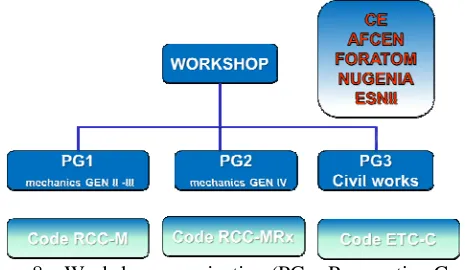
WS 64 – phase 2 will take place for a 4 years period, ending by 2018 with the following organization (Figure 8):
Figure 8 – Workshop organization (PG = Prospective Group)
First results
The prospective group dealing with GEN IV reactors has already identified a list of technical points as potential topics for a code improvement or a research and development topic:
Environmental degradation of material in innovative coolants,
softening/hardening..),
High irradiation degradation,
Fuel cladding design rules,
Residual stresses…
These topics have been prioritized and first proposals of modification and R&D have been established by the PG.
Some modifications proposals of RCC-MRx code have also been proposed within the Workshop and are now under instruction threw Afcen procedure:
Use of the code in innovative coolant environment,
Negligible creep curve,
Extension of Temperature Range for Mechanical Properties of Specific Materials in RCC-MRx,
Extension of creep strain and rupture data range.
In parallel to the workshop, the European Community launched a feasibility study on harmonization of nuclear design and construction codes at EU level. 1, with the following purposes:
To follow closely the work of CEN/WS 64-2, mainly through the participation in Prospective Group meetings and general meetings of WS 64-2.
To evaluate how far the goals of WS 64 are achieved:
o to support learning processes for new users of the different codes,
o to integrate the requirements of new users for evolution of the reference code,
o to provide detailed sheets to R&D, necessary for long term evolution,
o to integrate into WS 64-2 all the activities realized in other international organizations aiming at harmonization of codes for design, building, operation and safety management: MDEP, WENRA, ETSON etc.
To evaluate how far the WS 64-2 process is necessary to foster harmonization of nuclear codes at EU level,
and to recommend further actions for EC, CEN or other bodies to reach significant results in the field of codes harmonization in EU and worldwide.
Some elements have already been discussed in the framework of the study and two new items have also been identified.
First, enabling a pathway by which Safety Class 2/3 Structures, Systems or Components based on high quality non-nuclear normal industrial standards can be applied in European nuclear plants. It could be described as a pre-defined European standardized process supporting cost efficient national regulatory acceptance of non-nuclear industrial standards as an alternative for SC 2/3 SSC. Enabling this pathway will need “a new way of thinking”.
24th Conference on Structural Mechanics in Reactor Technology
BEXCO, Busan, Korea - August 20-25, 2017 Division 10-02-03
supporting cost efficient national regulatory acceptance of non-European standards as an alternative for SC 1/2/3 SSC. Enabling this pathway will need acceptance of “national nuclear dialects”.
CONCLUSION
The new edition of the RCC-MRx has been published at the end of 2015. This edition is the conclusion of three years of application of the code. Nevertheless, work is still in progress, related to the feedback, in the scope of rules, definition and way to use them, but also in order to share this feedback at the scale of international background and request. Other works (also called studies) are on-going or will start very soon to support the code:
- two Studies are now closed :
o New material study: closed in 2016 and concluded by Afcen technical publication on introduction of a new material ([14], [15] and [3]),
o Irradiation study: closed in 2016, future modifications implemented in the next edition of RCC-MRx will come from this study [14].
- two Studies will start in 2017 :
o fast fracture : equipment specification guideline for the drafter,
o Rewriting french regulation parts (REC 3200).
A next step is also engaged with the European Community to prepare the future standards, to anticipate their needs in term of research, to be sure to get in time answers for the GEN IV technical issues.
REFERENCES
1 C. Pascal, C. Pétesch, T. Lebarbé, S. Dubiez Le Goff – Radiation damage and material limits: illustration of a way to codify rules with the RCC-MRx Code, IGORR 2014, Bariloche - Argentina, November 17-21.
2 RCC-MRx, 2015 edition, "Design and Construction Rules for Mechanical Components of Nuclear Installations: high temperature, research and fusion reactors", AFCEN.
3 PTAN-AFCEN 2017 “Guide for introducing a new material in the RCC-MRx - Requirements and
recommendations for obtaining the data necessary for preparing the Properties Groups for the materials in Appendix A3 of the RCC-MRx”, AFCEN.
4 M. Blanc, C. Petesch, Th. Lebarbé, O. Gelineau, M Blat , Consistency between evolution of codified rules and SFR prototype development: ASTRID and RCC-MRx example, PVP2014, Anaheim, USA July 20-24, 2013. 5 A.-A.F. Tavassoli, E. Diegele, R. Lindau, N. Luzginova , H. Tanigawa, Current status and recent research
achievements in ferritic/martensitic steels, Journal of Nuclear Materials 455 (2014) 269–276.
6 RCC-M 2016 edition, “Design and construction rules for mechanical components of PWR nuclear islands”, AFCEN.
7 EN 13445, “Unfired pressure vessels”, 2014 edition, AFNOR. 8 EN 13480, “Metallic industrial piping”, 2012 edition, AFNOR
9 Y. Kayser, S. Marie, S. Chapuliot, P. Le Delliou, C. Faidy BENCH-KJ: benchmark on analytical calculation of fracture mechanics parameters KI and J for cracked piping components – final results and conclusions Transactions, SMiRT-23 Manchester, United Kingdom - August 10-14, 2015 Division II, Paper ID 133.
10 Dr. Andrew Wasylyk CORDEL Codes & Standards Task Force International Code Convergence AFCEN International conference 25th March 2015, Paris.
11 S. Dubiez-Le Goff, A. Martin, D. Bonne Analysis of the EN 13 445 creep rules and comparison with RCC-MRx creep rules , Creep 2015, 13th International Conference on Creep and Fracture of Engineering Materials and Structures, May 31 – June 4, 2015, Toulouse, France.
12 S. Holmström, N. Luzginova, Negligible creep of P91 steel, Proc. ECCC conference, Creep & Fracture in High Temperature Components, Design & Life Assessment, May 5-7th 2014.
13 Design and Construction Code for mechanical equipments of innovative nuclear installations, CWA 16519. 14 C. Pétesch, T. Lebarbé, M. Blat, D. Bonne, F. de la Burgade – RCC-MRx edition 2015: Overview of three years
of developments, PVP 2015, Boston, July 19-23, Paper 45270.