Performance Analysis of QoS for Different
Techniques in Wireless Sensor Network:
A Survey
Dattatray S. Waghole 1, Shubham Khedekar 2, Abhijeet S. Patil3, Dipali Ghalme4, Prajakta Ugile5,
Hyder Ali Hingoliwala6
Assistant Professor, Dept. of Computer Engineering, JSCOE, Hadapsar, Pune, India1
UG Student, Dept. of Computer Engineering, JSCOE, Hadapsar, Pune, India2,3,4,5
Assistant Professor, Dept. of Computer Engineering, JSCOE, Hadapsar, Pune, India6
ABSTRACT: Wireless Sensor Network is group of nodes which are densely deployed in the sensor area. The distributed nodes are deployed in the sensor field to monitor the environmental conditions like Humidity, sound and pressure. The information about environmental conditions is stored and sends to the sink node. The source node and sink node communicate with each other in single hop or multi-hop network. The sensor nodes are affected by the external factors which degrade the Quality of Services (QoS) like Reliability, End to End Delay, Energy, Jitter, Throughput, Scalability, Packet Delivery Ratio (PDR), Packet Loss Ratio (PLR) and Congestion control near the sink node. In this survey paper we study the different protocols and techniques for reducing energy consumption, network overhead and congestion control. This paper focuses on the routing and MAC protocols for achieving the maximum QoS of wireless sensor networks. This paper is very useful for new researchers for study various protocols and algorithms which are covered in this paper.
KEYWORDS: Wireless Sensor Networks, CSMA, TDMA, Quality of Services (QoS), Energy Consumption,
Congestion Control, Packet Delivery Ratio, Routing Protocols.
I. INTRODUCTION
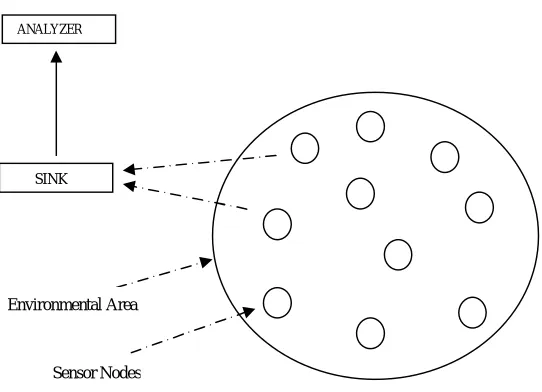
Refer figure 1 for structure of wireless sensor networks. Figure shows the communication between the source and destination. Numbers of sensor nodes are deployed in environmental area. Source nodes sense the information and forward to sink node.
The efficiency of QoS is dependent upon the proper selection of routing protocols. Different routing protocols like AODV, DSDV, DSR, and AOMDV were designed to achieve maximum QoS components like energy efficiency, packet delay ratio (PDR), Packet loss ratio (PLR) end to end delay etc. [11]. By dividing the bandwidth the traffic priority of the nodes can be achieved using the Priority Based Congestion Control Protocol (PCCP). To calculate the energy efficiency and energy consumption in WSN, the Energy Consumption Aware Models were used. To reduce the Overhead and Delay, different Compressed Sensing Based Protocols were used [18].
Different Scheduled Based and Contention Based MAC protocols like SMAC, BMAC, T-MAC, Z-MAC, CMAC and WMAC etc. were used for monitoring the traffic in the WSN in order to achieve energy consumption. Sensor MAC (SMAC) is used to decrease the energy consumption at low traffic. BMAC is the Berkeley MAC protocol used to reduce the overhead when the network is idle. It is easy to implement and hence energy consumption is less. Wise MAC (WMAC), Data Gathering MAC (DMAC) and Convergent MAC (CMAC) are also used to save the energy consumption and decrease the latency. [15]. To reduce the Energy consumption while data transmission is taking place, the Energy-efficient Adaptive TDMA (EA-TDMA) and Energy-efficient BMA (E-BMA) are used. EA-TDMA exceeds the protocols like TDMA (Time Division Multiple Access) and BMA (Bit-Map Assisted Protocol) for medium to high traffic conditions in the network. E-BMA also betters the TDMA and BMA for low to medium traffic [16]. Context Aware MAC Protocols (CA-MAC) works on Traffic Aware Adjustment, Channel Aware Adjustment and Hybrid Superframe Structure to manage the high network efficiency and reliability. CA-MAC achieve minimized synchronized overhead [17][18]. Time-out MAC (TMAC) is used to reduce the problem of idle listening. TMAC protocol achieves energy efficiency even when message rate fluctuates in time or location [19]. Z-MAC (Zebra MAC) protocol uses the CSMA and TDMA protocols to achieve low and high contention levels respectively. The time synchronization failure and topological changes cannot affect the behavior of the Z-MAC protocol [20].
Figure 1: - Structure of Wireless SensorNetwork SINK
ANALYZER
Environmental Area
All these protocols and techniques were designed so as to achieve the energy efficiency, delay and overhead, high channel utilization and more. The each technique used was only satisfying two to three QoS qualities and was unable to achieve the maximum throughput from the sensor nodes.
ROUTING PROTOCOLS
I. Ad hoc On-demand Distance Vector Routing (AODV)
The AODV protocol finds the route between source node and destination node only when there is information to be exchanged. At each node, next hop information is stored. This protocol finds the path on demand by broadcasting the request packet in the network. It requires more time for connection establishment. When a particular link fails, an error message is passed back to a transmitting node, and the process continues. The difference between AODV and other on-demand routing protocols is that it uses a destination sequence number (DestSeqNum) to determine the exact path from source to destination.
II. Destination Sequenced Distance Vector Routing (DSDV)
This type of protocol forms the list of destination nodes and their route information in the routing table. It contains the information of all possible paths reachable from the current node. For every entry the sequence number is assigned. If the link is present between nodes then even sequence numbers are used, else odd sequence numbers are used. In this protocol, the delay is less since all the possible paths to the destination are available to user. The sequence number is used to differentiate the routes and thus avoids the formation of loop, i.e. if the particular router receives the new information then it uses latest sequence number else route with the better matrix is used.
III. Dynamic Source Routing (DSR)
As the name suggests the DSR protocol is based on the source routing where all the routing information is stored at mobile nodes. Like AODV, this protocol also broadcast route request packets in the network. In this approach path is formed only if there is actual requirement of path formation. The DSR is designed to control the bandwidth consumed by control packets in ad hoc wireless networks by eliminating the periodic update messages essential in the table-driven approach. The routing overhead increases as the path length increases
II. LITERATURESURVEY
The author Yanjun Yao et al. developed the Energy-efficient Delay Aware Lifetime-Balancing (EDAL) Data Collection Protocol to solve the open vehicle routing problem. EDAL protocol achieves the increased network lifetime, minimized packet delay and also connects all the nodes in the network with minimum path cost [6]. The author Jenq-Shiou Leu et al. developed the Regional Energy Aware Clustering method using Isolated Nodes (REAC-IN) which is used to solve the problem of random selection of nodes that creates isolated nodes in the WSN. This method increases the lifetime and the stability of the network and also helps to improve the cluster head selection among the energy nodes [7]. The author A Liu et al. used efficient data gathering scheme for increasing network reliability. The optimization approach is used for single-source linear network. This approach increases the network lifetime, reduces the energy consumption without affecting the network reliability [8].
The author Anu Arya et al. comparatively studied the AODV, DSDV and DSR routing protocols. The authors concluded that the DSR is better for throughput, AODV is better in PDR and End to End delivery ratio [9]. The author Kamal Kr. Gola et al. implemented the high speed data collection technique. With the help of this technique, the energy consumption is reduced and the network lifetime is increased. This technique ensures the secure data transmission in the network [10]. The author compared the routing protocols like AODV, DSDV, DSR and AOMDV with 802.11 and 802.15.4 protocols. Authors observed that the DSDV protocol is the better solution for 802.11 and 802.15.4 protocols [11]. The author Kriti Thakur et al. implemented energy efficient network using multi sink scenario. The Wi-Max communicates with the sink nodes which are passing data in the network. The network lifetime is increased [12]. The author implemented the solution for network congestion by detecting and minimizing the congestion for the distributed nodes in the wireless sensor network. The author implemented multipath rate organization technique which is used with priority support having distributed load on the nodes [13]. The author proposed energy consumption aware model in WSN. It works on listen/sleep mechanism for the sensor nodes so as to increase the energy efficiency in the Wireless sensor network [14].
III.PERFORMANCEREVIEWTABLE
Pp. No. Paper Title Techniques Parameters Achieved
1. An Efficient Cluster-Tree Based
Data Collection Scheme for Large
Mobile Wireless Sensor
Network(2015)
Velocity Energy-Efficient and
Link-aware Cluster-tree
(VELCT)
1.Reduce Energy
Consumption
2. Increase throughput 3. Reduce End-to-End delay
2. Ring Routing: An Energy- Efficient
Routing Protocol for Wireless
Sensor Networks with a Mobile Sink(IEEE-2015)
Ring Routing Protocol 1. Reduce control overhead
in case of wastage of Energy and Packet Delay.
3. An Intelligent Hybrid MAC With
Traffic- Differentiation-Based QoS for WSN(IEEE-2013)
IH-MAC Protocol(broadcast
scheduling-link scheduling)
1.Reduce Energy
Consumption 3. Reduce Delay.
4. An energy Efficient Cross-Layer
network operation Model for
802.12.4-Based Mobile WSN(IEEE-2015)
Energy Efficient cross-Layer Network Operation Model
1.Reduced Energy
consumption
2.Throughput Improved 3. Low end-to-end delay.
5. Mobile Sink-Based Adaptive
Immune Energy efficient Clustering Protocol for Improving the Lifetime and Stability Period of WSN(IEEE-2015)
MSIEE Protocol 1.Eliminate energy hole
problem
2. stability period 3.Improved PDR 4. Packet delay.
6. EDAL: An Energy-Efficient,
Delay-Aware, and lifetime- Balancing
Protocol for Heterogeneous
WSN.(IEEE-2015)
EDAL Protocol 1. Increased N/W lifetime,
2.Minimize packet delay.
7. Energy Efficient Clustering Scheme
for Prolonging the Lifetime of
wireless Sensor Network with
Isolated Nodes.(IEEE-2015)
Regional energy Aware
Clustering method using
isolated nodes (REAC-IN)
1. Improved the lifetime 2. stability of N/W.
8. Reliability Guaranteed Efficient
Data Gathering in WSNS(IEEE-2015)
Efficient Data Gathering
Scheme
1.Reduced energy
consumption
2. Increased N/W lifetime.
9. Comparative Study of
AODV,DSDS and DSR Routing
Protocols in Wireless Sensor
Network Using NS-2
Simulator(IJCSIT-2014)
Comparing the performance of DSR, DSDV and AODV
1. Increased throughput
2.Improved End-to-end
delivery Ratio.
10. High Speed Data Collection in
WSNs(IJARI-2014)
High Speed data collection. 1.Maximize N/W lifetime
2. Decreased energy
consumption
3. Transferring secure data.
11. Performance Comparison of
Different Routing Protocol Over WSN(IJCNS-2014)
Routing Protocols AODV,
DSDV, DSR and AOMDV.
1.Increase Throughput from DSDV
2. Decreased energy
IV.CONCLUSIONANDFUTUREWORK
Wireless sensor network is a set of distributed nodes randomly deployed in environmental area. Performance of the networks is measured using QoS of networks. Depending upon the congestion control performance of the network can be improved. Many researchers implement the different protocols, techniques and algorithms for performance improvement of network. In this paper we covered maximum techniques and protocols implemented by the many researchers. Techniques which achieve maximum QoS like delay, congestion control, throughput, energy efficiency in the network are proposed in this paper. The Given Table shows the techniques and protocols implemented by researchers. The QoS is achieved by the protocols and techniques. We come to the conclusion that this paper is very useful for new researchers for the innovation of new techniques and protocols in sensor network. Table contains advantages and list of the QoS achieved by authors. In future work we invent the hybrid protocol or technique which is very useful to achieve more parameters of sensor networks.
Novel Approach Based On
Clustering(IJCSMC-2014)
13. Congestion Detection &
Minimization in Wireless Sensor
Network By Multipath Rate
Organization Technique(IJCSMC-2014)
Multipath Rate Organization Technique.
1.Congestion control 2. Normalized throughput. 3. Increase PDR
14. Proficient Energy Consumption
Aware in WSN(2014)
Energy Aware Model. 1.Reduced Energy
Consumption
2.Increases the life time of node.
15. Energy Efficient MAC Protocols for
WSN: A Survey(IJCSES-2011)
MAC Protocol. 1.Increase energy efficiency
2.Increases the life time of network.
16. Energy Efficient Wireless MAC
Protocols for Railway Monitoring Application(IEEE-2013)
EA-TDMA, B-MAC 1.Increase energy efficiency
2.Reduce Network Traffic
17. MAC Protocol in Wireless Body
Area Networks for E-Health:
Challenges And a Context-Aware Design.(IEEE-2013)
CA-MAC. 1.Network Efficiency and
Reliability
2 .Congestion control
18 Compressed Sensing Based Protocol
for Interfering Data Recovery in Multi-Hop Sensor Network(IEEE-2014)
Compressed Sensing Based
Protocol: Conv. AODV, Conv. CDMA
1.Reconstruction error is minimized
2.Overhead and Delay is minimized
19 An Adaptive Energy-Efficient MAC
Protocol for WSN(IEEE-2003)
T-MAC 1.Reduce Energy
Consumption
2.Idle listening problem is solved.
20. Z-MAC: a Hybrid MAC for
WSN(IEEE-2005)
Z-MAC 1.Reduce Collision near
destination node
2.Increased network
REFERENCES
[1] R. Velmani and B. Kaarthick, An Efficient Cluster-Tree Based Data Collection Scheme for Large Mobile Wireless Sensor Networks, page no. 2377, IEEE Sensors Journal, Vol. 15, no. 4, April 2015.
[2] C. Tunca, S. Isik, M. Donmez, and C. Ersoy, Ring Routing: An Energy-Efficient Routing Protocol for WSNs with a Mobile Sink, page no. 1947, IEEE Transactions on mobile computing, Volume 14, No. 9, Sept 2014.
[3] M. Arifuzzaman, M. Matsumoto and T. Sato, An IH-MAC With Traffic-Differentiation-Based QoS for WSNs, IEEE Sensors Journal, Vol. 13, No. 6, June 2013.
[4] K. Kr. Gola, B. Gupta, Z. Iqbal, An Energy Efficient Cross-Layer Network Operation Model for IEEE 802.15.4 Based MWSNs, IEEE 2014.
[5] M. Abo-Zahhad, S. M. Ahmed, N. Sabor and S. Sasaki, Mobile Sink Based Adaptive Immune Energy Efficient Clustering Protocol for Improving Lifetime and Stability Period of WSNs, IEEE Sensors Journal, Vol. 15, No. 8, August 2015.
[6] Y. Yao, Q. Cao and A. V. Vasilakos, EDAL: Energy Efficient Delay Aware and Lifetime Balancing Data Collection Protocol for Heterogeneous WSNs. IEEE 810 IEEE/ACM Transactions on Networking, Vol. 23, No. 3, June 2015.
[7] J. Leu, T. H. Chiang, M. Yu, and K. Su, An Energy Efficient Clustering Scheme for Prolonging the Lifetime of WSN With Isolated Nodes, IEEE Communication Letters, Vol. 19, No. 2, Feb. 2015.
[8] J. Long, M. Dong, K. Ota, A. Liu and S. Hai, Reliability Guaranteed Efficient Data Gathering in Wireless Sensor Network, Digital Object Identifier 10.1109/ACCESS.2015.2426794, 28 April 2015.
[9] A. Arya, J. Singh, Comparative Study of AODV, DSDV and DSR, Routing Protocols in WSN Using NS-2 Simulator, IJCSIT, Vol. 5 (4) , 2014, 5053-5056.
[10] K. Kr. Gola, B. Gupta, Z. Iqbal, High Speed Data Collection in Wireless Sensor Network, IJARI, Vol. 2, Issue 3 618-622, ISSN 2347 – 3258, August 2014.
[11] S. Mohapatra and C. R. Tripathy, Performance Comparison of Different Routing Protocol over WSN (IJCNS-2014), Vol. 4, Issue 3, 30 September 2014.
[12] K. Thakur, R. Sahu, To Enhance the lifetime of Wireless Sensor Network using novel approach based on Clustering, IJCSMC, pg.1052 – 1058, Vol. 3, Issue. 3, March 2014.
[13] S. Patel, R Pandit, A. Rathod, Congestion Detection and Minimization in WSN by Using Multipath Rate Organization Technique, IJCSMC, pg.569 – 575, Vol. 3, Issue. 3, March 2014.
[14] R. S. Bhadoria, G. S. Tomar and S. Kang , Proficient Energy Consumption Aware Model in WSN , IJMUE , Vol.9, No.5 (2014), pp.27-36, ISSN: 1975-0080.
[15] B. Narain, A. Sharma, S. Kumar, V. Patle nd Pt. R. Shukla, Energy Efficient MAC Protocols For WSNs: A Survey, IJCSES, Vol. 2, No. 3, August 2011.
[16] G. M Shafiullah, S. A. Azad and A.B.M. Shawkat Ali, Energy Efficient MAC Protocols for Railway Monitoring Applications, IEEE Transactions on transportation system, Vol. 14, No. 2, June 2013.
[17] B. Liu and Z. Yan, C. W. Chen, MAC Protocols In Wireless Body Area Network For E-Health: Challenges & Context-Aware Design, IEEE Wireless Communications, August 2013.
[18] M. Kaneko and K. Al Agha, Compressed Sensing Based Protocol for Interfering Data Recovery in Multihop WSNs, IEEE Communications Letters, Vol.18, No. 1, January 2014.