Abstract: Today, the Wireless Sensor Network (WSN) is emerging to be a very promising technology to be employed in the future. There were different protocols in energy-efficient routing that were designed and further developed for the WSNs for the purpose of supporting data delivery given to their respective destinations. The different techniques of clustering are perused widely by different researchers for increasing their objectives of scalability and also their lifetime. There have been many protocols used for the creation of a hierarchical structure to reduce the cost of the path at the time of making any communication to the base station. This work increases an energy lifetime and the stability of the network in an efficient manner within the protocols of clustering for which several protocols were suggested. Discussion is made on the Bat Algorithm (BA), the Bat algorithm along with mutation and the Genetic Algorithm (GA). This BAT algorithm had search abilities with various applications to solve problems in engineering. There was viability for the mutated BAT algorithms observed in various tasks that were proven and were shown by the empirical outcomes thus making the proposed scheme to perform better in comparison with all schemes.
Index Terms: Bat algorithm (BAT), Clustering, Cluster Head (CH), Energy efficient clustering scheme (EECS), Genetic Algorithm (GA), Hybrid energy efficient distributed clustering (HEED), Low Energy Adaptive Clustering Hierarchy (LEACH), Wireless Sensor Network (WSN).
I. INTRODUCTION
The Wireless Sensor Network (WSN) is emerging to be a very promising technology and is enabled by the advancement observed in technology along with the small smart sensors that were also inexpensive. Recently, interest has been observed worldwide in the Wireless Sensor Networks. This is perhaps the most commonly researched areas in the recent decade. The WSN may be defined as a new network of tiny certain devices known as the sensor nodes that these are distributed partially and for cooperatively communicate all information that was obtained from the field which was monitored using wireless links.
This WSN technology has offered several advantages over other networking solutions like flexibility, accuracy, dependability, scalability and lower costs. The advancement of technology has made the sensors, cheaper, smaller and smarter thus enabling billions of sensors to be deployed in various applications. A few of such potential domains were found to be security, healthcare, environment, and military services. In the case of the military, the sensor nodes are used
Revised Manuscript Received on September 06, 2019
Mr.MAHARAJAN M S, Assistant professor, Computer Science & Engineering, GRT Institute of Engineering and Technology, Tiruttani, [email protected]
Dr.T.Abirami, Associate Professor, Information Technology, Kongu Engineering College, [email protected],[email protected]
for detecting tracking and locating movements of enemies. In situations of natural disasters, the sensor nodes will be able to detect aspects of the environment in order to forecast disasters earlier. In the field of health care, the sensor nodes help to monitor the health of patients. Taking security into consideration, the sensors are able to offer vigilance in surveillance and also be able to increase alertness to terrorist attacks. This may not take long to monitor hurricanes, avalanches or forest fires and failure of utility equipment in hospitals or traffic. There is a wider potential to the applications of the WSN which is today a fast growing market of multibillion dollars, however, needing more progress in terms of standards, as well as technologies for supporting other applications [1].
The WSN has been constituted by autonomous devices that are distributed spatially for wireless communication that gather information and detect significant events in conditions that are both environmental and physical. Every such device will be capable of sensing, communicating and processing in a concurrent manner. For instance, an area of the oldest application in the WSN was observed in environmental monitoring that ranges from tracking animal herds and monitoring areas that are challenging to reach. There were the military battlefields that constituted applying the WSNs in hostile or inaccessible territories thus making the WSNs indispensable to detect snipers to track activity. In addition to this, deploying the WSNs becomes useful in the improvement of logistics in which challenges are tackled by transporting them and preserving quality by means of container temperature monitoring and so on.
Yet another example was that the WSNs were employed to improve the experience of gaming by means of enhancement of interactions observed between the virtual and the physical world by making use of implantable and wearable camera sensors. The applications of health and medicine will form yet another important application that ensures the carers are able to monitor the patient condition in the hospital or even from their homes. The control of radiation level, level of explosive gas and detection of leakage are all a critical part of applications of emergency and security. While employing the Internet of things (IoT), there are various applications observed by using WSNs in smart environments of smart cities, smart provision of water and remote metering. There were several other sophisticated applications to the WSN proposed to improve human life and its quality in terms of control of supply chain,
An Energy Efficient Mechanism using Mutated
Bat Algorithm in Wireless Sensor Network
home appliance operation using remote control automation of industrial factories, air-traffic control, and disaster management and control to name a few [2].
The WSN has a collection of several wireless nodes that have limited capabilities in terms of energy that is either stationary or mobile and located in an environment that is changing dynamically. The selection of strategies of routing is a critical issue in the delivery of packets made to their respective destinations. Furthermore, these networks will need a strategy of applied routing that ensure minimal consumption of energy to ensure network lifetime is maximized. The initial WSNs were designed during the mid-70s for the defence and the military industries. The WSNs had been used at the time of the Vietnam War to support enemy detection in remote areas. But, implementation of this has various drawbacks that include sensors of large size, energy consumed and limitations to energy consumption. From then on, plenty of work in the field of the WSNs was carried out and they resulted in developing the WSNs to varied systems or applications. There were several other protocols that were energy-efficient that were designed and further developed for the WSNs for the purpose of supporting efficient delivery of data to their respective destinations. So, every protocol of routing which is efficient in terms of energy, will have certain specific traits that are dependent on the network architecture and application [3].
The WSN denotes a sensor node set that is deployed within a particular physical area that is connected by means of wireless links. Several challenges have been observed in the wireless sensor networks the primary one being the maximization of stability and network lifetime. It may not be a feasible option to replace batteries of many thousands of such sensor nodes once the deployment is complete. For the sensor network, there is a grouping of cluster nodes known as clustering. Each cluster will have a leader known as the cluster head. The cluster head or the CH is either elected or pre-assigned by the members and collects node data inside the cluster that transfers this to the destination (which is the base station). The techniques of clustering are perused widely by the researchers to increase the network lifetime and improve the objectives of scalability. There are several protocols of clustering that are used for the creation of a hierarchical structure to reduce the cost of a path at the time co communication with its base station. Identified were many methods to differentiate and further classify these algorithms of clustering found in the WSNs. All popular algorithms were differentiated based on the process of selection of cluster heads [4].
In the case of large WSNs, the sensors will generally be divided into clusters. Clustering is well-suited for the WSNs of a large scale with a useful approach to the management of topology that brings down communication. Clustering is critical for the applications of sensor network wherein there are plenty of ad hoc sensors deployed to ensure sensing. Clustering will further facilitate effective utilization of sensor node energy thus extending the lifetime of the network. The schemes of clustering have a crucial role to play in the WSNs. The Low-Energy Adaptive Clustering Hierarchy (LEACH) will form clusters by means of employing a new distributed algorithm in which the nodes and their decisions are
autonomous and do not have centralized control. In the initial stages, the node will become a CH having a probability p and this will further broadcast the decision. The Two-Level Low-Energy Adaptive Clustering Hierarchy (TL-LEACH) was proposed as an extension to this LEACH algorithm. It further uses two different CH levels (both primary, as well as secondary). The Energy efficient clustering scheme (EECS) denotes an algorithm that the candidates of the CH to compete for elevating the CH. The Hybrid Energy Efficient Distributed clustering (HEED) was the multi-hop clustering algorithm used in the WSNs. The CHs will be selected on the basis of two different parameters which are the residual energy along with the cost of intra-cluster communication [5]. A critical feature of the WSNs will be a part of the sensor nodes and their limited batteries. The gathering of data is quite common but it may have some critical operations to perform in various applications of the WSN among which hierarchical mechanisms and aggregation of data were the techniques used widely. The aggregation of data will be able to eliminate redundancy of data and also bring down the load of communication. Genetic Algorithm (GA) indicates a technique used for searching in a randomized manner where optimization is applied to varied types of studies. It is a technique of metaheuristic optimization producing several results that are fruitful in the field of engineering. This is structured and also randomized as a technique of search primarily working on the basis of three different operations which are the selection, the crossover, and finally mutation. The basic flow of operation for the GA will include the creation of its initial population, fitness evaluation, crossover, selection, mutation, updating of optimal chromosomes and checking of the condition of termination [6].
In recent decades, there are researchers and scientists applying analogy from the biological and natural systems. They include operative, distributed as well as intelligent techniques to problem-solving that are observed among the swarms of ants, bees, birds, and bats. These help in handling complexities and challenges faced among the mathematical, engineering and scientific problems and are very effective in solving problems of optimization. The algorithms of swarm intelligence denote a group of algorithms that are meta-heuristic that make use of certain evolutionary steps at the time of simulation of swarm intelligence found in nature. This will be a collaboration of intelligence of the members of the swarm to move towards a level of decision making in a better society. Every swarm member will have a local vision that is small and if this is combined ideally, the overall vision will be a global and big one emerging from the intelligent behaviour from their local interactions or self-organization. Some of the most common examples are the Artificial Bee Colony (ABC), the Particle Swarm Optimization (PSO) and the Ant Colony Optimization (ACO). One more new technique of optimization is the Bat Algorithm (BA).
The results of the experiment are discussed in Section 4 and the conclusion is made in Section 5.
II. RELATEDWORK
Selim and Senol [8] had made a proposal of the Genetic Algorithm based method (GABEEC) that was proposed for optimizing the wireless sensor networks and their lifetime. The method is based on clusters like the LEACH. The GA is employed for maximizing network lifetime using rounds. There are two phases to this which are the Set-up phase and the Steady-state phase. In the case of the former, clusters will be created and they are changed in the entire network. These clusters will not be recreated and there are some static clusters that have cluster heads that change dynamically. There is also a simulator which is developed using the MS Visual C# 2010 development and its environment for validating this method. For the purpose of simulation, there are 100 nodes distributed randomly in a total of 50x50 square meters. The results have proved the proposed method to be much more efficient compared to the LEACH.
A new algorithm based on the GA was proposed by Abo-Zahhad et al., [9] known as the Genetic Algorithm-based Energy-Efficient adaptive clustering hierarchy Protocol (GAEEP). This was for an efficient maximization of network lifetime and for improving the period of stability of the WSNs. This new protocol aimed at increasing the WSN lifetime by means of identifying the optimum cluster heads along with their locations thus optimizing. The GAEEP operation is divided into rounds in which every round will start with the set-up phase and at the time the base station is able to identify an optimal number of the CHs, it helps in assigning the nodes to the CH. After this, the steady-state phase is performed where the data sensed gets transferred into its base station. The GAEEP and its performance have been compared to the other protocols found in the homogeneous, as well as the heterogeneous cases. Furthermore, the GAEEP protocol can increase the dependability of the process of clustering since it is able to expand the period of stability thus compressing the period of instability.
An algorithm was proposed by Baranidharan and Santhi [10] which was known as the Genetic Algorithm based Energy Efficient Clustering Hierarchy (GAECH) algorithm for increasing the FND, HND, and the LND employing a novel function of fitness. This GAECH fitness function has some clusters that are well-balanced and also take into consideration the cluster and its core parameters. The results of the experiment had indicated the performance of the GAECH to be better compared to the other algorithms found in all parameters.
A Genetic Algorithm with the concept of hierarchical clustering that was proposed by Shurman et al., [11]. The results of the simulation were very promising with a significant level of improvement over the other heuristics such as the normal Genetic Algorithms.
A method of heterogeneous sensor node clustering that was proposed by Elhoseny et al., [12] along with a Genetic Algorithm. This was for optimizing energy exhaustion such as Dynamic Clustering of Heterogeneous WSNs with the Genetic Algorithm ’DCHGA’. In the DCHGA, network
structure was decided in a dynamic fashion once every message had a round of transmission. When compared to the other methods that were state of the art, the DCHGA had extended the life of the network along with an average level of improvement in connection to that of the performance which was second best (with stable nodes) that were based on the first-node-die and last-node-die that had been observed as 33.8% and 13%. For the sensors and their mobility heterogeneity, there was an improvement recorded between the range of 12.6% and 9.8%. This balanced consumption of energy had improved the lifetime of the network thus permitting an even depletion of energy. The efficiency of computation of the DCHGA could be compared to other methods and the average time observed overall was about 0.6 seconds having a standard deviation of about 0.06.
A fuzzy logic coupled with some Genetic algorithms that were chaotic were combined by Karmi et al., [13]. There was fuzzy logic that was proposed on the basis of three different variables which were energy, density and finally centrality. After this, the number and the place of these cluster heads had been determined within the base station using the Genetic algorithm that was based on the chaotic. The results of simulation found in the NS-2 proved that there was a longer lifetime for the network compared to the GFS, SEDEEC, DEEC, and LEACH.
A new optimization algorithm called the Bat Algorithm that was described for evaluating the problem of node localization proposed by Goyal and Patterh [14]. At the same time, the currently existing Bat Algorithm was modified with Bacterial foraging strategies. On being compared to the current Bat Algorithm, the proposed modified Bat Algorithm was depicted using simulations to improve performance and increase the ratio of success of localization along with its fast speed of convergence to enhance robustness.
The problem of localization identified in the WSN which was formulated to be a problem of optimization with Bat algorithm proposed by Goyal and Patterh [15]. The results of simulation prove that an error of mean localization will keep decreasing with the increase in anchor nodes. There was also a new hybrid stochastic algorithm that was proposed for purposes of accuracy. The proposed algorithm’s effectiveness was verified based on the sensor network and its experimental setup.
III. METHODOLOGY
For the purpose of increasing stability and also to increase the lifetime of network energy, there were various protocols of clustering that were proposed. There was a discussion on the Bat algorithm, the Bat algorithm along with mutation and the Genetic Algorithm (GA).
A.Genetic Algorithm (GA)
Genetic Algorithm (GA) was used for making randomized searches with optimization.
The basic flow of operation of the GA will include the creation of its initial population, evaluation of levels of fitness, selection, mutation,
optimal chromosome
condition of termination depicted in Figure 1.
The GA will begin with a set of solutions that are generated randomly known as the population. For every such individual solution within the population, there is a chromosome or the individual. These functions are based on the actual level at which this is close to an optimal solution. There are two different chromosomes chosen randomly called the parents that are able to exchange any genetic information using a process known as crossover or recombination. This may produce two other chromosomes called the offspring or child. In case both parents happen to share the same pattern within their chromosome, it will also be carried forward to their offspring. For the purpose of getting an ideal solution, mutation may be applied to the chromosomes chosen randomly once the crossover is complete. The mutation may further help in restoring the genetic values that were lost earlier at the time there was a very fast convergence of population. The GA may also be used in an effective manner to look out for optimality among clusters. Every chromosome is represented to be a simple string or a gene array that consists of one part of its solution. The gene values are also known as the alleles. The actual length of the chromosome within the population will continue to remain the same and the fitness function will be given for assigning every individual’s fitness value [16].
The actual fitness of that of a chromosome is dependent on various parameters of fitness. Once the fitness is duly evaluated for every chromosome, the best-fit ones are determined by the GA with certain specific criteria of selection by applying two different operations which are the Crossover and the Mutation. All operations are made for producing a new population that is better compared to the earlier one in the subsequent generation.
Fitness Function
The primary aim was to maximize the network lifetime. This fitness function contained three different parameters which were:
� RFND: This is the round where the first nodes die � RLND: This denotes the round where the last node dies, The Fitness Function
Cluster distance: This denotes the sum of its distance from
all member nodes to their CH and also the distance from a CH to its BS. The fitness parameter can be made important compared to the other by means of making a change to its weight or equal importance may be given to them by setting all weights equally.
Selection: This will determine the actual chromosomes from their current population for the creation of new child chromosomes through crossover or mutation. The new child will then join the current population. Those chromosomes having better values of fitness have a greater probability of being chosen. There are many methods uses which are the Tournament selection, Rank selection, and the Roulette-Wheel selection. For this method proposed the Roulette-Wheel method was employed.
Crossover: This denotes the genetic operator to generate two child chromosomes from two parent chromosomes. An easy way to get this done is to select a random point of crossover with two parent chromosomes being able to exchange information. After this, a crossover is done once the process of selection gets dependent on the probability that is defined in the initial stage even before the GA begins. The probability of a crossover taking place is dependent on the rate of crossover.
Mutation: Once the crossover is complete, a mutation will take place. This was for the purpose of preventing the solutions from falling within the local optimum for the solved problem. The changes to mutation for the child chromosome will have a probability known as the rate of mutation [17].
B.Bat Algorithm
Bat algorithm had been developed in the year 2010 by Xin-She Yang to exploit the echolocation of bats. The bats make use of some sonar echoes for detection of obstacles with sound pulses transformed into a new frequency. They navigate using time delay and emit short but loud impulses of sound. Their pulse rate is normally 10 to 20 times for each second. Once they are hit and reflected, they transform their pulse as useful information to gauge the distance of their prey. They use wavelengths varying within the range between 0.7 to 17 mm or the inbound frequencies of about 20-500 kHz. For implementing this algorithm, there was a pulse frequency with the rate that is defined. This pulse rate may be determined within the range falling between 0 and 1 wherein, 0 indicates no emission and 1 indicates the emission of the bats is at its maximum.
The behaviour of bats is used for formulating the new BA. There are three different generalized rules used while implementing these bat algorithms which are:
1. All bats make use of echolocation for sensing distances and guessing difference between their prey and barriers of background magically.
2. While looking out for prey, bats y randomly using velocity which is vi at a position xi using the fixed frequency fmin, and a varying wavelength along with loudness of A0. The bats are able to adjust their wavelength automatically from emitted pulses and also adjust their pulse emission rates which is pulse emission r >
[0; 1] and this is dependent on the target and its proximity.
Begin
Generate an initial population
Compute the fitness of each individual
While (not stopping criterion) do
Choose parents from population
Perform crossover to produce offspring’s
Perform mutations
Compute fitness of each individual
Replace the parents by the corresponding
offspring’s in new generation
End
3. Even though there can be a variation to the loudness, we will have to assume it varies from the large (positive) A0 to the minimum constant value Amin.
The BAT Algorithm
1: The Objective function which is f(x), x = (x1;:::; xd)T 2: Initializing of Bat population which is xi and vi for that of i = 1: : :n
3: De_ne pulse frequency which is Qi > [Qmin;Qmax] 4: Initializing of pulse rates ri and their loudness which is Ai
5: When (t < Tmax) // is the number of such iterations 6: Generation of new solutions made by making adjustments to frequency and
7: Updating of velocities, as well as solutions, or locations 9: Selection of one solution from among the best ones 10: Generation of a local solution made around the solution that is the best
11: End if
12: Generation of another new solution by the ying in a random manner
13: In case (rand (0; 1) < Ai and the f(xi) < f(x)) 14: Accepting new solutions
15: Increasing ri and reducing Ai 16: End if
17: Ranking of the bats and the _nd which is the current best
18: End
19: Visualisation and results to be post-processed For this algorithm, the behaviour of the bats is captured within a _tness function for the problem that needs a solution. This contains the components below:
• initialization (in lines 2-4),
• generation for all new solutions (in lines 6-7), • local search (in lines 8-11),
• generation a new solution by randomly flying randomly (in lines 12-16) and
• finding its current best solution [18]
C.BAT Algorithm with Mutation (BAM)
Bat algorithm has been identified as a new method of swarm intelligence where search algorithms are inspired by the bats and their social behaviour along with a phenomenon known as echolocation for sensing distance. In the case of BA, every bat will be defined by means of its position which is t i x, its velocity ti v, its frequency fi, its loudness ti A and finally, its emission pulse rate which is ti r found within a d-dimensional space. For the part of local search, as soon as a new solution is chosen from the best ones, there is a new solution generated for every bat locally by using the concept of a random walk.
xnew = xold + εAt (1)
Wherein, ε∈ [−1, 1] denotes the factor of scaling that is always a random number and tt i A =< A > will be bats and their average loudness at a time step t, Wherein, α and γ will be constants. Here, α will be very similar to its cooling factor in the cooling schedule within Simulated Annealing (SA).
There is also a certain level of Differential Evolution (DE) which was proposed as a new Evolutionary Algorithm (EA) by Storn and Price which generated newer candidate solutions
by means of combining a parent individual with other individuals belonging to a similar population. This is a scheme of selection found to be greedy and it also overtakes all traditional EAs. The primary advantages of the DE are its robustness, speed, simplicity and its easy implementation. In the Bat Algorithm, since the search is dependent on random walks, there is no guarantee for fast convergence.
The primary modification to this is to add a mutation operator to the BA with some minor changes aiming at increasing the convergence speed thus enabling better, wider and practical applicability. The very first modification was to make use of a fixed frequency which is f and a loudness A as opposed to different frequencies such as fi and ti A. In the same way, for the BAM, there are positions ti x, emission pulse rate ti r, loudness A, fixed frequency f, and velocity ti v that are identified for every bat within the d-dimensional space. The next modification was adding a mutation operator for decreasing diversity in terms of population for improving the efficiency of search and as soon as a solution is arrived at, the new solution gets locally generated with a random walk [19].
IV. RESULTSANDDISCUSSION
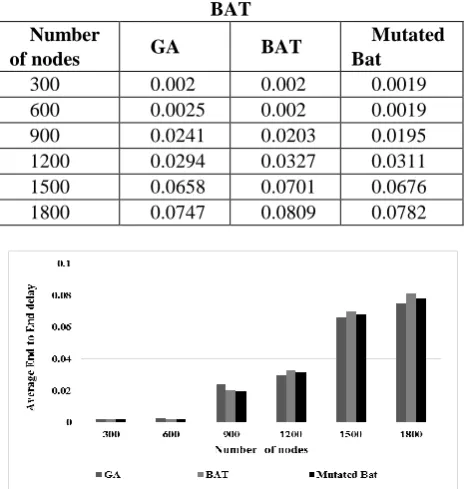
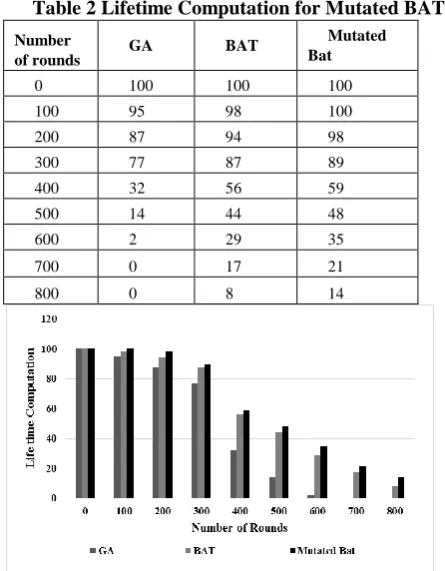
[image:5.595.311.544.403.648.2]In this section, the simulation results for GA, BAT and Mutated BAT is presented. An average end to end delay, average packet drop ratio and life time computation as shown in tables 1 to 3 and Fig 1 to 3.
Table 1 Average End to End Delay (sec) for Mutated BAT
Number
of nodes GA BAT
Mutated Bat
300 0.002 0.002 0.0019
600 0.0025 0.002 0.0019
900 0.0241 0.0203 0.0195
1200 0.0294 0.0327 0.0311
1500 0.0658 0.0701 0.0676
1800 0.0747 0.0809 0.0782
Fig 1 Average End to End Delay (sec) for Mutated BAT From the Fig 1, it can be observed that the Mutated BAT has lower average end to end delay when compared with GA and BAT algorithm. At number of nodes 300, an average end to end delay of mutated BAT is lowered by 5.13% and by 5.13% than GA and BAT respectively. At number of nodes 1200, an average end to end delay of mutated BAT is lowered by 5.62% and by 5.02% than
mutated BAT is lowered by 4.58% and by 3.39% than GA and BAT respectively.
Table 1 Average Packet Delivery Ratio for Mutated BAT
Number
of nodes GA BAT
Mutated Bat
300 0.7059 0.7882 0.8263
600 0.6806 0.7914 0.8303
900 0.6242 0.829 0.8695
1200 0.5932 0.7354 0.7689 1500 0.6111 0.7115 0.7418
[image:6.595.54.277.468.754.2]1800 0.5218 0.6347 0.6615
Fig 2 Average Packet Delivery Ratio for Mutated BAT From the Fig 2, it can be observed that the Mutated BAT has greater average packet delivery ratio when compared with GA and BAT algorithm. At number of nodes 300, an average packet delivery ratio of mutated BAT is increased by 15.72% and by 4.72% than GA and BAT respectively. At number of nodes 1200, an average packet delivery ratio of mutated BAT is increased by 25.79% and by 4.45% than GA and BAT respectively. At number of nodes 1800, an average packet delivery ratio of mutated BAT is increased by 23.61% and by 4.14% than GA and BAT respectively.
Table 2 Lifetime Computation for Mutated BAT Number
of rounds GA BAT
Mutated Bat
0 100 100 100
100 95 98 100
200 87 94 98
300 77 87 89
400 32 56 59
500 14 44 48
600 2 29 35
700 0 17 21
800 0 8 14
Fig 3 Lifetime Computation for Mutated BAT
From the figure 3, it can be observed that the Mutated BAT
has greater lifetime computation when compared with GA and BAT algorithm. At number of nodes 200, lifetime computation of mutated BAT is increased by % and by % than GA and BAT respectively. At number of nodes 400, lifetime computation of mutated BAT is increased by % and by % than GA and BAT respectively. At number of nodes 600, lifetime computation of mutated BAT is increased by % and by % than GA and BAT respectively
V.CONCLUSION
Energy-effective algorithms of clustering used for the WSNs were proposed here and the network lifetime was duly extended by selecting the BAT algorithm. Results show that the Mutated BAT has greater average packet delivery ratio when compared with GA and BAT algorithm. At number of nodes 300, an average packet delivery ratio of mutated BAT is increased by 15.72% and by 4.72% than GA and BAT respectively. At number of nodes 1200, an average packet delivery ratio of mutated BAT is increased by 25.79% and by 4.45% than GA and BAT respectively. At number of nodes 1800, an average packet delivery ratio of mutated BAT is increased by 23.61% and by 4.14% than GA and BAT respectively.
REFERENCES
1. Rawat, Priyanka, Kamal Deep Singh, Hakima Chaouchi, and Jean Marie Bonnin. "Wireless sensor networks: a survey on recent developments and potential synergies." The Journal of supercomputing 68, no. 1 (2014): 1-48.
2. Yetgin, Halil, Kent Tsz Kan Cheung, Mohammed El-Hajjar, and Lajos Hanzo Hanzo. "A survey of network lifetime maximization techniques in wireless sensor networks." IEEE Communications Surveys & Tutorials 19, no. 2 (2017): 828-854.
3. Pantazis, Nikolaos A., Stefanos A. Nikolidakis, and Dimitrios D. Vergados. "Energy-efficient routing protocols in wireless sensor networks: A survey." IEEE Communications surveys & tutorials 15, no. 2 (2012): 551-591.
4. Jain, Neeraj, P. Sinha, and S. K. Gupta. "Clustering protocols in wireless sensor networks: A survey." International Journal of Applied Information System (IJAIS) 5, no. 2 (2013).
5. Boyinbode, Olutayo, Hanh Le, Audrey Mbogho, Makoto Takizawa, and Ravi Poliah. "A survey on clustering algorithms for wireless sensor networks." In 2010 13th International Conference on Network-Based Information Systems, pp. 358-364. IEEE, 2010.
6. Zahmatkesh, Afsane, and M. H. Yaghmaee. "A genetic algorithm-based approach for energy-efficient clustering of wireless sensor networks." International Journal of Information and Electronics Engineering 2, no. 2 (2012): 165.
7. Kabir, Md Wasi Ul, and Mohammad Shafiul Alam. "Bat algorithm with self-adaptive mutation: a comparative study on numerical optimization problems." International Journal of Computer Applications 100, no. 10 (2014).
8. Bayraklı, Selim, and Senol Zafer Erdogan. "Genetic algorithm based energy efficient clusters (gabeec) in wireless sensor networks." Procedia Computer Science 10 (2012): 247-254.
9. Abo-Zahhad, Mohammed, Sabah M. Ahmed, Nabil Sabor, and Shigenobu Sasaki. "A new energy-efficient adaptive clustering protocol based on genetic algorithm for improving the lifetime and the stable period of wireless sensor networks." International Journal of Energy, Information and Communications 5, no. 3 (2014): 47-72. 10. Baranidharan, Balakrishnan, and B. Santhi. "GAECH: genetic
11. Shurman, Mohammad M., Mamoun F. Al-Mistarihi, Amr N. Mohammad, Khalid A. Darabkh, and Ahmad A. Ababnah. "Hierarchical clustering using genetic algorithm in wireless sensor networks." In 2013 36th International Convention on Information and Communication Technology, Electronics and Microelectronics (MIPRO), pp. 479-483. IEEE, 2013.
12. Elhoseny, Mohamed, Khaled Elleithy, Hamdi Elminir, Xiaohui Yuan, and Alaa Riad. "Dynamic clustering of heterogeneous wireless sensor networks using a genetic algorithm, towards balancing energy exhaustion." International Journal of Scientific & Engineering Research 6, no. 8 (2015): 1243-1252.
13. Karimi, Abbas, S. M. Abedini, Faraneh Zarafshan, and S. A. R. Al-Haddad. "Cluster head selection using fuzzy logic and chaotic based genetic algorithm in wireless sensor network." Journal of Basic and Applied Scientific Research 3, no. 4 (2013): 694-703.
14. Goyal, Sonia, and Manjeet Singh Patterh. "Performance of BAT algorithm on localization of wireless sensor network." International Journal of Computers & Technology 6, no. 3 (2013): 351-358. 15. Zahmatkesh, Afsane, and M. H. Yaghmaee. "A genetic
algorithm-based approach for energy-efficient clustering of wireless sensor networks." International Journal of Information and Electronics Engineering 2, no. 2 (2012): 165.
16. Bayraklı, Selim, and Senol Zafer Erdogan. "Genetic algorithm based energy efficient clusters (gabeec) in wireless sensor networks." Procedia Computer Science 10 (2012): 247-254.
17. Fister Jr, Iztok, Dušan Fister, and Xin-She Yang. "A hybrid bat algorithm." arXiv preprint arXiv:1303.6310 (2013).
18. Zhang, Jia Wei, and Gai Ge Wang. "Image matching using a bat algorithm with mutation." In Applied Mechanics and Materials, vol. 203, pp. 88-93. Trans Tech Publications, 2012.
AUTHORS PROFILE
Chandrakala H L. Received B.E in CSE from Malnad College of Engineering ,Hassan, M.TECH IN CSE from VTU study center ,BMS College Of Engineering ,Bangalore. PhD in CSE from from VTU-RRC. He is now working as Associate professor of HKBK College of Engineering, Bangalore. His Academic experience is 23 years. He published his research work in 2 journals and attended Seminars and workshops.