1
Complete genome sequence of a distinct isolate of
Cassava common mosaic
1
virus (CsCMV) infecting cassava in Hainan, China
2Nai-tong Yu1,2*, Yi Yang3, Jun-hua Li1, Wei-li Li1, Zhi-xin Liu1* 3
1. Key Laboratory of Biology and Genetic Resources of Tropical Crops, Ministry of Agriculture and Rural 4
Affairs, Institute of Tropical Bioscience and Biotechnology, Chinese Academy of Tropical Agricultural 5
Sciences, Haikou 571101, China. 6
2. Hainan Key Laboratory for Biosafety Monitoring and Molecular Breeding in Off-Season Reproduction 7
Regions, Haikou 571101, China. 8
3. Environment and Plant Protection Institute, Chinese Academy of Tropical Agricultural Sciences, Haikou 9
571101, China 10
11
*Corresponding author: 12
Nai-tong Yu, Email: [email protected] 13
Zhi-xin Liu, Email: [email protected] 14
Institute of Tropical Bioscience and Biotechnology, Chinese Academy of Tropical Agricultural Sciences 15
Tel: 086-898-66890770 16
17 18
Email addresses: 19
NTY: [email protected] 20
YY: [email protected] 21
JHL: [email protected] 22
WLL: [email protected] 23
ZXL: [email protected] 24
Abstract: The complete genomic sequence of a Cassava common mosaic virus Linggao isolate 27
(CsCMV-LG) was determined from cassava (Manihot esculenta Crantz) with mild leafy mosaic symptom 28
to no symptom in China. Excluding the poly(A) tail, the CsCMV-LG genome (GenBank accession No. 29
MT038420) is 6374 nucleotides (nts) in length, with five major open reading frames encoding a 30
1450-amino acids (aa) RNA-dependent RNA polymerase (RdRp), three triple gene block (TGB) proteins 31
(231-aa, 110-aa and 95-aa), and a 229-aa coat protein (CP). Phylogenetic analysis indicated that the 32
complete genome of the CsCMV-LG is closely related to that of CsCMV-Brazilian which has been 33
assigned to the genus Potexvirus, but the sequence identity shared only 88.0%. Notable, the mild 34
CsCMV-LG isolate can also infect Nicotiana benthamiana in laboratory through rub inoculation causing 35
mild vein yellowing at 15-day post inoculation. This is the first full-length genome sequence of a distinct 36
isolate of Cassava common mosaic virus (CsCMV) infecting cassava in Hainan, China. 37
Keywords:Manihot esculenta Crantz, potexvirus, Cassava common mosaic virus, genomics 38
39
Cassava (Manihot esculenta Crantz) is a tropical plant in the genus Manihot in the family Euphorbiaceae. 40
It is the sixth largest food crop in the world, mainly grown in sub-Saharan Africa, South Asian and South 41
America. With a production of over 270 million tonnes, it provides staple food for more than 500 million 42
people (FAO, 2017). Besides used as a staple, cassava is also a potential raw material for bioenergy and 43
bio-based materials. In China, cassava is an important tropical crop in southern provinces, with a planting 44
area of 500,000 hectares and a total output of 10 million tons (FAO, 2017). Viral diseases such as Cassava 45
mosaic disease (CMD) and Cassava brown steak disease (CBSD) are the main causes of severe economic 46
losses in cassava plantation worldwide (Kuon et al., 2000; Mulenga et al., 2018). However, there are other 47
49
Cassava common mosaic virus (CsCMV) is a re-emergent virus affecting cassava production in South 50
American countries such as Brazil, Peru, Colombia and Paraguay (Legg et al., 2015). The virus has also 51
been reported to infect Chaya (Cnidoscolus aconitifolius), a plant in the same family as cassava, in Mexico 52
(Jones et al., 1998). The genome of CsCMV has been sequenced from Brazilian isolate (CsCMV-Brazilian) 53
and it was classified into genus Potexvirus on the basis of viral particle morphology, genome and serology. 54
CsCMV-Brazilian consisted of 6376 nts long single-strand RNA which potentially encoded 55
RNA-dependent RNA polymerase (RdRp), triple gene block 1-3 (TGB1-3) and coat protein (CP) just as 56
many other Potexvirus (Calvert et al., 1996). 57
58
In 2019, 16 symptomatic cassava samples with mild leafy mosaic and 12 asymptomatic samples were 59
collected from Linggao County, Hainan Province, China. To ascertain the presence of potexvirus, total 60
RNAs of these samples were extracted by using a Quick RNA isolation kit (Bioteke, Beijing, China) and 61
reverse transcribed into the first strand cDNA by using EasyScript Reverse Transcriptase (Trans, China). 62
PCR targeting CsCMV RDRP gene was performed by using specific primers CsCMV 3280F/3892R (Table 63
1) and the result showed that the DNA fragments of the expected sizes were obtained from all 16 diseased 64
samples (100%) and three asymptomatic samples (25%). The DNA fragments were purified by an OMEGA 65
gel recovery kit (Bio-Tek, USA). Each DNA fragment was cloned into the pMD18-T vector (Takara, Dalian, 66
China), and then transformed into E. coli DH5a competent cells (2nd Lab, Shanghai, China). Three positive 67
clones were randomly selected for Sanger sequencing at Invitrogen (Guangzhou, China). Bioinformatic 68
analysis showed that the sequence was highly identical (99.9 % sequence similarity) and highly similar to 69
71
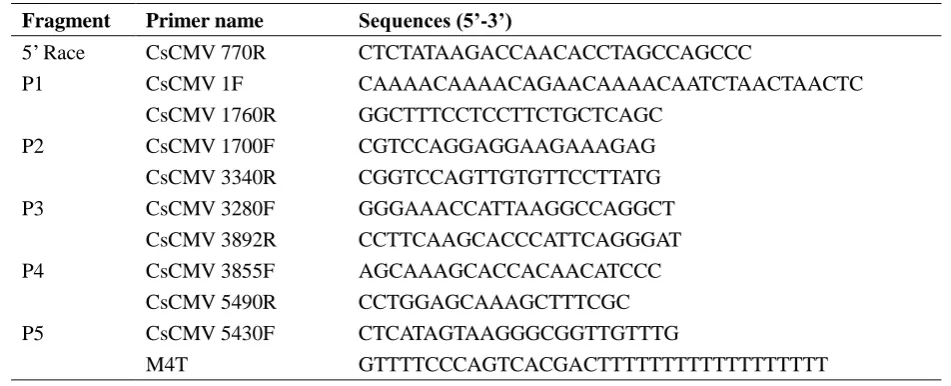
To determine the complete nucleotide sequence of this virus, another four pair-primers (Table 1) were 72
further designed base on the complete genome sequence of CsCMV-Brazilian (GenBank accession no. 73
U23414.1). The PCR reaction and amplification cycle were conducted as described by Li et al (Li et al., 74
2020). The five overlapping fragments were edited by ChromasPro software (Technelysium Pty. Ltd., 75
Australia) and were used to assemble into the complete genome of CsCMV-LG by BioEdit software. The 5’ 76
end sequence was further determined using a 5’ Rapid Amplification of cDNA Ends (5’ RACE) kit 77
(Invitrogen, Shanghai, China) according to the manufacturer’s instructions. The complete genome of 78
CsCMV-LG was deposited in GenBank under accession number MT038420. The CsCMV-LG isolate 79
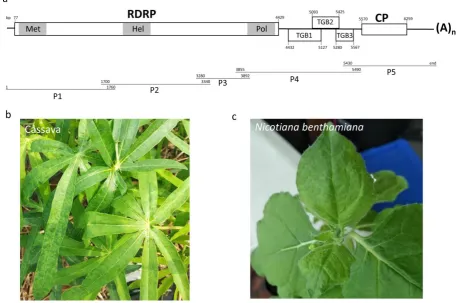
comprises 6374 nts (excluding the poly(A) tail) and has similar genome organization to potexvirus (Fig. 80
1A). Complete genome comparison between CsCMV-Brazilian and CsCMV-LG shows the two isolates 81
sharing only 88.0 % sequence similarity in full length, but 94.7% and 92.1% in 76-nt 5’ UTR and 115-nt 3’ 82
UTR, respectively (Table 2). Another two Potexviruses that close related to CsCMV-LG are Tulip virus X
83
(AB066288.1) and Hydrangea ringspot virus (LC107516.1), sharing 55.3% and 55.2% sequence similarity, 84
respectively. 85
86
Five open reading frames (ORFs) were predicted to encode proteins RdRp, TGB1, TGB2, TGB3, and 87
CP in CsCMV-LG at nt positions 77–4429, 4432–5127, 5039–5425, 5280–5567, and 5570–6259, 88
respectively. The similarities of these putative proteins and the corresponding ones between CsCMV-LG 89
and CsCMV-Brazilian were 87.30-92.0% at nucleotide level and 91.7-97.8 % at amino acid level, with 90
highest aa similarity found in CP coding region (Table 2). RdRp of CsCMV-LG is a 164.91 kDa protein and 91
like in those of other potexviruses. As expected, CsCMV-LG RdRp has a viral methyltransferase motif at aa 93
39–336, a viral RNA helicase domain at aa 733–963, and a RdRp motif at aa 1236–1343, which are 94
conserved motifs found in potexviruses RdRp. 95
96
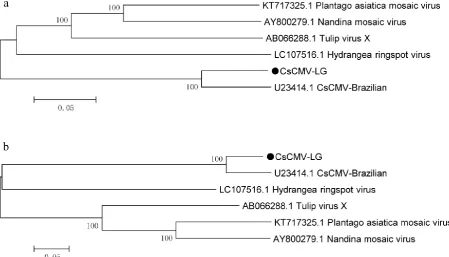
In order to further determine the homology and evolutionary relationships of CsCMV-LG with other 97
potexvirus, two phylogenetic trees based on the complete genomes nucleotide sequences were constructed 98
by using two methods in MEGA6.0 software (Tamura et al., 2013). The two methods used were 99
Neighbor-Joining method (Saitou and Nei, 1987) and maximum likelihood method (Tamura and Nei, 1993), 100
each with bootstrap values of 1000 replications. The result showed that both trees showed that CsCMV-LG 101
was the highest homology to the CsCMV-Brazilian and clearly distinct from the other potexviruses. 102
103
CsCMV is a re-emergent virus significantly affecting cassava production in many countries in South 104
America. The main symptoms of CsCMV infection in cassava were mosaic and chlorotic symptoms in 105
previous reports (Zanini et al., 2018). However, the diseased leaves of cassava plant present only very mild 106
mosaic symptoms in this study and some of them were even asymptomatic (Fig. 1B). The diseased fresh 107
leaves were ground in PBS buffer and inoculated into tobacco (Nicotiana benthamiana) leaves. The result 108
showed that the mild vein yellowing symptoms were observed on tobacco leaves varying at 10-15 dpi 109
(most plants presented the symptoms at 15 dpi) (Fig. 1C). However, CsCMV could be detected by RT-PCR 110
starting at day-5 in the systematic leaves. This biological experiment further showed that the CsCMV-LG is 111
a distinct isolate of the CsCMV-Brazilian. 112
113
China. It is likely that the disease would further spread without prevention and proper management. Further 115
studies are needed in order to clarify the genetic diversity, biological characterization, and epidemiology of 116
CsCMV in different geographic regions. Due to the wide distribution of CsCMV in Hainan and other 117
southern provinces in China, the genome information presented in this work will allow the design of 118
molecular tests aimed at detecting CsCMV in future. 119
120
Funding 121
This work was funded by the National Key R&D Program of China (2019YFD1000500), National Natural 122
Science Foundation of China (31261140363) and Young Elite Scientists Sponsorship Program by CSTC 123
(Project No. CSTC-QN201704). 124
125
Declarations 126
Consent for publication 127
All authors agreed to the publication of this manuscript. 128
129
Competing interests 130
The authors declare that they have no conflict of interest. 131
132
References 133
[dataset] Food and Agriculture Organization [FAO]. Food Outlook. Biannual report on global food markets. 2017; Available
134
at: http://www.fao.org/3/a-I8080e.pdf.
135
Calvert, L.A., Cuervo, M.I., Ospina, M.D., Fauquet, C.M., Ramirez, B.C. 1996. Characterization of Cassava common mosaic 136
virus and a defective RNA species.J Gen Virol. 77 (Pt 3): 525-530.
137
Jones, P., Devonshire, J., Dabek, A., Howells, C. 1998. First report of Cassava common mosaic potexvirus infecting Chaya
138
(Cnidoscolus chayamansa) in Tuvalu.Plant Dis. 82(5): 591.
Kuon, J.E., Qi, W., Schläpfer, P., Hirsch-Hoffmann, M., von Bieberstein, P.R., Patrignani, A., Poveda, L., Grob, S., Keller,
140
M., Shimizu-Inatsugi, R., Grossniklaus, U., Vanderschuren, H., Gruissem, W. 2000.Haplotype-resolved genomes of
141
geminivirus-resistant and geminivirus-susceptible African cassava cultivars.BMC Biol. 17(1): 75.
142
Legg, J.P., Lava Kumar, P., Makeshkumar, T., Tripathi, L., Ferguson, M., Kanju, E., Ntawuruhunga, P., Cuellar, W.2015.
143
Cassava virus diseases: biology, epidemiology, and management.Adv Virus Res. 91: 85-142.
144
Li, W.L., Yu, N.T., Wang, J.H., Li, J.C., Liu, Z.X.2020. The complete genome of Banana streak GF virus Yunnan isolate
145
infecting Cavendish Musa AAA group in China.PeerJ. 8: e8459.
146
Mulenga, R.M., Boykin, L.M., Chikoti, P.C., Sichilima, S., Ng'uni, D., Alabi, O.J.2018. Cassava brown streak disease and
147
Ugandan cassava brown streak virus reported for the first time in Zambia.Plant Dis. 102(7): 1410-1418.
148
Saitou, N., Nei, M. 1987. The neighbor-joining method: A new method for reconstructing phylogenetic trees. Mol Biol Evol.
149
4(4): 406-425.
150
Tamura, K., Nei, M. 1993. Estimation of the number of nucleotide substitutions in the control region of mitochondrial DNA
151
in humans and chimpanzees. Mol Biol Evol. 10(3): 512-526.
152
Tamura, K., Stecher, G., Peterson, D., Filipski, A., Kumar, S. 2013. MEGA6: Molecular evolutionary genetics analysis
153
version 6.0. Mol Biol Evol. 30(12): 2725-2729.
154
Zanini, A.A., Cuellar, W.J., Celli, M.G., Luque, A.V., Medina, E.D., Conci, V.C., Di Feo, L.V. 2018. Distinct strains of the
155
re-emergent Cassava common mosaic virus (genus: Potexvirus) infecting cassava in Argentina. 67(8): 1814-1820.
156
Table 1 Primers used for CsCMV-LG amplification in this study. 159
Fragment Primer name Sequences (5’-3’)
5’ Race CsCMV 770R CTCTATAAGACCAACACCTAGCCAGCCC
P1 CsCMV 1F CAAAACAAAACAGAACAAAACAATCTAACTAACTC
CsCMV 1760R GGCTTTCCTCCTTCTGCTCAGC
P2 CsCMV 1700F CGTCCAGGAGGAAGAAAGAG
CsCMV 3340R CGGTCCAGTTGTGTTCCTTATG
P3 CsCMV 3280F GGGAAACCATTAAGGCCAGGCT
CsCMV 3892R CCTTCAAGCACCCATTCAGGGAT
P4 CsCMV 3855F AGCAAAGCACCACAACATCCC
CsCMV 5490R CCTGGAGCAAAGCTTTCGC
P5 CsCMV 5430F CTCATAGTAAGGGCGGTTGTTTG
M4T GTTTTCCCAGTCACGACTTTTTTTTTTTTTTTTTT
Table 2 The sequence identities of viral gene nucleotide and amino acid between CsCMV-Brazilian and 162
CsCMV-LG. 163
Gene name Nucleotide (%) Amino acid (%)
Complete genome 88.0 —
5’ UTR 94.7 —
RDRP 87.40 94.30
TGB1 87.30 94.30
TGB2 92.0 92.80
TGB3 90.8 91.7
CP 88.5 97.8
3’ UTR 92.1 —
166
Fig. 1 Schematic representation of the genome organization of CsCMV-LG. 167
The 5’- and 3’-untranslated regions (UTR) are represented by a solid line. The viral proteins RDRP, 168
TGB1-3 and CP are indicated by boxes in white. The putative domains Met, Hel and Pol with RDRP 169
protein are indicated in gray (A). Symptoms of mild mosaic on the diseased cassava plant (B). Symptoms 170
of mild vein yellowing on the diseased tobacco plants at 15 day post inoculation (C). 171
175
Fig. 2 Phylogenetic analysis of the CsCMVs and other potexviruses based on the complete genome 176
nucleotide sequences. 177
The Neighbor-Joining method (A) and the Maximum Likelihood method (B) were used to construct the 178
phylogenetic trees. The bootstrap values (NJ/ML: 1000 replications) of identical branches in each tree 179
constructed by the two methods are shown above and below the branches. All positions containing gaps 180
and missing data were eliminated. Evolutionary analysis was conducted using MEGA6. The following 181
viruses were included in the analysis: CsCMV-LG (MT038420), CsCMV-Brazilian (U23414.1), 182
Hydrangea ringspot virus (LC107516.1), Tulip virus X (AB066288.1), Plantago asiatica mosaic virus
183
(KT717325.1) and Nandina mosaic virus (AY800279.1). 184