Study of Surface Parameters of Inconel 600 by Extrusion Honing
Process
Manjunath L Naduvinamani
1, Dr H P Raju
21
2
Assistant Professor, Department of Mechanical Engg, Mallareddy Engineering College
and management Sciences, Medchal, Telangana.
Professor, Department of Mechanical Engineering, PESCE Mandya, Karnataka, India
Abstract
Extrusion Honing (EH) is also known as Abrasive flow machining (AFM) is an effective method that is used to deburr, clean, polish, remove recast layer and micro cracks by flowing pressurized semisolid abrasive laden visco-elastic media over those surfaces. Inconel 600 is one of the most difficult-to-cut materials because of its low thermal diffusive property, high hardness and high strength at elevated temperature. In this paper, the influence of the process parameters on surface roughness is investigated on Inconel 600 material. The processed surfaces were measured and analyzed with the help of surface roughness tester and Scanning Electron Microscope (SEM). Results show a significant improvement in surface finish and EH/AFM is capable of removing the micro cracks and recast layer.
Key Words:
Surface finish, Extrusion honing, Inconel, Abrasive Flow machining, Silicone.---***---I.
INTRODUCTION
Extrusion Honing (EH) is also known as Abrasive flow
machining (AFM) is an advance machining process which is used to machine complex shape and is used to deburr, remove recast layer and radius surfaces. It is a manufacturing technique that uses the flow of a pressurized abrasive media to remove work piece material. In comparison with other polishing technique, AFM is very efficient, suitable for the finishing of complex inner surfaces. In recent years, hybrid-machining processes have been developed to improve the efficiency of a process by clubbing the advantages of different machining processes and avoiding limitations. It is experimentally confirmed that abrasive flow machining can significantly improve surface quality of nonlinear runner, and experimental results can provide technical reference to optimizing study of abrasive flow machining theory.The process of abrasive flow machining produces a smooth, polished finish using a pressurized media. The medium used in abrasive flow machining is made from a specialized polymer[1]. Abrasives are added to the polymer, giving it the ability to smooth and polish metal while retaining its liquid properties. The liquid properties of the polymer allow it to flow around and through the metal object, conforming to the size and shape of the passages and the details of the cast metal. In a single flow system, the abrasive media is forced through the project at an entry point and then exits on the other side, leaving a polished interior to mark its passage. For more aggressive polishing, the dual flow abrasive flow machining system might be employed. In dual flow system, the abrasive media flow is controlled by two hydraulic cylinders. These cylinders alternate motions push and pull the media through the project. This delivers a smoother, highly polished end result in much less time than a single-flow system Extrusion Honing promises to provide the accuracy, efficiency and economy of surface finish on wide variety of metals,
ceramics and other materials. Extrusion Honing which is an automatic finishing process that can be applied to a wide range of applications, from critical aerospace and medical components to high production volumes of parts.
Today, EH enjoys the status of one of the best processes for finish machining of inaccessible contours on difficult to machine components of a wide range of metallic materials.
II.
LITERATURE REVIEW
Raju et.al [1] have reported that extrude honing of SG iron
(600 grade) has been performed hydraulically actuated extrude honing set-up using a select grade of polymer as abrasive carrier medium. SiC grit of 36 mesh size is used as abrasive. The surface finish parameters were measured at two locations on entry side and exit side of the abrasive media. The results obtained show that extrusion honing process in 10 bar range shows good improvement in surface finish parameters is seen till seventh pass, beyond which the surface starts deteriorating. The extrude honing process in the lower pressure range yields good results in finishing SG Cast Iron (600 grade). Out of roundness of extrude honed surface is improved, and Surface in the middle zone is better than the entry/exit zone due to better contact with the abrasive medium.
Jain Raj et.al [2] have described the concepts of a
stochastic methodology, which generates and statistically evaluates the interaction between spherical abrasive grains and work piece surface. The simulation enables prediction of the active grain density at any concentration and mesh size. A microscopic technique has also been developed to determine abrasive grain density. Grain density increases with increase in abrasive mesh size and percentage concentration of abrasives. The proposed stochastic simulation can be easily extended for simulation of surface generation in abrasive flow machining.
Available online:
https://edupediapublications.org/journals/index.php/IJR/
P a g e | 2194applications like aerospace, medical and automobile. It is
commonly applied to finish complex shapes for better surface roughness values and tight tolerances. Though there are many advantages of AFM process, but it has a few disadvantages also, such as low material removal and surface finishing rate, and incapability to correct the form geometry. The better performance is achieved if the process is monitored online. So, acoustic emission technique is used to monitor the surface finish and material removal but ended with only marginal improvement. To achieve an accurate and efficient finishing operation without compromising the finishing performance, input parameters and output responses, many modified processes such as Magnetic Abrasive Flow Machining (MAFM), Drill Bit Guided Abrasive Flow Finishing (DBGAFF), Centrifugal Force Assisted Abrasive Flow Machining (CFAAFM), R-AFF Spiral Polishing Method etc are used. In spiral polishing, CFAAFM and DBGAFF processes, the probability of role of additional tooling which is at the middle of the slug has less influence on the finishing direction of active abrasive grain. But later this problem is solved by rotating the work piece itself. It makes the active abrasive grains to follow helical path, which improves the contact length of the active abrasive grain with work piece.
Ramandeep Singh and Walia [4] explained a magnetic
field has been applied around the work-piece being processed by MFAAFM and an enhanced rate of material removal was achieved. The following conclusions can be drawn from the study: Magnetic field significantly affects MR. The slope of the curve indicates that MR increases with magnetic field. At 0.4 Tesla magnetic field density MR is maximum and then there is marginal variation upto 0.6 Tesla. Thereafter the MR reduces sharply.
Lal et.al [5] studied the modes of material deformation
under realistic conditions of grain–work piece interaction. The AFM experimental results showed that axial force, radial force, active grain density and grain depth of indentation, all have a significant influence on the scale of material deformation. Results suggested that considerable care should be exercised when evaluating and interpreting the force on a single grain followed by grain depth of indentation which is used in prediction of mode of material deformation. The two established grain–work piece interaction parameters, viz., the minimum depth of indentation and minimum load required for chip formation, were found to correlate well with the mode of material deformation. The theoretical and experimental results showed that the rubbing mode of material deformation dominates in the study; however, some evidences of ploughing during AFM are present.
Jitender Panchal et.al (2013) concluded that it is generally
applied to finish complex shapes for better surface roughness values and tight tolerances. It is possible to increase the performance of conventional AFM by providing additional motion to the media. But the major shortcoming of this process is slow finishing rate. So continuous efforts are being made to increase finishing rate, improve surface texture and to some extend to improve MRR. If higher the Extrusion pressure and speed of the piston higher will be the material removal rate and surface finish.
III.
EXPERMENTAL DETAILS
Experiment conducted in Extrusion honing built in Laboratory and surface parameters are evaluated for each trial. Surface roughness measurements were taken at enrtry and exit positions. Finally, SEM photographs of work pieces before and after the EH process were taken.
3.1 Work Material details
Inconel 600 is a nickel-chromium alloy with good oxidation resistance at higher temperatures, with good resistance in carburizing and chloride containing environments. Inconel 600 is a nickel-chromium alloy designed for use from cryogenic to elevated temperatures in the range of 2000 F (1093 C). The high nickel content of the alloy enables it to retain considerable resistance under reducing conditions and makes it resistant to corrosion by a number of organic and inorganic compounds.
Table 3.1: Composition of Inconel 600
Element Composition [%]
Nickel 72 min
Carbon 0.15 max
Manganese 1.0 max
Iron 6.0-10 max
Sulphur 0.015 max
Silicon 0.5 max
Chromium 14.0-17.0 max
Table 3.2: Mechanical properties of Inconel 600
Density
8.47 g/cm³
Hardness
84 BHN
Tensile strength 655 MPa
Yield strength
275 MPa
3.2 Specimen preparation
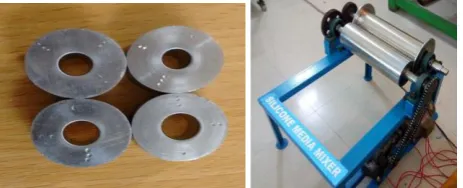
Inconel 600 specimens of 25 mm diameter and length 12 mm with hole diameter of 6, 7, 8 and 9 mm. The specimens were initially drilled using carbide drill bits and thoroughly washed with acetone to remove the clogged particles. Surface roughness parameters were measured using a surface roughness measuring instrument (Surfcom 130A) before conducting the experiment.
Fig 3.1: Inconel 600 specimens and Silicone media mixer
3.3 Experimental Procedure
Initially the extrusion honing machine is switched “on”, the actuation of directional control valve in forward direction results in abrasive media to extrude through the specimen from one side and exits out at the other. After each trial the test specimens were thoroughly cleaned with acetone solution to remove clogged polymer and other dust particles and surface roughness parameters were measured at 2 locations (drill entry side and drill exit side). Also for each and every pass the specimens were weighed using a electronic balance. This procedure is repeated for 10 passes and results were tabulated.
Fig 3.2: Extrusion honing process
Fig 3.3: Surface roughness measuring instrument
(Surfcom 130A)
Table 3.3: Extrusion Honing Process Parameters
Parameters
Details
Number of passes
10
Hole diameter (mm)
6, 7, 8, 9
Abrasive mesh size
36
Volume fraction of abrasives
30%
Pressure
60 bar
Temperature
Ambient
Stroke length
600 mm
IV.
RESULTS AND DISCUSSION
Extrusion honing is mainly used as surface finishing operation. The main aim of this work is to investigate the influence of extrusion honing process parameters on surface
finish. Following plots show the variation of surface
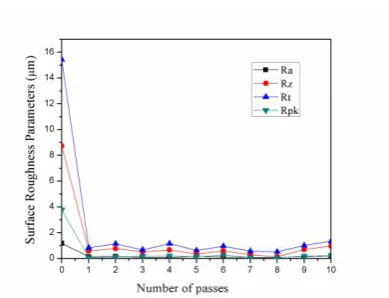
roughness parameters and material removed for Inconel 600. Here Ra, Rz, Rt, Rpk have been used as the surface
roughness parameters and are measured at 2 locations (entry side and exit side) of the specimen.
Graph 4.1: Hole dia 6 mm (Drill entry) effect of number of
passes on surface roughness.
Graph 4.2: Hole dia 6 mm (Drill exit) effect of number of
passes on surface roughness.
Graph 4.3: Hole dia 7 mm (Drill entry) effect of number of
passes on surface roughness.
Graph 4.4: Hole dia 7 mm (Drill exit) effect of number of
Available online:
https://edupediapublications.org/journals/index.php/IJR/
P a g e | 2196Graph 4.5: Hole dia 8 mm (Drill entry) effect of number of
passes on surface roughness
Graph 4.6: Hole dia 8 mm (Drill exit) effect of number of
passes on surface roughness
Graph 4.7: Hole dia 8 mm (Drill entry) effect of number of
passes on surface roughness
Graph 4.8: Hole dia 8 mm (Drill exit) effect of number of
passes on surface roughness
In all above graphs indicates that Zero pass shows the initial surface roughness before extrusion honing. It can be seen from the figure that there is a drastic change in surface roughness parameters in the first pass. As the number of passes increase there is a gradual improvement in the surface roughness. later there is rise in surface roughness parameters in 3rd or some passes. Further as the number of passes increase their surface roughness parameters improves. Later surface roughess improves till 10th pass. Further 10th passes surface roughness starts deteriorating.
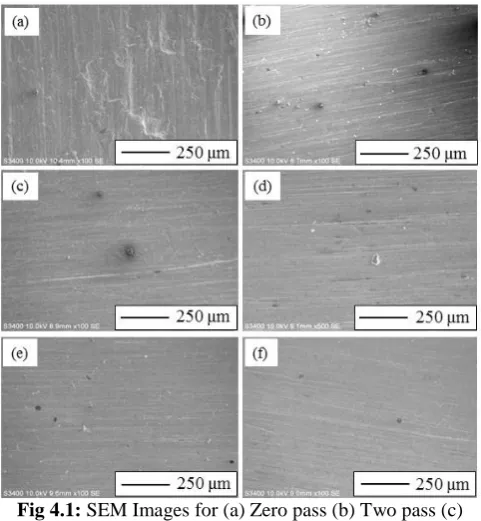
Fig 4.1: SEM Images for (a) Zero pass (b) Two pass (c)
Four pass (d) Six pass (e) Eight pass (f) Ten pass
Drilled and extrusion honed surfaces of inconel 600 is observed using Scanning electron microscope. The bored lay pattern is revealed in fig 4.1 (a). After two passes of abrasive laden medium under high pressure through the work surface, bored lay pattern is wiped off; texture of particle flow and abrasion scratches can be seen in fig 4.1 (b). A progressive improvement in surface finish and folding of aspirities is depicted in Fig 4.1 (c) Four pass, (d) Six pass, (e) Eight pass and (f) Ten pass respectively.
V.
CONCLUSIONS
In the present study extrusion honing of Inconel 600 has been carried out with silicone polymer and SiC abrasives. Following conclusions can be drawn.
1. The Select grade of polymeric medium can be used
as abrasive carrier medium in extrusion honing.
2. The extrusion honing process with 60 bar pressure,
abrasive particle size of 36 and 10 EH passes shows good results in finishing of Inconel 600
3. At the entry side of the specimen drastic reduction
within 3rd pass, after that there was continuous
improvement in surface finish parameters up to 9th
pass, beyond which the surface starts deteriorating.
4. It was also observed that the surface finish
deteriorates at entry side, but at the exit side the core roughness is obtained.
5. Better surface finish obtained exit side of than entry side of media.
6. SEM images of extrusion honed surface observed
that the micro cracks and recast layer has been successfully removed by EH process.
7.
REFERENCES
[1]. Jitender Panchal, Sushil Mittal and Harmesh Kansal, “Surface Finishing using Abrasive Flow Machining: A Review” IJAIEM, Volume 2, Issue 7 (July 2013) ISSN 2319 – 4847.
[2]. Raju H P, Devadath V R, Murali Krishna N L, “Extrusion Honed Surface Characteristics of Inconel 600”, International Journal of Engineering Research and Applications , Vol. 3, Issue 6 (Nov-Dec 2013), pp.1338-1343.
[3]. Ramandeep Singh and Walia R.S, Hybrid Magnetic Force Assistant Abrasive Flow Machining Process Study for Optimal Material Removal Vol.7 No.11 (2012).
[4]. Ramandeep Singh, and R.S. Walia - " Study the Effects of Centrifugal Force on Abrasive Flow Machining Process" at IJRMET Vol. 2, Issue 1, April 2012.
[5]. Rajendra K. Jain, Vijay K. Jain, P.M. Dixit Modeling of material removal and surface roughness in Abrasive flow machining process International Journal of Machine Tools & Manufacture 39 (1999) pp.1903–1923.