A survey of the Results of The QoS parameters in The Job
Scheduling to Allocate Virtual Machines in the Cloud
Mahdi Kanani and Shahram Jamali
1Department of computer, Germi branch, Islamic Azad University, Germi, Iran
2Associate Professor, University of Mohaghegh Ardabili, Ardabil, Iran
1
2
Abstract
With regard to the commercial features of cloud computing and virtualization, in this paper, the job scheduling algorithms in which justice and increasing the efficiency of using the service quality parameters has been discussed. In the process of scheduling algorithms, restricting justice to face the first two limits, segmentation based on user role and selection of priorities is Qos. The second limitation is the definition of equity in the allocation of resources and judge the fairness of justice in the allocation of resources to determine user satisfaction. All these algorithms is simulated by simulator Cloudsim and implemented in this environment. And specified that the use of quality of service parameters, to establish justice and ensure user satisfaction has been sent.
Keywords: Cloud computing, Job scheduling, Quality of Service, Fairness constrain, Neural Network.
1.Introduction
The main mechanism of cloud computing and computing resource allocation functions that comprise most calculations. A large number of users to get more computing power, storage and software components of the needs to access it. The commercialization of technology in accordance with the structure of cloud computing is one of the new features. For example, the complexity of scheduling jobs cloud computing through virtualization resources assigned to the virtual machine layer. In addition, a number of new features in scheduling application creates, such as cloud computing much attention to the clarity of its resource allocation. In this paper, we investigate the scheduling algorithm based on QoS parameters are designed to make you pay.
1.1.Limit first : Classification of jobs on the basis of quality of service
QoS parameters of the mechanism of action of cloud computing is Internet, a service quality parameters to measure user satisfaction of cloud services. Commercial characteristics of cloud computing need to provide quality services for
multiple users creates. But many users have a high demand on the scheduling of the application and allocation of resources in cloud computing provides.
User tasks classified according to QoS parameters to define a glimpse of them:
Completion time: real-time response to user requests is small, if possible, the job should be completed in less time.
Bandwidth: If demand requires more communication bandwidth, bandwidth priority equipment. For evaluating user satisfaction according to QoS parameters, different evaluation criteria quantify the quality of service should be created for different parameters.
1.2.Second limit : . The justice evaluation function and JEF calculations
Limiting the right process, the general expectation is done by limiting noise source. It is therefore necessary between tasks and resources, according to the expectations of service quality attributes to be created. When jobs need to have the equipment, you should expect jobs to be consistent with public expectations. To express these types of restrictions under the Berger [1] to pay the user will have on jobs that resources will be allocated if the resources will be compared. After a user request parameter (AR) is the next parameter to allocate real resources to user requests or the public expected (JR) is.
JEF = Ɵ(AR /JR)
Accordingly (0< Ɵ≤1) values for the function of justice must be between zero and one such that if the amount is equal to the true meaning of justice itself is in place and if this amount is equal to zero, ie, there is no justice is [1].
2. over view of Job Scheduling
Algorithms and methods
2.1. Job Scheduling Algorithm Based on
Berger
Cloud computing entities, users, providers and system resources are scheduled. The main component that is associated with user tasks, resources and strategy is scheduling. In this model, they have to be able to use the theory of division of labor done Berger, and for justice in the allocation of resources and jobs done. As shown in Figure 1 is as follows [1].
The main working mechanisms algorithm Berger
1) Classification of tasks based on QoS parameters, the general expectation of jobs, which act as barriers to the right to choose and the allocation of resources, is created.
2) The parametric features work and limiting public expectation in accordance with the resources to do the job better virtual machine selects.
3) The true function of resource allocation is calculated based on the results [1].
TaskT , T2,...,Tn
Release virtual machine
Adjust general expectation vector According to priority sorting
Task parametrization
Task classification
Match general expectation
Match resources
bind task to virtual machine Existence priority?
Success?
Meet fairness constraint? Resources parameter
normalization
Create DataCenter Create virtual machine
Create Host H1, H2,...,Hm
End Begin
Yes
Yes
Yes NO NO
NO
Figure.1. Berger Algorithm [1].
2.2.Greedy-Based Algorithm
Jobs for a set of virtual machines, greedy algorithm, the optimal way to allocate resources for local use. That's why the Greedy-Based Algorithm named. The overall structure of the Greedy-Based Algorithm using the algorithm Berger designed and has done time in Berger has optimized algorithm in Figure 2 and Figure 3 is depicted in the picture on the run [2].
Figure.2.The general structure of the Greedy-Based Algorithm .
User 1
User 2
User n
Task preprocessing Unit And Task - Classifier
Time type job queue
BW type job queue
Dat a Center Runni ng
Scheduling Strategy
JEF = Ɵ(AR /JR)
Jus tice eveluation
F
ee
d
b
a
ck
Input Queue
Out
pu
t Q
ue
ue
Figure.3. An illustration for Greedy-Based Algorithm [2].
2.3. The allocation of resources based on
Neural Network
In cloud computing in order to maximize the use of resources, many scheduling algorithm is designed.
Job scheduling model and other models of such algorithms are the burgers. The algorithm is a combination of neural network models and defects Berger and Berger, on behalf of the model. In this work, jobs are based on various parameters such as bandwidth, memory, time of completion and exploitation of resources. Users neural network classification tasks to be transferred. The neural network consists of an input layer, hidden layer and output layer. With the help of hidden layers, businesses with resources equal weight. The performance of the system using the efficient use of bandwidth, reducing the completion time, which in turn improves the use of resources has been improved [3].
Figure.4. The Allocation of Resources Based on Neural Network [3].
Performance Comparisons
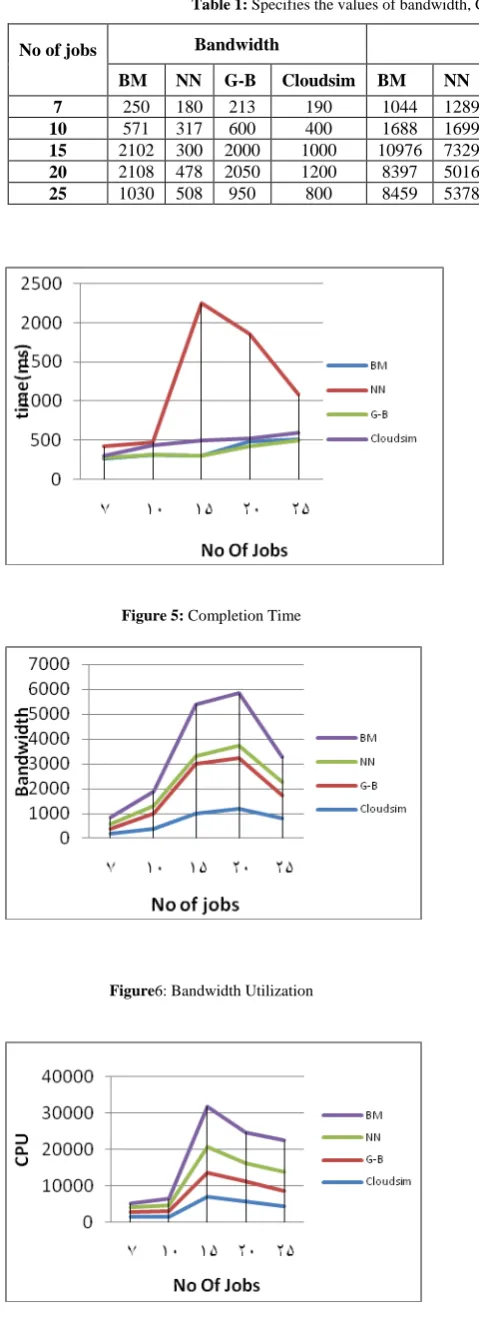
In our evaluation, comparison Berger algorithms, Greedy-Based Algorithm, Neural Network algorithm works in Cloudsim time it becomes clear that the algorithm works for Berger in the first and the second and third tests is better than other algorithms result in Figure 5 is shown. However, further testing of algorithms Neural Network algorithm and Cloudsim is just better. Greedy-Based Algorithm outperformed the other algorithms. This algorithm only available bandwidth will not be able to optimally use Figure6 and Figure7 between these algorithms only algorithm Berger bandwidth for optimal uses in terms of algorithms Berger of all existing algorithms and user satisfaction due to better use of resources for optimum draw.But it seems that with
ongoing training neural network is gradually being reduced completion time and may do better with the continuing education of the algorithms serve Berger.The results can be seen in Table 1.
Table 1: Specifies the values of bandwidth, CPU Utilization and Completion time
Figure 5: Completion Time
Figure6: Bandwidth Utilization
Figure 7: CPU
REFERENCES
[1] C. Z. Baomin XU, “Job scheduling algorithm based on berger model in cloud environment,” Advances in Engineering Software, vol. 42, pp. 419–425, 2011. [2] J.Li, L.Feng, S.Fang," An Greedy-Based Job Scheduling Algorithm in Cloud Computing",JOURNAL OF SOFTWARE, VOL. 9, NO. 4, APRIL 2014
[3] K. Dinesh, G. Poornima, and K. Kiruthika .,"Efficient Resources Allocation for Different Jobs in Cloud "., International Journal of Computer Applications (0975 – 8887) Volume 56– No.10, October 2012
[4] A. B. a. P. V. P.Varalakshmi, Aravindh Ramaswamy, “An optimal workflow based scheduling and resource allocation in cloud,” Advances in Computing and Communications, pp. 411–420, 2011. [5] R. C. J. D Dutta, “A genetic calgorithm approach to cost-based multi-qos job scheduling in cloud computing environment, ” International Conference and Workshop on Emerging Trends in Technology, 2011.
[6] M. O. Shamsollah Ghanbari, “A priority based job scheduling algorithm in cloud computing,” International Conference on Advances Science and Contemporary Engineering, 2012.
[7] J. H. Zheng HU, Kaijun WU, “An utility-based job scheduling algorithm for current computing cloud considering reliability factor,” Information of China Construction, pp. 296–299, 2012.
[8] C.-F. L. Ruay-Shiung Chang, Chih-Yuan Lin, “An adaptive scoring job scheduling algorithm for grid computing,” Information Sciences, vol. 207, pp. 79–89, 2012.
[9] L. LI, “An optimistic differentiated service job scheduling system for cloud computing service users and providers,” Multimedia and Ubiquitous Engineering, 2009. MUE ’09. Third International Conference on, pp. 295–299, 2009.
[10] Z. M. Berger J, Cohen BP, “Status characteristics and expectation states,” Sociological theories in progress, vol. 1, pp. 29–46, 1966.
[11] C. T. Z. M. Berger J, Cohen BP, “Status characteristics and expectation states: a process model,” Sociological theories in progress, vol. 1, pp. 47–74, 1966.
[12] G. Jasso, “The theory of the distributive-justice force in human affairs:analyzing the three central
No of jobs Bandwidth CPU Time
BM NN G-B Cloudsim BM NN G-B Cloudsim BM NN G-B Cloudsim 7 250 180 213 190 1044 1289 1350 1500 258 420 278 299 10 571 317 600 400 1688 1699 1500 1550 317 474 310 430 15 2102 300 2000 1000 10976 7329 6500 7000 300 2250 300 490 20 2108 478 2050 1200 8397 5016 5500 5750 478 1857 420 520 25 1030 508 950 800 8459 5378 4200 4400 508 1081 490 589
questions,” Sociological theories in progress:new equation, vol. SAGE Publications, pp. 357–87, 2012.
mahdi kanani is currently a M.Sc. student in the Department of Computer in the Science and Research branch, Islamic Azad University, Germi, Iran. His research interests are in the areas of distributed systems with emphasis on scheduling algorithms for grids and clouds, cloud computing. He is a teacher in Computer Science at technical college.
Shahram Jamali is an associate professor leading the Computer Networking Group at the Department of Engineering, University of Mohaghegh Ardabili. He teaches on computer networks, network security, computer architecture and computer systems performance evaluation. Dr. Jamali received his M.Sc. and Ph.D. degree from the Dept. of Computer Engineering, Iran University of Science and Technology in 2001 and 2007, respectively. Since 2008, he is with Department of Computer Engineering,University of Mohaghegh Ardabil and has published more than 80 conference and journal papers. He
also serves as editor member for some international
journals.
![Figure.4. The Allocation of Resources Based on Neural Network [3].](https://thumb-us.123doks.com/thumbv2/123dok_us/7845044.1300553/3.595.324.521.277.364/figure-allocation-resources-based-neural-network.webp)