An Empirical Approach of Optimizing AODV
Routing Protocol for Route Discovery in Mobile
Ad-Hoc Network
Hirkani Padwad#1, S. V. Sonekar*2
#1
Research Scholar, Department of CSE, JDCOEM, RTMNU Nagpur University Nagpur, Maharashtra, India
*2
Professor, Head Of The Department, Department of CSE, JDCOEM, RTMNU Nagpur University Nagpur, Maharashtra, India
Abstract— A Mobile Ad-Hoc network is a network of mobile devices which does not require any wired infrastructure for intercommunication. Here, a node can move in any direction & it acts as a router. This paper puts forth a reactive algorithm for allocating traffic. The proposed allocation technique considers the factors of load and time delay. It aims to improve resource utilization by streamlining traffic along a path which gives a minimum sum of load and delay. It applies this optimization over the most popular routing protocol in MANET that is AODV routing protocol. The basis of load at a node is number of bytes received and delay is in terms of time unit. For every node average load and average delay is calculated which is summed for all nodes in a path. Thus proposed approach selects a path with minimum weightage hence improving network performance. The said technique is realized using NS3.13 simulator.
Keywords— MANET, AODV, weight, load, delay
I. INTRODUCTION
Mobile Ad-Hoc Network is a complex infrastructure consisting of various wireless mobile nodes which can dynamically organize into temporary or “ad-hoc” network topologies. Fig. 1 illustrates the overview of Mobile Ad-Hoc Network. A wireless mobile node can be any device with computing power that uses air as the transmission medium. A wireless mobile node may enable wireless communication among entities such as an airplane, vehicle, human by being physically attached with them.
Fig. 1 A Mobile Ad-Hoc Network
Fig. 1 shows the structure of Mobile Ad-Hoc network. In this type of network there is no fixed infrastructure or base stations. The forwarding of packets is done by mobile devices and hence they perform the role of a router. The mobile nodes themselves assist in route discover and route maintenance. The nodes in a MANET may move in or out
of network thus affecting the topology. Hence, the routing protocols in MANET should work in an adaptive manner and routing becomes an important issue in Mobile Ad-Hoc network. A few other important issues of Mobile Ad-Hoc network are discussed below
A. Issues of MANET
(a) Security – At present MANET does not have a strict policy due to which it is prone to attacks. The security requirements of MANET include discovery of a route if it exists, identification and separation of malicious node, hiding location information of nodes properly.
(b) Unpredictable environment: MANET may be established in hazardous environment thus causing frequent node failures.
(c) Limitation on resource - Nodes in MANET are battery powered. Also they have limited processing and storage capacity. In an unpredictable environment it may not be possible to re charge node battery. Hence routing techniques in MANET must be power efficient.
(d) Self-organizing – In MANET there is absence of centralized controller. Nodes come together to form a network by self configuring.
Other issues in MANET include quality of service, medium access scheme, scalability, multicasting, etc.
B. Advantages And Disadvantages
Advantages of Mobile Ad hoc Networks include freedom from central administrator, self configuration, self re-configuration in case of node failure, economical and fast deployment.
Disadvantages include reliability problem, loading affecting throughput and high delay for large networks.
C. Applications
II. LITERATURE SURVEY
Distance Vector Routing and link state routing are effective and efficient protocols for wired networks. In wireless networks, due to dynamic and unpredictable topology changes in MANETs these protocols seldom achieve stability owing to slow propagation of update message. Moreover, the maintenance of routes and control messages consume large amount of battery and CPU resource.
Routing protocols in MANET are broadly classified as proactive and reactive. Proactive protocols maintain route information irrespective of whether it is required at the moment. Thus whenever packet is to be transferred route is already available. All the nodes have to maintain consistent routes to other reachable nodes. Reactive routing protocols, on the other hand initiate route discovery only when a packet is to be transferred. They do not need to maintain routes all the time. A combination of these two has emerged called Hybrid routing protocols which combine advantages of reactive and proactive protocols. Examples of proactive protocol are DSDV, WRP and those of reactive are AODV, TORA, etc.
Destination Sequenced Distance Vector (DSDV) is a proactive protocol derived from DBF. It generates single shortest path and is loop free as opposed to its predecessor. It uses unique sequence numbers associated with each entry in routing table and each update message. The sequence number value is used by all other nodes in the network to determine the “freshness” of the information contained in a route update for the destination. Since the value is sequentially incremented, a higher sequence number indicates that the routing information is newer [1].
The Associativity Based Routing (ABR) protocol [2] is an on-demand routing protocol. In order to generate route it considers stability of nodes. Stability is calculated in terms of associativity tick. Each node transmits a beacon to its neighbors who cache this message termed as Associativity tick. When a node needs to discover a route it selects a suitable neighbor with high associativity tick i.e. with least mobility. The routes discovered are long-lived but may not be the shortest in terms of hop count between the source and destination.
The Ad Hoc On-Demand Distance Vector (AODV)[3], Routing Protocol is a reactive routing protocol. AODV uses a destination sequence number for each routing table entry, which is created by the destination node. Using sequence numbers other nodes can find the freshness of routing information. Working of AODV is based on three messages i.e. RREQ – Route request, RREP – Route reply, RERR –Route error. AODV is loop-free due to the destination sequence numbers associated with routes. It quickly converges when the ad hoc network topology changes.
A Tactical On-demand Distance Vector Routing algorithm (TAODV) [4] is proposed in which AODV is optimized by considering two additional parameters i.e. query localization and load checking. Conventional routing algorithms use flooding techniques to initiate route discovery which causes excessive routing overhead. TAODV uses query localization to forward route request.
Location of nodes is tracked using GPS. When an intermediate node receives request it is forwarded if location of intermediate node is closer to destination as compared to sending node otherwise packet is discarded. This is similar to Location Aided Routing [5]. TAODV also does load checking where load is the length of packet queue at a node. When a node receives a request it checks the queue length. If queue length is below threshold request is processed otherwise it is dropped. TAODV outperforms AODV in terms of delay in stable as well as highly mobile network [4]. It is mainly targeted towards PCS tactical network. This scheme needs to maintain location information and has no provision to consider height in distance measure.
Extended AODV (X-AODV)[6] is an adaptive approach for secure and optimal path selection that is combined with Bays Estimator Artificial Intelligent Technique on basis of probabilistic theory in order to adapt secure and non-congested path. Each node calculates the best suitable path on the basis of two parameters i.e. congestion and SNR. This technique focuses on reasons for packet loss and minimization of packet loss ratio.
RO AODV (Route Optimized Ad Hoc On demand Distance Vector Routing Protocol) [7] limits the route request broadcasting activity based on Route optimization. It optimizes AODV to perform effectively and reduces routing overhead, delay and energy consumption under high load conditions. It uses an Accumulation Path List to record all path nodes when a node receives an RREQ to update the route table. Thus RO AODV eliminates some RREQs and reduces the overhead of control messages and thus improves the performance. This method however increases the packet header since it needs to maintain the source route.
Packet scheduling algorithm over AODV [8] is an enhancement of AODV which uses weight hop based packet scheduling technique. Intermediate nodes schedule packets according to rate of sending data. In case of link breakage, packets are scheduled through alternate routes. This method uses round robin scheduler to cope with starvation. Weight is given to data packets based on number of hops. The packets with smaller numbers of hops or shorter geographic distances to their destinations are given more priority. It outperforms AODV in terms of end-to-end delay, packet delivery ratio. Long distant packets, however, may take longer time to propagate over a route.
by TTL estimation equation. It has the overhead to maintain consistent location information in Location table. A Real-time communication protocol considering load balancing in Adhoc Network [10] optimizes AODV by considering load balancing. It uses ETX (Expected Transmission Count) as a link quality estimator. For load balancing the criterion used is remaining energy. The RREQ packet carries additional fields that is etx and mrE (minimum remaining energy) which is processed by the receiving node based on few computations. This method provides reliable communication and load balancing. It outperforms AODV in end-to-end delay, packet delivery ratio, average jitter, and load balancing in network. It avoids congestion and thus packet loss. It works significantly under low and high traffic.
The reference [11] proposed Load-Balanced Ad hoc Routing (LBAR) protocol. In LBAR, routing information on different paths is forwarded through setup messages to the destination. The destination node selects the path with the minimum cost that depends on the nodal activity. The path with least nodal activity is selected and thus it avoids congested paths. The traffic over the network is evenly distributed. In addition, it deals with topological changes by quickly healing the problem of link failure. LBAR outperforms DSR and AODV in terms of packet delivery fraction and average end-to-end delay.
III. PROPOSED WORK
Proposed work includes two additional parameters to optimize AODV protocol i.e. delay and load checking for route discovery. Among multiple paths generated by AODV the proposed technique selects a path having minimum weight. Weight is calculated on the basis of average delay and average load of a path. The parameters are applied over basic operation of AODV. This work focuses on a new combination of parameters other than hop count. With the augmentation of said parameters the proposed work is expected to outperform basic AODV. A. Delay
The transmission delay includes delay for processing incoming packet (dep), delay while a packet waits in a queue (deq), delay to transmit all the packet information on the link (det) and time required to propagate from source to destination (der). Thus total delay can be summed as
dtot=dep+deq+det+der
Here, we concentrate on queuing delay which is considered in unit of nanoseconds.
B. Load
Load of path from source to destination is the average load of all the nodes in that path. The load of an individual node is calculated on the basis of number of packets (or bytes) received by the node. Average load at a node is the average of delay of all packets received at the node.
During route discovery process when the RREQ is sent, the packet keeps track of every node's load and calculates total load of path. Among n number of paths discovered, the path with minimum weight that is sum of load and delay is considered. The route is established by sending RREP.
C. Calculation for Weight of a Path
The weight of a path is calculated on the basis of sum of load and delay for that path. The weight can be given as
Weight of path = Total load + Total delay
Above technique gives equal emphasis to load and delay of a node. There may be heavily loaded networks where minimized load plays a crucial role. Also there may be networks where minimized delay is preferred over load. For coping with this situation above formula can be modified as
Weight of path = pl*Total load + pd*Total delay Where, pl and pd are constants that sum to a 1.There values may be varied depending on the situations cited above. For former situations pl is greater than pd and for latter vice versa. This calculation is applied for every node in the path to find weight at a node. Total weight is the sum of weights of all nodes in the path. Thus out of multiple paths with varying weights the path with minimum weight criterion is selected.
D. Steps
The overall process can be divided into 2 steps Simulation of AODV protocol using NS3 and detection of optimal path.
1) Implementation of AODV in NS3
1. Start simulation using AODV routing protocol 2. Flood RREQ for every node
3. Fetch flow statistics such as number of packets received, number of bytes received, delay, etc.
4. Collect the statistics into an XML file
2) Detection of optimal path and simulation in Java
1. Read XML file using DOM parser
2. Fetch average load and delay for every node
3. Calculate the weight for every path by summing the average load and average delay for each node in the path. 4. Select a path which gives minimum weight
5. Display all nodes at their respective x and y co-ordinates along with the optimal path between given source and destination node.
IV. SIMULATION AND RESULTS A. Introduction
For our simulation of AODV we used one of the most popular network simulator i.e. NS 3.13. To check the validity of proposed scheme we compare its performance with the basic AODV[3] and TAODV[4] based on various performance metrics such as Packet delivery ratio, End-to-end delay, traffic load, mobility, etc.
B. Simulation Model
seconds that is the pause time. A node moves with a speed in the range of (1,5). The inter-packet interval is set as 1 second. The number of nodes created for simulation is between 20 to 45 nodes that are Wi-Fi enabled.
TABLE I
SIMULATION PARAMETERS Simulation Parameter Value
Routing protocol AODV
Nodes 20 to 50
Simulation time 100 seconds Packet size 1000 bytes
Mobility Model Random Way Point Model Traffic Model Constant Bit Rate
Node speed 10 m/s to 40 m/s
Pause Time 5 seconds
C. Simulation Results
Using NS3.13 we simulated AODV protocol over a MANET of 25 nodes. The graphical representation of simulation is shown through JAVA applet. The output of NS3 simulation is an XML file which is parsed further to get the load and delay values for all nodes in the network, using which weights of all possible paths is calculated. Finally the algorithm selects a path with minimum weight. An example output of optimal path is shown in Fig. 2. considering node 2 as source and node 12 as destination. It also shows all intermediate nodes in the selected path.
Fig. 2 Optimal path for given source and Destination
Fig. 3 All path possibilities between node 2 and node 12
Fig. 3 shows all the possibilities of path between node 2 and node 12 as source and destination respectively. The total number of paths available is 25 among which
optimal path with minimum weight is 2, 6, 13, 24, 10, 12 with weight equal to 7876243.
D. Performance metrics
We have generated the results after conducting atleast 40 experiments for different set of parameters.
End-to-End Delay as a fuction of Node Speed
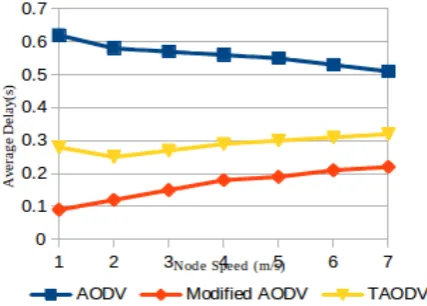
Fig. 4 we show the results of comparing AODV, TAODV and modified AODV i.e. the proposed scheme. The
proposed algorithm shows a huge decrease in average delay when compared to AODV and TAODV in a network of 20 nodes. The delay increasesgradually for increased number of nodes.
Fig. 4 Comparison of AODV, TAODV and Proposed Algorithm for Delay vs. Node speed
Fig. 5 End-to-End Delay for different weightage of load (pl) and delay(pd) constants
End-to-End Delay vs. Node speed for varying emphasis on Load and delay constants
In high mobility MANETS usually nodes change their positions at a faster rate. In this situation delay parameter is of more importance than load. Whereas in low mobility MANETS nodes form a stable route and as a result the number of incoming packets at a node may be more. Therefore for less node speed load is a better parameter to be emphasized over delay, as seen from Fig. 5.
Packet Delivery Ratio vs. Mobility
observed that packet delivery ratio decreases for all three protocols with increase in mobility rate. But in all node speed scenarios, percentage of packets delivered by proposed algorithm is more than that of AODV and TAODV.
Fig. 6 AODV, TAODV and Proposed Algorithm based on Packet
Delivery Ratio (%) vs. Mobility
Fig. 7 Proposed Algorithm compared with AODV based on End-to-End Delay vs. CBR
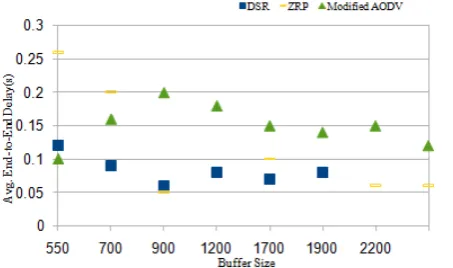
Fig. 8 End-to-end delay comparison of proposed Algorithm with DSR and ZRP based on Buffer size
End-to-End Delay vs. CBR
In Fig. 7 we compare the performance of proposed algorithm with AODV. The delay of proposed scheme is at least 0.02 seconds lesser than AODV for all traffic conditions. For small data packet rate, traffic is lighter and hence delay is lesser. For increased traffic, the proposed technique shows a slower increase in delay as compared to AODV because of weightage given to minimum delay and load parameters.
End-to-End Delay vs. Buffer size
In Fig. 8 we compare proposed scheme with ZRP and DSR in terms of the End-to-End delay vs. packet size. It is
observed that proposed scheme gives maximum delay of 0.2 seconds at packet size 3 i.e. 900 bytes after which there is a decrease in delay.
Load Balancing Efficiency
We considered Load balancing efficiency in terms of percentage by which load of optimal path is lesser than average load of all other paths discovered by our scheme. After conducting at least 30 experiments for varying number of packets per seconds(CBR), we find that load of selected path is 60% lesser as compared to average load of all other paths. Thus the proposed scheme performs satisfactory distribution of load over the routes.
V. CONCLUSIONS
We proposed simple and effective optimization of AODV routing protocol in MANET. The Proposed scheme aims at increased load balancing and minimum delay path. It optimizes the basic working of AODV protocol by addition of two parameters i.e. the delay and load. Also, this scheme gives multiple routes which serves as alternative on route failure. The proposed scheme shows a decrease is End-to-End delay and increased Packet delivery ratio as compared to existing AODV and TAODV protocols.
REFERENCES
[1] N. S. M. Usop, A. Abdullah and A. F. A. Abidin, “Performance
evaluation of AODV, DSDV & DSR routing protocol in grid environment”, International Journal of Computer Science and Network Security, vol.9, no.7, pp.261-268, 2011.
[2] S. Buruhanudeen, M. Othman, B. M. Ali”, Performance
comparison of MANET associativity based routing (ABR) and the improvisation done for more reliable and efficient routing”, The 3rd Information and Communication Technology Seminar, 2011.
[3] C. Perkins and E. Royer, “Ad-hoc on-demand distance vector
routing,” Second IEEE Workshop on Mobile Computing Systems and Applications (WMCSA), pp. 90 –100, Feb 1999
[4] Mueen Uddin et al , “Improving performance of Mobile Ad hoc
Networks using efficient tactical on demand distance vector (taodv) routing algorithm ”, International Journal of Innovative Computing, Information and Control Vol 8 No 6, pp. 4375–4389 , June 2012, ISSN 1349-4198
[5] Y.-B. Ko and N. H. Vaidya, “Location-aided routing (LAR) in
mobile ad hoc networks, Wireless Networks”, Vol 6, No 4, pp.307-321, 2000
[6] Khalid Hussain, Abdul Hanan Abdullah, Khalid M. Awan and
Zohair Ihsan,”An Artificial Intelligence Based X-AODV Routing Protocol for MANET”,World Applied Sciences Journal 23 (4): 541-548, ISSN 1818-4952, 2013
[7] Dinesh Shetty,“RO AODV: Route Optimized Ad hoc On demand
distance Vector Routing Protocol”
[8] Dhirendra Kumar Sharma, Chiranjeev Kumar ,Sandeep Jain,
Neeraj Tyagi , “An Enhancement of AODV Routing Protocol for Wireless Ad Hoc Networks ”, 1st Int’l Conf. on Recent Advances in Information Technology RAIT-2012, IEEE 978-1-4577-0697-4/12 2012
[9] Mohannad Ayash , Mohammad Mikki , “Improved AODV Routing
Protocol to Cope With High Overhead in High Mobility MANETs”, IEEE , 978-0-7695-4684-1/12 , 2012
[10] Anh Tai Tran, Myung Kyun Kim, “A real-time communication
protocol considering load balancing in Adhoc Network ”, 978-1-4673-1773-3/12 IEEE , 2013
[11] Hossam Hassanein and Audrey Zhou,”Routing with Load
[12] Yashi Rajvanshi et al,”, Comparative study of different Parameters of MANET Routing Protocol for different Buffer Size”, Conference on Advances in Communication and Control Systems 2013 (CAC2S 2013)
Mahendra Kumar, A. K. Jain, “Comparative Performance Analysis of Different Routing Protocols in Wireless Ad-hoc networks (IEEE 802.11)", InternationalJournal of Computers And Technology, vol. 8 No 3, June 2013
[13] Yashar Ganjali, Abtin Keshavarzian,”Load Balancing in Ad Hoc
Networks: Single-path Routing vs. Multi-path Routing”, IEEE INFOCOM 2004, 0-7803-8356-7/04
Subramanya Bhat, M Shwetha, D Devaraju J.T, “A Performance Study of Proactive, Reactive and Hybrid Routing Protocols using Qualnet Simulator, International Journal of Computer Applications (0975 – 8887), Vol 28 No 5, August 2011
[14] The NS 3 website. [Online]. Available: http://www.nsnam.org /
[15] Mustafa Bani Khalaf, Ahmed Y. Al-Dubai and Mourad Abed ,
“New Velocity Aware Probabilistic Route Discovery Schemes for Mobile Ad hoc Networks”, IEEE 20th Int. Conference on Software, Telecommunications and Computer Networks-(SoftCOM 2012)
[16] Per Johansson et al, “Scenario-based Performance Analysis of
Routing Protocols for Mobile Ad-hoc Networks”, ACM 1999 I-58113-142-9/99/08
[17] Behra Rajesh Umashankar “A Comparative Study of Delay, Traffic and Hybrid Based Load Balancing Routing Protocols in Mobile Ad Hoc Networks”, International Journal of Advance Research in Computer Science and Management Studies, Vol 2, Issue 4, April 2014 pg. 95-99
[18] Amjad Ali, Wang Huiqiang “Node Centric Load Balancing Routing