A Distortion-Resistant Routing
Framework for Video Traffics in Wireless
Multihop Networks
STUDENT NAME: KONDETI VENKAT RAMANA MURTHY
Mail id:[email protected]
PYDAH COLLEGE OF ENGINEERING - VISAKHAPATNAM
GUIDE NAME: SRIKANTH VELUMURU, M.TECH ASSOCIATE PROFESSOR. MAIL ID : [email protected]
PYDAH COLLEGE OF ENGINEERING VISAKHAPATNAM
ABSTRACT:
Traditional routing metrics designed for wireless networks are application-agnostic. In this paper, we consider a wireless network where the application flows consist of video traffic. From a user perspective, reducing the level of video distortion is critical. We ask the question “Should the routing policies change if the end-to-end video distortion is to be minimized?” Popular link-quality-based routing metrics (such as ETX) do not account for dependence (in terms of congestion) across the links of a path; as a result, they can cause video flows to converge onto a few paths and, thus, cause high video distortion. To account for the evolution of the video frame loss process, we construct an analytical framework to, first, understand and, second, assess the impact of the wireless network on video distortion. The framework allows us to formulate a routing policy for minimizing distortion, based on which we design a protocol for routing video traffic. We find via simulations and test bed experiments that our protocol is efficient in reducing video distortion and minimizing the user experience degradation.
1. INTRODUCTION
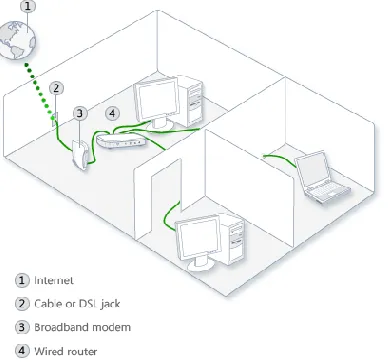
Networking is the word basically relating to computers and their connectivity. It is very often used in the world of computers and their use in different connections. The term networking implies the link between two or more computers and their devices, with the vital purpose of sharing the data stored in the computers, with each other. The networks between the computing devices are very common these days due to the launch of various
Fig 1:-Structure of Networking between the different computers
1.1 How networking works?
General Network Techniques - When computers communicate on a network, they send out data packets without knowing if anyone is listening. Computers in a network all have a connection to the network and that is called to be connected to a network bus. What one computer sends out will reach all the other computers on the local network. For the different computers to be able to distinguish between each other, every computer has a unique ID
called MAC-address (Media Access Control
Address). This address is not only unique on your network but unique for all devices that can be hooked up to a network. The MAC-address is tied to the hardware and has nothing to do with IP-addresses. Since all computers on the network receives everything that is sent out from all other computers the MAC-addresses is primarily used by the computers to filter out incoming network traffic that is addressed to the individual computer.
When a computer communicates with another computer on the network, it sends out both the other computers MAC-address and the MAC-address of its own. In that way the receiving computer will not only recognize that this packet is for me but also, who sent this data packet so a return response can be sent to the sender.
Fig 2:- Functionality of Networking
1.2 Characteristics of Networking:
The following characteristics should be considered in network design and ongoing maintenance:
1) Availability is typically measured in a percentage based on the number of minutes that exist in a year. Therefore, uptime would be the number of minutes the network is available divided by the number of minutes in a year.
2) Cost includes the cost of the network components, their installation, and their ongoing maintenance.
3) Reliability defines the reliability of the network components and the connectivity between them. Mean time between failures (MTBF) is commonly used to measure reliability.
4) Security includes the protection of the network components and the data they contain and/or the data transmitted between them.
5) Speed includes how fast data is transmitted between network end points (the data rate). 6) Scalability defines how well the network
can adapt to new growth, including new users, applications, and network components.
7) Topology describes the physical cabling layout and the logical way data moves between components.
1.3 Types of Networks:
Organizations of different structures, sizes, and budgets need different types of networks. Networks can be divided into one of two categories:
peer-to-peer
server-based networks 1. Peer-to-Peer Network:
2. Server-Based Networks:
In server-based network data files that will be used by all of the users are stored on the one server. With a server-based network, the network server stores a list of users who may use network resources and usually holds the resources also. This will help by giving you a central point to set up permissions on the data files, and it will give you a central point from which to back up all of the data in case data loss should occur. 1.4 Advantages of Networking:
1. Easy Communication:
It is very easy to communicate through a network. People can communicate efficiently using a network with a group of people. They can enjoy the benefit of emails, instant messaging, telephony, video conferencing, chat rooms, etc.
2. Ability to Share Files, Data and Information:
This is one of the major advantages of networking computers. People can find and share information and data because of networking. This is beneficial for large organizations to maintain their data in an organized manner and facilitate access for desired people.
3. Sharing Hardware:
Another important advantage of networking is the ability to share hardware. For an example, a printer can be shared among the users in a network so that there’s no need to have individual printers for each and every computer in the company. This will significantly reduce the cost of purchasing hardware.
4. Sharing Software:
Users can share software within the network easily. Networkable versions of software are available at considerable savings compared to individually licensed version of the same software. Therefore large companies can reduce the cost of buying software by networking their computers.
5. Security:
Sensitive files and programs on a network can be password protected. Then those files can only be accessed by the authorized users. This is another important advantage of networking when there are concerns about security issues. Also each and every
user has their own set of privileges to prevent those accessing restricted files and programs.
6. Speed:
Sharing and transferring files within networks is very rapid, depending on the type of network. This will save time while maintaining the integrity of files
2. LITERATURE SURVEY
1) Overview of the H.264/AVC video coding standard
AUTHORS: T. Wiegand, G. J. Sullivan, G. Bjontegaard, and A. Luthra
H.264/AVC is newest video coding standard of the ITU-T Video Coding Experts Group and the ISO/IEC Moving Picture Experts Group. The main goals of the H.264/AVC standardization effort have been enhanced compression performance and provision of a "network-friendly" video representation addressing "conversational" (video telephony) and "nonconversational" (storage, broadcast, or streaming) applications. H.264/AVC has achieved a significant improvement in rate-distortion efficiency relative to existing standards.
2) A high throughput path metric for multi-hop wireless routing
AUTHORS: D. S. J. D. Couto, D. Aguayo, J. Bicket, and R. Morris
3) Packet loss resilient transmission of MPEG video over the internet
AUTHORS: J. M. Boyce
A method is proposed to protect MPEG video quality from packet loss for real-time transmission over the Internet. Because MPEG uses inter-frame coding, relatively small packet loss rates in IP transmission can dramatically reduce the quality of the received MPEG video. In the proposed high-priority protection (HiPP) method, the MPEG video stream is split into high- and low-priority partitions, using a technique similar to MPEG-2 data partitioning. Overhead resilient data for the MPEG video stream is created by applying forward error correction coding to only the high-priority portion of the video stream.. Simulations were performed comparing the improvement in video quality using the HiPP method, using experimental Internet packet loss traces with loss rates in the range of 0–8.5%. Overhead resiliency data rates of 0%, 12.5%, 25%, and 37.5% were studied, with different compositions of the overhead data for the 25% and 37.5% overhead rates, in an attempt to find the “best” composition of the overhead data. In the presence of packet loss, the received video quality, as measured by PSNR and the Negsob measure, was significantly improved when the HiPP method was applied.
4) Layered coded vs. multiple description coded video over error-prone networks
AUTHORS: Y.-C. Lee, J. Kim, Y. Altunbasak, and R. M. Mersereau
Layered (LC) and multiple description coding (MDC) have been proposed as source coding techniques that are robust to channel errors for video transmission. LC and MDC have similar characteristics: they both generate multiple sub-bitstreams, and it is permissible to drop some portion of the data from the sub-bitstreams during transmission for both methods. However, they are different in the sense that the sub-bitstreams for LC have different levels of importance while all sub-bitstreams for MDC are equally important. Since these two encoding techniques have similar properties, some performance comparisons between LC and MDC have recently been reported. Furthermore, they have been performed in different environments. In this paper, we further investigate the error-resilience capabilities of these two encoding techniques through extensive experimentation..
5) Layered coding vs. multiple descriptions for video streaming over multiple paths
AUTHORS: J. Chakareski, S. Han, and B. Girod In this paper, we examine the performance of specific implementations of multiple description coding and of layered coding for video streaming over error-prone packet switched networks. We compare their performance using different transmission schemes with and without network path diversity. It is shown that, given specific implementations, there is a large variation in relative performance between multiple descriptions coding and layered coding depending on the employed transmission scheme. For scenarios where the packet transmission schedules can be optimized in a rate-distortion sense, layered coding provides a better performance. The converse is true for scenarios where the packet schedules are not rate-distortion optimized.
3. SYSTEM DESIGN & IMPLEMENTATION
3.1 Input &Output Design
The input design is the link between the information system and the user. It comprises the developing specification and procedures for data preparation and those steps are necessary to put transaction data in to a usable form for processing can be achieved by inspecting the computer to read data from a written or printed document or it can occur by having people keying the data directly into the system. The design of input focuses on controlling the amount of input required, controlling the errors, avoiding delay, avoiding extra steps and keeping the process simple. The input is designed in such a way so that it provides security and ease of use with retaining the privacy. Input Design considered the following things:
What data should be given as input?
How the data should be arranged or coded?
The dialog to guide the operating personnel in providing input.
other system through outputs. In output design it is determined how the information is to be displaced for immediate need and also the hard copy output. It is the most important and direct source information to the user. Efficient and intelligent output design improves the system’s relationship to help user decision-making.
1. Designing computer output should proceed in an organized, well thought out manner; the right output must be developed while ensuring that each output element is designed..
2. Select methods for presenting information.
3. Create document, report, or other formats that contain information produced by the system.
The output form of an information system should accomplish one or more of the following objectives.
Convey information about past activities, current status or projections of the
Future.
Signal important events, opportunities, problems, or warnings.
Trigger an action.
Confirm an action. 3.2 System Analysis
Different approaches exist in handling such an encoding and transmission. The Multiple Description Coding (MDC) technique fragments the initial video clip into a number of sub-streams called descriptions. Standards like the MPEG-4 and the H.264/AVC provide guidelines on how a video clip should be encoded for a transmission over a communication system based on layered coding. Typically, the initial video clip is separated into a sequence of frames of different importance with respect to quality and, hence, different levels of encoding. In another existing model, an analytical framework is developed to model the effects of wireless channel fading on video distortion. In other existing model, the authors examine the effects of packet-loss patterns and specifically the length of error bursts on the distortion of compressed video.
In this paper, our thesis is that the user-perceived video quality can be significantly improved by
accounting for application requirements, and specifically the video distortion experienced by a flow, end-to-end. Typically, the schemes used to encode a video clip can accommodate a certain number of packet losses per frame. However, if the number of lost packets in a frame exceeds a certain threshold, the frame cannot be decoded correctly. A frame loss will result in some amount of distortion. The value of distortion at a hop along the path from the source to the destination depends on the positions of the unrecoverable video frames (simply referred to as frames) in the GOP, at that hop. As one of our main contributions, we construct an analytical model to characterize the dynamic behavior of the process that describes the evolution of frame losses in the GOP (instead of just focusing on a network quality metric such as the packet-loss probability) as video is delivered on an end-to-end path. Specifically, with our model, we capture how the choice of path for an end-to-end flow affects the performance of a flow in terms of video distortion. Our model is built based on a multilayer approach.
3.3 System Architecture
Fig 4: Block Diagram
The DFD is also called as bubble chart. It is a simple graphical formalism that can be used to represent a system in terms of input data to the system, various processing carried out on this data, and the output data is generated by this system. The data flow diagram (DFD) is one of the most important modeling tools. It is used to model the system components..DFD shows how the information moves through the system and how it is modified by a series of transformations. It is a graphical technique that depicts information flow and the transformations that are applied as data moves from input to output. DFD is also known as bubble chart. A DFD may be used to represent a system at any level of abstraction. DFD may be partitioned into levels that represent increasing information flow and functional detail. Activity diagrams are graphical representations of workflows of stepwise activities and actions with support for choice, iteration and concurrency. In the Unified Modeling Language, activity diagrams can be used to describe the business and operational step-by-step workflows of components in a system. An activity diagram shows the overall flow of control.
Fig 5: Activity Diagram
3.4 Implementation
Model Formulation
Our analytical model couples the functionality of the physical and MAC layers of the network with the application layer for a video clip that is sent from a source to a destination node. The model for the lower layers computes the packet-loss probability through a set of equations that characterize multiuser interference, physical path conditions, and traffic
rates between source – destination pairs in the network. This packet-loss probability is then input to a second model to compute the frame-loss probability and, from that, the corresponding distortion. The value of the distortion at a hop along the path from the source to the destination node depends on the position of the first unrecoverable frame in the GOP.
Video Distortion Model
Our analysis is based on the model for video transmission distortion. The distortion is broken down into source distortion and wireless transmission distortion over a single hop. Instead of focusing on a single hop, we significantly extend the analysis by developing a model that captures the evolution of the transmission distortion along the links of a route from the source node to the destination node.
Video Distortion Dynamics
The value of the distortion at hop along the path from the source to the destination node depends on the position of the first unrecoverable frame in the GOP. The value 0 indicates that the first (I-frame) is lost, and therefore the whole GOP is unrecoverable. A value between 1 and denotes that the corresponding P-frame is the first frame in the GOP that cannot be decoded correctly.
Optimal Routing Policy
4. RESULTS
CONCLUSION
In this paper, we argue that a routing policy that is application- aware is likely to provide benefits in terms of user-perceived performance. Specifically, we consider a network that primarily carries video flows. We seek to understand the impact of routing on the end-to-end distortion of video flows. Toward this, we construct an analytical model that ties video distortion to the underlying packet-loss probabilities. Using this model, we find the optimal route (in terms of distortion) between a source and a destination node using a dynamic programming approach Based on our approach, we design a practical routing scheme that we then evaluate via extensive simulations and test bed experiments. Our simulation study shows that the distortion (in terms of PSNR) is decreased by 20% compared to ETX-based routing. Moreover, the user experience degradation due to increased traffic load in the network is kept to a minimum.
REFERENCES
[1] ISO/IEC JTC1/SC29/WG11, “ISO/IEC 14496— Coding of audio-visual objects, ” [Online]. Available:
http://mpeg.chiariglione.org/standards/mpeg-4/mpeg-4.htm
[3] D. S. J. D. Couto, D. Aguayo, J. Bicket, and R.
Morris, “A highthroughput path metric for multi-hop wireless routing,” in Proc. 9th MobiCom, USA, Sep. 2003, pp. 134–146.
[4] J. M. Boyce, “Packet loss resilient transmission of MPEG video over the internet,” Signal Process., Image Commun., vol. 15, no. 1–2, pp. 7–24, Sep. 1999.
[5] Y.-C. Lee, J. Kim, Y. Altunbasak, and R. M.
Mersereau, “Layered coded vs. multiple description coded video over error-prone networks,” Signal Process., Image Commun., vol. 18, no. 5, pp. 337–