A Stimulus Structure for Nuclear Service Offloading
Mr. E.KIRAN 1& Ms. J. Vinitha 2
1
Assistant Professor Department of CSE Vaagdevi Engineering College, Bollikunta, Warangal,
and Telangana State, India.
2
M-Tech Computer Science & Engineering Department of CSE Vaagdevi Engineering College,
Bollikunta, Warangal, and Telangana State, India.
Abstract: cell networks (e.g., 3G) are presently going through extreme site visitors overload problems resulting from immoderate traffic demands. Offloading part of the mobile visitors via
different forms of networks, along with put off Tolerant Networks (DTNs) and WiFi hotspots, is a
promising answer. however, in view that those networks can most effective provide intermittent
connectivity to cellular customers, utilising them for cellular visitors offloading may additionally
result in a nonnegligible postpone. because the put off increases, the customers’ satisfaction
decreases. in this project, we check out the tradeoff among the amount of traffic being offloaded and
the customers’ pride. We provide a unique incentive framework to encourage users to leverage their
put off tolerance for mobile visitors offloading. To decrease the incentive cost given an offloading
target, users with excessive delay tolerance and huge offloading ability should be prioritized for site
visitors offloading. To correctly capture the dynamic traits of customers’ postpone tolerance, our
incentive framework is primarily based on reverse public sale to let customers proactively explicit
their put off tolerance with the aid of submitting bids. We similarly illustrate how to are expecting the
offloading capability of the users by way of the use of stochastic analysis for both DTN and WiFi
instances. Significant hint-pushed simulations affirm the efficiency of our incentive framework for
cellular visitors offloading.
Index terms—cellular site visitors offloading, auction, postpone tolerant networks, WiFi hotspots
1 CREATION
THE latest popularization of mobile networks (e.g., 3G) offer mobile customers with ubiquitous internet access. However, the explosive growth of consumer populace and their needs for bandwidth-keen multimedia content raise big demanding situations to the cell networks. A huge amount of mobile
records visitors has been generated through mobile customers, which exceeds the potential
of mobile network and, consequently,
deteriorates the network pleasant. To deal with
such demanding situations, the most
select a small part of key locations to comprehend ability improve, and shift site visitors to them by means of exploiting user delay tolerance. closing the potential of cell networks unchanged, offloading a part of mobile traffic to different coexisting networks could be any other perfect and promising method to remedy the overload hassle.A few latest studies efforts have been focusing on offloading mobile site visitors to different types of networks, such as DTNs and WiFi hotspots and they typically attention on maximizing the amount of cellular site visitors that could be offloaded. In most instances, due to person mobility, these networks to be had for cell site visitors offloading handiest provide intermittent and opportunistic network connectivity to the customers, and the site visitors offloading hence outcomes in non negligible data downloading postpone. In general, greater offloading possibilities may additionally seem through asking for the cell customers to look forward to
a longer time earlier than sincerely
downloading the facts from the mobile networks, however this may also make the customers grow to be greater impatient and, consequently, reduce their pleasure.
In this project, we cognizance on investigating the tradeoff between the amount of visitors being offloaded and the users’ delight, and propose a novel incentive framework to motivate users to leverage their postpone tolerance for traffic offloading. customers are provided with incentives; i.e., receiving bargain for his or her provider rate if they are willing to attend longer for facts downloading. all through the postpone, part of the cellular records traffic may be opportunistically offloaded to different networks cited above, and the person is confident to receive the ultimate a part of the
statistics via cellular network whilst the put off length ends. The important venture of designing such an incentive framework is to decrease the incentive price of mobile community operator, which includes the whole cut price furnished to the cell customers, issue to an anticipated amount of site visitors being offloaded. To attain this aim, important elements ought to be taken into account, i.e., the put off tolerance and offloading capacity of the customers. The customers with excessive delay tolerance and big offloading potential have to be prioritized in cellular site visitors offloading. First, with the equal length of delay, the users with better delay tolerance require less bargain to compensate their satisfaction loss. To correctly capture the dynamic characteristics of the users’ delay tolerance, we suggest an incentive mechanism based totally on reverse public sale, which is proved to behavior a justified pricing. In our mechanism, the users act as dealers to ship bids, which encompass the put off that they are inclined to enjoy and the discount that they want to achieve for this delay. Such cut price requested by way of customers is known as ―coupon‖ in the rest of the project. The community operator then acts because the purchaser to shop for the put off tolerance from the customers. 2d, with the identical length of
postpone, users with larger offloading
accurate prediction fashions for DTN and WiFi case, respectively.
The surest auction outcome is determined with the aid of thinking about both the put off tolerance and offloading capability of the customers to obtain the minimum incentive value, given an offloading goal. The auction winners set up contracts with the community operator for the put off they wait and the coupon they earn, and different customers immediately download information through cellular community on the authentic rate. more in particular, the contribution of the project is threefold:
. We recommend a unique incentive
framework, Win- Coupon, primarily based on reverse public sale, to motivate users leveraging their postpone tolerance for cell site visitors offloading, which have three perfect homes:
- truthfulness,
- character rationality, and
- low computational complexity.
. We offer an correct version the use of stochastic
evaluation to predict users’ offloading capability primarily based on their facts get entry to and mobility patterns in the DTN case.
. We provide an correct Semi Markov-primarily based prediction model to are expecting users’ offloading capability based on their mobility styles and the geographical distribution of WiFi hotspots within the WiFi case.
2 ASSOCIATED PAINTINGS
To address the trouble of cellular site visitors overload, some studies advocate to make use of DTNs to behavior offloading. Ristanovic et al. propose a easy algorithm, MixZones, to permit the operator notify users to replace their interfaces for records fetching from other
friends while the opportunistic DTN
connections arise. Whitbeck et al. [7] layout a framework, known as Push-and-track, which incorporates multiple techniques to decide what number of copies should be injected by cellular network and to whom, after which leverages DTNs to dump the site visitors. Han et al. offer three easy algorithms to make the most DTNs to facilitate facts dissemination amongst cellular users, to reduce the general mobile traffic. Many studies efforts have centered on how to improve the performance of facts get entry to in DTNs. The authors offer theoretical analysis to the desk bound and brief regimes of
data dissemination. Some later works
disseminate information among cell customers by way of exploiting their social family members. Being orthogonal with how to improve the performance of information get right of entry to in DTNs, in this project, we endorse a correct model to seize the predicted site visitors that may be offloaded to DTNs to facilitate our framework layout.
Public WiFi also can be utilized for cellular
visitors offloading. The authors design
HotZones to allow customers turning on WiFi interfaces when a WiFi connection is expected to occur primarily based on the consumer mobility profile and area records of hot zones protected by means of WiFi. The authors
degree the supply and the offloading
observe on not on time and on-the-spot offloading by the usage of WiFi. The prediction of destiny WiFi availability is essential to the offloading scheme design, and has been studied. The authors suggests to enable cellular customers to time table their facts transfers while higher WiFi transmission price may be accomplished based on the prediction. A Lyapunov framework-based algorithm, called SALSA, is proposed to optimize the strength-postpone tradeoff of the cell devices with each mobile community and WiFi interfaces. Specific from the prevailing work, in this project, we suggest an correct version to predict how tons visitors that can be offloaded via WiFi hotspots if a cellular consumer is willing to anticipate positive put off time. All the prevailing offloading studies have not taken into consideration the pleasure loss of the customers when a longer put off is due to site visitors offloading. To motivate users to leverage their delay tolerance for cell traffic offloading, we recommend an auction-based totally incentive framework. public sale has been broadly utilized in community layout. making use of public sale inside the spectrum leasing is one of the maximum realistic
applications. Federal Communications
commission (FCC) has already auctioned the unused spectrum inside the beyond decade, and there are a huge quantity of works on wi-fi spectrum auctions. Moreover, public sale has additionally been implemented for designing incentive mechanism to encourage egocentric nodes to forward facts for others. However, none of them has carried out auction strategies to cell visitors offloading. This project drastically extends the preliminary version of our results seemed in [18]. In [18], we specially focused on the way to stimulate customers to
offload cell visitors through DTNs. in this project, we advocate a more widespread framework that considers both DTNs and WiFi case. We provide an accurate version to predict users’ offloading potential within the WiFi case and perform hint-driven simulations to assess its performance. Similarly, we alternate the information question model in [18] to greater sensible Zipf-like distribution to compare our framework.
Fig. 1. The main idea of Win-Coupon.
3 ASSESSMENT
3.1 The big picture
delay. Then, the network operator infers users’ postpone tolerance. in addition, customers’ offloading ability need to additionally be taken into consideration while figuring out the public sale outcome. primarily based at the historic gadget parameters amassed, along with users’ statistics get entry to and mobility styles, their destiny value can be expected by using accomplishing network modeling, after which based totally at the records, customers’ offloading capacity may be expected. The foremost auction final results is to decrease the network operator’s incentive value challenge to a given offloading target in step with the bidders’ put off tolerance and offloading capability. The auction carries most important steps: allocation and pricing. inside the allocation step, the network operator decides which bidders are the winners and the way lengthy they want to wait. Within the pricing step, the network operator decides how a good deal to pay for every winner. subsequently, the network operator returns the bidders with the auction final results that consists of the assigned put off and the price of coupon for every bidder. The winning bidders (e.g., user u1 and u2 shown in Fig. 1) attain the coupon, and are assured to receive the records through cellular community whilst their promised postpone is reached. as an example, assume p is the authentic facts provider fee, if user u1 obtains the coupon with value c in return for delay t, it simplest wishes to pay p - c for the statistics provider. in the course of the put off length, u1 may also retrieve some information portions from other intermittently available networks, for instance, by using contacting different
friends that cache the information or
movements into the wireless range of APs. As soon as put off t passes, the cell community
pushes the ultimate records portions to u1 to assure the promised put off. The losing bidders (e.g., user u3 shown in Fig. 1) right now download information via mobile network at the unique fee.
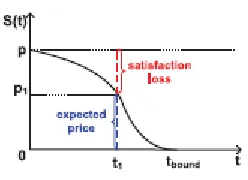
Fig. 2. Satisfaction function.
3.2 user delay Tolerance
With the increase of downloading postpone, the consumer’s satisfaction decreases therefore, the rate of which displays the consumer’s postpone tolerance. To flexibly model customers’ postpone tolerance, we introduce a satisfaction feature S(t), that is a monotonically decreasing function of delay t, and represents the charge that the user is willing to pay for the data service with the postpone. The pleasure characteristic is decided by using the person himself, his requested statistics, and various environmental elements. We anticipate that every person has an top certain of put off tolerance for each records. as soon as the delay reaches the sure, the person’s pleasure will become zero, indicating that the consumer isn't inclined to pay for the facts provider. Fig. 2 shows an example of the pride characteristic S(t) of a particular consumer for a particular
information, in which tbound is the upper certain
willing to pay p1 rather than p. p - p1 is the delight loss because of postpone t1.
3.3 Auctions
In economics, auction is a regular technique to determine the fee of a commodity that has an undetermined and variable price. it has been broadly carried out to many fields. Maximum auctions are ahead auction that entails a single supplier and multiple consumers, and the consumers’ ship bids to compete for acquiring the commodities bought by using the seller. In this project, we use opposite public sale that includes a unmarried buyer and multiple dealers, and the consumer decides its purchase based totally on the bids despatched with the aid of the sellers. to begin with, we introduce some notations: Bid(bi): it is submitted by bidder i to explicit i’s valuation on the resource for sale, which isn't always actual.
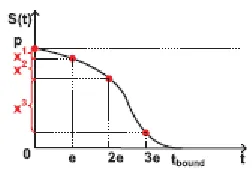
Personal price(xi): it's miles the proper valuation made by means of bidder I for the sources, i.e., the true rate that i desires to attain for promoting the aid. This price is handiest known by means of i.
Market-clearing price(pi): it's far the rate simply paid by way of the consumer to bidder i. This charge can not be less than the bids submitted through i.
Application (ui): it is the residual really worth of the offered useful resource for bidder i, specifically the distinction between i’s market-clearing price pi and personal value xi. The bidders inside the public sale are assumed to be rational and risk impartial. A commonplace requirement for auction design is the so-referred to as character rationality.
Fig. 3. Private value.
4. Essential method OF WIN-COUPON
In this segment, we illustrate the details of Win-Coupon. In the reverse auction-primarily based Win-Coupon, the consumer is the community operator who will pay coupon in trade for longer delay of the customers. The dealers are the cell users who promote their postpone tolerance to win coupon. The right side of Fig. 1 shows the float chart of Win-Coupon. before everything, the network operator collects the bids to derive the postpone tolerance of the bidders, and predicts their offloading capacity.
Then, primarily based at the derived
information, a opposite public sale is
conducted, which incorporates foremost steps: allocation and pricing. eventually, the network operator returns the auction outcome to the bidders. in the rest of this phase, we first introduce the bidding. Then, we present auction mechanism and prove its houses. Subsequently, we illustrate a way to are expecting bidders’ offloading ability for each DTN and WiFi cases.
4.1 Bidding
To achieve coupon, the customers attach bids with their statistics requests to reveal their delay tolerance. For every user, the upper certain tbound of its put off tolerance can be considered
as the assets that it desires to sell. The
consumer can divide tbound into more than one
b2; . . . ; bl} to suggest the value of coupon it wants to achieve for every extra time unit of put
off, in which l equals btbound e c, and e is the
duration of 1 time unit. via receiving those bids, the community operator knows that the user wishes to achieve coupon with fee no less than
Pki okay=1 bk through waiting for ki time
devices. The duration of time unit e may be flexibly decided by the network operator. Shorter time unit outcomes in larger bids with greater records, which will increase the performance of the public sale, but it additionally induces extra communication overhead and better computational complexity. To simplify the presentation, in the relaxation of the project delay t is normalized with the aid of time unit e.
4.2 Auction Algorithms
Win-Coupon is administered periodically in each public sale round. usually, the auction would result in an additional put off for the bidders to watch for the auction outcome. but, distinctive from other lengthy-term auctions, along with the FCC-style spectrum leasing, the auction round in our scenario is very short, since loads of users may additionally request cell records service at the equal time. Additionally, due to the fact the bidders who're willing to submit bids are speculated to have a sure diploma of put off tolerance, the extra postpone resulting from auction can be ignored. Subsequent, we describe two major steps of the public sale: allocation and pricing.
4.2.1 Allocation
In conventional opposite auction, the allocation solution is merely determined by using the bids; i.e., the bidders who bid the lowest charge win the sport. It is straightforward to prove that our
allocation problem may be decreased to the 0-1
knapsack problem, beneath the belief that li = 1,
for all i. The zero-1 knapsack hassle is proved to be NP-difficult, and as a result, our hassle is
also NPhard. Next, we rework the unique
problem, and derive the most useful answer of the new hassle with the aid of dynamic programming (DP).
mintiΣi€NΣk=1tibik (1)
s.t. Σi€N Vid (ti) ≥ v0 (2)
For all i; ti € {0; 1; 2; . . . ; li): (3)
4.2.4 Reserve fee
4.3 Prediction of Offloading ability: The DTN Case by motivating users to anticipate a while, part of the cell site visitors can be offloaded to different intermittently available networks. One such instance is DTN that generally coexists with mobile networks, and does now not depend on any infrastructure. cellular customers can proportion data thru DTNs by means of contacting every different. In urban place with better person density, cell users have extra possibilities to contact different users who've their asked information. massive facts requests which includes video clips tend to drain most of the cell community resource, and such requests can also tolerate some postpone. By offloading them thru DTNs, the payload of mobile network may be appreciably decreased. on this phase, we illustrate the way to are expecting the potentials of the customers to offload their traffic thru DTNs.
4.3.1 Fashions
Because of excessive node mobility, huge statistics gadgets are tough to be completely transmitted whilst nodes contact. It has been proved that the random linear network coding (RLNC) techniques can appreciably improve the records transmission efficiency, particularly
when the transmission bandwidth is
constrained. thus, in our model, RLNC is followed to encode the authentic statistics into a hard and fast of coded packets. As long because the requester collects sufficient variety of any linearly independent coded packets of its requested records, the statistics may be reconstructed. because of web page restrict, we omit the info of RLNC and advocate interested readers to consult. Except, when the data item is massive, multi-generation community coding
is normally followed. To balance the
information transmission efficiency, the
computational, and the transmission value, the way to decide the era length and the way to time table their era transmissions need to be carefully considered. on account that this is not the focus of this project, we are able to now not talk it in the project. Inside the following analysis to simplify the presentation, we expect that the touch method among each node pair follows i.i.d. Poisson distribution with price λ, and precisely one packet can be transmitted when two nodes contact. Our analysis primarily based on these assumptions may be prolonged to extra well known instances which include node pairs observe contact strategies aside from Poisson, and they could transmit arbitrary number of packets at some point of a contact.
4.3.2 the primary idea of Prediction
We describe the reason of prediction in a single public sale spherical. The starting time of this spherical is denoted with the aid of t0. The goal of the prediction is to calculate the expected
volume of traffic Vdi (t) that may be offloaded
node contacts any other node, which has cached some coded packets of the requested statistics, it can always retrieve an modern packet with a totally high possibility. This assumption has been generally utilized in previous works. In practice, if the size of the finite area to generate the coding coefficients is big sufficient, the opportunity could be very close to 1.
4.3.5 Numerical consequences
To confirm the accuracy of our DTN-primarily based prediction model and analyze the influences of the device parameters, we numerically clear up the ODEs and compare the prediction results to the actual values derived from the Monte-Carlo simulations. within the simulations, we generate three hundred nodes following i.i.d. Poisson touch system, and one data item with 16 packets and query fee q = 0:001. The equal set of parameters is imported to the ODEs. We recognition at the range of downloaded packets along time t on a particular node, and evaluate the consequences derived inside the simulation with that from fixing the ODEs. The outcomes given by means of the simulation are averaged over 200 runs. Fig. 5a indicates the results with different contact charge . we can see that the prediction results are very close to the values given by using the simulations, which verifies the accuracy of our prediction version. the bigger the touch charge is, the earlier the node collects all sixteen packets. We further evaluate the consequences while the question fee q varies, as shown in Fig. 5b. The prediction also achieves consequences near that of the simulations. Because the query rate increases, the node collects more packets from other friends as time passes. this means that if a
node requests a famous item, its offloading potential is big.
4.4 Prediction of Offloading capability:
The WiFi Case similar to the DTN case, with the aid of motivating mobile customers to attend for some time, part of their cellular site visitors may be redirected to WiFi networks after they touch a few WiFi hotspots. In urban areas with extensive deployment of WiFi networks, WiFi offloading can notably mitigate the cellular community overload hassle. in this phase, we illustrate the way to expect the capability of the users to offload their statistics visitors via WiFi networks.
4.4.1 fashions
Maximum cellular users have a few diurnal patterns (e.g., following the identical trip direction each day), and hence we can formulate their mobility based on the Markov version. Due to high node mobility, we also remember the touch period limits inside the WiFi case. this is, a big data object may not be absolutely downloaded whilst a node contacts a WiFi hotspot. To predict the offloading capability, both regular and transient conduct of
node mobility should be taken into
and the average downlink records price of
country j is denoted as rj.
Fig. 7. Numerical results—WiFi.
5 PERFORMANCE ASSESSMENT
In this segment, we evaluate the performance of Win-Coupon via trace-driven simulations for both DTN and WiFi instances. For each case, we first introduce the simulation setup, and then examine the performance of Win-Coupon underneath diverse device parameters. Within
the evaluation, the subsequent overall
performance metrics are used:
. Offloaded traffic. the whole amount of site visitors this is without a doubt offloaded. . allotted coupon. the total incentive price spent via the community operator for offloading reason.
. common downloading postpone. The common time a bidder spends to get the whole records after sending the request.
5.1 The DTN Case
5.1.1 Simulation Setup
Our overall performance evaluation in the DTN case is conducted at the u.s. hint, which facts the contact history of 275 HP Jornada PDAs carried by using students over seventy seven days. Primarily based at the trace, we generate
50 information items, and every carries 8 packets. The query price qd for each record d is generated following Zipf distribution, and the default skew ness parameter w is about to 1.5.
5.1.2 Simulation results—impact of quantity of Bidders
actually offload 80 visitors gadgets, and the average downloading put off is 12.1, 5.3, and 3.7 hours. The purpose at the back of this phenomenon is that after greater bidders participate within the auction, it is greater probable to have greater bidders with excessive delay tolerance or huge offloading capacity. to offload the equal quantity of site visitors, the bidders with high delay tolerance request less coupon to compensate their delight loss, and the bidders with huge offloading capability want to wait for shorter time. thus, the incentive value and the delay lower while extra bidders participate in the auction.
5.1.3 Simulation effects: Effect of Reserve charge to evaluate the effect of reserve fee, we repair the duration of 1 auction spherical to be 10 minutes, and set the reserve rate to 0.04, 0.06, 0.1, and zero.2, respectively. We run the simulations for 20 consecutive auction rounds. The results are proven in Figs. 8d, 8e, and 8f. As may be seen, with the growth of reserve charge, greater site visitors may be offloaded. This is because better reserve fee shows large willingness of the community operator to pay for offloading one unit of traffic, after which potentially motivates more users for offloading. when the reserve price is set to 0.2, almost 60 percentage of the visitors may be offloaded as shown in Fig. 8d. however, better reserve price effects in higher incentive price as proven in Fig. 8e. To balance this tradeoff, the network operator can set the reserve price correctly according to its price range. additionally, as proven in Fig. 8f, the average postpone will increase because the reserve fee increases, given that greater users are decided on as the triumphing bidder and encouraged to attend. Because the offloading target further increases, the amount of visitors that is sincerely
offloaded stays nearly the identical inside the low delay tolerance situation. this is due to the fact the users on this state of affairs aren't willing to wait longer and the site visitors being offloaded is bounded. Then, the price of the allocated coupon on this state of affairs stays the same. but, in the eventualities with center and excessive postpone tolerance, because the offloading goal will increase greater traffic can be offloaded by way of higher exploiting users’ put off tolerance, after which the allocated coupon increases.
almost 70 percent of the visitors can be offloaded within the case of w ¼ 2. also, as shown in Fig. 9b while the offloading target is quite small, larger w outcomes in shorter delay. that is also because of the fact that the skewer facts question distribution benefits more for the cellular traffic offloading. while the offloading target keeps to growth, smaller w effects in shorter put off, since the offloading goal exceeds the offloading ability and lots of customers immediately down load statistics through cellular network. More importantly, we will see that the average postpone decreases significantly and turns into more reasonable for practical use within the massive-scale scenario.
5.2 The WiFi Case
5.2.1 Simulation Setup
To evaluate the overall performance of Win-Coupon inside the WiFi case, we use the UMass DieselNet trace [30], which includes the mobility histories of 32 buses. in the hint, each bus is prepared with a GPS tool, and periodically data its GPS region. to apply our prediction version, the map is divided into 10 15 uniform-sized geographical grids. based at the mobility statistics provided by using the hint, we in addition upload synthetic WiFi data. We anticipate that a few WiFi hotspots are disbursed at the map. We preset a WiFi coverage price, which represents the ratio of the range of grids with some WiFi hotspots to the total number of grids. The downlink statistics price for the ones grids with WiFi hotspots are randomly generated inside the range of 50 Kbps and 1 Mbps.
To derive the transition probability matrix and the corresponding sojourn time possibility distributions for every node, we take two-week
lines because the training information. We select up someday trace (eleven-06-2007) which has distinctly high network density to carry out Win-Coupon. the primary public sale spherical starts offevolved at eight:30 AM and the public sale is carried out for 10 consecutive rounds with the c language of 1 hour. given that the whole number of nodes inside the trace is pretty constrained, we count on that every node will take part inside the public sale to growth the variety of participants. the size of statistics asked by using nodes are randomly generated in the variety of one hundred and 500 Mb.
Fig. 10. Impact of reserve price and delay tolerance—WiFi.
5.2.3 Simulation outcomes: impact of put off Tolerance: We in addition evaluate the impact of customers’ postpone tolerance. three scenarios with high, middle, and low postpone tolerance are generated with the aid of randomly placing the parameter inside the delight feature in the range of |0.1; 0:2, |0.2,0.3, and |0:3; 0.4, respectively. The reserve price is about to 0.07.
DTN case. better put off tolerance results in better offloading performance at the rate of longer downloading postpone. to dump the equal amount of visitors, much less coupon is allotted in the high postpone tolerance scenario. for instance, to offload 20 percentage visitors, sixty two.6, 47.8, and 28.1 coupons are allocated inside the low, middle, and high put off tolerance situations, respectively. within the high delay tolerance scenario, nearly seventy five percent of the traffic can be offloaded and the common downloading delay is handiest about 50 mins.
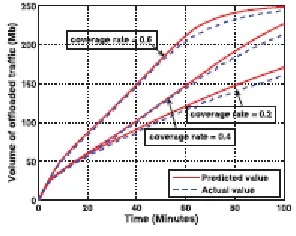
5.2.4 Simulation consequences: impact of WiFi insurance price - We set the WiFi coverage price to 0.four and 0.6, respectively, to examine the effect of WiFi availability on the performance of Win-Coupon. The assessment consequences are proven in Fig. 11. Figs. 11a and 11b display the percentage of offloaded visitors and the average delay, respectively, when offloading target will increase from 1,000 to 4,500 Mb. whilst the offloading target is set to be low, as an example, much less than 2,000 Mb, one-of-a-kind WiFi coverage charge outcomes in similar percentage of offloaded site visitors. that is because the fantastically low offloading target can be without difficulty done in both community scenarios. But, to dump the equal quantity of site visitors, the common put off is plenty shorter while the WiFi insurance rate is higher. when the WiFi coverage rate is 0.6, almost 85 percentage of the site visitors can be offloaded, and the common postpone is ready 30 minutes. Figs. 11c and 11d display the comparisons of the anticipated offloaded traffic expected by our prediction version and the actual. The yellow components proven within the bars constitute the expected traffic to be offloaded based totally on our prediction
version and the traces drawn in the
determination denote the site visitors that has been actually offloaded. As may be visible, the predicted effects are near the actual results in both network situations. The inexperienced parts shown in the bars represent the volume of visitors that is anticipated to be offloaded by means of the virtual bidder. As explained in phase 4.2.4, the virtual bidder is delivered to
ensure the community operator gaining
nonnegative earnings. In other phrases, if the actual bidders have low delay tolerance or small offloading ability, the community operator could not trade with them and ask them to without delay down load facts thru mobile community (letting the virtual bidders win the sport), even supposing the offloading goal can't be performed. As may be visible when the WiFi coverage charge reaches 0.6, the offloading goal may be nearly executed, because of the large offloading potential of the bidders.
6 DISCUSSIONS
In this project, we specially targeted on the downloading situation because the majority of cell visitors is at the downlink. We additionally separate WiFi and DTN whilst discussing Win-Coupon layout. certainly, our framework is very popular, and can be extended to healthy many different eventualities. Win-Coupon includes elements: auction-based incentive mechanism and prediction. so long as the extent
of offloaded traffic Vdi(t) can be anticipated, the
Uploading situation: Inside the WiFi case, seeing that most effective the contact between the user and the WiFi hotspot impacts offloading, the identical prediction approach may be used in the uploading situation. in the DTN case, the current prediction approach is based on the belief that more than one users request the equal famous gadgets to share them via DTNs. for this reason, it can't be at once implemented to the importing situation, when you consider that customers normally add exclusive gadgets. Hence, we want to layout other offloading strategies and the prediction methods for the DTN case. as an example, the uploading site visitors can be offloaded by using mutually using DTN and WiFi. Then, the node that generates statistics can transmit it through DTN to a contacted node which has massive ability to have a WiFi connection in the near destiny, and add the information thru WiFi.
Hybrid network situation: In the hybrid state of affairs that keep in mind both DTN and WiFi, the person offloading capacity ought to be recalculated. A naive way is to absolutely deal with them as independently coexisting networks; i.e., cell users can get statistics portions from each networks in the course of their ready period. Then, the prediction is to discover the ―expected offloaded site visitors‖ of DTN and WiFi one after the other the usage of the present day prediction strategies, and sum them together. However, there are different better answers. as an example, as opposed to handiest downloading the information to satisfy their own call for, users can proactively down load the famous statistics gadgets from WiFi, then cache and proportion them with others via DTN. In this example, a joint prediction version is essential. Additionally, greater advanced
caching mechanisms can be carried out. Based at the strategies, socially lively nodes can use WiFi to proactively fetch and cache objects with high reputation and occasional availability in their social communities and share them with different nodes thru DTNs.
7 END
In this project, we proposed a novel incentive framework for mobile traffic offloading. The simple idea is to encourage the mobile customers with high put off tolerance and big offloading ability to offload their traffic to other intermittently related networks together with DTN or WiFi hotspots. To seize the dynamic characteristics of users’ delay tolerance, we layout an incentive mechanism primarily based on opposite auction. Our mechanism has been proved to guarantee truthfulness, man or
woman rationality, and occasional
computational complexity. furthermore, we design accurate fashions to expect the offloading capacity of the customers for both DTN and WiFi cases. Extensive trace driven simulations validate the efficiency and sensible use of our incentive framework.
REFERENCES
[1] M. Reardon, ―Cisco Predicts Wireless-Data
Explosion,‖ http://
news.cnet.com/8301-30686_3-10449758-266.html, 2013.
[2] I. Trestian, S. Ranjan, A. Kuzmanovic, and A. Nucci, ―Taming the Mobile Data Deluge with Drop Zones,‖ IEEE/ACM Trans. Networking, vol. 20, no. 4, pp. 1010-1023, Aug. 2012.
[3] B. Han, P. Hui, V. Kumar, M. Marathe, J. Shao, and A. Srinivasan, ―Mobile Data
Communications and Social Participation,‖ IEEE Trans. Mobile Computing, vol. 11, no. 5, pp. 821-834, May 2012.
[4] K. Lee, I. Rhee, J. Lee, S. Chong, and Y. Yi, ―Mobile Data Offloading: How Much Can WiFi Deliver?‖ Proc. ACM Sixth Int’l Conf.
Emerging Networking Experiments and
Technologies (CoNEXT), 2010.
[5] A. Balasubramanian, R. Mahajan, and A. Venkataramani, ―Augmenting Mobile 3G Using WiFi,‖ Proc. ACM MobiSys, 2010.
[6] N. Ristanovic, J.-Y.L. Boudec, A. Chaintreau, and V. Erramilli, ―Energy Efficient Offloading of 3G Networks,‖ Proc. IEEE Eighth Int’l Conf. Mobile Ad-Hoc and Sensor Systems (MASS), 2011.
[7] J. Whitbeck, Y. Lopez, J. Leguay, V. Conan, and M.D. Amorim, ―Relieving the Wireless Infrastructure: When Opportunistic Networks Meet Guaranteed Delays,‖ Proc. IEEE Int’l Symp. a World of Wireless, Mobile and Multimedia Networks (WoWMoM), 2011.
Mr. E.KIRAN was born in India in the year of 1985. He received B.Tech degree in the year of 2007 from BITS College &M.Tech PG in the year of 2012 from Vaagdevi College of Engineering. He was expert in Computer system and design,
Network Security, Dataminingand
Programming. He is currently working as An Assistant Professor in the CSE Department in
Vaagdevi College Of Engineering, Bollikunta, Warangal.
Mailid :[email protected]
Ms .J. VINITHA was born in India .She is pursuing M.Tech degree in Computer Science & Engineering in CSE
Department in Vaagdevi College Of
Engineering,UGC
autonomous,Bollikunta,Warangal