A Comprehensive Study on Mobile Cloud
Computing (MCC) & It’s Internals
Saania Sayed#1, Jovi D’Silva#2 #1
PG Student, Department of Computer Application, The Don Bosco Institute For Post Graduate Studies & Research, Panjim, Goa, India
#2
Assistant Professor, Department of Computer Application, The Don Bosco Institute For Post Graduate Studies & Research, Panjim, Goa, India
Abstract— Cloud computing is naturally combined with mobile devices to enable the active functionalities. Mobile Cloud Computing is a combination of mobile computing and cloud computing. Mobile Cloud computing is the most influential section of cloud computing and it’s expected to expand the mobile ecosystem. Mobile devices evolved from voice calls enabled devices to smart devices which enabled the user to access services at anytime from anywhere. The main aim of Mobile Cloud Computing is to provide rich mobile applications with rich user experience of mobile devices. This paper describes a research in the field of mobile cloud computing which presents an overall view of the architecture, its advantages and limitations, its applications, challenges and future research trends.
Keywords— Cloud Computing, Mobile Cloud Computing, MCC Architecture
I. INTRODUCTION
Mobile gadgets have become an essential part of human life as it’s the most effective and convenient way to communicate which is not bounded by time and place. Due to this, there have been an increased number of applications that have migrated to the cloud, and new cloud-based applications that have become popular. Mobile Cloud Computing is a combination of mobile as well as cloud computing with various other wireless networks which helps to bring rich computational resources to cloud computing providers, mobile users and to networks operators as well. Nature of cloud applications also is advantageous for users since they do not need to have very technical hardware to run applications as these computing operations are run within the cloud. This reduces the price of mobile computing to the end users.
II. WHAT IS MOBILE CLOUD COMPUTING?
The concept Mobile Cloud Computing was defined on 5th of March, 2010 in the Open Gardens Blog. The Mobile Cloud Computing Forum defines MCC as follows: Mobile Cloud Computing at its simplest, refers to an infrastructure where both the data storage and the data processing happen outside of the mobile device. Mobile cloud applications move the computing power and data storage away from mobile phones and into the cloud, bringing applications and mobile computing to not just Smartphone users but a much broader range of mobile subscribers”. [1]
Mobile computing is different from mobile cloud computing. Mobile computing refers to variety of mechanism that allows people to access data and information and even by facing many challenges like communications with respect to security, mobility and
privacy and resources like battery life, storage and bandwidth. Mobile cloud computing can be referred in two perspectives: Infrastructure based mobile cloud and Ad-hoc mobile cloud. In infrastructure based mobile cloud, the hardware infrastructure is stable as well as provides services to mobile users whereas in Ad-hoc mobile cloud behaves like cloud and permits access to the Internet based cloud or local services to mobile devices. Therefore mobile cloud computing prefers Ad-hoc mobile cloud based application/system models. The number of applications based on Mobile cloud computing such as Google’s Gmail, Navigation, Maps Voice search applications to mobile devices. Platforms for a mobile devices are BlackBerry platform developed by Research In Motion (RIM), iMac developed by Apple, Android platform developed by Google, Moto blur from Motorola, Live Mesh developed by Microsoft.
III. ARCHITECTURE IN MOBILE CLOUD COMPUTING
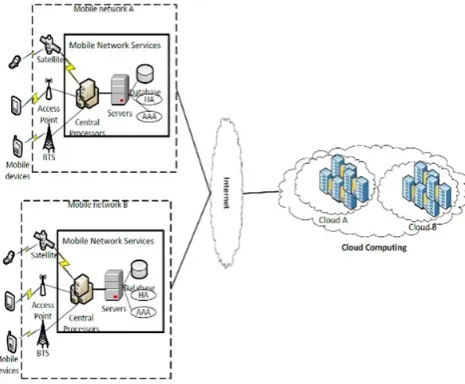
The mobile gadgets are connected to the mobile structure over the base stations that create and control the connections between the networks and the mobile devices. Mobile users send in the request and the information is then broadcasted to the central processors that are connected to the servers providing mobile network services. Here, utilities like Authentication, Authorization and Accounting, known as AAA, can be provided to the users based on Home Agent (HA) and subscribers data stored in databases. The subscriber’s requests are then dispatched to a cloud over the Internet. The cloud controllers then process the requests and then provide the cloud service to the mobile user.
IV. ADVANTAGES OF MOBILE CLOUD COMPUTING 1) Increase battery life: Battery is one of the main
worry for mobile devices. There are several solutions that have been proposed to boost the performance of the CPU and to manage the display in an intelligent manner so that it helps in reducing the usage of power. However, these require changes in the structure of mobile gadgets may results in an increase of cost and may not be reasonable for all mobile devices.
2) Bettering data storage capacity and processing power: Mobile Cloud Computing is developed to implement mobile users to store/access the large data on the cloud through wireless networks. 3) Improving Accuracy: An effective way to improve
accuracy and reliability is to store the data or run applications on clouds. This helps in reducing the chance of data and the application being lost on the mobile devices. In addition, MCC can be designed as a comprehensive data security model for both service providers and users.
4) Dynamic provisioning: Dynamic on-demand provisioning of resources on a fine-grained, self-service basis is a flexible way for self-service providers and mobile users to run their applications without advanced reservation of resources.
5) Scalability: The deployment of mobile applications can be performed and scaled to meet the unpredictable user demands due to flexible resource provisioning. These service providers easily add and increase the applications and services with or without little constraint on the resource usage.
6) Multi-tenancy: Service providers can share the resources and costs to support a variety of applications and large number of users.
7) Ease of Assimilation: Multiple services from different service providers can be unified easily through the cloud and the Internet to meet the user’s demands.
8) Multiple platforms: Unlike traditional applications, mobile cloud computing allows for multiple platform support. In other words, whatever the platform may be, you can easily access the data and applications stored in the cloud.
9) No upfront costs: Cloud applications have minimal or no upfront cost. It is very much a pay-for-use service which has helped to grow adoption of the model. Without large fees for licensing and upgrades, the cost of adoption is less of a barrier when cash flow is an issue.
V. LIMITATIONS OF MOBILE CLOUD COMPUTING
1) Security: Security is considered one of the main concerns of MCC. Often the mobile users provide data that contain sensitive information through the network, and if the data is not being protected, it
can lead to major damages in the case of a security breach.
2) Performance: Some users feel performance is not as good as with original applications. So, checking with your service provider and understanding their track record is desirable.
3) Connectivity: Internet connection is critical to mobile cloud computing. So, you should make sure that you have a good one before opting for these services.
4) Mobile Network Cost and Scalability: Besides the high cloud operating expenses, and cloud scalability concern, the applications by MCC have a high demand on wireless network bandwidth. Moreover, the high wireless bandwidth requirement may prohibitively raise the wireless data bills of mobile users, making MCC applications impractical.
5) Availability: Service availability is an important concern in MCC with wired networks because most of the mobile users may be unable to connect to the cloud due to traffic congestion or network loss.
6) Heterogeneity: MCC is used in heterogeneous networks in terms of wireless network interfaces. Different mobile nodes try to access the cloud through different radio access technologies. This is one of the major concerns that has arisen of how to handle the wireless connectivity by satisfying the mobile cloud computing requirements.
7) Issuesincomputingoffloading: This is one of the main features of MCC to improve the battery lifetime for the mobile phones and to increase the performance of applications. However, offloading is not always the effective way to save energy. When the code size is small, Offloading might consume more energy than that of local processing.
VI. APPLICATIONS OF MOBILE CLOUD COMPUTING
1) Mobile Commerce: Mobile commerce popularly known as m-commerce is a business model for commerce using mobile devices. The m-commerce applications perform tasks that require mobility. These applications can be classified into a few classes including finance, advertising and shopping. These applications have to face various challenges with regards to low network bandwidth, security and high complexity of mobile device configurations. Therefore, these m-commerce applications are unified into the cloud computing environment to address these issues. 2) Mobile Learning: Mobile learning popularly
3) Mobile Health Care: The purpose of applying Mobile Cloud Computing in medical applications is to minimize the limitations of traditional medical treatment such as small physical storage, medical errors, security and privacy. M-healthcare provides mobile users with beneficial helps to access resources easily and quickly.
4) Mobile Gaming: Mobile game popularly known as m-game is a possible market generating revenues for service providers. They perfectly offload game engine which requires large computing resources to the server in the cloud. Here, the gamer only collaborates with the screen on their devices and determines that offloading can minimize energy of their mobile gadgets, thereby increasing game playing time on their mobiles.
VII. CHALLENGES OF MOBILE CLOUD COMPUTING
The challenges of mobile cloud computing can be classified into various categories given below.
A. Challenges regarding mobile devices
1) Limited source of energy for mobile gadgets: The mobile gadgets now days are generally less powerful and use batteries that have a limited capacity. It is necessary to increase the lifespan of the battery with the help of careful partitioning of the applications. There are basically two things that consume a lot of energy in the mobile devices are the display element and cellular connectivity. Larger display screens and sophisticated applications tend to have a large battery pack as compared to non-display applications.
2) Resource poverty of hand-held devices versus fixed devices: The challenges presented by the mobile devices are drivers for adoption of MCC. In an effort to offset device limitations, resources can be added to the cloud infrastructure to provide logical user experiences for leading applications. Over the past few years the mobile technology has increased which gave a rise to the significant cost of flexibility and level of technology available.
B. Challenges regarding network
1) Inherent Challenges of Wireless Network:
Wireless network is base for carrying out cloud computing and it has its own intrinsic nature and constraints. These objection impede its design for mobile gadgets even more. Fixed broadband is supported by consistent network bandwidth while wireless connectivity is described by variable data rates, less throughput, longer latency and intermittent connectivity due to gaps in coverage. Subscriber mobility and uncontrollable factors are also responsible for varying bandwidth capacity and coverage.
2) Various Network Access Schemes: For implementing cloud computing to mobile devices basic requirement is to have an access to network. There are a number of access scenarios, each of which having a different access technology with
their own policies and restrictions. We need seamless connection handover schemes when we move from one network access point to another network access point, this is needed because of existence of different access scheme.
3) Reducing Network Latency: Factor responsible for overall delay response of applications are: Processing time on the device as well as the data centre, Network latency and Data transport time. Processing time involved is based on application depending on which measures can be taken to improve the network latency. To reduce the latency delay, the applications can be kept close to the users. Heavy data like video and podcasts if kept near to the device then it will help save bandwidth and cut the transmission delay. Similar is the case with highly immersive apps. Latency can be positively improved by allowing service providers to re-route internet traffic logically and can save bandwidth effectively.
4) Lack of Mobile Internet Access Everywhere: In order to get fast mobile internet access new technologies are being developed which provide facility of local caching. Technologies like OMA's Smartcard Web Server, basically a souped-up SIM card that connects directly with the carrier to provide applications to mobile phones, whereas TokTok, allows voice enabled access to web services, are being introduced just to provide a better access to mobile web. Through these voice-enabled searches, mobile apps talk directly to the service itself sitting on the edge of the network, avoiding the requirement to launch a web browser and navigate through the mobile web.
5) Seamless Connection Handover: In order to equip data communication using mobile, network operators are trying to set up Wi-Fi Aps on street so that offload traffic can be reduced, resulting in reduced cellular traffic congestion. Here the basic requirement is to grant smooth connection handover between access networks. Currently executing application is cancelled or returns error when we move from Wi-Fi network to 3G-based cellular network due to occurrence of communication failure and connection reestablishment situation.
be achieved from hosting environments to cover surges in Internet or network activity.
C. Challenges related to Mobile Applications
1) Interoperability: Organizations that follow Bring-your-Own-Mobile (BYOD) policy generally faces interoperability challenges. It’s possible that there is an assorted mix of mobile devices are used by employees in an organization or a group of people sharing a network. And in such situation according to the nature of cloud applications being used and operating system of mobile device interoperability issue can prove to be a major challenge in pulling/ pushing data across multiple devices. BYOD policy acceptance forces developers to think of a wide range of new security and management features that have to be framed into application, providing safe access to company data. By using context and location information we can work for optimizing mobile access. Context aware services exploit data collected from terminal sensors or network sensors measuring network statues and load. Network services and consumer application both uses these information.
2) Cloud Application Flexibility: An application is going to be supported by certain mobile cloud infrastructure or not, can easily be judged on the basis of its requirements against the cloud infrastructure characteristics along the device, network bandwidth and latency vectors. Different applications needs are different for its respective cloud infrastructure attributes. For example, a loosely coupled and low-content application like web search will provide optimal result on a 3G network with relatively low compute servers at a distant data centre. But if we consider immersive and content-rich applications it will require a high-bandwidth/low-latency network like LTE so that large image content can be transferred quickly and seamlessly to the servers running the face recognition algorithm and the user-facing devices. In high-demand applications latency delay and transmission can be reduced by considering nearby data centres. And for a highly immersive application mobile cloud infrastructure can go for Wi-Fi offload that reduced latency further which is generally required by such applications.
3) Mobile Cloud Convergence: In order to achieve advantage of mobility by integrating cloud computing to mobile world, Data distribution is the key issue. Limitation of mobile devices for their computing power makes task distribution very important as the computing power of mobile devices is not powerful enough. Mobile cloud convergence provides performance improvement, longer battery life, and a solution to the computation power problem. Basic approach of mobile cloud convergence is to partition application such that parts that need more computation run on the cloud and remaining parts
which is associated with the user interface run on the mobile device. As a single process is being partitioned here so inter-process communication is very important to realize this convergence. An improved and optimal PI calculation algorithm can be achieved by optimizing mobile cloud convergence. Wireless technologies, advanced electronics and internet are overlapped and integrated to achieve pervasive and ubiquitous computing.
D. Challenges regarding Security
2) Privacy and Confidentiality: There are various policies and schemes being proposed which require rigorous controls and procedures to protect the privacy of individuals. Organizations that collect data\information must have some policies and procedures in order to handle, store, and dispose them securely and must be implemented to maintain the privacy. Risk of privacy exposure, identity theft and fraud can be reduced by resolving enhanced protection measures for sharing information in interconnected systems, resolving monitoring capabilities and protocols, and by educating users about proper social media safe-surfing. By enforcing policies regarding use of social media and implementing processes to protect their infrastructures from unapproved use of social media an organization can protect themselves from serious legal and security-related problems. Otherwise their information infrastructure and reputation both will be irreparably damaged. Encryption provides most powerful way to maintain integrity and confidentiality of information. Encryption favours data storage and transport but it fundamentally prevents data processing. Therefore, initially it was quite useless to send encrypted data to cloud providers for processing. But this challenge has been met by homomorphic cryptography (HC) which ensures that activities performed on an encrypted text results in an encrypted version of the processed text.
3) Malicious Attacks: All networks are susceptible to one or more malicious attacks. As more as external Web sites are being accessed malicious actors will have more opportunities to access the network and operational data of that organization. Implementing security controls across all Web 2.0 servers and verifying these rigorous security controls can reduce the threats to internal networks and operational data. Additionally, separating Web 2.0 servers from other internal servers may further mitigate the threat of unauthorized access to information through social media tools and Web sites. Some of the potential attacks include: Denial of Service (DoS) attacks, Side Channel attacks, Authentication attacks and Man-in-the-middle cryptographic attacks.
4) Network Monitoring: In addition to latency and bandwidth problems network performance monitoring is also an important issue which need proper concern and care. It is critical to have a dynamic cloud performance system that can allow access swapping, traffic re-routing and handover. With all these key challenges given mobile computing is still viable business and is being preferred by more cloud users. Foreign intelligence services (FIS) have extensive resources and have repeatedly demonstrated their capability to use automated social engineering techniques to mine social media sites. By their
very nature, social media sites have an abundance of information, which makes them susceptible to data mining. Our adversaries can use this data to consider aggregated information. Without adequate network monitoring, an organization cannot ensure that whether users are complying or not its policies regarding the release of high-value information. Additionally, programming languages used in Web 2.0 applications may create other opportunities for malicious actors to access an organizations back-end network infrastructure and do irreparable damage. Consequently, an organization using social media may need to implement increased security controls for any separate sensitive information residing on the server’s backend.
VIII. FUTURE RESEARCH ISSUES
1) Energy efficiency: Owing to the limited resources such as battery life, available network bandwidth, storage capacity and processor performance, on the mobile devices, researchers are always on the lookout for solutions that result in optimal utilization of available resources.
2) Security: The absence of standards poses a serious issue specifically with respect to security and privacy of data being delivered to and from the mobile devices to the cloud.
3) Better service: The original motivation behind MCC was to provide PC-like services to mobile devices. However, owing to the varied differences in features between fixed and mobile devices, transformation of services from one to the other may not be as direct.
4) Task division: Researchers are always on the lookout for strategies and algorithms to offload computation tasks from mobile devices to cloud. However, due to differences in computational requirement of numerous applications available to the users and the variety of handsets available in the market, an optimal strategy is an area to be explored.
IX. CONCLUSION
ACKNOWLEDGEMENT
I consider it is a privilege to express my gratitude and respect to all those who guided me in completion of this research paper. It’s a great privilege to place on record my deep sense of gratitude to our HOD Ms. Chitra Nayagam, of The Don Bosco Institute of Post Graduate Studies & Research. I would like to thank the reviewers for their time and expertise, constructive comments and valuable insights.
REFERENCES
[1] Hoang T. Dinh, Chonho Lee, Dusit Niyato, and Ping Wang, “A Survey of Mobile Cloud Computing: Architecture, Applications, and Approaches”, Wireless Communications and Mobile Computing - Wiley.
[2] Pooja N. Dharmale and P. L. Ramteke, “Mobile Cloud Computing”,
International Journal of Science and Research, 2013.
[3] Neelam D. S. and Dr. Monica R. Mundada, “Mobile Cloud Computing”, International Journal of Engineering and Technical Research, Volume-3, Issue-2, February 2015.
[4] Lalit Kumar, Nishant Malik, Gouraf Agghi and Ajay Anand, “Mobile Cloud Computing”, International Journal of Research in Information Technology, Volume-2, Issue-9, September 2014. [5] Dhammapal Tayade, “Mobile Cloud Computing: Issues, Security,
Advantages, Trends”, International Journal of Computer Science and Information Technologies, Volume 5, 2014.
[6] Mukesh Goyal and Sukhwinder Singh, “Mobile Cloud Computing”,
International Journal of Enhanced Research in Science Technology & Engineering, Volume-3, Issue-4, April 2014.
[7] Pragya Gupta and Sudha Gupta, “Mobile Cloud Computing: The Future of Cloud”, International Journal of Advanced Research in Electrical, Electronics and Instrumentation Engineering, Volume-1, Issue-3, September 2012.
[8] Deepti Sahu, Shipra Sharma, Vandana Dubey, Alpika Tripathi, “Cloud Computing in Mobile Applications”, International Journal of Scientific and Research Publications, Volume-2, Issue-8, August 2012.
[9] Pragaladan R and Leelavati M, “A Study of Mobile Cloud Computing and Challenges”, International Journal of Advanced Research and Communication Engineering, Volume-3, Issue-7, July 2014.