252
Utilization of the Construction and Demolition
(C&D) Debris Waste in the Industry of
Cement Bricks for Environment Cleaner
Emhemmad A. BashaP
1
P
, Abd- Alazez AlkilaniP
2
P
, Abdullah E. BashaP
3
P
1
P
Department of Civil Engineering, Gasar Ben-Gasher Higher Institute for Comprehensive Professions, Tripoli, Libya
P
2
P
Department of Highways and Airports Engineering, Higher Institute of Civil Aviation and Meteorology, Sbeah City, libya
P
3
P
Libyan Academic, Department of Civil Engineering, Janzor , Tripoli, Libya
Abstract
Today solid waste is represents one of the environmental pollutions, including demolition, maintenance and construction waste, where are the largest and the most serious problems of this era on the environment, health and safety of human. They are considered one of the main reasons for the spread of dangerous diseases and lethal for human life, such as some types of cancers including liver, brain and lung, as well as lead to kidney failure, asthma, sterility, venereal diseases, allergies and others. For these reasons mentioned above was the goal of the study, where is to benefit advantage of this waste to disposal of them by a scientific method which is recycled and invested in some civil engineering applications, so it has been selected cement bricks to achieve this goal, as well as protection of the environment and human of serious harm. In this paper have been a number of studies where to determine the compressive strength, absorption, effective of variation proportion of water, natural fine aggregate and cement on compressive strength. The results showed for all studies the strength of pressure resistance of the brick produced from the construction waste in this research is higher than the strength of the resistance of the bricks produced locally with natural materials when adding 12% cement at storage period time 7 days. The results also have proven showed the rate of water absorption for all samples falls within the Libyan specifications with a maximum value of 21%. The results that it is possible to take advantage of construction, demolition and maintenance waste in making cement bricks, so that it can be used in many areas of civil engineering applications, such as building sidewalks, car parking, footpaths, squares and fences floors, water drainage channels, retaining walls and other construction work.
Keywords: Construction Waste, Compressive Strength, Absorption, Ordinary Portland Cement, Chemical Adjacent, (Sekament-163), Fine Natural Aggregate.
1. Introduction
The industrial development stunning and accelerated in this era led to the emergence of new lifestyles have contributed significantly and directly to the appearance of a multiplicity of various environmental contaminants. Pollution has spread encompassing all the elements of the different environment, and problem of environment, its pollution and how to face it has become the preoccupation of many official bodies and various scientific bodies. Generally pollutants are divided into three main types of gaseous, liquid and solid. The Solid waste is considered more dangerous than liquid and gaseous wastes, where causing pollution of all the different elements of environment. Solid pollutants are defined as those solid or semi-solid materials whose components vary according to their severity and source, the solid waste disposed are different methods, for example, when burned causing air pollution and when dumped in landfills causing soil and groundwater contamination. It is worth mentioning that there are some residues that pose a direct threat to the environment and human which contain toxic substances such as lead in paint, as well as asbestos or certain radioactive materials and plastic materials such as PVC [1].
253
the remains of crushed concrete, tiles and aggregate and classified into different sizes are used in the creation of new materials such as concrete, cement bricks and others of civil engineering applications.The optimal employment of construction waste contributes to an active role in protect, maintenance of environment, reduced construction projects costs and achieve a clean and beautiful environment. It is not secret what is produced from the various problems on the environment and public health when you leave piles of waste construction on roadsides or in the spaces, therefore must be taken care to recycle the largest possible amount of this waste for the prevention of hazards and damage which caused by it, for this reason are still many researches taking place in many countries of the world in how to manage and evaluate construction waste and exploitation and utilization of safe and effective manner [2-7].
1.2 Waste Types in Terms of Risk
1.2.1 Materials and Products of Hazardous
Materials containing asbestos stainless and non-stainless fragmentation, plastics of various types, hazardous waste listed set by the agency protect the global environment, products containing diphenyl component (PCBRSR), solvents,
chemicals substances, derived products from petroleum, dust, ash, fluorescent lights and electronics lights, medical waste, contaminated with waste materials [1].
1.2.2 Non-Hazardous Materials
Wood, plant material, plaster, rubble, stones, rocks, debris, ferrous metals, non-ferrous materials, carpets, cotton, woolen, linen, glasses, natural doors and windows, gypsum board, cardboard and lighting fixtures.
1.3 Impacts of Waste of Environmental and Health
Many residues contain chemical substances have negative effects of environmental and health in their accumulation in the environment, as well as during disposal operations incineration and land filling. During burning gas produces vinyl chloride where it is considered carcinogenic substances for to contain a chemical group actives within the chemical structure, as it poisonous gas leads to health damage when exposed it so simple concentration, studies have proved that free chlorine vinyl can cause some types of cancer including liver and brain cancer, and also where exposure to the dust of the waste can lead to lung cancer and asthma. Use chemicals organic and inorganic as additives contain heavy metals such as lead (Pb), cadmium (Cd) and these chemical elements considered toxic elements, and when there are the right conditions in the landfill and during the landfill, these substances migrate from waste structure to the surrounding medium and then to the soil and sources water after that to plants and humans. The presence of compounds phthalates within the compounds in the waste poses great dangers, which are considered carcinogenic substances causing at long exposure disturbances in endocrine system and levels hormonal, several countries has prevented use phthalate esters in children toys due to the proven transmission to children bodies and incidence suspected impact of carcinogenic and effect an adverse on the reproductive system. The United States Agency for Safety (US Consumer Products Safety Commission) considered that the substance DEHP properly to be carcinogenic to human liver [8].
1.4 Waste Amounts at the International Level
It is difficult to obtain precise information about the amounts and types of wastes construction, demolition and maintenance of urban, for to lack of a fixed information base and to give a clear picture of the environmental situation for wastes management, but there are some countries that have been able to achieve the full advantage of the management and recycling restoration of concrete resulting from acts buildings demolition including Netherlands, Japan, Belgium, Germany, USA, Canada, Australia and China. It is a fact that the world is produced about 26.6 billion tons per year of solid waste, it is fill 1.7 billion transport vehicle annually or fill 6.4 million truck per day, and is expected to rise from 70% to 80% in the next decades where leading to an increasing amount of solid waste, the Agency of the Global Environment Protection (IEPA) reported that the size total of solid waste in the European Union up to 1300 million tones contain 40% or 510 million tons of waste demolition and construction, and the countries more production is United States where produced 325 million tons per year, followed by Japan produces 77 million tons, then India and China [9].
254
22,678 hectares of land, as well as during the manufacture process of bricks can eliminate 400 thousand tons of coal ash and reduce 360 tons of sulfur dioxide emitted from burning bricks. [10]In United States of America studies conducted to the amount of recycled waste which generated from projects establishment of facilities and residential buildings, the results were the establishment of 500 square feet generates 12,344 pounds of waste where an average of 24.688 lbs/square feet. As for construction waste the United States Environmental Protection Agency (EPAUS) were estimated ratios materials in the construction and demolition waste at the following rates: Concrete mixture breaking stones 50-40%, wood 30-20%, ready breakers 15.5%, asphalt surfaces 10-1%, metals 5.1%, bricks 5.1% and plastic 5.1%. There is an additional important part of the ruins of the demolition and construction is generated from the construction of roads and bridges. As for the “environmental health risk”, for example, the initial estimates refers in America the direct cost of processing residues diseases and contaminants construction materials the range are $ 30 billion and indirect cost more than $ 100 billion annually [11].
2. Methods of Waste Disposal
2.1 Burning
The burn method some of the wastes in the open area leading to a number of gases emission harmful to the environment and public health, and the most dangerous of these gases hydrogen chloride (HCl), which causes serious economic and environmental damage, additional to damage of health, where consider a carcinogenic gas. Also emit carbon dioxide (COR2R) causes the rate of rise in atmospheric air, also reduces the concentration of oxygen in the indoor
places and cause suffocation, it is also basic charge of the occurrence of the phenomenon of global warming and rising temperatures in the world. Also emit carbon monoxide (CO) from combustion processes especially in the presence of a small percentage of oxygen where is considering a toxic and a murderer gas. It is also the output of the burning process ash contains heavy elements added in the form of organic salts during manufacturing processes, which caused the high temperatures during the burning process (more than 1000P
o
P
C), it can be evaporate and spread into the atmospheric air, as the burning process lead to the consumption of natural resources. Dioxin component considered the most dangerous gases on the environment and public health, where lead exposure to dioxin formed at burning waste even in small proportions to human infection weak resistance against diseases caused by bacteria, viruses and parasites, also causes cancer in humans, and pregnant women exposed to dioxin leads to the birth of children suffer from a lack of the hormone levels of male and decreased sperm counts at adulthood stage, as well as impairments congenital [12-14]. 2.2 Landfill
Land filling of waste in the soil is one of the methods used to reduce and disposal of the wastes quintets through the design and excavation of landfills, the size of the site depends on the amount of waste and the expected nature of the land. The failure to take the necessary measures to protect the environment is dangerous precaution and the migration of contain residues of chemical additives which are liberated by natural factors over time and seep through leaching into the groundwater this working on contaminated and thus reach different organisms, where one ton of waste contaminate about half a million liters of groundwater when drink human cause a number of different types of cancers in addition to kidney failure, venereal diseases, diseases of the liver and the immune system [15].
2.3 Recycle
Recycling method is consider the more effective and evolution from indicated methods above, where offering a partial solution of the problem and reduce the accumulation of waste, thus work to reduce the amount of pollutants to elements of environment, addition to provide economic return through the use of consuming raw materials, and some of previous studies indicated the recycling of some materials rates have reached 95% [16]. So is the re-use and recycling of construction waste and demolition of the best alternative ways for the benefit of the environment. Also, advances in knowledge and the requirements of civil engineering applications such as roads and making cement bricks, as well as in concrete production in large quantities in various construction works.
255
Studies Leanordo and colleagues have used sand recycled from the waste in the production of bricks used in paving roads and streets [31]. Studies also used the solid construction waste in improving the intumescent soil [32, 33]. As for the roads, foundations and enhance of strengthen the soil, has studies on the properties of compaction conducted when using solid waste in this area [34, 35].2.4 Waste Recycling Advantages
1. Preservation of the sanitary landfill sites at high value maintain in the land spaces as well as the preservation of the environment.
2. Considered as a type of economic income for the country.
3. Reduce of the cost paid for landfills, transport fare and other wages.
4. Reduce the proportion of resource depletion and negative effects on the environment. 5. Provide savings in energy costs.
6. Site recycling process as a way to avoid the cost of transport.
7. Financial revenues generated from the sale of recycled selected materials. 8. Establishment of new factories and provision of vacant places for employment. 9. Obtain of economic bricks.
10. Exploit of local resources for recycling to dispense of the imported materials. 11. Used in the construction of building walls.
12. Used in the paving of residential neighborhoods streets. 13. Used in the construction of gardens and parks.
14.
2.5 The Aim of the Study
1. Reduce the material cost of aggregates used in construction bricks. 2. Get rid of this waste for recyclers to take advantage as much as possible. 3. Provide land areas occupied by landfills and landfill sites from these wastes.
4. Protect the environment from pollution which caused by the accumulation in landfills.
5. Continue to deep scientifically study and experimentally for to understand their behavior and try to take advantage of wide range.
3. Materials used
3.1 Construction wastes:
Was obtained the buildings wastes of output of old buildings demolished and remnants of the maintenance and construction from Sbeah city area, which lies southeast of capital city (Tripoli) a distance of 40 kilometers. Have been separating undesirable materials, such as wood, plastic, glass, steel. aluminum, etc., it has been crushed manually by the hammers of steel in the basin of concrete, and then classified by sieve No. 8 to sieve No. 200 and remaining on the pan according to the American Standard Specifications (ASTM).
3.2 Cement
Cement used in this research is an ordinary Portland cement from Libya making, manufactured of Sooq Alkhames market area, which is located southeast of Tripoli city, a distance of 70 km, where classified on the strength of 42.5 Newton, according to British specifications (BS).
3.3 Sand
Sand user was supplied from the local market and extracted from quarries Zliten city, where is located east of Tripoli city, a distance of 160 km, and according to the Libyan specifications No. (49) of aggregate and sand.
3.4 Water
Water used in this research obtained from water Sbaea city network which is safe to drink and use in construction projects according to Libyan specifications.
256
Have been getting this chemical substance from the local market, and is used as a highly efficient to reduce the water content and strong as a plasticizer, increases workability employability high degree for the production of concrete of high quality in a warm climate. And leads the dual effect of improving the speed of hardening and increase early and final stresses where are according to USA and British specifications. (ASTM C 49 Type F & B.S. 5075 Part 3 for Super Plasticizer).4.Tests and equipment’s used
4.1 Specific weight of aggregate:
This test was conducted to the aggregate of the user of the waste, according to USA descriptors (ASTM-854-1958). 4.2 Percent of absorption of coarse and fine aggregates:
The determination of absorption ratio of aggregates is great importance, because used in its dry it will absorb part of the mixing water for purpose of access to the saturated condition, which leads to reduction of the effective mixing water. The share is calculated absorption of a sample of aggregates used in this research, so its weight at interior saturated and dry surface (W1), then dried in the oven at a temperature of 110° C for 24 hours and weighed after removing from the oven and cooled for two hours (W2), and be the absorption ratio of the sample under the following equation:
Absorption ratio ((W1-W2) / W2) 100... (1) =
According to Libyan specifications (47/74, 138/78, 247/82) the limits of the test specifications (standard requirements should be not exceed absorption ratio for all types of bricks of 21%).
4.3 Measuring Equipment of Compressive Strength
It has been measuring the compressive strength of samples of different bricks ages (7, 14, 28 days) according to the American specification number (ASTM C39) by means of resistance to compression device by loading them to the point of collapse, after that will be calculate the resisting of compression strength from the load device causes the collapse on area of brick face exposed to concentrated load of the pressure device, as shown in the following equation: Stress: σ = F / A……….. (2)
Where: σ = pressure or stress resistance. P = concentrated load. A = face brick area
(Compressive Strength Machine Serial Number: 1796-8-2539 International ELE).
5.Practical program
5.1 Processing and preparation of samples:
Preparing the mixture of samples accordance to the amount of local mixture used in production of cement bricks, 78.5% fine aggregate, 12% cement and 9.5% water, it is considered the reference in this research, so that the total weight of the mixture of laboratory microcosm of the original weight to 30.367 kg of cement, aggregate and water. 5.2 Tests program
5.2.1 First group
257
keeps the bricks for 24 hours and then immersed in water according to the prescribed period (7 days, 14 days and 28 days).Table 1: Illustrate the variation of addition cement proportion and curing period of specimens immersed in the water for all proportions (7, 14, 28) days Water Aggregate Cement Group % 9.5 % 82.5 % 8 First % 9.5 % 80.5 % 10 % 9.5 % 78.5 % 12 % 9.5 % 76.5 % 14 % 9.5 % 74.5 % 16 % 9.5 % 70.5 % 20 % 9.5 % 66.5 % 25
5.2.2 Second group: Reducing the proportion of coarse aggregate No. 1, No. 2 and add the proportion of fine aggregate as alternative, for 7 days curing time. See table 2.
Table 2: Illustrate add waste fine aggregate and reduction of coarse aggregate proportions for 7 days curing period in water immersed.
Water Cement
of fine aggregate Coarse aggregate Group % 9.5 % 12 % 10 % 68.5
Second 63.5% 15% 12% 9.5%
% 9.5 % 12 % 20 % 58.5
5.2.3 Third group: Reduction waste fine aggregate proportions and added natural sand proportions (25%, 50%, 75%, and 100%) as alternative (curing time 7 days). See table 3.
Table 3: Show the added of natural sand proportions (25%, 50%, 75%, 100%) and reduction waste fine aggregate as alternative, curing time 7 days with water immersed.
Water Cement Natural fine aggregate Waste fine aggregate Aggregate Group Coarse 1 Coarse 2 % 9.5 % 12 % 0 % 26.16 % 26.16 % 26.16 Third % 9.5 % 12 % 6.54 % 19.62 % 26.16 % 26.16 % 9.5 % 12 % 13.08 % 13.08 % 26.16 % 26.16 % 9.5 % 12 % 19.62 % 6.54 % 26.16 % 26.16 % 9.5 % 12 % 26.16 % 0 % 26.16 % 26.16
5.2.4 Fort group: Water variation proportion, increase and decrease of local reference water mixture, curing time 7 days. See table 4.
Table 4: Illustrates variation of water percent’s (-8.5%, -9%, +10%, +10.5%) of reference of local water mixture (9.5%), curing time 7 days.
258
5.2.5 Fifth group: Added liboment-163 additive to mixture for 7 days curing time. See table 5.Table 5: show the proportions add of sikament-163 additive to the concrete mixture and for 7days curing time.
Water Sikament
Cement Aggregate
Group
% 8.9 %
0.6 %
12 %
78.5
Fifth 78.5% 12% 1.55% 7.95%
% 7.0 %
2.5 %
12 %
78.5
5.3 Test measuring compressive strength:
Used in this test four samples to find the average compressive strength and following device has been used to find the compressive strength: (Compressive Strength Machine Serial Number: 1796-8-2539 (International E L E)).
5.4 Sample preparation for testing:
1. Bricks output from the water and leave to dry at room temperature for some minutes, then wipe with a cloth to remove the water stuck to the sample surface.
2. The horizontal dimensions of the sample face was measuring to nearest millimeter or centimeter, which will be located on the download for to find surface area of face brick in order to calculate the compressive strength. 3. The sample is placed in a test machine center, and is loaded so that the loading axis perpendicular to the
sample surface, and gradually raise the inductive load when occurrence of collapse or failure of sample.
6. Desiccation and analysis of results
6.1 Group 1: The change ratio of cement added to the mixture higher or lower than the reference laboratory
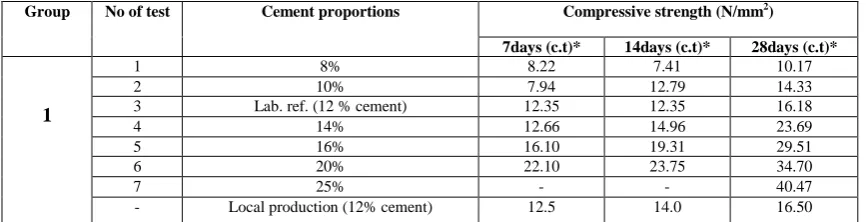
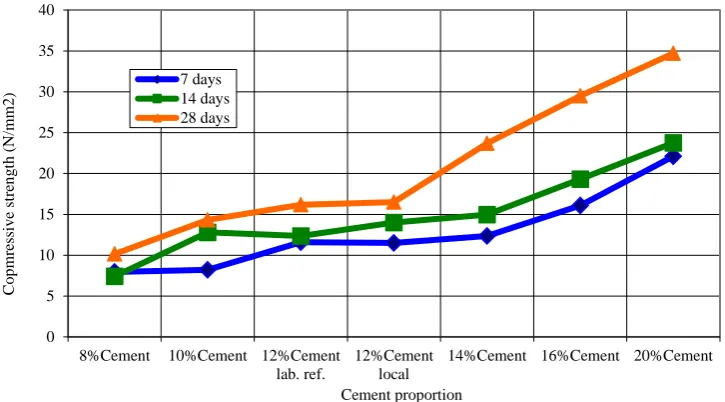
Considering the results shown in the table (1) and figure (1) shows the changes in the compressive strength at different curing periods and at different add proportions of cement, where can be noted the more add cement ratio increased value of strength, where found the cement percentages which gave the best strength even exceeded local product bricks strength are 14%, 16%, 20%, and 25%. But the weaker results of strength were at add 8%, 10%, and 12%, compared with the reference laboratory and local product of bricks. When the strength compared to the reference mixture laboratory which consisting waste aggregate with a mixture of locally produced consisting of natural aggregates, found the local strength of the product is greater than the reference produced in the laboratory (except at 7 days period time), although the proportions of both water and cement are same, and perhaps accrued to several reasons, including the aggregate waste weakest strength than the natural aggregates strength, because the presence of high pores ratio in waste aggregate compared to natural aggregates, in addition to the aggregate of a component residues of different types of materials such as marble, ceramic tile and cement mortar, etc. these materials are weaker than the natural aggregates components, as well as the water absorption of the aggregate waste is greater than natural, because it contains a high percentage of voids this in turn increase in absorption of mixture and this effects on efficiency and completeness of the cement reaction.
Table 1: Illustrates results of compressive strength at increasing or decreasing of cement proportion of reference mixture (according to Libyan
specification for local bricks 12% cement), (waste of aggregate used c.t*: curing time
Compressive strength (N/mmP
2
P
) Cement proportions
No of test Group
28days (c.t)* 14days (c.t)*
7days (c.t)*
10.17 7.41
8.22 %
8 1
1
14.33 12.79
7.94 %
10 2
16.18 12.35
12.35 )
% cement 12
( Lab. ref. 3
23.69 14.96
12.66 %
14 4
29.51 19.31
16.10 %
16 5
34.70 23.75
22.10 %
20 6
40.47
-%
25 7
16.50 14.0
12.5 Local production (12% cement)
-259
Preferably use 14% cement ratio if like to get good-strength bricks and economical quantity of cement, but it must be cure 28 days of time, also if like to get good compressive strength of bricks after one week period time could use cement ratio of 20%.Figure (2) shows the relationship between the proportion of cement additives and the compressive strength, from the shape of curve note the more curing period increased compressive strength, as well as the higher proportion of cement also increased compressive strength and were higher than the local product.
It could be argue the use of demolition waste and construction in the production of cement bricks, which is considered one of the means to disposal of these wastes in order to protect the environment cleanliness and beauty, with its
0 5 10 15 20 25 30 35 40
8%Cement 10%Cement 12%Cement
lab. ref.
12%Cement local
14%Cement 16%Cement 20%Cement
C
o
p
m
re
ss
iv
e
st
re
n
g
th
(
N
/m
m
2
)
Cement proportion
Figure 2 Show the relation ship between cement added and compressivestrength (group 1)
260
investment, exploit it and benefit from it in several engineering applications, but not only that, also the following includes:1. The product is privilege lightweight, because the aggregate waste density is less than the density of natural aggregate.
2. Economically, the costs of cement bricks made from wastes of demolition and construction is less than concrete bricks made from natural materials.
3. Use of these wastes to achieve a clean and beautiful environment.
6.2 Group 2: The change in the percentage of the waste fine aggregate at 12% cement
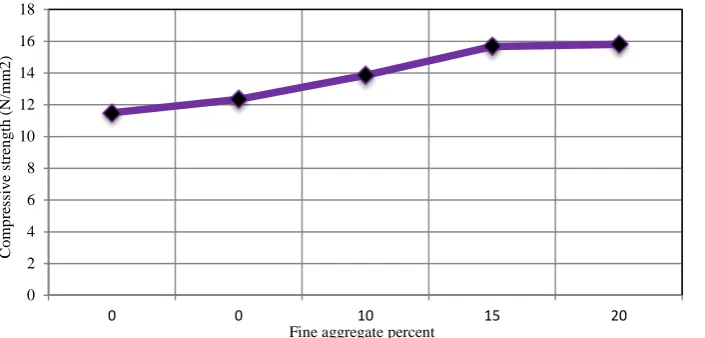
Through results shown in table (2) considering curve (3) which represents the relationship between the increases proportion waste of fine aggregate and compressive strength, note from path of curve the compressive strength is increases with increase fine aggregate, also note all the results are higher than the compressive strength values of both local and laboratory bricks, and also note the value of the compressive strength of laboratory product are exceeded more than the value of the local product at added 12% cement. From figure watched the conduct of curve rises rapidly at addition of 10% to 15% fine aggregate, after that the curve starts in moderation and very slowly between 15% and 20% of added of waste fine aggregate, it is clear from the result values of the compressive strength close to each other. The increase in strength after an increase of waste fine aggregate to the mixture is evidence to presence of big size of voids in the mixture, once add waste fine aggregate fill those voids and then increase density, therefore increases compressive strength, this reason one of properly. And may there are other reason, where the waste of fine aggregate are increase the reaction with cement which is cold (pozolonic reaction) then cause to increase the compressive strength.
(Through the figure, note the first and second percentage on the horizontal line (x-axis) and their values 0% and 0%, they are representing a mix of local and lab mixes of references respectively).
Table 2: Shows the compressive strength results of the second group when increasing portion of waste fine aggregate and decrease of waste coarse aggregate at 12% cement.
Compressive strength (N/mmP
2
P
) curing time (7 days) Waste fine aggregate
Waste course aggregate Test
No. Group
No.
13.85 %
10 %
90 1
2
15.67 %
15 %
85 2
15.80 %
20 %
80 3
12.35 )
% cement 12 ( Lab. ref.
-11.50 Local production (12% cement)
-0 2 4 6 8 10 12 14 16 18
0 0 10 15 20
C
o
m
p
re
ss
iv
e
st
re
n
g
th
(
N
/m
m
2
)
Fine aggregate percent
261
6.3 Group 3: when replace a natural fine aggregate (sand) by waste fine aggregate in the mix, (12% cement, and 7 dayscuring time).
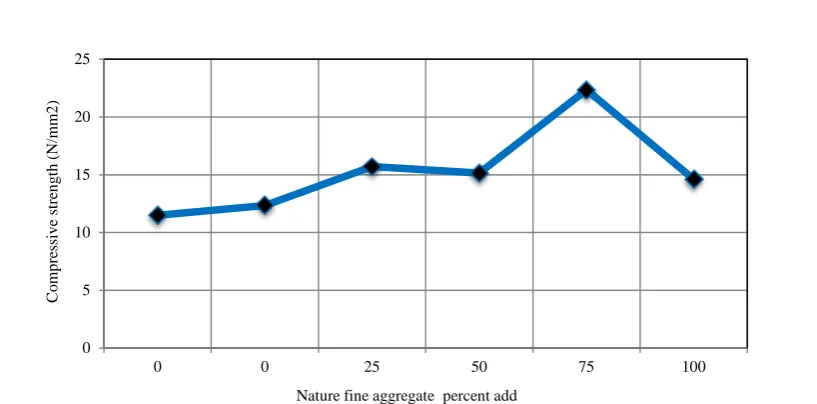
Through the results in the table (3) and from figure (4) note, at add natural fine aggregate (sand) as replacing waste of fine aggregate gave good results of compressive strength and exceeded more than results of the local brick and laboratory bricks references. In fact, when interpreting changes in the compressive strength results after replacing the waste fine aggregate by natural fine aggregate, may probably attributed to three reasons, First: the strength of natural fine aggregate is stronger than the waste fine aggregate, while the second reason: is attributable to the grain size distribution of the components of the mixture were improved. And the third reason: attributed to the high water absorption of the waste fin aggregate more than natural aggregate, and this attributed to surface area of fine aggregate waste where were more begets than natural aggregate and this caused in decrees of compressive strength, and this interpretation may supported by result values in table (3), where the best proportion of addition is 75% of nature aggregate with 25% of fine waste aggregate give best strength, this beyond to the size distribution is optimized for mixture, and when decrease or increase the proportions at 75% the compressive strength is drop.
Table 3 shows the compressive strength results when you add natural sand as alternative waste aggregate (7 days curing).
Compressive strength (N/mmP
2
P
) curing time
(7 days) Proportions of nature
fine aggregate Proportions of waste
fine aggregate Test No.
Group No.
11.5 Local ref.
% 100
-3
12.35 Lab. ref.
% 100
-15.70 %
25 %
75 1
15.15 %
50 %
50 2
22.35 %
75 %
25 3
14.6 %
100 %
0 4
0 5 10 15 20 25
0 0 25 50 75 100
C
o
m
p
re
ss
iv
e
st
re
n
g
th
(
N
/m
m
2
)
Nature fine aggregate percent add
262
6.4 Group 4: When change the water proportions of higher or lower than the proportion of reference mixtures at 7 days curing time.Note, from results contained in table (4), which is represented by the figure (5), the change in the percentage of water in the mixture has a great impact on changing the value of compressive strength resistance, where find the best strength obtained was when add water ratio of 9%, and this ratio is lower than water authorities (9.5%), followed by adding the percentage of 10% which is highest than ratios of water authorities, also note the lowest strength was obtained when adding 8.5% of water, and this lowest value used at less than references percentages. Through these results conclude the cause of obtained the best compressive strength resistance when add water ratio of 9% and 10% respectively, and properly these percentages are optimized for amount cement added in the mix, where the reaction has been completed fully, therefore gave best compressive strength resistance.
Table 4 Shows the results of the stress when the change in the percentage of water in addition to the increases and decreases to the batch reference laboratory at the storage period of 7 days.
Group
No.
Test
No.
Water
proportions
Compressive strength (N/mmP
2
P
)
curing time (7 days)
4
Local ref. 9.5 11.5
Lab. ref. 9.5 12.35
1 10.5 16.50
2 10.5 13.47
3 9.0 17.27
4 8.5 10.65
6.5 Group 5: When add sikament-163 to the batch reference laboratory
When add substance of sikament-163 to reference laboratory mixture at different ratios (0.6%, 1.55% 2.50%), the results of compressive strength recorded in table (5) where has represented by curve of relationship between the percentages of sikament and the values of compressive strength shown figure (6). it is clear from the curve, when add sikament to mixture find the results have exceeded expectations and surprising, especially with the addition of 0.6% to the mixture, where find the strength reached to 18.67 N/mm², then followed by other strength when adding 1.55%, 2.50% sikament, where it reached 16.30 N/mm² and 16.27 N/mm² respectively, and all of these results significantly
0 2 4 6 8 10 12 14 16 18 20
8.5 9 9.5 9.5 10 10.5
C
o
m
p
re
ss
iv
e
st
re
n
g
th
(
N
/m
m
2
)
Water percent
263
higher than the strength of the local brick reference and also higher than the strength of reference product in the laboratory. Through these results conclude, the material of sikament have a great impact on the increase of compressive strength. The increases of compressive strength at added sikament-163 to mixture are may attributed due to reaction of sikament with cement which cause the increase of strength.Table 6: Shows the results of compressive strength at added sikament-163 to the mixture reference (curing period 7 days).
Group
No.
Test
No.
Sikament proportions
Water
proportions
Compressive strength (N/mmP
2
P
)
curing time (7 days)
5
Local ref. 0 9.5 11.5
Lab. ref 0 9.5 12.35
1 .6 8.9 18.67
2 1.55 7.95 16.30
3 2.5 7.0 16.27
Comparing results between different groups, found a beigest compressive strength had been obtained it add 75% of the natural sand to the mix where reaching 22.35 N/mm², followed by strength when adding 0.6% to sikament where is reaching 18.67 N/mm², in third place when adding water by 9% of the mixture where the compressive strength reaching 17.27 N/mm², and these strengths exceeded the strength of the local and laboratory bricks references by amount of one time and a half to double the strength, for a period time of storage of 7 days, and the remaining cement quantity a fixed percentage of 12%.
Absorption ratio results of bricks
Through the results contained in tables (7) and (8), which show the absorption ratio for all groups, noted the less result of absorption rate is at cement ratio of 20%, followed by cement ratio of 25%, and the highest result was at add 10% cement. At comparing the all results with Libyan local specifications, which states the proportion of absorption must
0 2 4 6 8 10 12 14 16 18 20
0 0 0.6 1.55 2.5
Com
pr
es
siv
e s
tr
en
gt
h
(N
/m
m
2)
Sikament proportion
264
not exceed more than 21% of the cement bricks, in this research found the values absorption for all samples were less than the rate of absorption stipulated by the Libyan specifications, namely 21%.Table 7 Illustrate water absorption proportions of cement bricks at different curing time.
Absorption percent Curing time days) ( Proportion of additive Type of additive Spacemen No. 13.81 7 % 8 Cement 1 15.47 14 2 13.27 28 3 17.39 7 % 10 Cement 1 13.44 14 2 13.96 28 3 14.56 7 % 12 Cement 1 12.98 14 2 16.60 28 3 11.71 7 % 14 Cement 1 12.74 14 2 11.35 28 3 12.92 7 % 16 Cement 1 15.59 14 2 13.53 28 3 11.71 7 % 20 Cement 1 12.74 14 2 11.35 28 3 8.35 28 % 25 Cement 1
Table 8 Illustrate water absorption proportions of cement bricks at different type of additives.
Absorption percent Curing time (days) Cement percentage additive proportions
Increment or decrement Type of additive
265
7. Conclusions
1. The results showed, the compressive strength of the cement bricks waste of construction increases with increase period time storage.
2. The results appeared the compressive strength of construction waste bricks increases with increase proportion of cement.
3. The results indicated, the compressive strength is affected by increase or decrease of water ratio in the mixture, as some of them exceeded the compressive strength of local and laboratory reference bricks.
4. The results showed, the compressive strength of the construction waste bricks increase with adding natural sand to the mixture, and the highest strength was obtained when adding 75% sand to the mixture, where the strength exceeded more than the strength of local and laboratory reference bricks.
5. The results illustrated, when reducing the proportion of coarse aggregate of construction waste and increase the fine aggregate waste of construction in the mixture as an alternative (10%, 15%, and 20%, the compressive strength obtained biggest than compressive strength of the local and laboratory bricks references.
6. The results indicated, the compressive strength when add sikament-163 at proportions (0.6%, 1.55%, 2.5%) higher than the compressive strength of the local and laboratory bricks references.
7. The results showed, the absorption values for all samples in all groups were less than the rate of absorption stipulated by the Libyan specifications, namely 21%.
REFRENCES
[1] Fadel Hussain (1996), “Environmental Engineering " Dar AlkotobAlwatania, Omar Almuktar University, Albida City – libya.
[2] Zezhou. W., Honggin. F., and Guiwen. L. (2013) “Forecasting construction and demolition waste using gene expression programming. Journal of computing in civil Eng. 2013.
[3] Jian. C, Shwang. L. and Weiwei. H. (2014) “Urban construction wastes resource utilization inquiry”.ICCREM 2014: 382 – 3888.
[4] Tamraz. S. N., et.al. (2011), “Construction demolition waste management in Lebanon”. ICSDC 2011. Pp. 375 – 383. [5] Jing. Z., et.al. (2013). “Waste based management in residential construction” Journal of construction engineering and
management Apr. 2005, Vo. 131, Vo.4, pp. 423 – 430.
[6] Wei. Z, and Qingmeiwu. (2011) “Development model for construction waste management of Chaina”. ICSDC 2011: 421 – 430.
[7] Samanoh. Z, et. al. (2012). Environnemental impact sassement on construction sites” Construction research congres 2012 : 1750 – 1759.
[8] Ahmed Hamza (2007), caveats and environmental health for the use and recycling of plastic waste, Arab Seminar to rotate the plastic waste, Cairo - Egypt, p (1-4, 12-14).
[9] N. Scarlat and Et. Al., "Evaluation of Energy Potential of Municipal Solid Waste from Africa Urban Areas. Academic Journal of Renewable and Sustainable Energy Review, 50 (2015) 1260-1286.
[10] Holly L. Story, "The Recycling and Reuse of C&D Débris" American National Association of Home Boulders (ANAHB). Université of South Californie, Institute for Public Service and Policy Research. Vol 3 No 3, www.Iopa.Sc. Edu.
[11] United States Environmental Protection Agency (USEPA). (1998a) “Characterization of Building –Related Construction and Demolition Debris in the United States." Office of Solid Waste and Emergency Response, EPA530-R-98-010. 1998.
[12] Abdul Hamid Dign, and others (2004), attended the reasons many material vinyl chloride (PVC), Scientific Meeting on Science and Environmental Technology, Tripoli – Libya.
[13] Pat Costner, 2000, Dioxin Elimination Published by Greenpeace International Amsterdam, the Netherlands.
[14] Bhandere P.S, Lee B.K, and Krishnan K, study of pyrolysis and international of disposable plastics using combined TG/FT_IR Technique, Journal of Thermal Analysis, (1997).
[15] Muthanna Abdul Razzaq Age (2000), Environmental pollution, Dar Weal for publication, first edition, Amman, Jordan.
[16] European Environmental Agency, Environment in European Union at the turn of the century, 1999, .Environmental assessment report No.2.ISBN 92-9157-202-0. Copenhagen.
[17] Giogio F., Mistuya M., Alberto F. (2014); “New sustainable technology for recycling returned concrete”. Construction and Building Materials. Vol. 67, part C, 30 Sep. 2014, pp 363 – 659.
266
[19] Gomes M, De Birto J, and Bravo M (2014) “Mechanical performance of structural concrete with theincorporation of coarse recycled concrete and ceramic aggregate”. J. Materials Civil Eng. 26(10), 04014076(2014).
[20] Adrinola O. S., and et. al., (2014), “Investigating the suitability of previous concrete in improving environmental qualities. Vol. 19 [2014], Bund. H.
[21] Chaojie Yi, et. al. (2013). “The Recovery and utilization of construction waste: waste concrete”. ICCREM 2013: 271 – 279.
[22] Sami W, Akmal S. A. (2009). Influence of recycled concrete aggregate on strength properties of concrete. Construction and building materials. Vol. 23, ISSUE 2, Feb. 2009, pp 1163 – 1167.
[23] Monalisa B. et. al. (2014). “Recycled aggregate from C & D waste and it is use in concrete a bricks rough towards sustainability in construction sector. 15 Oct. 2014, Vol. 68, pp 501 – 516. Construction and building materials.
[24] NwzadAbduljabar Abdulla, (2014); “Effect of Recycled coarse Aggregate Type on concrete”. Journal of materials in civil Engineering. Publication date 30 December 2014.
[25] Inthikab H, and et al. (2014); “Evaluation of the Mechanical performance of Recycled concrete Aggregate Used in Highway base layers”. Geo-Congress 2014, Technical papers: 3686 – 3694.
[26] Nasser Almesfer and Jason Lngham (2014), “Effect of waste Glass on the properties of concrete” J. materials civil Eng. 26(11) 06014022 (2014).
[27] Jared R. W, Chris C, Danfura and Farshad R (2014) “Fresh and hardened properties of concrete incorporating recycled Glass as 100% sand replacement”. J. materials civil Eng. 26(10), 04014073 (2014).
[28] Arulrajah A. and et al., (2014), “Recycled-glass blends in pavement Base/sub-base Applications Laboratory and Field Evaluation”. Journal of materials in civil engineering. July 2014, Vol. 26, No. 7.
[29] Lianyang Zhang, (2013); “Production bricks from waste materials. Construction and building materials. Vol. 47, Oct. 2013, pp. 643 – 656.
[30] Eshmail. G, Ghassan J, and Homayoon S (2015). “Reducing cement contents of paving blocks by using minerals waste and by-product materials”. J. Materials Civil Eng. 27(1), 0401406(2015).
[31] Leonardo F. R. M, and et. al.; (2013), “Use of recycled sand produced at construction sites in bedding mortars”. J. Materials Civil Eng. Feb. 2013, Vol. 25, No. 2, 263 – 242.
[32] Sabat A. K. (2012); “Stabilization of expansive soil uses waste ceramic dust”. EJGE, vol. 71 (2), pp. 3915 - 3926.
[33] Akshaya K. S, and Sub-basis P. (2014); “A review of literature on stabilization of expansive soil using solid wastes”. EJGE, vol. 19 [2014], Bond. V.
[34] James L. H, et. al., (2013), “Compaction characteristics of municipal solid waste”. Journal of Geotechnical and Geo-environmental Eng. Aug. 210, Vol. 136 No. 8, pp. 1095-1102.