HIMMO: A Lightweight Collusion-Resistant
Key Predistribution Scheme
Oscar Garc´ıa-Morch´on1, Domingo G´omez-P´erez2, Jaime Guti´errez2, Ronald Rietman2, Berry Schoenmakers3, and Ludo Tolhuizen1
1 Philips Group Innovation, Research, Eindhoven, The Netherlands
oscar.garcia,ronald.rietman,[email protected] 2 University of Cantabria, Santander, Spain
domingo.gomez,[email protected]
3 Eindhoven Universtiy of Technology, Eindhoven, The Netherlands
Abstract. In this paper we introduce HIMMO as a truly practical and lightweight collusion-resistant key predistribution scheme. The scheme is reminiscent of Blundo et al’s elegant key predistribution scheme, in which the master key is a symmetric bivariate polynomial over a finite field, and a unique common key is defined for every pair of nodes as the evaluation of the polynomial at the finite field elements associated with the nodes. Unlike Blundo et al’s scheme, however, which completely breaks down once the number of colluding nodes exceeds the degree of the polynomial, the new scheme is designed to tolerate any number of colluding nodes.
Key establishment in HIMMO amounts to the evaluation of a single low-degree univariate polynomial involving reasonably sized numbers, thus exhibiting excellent performance even for constrained devices such as 8-bit CPUs, as we demonstrate. On top of this, the scheme is very versatile, as it not only supports implicit authentication of the nodes like any key predistribution scheme, but also supports identity-based key predistribution in a natural and efficient way. The latter property derives from the fact that HIMMO supports long node identifiers at a reasonable cost, allowing outputs of a collision-resistant hash function to be used as node identifiers. Moreover, HIMMO allows for a transparent way to split the master key between multiple parties.
The new scheme is superior to any of the existing alternatives due to the intricate way it combines the use of multiple symmetric bivariate polynomials evaluated over “different” finite rings. We have extensively analyzed the security of HIMMO against two attacks. For these attacks, we have identified the Hiding Information (HI) problem and the Mixing Modular Operations (MMO) problem as the underlying problems. These problems are closely related to some well-defined lattice problems, and therefore the best attacks on HIMMO are dependent on lattice-basis reduction. Based on these connections, we propose concrete values for all relevant parameters, for which we conjecture that the scheme is secure.
1
Introduction
Background Efficient and practical pairwise key establishment is of extreme importance for industrial deployment of large networks of resource-constrained devices, such as wireless sensors. The nodes in these networks are severely lim-ited with respect to computational power, energy, and bandwidth. In this paper we propose an innovative method for pairwise key establishment. We do so by addressing a longstanding open problem regarding the existence of key predis-tribution schemes, as introduced by Matsumoto and Imai [17], which are both highly secure and highly efficient. Here, highly secure means that large collusions of corrupted nodes are tolerated, and highly efficient means that the running time for key establishment takes a fraction of a second only, even for very constrained devices such as 8-bit CPUs, and that the memory footprint is low.
The starting point for our work is Blundo et al.’s elegant key predistribution scheme [5]. Key predistribution schemes allow for the establishment of pairwise keys in a large network of nodes, where each node uses its so-called keying material as secret input [17]. In Blundo et al.’s scheme, a master key consisting of a symmetric bivariate polynomial over a finite field is generated by a trusted party, and each node’s keying material consists of the univariate polynomial obtained as the evaluation of the master key at a field element associated with the node.
Key establishment in Blundo et al.’s scheme is very efficient, as it amounts to the evaluation of a polynomial over a finite field. The scheme is secure against collusions whose size does not exceed the degree of the polynomial. For larger collusions, however, the security of Blundo et al.’s scheme breaks down com-pletely.
The challenge is to find a key predistribution scheme that achieves efficiency comparable to Blundo et al.’s scheme but with much better security, basically tolerating collusions of practically any size. The potential of such an efficient and collusion-resistant scheme is huge, as it enables secure communication in large networks of wireless sensors, for example. Moreover, key predistribution schemes naturally have benefits such as implicit authentication (ruling out man-in-the-middle attacks) and identity-based modes (avoiding the need for public keys).
Related work We motivate our approach by discussing related work covering three alternative approaches to key establishment.
The second approach is to use a simpler one-way function. For instance, [16] proposes a key exchange protocol based on the NTRU one-way function. Basically, two nodes establish a common key by exchanging NTRU encryptions of their private keys, which is computationally efficient. However, several serious drawbacks remain. In the first place, there is no protection against man-in-the-middle attacks as the corresponding public keys of the nodes are not certified. Secondly, the communication complexity of such a key establishment protocol is high, as it involves an exchange of public key encryptions; hence the protocol is too costly for resource-constrained devices. And, finally such a scheme lacks identity-based modes.
The third approach is to actually build a key predistribution scheme. All pairwise keys are determined by a master key, and one gets all the benefits mentioned above. Clearly, the main challenge is to achieve collusion resistance. In the literature there has only been one attempt at constructing an efficient scheme with collusion-resistance against arbitrary collusions [24]. However, the collusion resistance claims turned out to be flawed [2].
Contributions The HIMMO scheme introduced in this paper is the first efficient key predistribution scheme tolerating large collusions of corrupted nodes. Key establishment between two nodes amounts to the evaluation of a single low-degree univariate polynomial for each node. The numbers involved are reasonably sized, allowing for excellent performance even on constrained devices such as 8-bit CPUs. The performance of the scheme is thus comparable to the performance of an NTRU-based scheme, except that HIMMO requires a minimal amount of information exchange only (taking full advantage of the fact that pairwise keys are predetermined). The only information that needs to be exchanged serves to reconcile the keys computed by both nodes, which in general will differ slightly. Allowing a small discrepancy between the keys computed by the respective nodes turns out be an important degree of freedom, giving us just enough leeway to find a successful solution.
Being a key predistribution scheme, HIMMO automatically provides implicit authentication of the nodes, hence protection against man-in-the-middle attacks. Furthermore, the parameters can be set such that key establishment becomes identity-based. Identities may be bit strings of arbitrary length. The identities are simply hashed to a relatively small range of identifiers, for which the trusted party holding the master key may generate key material.
Finally, as a bonus we note that HIMMO is resistant to quantum computing as the cryptanalysis is entirely lattice-based.
Roadmap The paper is organized as follows. In Section 2, we describe key pre-distribution schemes and provide some basic examples. Section 3 introduces the HIMMO scheme, followed by a brief performance analysis in Section 4. In Sec-tion 5, we discuss the security model, describe two attacks, review the HI and MMO problems and security assumptions, also showing connection between the HI and MMO problems and the structure of the keying material and keys. In Section 6, we describe experimental results supporting our security analysis of the HI problem, and present parameters for which we consider HIMMO to be secure. Section 7 details further HIMMO-based schemes. In Section 8, we draw conclusions and indicate directions for further research. In the appendix, we val-idate the HIMMO scheme in that we show that the generated keys indeed are pairwise the same.
2
Key Predistribution Schemes
Key predistribution schemes have been introduced by Matsumoto and Imai [17], generalizing earlier work of Blom [4]. In a key predistribution scheme, a trusted party provides nodes in a system with information enabling any pair of nodes to establish a common key. A key predistribution scheme comprises three com-ponents:
– A setup algorithm, executed by the trusted party, that on input of a security parameterκgenerates system parametersσand secret root keying materialR.
– Akeying material extraction algorithm, executed by the trusted party, which on inputR, σand a node identifierξgenerates secret keying material Gξ.
– Akey establishment protocolapplied by two nodesξandηfor generating a pre-determined keyK(ξ, η), usingξ, η andσas common input, in whichξ andη use their secret keying materialGξ andGη, respectively.
The pre-determined keyK(ξ, η) is the same for all executions of the key estab-lishment protocol, and may depend on which node initiates the key estabestab-lishment protocol, that is,K(ξ, η) andK(η, ξ) need not be equal.
sends a message to the other node involved in the protocol, but no reply is required.
In a very simple key predistribution scheme [17], the secret root keying ma-terialRis a random symmetric function, soR(ξ, η) =R(η, ξ) for all nodesξand η, the keying materialGξ is a table of pairs (η, R(ξ, η)), and as its common key
with node η, node ξusesR(ξ, η) that it obtains from its look-up table. AsR is symmetric, nodeξ andη obtain a common key without interaction. Because of the random choice ofR, no information on the key between nodesξandηcan be obtained from the keys between all other pairs of nodes. For systems involving many nodes, however, the tables get large and it is preferable that Gξ specifies
a function to be applied in the key establishment protocol.
A straightforward and efficient key predistribution scheme was described by Blundo et al. [5] in 1992. In this scheme, which we will call Blundo’s scheme, the trusted party first randomly generates a symmetric bivariate polynomial R(x, y) of degree α in each of the variables with coefficients from Zp, the ring
of integers modulo p. Next, the trusted party provides, in a secure manner, to any node ξin the network the keying materialR(ξ, y)∈Zp[y]. The keyK(ξ, η)
that nodeξuses in order to communicate with nodeηequalsR(ξ, η) (computed modulop). AsR is symmetric, K(ξ, η) = K(η, ξ). Blundo’s scheme is fast and requires little storage. Other advantages are that it allows for any network of size at most p, so that it scales well, e.g., to the Internet, and that nodes can be added to a running network without the need to update already deployed nodes. Blundo’s scheme offers information-theoretic security if at mostαnodes are compromised. However, simple interpolation using the keying material of any α+ 1 nodes allows to retrieve the root keying material [5], thereby compromising the complete system. Also, the keying material of a single nodeξcan be obtained by simple interpolation of the keys of anyα+ 1 colluding nodes with ξ.
3
Description of HIMMO for Key Establishment
In this section, we describe the HIMMO scheme for key establishment. HIMMO has been designed to achieve fast key computation, low bandwidth needs, small memory footprint and low energy consumption. This is the reason why our scheme relies on simple polynomials. In order to achieve collusion resistance, we apply two novel design principles. First, polynomials in different finite rings are mixed to obtain the secret keying material of a device, that is again a simple polynomial. Second, in the key establishment protocol, part of the polynomial evaluation is hidden. Our analysis shows that these two design principles enable an operating and secure scheme.
We use the following notation: for each integerxand positive integerM, we denote byhxiM the unique integery∈ {0,1, . . . , M−1}such thatx≡ymodM.
Following the general description of key predistribution schemes from Sec-tion 2, HIMMO comprises three components.
– B, the bit length of the identifiers to be used in the system – b, the bit length of the generated keys
– α, the degree of polynomials to be used in the system – m≥2
– the public modulusN, an odd integer of length exactly (α+ 1)B+b bits
and the following secret randomly generated root keying material:
– mdistinct random moduli q1, q2, . . . , qm of the form qi =N−2bβi, where
where 0≤βi<2B and at least one ofβ1, . . . , βmis odd.
– for 1≤i≤m and 0≤j ≤k≤α, a random integerR(j,ki) with 0 ≤R(j,ki) ≤
qi−1, and fork < j≤α, R
(i)
j,k=R
(i)
k,j
The keying material extraction algorithm, which computes for each node ξ in the system, with 0 ≤ξ < 2B, the coefficients of the key generating
polynomialGξ:
Gξ(y) = α
X
k=0
Gξ,kyk whereGξ,k=
m
X
i=1 h
α
X
j=0
R(j,ki)ξjiqi
N. (1)
Thekey establishment protocol, in which a nodeξwishing to communi-cate with nodeη with 0≤η <2B, computes
Kξ,η =
hGξ(η)iN
2b (2)
and providesη with the helper datah(ξ, η) defined as
h(ξ, η) =hKξ,ηi2s, wheres=dlog2(4m+ 1)e. (3)
Nodeη obtainsKξ,η as
Kξ,η =hKη,ξ+jNi2b, (4)
wherej is the unique integer such that
|j| ≤2mandjN ≡h(ξ, η)−Kη,ξmod 2s. (5)
The common key K(ξ, η) for nodesξandη is
K(ξ, η) =b2−sK
ξ,ηc. (6)
Due to the mixing of modular operations,hGξ(η)iN andhGη(ξ)iN can differ
much from each other. The judicious combination of the system parameters, however, implies that theblast bits of these evaluations, that is,Kξ,η andKη,ξ,
although not necessarily equal, are close to each other. As shown in Theorem 1 in the appendix, if 0≤ξ, η≤2B, then
Node η can compute Kη,ξ and use Equation (7) to determine a candidate set
C of 4m+ 1 keys that containsKξ,η. In some use cases, η can obtainKξ,η by
decrypting messages encrypted with Kξ,η with all keys from C, and discarding
keys that yield invalid messages. In these cases, no helper data needs to be sent and theb-bits keyKξ,η can be used as common key betweenξ andη.
If discarding keys is infeasible, the helper data h(ξ, η) assists η to determine Kξ,η. As h(ξ, η) reveals thesleast significant bits ofKξ,η, only theb−smost
significant bitsKξ,η, that is, the numberb2−sKξ,ηc, are used as common key. In
order to not reduce the key length too much, s, and thusm, should not be too large; in particular,b should be larger thans.
We now show that application of Equations (4) and (5) indeed results inKξ,η.
Let 0 ≤ξ, η ≤2B. According to Equation (7), there is an integer j such that |j| ≤ 2m and Kξ,η ≡Kη,ξ+jNmod 2b. Ass ≤b and Kξ,η ≡h(ξ, η) mod 2s,
it follows that jN ≡h(ξ, η)−Kη,ξmod 2s, so nodeη can compute hjNi2s. As
N and 2sare relatively prime, nodeη thus can computehji
2s. Asjis in the set
{−2m,−2m+ 1, . . . ,2m}which contains 4m+ 1≤2sconsecutive integers, node
η can obtainj fromhji2s.
4
HIMMO Performance
HIMMO has been designed keeping in mind that it has to enable very efficient performance. From Equation (2) we observe that obtaining a symmetric key just requires the evaluation of a polynomial of degreeα moduloN and taking thebleast significant bits. This means that onlyα+ 1 modular multiplications are required to compute the key. In each multiplication, the B bit identifier multiplies the (α+ 1)B+b bit coefficient and the result is reduced moduloN. These modular operations can be implemented in a very efficient manner for appropriate choices forN, e.g. forN = 2(α+1)B+b−1.
in the Intel is in plain C. Finally, note that the tables include a row specifying the lattice dimension required in the identify attack to the HI problem that is further explained in Sections 5.3 and 6.2.
Table 1.HIMMO performance forB=b= 128 as a function ofα.
α
26 34 40 50
Keying material size (KB) 6.90 11.18 15.07 22.83
Lattice dimension 405 665 902 1377
ATMEGA128L (8-bit @ 8 MHz) 223 367 497 743 CPU time (msec) NXP LPC1769 (32-bit @ 120 MHz) 7.46 11.82 15.74 23.48
Intel i3 3120M (64-bit @ 2.5 GHz) 0.034 0.053 0.069 0.103
Table 2.HIMMO performance forα= 26 as a function ofb=B.
b=B
64 128 192 256
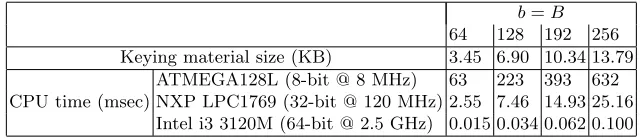
Keying material size (KB) 3.45 6.90 10.34 13.79 ATMEGA128L (8-bit @ 8 MHz) 63 223 393 632 CPU time (msec) NXP LPC1769 (32-bit @ 120 MHz) 2.55 7.46 14.93 25.16
Intel i3 3120M (64-bit @ 2.5 GHz) 0.015 0.034 0.062 0.100
5
Security Model, Assumptions, and Analysis
5.1 Security Model
We formalize the notion of collusion resistance, namely that an attacker who has obtained the keying materials of any number of different identifiers should not be able to calculate the key of a pair of uncompromised identifiers.
We consider a security model that is a game between a challenger and an adversary. The challenger has full knowledge of the key predistribution scheme and all secret parameters that the trusted party used in setting it up; the adver-sary only knows the public parameters of the system. The adveradver-sary can present queries to the challenger. In a query, the adversary randomly picks a valid iden-tifierζ and the challenger responds with the keying materialGζ.
After presenting c queries and receiving the corresponding responses, the ad-versary chooses a pair of identifiers (ξ, η), guesses the key Kξ,η, and presents
these results to the challenger, who checks if the key guess for the pair (ξ, η) was correct. The adversary wins if and only if the following holds:
1. neitherξnorη was used as the input to any query; 2. the adversary guessed the keyKξ,η correctly.
These conditions are similar to the winning condition in the computational COMP-SK security model which is used in the security analysis of ID-NIKE in [20].
5.2 The HI and MMO Problems
We present the two mathematical interpolation problems upon which the HIMMO system is built. The first of these problems is the Hiding Information problem.
Problem 1 (Hiding Information (HI) problem).
Let f ∈ Z[x] be of degree at most α, and let xi ∈Z and yi =hhf(xi)iNir for
0≤i≤c.
HI problem: givenα,N,r, (x1, y1), . . . ,(xc, yc), andx0, findy0.
This problem was studied in [18], where it was shown to be equivalent to a lattice problem in dimensionα+ 1 +c, and thatcmust be large enough for the solution y0 to be unique. For the instances of the HI problem that pertain to the HIMMO system, the resulting lattice dimension and structure are such that the known techniques for finding y0 fail to give the correct answer forα&20. A more detailed exposition is given in Section 6.
The second interpolation problem deals with interpolation of a function that is the sum of multiple polynomials, each evaluated modulo a different number. We distinguish two versions of this problem, depending on whether the moduli are given or unknown.
Problem 2 (Mixing Modular Operations (MMO) Problems).
Let m ≥ 2, g1, . . . , gm ∈ Z[x], all of degree at most α, and let xi ∈ Z and yi =P
m
j=1hgj(xi)iqj, for 0≤i≤c.
MMO problem with known moduli: givenα,m,q1, . . . , qm, (x1, y1), . . . ,(xc, yc),
andx0, findy0.
In [12], it was shown that the MMO problem with known moduli and c colluding nodes can be reduced to finding a vector in a lattice with dimension m(α+ 1 +c), and thatc must be at least m(α+ 1) to find a unique solution. Thus the adversary has to solve a lattice problem in a lattice of dimension at leastm(m+ 1)(α+ 1), which quickly becomes infeasible ifm grows.
Setting up the lattice requires knowledge of the secret moduli q1, . . . , qm.
When the moduli are unknown, there appears to be no efficient way to recon-struct them from anyc observations. For these reasons, we consider solving the MMO problem to be infeasible.
5.3 Security Analysis
In this section, we analyse two strategies that an adversary playing the game described in Section 5.1 can use to find Kξ,η from the keying materialsGζi(y),
1 ≤i ≤c. These two types of attack are in line with related security models used in other key predistribution schemes such as Matsumoto and Imai [17] and attacks on Blundo’s scheme and Zhang’s scheme.
The first strategy to calculateKξ,ηis to calculateGξfrom the keying
materi-alsGζi, and then to use Equation (2). Turning to the definition of theGζi(y) in
terms of the root keying material, see Equation (1), we see that finding the coeffi-cientGξ,kof the polynomialGξ(y) from the coefficientsGζi,kof the polynomials
Gζi(y) amounts to solving an instance of the MMO problem with unknown
mod-uli, which we consider infeasible. In fact, the adversary has to solve a somewhat more complex problem, because the definition of the keying material coefficients in Equation (1) has an additional modN operation.
In the second strategy, which avoids determining the moduli, the adversary evaluateshGζi(ξ)iN, and takes thebleast significant bits thereof, the keyKζi,ξ.
This key is used as an approximation to Kξ,ζi. FindingKξ,η from the setKξ,ζi
amounts to solving the HI problem with r = 2b. For such a low value of r,
compared to N, solving the HI problem is infeasible ifαis large enough. Usingr >2b, e.g., the whole output ofhG
ζi(ξ)iN, in the HI problem to find
Kξ,η is not feasible since Gξ(ζi)and Gζi(ξ) only show symmetry in the b least
significant bits. The (α+1)Bmost significant bits are related through the moduli qi.
To show this, from Lemma 1 in the appendix,hGξ(η)iN is the sum of three
terms. The first term is invariant under the exchange of ξ and η, the second term is a small multiple of N and the third a multiple of 2b. We consider the
effect of the last term in the difference between hGξ(η)iN and hGη(ξ)iN, i.e.,
(µη(ξ)−µξ(η))2b, where according to Lemma 1,
µξ(η) = m
X
i=1 βi
jAi(ξ, η) qi
k ,
withAi(ξ, η) = α
X
k=0
R(ki)(ξ)
qiη
k, andR(i)
k (ξ) = α
X
Although eachR(i)is symmetric, the functionA
i(ξ, η) is not, asR
(i)
k is evaluated
moduloqi, while the evaluation ofAiinηis performed over the integers (as is the
summation and multiplication with theβi’s). Ifηis large, thenAi(ξ, η) influences
all bits, including the highest order bits; if theβi0sare large,µξ(η) affects all bits,
including the highest order bits. Indeed, assume that the coefficients ofAi(ξ, η),
i.e., the integersR(ki)(ξ)qi are uniformly distributed in{0,1, . . . , qi−1} then
the expected value of Ai(ξ, η) equals 12qiP α k=0η
k ≈ 1
2qiη
α. We further assume
that eachβi is uniformly chosen from the integers in [0,2B). Then the expected
value ofµξ(η) ism2B−2ηα. Hence, if we take
η >2B(2/m)1/α, (8)
then we expect that 2bµ
ξ(η) is larger than 2bm2B−2ηα >2(α+1)B+b−1, so that
2bµ
ξ(η) affects all bits ofhGξ(η)iN. Since the µξ(η) and µη(ξ) are affected by
the mixing of modular operations, we conjecture that with identifiersηsatisfying Equation (8), no information on the (α+ 1)B most significant bits ofhGξ(η)iN
can be obtained fromhGη(ξ)iN.
The requirement onηexpressed in Equation (8) reduces the number of identi-fiers that we can use from 2B to 2B 1−(2/m)1/α
. In other words, the “effective bit length” of the identifiers is reduced by
−log2 1−(2/m)1/α
bits. For rea-sonable parameters, this is not a very big number, e.g., form= 10 andα= 26, the loss is just over four bits in the identifier space.
6
Experimental Results and HIMMO Parameters
This section describes experiments and provides further background supporting the results in Section 5.3. We also propose specific configuration parameters for which we believe HIMMO to be secure based on these experimental results.
6.1 Experimental Results in the Structure of hGξ(η)iN
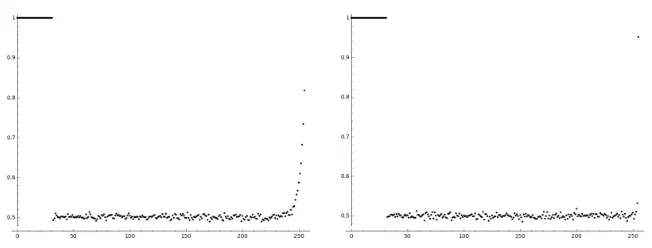
In Figure 1 we show experimental evidence for the claim that the (α+ 1)B most significant bits ofhGξ(η)iN andhGη(ξ)iN are uncorrelated if the identifier
interval is restricted according to Equation (8).
Note that this property does not appear to hold for a few most significant bits, which are equal with probability significantly above 0.5. This is because in our simulations some coefficients or identifiers might be slightly smaller so that the effect of the mixing of modular operations does not propagate to the very most significant bits. These few bits may thus be used in an attack as well if a way to find correlations between them is figured out. Currently, this remains an open problem. Effectively, the attacker would then solve a HI problem with a somewhat larger value of r, say r = 2b+δb, which is still much smaller than
Fig. 1.The probability that thei-th bit ofhGξ(η)iN equals thei-th bit of hGη(ξ)iN whenKξ,η=Kη,ξas a function ofiin a HIMMO system withα= 6,b=B= 32 and
m= 5. In the plot on the left, ξ andη are averaged over the interval [0,2B), in the plot on the rightξandηare averaged over the interval [2B(2/m)(1/α),2B).
6.2 HIMMO and the HI Problem
Minimum Value of c: The HI problem is analyzed in [18]. It is shown that the HI problem is equivalent to anoisy polynomial interpolation problem, which in turn is shown to be related to an approximation problem in a certain lattice of dimension α+ 1 +c. The approximation problem is to find a lattice vector that lies close enough, in infinity norm, to a target vector, i.e., it is a relaxed version of the well-known closest vector problem. It is shown that there are many lattice vectors that solve the approximation problem, each of these vectors gives an estimate fory0.
It is also shown that because of the structure of this lattice, there is a cross-over valuecmin, which depends on the distribution of thexi, such that whenc < cmin
the lattice vectors that solve the close vector problem give rise to many different estimates fory0, whereas for c > cmin, all solutions to the close vector problem give rise to one, or at most a few different estimates fory0.
The valuecminis found as the zero of the functionS, defined as
S(c) = log 2b+1
√ c
+ 1
2(c−α−1) α
X
i=1
log((α+ 1 +i)!)−log(i!)
−log
c α+ 1
−α(α+ 1) log(L)
, (9)
where we correct an error in the result from [18] and adapt their notation to the one used in this paper.
In the derivation of this formula, it is assumed that thecpointsxi are uniformly
chosen from an interval of lengthL. Numerical experiments in [18] confirm the validity of using this indicator. When B =b andL= 2B, an approximation to
For a moderately large value of α = 40 the attacker must solve a lattice problem in about 900 dimensions, which lies above the upper limit for practical lattice reduction algorithms. We point out that the record in the Ideal Lattice Challenge is in dimension 825, see [8]. Increasing α makes this lattice attack even more infeasible. In fact, our experiments described further below show that forb=B = 32 and α >27 the approximate methods for finding a close lattice vector fail.
The above analysis holds when the identifiers are uniformly distributed in [0,2B). When the attacker can choose the identifiers x1, . . . , xc, then he can
pick them from a smaller interval containing the identifierx0of the node under attack, improving his chances to attack the system. For instance, in the previous case withα= 40,b=B = 32 andL= 256, the indicator function is positive for c≥120. Simulations confirm this lower bound for a successful attack.
In a practical deployment of HIMMO such a small L attack can be prevented by making it infeasible for the adversary to choose thexi freely, e.g., by letting
the HIMMO identifierxi be a secureB-bit hash of a node’s identity.
Table 3. The value cmin for B = b as a function of α and b and compared with
f(α) := (α+ 1)(α+ 2)/2.
b
α f(α) 8 16 32 64 128 16 153 122 142 148 151 152 20 231 178 212 223 228 230 24 325 243 297 313 320 323 28 435 317 396 419 428 432 32 561 398 508 539 551 556 36 703 487 635 675 690 697 40 861 582 775 825 845 853
break down when the lattice dimension becomes too large. This is investigated experimentally for the lattices we encounter in solving the HI problem.
We first choose a value for b, the number of key bits, B, the number of ID bits, and α, the polynomial degree. We then choose a random odd integer N in the interval (2(α+1)B+b−1,2(α+1)B+b) and α+ 1 random integer
polyno-mial coefficients f0, . . . , fα from [0, N). With these coefficients we construct a
polynomial f(x) = Pα
j=0fjxj. We choose a number c and pick c+ 1
differ-ent numbers x0, x1, . . . , xc from the interval [0,2B) and calculate the numbers
yi =hhf(xi)iNi2b, 0≤i≤c. The numbersα, b, B, N, x0 and thec pairs (xi, yi)
for 1≤i≤c are input to the reconstruction algorithm. The algorithm outputs an estimate ˆy0 for y0. This is the same set-up that we used for the HIMMO challenges [14].
In the remainder of this section we report on our findings in solving our challenges. We chooseb=B= 32 for all challenges.
The main part of the algorithm is the generation of a set of integer coefficients g0, . . . , gα in [0, N) and the corresponding polynomial g(x) = Pαj=0gjxj. The
aim is to findg(x) such thathhg(xi)iNi2b=yi for 1≤i≤c. The estimate ˆy0 is
then output as ˆy0=hhg(x0)iNi2b. The algorithm for obtaining the coefficientsgj,
makes use of the equivalence of this reconstruction problem to a lattice problem, as described in [18].
It is rare to find a perfect fit in all points xi, 1 ≤ i ≤ c. Define ei =
hhN−1i
2b(hhg(xi)iNi2b−yi)i2b and
εi=
(
ei if 0≤ei<2b−1
ei−2b if 2b−1≤ei<2b
.
The absolute value |εi| is a measure for the quality of the fit in the point xi.
Since small errors in the fit can have a huge influence on the interpolation error in x0, we define
`i=12log2(1 +ε2i) (10)
for use in plots.
The lattice is spanned by the rows of the block matrix
L=
2bNIcused 0 2bV Iα+1
,
whereIcusedandIα+1denote unit matrices of sizecused×cusedand (α+1)×(α+1) respectively, and V denotes the (α+ 1)×cused Vandermonde matrix with ele-ments Vi,j =xiu(j), 0 ≤i ≤α, 1 ≤j ≤cused. The problem is to find a lattice
vector that lies inside a hypercube of edge length N around a target vector t that is constructed with the valuesyu(j), 1≤j≤cused.
This is a relaxed version of the Closest Vector Problem, and we use the em-bedding technique [15] for finding such a close vector. The emem-bedding technique works as follows. First, the matrix L is extended by a column of zeros on the right. Then the matrix is extended by a row on the bottom. The firstα+1+cused elements of this row (the ones belowL) form the vector−t, for the last element (below the column of zeros added in the first step) we take (N −1)/2, which is a reasonable guess for the distance between the lattice defined byL and the target vector. The resulting matrix is interpreted as the basis of aα+ 2 +cused -dimensional lattice. The next step is to find a reduced basis for this lattice, and, in this basis, find the basis vector of which the last component is equal to (N−1)/2. The firstα+ 1 +cusedcomponents of this basis vector are then added tot, which results in the lattice approximation tot.
The coefficients gj are obtained from the corresponding components of the
resulting lattice vector. We refer to [18] for details.
Results using LLL The first algorithm we use for finding a reduced lattice basis is the LLL [19] wrapper, as implemented in the fpLLL library [1] that is included in Sage [21], version 6.6. We always use the default parametersδ= 0.99, η= 0.501.
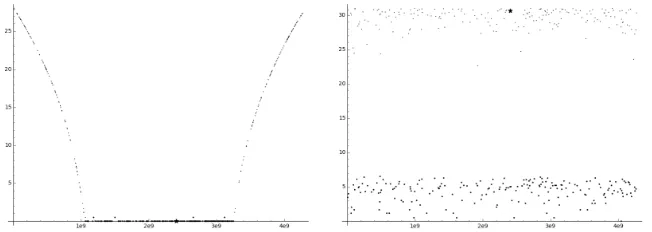
The results for an instance of the HI problem forα= 16 are shown in Fig. 2. The left-hand graph shows the errors when the used points are chosen according to strategy A. The fit in the used points is almost perfect, and the correct value of y0is found. The extrapolation error increases for the unused points further away from the central zone. The right-hand graph shows the errors when the used points are chosen according to strategy B. Here both the fit and extrapolation are almost perfect for all points, and the correct value ofy0is recovered.
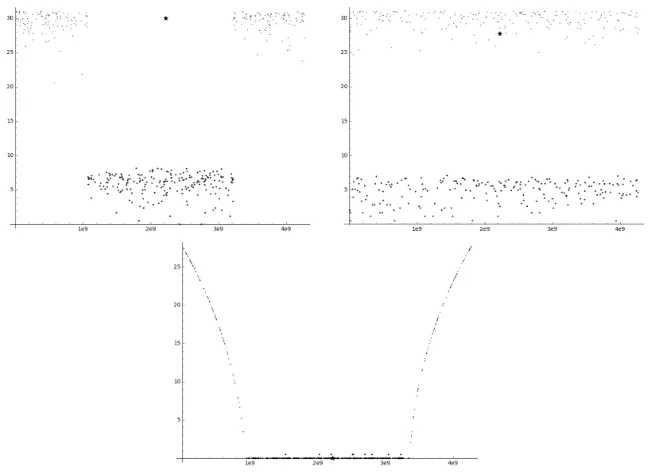
Fig. 3 shows the results for an instance of the HI problem withα= 18. The interpolation with used points chosen according to strategy A is again good, but for strategy B, LLL doesn’t even give a correct fit in the used points and then fails to interpolate correctly in the unused points. This is consistent with the expectation that strategy A should give a better interpolation.
Fig. 2.Plots of the points (xi, `i) where`iis defined in Eq.(10). The points that are used in the reconstruction algorithm are denotes by big dots, the ones that are not used by small dots and (x0, `0) is denoted by a star. For these plots,α= 16, c= 306,
and we used 153 points for the reconstruction. In the graph on the left, the used points were chosen according to strategy A, in the graph on the right according to strategy B.
Fig. 3.Plots of the points (xi, `i) where`iis defined in Eq.(10). The points that are used in the reconstruction algorithm are denotes by big dots, the ones that are not used by small dots and (x0, `0) is denoted by a star. For these plots,α= 18, c= 380,
The largest value ofαfor which we were able to recover the correcty0 using c/2 + 20 points and LLL as the lattice reduction algorithm, is α= 20. Taking even more points doesn’t appear to help. An example for α= 25 is shown in Fig. 5.
Fig. 4.Plots of the points (xi, `i) where`iis defined in Eq.(10). The points that are used in the reconstruction algorithm are denotes by big dots, the ones that are not used by small dots and (x0, `0) is denoted by a star. For these plots,α= 19, c= 420.
In the graphs in the top row we used 210 points for the reconstruction. In the graph on the left, the used points were chosen according to strategy A, in the graph on the right according to strategy B. In the graph on the bottom row we used 230 points according to strategy A.
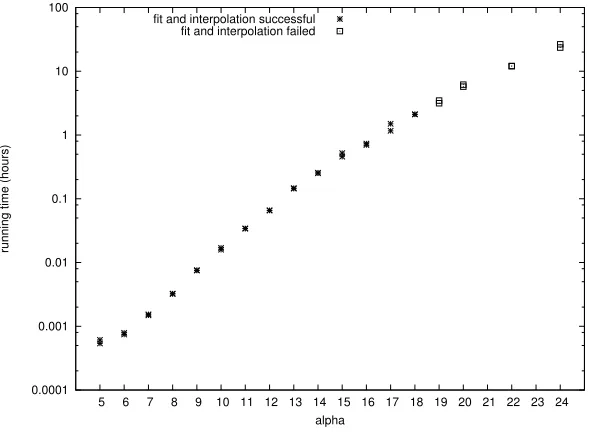
Fig 6 shows the times needed for solving a couple of instances of the HI problem using strategy A with c/2 points, the embedding method and LLL, running in Sage on a 3.0 GHz Intel Xeon.
Fig. 5.Plots of the points (xi, `i) where`iis defined in Eq.(10). The points that are used in the reconstruction algorithm are denotes by big dots, the ones that are not used by small dots and (x0, `0) is denoted by a star. The plots show the results of applying
LLL and strategy A on an instance of the HI problem withα= 25, c= 704. In the graph on the left,cused= 372, in the graph on the rightcused= 528.
0.0001 0.001 0.01 0.1 1 10 100
5 6 7 8 9 10 11 12 13 14 15 16 17 18 19 20 21 22 23 24
running time (hours)
alpha fit and interpolation successful
fit and interpolation failed
to a value that is too small, BKZ fails with the error message’infinite loop in babai’. To avoid this error in the basis reduction of our lattice, the precision must be set to a value not much smaller than (α+ 2)b bits, the number of bits of N. This is not surprising, as the largest numbers that appear in the basis matrix are about N times as large as the smallest number in the same column. Typically, the LLL wrapper, which is called as a preconditioning step from the BKZ routine, uses a similarly sized precision parameter in its final, successful, run.
The block size determines the quality of the lattice reduction; a block size value of 2 is equivalent to LLL, larger block sizes lead to a better reduced ba-sis, but it is a priori unclear what blocksize is needed to solve our interpolation problem, as the worst-case error bounds for these algorithms are quite conserva-tive and the algorithms typically behave much better than the worst-case error bounds would suggest.
In Fig. 7 we show the results for an instance of a HI problem withα= 24, using 325 points according to strategy A. For this instance, the block size must be increased to 16 in order to obtain a good interpolation.
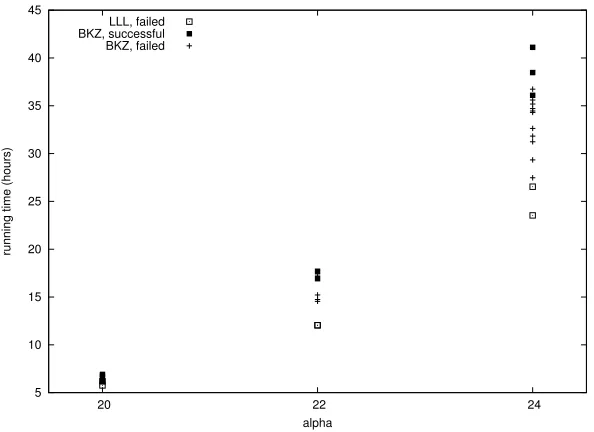
The timing results for a number of BKZ runs are given in Fig. 8.
The largest instance we have been able to solve so far using this method has α= 27, with c = 812, using c/2 + 20 points according to strategy A, and the BKZ algorithm with 928 bits precision and block size 18. It ran for 303 hours. The reason that we did not result in breaking even larger instances is not lack of patience, but most probably a problem with the BKZ implementation: for larger instances whenαgrows, it appears that a block size value of at least 20 is needed, but then the BKZ routine appears to end up in an infinite loop, without outputting any log messages, probably because of a subtle bug triggered by the block size and the large precision parameter. The above also seems to indicate that BKZ performance decreases when αincreases due to the higher block size that is required.
6.3 HIMMO Security Parameters
For security reasons, the HIMMO parameters advantageously have the following characteristics:
– a large value ofb so that keys cannot be guessed by brute-force.
– a large valueαso that attacking a keying materialGξ(y) requires solving a
lattice of big dimension.
– keeping theqi’s secret and optionally taking a relatively high value ofm to
ensure that attacking the root keying materialR(i)(x, y) involves solving a lattice of big dimension.
LLL BKZ-4
BKZ-6 BKZ-8
BKZ-10 BKZ-12
BKZ-14 BKZ-16
Fig. 7.Plots of the points (xi, `i) where`iis defined in Eq.(10). The points that are used in the reconstruction algorithm are denotes by big dots, the ones that are not used by small dots and (x0, `0) is denoted by a star. The plots show the results of
applying LLL and strategy A on an instance of the HI problem withα= 24,c= 650,
cused = 325. In the top left graph, the LLL wrapper algorithm was used, in the other
5 10 15 20 25 30 35 40 45
20 22 24
running time (hours)
alpha LLL, failed
BKZ, successful BKZ, failed
Fig. 8.Running times for solving two instances of a HI problem using (α+ 1)(α+ 2)/2 points according to strategy A, embedding and either fpLLL-wrapper or BKZ with various block sizes (4,6,8, . . .). For the instances withα= 20, block size 4 was sufficient to retrieve the correct answer, forα= 22 both instances required block size 8 and for
been compromised. As the highest dimensional lattice successfully attacked so far was on a lattice of dimension 455 (forα= 27), we feel this parameter choice is quite conservative. Attacking HIMMO through the MMO problem is hopeless since theqi’s are secret, and even if they were known, an attacker would have to
deal with a lattice of dimension 5610. Finding a key by means of a brute force attack is not feasible either due to the chosen key length.
As described in the next section, HIMMO enables practical applications that require mapping a bit-string of arbitrary length to aBbit identifier. In this case, B should be equal the output size of a collision-free hash function. In order that birthday attacks on the hash function and brute force attacks on the key have approximately equal complexity, we choose B = 2b. For such applications, the authors thus consider the following set of parameters to lead to a complexity -theoretic secure HIMMO instance:b= 80, B= 160, α= 50 andm= 10.
7
Practical Protocols and Schemes Enabled by HIMMO
HIMMO’s collusion resistance and excellent performance provides us with a new primitive to enable very practical security protocols. Building on HIMMO’s pairwise key agreement, any pair of devices in a network of any size can securely communicate with each other. With HIMMO, the system remains flexible since nodes can be added to a running network without the need to update already deployed nodes.
We now describe a simple protocol that allows a nodeξ to directly send a messageM to nodeη without incurring any round trip delays. Nodeξcomputes its keyKξ,η, the helper datah(Kξ,η) and the common keyK(ξ, η) as explained
Section 3. It protects M by using K(ξ, η) and some authenticated encryption algorithme, and sends to nodeηthe helper datah(Kξ,η) and the encrypted
mes-sageE=e(M, K(ξ, η)). Upon reception, nodeη computesKη,ξ and combines it
with the helper datah(Kξ,η) to obtainK(ξ, η), as explained in Section 3. Node
ηsubsequently obtainsM by by decrypting and verifying the authenticity of the received messageE.
The fact that the HIMMO scheme can efficiently use longB-bit identifiers allows us to design further identity-based protocols providing more functionality. These protocols are built by mapping an input bit string of arbitrary length to a B-bit HIMMO identifier by means of a collision resistant hash functionH. For instance, we can enable implicit certification and verification of creden-tialsbetween any pair of entities, as follows.
that Credentials(Ξ) are linked to the secret keying material by means ofH(·) and the keying material extraction algorithm.
In the operational phase, two devices can execute a protocol that allows not only for direct secure communication of a message M but also for implicit cer-tification and verification of the credentials of the sender Ξ because the key generating polynomial assigned to a node is linked to its credentials by means of H. The protocol builds on the protocol for direct secure sending of a message as described above. In fact, nodeΞ with HIMMO identityξuses the above proto-col to send to the node with HIMMO identityη the message M0 defined as the concatenation of ξ, M andCredentials(Ξ). Afterη has obtainedM0, it verifies the credentials ofΞ by checking whetherξ=H(Credentials(Ξ)).
If the output size ofH(·) is long enough, e.g., 256 bits, and equal toB, then it is infeasible for an attacker to find any other set of credentials leading to the same outputξ. The fact that credential verification might be prone to birthday attacks motivates the choice B= 2b for the relation between identifier and key sizes in the HIMMO scheme. In this way, the scheme provides an equivalent security level for credential verification and key generation. The capability for credential verification enables applications such as the verification of the expiration date of the credentials (and the keying material) of a node, the verification of the access roles of the sender nodeξ encoded in its credentials, or the capability of using any bit-string as the identity of the nodes.
The previous protocols have thekey escrow capabilitysince the trusted party keeps the secret root keying material that allows for the generation of any key in the system. In some settings, we would like to have this capability shared between several trusted partiesto enhance the security of the sys-tem. HIMMO supports such an extension supporting `different trusted parties in the following way. The setup algorithm consists of two steps: in a first step, parameters (b, B, m, α, N) are centrally determined and published; in a second step, for 1≤j ≤`, trusted partyjindependently generatesmsecretqj,iand the
corresponding m secret symmetric bivariate polynomials R(j,i)(x, y) over Zqj,i.
In the keying material extraction phase, each nodeξsecurely receives from each of the ` trusted parties a key generating polynomial G(ξj)(y) ∈ ZN[y]. Node η
computes the coefficients of its final key generating polynomial Gξ by adding
the corresponding coefficients of G(1)ξ , . . . , G(ξ`), so
Gξ(y) =
`
X
j=1
G(ξj)(y)
N. (11)
Key generation in the key establishment protocol is done as in HIMMO. Note that the scheme operates exactly as a scheme with a single trusted party which generates them·`root keying material polynomialsR(j,i)(x, y)∈
Zqj,i[x, y] for
1≤i≤m,1≤j ≤`. Clearly, if ` >1, a single trusted party cannot determine the key generating polynomial of individual nodes.
has been configured with their HIMMO identities and their secret key generating polynomials. The TTP wishes then to securely (in the sense of source authen-tication) send a broadcast message M to all devices. The TTP then computes the hash of M as µ=H(M) and obtains a key generating polynomial Gµ
as-sociated to µ. Next the TTP broadcasts{M, Gµ} where Gµ is playing the role
of a signature. When device η receives {M0, Gµ0}, it obtains µ0 =H(M0) and verifies the validity of the message by checking whetherKη,µ0 andKµ0,η satisfy Equation (7). A similar protocol is described in [23] although the underlying security primitive is now broken [2].
HIMMO can also be extended to allow fort-key agreement, i.e., key agree-ment in a group of t devices if the TTP uses polynomials in t variables and distributes a key generating polynomial in t−1 variables to the nodes. Note that in this case the HIMMO parameters need to be adapted to introduce the HI and MMO problem in the correct parts of the keys and coefficients of the key generating polynomial.
8
Conclusions
We have put forth a completely new approach to key predistribution schemes, avoiding the use of any costly one-way functions (and pairings) in a discrete log setting. Rather, we have used an approach remotely akin to NTRU, involving an intricate combination of polynomials evaluated over different “finite rings.” We believe that this approach is of high potential and may spark further research into related primitives.
The performance of the HIMMO key agreement protocol is very competitive, allowing for lightweight implementations needed for applications such as wireless sensor networks and the Internet of Things. We have also shown that the best (collusion) attacks currently known are based on lattice-basis reduction, and that these attacks are bound to fail for the proposed parameter selection using state-of-the-art algorithms, viz. the BKZ algorithm as implemented in thefpLLL library. Future work may address the use of more accurate algorithms in the attack, e.g., BKZ-2.0 [7] with large block sizes and aggressive pruning.
References
1. M. Albrecht, D. Cad´e, X. Pujol, and D. Stehl´e. fplll-4.0, a floating-point LLL implementation. Available athttp://perso.ens-lyon.fr/damien.stehle. 2. Martin Albrecht, Craig Gentry, Shai Halevi, and Jonathan Katz. Attacking
Cryp-tographic Schemes Based on ”Perturbation Polynomials”. In CCS09, Proc. 16th ACM Conference on computer and communications security, pages 1–10. ACM, 2009.
4. R. Blom. An optimal class of symmetric key generation systems. In T. Beth, N. Cot, and I. Ingemarsson, editors, EUROCRYPT ’84, LNCS 209, pages 335– 338. Springer, 1985.
5. C. Blundo, A. de Santis, A.Herzberg, S. Kutten, U. Vaccaro, and M. Yung. Per-fectly secure key distribution for dynamic conferences.Information and Computa-tion, 146:1–23, 1998.
6. Dan Boneh and Brent Waters. Constrained pseudorandom functions and their ap-plications. InAdvances in Cryptology-ASIACRYPT 2013, pages 280–300. Springer, 2013.
7. Yuanmi Chen and Phong Q. Nguyen. BKZ 2.0: Better Lattice Security Estimates. In Advances in Cryptology ASIACRYPT 2011, volume Volume 7073 of Lecture Notes in Computer Science, pages 1–20, 2011. http://www.iacr.org/archive/ asiacrypt2011/70730001/70730001.pdf.
8. TU Darmstadt. Welcome to the ideal lattice challenge. Web repository, 2014.
http://www.latticechallenge.org.
9. R´egis Dupont and Andreas Enge. Provably secure non-interactive key distribution based on pairings. Discrete Applied Mathematics, 154(2):270–276, 2006.
10. Eduarda S.V. Freire, Dennis Hofheinz, Eike Kiltz, and Kenneth G. Paterson. Non-interactive key exchange. In Kaoru Kurosawa and Goichiro Hanaoka, editors, Public-Key Cryptography PKC 2013, volume 7778 of Lecture Notes in Computer Science, pages 254–271. Springer Berlin Heidelberg, 2013.
11. Eduarda SV Freire, Dennis Hofheinz, Kenneth G Paterson, and Christoph Striecks. Programmable hash functions in the multilinear setting. In Advances in Cryptology–CRYPTO 2013, pages 513–530. Springer, 2013.
12. Oscar Garc´ıa-Morch´on, Domingo G´omez-P´erez, Jaime Guti´errez, Ronald Rietman, and Ludo Tolhuizen. The MMO problem. InProc. ISSAC’14, pages 186–193. ACM, 2014.
13. Rosario Gennaro, Shai Halvei, Hugo Krawczyk, Tal Rabin, Steffen Reidt, and Stephen D. Wolthusen. Strongly-resilient and non-interactive hierarchical key-agreement in manets. In ESORICS 2008, volume 5283 ofLecture Notes in Com-puter Science, pages 49–65. Springer, 2008.
14. The HIMMO Challenge. http://www.himmo-scheme.com.
15. R. Kannan. Minkowski’s convex body theorem an integer ptogramming. Math. Oper. Res., 12(3):415–440, 1987.
16. Xinyu Lei and Xiaofeng Liao. NTRU-KE: A lattice-based public key exchange protocol. Cryptology ePrint Archive, Report 2013/718, 2013.
17. T. Matsumoto and H. Imai. On the key predistribution system: a practical solution to the key distribution problem. In C. Pomerance, editor,Advances in Cryptology – CRYPTO’87, LNCS 293, pages 185–193. Springer, 1988.
18. Oscar Garc´ıa Morchon, Ronald Rietman, Igor E. Shparlinski, and Ludo Tolhuizen. Interpolation and approximation of polynomials in finite fields over a short interval from noisy values. Experimental mathematics, 23:241–260, 2014.
19. Phong Q. Nguyen and Brigitte Vall´ee, editors. The LLL Algorithm - Survey and Applications. Information Security and Cryptography. Springer, 2010.
20. Kenneth G Paterson and Sriramkrishnan Srinivasan. On the relations between non-interactive key distribution, identity-based encryption and trapdoor discrete log groups. Designs, Codes and Cryptography, 52(2):219–241, 2009.
21. Sage. http://www.sagemath.org.
23. W. Zhang, N. Subramanian, and G. Wang. Lightweight and Compromise-Resilient Message Authentication in Sensor Networks. In Proceedings IEEE INFOCOM 2008, 2008.
24. W. Zhang, M. Tran, S. Zhu, and G. Cao. A Random Perturbation-based Scheme for Pairwise Key Establishment in Sensor Networks. In 8th ACM Int. Symp. on Mobile Ad Hoc Networking and Computing (MobiHoc) 2007, pages 90–99, 2007.
Appendix: validation of HIMMO
As stated in Section 3, the keyKξ,η generated by nodeξfor communicating with
nodeη need not equalKη,ξ. In this appendix, we validate HIMMO by showing
a relationship between those keys.
Lemma 1 For all integersξ andη we have that
Gξ(η)
N = m X i=1
R(i)(ξ, η)qi+λξ(η)N−µξ(η)2b, with
λξ(η) = m
X
i=1
jAi(ξ, η) qi
k −j1
N
m
X
i=1
Ai(ξ, η)
k
andµξ(η) = m
X
i=1 βi
jAi(ξ, η) qi
k , where
Ai(ξ, η) = α
X
k=0
R(ki)(ξ)
qiη
k andR(i)
k (ξ) = α
X
j=0 R(j,ki)ξj.
Proof.We clearly have that
Gξ(η)N =Hξ(η)N where Hξ(η) = α X k=0 m X i=1
R(ki)(ξ)
qiη k.
As a consequence,
Hξ(η) = m
X
i=1 DXα
k=0
R(ki)(ξ)qiηkE
qi
+qi
j1 qi α X k=0
R(ki)(ξ)qiηkk !
.
Using the definition ofAi(ξ, η), we find that
Hξ(η) = m
X
i=1
R(i)(ξ, η)qi+N
m
X
i=1
jAi(ξ, η) qi k − m X i=1
(N−qi)
jAi(ξ, η) qi
k .
AsHξ(η)
N =Hξ(η)−N
Hξ(η)/N
, andHξ(η) =P m
i=1Ai(ξ, η), we infer that
Hξ(η)
N = m X i=1
R(i)(ξ, η)qi
+N
m
X
i=1
jAi(ξ, η) qi
k −j1
N
m
X
i=1
Ai(ξ, η)
k ! − m X i=1
(N−qi)
jAi(ξ, η) qi
Theorem 1 Let 0≤ξ, η≤2B−1. We have that
Kη,ξ∈
n
Kξ,η+jN
2b
j∈Z,|j| ≤2m}.
Proof.Using the notation from Lemma 1, we have
Kξ,η =
D Gξ(η)
N
E
2b=
DXm
i=1
R(i)(ξ, η)qi+N λξ(η)
E
2b, and
Kη,ξ=
DXm
i=1
R(i)(η, ξ)qi+N λη(ξ)
E
2b.
As each root keying polynomialR(i) is symmetric,
Kξ,η =
Kη,ξ+N(λξ(η)−λη(ξ))
2b.
We now give an upper bound to the absolute value ofλξ(η)−λη(ξ).
By definition,hAi(ξ, η)iqi =Ai(ξ, η)−qi
Ai(ξ, η)/qifor eachi, whence
λξ(η) = m
X
i=1
Ai(ξ, η)
qi
−
m
X
i=1
hAi(ξ, η)iqi
qi
−j1 N
m
X
i=1
Ai(ξ, η)
k = ˜λξ(η)− m X i=1
R(i)(ξ, η)
qi
qi
, where ˜λξ(η) = m
X
i=1
Ai(ξ, η)
qi
−j1 N
m
X
i=1
Ai(ξ, η)
k .
The symmetry of the root keying polynomials implies that
λξ(η)−λη(ξ) = ˜λξ(η)−˜λη(ξ). (12)
We continue with providing upper and lower bounds on ˜λξ(η).
As bxc ≤ x for all x, and for all i, Ai(ξ, η) ≥ 0 and qi ≤ N, it follows that
˜
λξ(η)≥0.
We clearly have that
˜ λξ(η)≤
m
X
i=1
Ai(ξ, η)
qi
+1− 1 N
m
X
i=1
Ai(ξ, η)
= 1 +
m
X
i=1 N−qi
N qi
Ai(ξ, η).
Moreover, for eachi we have that
Ai(ξ, η) = α
X
k=0
R(ki)(ξ)
qiη k ≤ α X k=0
(qi−1)ηk ≤(qi−1) α
X
k=0
(2B−1)k
< qi α X k=0 α k
(2B−1)k =qi2αB.
We conclude that 0≤λ0ξ(η)<1 +Pm
i=1(N−qi)2αB/N. As 0≤N−qi=βi2b≤
2B+b, and N >2(α+1)B+b−1, we have that
Of course, the same bounds are valid for ˜λξ(η). Combining these bounds with
(12), and the factλξ(η)−λη(ξ) is an integer number, the theorem follows.