Journal
of RANGE MANAGEMENT
vozum~:L,
i2Per
2
Are You Really Concerned About Your Society? . . . .._..._. . . . ..__. . . C. Wayne Cook 63
Effects of 2,4-D on Emergence and Seedling Growth of Range
Grasses _____ . . . _..~ __..._..._... ___ ._.._... _.____ . . . G. J. Klomp and A. C. Hull, Jr. 67
Forage Potential of Irrigated Blue Grama with Nitrogen
Fertilization ._... _ __.._.._..._... _________._.__ 0. R. Lehman, J. J. Bond, and H. V. Eck 71 Effect of Clipping on Herbage and Flower Stalk Production of Three
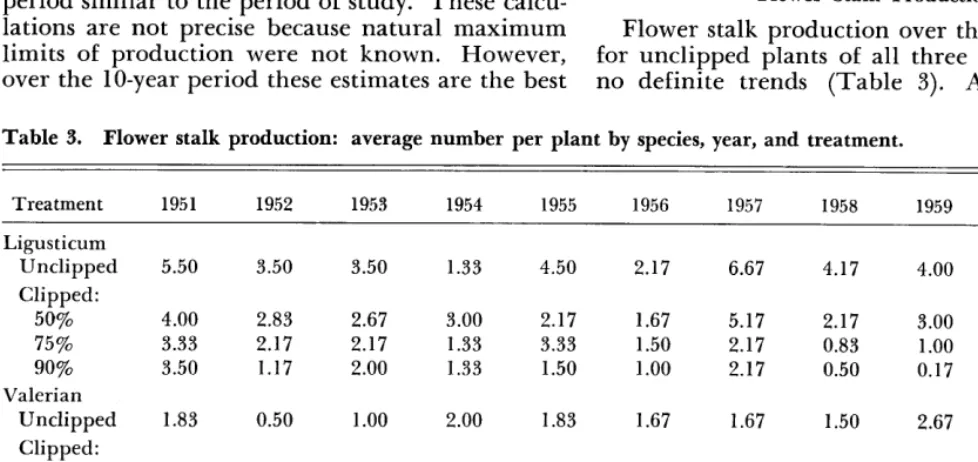
Summer Range Forbs ._..._.. __..________ . . . .._._._.._ _______.________________~_ ________ Ode11 Julander 74
Food Habits of Juvenile Sage Grouse . . . .._ Donald A. Klebenow and Gene M. Gray 80
Plains Pricklypear: Relation to Grazing Intensity and Blue Grama
Yield on Central Great Plains _._._._.__._________ . . . . . ______________________ ________ _. R. E. Bement 83
Time of Fertilizer Application on Desert
Grasslands __.._._ ____ ___..._.._...__..._.. ________ J. L. Stroehlein, P. R. Ogden, and Bahe Billy 86
Long-Term Effects of 2,4-D on Lanceleaf Rabbitbrush and
Associated Species .._..._.._..._.. . .._ William A. Laycock and Thomas A. Phillips 90 Control of Dalmatian Toadflax .._._.. ._.__.._._..._..._... ~~_._~_ _______ . . . ________ W. C. Robocker 94
Competition and Fertilization as Influences on Grass
Seedlings ._.._._..._.._...._.___._..._ ___ _____________________..- G. G. Bryan and W. E. McMurphy 98
Outline for Autecological Studies of Range Grasses ._... __~ . ..__..._.. ~... Neil E. West 102
Technical Notes:
Invasion of Grassland by Bacchuris
pilularis DC. _...__._._.._.___.._....___. _ ____..._._... Joe McBride and Harold F. Heady 106 Bias in Estimates of Herbage Utilization Derived from
Plot Sampling ______ _._._.____ ____.___ ____.._._._.__._ ____________ . . .._... __________________ Dixie R. Smith 109
A Permanent Plot for Measurement of Vegetation
Change ___________________.___.____________ __.._._.._..._ _._____. K. E. Sever-son and F. R. Gartner 11 1 Influence of Phosphorus Fertilizer Placement on Two Nebraska
Sub-irrigated Meadows . . .._. A. W. Moore, E. M. Brouse, and H. F. Rhoades 112 Management Notes:
Managing Grazing Resources for Profit on Commercial Timberlands ________________ 114
Book Reviews:
The Mineral Nutrition of Livestock (Joe D. Wallace) _... _._.____ ._... _~______________ 118 With the Sections __._ ._________._ _ ___..___..__... _ . . . .._ _ . . . .._...._.. __.._____________________.---_--_.._.__ ______ ____ ____ 119 News and Notes __________._..._._..._..._... _.__.._...__._....___.._.___...._..._._._..._.. ____ _______________________ 120
Are You Really Concerned
About Your Society?
President’s Address, Albuquerque,
N. Mex.,
February,
1968
C. WAYNE COOK
President, American Society of Range Management, 1967; Department of Range Science, Utah State University,
Logan, Utah.
The American Society of Range Management is entering a critical period in which it will face many important problems. This situation is not unique to this society. Many other scientific so- cieties feel that they are not keeping pace with scientific endeavor in the United States and other parts of the world. Areas of competence and recog- nition are being tested by all disciplines. Planning and financing to move forward are paramount if our profession is to survive. Otherwise our area of concern will be usurped by other disciplines and contemporary scientific societies.
Grassland societies in Australia, New Zealand, and South Africa are representing all areas of forage and rangeland scientific endeavor. Both agronomic and animal science disciplines are in- volved but range management per se as a science concerned with the balance of both plant and animal life is not truly considered. The initiation of grassland societies in both North and South America is being encouraged by various scientific interests. What sort of a competitive or coopera- tive effort should the ASRM undertake with these groups in the United States and abroad?
Sections
Advisory Council.-The sections are the corner stones of our Society. The Advisory Council com- posed of section presidents is an extremely im- portant organ of our organization. The Board of Directors of the Society relies upon the Council for (1) recommendations on all important issues, and (2) suggestions for improvement and de- velopment of the Society. It is the responsibility of the parent Society Officers to keep the Advisory Council informed of all our major activities and concerns. In turn it is the responsibility of each section president to keep the section membership informed. It is through the Council that indi- vidual members can have a voice and be brought closer to the Society.
Section Activity.-A satisfied and interested membership depends largely upon section activity. Sections should consider two or three field day
c. TVaye C”“k
meetings per year in various geographical locations in their area. All sections should consider the organization of chapters through which each indi- vldual member may become more aware of the benefits of the Society. The annual meeting of the section should be an important affair and not an hour or so of registration and an afternoon of mediocre presentations of papers, followed by in- stallation of officers. Make the meetings worth while to justify travel and attendance of the mem- bership. Likewise, employers should be liberal with travel expenses and paid leave for their em- ployees who desire to attend. Certainly a well- informed employee is better than one who re- mains in his community and POWS stagnant.
High quality newsletters m&ding pictures, some scientific information, and section business issued quarterly are doing more than most of us anticipated to create enthusiasm among section members.
The Public Relations program must be active at the section level. I hope that each section will initiate a public relations committee to work jointly with the parent public relations committee. This is, indeed, an important activity that requires par- ticipation by the sections. They can look forward to guidance from the Executive Secretary’s Office. Each section must assume the responsibility of soliciting new members and retaining stable mem- bership roles. This is an important function of the section and they must make this activity a perennial and continuous day-to-day program with- out even a temporary lull which often happens with the change in officers and committees each year.
Parent Society
because range managers show too little concern.
It is the objective of the ASRM to move our pro- fession from this present state of lethargy. Nec- essary steps include the following.
Finances and Membership.-It was necessary to
raise income for an action program. This is to be accomplished through increased dues and in- creased membership. Your dues are promoting a science and a profession that represents your area of concern. What does your profession mean to you without identification and stature?
The progress of Range Management in scientific development and recognition as a discipline ca- pable of managing the all important renewable range resources at full potential has moved for- ward, but much too slowly. Your membership and active participation in a dedicated manner is critically needed at this time if we hope to improve our professional image with other allied sciences and the lay people who have the erroneous concept that we are a selfish special interest group without scientific identification.
It has been calculated that slightly more than ’ 50% of our college graduates in range science
who are currently working as professional range managers are not members of our Society. This is truly a pathetic situation and must be evaluated with thoroughness. The Society apparently is not offering what our scientifically-trained range man- agers desire or these men do not realize what the Society stands for or can do for them. We must learn why we do not have these college graduates on our membership roles. There are at least 1,000 potential members and supporters in this group and the Society cannot hope to progress without them. Their support should be looked upon as promoting a science and a profession associated with their area of competence. Certainly, they need a Society that can represent and speak for them among allied scientific societies and multiple- use groups where their interests and training re- quire identification and recognition.
Executive Secretary.-The overall plan agreed
upon at the annual meeting in New Orleans in 1966 called for a full-time executive secretary-a person who is well trained and who can converse with all segments of our Society and other scientific areas as well. A person who can serve as the prime mover for our membership and public relations programs. We have selected such a man in Mr. Francis Colbert who has been a full partner and corporate officer of an agricultural management and consulting firm in Phoenix, Arizona for 16 years. He has a Master’s degree in range manage- ment with a most enviable scholastic record. He can communicate both orally and by written word exceedingly well. The Board recommends him without reservation. We hope you will give him
complete support in our new program to move Range Management forward.
National Headquarters.-At the New Orleans
meetings it was voted to move our National head- quarters to the vicinity of Denver, Colorado. Since this time, there has been a plea to consider Wash- ington, D.C. The planning committee and the Advisory Council will make recommendations to the Board when all factors are evaluated.
Pub Zic Relations.-It is common knowledge that
our Society needs an energetic public relations program. The public needs to know the importance of the range resource. They need to know the importance of developing and managing range lands at their full potential for food, employment, and economic stability of rural communities. All range technicians should be sufficiently knowl- edgeable to defend as well as to justify the grazing of the renewable range resource for the welfare of mankind.
At present the Society belongs to a public re- lations council having representation from the Na- tional Cattle Growers Association, the National Sheep and Wool Producers, the Forest Service, the Bureau of Land Management, and the Amer- ican Society of Range Management. This group will sponsor programs aimed at elementary school children, the general public, and allied societies through brochures, articles in popular magazines, motion pictures, and lectures. This will by neces- sity have a modest beginning this year but great things are expected from this cooperative effort.
Professional Stature.-A very important activity
initiated this past year concerns the improvement of our professional stature. The American Society of Range Management must be recognized in all biological resource management programs both in the United States and abroad.
The ASRM should be involved with the Na- tional Advisory Commission on Rural Poverty since they are concerned with the uses of the natural resources as they may create employment and eco- nomic stability for local communities. Certainly thousands of small communities throughout the West are, to a large degree, dependent upon range livestock production.
The world programs involved in the care and development of the native forage resources do not give Range Management the consideration it de- serves. The International Biological Program has a major section on development and use of bio- logical resources yet native range forage or native grasslands are not mentioned. This is an area where the ASRM can make a distinct and signifi- cant contribution. We must insist that range man- agement be included.
YOUR SOCIETY 65
vancement of Science, the National Research Council, the Agricultural Research Institute, and the American Institute of Biological Sciences.
Range Management Education.--It is hoped that
the ASRM will shortly be recognized as a partici- pant with the Commission on Education in Ag-ri- culture and Natural Resources. This commission expresses an interest in sciences dealing with de- velopment and use of renewable natural resources. The Professional Standards Committee and the Range Management Education Council should work closely with this commission, particularly with the panel presently studying future educa- tional curricula changes for scientists who will be involved in the management of renewable natural resources. Education of range scientists must keep pace with other areas of scientific advancement.
Education in range management today involves more than the ecological and physiological re- sponses of plants to defoliation, more than the technical knowledge of improving and developing range lands, more than the taxonomy of the plants on grazing lands and their forage values, more than the nutritional status of plants with respect to meeting the physiological requirements of grazing animals. A range technician in the future must have knowledge of the habitat requirements of native animals that are to be retained as part of the ecosystem, he must know something of the water budget of a watershed, he must know some- thing of the economic and aesthetic values of range lands, and most of all he must be knowl- edgeable of the social reactions to multiple-use programs. With some college training in these areas of learning, a range technician should be able to reasonably evaluate the demands of other users for range lands. He should be qualified to prescribe a program of multiple use on grazing lands in a rational manner with only minor aid from other disciplines. He should be so trained that he can scientifically defend and justify live- stock grazing on multipurpose lands.
Grazing and Other Uses
Paradoxically it seems, the better we see the future the more overwhelming becomes the un- certainty. As scientists we should not resist change but rather should adapt with it. Admittedly there has been a shift of emphasis in management of range resources on public lands. In our efforts to place more emphasis on other resource uses of range lands, we are unknowingly de-emphasizing grazing. Current emphasis on other land uses should not mean a lessening of the biological, economic, or social importance of domestic live- stock grazing.
Shifts of emphasis to watershed, wildlife, recrea-
tion, and aesthetic values may be consistent with multiple-use programs but the question remains how far and how fast? Grazing should not be a left over or residue use, but rather, should be con- sidered an important use and should be incorpo- rated into a multiple-use program in all cases where the land is suited and the need is apparent. Range technicians have a tendency to declare a moratorium on range improvement and changes in management systems because they are bewildered by all the objections from other users. It has been rather conclusively shown that these other uses can be integrated into a multiple-use program without sacrificing the grazing values materially. The range technician must bolster his confidence and display his competence in planning an inte- grated program with grazing as an integral and im- portant part of a multiple-use plan on public rangelands.
Should Range Management Become Sophisticated?
Many people feel that Range Management needs a new image. They feel that it can never be recog- nized as a science as long as people think of us as common western cowboys. Certainly, we in the Society know that this is not our area of function, but what about our allied scientists and people in general. We, as range managers or as a Society, could change our name and carry out essentially our same functions as scientists if this would bene- fit our scientific endeavor. We could change our terminology and converse in more scientific phraseology. These are ideas that we should con- sider seriously as we plan for the future.
66 COOK
sures that range science or range management is destined to survive. It may, however, progress more rapidly under a new title and with specialists trained somewhat differently. When the study of ecosystems and nutrient cycling are identified with purpose such as maximum primary productivity in terms of red meat for the table, the trained range manager is needed. What better purpose could we serve than in the realms of dedicated effort to- wards man’s future welfare?
Is This a Society for You?
A college student entering school for a degree in range management wants to see the time when he graduates and affiliates with a profession of high professional stature. A profession, if you please, that will delineate the area of resource management where his competence allows him to display ex- cellence and become a man among men. We hope we are reaching that period.
Range technicians who are working in the field of range resource management want to see the time when their area of concern is scientifically and professionally dealt with in a manner that truly identifies it as an area of specialization that no other discipline can claim.
Does not a range livestock producer want a highly trained technician to help him with his range and livestock husbandry problems? Does he not want practical and rational solutions to the public range controversies? Does he not want these matters dealt with by knowledgeable and well- trained range management specialists? He may not realize that he does but certainly and surely this is the only solution to his range management prob- lems.
Regardless of the name of our Society or the terms used in our communication as scientists, pro- fessionals, technicians or specialists, the renewable forage resource needs our attention and who is better trained to provide it than we are?
On the Bright Side
People are slowly but surely becoming aware of the need for range scientists. (1) Real estate ap- praisers are employing range management con- sultants to aid them in assessing the value of ranges. Many technically trained range men are serving as real estate appraisers and are proving that they can do ranch appraisal work better than non- trained range men. (2) Land management agencies are sensing the value of a well-trained and astute range scientist. (3) Ranchers are employing range- trained men to serve as foremen or managers. Livestock people are using more range consultants in their decision making operations. (4) Foreign Aid programs are beginning to realize the need for the bonafide range-trained scientist. Heretofore range problems abroad have been dealt with en- tirely by other disciplines such as Agronomy, Ani- mal Husbandry or Veterinary Science.
All people directly concerned with the manage- ment and use of the range resource sense the need for more range research. Therefore, more range scientists will be employed throughout the world to contribute answers to our multitude of range problems.
Range management course work is truly be- coming more scientific. Teaching has more re- search knowledge to draw upon, thus we have better instruction and better students. Range Science has developed to the stage where advanced degrees are awarded. Many universities are cur- rently offering both M.S. and Ph.D. degrees in Range Science. Although Civil Service require- ments for a professionally trained range man are still too low, they are twice as high as last year.
And last but not least, your Society is not stand- ing still. Progress will continue if we can obtain your support. Certainly the potential of this So- ciety is tremendous, but that potential can be obtained only through full and active membership narticination.
AAAS AFFILIATION
Effects of 2,4-D on Emergence
and Seedling Growth
of Range Grasses’
G. J. KLOMP AND A. C. HULL, JR.2 Range Scientists, Crops Research Division
Agricultural Research Service, U.S.D.A. Reno, Nevada and Logan, Utah
Highlight
In a tarweed infested soil in the greenhouse, intermediate and crested wheatgrass and smooth brome seedlings grow- ing with tarweed were sprayed with 2,4-D at 0.5, 1, 2, and 4 lb/A when seedlings had 1 to 2, 2 to 4, or 5 to 10 leaves. Tarweed was controlled at all rates. With simulated fall seeding, the higher the rate of 2,4-D and the younger the grass, the greater the injury to the grass. With simu- lated spring seeding, all rates of 2,4-D damaged the grass, but spraying at 0.5 or 1 lb/A of 2,4-D just after seeding resulted in the least damage. The field study indicated that .5 lb/A 2,4-D killed 90% of the tarweed; 1 lb/A killed 95% and 2 lb/A killed 99%. Rate of spraying had little effect on survival of the grass.
Herbicides have been widely and successfully used to control undesirable vegetation when seed- ing rangelands. Major advantages of herbicides are: (1) selectivity, (2) quick kill, (3) low cost (4) usable on steep and rocky areas, (5) do not expose the soil to erosion. When used at certain times and concentrations, however, herbicides damage the desirable plants. However, as many plants are susceptible to injury only at certain growth stages, injury may be reduced by controlling herbicidal concentrations and by proper timing. Klingman (1961) points out that susceptibility coincides with periods of active growth. For example, small grains may be very susceptible to 2,4-D in the germinating and seedling stages, tolerant in the fully tillered stage, and again susceptible in the jointing and heading stage. Though most plants become more tolerant with age, others remain susceptible.
Tee1 (1952) noted injury to grass seedlings during the l- to 3-leaf stage with 0.75 lb/A of 2,4-D. Watson (1949) found that normal amounts of 2,4-D caused malformation and serious injury to Z&day-old seedlings of bentgrass (Agrostis canina L.). Phillips (1949) found that three warm-season
l Cooperative research investigations of Crops Research Division, Agricultural Research Service, U.S. Department of Agriculture, and the Utah Agricultural Experiment Station. Utah Agr. Exp. Sta. Journal Paper 643. 2The authors thank Dayton Klingman and Wesley Keller
who made helpful comments on the study and reviewed the manuscript, and E. James Koch who made the statistical analyses.
grasses and three cool-season grasses were damaged when sprayed with an amine form of 2,4-D at 0.5 and 1 lb/A at emergence, but that they were not injured at 2, 4, and 8 weeks after emergence. Cool season species were affected less than warm season species and the rate of damage on all species de- creased at later dates and lower rates. However, Klingman ( 1959) reported no lasting herbicidal damage to seedlings of warm or cool season grasses.
In addition to the foliar sprays, grass seedlings may also be damaged by herbicides carried to the plant by surface water or leached downward to germinating seed or to the roots. Dunham (1965) states that 2,4-D has killed grass seedlings when applied to the soil in large amounts.
Our previous work indicates that young grass seedlings have been killed or damaged by spraying 2 lb/A of 2,4-D. In contrast, some workers indicate that up to 2 lb/A of 2,4-D has had no adverse effect upon seedlings at any stage of growth.3 This study was initiated because herbicidal control of weedy vegetation offers considerable promise, and be- cause results differ on possible damage to seeded grasses by herbicides.
Treatments and Procedures
Greenhouse studies were conducted at Utah State University. Soil for the greenhouse flats was ob- tained from Franklin Basin, 35 mi northeast of Logan, Utah. This is a typical high-elevation tar- weed area with abundant tarweed (Madia glom- erata Hook.) seeds in the soil.
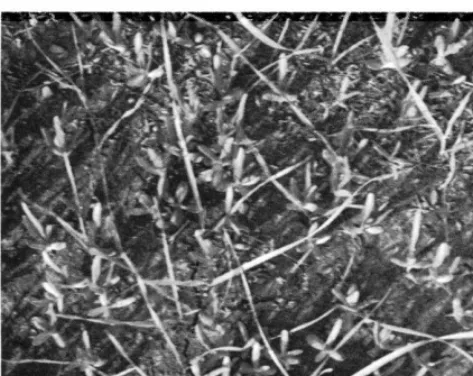
The simulated fall-seeded flats were planted on January 4. These flats and those to be seeded later which would simulate spring seeding were then put outside the greenhouse for exposure to winter weather conditions apparently necessary for germi- nation of tarweed. All flats were left out for 50 days, with 49 days of freezing temperatures. Soil in the flats was frozen solid on February 23 when brought into the greenhouse. Tarweed began to emerge within 2 days and soon averaged 119 plants per ft2 (Fig. 1). Grass emergence began in 6 days. Treatments designed to simulate fall and spring seeding were as follows:
Simulated fall seeding and spring spraying 1. Sprayed at the l- to Z-leaf stage. 2. Sprayed at the Z- to 4-leaf stage. 3. Sprayed at the 5- to lo-leaf stage.
4. Check (seeded before outdoor treatment,
5.
not sprayed, not weeded).
Check (ditto to number 4, but handweeded). Simulated spring seeding and spraying
6. Sprayed 2 hours before seeding. 7. Sprayed 2 hours after seeding.
3Personal communication with C. Wayne Cook.
8. Sprayed after seeding with seed uncovered in open furrows.
9. Check (seeded after outdoor treatment, not sprayed, not weeded).
10. Check (ditto to number 9, but handweeded). The following grasses with symbols used in the tables were seeded on each date:
Agin--Intermediate wheatgrass (Agro~yron in- termedium (Host) Beauv.)
Agde-Crested wheatgrass (A. desertorum (Fisch. ex Link) Schult.)
Brin-Smooth brome (Bromus inermis Leyss.) Grasses were seeded 0.5.inch deep, in 2 rows each, in greenhouse flats. As grass reached the planned growth stages, the herbicide was sprayed with a hand-sprayer fitted with a nozzle which delivered a fan pattern. At each growth stage, there were 4 rates of 2,4-D iso octyl low volatile ester (0.5, 1, 2, 4 lb/A acid equivalent), except that 0.5 lb was not used in all applications. A spraying was planned when grass plants were in early boot, but it was abandoned because tarweed produced seed prior to this stage.
There were 3 replicate blocks; and within these blocks the 10 dates and 4 rates of spraying were randomized with the 3 species randomized within each treatment. All tables are on the basis of 10 possible plants per foot of row. Significance of results at the 5% level was determined by Duncan’s (1955) multiple range test.
Results
Fall Seeding
Grass planu an simulated fall seedings were counted before and after spraying, and one week later. They were
Table 1. Numbers of grass plants per linear foot and grams of air-dry grass per plot from various fall-simulated treatments and different rates of 2,4-D.
2,4-D
Treatment (lb/A) *gin Agde Brin PLAIC’~~ PER Foot
Check, hand weeded 0 9.@bl IO.08 9.5Sb Check, not weeded 0 9.7b 9.7sb 9.w Hand weeded, 1-2 leaf 0 1o.oa 9.5Ub 9.0%b Sprayed, 1-2 leaf 1 10.0n 9.w 9.2a’b Sprayed, 1-2 leaf 2 10.08 9.7Sb 7.7c Sprayed, 1-2 leaf 4 9.% 9.2b 7.2c Hand weeded, 2-4 leaf 0 IO.08 10.0~ 9.3Ub Sprayed, 24 leaf 1 10.08 1o.oa 9.5Ub Sprayed, 24 leaf 2 10.08 9.3Ub 8.3bC Sprayed, 24 leaf 4 9.7b 9.w 7.7c Hand weeded, 5-10 leaf 0 10.0a 10.08 10.08 Sprayed, 5-10 leaf 1 10.0~ 9.8&b 9.7Xb Sprayed, 5-10 leaf 2 1o.oa 9.w 9.0” Sprayed, 5-10 leaf 4 9.8ab 9.w 7.3c
GRAMS AIR-DRY GRASS PER PLOT
Check, hand weeded 0 6.4ab 5.98 3.wc Check, not weeded 0 4.2ab 2.9e 2.5abc Hand weeded, l-2 leaf 0 8.1= 4.8a’~c 3.98b Sprayed, 1-2 leaf 1 5.9a+J 3.7bC 2.7abc Sprayed, 1-2 leaf 2 5.9Ub 3.w 3.2ak Sprayed, 1-2 leaf 4 4.5b 3.lC 1.P Hand weeded, 2-4 leaf 0 6.7Sb 4.5abe 4.1a Sprayed, 24 leaf 1 6.9&b 4.98bC 4.0Sb Sprayed, 24 leaf 2 6.3ab 5.oabc 3.9Sb Sprayed, 2-4 leaf 4 4.4b 3.5c 2.2abe Hand weeded, 5-10 leaf 0 5.1b 5.m 2.7aw Sprayed, 5-10 leaf 1 6.5nb 4.we 4% Sprayed, 5-10 leaf 2 5.4%b 3.9bC 1.4e Sprayed, 5-10 leaf 4 4.5b 3.9bC 2.lbC ‘A significant (5%) difference exists between two means not
followed by the same letter.
again counted and clipped far air-dry weight on April 21, 53 days after grass emergence (Table 1).
[email protected] plant numbers and herbage yields of the three grasses, intermediate wheatgrass was highest, crested wbeatgraas next, and smooth brome lowest in their resistance to injury from 2,4-D.
Growth stage.PDifferences are not statistically signifi- cant, but in general, the earlier the stage of growth at which grass seedlings were sprayed, the greater the reduction in numbers and yields. Spraying 2,4-D at 0.5 to 1 lb/A when grass had 2 to 4 leaves and tarweed 6 to 8 leaves, killed most of the rarweed with little injury to the grass. When all species and rates were averaged, the plots sprayed when grass had 1 to 2 leaves yielded 3.8 g of grass per plot as compared to 4.6 for spraying at 2 to 4 leaves and 4.1 at 5 to 10 leaves.
2,4-D AND GRASS SEEDLINGS
the higher the rate of 2,4~D the greater the reduction in “umber and yield of grass plants. Averaging all species when sprayed at the 1~ fo Z-leaf stage, the plots sprayed with 4 lb/A of 2,4~D yielded 2.9 g, as compared to 4.3 g at 2 lb/A, 4.1 at 1 lb/A, and 5.6 for the check.
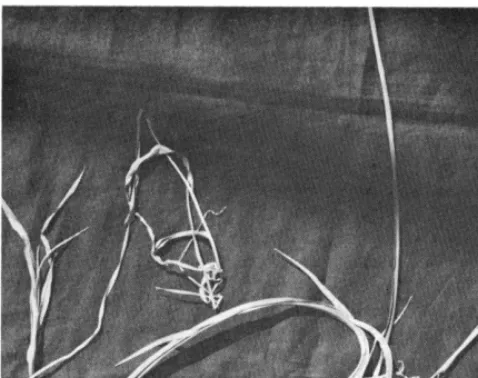
Many sprayed grasses were malformed and damaged. The blades were rollrd and the tip of the blade often did not emerge from the sheath. This retarded the growth of such plants (Fig. 2).
Spring Seeding
The flats which simulated spring seeding were sprayed and seeded on March 1 when tarweed averaged 2 to 4 leaves. Grasses emerged in 6 daya. Grass seedlings were counted and marked daily for 1 week, every 3 days for 3 weeks, and on the 40th day after seeding. Sixty days after initiation of emergence, plants were again counted and also clipped for air-dry weight (Table 2).
Species.-Averaging all spraying treatments, intermediate wheatgrass had the greatest plant numbers and yxtds, followed by crested wheatgrass and smooth brome.
Seedbed phase.-Spraying when grass seed was not covered in the open furrow reduced plant numbers and yielded as compared LO covered seed. When all species and rates were averaged, plots sprayed with 2,4~D after seeding yielded 7.9 g of grass. Those sprayed before seeding also yielded 7.9 g and those sprayed with seed in the open forrow yictded 5.8 g (Fig. 3).
Rates.-All rates of spraying kittcd all the tarweed plants. Though the differences were not statistically significant, increasing the amcunt of 2,4~D decreased the survival and yield of grass plants. Averaging all species and freatments, the plot sprayed at 1 lb/A of 2,4~D yielded 9.0 g of grass as compared to 7.0 and 5.5 g for 2 and 4 lb/A, respectively. ?‘he check yielded 9.4 g and the handweeded 11.5 g.
Spring drilling and spraying resulted in more and greater physical malformations of grasses than did spray ing on fall seeding.
Table 2. Grass plants per foot and grams air.dly grass per plot from various spring-simulated treatmcnrs.
2.4.”
Treatment (lb/A)
-‘~
*gin Agde PLANTS PER FoorHand weeded 0 8.3al s.9a
Not weeded 0 7.4nbe 7.we
Spray after seeding 1 7.5&b< 8.0ab Spray after seeding 2 6.7~s 6.lae Spray after seeding 4 7.labc 6.7bea Spray before seeding 1 6.2Cd 8.6% Spray before seeding 2 7.4s”e 4.9e Spray before seeding 4 6.5bcfl 5.4fle spray in open furrows 1 7.8Sb G.3ede Spray in open furrows 2 7.3=“e G.3cae Spray in open furrows
Hand weeded GRAMS ;~~sst;;;~o~ n ,;;I B
Not weeded 0 1 l.labc 9.wc
Spray after seeding 1 13.2n 7.Wd Spray after 3eedi”g 2 t2.2nb 5.4ae Spray after seeding 4 to.onbc 4.2ae Spray before seeding 1 8.9bC 10.6ab Spray before seeding 2 tt.3abc 7.2b@ Spray before seeding 4 9.7sbe 5.9cae Spray in open furrows 1 IO.l”bc G.5cfle Spray in open furrows 2 7.4c G.Geae Spray in open furrows 4 8.5bc 3.4e
Brin
7.0x 5.6b 5.8nb 2.w 3.40% 5.0bC 3.8~6 1.5% 4.5bca 3.3&e .6z
9.5x’b 7.1bC tt.tn
3.5ae 3.8de 7.3bC 7.3bC 2.8” 5.7Cd 3.4@
.7e
Field Studies
of intermediate and slender wheatgrasses (Agropyron trachy-
caulum (Link) Malte) and smooth brome were sprayed with the iso octyl ester of 24-D at 0.5, 1, and 2 lb/A when the grass was seeded and when it had 1 to 2 and 2 to 4 leaves. At these three stages, tarweed had 2 to 4, 6 to 12, and 16 to 30 leaves. Tarweed was 90% in bud at the last spraying. The calendar dates were May 25, June 24, and July 11. There were four replications of each treatment.
In the field, as in the greenhouse trials, the heavier the rate of herbicide, the more tarweed was killed. There were 108 tarweed plants/ftz in the untreated check plots. Averaging all growth stages, spraying with 0.5 lb/A of 2,4-D killed 90% of the tarweed. The 1 lb/A rate killed 95% and the 2 lb/A rate 99%. The tarweed plants which did survive the spraying were generally stunted and ap- parently did not compete seriously with grass seedlings. Uneven spray distribution with a small hand sprayer un- doubtedly allowed more tarweed plants to survive than if better spray equipment were used.
Grass seedlings in the field were little affected by the different rates of 2,4-D. Also as seedlings responded simi- larly to treatment, the species are averaged. Spraying at different plant growth stages caused some differences in grass seedling survival, but numbers varied greatly. Seed- ling survival may have been more affected by extremely adverse growing conditions than by spray treatments. At the time of the last spraying, there had been no precipita- tion for 22 days, and soil moisture was below the wilting coefficient. There was no effective precipitation for the next 23 days.
Averaging all rates of spraying and all growth stages, there were 6.4 grass seedlingslftz, which is adequate for a full stand of grass.
Discussion
These studies and field observations show that spraying tarweed infested lands with 2,4-D is an excellent method of removing plant competition to allow seedling establishment. However, when grass seedlings are sprayed either at susceptible growth stages, or with too heavy rates of 2,4-D,
injury can result. If injury is not severe, plants outgrow it. If grass stands become infested with tarweed, they may be sprayed with 0.5 to 1 lb/A of 2,4-D in the spring when grass is at the 2 to 4 leaf stage, and when tarweed is at the 6 to 8 leaf stage.
Where spring seeding of tarweed infested lands is feasible, the best procedure is to drill early and follow by spraying with 0.5 to 1 lb/A of 2,4-D. This gave good weed control and minimal grass damage. Higher rates of 2,4-D are excessive, con- trol only slightly more tarweed, and often damage the grass.
When undesirable plants, not easily killed with 2,4-D, are growing with tarweed, it may be neces- sary to spray as much as 2 lb/A to kill these weeds. In this case, spraying can be delayed until after the 2 to 4 leaf stage of grass seedlings to reduce damage to grass.
LITERATURE CITED
DUNHAM, R. S. 1965. Herbicide manual for noncropland weeds. U.S. Dep. Agr., Agr. Handbook No. 269. 90 p. DUNCAN, DAVID B. 1955. Multiple range and multiple
F tests. Biometrics 11: l-42.
KLINGMAN, D. D. 1949. Second year response of six cool-season grasses sprayed as seedlings with 2,4-D for weed control. Abst. Research Report, 6th Ann. NCWCC. p. 65.
KLINGMAN, G. C. 1961. Weed control; as a science. John Wiley and Sons, New York, 421 p.
PHILLIPS, W. M. 1949. Effect of 24-D on seedling grasses under greenhouse conditions. Abst. Research Report, 6th Ann. NCWCC. p. 65.
TEEL, M. R. 1952. 2,4-dichlorophenoxy-acetic acid as a herbicide for controlling broad-leaved weeds in grass seedings. M.S. Thesis. Univ. Nebr. 73 p.
WATSON, D. P. 1949. Anatomical changes of bentgrass (Agrostis can&a) from soil treatment with 2,4-D acid. Abst. Research Report, 6th Ann. NCWCC. p. 66.
FIRST CALL FOR PAPERS
22nd Annual Meeting, ASRM Calgary, Alberta
Request for volunteer papers to be presented at the 1969 annual meeting of the American Society of Range Man- agement has been made by the Pro- gram Committee.
The annual meeting is one of the Society’s principal means “. . . to stim- ulate discussion and understanding of range and pasture problems, (and) to provide a medium of exchange of ideas and facts among members and with allied scientists . . . .” Hence, papers are earnestly solicited from all people who are engaged in any phase of range
management: ranchers, researchers, ad- ministrators, teachers, and students. The author need not be a member of the Society. The committee will ap- preciate agency or department heads bringing this notice to the attention of promising people in their organiza- tion.
Those who wish to present papers at the Calgary meeting should submit to the Program Committee, by June 1, 1968, the following: (1) title, (2) pre- liminary abstract of 200 words or less, and (3) a separate supporting state- ment. The latter should indicate the significance of the paper, tell if it is new research, literature review, prac- tical experience, or philosophical, and
also state the method of presentation (reading, charts, slides, etc.). Four copies of this material should be sent to:
Mr. Alex Johnston
Canada Agricultural Research Branch
Research Station
70
KLOMP AND HULLof intermediate and slender wheatgrasses (Agropyron trachy-
caulum (Link) Malte) and smooth brome were sprayed with the iso octyl ester of 24-D at 0.5, 1, and 2 lb/A when the grass was seeded and when it had 1 to 2 and 2 to 4 leaves. At these three stages, tarweed had 2 to 4, 6 to 12, and 16 to 30 leaves. Tarweed was 90% in bud at the last spraying. The calendar dates were May 25, June 24, and July 11. There were four replications of each treatment.
In the field, as in the greenhouse trials, the heavier the rate of herbicide, the more tarweed was killed. There were 108 tarweed plants/ftz in the untreated check plots. Averaging all growth stages, spraying with 0.5 lb/A of 2,4-D killed 90% of the tarweed. The 1 lb/A rate killed 95% and the 2 lb/A rate 99%. The tarweed plants which did survive the spraying were generally stunted and ap- parently did not compete seriously with grass seedlings. Uneven spray distribution with a small hand sprayer un- doubtedly allowed more tarweed plants to survive than if better spray equipment were used.
Grass seedlings in the field were little affected by the different rates of 2,4-D. Also as seedlings responded simi- larly to treatment, the species are averaged. Spraying at different plant growth stages caused some differences in grass seedling survival, but numbers varied greatly. Seed- ling survival may have been more affected by extremely adverse growing conditions than by spray treatments. At the time of the last spraying, there had been no precipita- tion for 22 days, and soil moisture was below the wilting coefficient. There was no effective precipitation for the next 23 days.
Averaging all rates of spraying and all growth stages, there were 6.4 grass seedlingslftz, which is adequate for a full stand of grass.
Discussion
These studies and field observations show that spraying tarweed infested lands with 2,4-D is an excellent method of removing plant competition to allow seedling establishment. However, when grass seedlings are sprayed either at susceptible growth stages, or with too heavy rates of 2,4-D,
injury can result. If injury is not severe, plants outgrow it. If grass stands become infested with tarweed, they may be sprayed with 0.5 to 1 lb/A of 2,4-D in the spring when grass is at the 2 to 4 leaf stage, and when tarweed is at the 6 to 8 leaf stage.
Where spring seeding of tarweed infested lands is feasible, the best procedure is to drill early and follow by spraying with 0.5 to 1 lb/A of 2,4-D. This gave good weed control and minimal grass damage. Higher rates of 2,4-D are excessive, con- trol only slightly more tarweed, and often damage the grass.
When undesirable plants, not easily killed with 2,4-D, are growing with tarweed, it may be neces- sary to spray as much as 2 lb/A to kill these weeds. In this case, spraying can be delayed until after the 2 to 4 leaf stage of grass seedlings to reduce damage to grass.
LITERATURE CITED
DUNHAM, R. S. 1965. Herbicide manual for noncropland weeds. U.S. Dep. Agr., Agr. Handbook No. 269. 90 p. DUNCAN, DAVID B. 1955. Multiple range and multiple
F tests. Biometrics 11: l-42.
KLINGMAN, D. D. 1949. Second year response of six cool-season grasses sprayed as seedlings with 2,4-D for weed control. Abst. Research Report, 6th Ann. NCWCC. p. 65.
KLINGMAN, G. C. 1961. Weed control; as a science. John Wiley and Sons, New York, 421 p.
PHILLIPS, W. M. 1949. Effect of 24-D on seedling grasses under greenhouse conditions. Abst. Research Report, 6th Ann. NCWCC. p. 65.
TEEL, M. R. 1952. 2,4-dichlorophenoxy-acetic acid as a herbicide for controlling broad-leaved weeds in grass seedings. M.S. Thesis. Univ. Nebr. 73 p.
WATSON, D. P. 1949. Anatomical changes of bentgrass (Agrostis can&a) from soil treatment with 2,4-D acid. Abst. Research Report, 6th Ann. NCWCC. p. 66.
FIRST CALL FOR PAPERS
22nd Annual Meeting, ASRM Calgary, Alberta
Request for volunteer papers to be presented at the 1969 annual meeting of the American Society of Range Man- agement has been made by the Pro- gram Committee.
The annual meeting is one of the Society’s principal means “. . . to stim- ulate discussion and understanding of range and pasture problems, (and) to provide a medium of exchange of ideas and facts among members and with allied scientists . . . .” Hence, papers are earnestly solicited from all people who are engaged in any phase of range
management: ranchers, researchers, ad- ministrators, teachers, and students. The author need not be a member of the Society. The committee will ap- preciate agency or department heads bringing this notice to the attention of promising people in their organiza- tion.
Those who wish to present papers at the Calgary meeting should submit to the Program Committee, by June 1, 1968, the following: (1) title, (2) pre- liminary abstract of 200 words or less, and (3) a separate supporting state- ment. The latter should indicate the significance of the paper, tell if it is new research, literature review, prac- tical experience, or philosophical, and
also state the method of presentation (reading, charts, slides, etc.). Four copies of this material should be sent to:
Mr. Alex Johnston
Canada Agricultural Research Branch
Research Station
Irrigated Blue Grama
with Nitrogen Fertilization’
0. R. LEHMAN, J. J. BOND,2 AND H. V. ECK
Agricultural Research Technician and Research Soil Scientists, U.S.D.A., Southwestern Great Plains Research Center,
Bushland, Texas
Highlight
In 1959, ammonium nitrate was surface applied to blue grama at rates of 0, ZOO, 400, and 800 lb N/acre. Initial plant response to fertilizer N was measured in 1959, and residual response in 1960 and 1961. High moisture levels were maintained by irrigation. Each increment of applied N increased forage yields and yield trends indicate that with adequate water and N blue grama will produce at least 7,500 lb/acre/year of oven-dry forage. Recovery of added N was very low, ranging from 28 to 34% for the ZOO- and 800-lb rates, respectively. Total water use was similar for all treatments, but pounds of forage produced per inch of water used increased with each increment of N. The results indicate blue grama is a relatively inefficient user of moisture and N when compared with Sudan grass, bermuda grass, and some other introduced grasses. How- ever, further studies are needed to determine if blue grama can be managed to use fertilizer and water more efficiently.
Nonfertilized blue grama
[Bouteloua
gracilis
(H.B.K.) Lag. ex Steud.] exhibits limited response to irrigation and distribution of precipitation. Ex- periments at Bushland, Texas, showed that irriga- tion before and during the growing season in- creased forage yields by % ton/acre or less.3 Aver- age forage production during a 6-year period of near-average precipitation was l/3 ton/acre/year, with little difference between years (Whitfield et al., 1949). However, Cosper et al. (1961) showed that native grasses in the Northern Great Plains produce more forage on less water when soil fer- tility is not limiting.The following experiment was designed to evalu- ate the production of blue grama supplied with high levels of nitrogen and water.
lcontribution from the Southern Plains Branch, Soil and Water Conservation Research Division, Agricultural Re- search Service, U.S.D.A., in cooperation with the Texas Agricultural Experiment Station, Texas A & M University. Appreciation is expressed to T. J. Army, currently Senior Research Associate, International Minerals and Chemical Corporation, Skokie, Illinois, for initial leadership and guidance in this project.
*Presently Research Soil Scientist, U.S.D.A., Northern Great Plains Research Center, Mandan, North Dakota.
3 Unpublished data. G. F. Ellis, Jr. et al., Southwestern Great Plains Research Center, Bushland, Texas.
This study was initiated in 1959 at the Southwestern Great Plains Research Center on an almost pure stand of blue grama originally seeded in 1940. Only a few broad- leafed weeds and grasses, such as little barley (Hordeum pusillum Nutt.), 6-weeks fescue (Festuca octoflora Walt.), and tumblegrass [Schedonnardus paniculatus (Nutt.) Trel.], were present.
The deep, slowly permeable soil of the experimental area is a Pullman silty clay loam and is representative of about 12 million acres of medium- to fine-textured soils commonly referred to as the “hardlands” of the Southern High Plains (Coover et al., 1953). Average total soil N by depths on the check plots in 1959 was: 0 to 6 inches, 0.115%; 6 to 12 inches, 0.093%; 12 to 24 inches, 0.063%; 24 to 36 inches, 0.046%; and 36 to 48 inches, 0.041%.
Ammonium nitrate was surface applied to obtain the following N applications: 0 (check), 200, 400, and 800 lb/ acre. The 200- and 400-lb rates were applied on May 22, 1959. To prevent burning, half the 800-lb rate was applied on each of the two dates-May 22 and July 31, 1959. All N applications were watered in. No additional fertilizer was applied after 1959. Treatments were replicated three times in a randomized block design.
Individual plots 20 x 30 ft were isolated by borders for flood irrigation and to prevent interplot water movement. Water was applied through a meter and gated pipe. Peri- odic, replicated soil moisture measurements to a depth of 4 ft were made in each plot. Gravimetric measurements were made in the first foot, and neutron soil moisture readings were used in the second, third, and fourth feet. The plots were irrigated when one-half to two-thirds of the available soil moisture was depleted from the upper 2 ft of soil. Seasonal precipitation plus irrigation averaged about 40 inches of water for each of the 3 years of study. The seasons, from first irrigation to final clipping, were May 11 to October 21, April 1 to November 14, and May 4 to October 3 in 1959, 1960, and 1961, respectively. Seasonal rainfall totaled 10.3, 24.7, and 10.5 inches respectively.
Forage yields were determined by clipping entire plots with a reel-type lawn mower set to leave a stubble height of approximately 0.5 inch. All plots, including the check plot, were clipped at each harvest date. Clipping dates were arbitrarily set to favor fullest development of the fertilized herbage without allowing advanced maturity. At most clipping dates the grass had begun to head and bloom. Initial N response in 1959 produced five clippings, whereas the smaller residual responses in 1960 and 1961 produced only three and one clippings, respectively. Forage production was determined by weighing the entire plot yield and oven-drying a representative subsample at 70 C. Forage N was determined by a modified Kjeldahl tech- nique (Jackson, 1958). The factor 6.25 was used to convert plant nitrogen to protein. Recovery of applied nitrogen was calculated as:
N in fertilized crop - N from check N applied X 100 Soil samples were collected to a 4-ft depth and analyzed for total N (Kjeldahl procedure modified to include NO, - N) at the end of the experiment in October 1961.
Differences between treatment means were tested by analysis of variance. The probability (P) that differences are due to chance alone is shown in the appropriate tables.
72 LEHMAN ET AL.
Table 1. Forage yields of irrigated blue grama as affected by applied nitrogen.
Forage yields
1959 treatment (lb N/acre)
0 200 400 400 + 400
P
1959 1960 1961 (lb/acre) 1,260 1,350 1,610 3,940 1,820 1,850 6,060 2,950 2,000 7,060 7,640 3,940
.Ol .Ol .Ol
Total 3 Y’ increase
(lb/lb N) 4,220 - 7,610 16.9 11,010 17.0 18,640 18.0 NS
Results and Discussion
Forage Yields .-Annual forage production on the irrigated check plots was one-half to two-thirds ton/acre (Table 1). Added N markedly increased irrigated blue grama yields. For the 3-year period, blue grama receiving 200, 400, and 800 lb N pro- duced approximately 2, 3, and 4 times as much forage, respectively, as the check. Greatest yield responses from the ZOO- and 400-lb N rates were measured during the first year when those treat- ments produced nearly one-half the total 3-year forage production. The ZOO-lb rate had little effect after the first season. The application of 800 lb N apparently resulted in large quantities of residual N, and yields were higher during the second season than during the first.
Direct comparisons between the blue grama and other perennial forage crops were not made in this study; however, annual Sudan grass [Sorghum su- danense (Piper) Stapfl was grown in an irrigated fertilizer trial at Bushland in 1959 (Ellis et al.,
1961). Sudan grass produced about 9,500 and lO,- 200 lb/acre oven-dry forage with 200 and 400 lb N/acre, respectively. Elder and Murphy (1961) studied N rates on Midland bermuda grass [Cyn- odon dactylon (L.) Pers.] at Stillwater, Oklahoma, in 1955 and 1956. Average annual yields were about 7,000 and 8,500 lb/acre for 200 and 400 lb N/acre/year, respectively.
Available results indicate that blue grama prob- ably does not have as high a yield potential as some other species.
Forage Protein.-Added N increased the protein content of the forage in proportion to the amount of N applied (data not shown). The greatest in- crease in protein was from 6.8 to 17.2% in June of the first year of study, but response occurred in the two succeeding years. Differences in protein content gradually diminished with clipping. In
196 1, only forage from the 800-lb rate contained more protein than the check.
Nitrogen Recovery.-Recovery of N was low for all treatments, with only about one-third of the
Table 2. Recovery of applied nitrogen (percent) by irri- gated blue grama.l
1959 treatment
(lb N/acre) 1959 1960 1961 Total
0 - - -
200 24 < 1 28
400 27 5 1 33
400 + 400 18 13 3 34
P - - - -
1N uptake from check plots was 16, 14, and 12 lb/acre in 1959, 1960, and 1961, respectively.
applied N being recovered in the forage during the 3-year period (Table 2). Fate of the remaining two-thirds of applied N is not known. More than 80% of the total N recovery from the ZOO- and 400- lb N rates occurred during the first year. On the 800-lb rate, 53% of the total recovery occurred dur- ing the first year and 39yo occurred during the second year. In the previously cited studies (Ellis et al., 1961; Elder and Murphy, 1961), Sudan grass and bermuda grass recovered similar amounts of applied N. First year N recovery was 57 and 45yo for the ZOO- and 400-lb N rates, respectively.
At the termination of this experiment, there was no statistically significant difference in total soil N between treatments in the 0 to 6, 6 to 12, 12 to 24, 24 to 36, or 36 to 48-inch depths (data not shown).
The low N recovery and absence of differential residual N in the soil indicate rather large losses of N from the soil.
Appreciable losses of applied N can occur from the soil by several mechanisms. For example, under some conditions leaching losses can be significant. However, in this experiment soils were rather dry below 4 ft, indicating that no appreciable amount of leaching occurred. Gaseous losses to the atmo- sphere of applied N can also be large. Soulides and Clark (1958) f ound N deficits as great as 60% on some grassland soils.
Table 3. Water-use efficiency (lb/inch) of irrigated blue grama as affected by applied nitrogen.
1959
treatment (lb N/acre)
Water-use efficiency 1959 1960 1961
0 31 33 39
200 92 44 45
400 140 72 49
400 + 400 163 182 97
P .Ol .Ol .Ol
the appreciable quantity of fertilizer N in the root material would eventually mineralize and become available for top growth of subsequent crops.
The results of this experiment, in which two- thirds of the applied N was unaccounted for, point to the need for detailed research on the fate of fertilizer N applied to perennial grasses on this soil.
Total Water Use and Water-Use Efficiency.-
Applied N had little effect on water use (data not shown). The seasonal water use by blue grama ranged from 40 to 43 inches. This is much higher than the 22 and 28 inches thought to be normal seasonal water use for optimum yields of irrigated grain sorghum and wheat, respectively, on the hard- lands (Jensen and Sletten, 1965).
Where N was added, water-use efficiencies were greatly increased, leaving no doubt that N must be supplied for maximum efficiency (Table 3). Compared with the check, 800 lb of N increased water use efficiency more than five times in both 1959 and 1960. Apparently, water was lost from the soil at about the same rate regardless of the amount of dry matter produced. This was true in numerous experiments summarized by Viets (1962).
Without added N, water-use efficiencies were about the same as on native range on the hardlands.
[Whitfield et al. (1949) reported that native range produced an average of 48 lb forage/inch of pre- cipitation from May 1 through October 31.1 Prob- ably, lower water use and higher water-use effi- ciencies could have been obtained by adjusting
dates and amounts of irrigation to periods of rapid or slow vegetative growth. It appears, however, that even with optimum irrigation and fertilizer treatments, water-use efficiency of blue grama would remain lower than that of some other forages. For example, Ellis et al. (1961) reported that irrigated annual Sudan grass, growing on Pull- man soil fertilized with 200 lb N, produced more than 300 lb forage/inch of water used.
LITERATURE CITED
COOVER, J. R., C. E. VAN DOREN, AND C. J. WHITFIELD. 1953. Some characteristics of the Pullman soils on the
Amarillo Experiment Station. Texas Agr. Exp. Sta. Misc. Pub. 97. 11 p.
COSPER, H. R., AND J. R. THOMAS. 1961. Influence of supplemental runoff water and fertilizer on production and chemical composition of native forage. J. Range Manage. 14:292-297.
ELDER, W. C., AND H. F. MURPHY. 1961. Grazing char- acteristics and clipping responses of bermuda grass. Okla- homa Agr. Exp. Sta. Bull. B-577. 23 p.
ELLIS, G. F., JR,, 0. R. LEHMAN, AND J. J. BOND. 1961. Effect of nitrogen fertilizer on yield and composition of irrigated Sudan grass on the High Plains. Texas Agr. Exp. Sta. Prog. Rep. 2173. 4 p.
JACKSON, M. L. 1958. Soil Chemical Analysis. Prentice Hall, Inc., Englewood, N. J. p. 183-190.
JENSEN, M. E., AND W. H. SLETTEN. 1965. Evapotranspira- tion and soil moisture-fertilizer interrelations with irri- gated grain sorghum in the Southern High Plains. Conserv. Res. Rep. No. 5, U.S.D.A., ARS. 27 p.
JENSEN, M. E., AND W. H. SLETTEN. 1965. Evapotranspira- tion and soil moisture-fertilizer interrelations with irri- gated winter wheat in the Southern High Plains. Conserv. Res. Rep. No. 4, U.S.D.A., ARS. 26 p.
POWER, J. F. 1966. The effect of moisture on fertilizer N immobilization in grasslands. Soil Sci. Sot. Amer. Proc. (In press).
SOULIDES, D. A., AND F. E. CLARK. 1958. Nitrification in grassland soils. Soil Sci. Sot. Amer. Proc. 22:308-311. VIETS, F. G., JR. 1962. Fertilizers and efficient use of
water. Advances in Agron. 14:223-224.
Effect of Clipping on Herbage
and Flower Stalk Production
of Three Summer Range Forbs
ODELL JULANDERl Principal Plant Ecologist,
Intermountain Forest and Range Experiment Station, Forest Service, U.S.D.A., Ogden, Utah;
headquartered at Provo, Utah.
Highlight
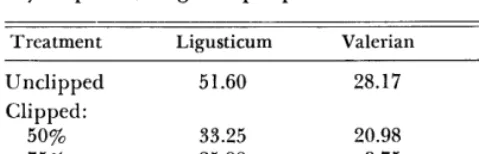
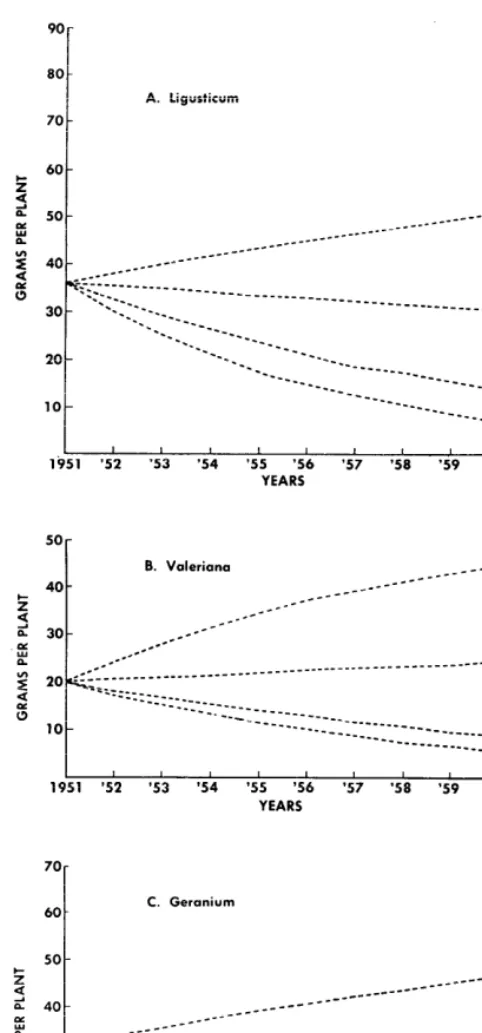
Unclipped forbs produced more herbage and flower stalks over a lo-year period than plants clipped 50, 75, and 90%. Herbage production by the plants clipped 75 and 90% decreased rapidly over the years and few mature seeds were produced after 3 or 4 years of treatment. Ligusticum and valerian can apparently stand about 50% use each year, but geranium should be grazed somewhat less.
Forbs supply the primary forage for deer and sheep on mountainous ranges from early spring to late summer. Forbs also supply much of the choice spring and summer forage for elk and cattle on many ranges. Therefore, some standard of opti- mum utilization of palatable forbs is necessary as a guide to regulation of grazing. Obviously, to preserve the grazing lands, range managers must determine how many animals should be grazed on a given range. Yet, information is lacking about the amount of grazing that forbs can withstand and still produce a sustained yield of forage. One way to study this problem is to approximate various grazing intensities by clipping of plants and to observe the effects over a long period of time.
Most previous studies employing the clipping method have dealt with grasses and shrubs; but results of these studies apply to forbs because the physiological processes of all three groups of plants are much the same. Studies of the effects of dif- ferent intensities of clipping on grasses show that grazing during the growing season usually reduces plant growth. The more frequent and severe the defoliation, the more depressed the herbage pro- duction and root growth (Parker and Sampson, 193 1; Robertson, 1933; Weaver and Hougen, 1939; Carter and Law, 1948; Branson, 1956; and Cook et al., 1958). Heavy clipping of forage plants like- wise reduces seed production (Julander, 1937; Hanson and Stoddart, 1940; Blaisdell and Pe- chanec, 1949; Driscoll, 1957). The time of clipping strongly affects results. McCarty and Price (1942)
l Justin G. Smith of the Pacific Northwest Forest and Range Experiment Station did the first few years of clipping on this study. His help is appreciated.
found that, in the mountains of Utah, Richardson geranium (Geranium richardsoni Fisch. and Trautv.) plants clipped 1 inch above the ground at the close of the grazing season maintained a greater percent of yield and higher carbohydrate reserves the following year than those clipped dur- ing the main part of the growing season. Blaisdell and Pechanec (1949), working on the Snake River Plains of Idaho, found that complete removal of arrowleaf balsamroot (Balsamorhiza sagittata (Pursh) Nutt.) herbage reduced the following year’s herbage and flower stalk production. Flower stalk production was more severely affected than herb- age. Clipping in May and early June-the period of full bloom for balsamroot-was most harmful. Injury was progressively less severe for clippings later in the season.
The present study was designed to provide guides to the proper utilization of three important forbs by determining the effect of different degrees of clipping on herbage and flower stalk production over a IO-year period. The plants chosen are im- portant as summer forage for deer and livestock; they are Richardson geranium, Porter ligusticum (Ligusticum porteri Coult. & Rose), and edible valerian (Valeriana edulis Nutt. ex T. & G.). All are long-lived perennials. The study area is on the west flank of the Wasatch Plateau east of Ephraim, Utah. Here the geranium plants grow in the lower aspen zone at an elevation of 8,450 ft, and the other species grow in the subalpine zone at about 9,900 ft. Precipitation averages about 23 inches annually in the lower aspen zone and about 33 inches in the subalpine zone.
Methods
Twenty-four vigorous plants of each species were chosen for the study, including 12 in each of two adjacent blocks. The plants varied in size and were randomly assigned treatment within each block; some were control plants (unclipped) and others were clipped 50, 75, or 90% by weight. Treatments were repeated once each year over a IO-year period, from 195 1 through 1960. All plants were protected from grazing during the study period.
Plants were clipped in late flowering, at or near maxi- mum vegetative growth stage. This stage was usually reached near the middle of July for geranium and during the first 10 days of August for ligusticum and valerian. During the first 4 years, regrowth was measured, but later regrowth was found to be negligible. Regrowth was there- fore ignored in calculations.
In clipping, appropriate percentages of both leaves and flower stalks were removed; clipping simulated natural grazing as closely as possible. Green weights of the clipped portions were converted to air-dry weights, and the con- version factors were determined annually for each species. Total production of the clipped plants was calculated according to the percentage of the plant represented by the clipped portions. The production of the unclipped control plants was estimated by counting the leaves and