Received October 9, 2018, accepted October 30, 2018, date of publication November 5, 2018, date of current version December 7, 2018.
Digital Object Identifier 10.1109/ACCESS.2018.2879473
Fuzzy Connectives for Efficient Image Reduction
and Speeding Up Image Analysis
GLEB BELIAKOV 1, (Senior Member, IEEE), GITA DAS1, HUY QUAN VU2, TIM WILKIN1, (Member, IEEE), AND YONG XIANG1, (Senior Member, IEEE)
1School of Information Technology, Deakin University, Burwood, VIC 3125, Australia
2Centre for Tourism and Regional Opportunities, School of Engineering and Technology, Central Queensland University, Norman Gardens, QLD 4701, Australia
Corresponding author: Gleb Beliakov ([email protected])
ABSTRACT We discuss non-monotone fuzzy connectives in large-scale image processing. We present an image reduction algorithm capable of differentiating between fine image details and noise in the image, particularly salt and pepper noise. The reduction algorithm is based on mode-like averaging functions. We compare the performance of the proposed method to the alternative reduction methods on artificial images and on two case studies: content-based image retrieval and pedestrian detection. Our algorithm improves the speed of the subsequently applied image analysis methods and allows efficient filtering of salt and pepper noise. Applications to on-board image recognition in autonomous robotic devices are envisaged.
INDEX TERMS Aggregation operators, fuzzy connectives, image reduction, averaging, mode.
I. INTRODUCTION
Modern data is captured much faster than it can be analyzed. Novel applications of digital imaging demand super-fast image analysis and recognition. Self-driving vehi-cles, unmanned aerial vehicles (UAV) and autonomous robots are some examples where recognition (of small objects or pedestrians) from video footage must be per-formed in real time. UAVs and underwater robots are restricted in their computational capabilities, as more com-puter power means heavier battery and larger dimen-sions which are at a premium, and therefore sophisticated on-board image recognition algorithms are way too slow for autonomous operation of these devices.
One common issue in these applications is that the large amount of visual data captured by the high resolution cameras cannot be analyzed on the low computing capacity devices by which the data is captured. The main reasons here are severe limitations on the cost, size, weight and power con-sumption. While image acquisition is performed at a linear rate (with image resolution), image analysis has a super-linear computational cost, and the computational bottleneck is thus inevitable. As the technology develops, more advanced pro-cessing hardware also means even higher resolution cameras, and the hence even higher demands on processing power.
Furthermore, the high rate of image acquisition leads to unavoidable noise in the image data, thermal noise being one of the problems here, but also missing data due to
interference, radiation, etc. The likelihood of corrupted pixels in an image, while not very large per se, is not negligible and grows with image resolution. While dropping image resolu-tion seems a feasible alternative here, that also degrades the quality of the subsequent analysis. One of the challenges in big data (at least in image processing) is that most of the data captured are uninteresting and are subsequently discarded, but have to be processed in order to identify the interest-ing parts, that need to be captured at the highest resolution available. Timely image analysis on board is also important for automation of the behavior of autonomous devices, like identification of targets and obstacles.
This paper advocates the use of image reduction tech-niques based on granular computing, in particular on fuzzy sets aggregation techniques. The goal here is to artificially reduce image resolution to facilitate faster processing, for example on autonomous underwater or aerial vehicles, yet in such a way that the reduced image preserves the important characteristics of the original image and at the same time filters out Gaussian and non-Gaussian noise. Furthermore, we aim to achieve reduction while preserving very fine details of the high resolution image but distinguish them from noise. Often the objects of interest in the images are small, or have particular characteristics (like texture) that are not usu-ally preserved by the simple reduction methods. Finusu-ally, the linear time complexity of the reduction algorithm is paramount.
Thus image reduction consists in diminishing the reso-lution of the image while keeping as much information as possible from the original image [2], [31]. Image reduction (and the inverse process, image magnification) is a widely studied topic due to its applicability in mobile gadgets such as phones, PDAs or cameras, where the images must be visualized in small screens and the need of changing the size of the images without significantly changing their quality is very important.
In the literature there exist many different image reduction methods. Some of them consider the image to be reduced globally or in a transform domain [26], [29], [33]. Some oth-ers divide the image into pieces and act on each of them locally [2], [18], [28], [31], [34]. The latter procedure allows one to design algorithms which are very efficient in time (so the image reduction is performed at the same rate as image acquisition) and which preserve some of the specific properties of the images such as textures, edges, etc.
Our aim in this work is to design a reduction algorithm that, given an image, provides a new image of lower resolution that keeps the intensity properties of the original image, filters out non-additive noise and in addition preserves even very small details of the original image, such as 1-pixel wide lines. The latter is very challenging, as such details are easy to confuse with the noise.
We follow the approach presented in [2], [30], and [31] where the concept of local image reduction operators was for-malized. The input image is divided into possibly overlapping small rectangular blocks, and the intensities of the pixels in each block are combined to produce a representative value, which will be the intensity of one pixel in the output image. Thus we perform fusion of intensities of pixels in a block, which is then reduced to one pixel. Evidently, this process is computationally efficient and easily parallelizable.
The representative pixel value is calculated by using aggregation functions employed in the fuzzy sets theory, also called fuzzy connectives, and in particular averaging functions [1], [7], [23]. Typical averaging functions are the arithmetic mean and the median, and they are relied upon in the naive image reduction methods. We shall see later on that such averages result in oversmoothing of the images and losses of small details. We explore more sophisticated averages, such as penalty-based and mode-like functions pre-sented in [1], [3], [5], and [42] and we show their superior per-formance in image reduction tasks, especially in the presence of noise.
In order to study the use of sophisticated reduction oper-ators, we carry out several experimental studies. Firstly, we perform laboratory experiments using artificially gen-erated images, in order to demonstrate the capability of the selected averaging functions to differentiate between the noise and small image details.
Then, we perform experiments with real-world images on two case studies. The first case study is image retrieval [17], [36], [37]. We use state-of-the-art retrieval methods in order to query image databases and select images
matching a particular query image. In this task the vector of image features is computed and matched against feature vectors in the image database. We analyze the performance of image retrieval algorithms (in terms of the accuracy and CPU time) for full scale and reduced images as a function of image reduction method employed.
The second case study is pedestrian identification [21]. This problem is particularly important for the development of self-driving vehicles. It is conjectured that the expensive equipment currently used on prototypes of such vehicles can be replaced with inexpensive small cameras coupled with pedestrian identification algorithms. Here again, we analyze the performance of pedestrian identification algorithms for full-scale and reduced images in the presence of noise in the data, as a function of image reduction method.
In both cases we use off-the-shelf third party image analy-sis algorithms and apply them to the full-scale and reduced images. Evidently, the analysis algorithm will work much faster on the reduced images. The question is: what are the losses in quality of the output (e.g., accuracy), and whether such losses are justified by the gains in the speed of processing.
In both case studies we contaminate the query images with different types of noise: Gaussian, speckle, and salt and pepper noises, and analyze the accuracy of the recognition methods as a function of noise and the reduction method applied.
The paper is structured as follows. Section II gives preliminary definitions. SectionIIIpresents mode-like aver-aging functions based on minimization of various penal-ties. Section IV outlines the image reduction algorithm. SectionVdetails our the experimental analysis. SectionVI concludes.
II. PRELIMINARY DEFINITIONS A. IMAGE REDUCTION
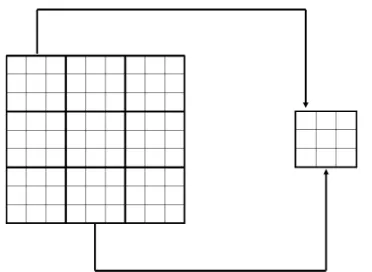
We now formulate the problem of image reduction based on local, block-based reduction operators. Local opera-tors based on aggregation functions have been shown to be both effective and fast, and they easily admit parallel implementations [2], [31], [32]. In this approach an image of sizeM ×N is subdivided into non-overlapping blocks of size m×n, and each block is aggregated to generate a single value representative of the original data, as illustrated on Figure1. This value becomes the intensity of a single pixel within the reduced image. The original image is reduced to the sizeM0×N0= bM
mc × b N
FIGURE 1. A scheme for image reduction based on representative values within 3×3 blocks.
The core of block-based reduction algorithms is a function which generates a representative intensity value for a given block of pixels. Such functions require the properties of averaging functions, such that the output is within the range of the intensities of the input pixels, and is also idempotent. This latter property ensures that if the block is of uniform intensity, its representative value is exactly the same as the intensity of all input pixels.
There are several alternative methods of image reduc-tion. The interpolation methods, like bilinear and bicubic interpolation, build a piecewise polynomial model of the image, and then compute the pixel values of the reduced image by using such an interpolant. Fuzzy transform methods (F-transform) [18], [32]–[34] have also been applied to image reduction and will be used here for benchmarking.
Color image reduction is typically performed componen-twise, by calculating intensities of each color channel sepa-rately. However that might lead to pixel colors not present in the original image. We show later how this can be avoided by using penalty-based approach.
B. AVERAGING FUNCTIONS
The class of functions with the above mentioned requirements is known as means (or averages), and is well studied, in partic-ular from the point of view of fuzzy connectives [1], [7], [11]. The simplest examples are the weighted arithmetic mean and the median, which play an important role in Gaussian and median filtering. All suitable averaging functions can be obtained by using penalty-based approach [13], wherein a certain penalty for intensity deviations is minimized. A com-parative analysis of various penalty-based averages in this context was presented in [2], [12], and [31].
Typically, averaging functions satisfy another condition, that of monotonicity [7], [11]. If any of the input values increases, the output cannot decrease. This condition is useful when the data are noiseless, however, when the data may be contaminated by noise, monotonicity is not desirable. An increase or decrease of the intensity of a pixel to an extreme (or away from the most prevalent value in a region) is plausibly indicating that it is corrupted and thus should be
disregarded in the average. Permitting outlying pixel intensity to affect the average of the image block leads to a degradation of performance in tasks such as filtering and image reduction. Non-monotone averages have been treated in [4], [5], [8], [9], [41], and [42], and they also play a significant role as robust estimators of location [35]. Typical examples here are the shorth and the least trimmed squares (LTS) estimator. Non-monotone averages can be represented as penalty-based functions [1], [13], and it is within this context that we wish to design penalties that account for the spatial organization of pixels. The subsequent averaging functions may then be applied within block-based image reduction of noisy images. Formally, following [2] and [13], if the input intensities in a block are represented byx ∈ Ik,k = m×n, the average intensity is found by solving the minimization problem
y=f(x)=arg min
y P(x,y),
whereP : Ik+1 → Ris a penalty function satisfying the conditions:
1) P(x,y)≥c ∀x∈Ik,y∈I; 2) P(x,y)=cif and only if allxi=y
for some constantc∈Rand any closed, non-empty intervalI. That is, the average is the value y which minimizes the total penaltyP for disagreement between that value and the individual pixel intensitiesxi. It is known that all idempotent functions can be represented in this way [1], [13].
For example, the arithmetic mean is obtained by using squares of the differences,
P(x,y)= k
X
i=1
(xi−y)2,
whereas the median is obtained by using the absolute differ-ences
P(x,y)= k
X
i=1
|xi−y|.
III. MODE-LIKE AVERAGING
It is known that the arithmetic mean is not robust against outliers [35]. Just one extreme value of an input (like when we have the salt and pepper noise) drives the output in its direc-tion away from the main group of uncontaminated inputs. The median is robust, as its value is not affected by the outliers, but it discards all but one (central) input. There are other robust estimators of location [35] such as the shorth and the least trimmed squares estimator, which all belong to the class of weakly monotone averages [1], [42]. These averages model the majority: the output is always a value representing the majority of inputs, which are considered uncontaminated by noise.
intensities, whereas the majority of pixels in a block belong to the background, but their intensities are more spread. To pre-serve such fine lines in the reduction process we need to select a compact cluster of inputs and discard the majority which are not closely aligned with each other.
The mode function selects the most frequent input, and if we have a perfect cluster of inputs that share the same value, the mode would identify such a value. Mode-seeking algorithms are known in image filtering [14], [40]. In reality, however, a cluster of pixels intensities will not have one com-mon value, and in fact all inputs might be distinct, in which case there is no unique mode. For this reason below we define a mode-like average which mimics the mode when the inputs are distinct. For this we use penalty based approach [13].
Unlike in [2], [12], and [13], where P was required to be quasiconvex to guarantee a unique minimum, and also to ensure continuity off, we do not impose this condition as we are interested in non-monotone averages. In [41] a penalty function based on a weighted sum of intensity-based partial penalties was given by
P(x,y)= k
X
i=1
wi(y)ρ(xi,y) (1)
where
ρ(xi,y)=
(
r(j) r(j)< τ, βτ r(j)≥τ.
τ =αmax(,r(t)) andα >0, 0≤β≤1, 2≤t≤k. (2)
The parameters of this model are described below.
Givenri= |xi−y|thenr(j)denotes thejth smallest element of the set of ordered (ascending) values of ri, the abso-lute deviations from the aggregate value y. This function generates a mode-like non-monotonic average of the input vector x, and it was shown to outperform other monotonic and non-monotonic block-based reduction operators when applied to images corrupted by speckle or impulse noise.
The functionρfavors compact clusters of intensity values in x by assigning smaller penalties to inputs closer to the proposed output. Thus the value y that minimizes P is a value representative of the most compact cluster withinx. The parameterαtunes the cluster boundary as a function of the minimum non-zero intensity difference between inputs, and βis a fixed constant penalty for non-cluster members. ThusP attempts to minimize the number of outliers while also trying to identify the most compact cluster. This averaging method is calledPmode.
However,ρdoes not take into account spacial information of the pixels; i.e., it does not distinguish between a geo-metrically compact group of pixels having similar intensity and similar pixels scattered within a given block. To account for this the weightswishould depend on the position of the pixels within the block. In [41] this was achieved using a
normalized distance,
wi(y)=
d(xi,y)
Pk
i=1d(xi,y)
, ∀y=xj∈ {x1, ...,xk}. (3)
This function arose from the additional constraint that the average must also be a locally internal function (i.e., the out-put should be one of the inout-puts), which is a reasonable requirement in image reduction tasks. A more sophisticated weighting function was presented in [6], which is based on fuzzy measures. That function favors larger clusters of pixel intensities, which are also compact in the geometrical sense. For example three neighboring pixels with similar intensities are favored with respect to pixels spread over the image block. The penalty in [6] which accounts for spatial organization of pixels is expressed as
P(x,y)=w(A) k
X
i=1
ρ(xi,y), (4)
where cluster-based weights w(A) replace the individual pixel weightswi(y) in (1). Here w(A) = 2−v(A) ≥ 1, vis a fuzzy measure computed by one of three approaches in [6] andAdenotes the subset of pixels having intensities that satisfyr(k) < τ as per Eqn. (2). This average is called
theCmode. The values ofware precomputed and thus do not
affect the run time of theCmodealgorithm.
IV. REDUCTION ALGORITHM
The overall block-based image reduction algorithm is as follows.
Algorithm 1Image Reduction Algorithm
Inputs: A (original image as an M × N array), M,N
(dimensions),m,n(reduction ratios)
Output:B(the reduced image of sizeM0×N0) 1 M0= bM
mcN
0= bN nc
2 Select an averaging functionF
3 For each (non-overlapping) block ofAof sizem×n
denoted byC
3.1 c=F(C);
4 Build the reduced imageBfrom the outputs of Step 3.1.
In our study we used several different averaging functions as F, thePmode andCmode functions as described in the previous section, shorth, and the LTS estimator [35] as exam-ples of robust estimators, and the arithmetic mean and the median for comparison purposes. We also used alternative reduction methods based on bilinear and bicubic interpolation and Lanczos method (available in Matlab Image Processing toolbox), as well as based on the F-transform [32], [33].
The minimization of the penalty function in thePmodeand
Cmodefunctions was performed over the set of input
intensi-ties, which ensured the output did not contain pixel intensities not present in the input image. The weighting functionsw
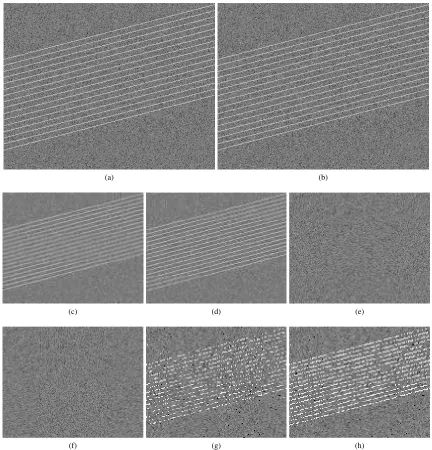
FIGURE 2. Lines image before and after reduction (not to scale). (a) Original. (b) Original with Noise. (c) BILINEAR. (d) MEAN. (e) MEDIAN. (f) SHORTH. (g) PMODE. (h) CMODE.
not necessary to perform reduction for each color channel independently. Penalty minimization can be performed on a product lattice of color intensities as presented in [2].
V. EXPERIMENTAL ANALYSIS A. FINE DETAIL PRESERVATION
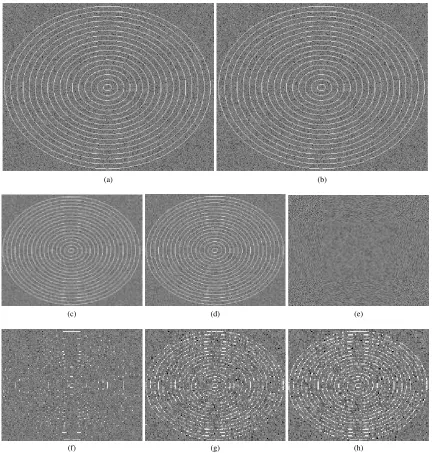
In the first series of experiments we used synthetic grayscale images called respectively lines and circles (Figures 2-3). The lines and circles are one pixel wide, nearly white on non-uniform gray background. The intensities of pixels of the lines and circles are not constant but vary within 10% of the range of intensities (the standard 0–255 range), whereas the intensities of the gray background vary within 30% of
the range of intensities. Subsequently salt and pepper noise was added to the image, changing 0.5% of pixels to black or white.
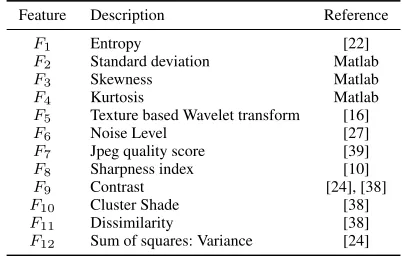
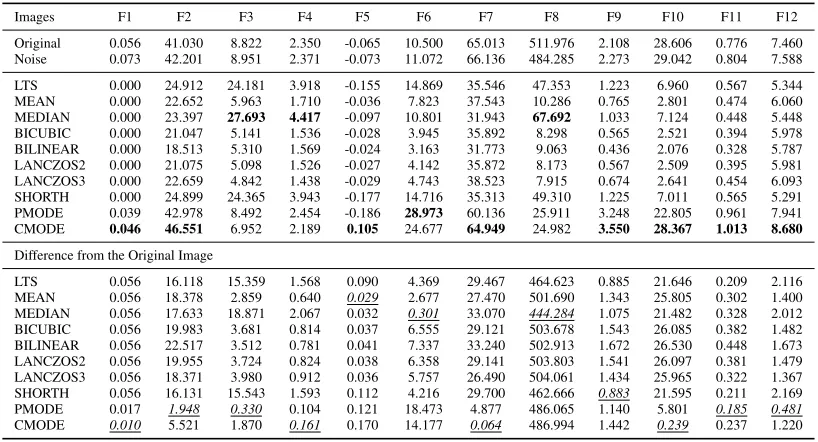
Our aim here is to establish the robustness of the reduction methods to the salt and pepper noise and their ability to preserve visible fine line structures. In addition to visual inspection, which can be done using Figures 2-3), we also calculated various quantitative characteristics of the original image, noisy image and the reduced images. The image characteristics are presented in Table 1, together with the references to their origins.
FIGURE 3. Circles image before and after reduction (not to scale). (a) Original. (b) Original with Noise. (c) BILINEAR. (d) MEAN. (e) MEDIAN. (f) SHORTH. (g) PMODE. (h) CMODE.
these characteristics. Therefore we computed the mentioned characteristics for the noiseless image, for the noisy image for comparison, and then for reduced noisy images. The images were reduced by one of the mentioned methods by a factor of 9 (bothm,n=3 in Algorithm 1).
Figures2-3reveal that the mean block-reduction and bilin-ear interpolation methods preserve the lines structure, but smoothen the lines. Indeed, the pixel intensity of the visible lines is only a fraction of that in the original image, which is averaged with the intensity of the background. The median and the shorth functions, while robust to the salt and pepper noise, also remove the lines and circles from the image, which is unsatisfactory. ThePmodeandCmodefunctions produce
the lines and the circles with their original intensity and filter most but some noise.
TABLE 1. List of features reflecting image characteristics.
image, all the characteristics are better preserved when using
the Pmode and Cmode algorithms. In case of the Circles
image, some characteristics are better preserved usingPmode
andCmode, but there are some which are preserved better
with more smoothing.
B. IMAGE RETRIEVAL
Content-Based Image Retrieval (CBIR), where an image is represented by its visual and semantic contents, is crucial to successfully retrieve images from huge databases [36], [37]. A feature vector is extracted for each query image and then compared to the feature vectors in the database. Based on the matching of feature vectors, the most similar images to the query are retrieved.
While extracting feature vectors from the database can be done offline, and hence computation time is not that critical, extraction of the features from the query images is usually performed online and it is time-critical. In addition query images could be noisy, and therefore noise filtering is required. Performing noise-cancelling reduction of the query images allows to significantly speed up the whole CBIR process.
We studied how image reduction affects the precision of the image retrieval process measured as
precision=Number of relevant retrieved images
Number of retrieved images .
We have used the scope value (i.e., the number of retrieved images presented to the user) of 20.
We have chosen Wang database (http://wang.ist.psu.edu/ docs/related), a benchmark database that has been widely used in CBIR research community. The Wang database is a subset of 1,000 images of the Corel stock photo database which has been manually selected and which form 10 classes (contains Africa, Beach, Buses, Dinosaurs, Elephants, Flow-ers, Food, Horses, Monuments, Mountains) of 100 images each. Each image is of size 256 x 384. All images have been converted topngfromjpegformat (using Format Factory software) to form the original dataset.
To model a scenario when the CBIR system is presented with noisy images, noise (as indicated in Table 4) was
added to query images, and then the images were either reduced by one of the mentioned methods by a factor of 9 (both m,n = 3 in Algorithm 1), or left unchanged (for comparison).
A compact 25-dimensional feature vector using the ele-ments of Colour Co-occurrence Matrices (CCM) in Hue, Sat-uration, Value (H,S,V=16,3,3) space [15] was then extracted from the query images and compared against feature vec-tors in the original, noiseless database. The L1-norm was used to measure similarity between query and database images.
As expected, we obtained a reduction in computation time by a factor of 7.8 when using reduced images (total time 242.49 sec for 1000 full images vs 30.74 sec for reduced images). The retrieval time was not affected by reduction.
The results are presented in Table4. We can observe that compared to clean original images (the gold standard in this case) all reduction methods have shown a degradation in retrieval accuracy. This reduction is least for ourPmodeand
Cmode algorithms. On the other hand, when noisy query
images were presented, in all cases reduction resulted in improvements to the retrieval precision, attributed to smooth-ing filtersmooth-ing effect of reduction.
The algorithms performed differently depending on the type of noise in the images. For Gaussian and speckle noise with variances indicated in Table4, block-based reduction by using the mean function delivered the best results. This is expected, as the arithmetic mean is precisely the minimizer of the sum of squared deviations, which is the maximum likelihood estimator under Gaussian noise assumption [13]. F-transform also delivered similar precision. For speckle noise with small variance, bicubic reduction and Cmode
resulted in good precision, but so was the benchmark - using noisy original size images. This means that filtering in the reduction process did not play a major role. For speckle noise with larger variance the arithmetic mean-based reduction delivered better results.
For the salt and pepper noise the proposed Pmode and
Cmodealgorithms were clear winners. These two methods
also performed well for clean images. The median filtering, which is usually used for this type of noise, was not as effec-tive, most likely because of reduction in image contrast and other related features. The mean-based filtering was unable to remove the outliers. In contrast,Pmode andCmode did not affect the features used for retrieval, yet were able to successfully filter out the salt and pepper noise.
C. PEDESTRIAN DETECTION
Pedestrian detection is an essential task in Computer Vision [21], where the quality and speed of the detector is of importance. The use of reduced test images can contribute towards less computation time and provide better detection accuracy in noisy environment.
TABLE 2. Features extracted from the lines images.
TABLE 3. Features extracted from the circles images.
TABLE 4. Precison (%) at scope 20 with query images, both clean and noisy, original and reduced by the indicated method. The noise level is indicated by the percentage (S&P) and variance (Gaussian and Speckle). The best precision is indicated in boldface.
noisy and reduced noisy images. Computations were per-formed using Piotr’s Computer Vision Matlab Toolbox [19]. We used the INRIA pedestrian dataset [25], one of the
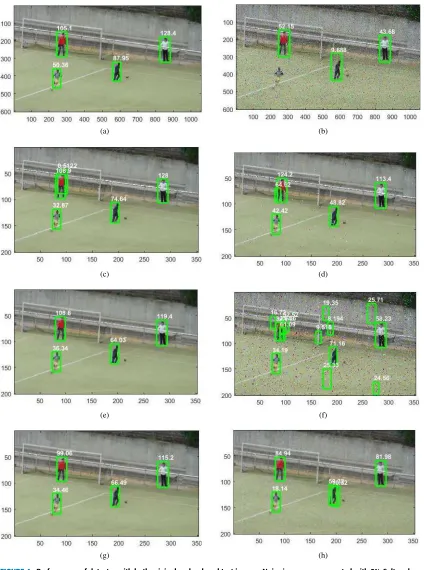
FIGURE 4. Performance of detector with both original and reduced test images. Noisy images are corrupted with 5% Salt and Pepper noise and then reduced. (a) Clean & Original. (b) Noisy & Original. (c) Clean & Pmode-reduced. (d) Noisy &
Pmode-reduced. (e) Clean & Median-reduced. (f) Noisy & Median-reduced. (g) Clean & Mean-reduced. (h) Noisy & Mean-reduced.
There are 614 positive training images along with ground truth Bounding Box( BB) and 1218 negative images with no pedestrians. For testing we used 288 positive images along with ground truth BBs. Ground truth BBs are scaled down by
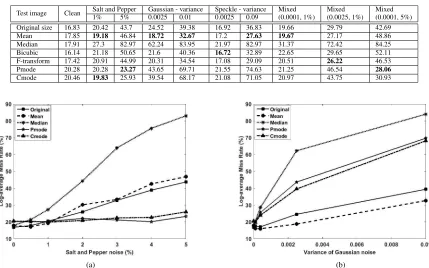
TABLE 5. Log-average Miss Rate (%) with test images, both clean and noisy, original and reduced by the indicated method. The noise level is indicated by the percentage (S&P) and variance (Gaussian and Speckle). The best precision is indicated in boldface.
FIGURE 5. Performance of the pedestrian detector with both original and reduced test images. ROC curves are obtained using Piotr’s Matlab Toolbox [19], and with INRIA dataset. (a) Salt and pepper noise. (b) Gaussian noise.
For reduced test images the detector was modified to work with downscaled images. The training images were not reduced. Features for training images are computed once only, and the features at other scales can be approximated. This makes the detector fast.
The following reduction operators were used: Mean, Median, Pmode, Cmode, Bicubic and F-transform. Other reduction methods did not show any significant difference in performance to the existing methods used for benchmarking, and hence the results are omitted.
As expected, the use of reduced test images resulted in significant reduction in the detection time, by a factor of 9.5 (7.95 frames per second vs. 0.83 frames per sec-ond). The accuracy of the detector was measured through the Log-average Miss Rate [20], [21], where the lower values mean better accuracy.
The results are presented in Table5. As expected, added noise degrades the performance of the detector, often signif-icantly (data row 1). The reduction of clean test images did not result in a drastic decrease in performance for the existing reduction methods, but led to some decrease in performance for the proposedPmodeandCmode(data column 2).
However, reduction of noisy images resulted in a better performance than with non-reduced images. For Gaussian and speckle noise, as well as mixtures with these noises, the arithmetic mean-based reduction was the best approach,
followed by F-transform. This is expected as the arithmetic mean effectively filters out Gaussian noise. For the salt and pepper noise thePmodeandCmodehave shown superior per-formance, very significant at the 5% noise level. Surprisingly, the median-based reduction led to very poor performance of the detector.
Figure4 shows one example of a frame with pedestrians and the bounding boxes found by the ACF algorithm. The ROC curves for different reduction methods are presented in Figure5.
VI. CONCLUSION
This paper discussed the use of fuzzy connectives in process-ing large image streams as a tool to overcome computational bottlenecks. Local image reduction is computationally effi-cient, easily parallelizable method of reducing and filtering images at approximately the same rate of image acquisition. The subsequent image analysis can then be performed at a much faster pace. To preserve the accuracy of image anal-ysis algorithms it is important to preserve important fea-tures of an image and differentiate between noise and fine details.
1-pixel wide lines and curves. The traditional reduction tech-niques often oversmooth the images, but are better dealing with Gaussian and speckle noises. We also conducted two case studies, content based image retrieval and pedestrian detection, where we applied third party image analysis algo-rithms to the original, noisy and reduced images.
We found that the proposedPmodeandCmodealgorithms are better at preserving accuracy of the subsequently applied methods in the presence of salt and pepper noise. In all cases significant acceleration of the queries (in CBIR) and detec-tion (Pedestrian) was achieved by using the reduced images, and the accuracy of these methods was better when compared to the large-sized but noisy images. The question as to which reduction method to use depends much on the type of noise in the images. For salt and pepper noise we recommend the mode-like reduction, whereas for Gaussian and speckle noise mean-based local reduction and F-transform methods are preferable.
REFERENCES
[1] G. Beliakov, H. Bustince, and T. Calvo,A Practical Guide to Averaging Functions(Studies in Fuzziness and Soft Computing). Berlin, Germany: Springer-Verlag, 2016.
[2] G. Beliakov, H. Bustince, and D. Paternain, ‘‘Image reduction using means on discrete product lattices,’’IEEE Trans. Image Process., vol. 21, no. 3, pp. 1070–1083, Mar. 2012.
[3] G. Beliakov, T. Calvo, and T. Wilkin, ‘‘Three types of monotonic-ity of averaging functions,’’Knowl.-Based Syst., vol. 72, pp. 114–122, Dec. 2014.
[4] G. Beliakov, T. Calvo, and T. Wilkin, ‘‘On the weak monotonicity of Gini means and other mixture functions,’’Inf. Sci., vol. 300, pp. 70–84, Apr. 2015.
[5] G. Beliakov, S. James, T. Wilkin, and T. Calvo, ‘‘Robustifying OWA operators for aggregating data with outliers,’’IEEE Trans. Fuzzy Syst., vol. 26, no. 4, pp. 1823–1832, Aug. 2018.
[6] G. Beliakov, G. Li, H. Q. Vu, and T. Wilkin, ‘‘Characterizing compactness of geometrical clusters using fuzzy measures,’’IEEE Trans. Fuzzy Syst., vol. 23, no. 4, pp. 1030–1043, Aug. 2015.
[7] G. Beliakov, A. Pradera, and T. Calvo,Aggregation Functions: A Guide for Practitioners(Studies in Fuzziness and Soft Computing), vol. 221. Berlin, Germany: Springer-Verlag, 2007.
[8] G. Beliakov and J. Špirková, ‘‘Weak monotonicity of Lehmer and Gini means,’’Fuzzy Sets Syst., vol. 299, pp. 26–40, Sep. 2016.
[9] G. Beliakov and T. Wilkin, ‘‘On some properties of weighted averaging with variable weights,’’ Inf. Sci., vol. 281, pp. 1–7, Oct. 2014.
[10] G. Blanchet and L. Moisan, ‘‘An explicit sharpness index related to global phase coherence,’’ inProc. IEEE Int. Conf. Acoust., Speech Signal Pro-cess. (ICASSP), Mar. 2012, pp. 1065–1068.
[11] P. S. Bullen, Handbook of Means and Their Inequalities. Dordrecht, The Netherlands: Kluwer, 2003.
[12] H. Bustince, G. Beliakov, G. P. Dimuro, B. Bedregal, and R. Mesiar, ‘‘On the definition of penalty functions in data aggregation,’’Fuzzy Sets Syst., vol. 323, pp. 1–18, Sep. 2017.
[13] T. Calvo and G. Beliakov, ‘‘Aggregation functions based on penalties,’’ Fuzzy Sets Syst., vol. 161, no. 10, pp. 1420–1436, 2010.
[14] D. Comaniciu and P. Meer, ‘‘Mean shift: A robust approach toward feature space analysis,’’IEEE Trans. Pattern Anal. Mach. Intell., vol. 24, no. 5, pp. 603–619, May 2002.
[15] G. Das and S. Ray, ‘‘Feature re-weighting in content-based image retrieval,’’ inProc. 5th Int. Conf. Image Video Retr., in Lecture Notes in Computer Science, vol. 4071. Tempe, AZ, USA: Springer, Jul. 2006, pp. 194–200.
[16] R. Datta, D. Joshi, J. Li, and J. Z. Wang, ‘‘Studying aesthetics in pho-tographic images using a computational approach,’’ inProc. Eur. Conf. Comput. Vis., May 2006, pp. 288–301.
[17] R. Datta, D. Joshi, J. Li, and J. Z. Wang, ‘‘Image retrieval: Ideas, influences, and trends of the new age,’’ACM Comput. Surv., vol. 40, no. 2, 2008, Art. no. 5.
[18] F. Di Martino, V. Loia, I. Perfilieva, and S. Sessa, ‘‘An image cod-ing/decoding method based on direct and inverse fuzzy transforms,’’Int. J. Approx. Reasoning, vol. 48, no. 1, pp. 110–131, 2008.
[19] P. Dollár,Piotr’s Computer Vision MATLAB Toolbox (PMT). [Online]. Available: http://vision.ucsd.edu/~pdollar/toolbox/doc/index.html [20] P. Dollár, R. Appel, S. Belongie, and P. Perona, ‘‘Fast feature pyramids
for object detection,’’IEEE Trans. Pattern Recognit. Mach. Intell., vol. 36, no9. 8, pp. 1532–1545, Aug. 2014.
[21] P. Dollár, C. Wojek, B. Schiele, and P. Perona, ‘‘Pedestrian detection: An evaluation of the state of the art,’’IEEE Trans. Pattern Recognit. Mach. Intell., vol. 34, no. 4, pp. 743–761, Apr. 2012.
[22] R. C. Gonzalez, R. E. Woods, and S. L. Eddins,Digital Image Process-ing UsProcess-ing MATLAB. Upper Saddle River, NJ, USA: Prentice-Hall, 2003, ch. 11.
[23] M. Grabisch, J.-L. Marichal, R. Mesiar, and E. Pap, ‘‘Aggregation func-tions,’’ inEncyclopedia of Mathematics and Its Foundations. Cambridge, U.K.: Cambridge Univ. Press, 2009.
[24] R. M. Haralick, K. S. Shanmugam, and I. Dinstein, ‘‘Textural features for image classification,’’IEEE Trans. Syst., Man, Cybern., vol. SMC-3, no. 6, pp. 610–621, Nov. 1973.
[25] INRIA. (2005). Inria Pedestrian Dataset. [Online]. Available: http://pascal.inrialpes.fr/data/human/ and http://www.vision.caltech.edu/ Image_Datasets/CaltechPedestrians/datasets/INRIA/
[26] H. Kirshner and M. Porat, ‘‘On the role of exponential splines in image interpolation,’’ IEEE Trans. Image Process., vol. 18, no. 10, pp. 2198–2208, Oct. 2009.
[27] X. Liu, M. Tanaka, and M. Okutomi, ‘‘Noise level estimation using weak textured patches of a single noisy image,’’ inProc. 19th IEEE Int. Conf. Image Process., Orlando, FL, USA, Sep./Oct. 2012, pp. 665–668. [28] V. Loia and S. Sessa, ‘‘Fuzzy relation equations for coding/decoding
processes of images and videos,’’Inf. Sci., vol. 171, nos. 1–3, pp. 145–172, 2005.
[29] H. Nobuhara, K. Hirota, S. Sessa, and W. Pedrycz, ‘‘Efficient tion methods of fuzzy relation and their application to image decomposi-tion,’’Appl. Soft Comput., vol. 5, no. 4, pp. 399–408, 2005.
[30] D. Paternain, H. Bustince, J. Fernández, G. Beliakov, and R. Mesiar, ‘‘Some averaging functions in image reduction,’’ inTrends in Applied Intelligent Systems. Berlin, Germany: Springer, 2010, pp. 399–408. [31] D. Paternain, J. Fernandez, H. Bustince, R. Mesiar, and G. Beliakov,
‘‘Construction of image reduction operators using averaging aggregation functions,’’Fuzzy Sets Syst., vol. 261, pp. 87–111, Feb. 2015.
[32] D. Paternain, A. Jurio, R. Mesiar, G. Beliakov, and H. Bustince, ‘‘Image reduction operators as aggregation functions: Fuzzy transform and under-sampling,’’Adv. Soft Comput., vol. 228, pp. 405–414, Nov. 2013. [33] I. Perfilieva, ‘‘Fuzzy transforms: Theory and applications,’’Fuzzy Sets
Syst., vol. 157, no. 8, pp. 993–1023, 2006.
[34] I. Perfilieva and P. Vlašánek, ‘‘Image reconstruction by means of F-transform,’’Knowl.-Based Syst., vol. 70, pp. 55–63, Nov. 2014. [35] P. J. Rousseeuw and A. M. Leroy,Robust Regression and Outlier
Detec-tion. New York, NY, USA: Wiley, 2003.
[36] Y. Rui, T. S. Huang, and Sh-F. Chang, ‘‘Image retrieval: Current tech-niques, promising directions, and open issues,’’J. Vis. Commun. Image Represent., vol. 10, no. 1, pp. 39–62, 1999.
[37] A. W. M. Smeulders, M. Worring, S. Santini, A. Gupta, and R. Jain, ‘‘Content-based image retrieval at the end of the early years,’’IEEE Trans. Pattern Anal. Mach. Intell., vol. 22, no. 12, pp. 1349–1380, Dec. 2000. [38] L.-K. Soh and C. Tsatsoulis, ‘‘Texture analysis of SAR sea ice imagery
using gray level co-occurrence matrices,’’IEEE Trans. Geosci. Remote Sens., vol. 37, no. 2, pp. 780–795, Mar. 1999.
[39] Z. Wang, H. R. Sheikh, and A. C. Bovik, ‘‘No-reference perceptual quality assessment of JPEG compressed images,’’ inProc. Int. Conf. Image Pro-cess., Rochester, NY, USA, Sep. 2002, pp. 477–480.
[40] J. van de Weijer and R. van den Boomgaard, ‘‘Local mode filtering,’’ inProc. IEEE Comput. Soc. Conf. Comput. Vis. Pattern Recognit. (CVPR), vol. 2. Oct. 2001, pp. 428–433.
[41] T. Wilkin, ‘‘Image reduction operators based on non-monotonic averaging functions,’’ inProc. 10th IEEE Int. Conf. Fuzzy Syst., Hyderabad, India, Jul. 2013, pp. 1–8, doi:10.1109/FUZZ-IEEE.2013.6622458.
GLEB BELIAKOV (M’08–SM’08) received the Ph.D. degree in physics and mathematics in Moscow, Russia, in 1992. He is currently a Pro-fessor with the School of Information Technology, Deakin University. His research interests are in the areas of fuzzy systems, aggregation operators, multivariate approximation, global optimization, and computational mathematics. He has authored over 150 research papers and two monographs in the mentioned areas, and a number of software packages. He serves as an Associate Editor of the IEEE TRANSACTIONS ON
FUZZYSYSTEMS,Fuzzy Sets and Systems, andTOPjournals.
GITA DAS received the B.Tech. and M.Tech. degrees in radio physics and electronics from the University of Calcutta, India, in 1990 and 1992, respectively, and the Ph.D. degree in information technology from Monash University, Australia, in 2008. She has a broad exposure of working across projects, including defence, medical, teach-ing, and research. She has 15 research publica-tions (including IEEE conferences). Her current research interests include data analysis, image analysis and retrieval, machine learning, and deep learning.
HUY QUAN VUreceived the Ph.D. degree from the School of Information Technology, Deakin University. He is currently a Lecturer in ICT at Central Queensland University, Australia. Prior to joining CQU, he was a Research Fellow with the Center for Applied Informatics, Victoria Univer-sity. His research interests include data mining and social media analytics applications in tourism management.
TIM WILKIN(M’12) received the Ph.D. degree in computer science from Deakin University, Burwood, Australia, in 2014. He is currently an Associate Professor with the School of Informa-tion Technology, Deakin University. His research interests cover the mathematical formulation of problems in image processing and sensor analyt-ics, with a focus on real-time problems arising in robotics and cyber-physical systems. He has authored more than 25 research papers in the men-tioned areas and several software packages, and a Co-Winner of the Best Paper Award at PRICAI’00. He is the Publications Co-Chair for FUZZ-IEEE 2019. He serves as a Reviewer for the IEEE TRANSACTIONS ONFUZZYSYSTEMS
andInformation Sciences(Elsevier).
YONG XIANG (SM’12) received the Ph.D. degree in electrical and electronic engineering from The University of Melbourne, Australia. He is currently a Professor and the Director of the Artificial Intelligence and Image Processing Research Cluster, School of Information Technol-ogy, Deakin University, Australia. His research interests include information security and pri-vacy, signal and image processing, data analytics and machine intelligence, and Internet of Things. He has published two monographs, over 100 refereed journal articles, and numerous conference papers in these areas. He has served as the program chair, TPC chair, symposium chair, and session chair for a number of international conferences. He is an Associate Editor of the IEEE SIGNAL