A Practical Oblivious Map Data Structure
with Secure Deletion and History Independence
Daniel S. Roche, Adam J. Aviv, and Seung Geol Choi
United States Naval Academy [roche,aviv,choi]@usna.edu
22nd November 2015
Abstract
We present a new oblivious RAM that supports variable-sized storage blocks (vORAM), which is the first ORAM to allow varying block sizes without trivial padding. We also present a new history-independent data structure (a HIRB tree) that can be stored within a vORAM. Together, this construction provides an efficient and practical oblivious data structure (ODS) for a key/value map, and goes further to provide an additional privacy guarantee as compared to prior ODS maps: even upon client compromise, deleted data and the history of old operations remain hidden to the attacker. We implement and measure the performance of our system using Amazon Web Services, and the single-operation time for a realistic database (up to218entries) is less than 1 second. This represents a 100x speed-up compared to the current best oblivious map data structure (which provides neither secure deletion nor history independence) by Wang et al. (CCS 14).
1
Introduction
1.1 Motivation
Increasingly, organizations and individuals are storing large amounts of data in remote, shared cloud servers. For sensitive data, it is important to protect the privacy not only of the data itself but also of the access to the metadata that may containwhich records have been accessed andwhen, thereby revealing properties of the underlying data, even if that data is encrypted. There are multiple points of potential information leakage in this setting: an adversary could observe network communication between the client and server; an adversary could compromise the cloud itself, observing the data stored at the server, possibly including mirrored copies or backups; an adversary could observe the computations performed by the remote server; the adversary may compromise the locally-stored client data; or, finally, the adversary may compromise the data in multiple ways, e.g., a complete compromise of both the remotely stored cloud storage and locally-stored client storage1.
While a complete compromise will inevitably reveal private data, we seek data storage mechanisms which maximize privacy while maintaining reasonable, practical efficiency, at any level of compromise. For generality, we assume a computationally-limited server which may only store and retrieve blocks of raw data, and we focus on the most basic (and perhaps most important) data structure: a key/value map.
Oblivious RAM (ORAM). With a computationally-limited server, theaccess patternof client-server com-munication reveals the entire history of the remote data store. This access pattern, even if the actual data is
1
encrypted, may leak sensitive information about the underlying stored data, such as keyword search queries or encryption keys [12, 20, 42].
A generic solution to protect against access pattern leakage is oblivious RAM (ORAM) [13], which obscures the operation being performed (read/write), the address on which it operates, and the contents of the underlying data. Any program (with the possible necessity of some padding) can be executed using an ORAM to hide the access patterns to the underlying data.
A great number of ORAM schemes have been recently proposed, most aiming to improve the efficiency as it relates to the recursive index structure, which is typically required to store the hidden locations of items within the ORAM (for example [11, 16, 21, 24, 36, 37] and references therein). However, an important aspect overlooked by previous work is the sizeof data items themselves. The vORAM construction we propose provides an affirmative answer to the following question:
Can an oblivious RAM hide the size of varying-sized items, with greater efficiency than that achieved by trivial padding?
Oblivious data structure (ODS). Recently, Wang et al. [40] showed that it is possible to provide oblivious-ness more efficiently if the specifics of the target program are considered. In particular, among other results, Wang et al. achieved an oblivious data structure (ODS) scheme for a key-value map, by constructing an AVL treeon a non-recursive ORAM without using the position map. Their scheme requires O˜(logn) ORAM blocks of client storage, wherenis the maximum number of allowable data items. More importantly, due to lack of position map lookups, the scheme requires onlyO(log2n)blocks of communication bandwidth, which constituted roughly anO(logn)-multiplicative improvement in communication bandwidth over the generic ORAM solution. We will briefly explain “the pointer-based technique” they introduced to eliminate the position map in Section 1.3.
The practicality of oblivious data structures are challenging, however, owing to the combination of inefficiencies in the data structures compounded with that of the underlying ORAM. In our experimental results presented in Section 6, and Table 1 specifically, we found that the AVL ODS suffers greatly from a high round complexity, and also that the per-operation bandwidth exceeds the total database size (and hence a trivial alternative implementation) until the number of entries exceeds 1 million.
Similar observations for ORAMs more generally were made recently by Bindschaedler et al. [4], who examined existing ORAM alternatives in a realistic cloud setting, and found many theoretical results lacking in practice. We ask a related question for ODS, and answer it in the affirmative with our HIRB data structure stored in vORAM:
Can an oblivious map data structure be made practically useful in the cloud setting?
Catastrophic attack. In the cloud storage scenario, obliviousness will protect the client’s privacy from any observer of network traffic or from the cloud server itself. However, if the attacker compromises the client and obtains critical information such as the encryption keys used in the ODS, all the sensitive information stored in the cloud will simply be revealed to the attacker.
We call this scenario acatastrophic attack, and it is important to stress that this attack is quite realistic. The client machine may be stolen or hacked, or it may even be legally seized due to a subpoena.
Considering the increasing incidence of high-profile catastrophic attacks in practice (e.g., [1, 19]), and that even government agencies such the CIA are turning to third-party cloud storage providers [23], it is important to provide some level of privacy in this attack scenario. Given this reality, we ask and answer the following additional question:
Specifically, our vORAM+HIRB construction will provide strong security for deleted data, as well as a weaker (yet optimal) security for the history of past operations, after complete client compromise.
1.2 Security Requirements
Motivated by the goals outlined previously, we aim to construct a cloud database system that provides the following two security properties:
• Obliviousness: The system should hide both the data and the access patterns from an observer of all client-server communication (i.e., be an ODS).
• Secure Deletion and History Independence: The system, in the face of a catastrophic attack, should ensure that no previously deleted data, the fact that previous data existed, or the order in which extant data has been accessed, is revealed to an attacker.
Additionally, we require that the system be practically useful, meaning it should bemore efficient (w.r.t. com-munication cost, access time, and round complexity) than previous ODS schemes, even those that do not necessarily provide secure deletion nor history independence.
Each required security notion has individually been the focus of numerous recent research efforts (see Section 2). To the best of our knowledge, however,there is no previous work that considers all the properties simultaneously. We aim at combining the security properties fromobliviousness,secure deletion, and his-tory independenceinto a new, unified system for secure remote cloud storage. The previous ODS schemes do not provide history-independence nor secure deletion and are inefficient for even small data stores. Pre-vious mechanisms providing secure deletion or history independence are more efficient, but do not hide the access pattern in remote cloud storage (i.e., do not provide obliviousness). And unfortunately, the specific requirements of these constructions means they cannot trivially be combined in a straightforward way.
To better understand the necessity of each of the security requirements, consider each in kind.
Obliviousness: The network traffic to a remote server reveals to an attacker, or to the server itself, which raw blocks are being read and written. Even if the block contents are encrypted, an attacker may be able to infer sensitive information from this access pattern itself. Like previous ODS schemes, our system will ensure this is not the case; the server-level access pattern reveals nothing about the underlying data operations that the user is performing.
History independence: By inspecting the internal structure of the currently existing data in the cloud after a catastrophic attack, the attacker may still be able to infer information about which items were re-cently accessed or the likely prior existence of a record even if that record was previously deleted [2]. However, if an ODS scheme providedperfect history independence, the catastrophic attacker cannot infer which sequence of operations was applied, among all the sequences that could have resulted in the current set of the data items. Interestingly, we show that it is impossible to achieve perfect history independence in our setting with a computationally-limited server; nonetheless, providing`-history independence is still desirable, where only the most recent`operations are revealed but nothing else.
1.3 Our Work
Pointer-based technique. Wang et al. [40] designed an ODS scheme for map by storing an AVL tree on top of the non-recursive Path ORAM [37] using the pointer-based technique, in which the ORAM position tags act as pointers, and the pointer to each node in the AVL tree is stored in its parent node. With this technique, when the parent node is fetched, the position tags of its children are immediately obtained. Therefore,the position map lookups are no more necessary.
Similarly, in our ODS scheme, we will overlay a data structure on a non-recursive ORAM using a pointer-based technique for building the data structure.
We stress that the non-recursive Path ORAM still remains the best choice when we would like to embed our data structure in an ORAM with the pointer-based technique, in spite of all the recent improvements on ORAM techniques. This is mainly because all ORAM improvement techniques consider the setting where an ORAM runs in a stand-alone fashion, unlike our setting where the ORAM actions, in particular with position map lookups, depend on the upper-layer data structure. In particular, with the non-recursive Path ORAM, each ORAM operation takes only asingle round of communication between the client and server, since there is no position map lookup; moreover, each operation transfersO(logn)blocks where the size of each block can be arbitrarily small up toΩ(logn). To compare the non-recursive Path ORAM with the most recent stand-alone ORAMs, each operation of the constant communication ORAM [29] transfers
O(1) blocks each of which should be of size Ω(log4n), and it additionally uses computation-intensive homomorphic encryptions. For Ring ORAM [35], it still refers to the position map, and although its online stage may be comparable to the recursive Path ORAM, it still has the additional offline stage. The non-recursive version of these ORAMs has essentially the same efficiency as the non-non-recursive Path ORAM.
Impracticality of existing data structures. Unfortunately, no current data structure exists that can meet our security and efficiency requirements:
• It should be arooted tree. This is necessary, since we would like to use the pointer-based technique. Because the positions are randomly re-selected on any access to that node, the tree structure is impor-tant in order to avoid dangling references to old pointers.
• The height of the tree should beO(logn)in the worst case. To achieve obliviousness, all operations must execute with the same running time, which implies all operations will be padded to some upper bound that is dependent on the height of the tree.
• The data structure itself should be(strongly) history-independent, meaning the organization of nodes depends only on the current contents, and not the order of operations which led to the current state. As a negative example, consider an AVL tree, which is not history independent. Inserting the records A, B, C, D in that order; or B, C, D, A in that order; or A, B, C, D, E and then deleting E; will each result in a different state of the data structure, thereby revealing (under a catastrophic attack) information on the insertion order and previous deletions.
To the best of our knowledge, there is no data structure satisfying all of the above conditions. Most tree-based solutions, including AVL trees and B-trees, are not history independent. Treaps and B-treaps are rooted trees with history independence, but they have linear height in the worst case. Skip-lists and B-Skip-lists are history independent and tree-like, but technically they are not rooted trees and thereby not amenable to the pointer-based technique. That is, Skip-lists and B-Skip-lists have multiple incoming links, requiring linear updates in the ORAM to maintain the pointers and position tags in the worst case.
each item is inserted, the level in HIRB tree is determined bylogβntrials of (pseudorandom) biased coin flipping whereβ is the block factor. The tree may split or merge depending on the situation, but it never rotates. The fixed height of the tree, i.e. H = 1 + logβn, is very beneficial for efficiency. In particular, every operationvisits at most2Hnodes, which greatly saves on padding costs, compared to the ODS scheme of [40] where each AVL tree operation must be padded up to visiting3·1.44·lgnnodes.
The HIRB is described more carefully in Section 5, with full details in the appendix.
vORAM. One challenge with HIRB trees is that number of items that each tree node contains are variable, and in the unlucky case, it may become too large for an ORAM bucket to store.
This challenge is overcome by introducing vORAM (ORAM with variable-size blocks). The design of vORAM is based on the non-recursive version of Path ORAM where the bucket size remains fixed, but each bucket may contain as many variable-size blocks (or parts of blocks) as the bucket space allows. Blocks may also be stored across multiple buckets (in the same path).
We observe that the irregularity of the HIRB node sizes can be smoothed overO(logn)buckets from the vORAM root to an vORAM leaf, and we prove that the stash size on the client can still be smallO˜(logn)
with high probability. We note that vORAM isthe first ORAM that deals with variable size blocks, and may be of independent interest.
The vORAM is described carefully in Section 4, and the full details are provided in the appendix.
Secure deletion. Finally, for secure deletion, a parent vORAM bucket contains the encryption keys of both children. When a bucket is modified, it is encrypted with a fresh key; then the encryption keys in the parent is accordingly modified, which recursively affects all its ancestors. However, we stress that in each vORAM operation, leaf-to-root refreshing takes place anyway, and adding this mechanism is bandwidth-free. Additionally, instead of using the label of each item directly in HIRB, we use the hash of the label. This way, we can remove the dependency between the item location in HIRB and its label (with security proven in the random oracle model).
Imperfect history independence. Our approach does not provide perfect history independence. Although the data structure in the vORAM is history independent, the vORAM is not. Indeed, in any tree-based or hierarchical ORAM, the items near the root have been more likely recently accessed as compared to items near the leaves. The catastrophic adversary can observe all the ORAM structure, and such leakage breaks perfect history independence. We show a formal lower bound for the amount of leakage in Section 3.
Experiments and efficiency of our scheme. In order to empirically measure the performance of our construction, we first performed an analysis to determine the smallest constant factor overhead to achieve high performance with negligible likelihood of failure. Following this, we implemented our system in the cloud with Amazon Web Services as the cloud provider and compared it to alternatives that provide some, but not all of the desired security properties. To the best of our knowledge,there has been no previous work that implements and tests any ODS system in the actual cloud setting. As argued in Bindschaedler et al. [4], who independently compared various ORAM systems in the cloud, it is important to see how systems work in the actual intended setting. As comparison points, we compare our system with the following implementations:
• ORAM+AVL: We reimplemented the ODS map by Wang et al. [40] that provides obliviousness but not secure deletion nor history independence.
• SD-B-Tree: We implemented a remotely stored block-level, encrypted B-Tree (as recommend by the secure deletion community [34]) that provides secure deletion but not history independence nor obliviousness.
In all cases the remotely stored B-Tree is the fastest as it requires the least amount of communication cost (no obliviousness). For similar reasons, vORAM+HIRB is much faster than the baseline as the number of items grows (starting from214items), since the baseline requires communication that is linear in the number of items. We also describe a number of optimizations (such as concurrent connections and caching) that enables vORAM+HIRB to be competitive with the baseline even when storing as few as29items. It should be noted, without optimizations, the access time is on the order of a few seconds, and with optimizations, access times are less than one second.
Surprisingly, however, the vORAM+HIRB is20x faster than ORAM+AVL, irrespective of the number of items, even though ORAM+AVL does not support history independence or secure deletion. We believe this is mainly because vORAM+HIRB requires much smaller round complexity. Two factors drive the round complexity improvement:
Much smaller height: While each AVL tree node contains only one item, each HIRB node containsβitems on average, and is able to take advantage of slightly larger buckets which optimize the bandwidth to remote cloud storage by storing the same amount of data in trees with smaller height.
Much less padding: AVL tree operations sometimes get complicated with balancing and rotations, due to which each operation should be padded up to3·1.44 lgnnode accesses. However, HIRB operations are simple, do not require rotations, and thus, each operation accesses at most2 logβnnodes.
Although the Path-ORAM bucket for ORAM+AVL is four times smaller than the vORAM bucket in our implementation, it affects bandwidth but not the round complexity. The fully optimized vORAM+HIRB protocol is about100x faster than ORAM+AVL. We describe the details of our experiments in Section 6.
Summary of our contributions. To summarize, the contributions of this paper are:
• New security definitions of history independence and secure deletion under a catastrophic attack.
• The design and analysis of an oblivious RAM with variable size blocks, the vORAM;
• The design and analysis of a new history independent and randomized data structure, the HIRB tree;
• A lower bound on history independence for any ORAM construction with sub-linear bandwidth;
• Improvements to the performance of mapped data structures stored in ORAMs;
• An empirical measurement of the settings and performance of the vORAM in the actual cloud setting;
• The implementation and measurement of the vORAM+HIRB system in the actual cloud setting.
2
Related Work
We discuss related work in oblivious data structures, history independence, and secure deletion. Our system builds upon these prior results and combines the security properties into a unified system.
ORAM and oblivious data structures. ORAM protects the access pattern from an observer such that it is impossible to determine which operation is occurring, and on which item. The seminal work on the topic is by Goldreich and Ostrovsky [13], and since then, many works have focused on improving efficiency of ORAM in both the space, time, and communication cost complexities (for example [11, 16, 21, 24, 36, 37] just to name a few; see the references therein).
There have been works addressing individual oblivious data structures to accomplish specific tasks, such as priority queues [39], stacks and queues [27], and graph algorithms [5]. Recently, Wang et al. [40] achieved oblivious data structures (ODS) for maps, priority queues, stacks, and queues much more efficiently than previous works or naive implementation of the data structures on top of ORAM.
differing-sized B-tree nodes from the HIRB, there may be wider applicability to any context where the size (as well as contents and access patterns) to data needs to be hidden.
Interestingly, based on our experimental results, we believe the ability of vORAM to store partial blocks in each bucket may even improve the performance of ORAM when storing uniformly-sized items. However, we will not consider this further in the current investigation.
History independence. History independence of data structures requires that the current organization of the data within the structure reveals nothing about the prior operations thereon. Micciancio [26] first considered history independence in the context of 2-3 trees, and the notions of history independence were formally developed in [8, 17, 30]. The notion ofstrong history independence [30] holds if for any two sequences of operations, the distributions of the memory representations are identical at all time-points that yield the same storage content. Moreover, a data structure is strongly history independent if and only if it has a unique representation[17]. There have been uniquely-represented constructions for hash functions [6, 31] and variants of a B-tree (a B-treap [14], and a B-skip-list [15]). We adopt the notion of unique representation for history independence when developing our history independent, randomized B-tree, or HIRB tree.
We note that history independence of these data structures considers a setting where a single party runs some algorithms on a single storage medium, which doesn’t correctly capture the actual cloud setting where client and server have separate storage, execute protocols, and exchange messages to maintain the data structures. Therefore, we extend the existing history independence and give a new, augmented notion of history independence for the cloud setting with a catastrophic attack.
Independently, the recent work of [3] also considers a limited notion of history independence, called∆ -history independence, parameterized with a function∆that describes the leakage. Our definition of history independence has a similar notion, where the leakage function∆captures the number of recent operations which may be revealed in a catastrophic attack.
Secure deletion. Secure deletion means that data deleted cannot be recovered, even by the original owner. It has been studied in many contexts [33], but here we focus on the cloud setting, where the user has little or no control over the physical media or redundant duplication or backup copies of data. In particular, we build upon secure deletion techniques from the applied cryptography community. The approach is to encrypt all data stored in the cloud with encryption keys stored locally in erasable memory, so that deleting the keys will securely delete the remote data by rendering it non-decryptable.
Boneh and Lipton [7] were the first to use encryption to securely remove files in a system with backup tapes. The challenge since was to more effectively manage encrypted content and the processes of re-encryption and erasing decryption keys. For example, Di Crescenzo et al. [10] showed a more efficient method for secure deletion using a tree structure applied in the setting of a large non-erasable persistent medium and a small erasable medium. Several works considered secure deletion mechanisms for a version-ing file system [32], an inverted index in a write-once-read-many compliance storage [28], and a B-tree (and generally a mangrove) [34].
3
Preliminaries
We assume that readers are familiar with security notions of standard cryptographic primitives [22]. Letλ
denote the security parameter.
EXPoblA1-,Ahi2(D, λ, n, h, b) acc0← D.Init(1λ, n); (−→op(0),−→op(1),ST)← A
1(1λ,acc0);
−→
acc← D.−→op(b)(); ifh= 1:
returnA2(ST,−→acc,D.em); else
returnA2(ST,−→acc);
EXPsdelA1,A2,A3(D, λ, n, b) acc0← D.Init(1λ, n);
d0← A1(1λ,0);
d1← A1(1λ,1);
(−→opd0,d1, S)← A2(acc0, d0, d1);
−→
acc← D.(−→opd0,d1 onS db)(); returnA3(acc0,−→acc,D.em);
Figure 1:Experiments for security definitions
setting where cloud storage is large and persistent due to lack of user control, and local storage is more expensive but also controlled directly.
We define a data structureDas a collection of data that supports initialization, insertion, deletion, and lookup, using both the erasable memory and the persistent storage. Each operation may be parameterized by some operands (e.g., lookup by a label). For a data structureDstored in this model, letD.emandD.ps
denote the contents of the erasable memory and persistent storage, respectively. For example, an encrypted graph structure may be stored inD.pswhile the decryption key resides inD.em. For an operationopon
D, let acc← D.op() denote executing the operation op on the data structure D where acc is the access pattern over the persistent storage during the operation. The access pattern to erasable memory is assumed to be hidden. For a sequence of operations −→op = (op1, . . . ,opm), let −→acc← D.−→op() denote applying the operations onD, that is,acc1← D.op1(), . . . ,accm← D.opm(),with
−→
acc = (acc1, . . . ,accm). We note that the access pattern−→acccompletely determines the state of persistent storageD.ps.
Obliviousness and history independence. Obliviousness requires that the adversary without access to erasable memory cannot obtain any information about actual operations performed on data structure D
other than the number of operations. This security notion is defined through an experimentobl-hi, given in Figure 1, whereD,λ,n,h,bdenote a data structure, the security parameter, the maximum number of items
Dcan contain, history independence, and the challenge choice.
In the experiment, the adversary chooses two sequences of operations on the data structure and tries to guess which sequence was chosen by the experiment with the help of access patterns. The data structure provides obliviousness if every polynomial-time adversary has only a negligible advantage.
Definition 1. For a data structureD, consider the experimentEXPoblA -hi(D, λ, n,0, b)with adversaryA=
(A1,A2). We call the adversaryAadmissibleifA1always outputs two sequences with the same number of operations storing at mostnitems. We define the advantage of the adversaryAin this experiment as:
AdvoblA (D, λ, n) =
Pr[EXPoblA -hi(D, λ, n,0,0) = 1]
−Pr[EXPoblA -hi(D, λ, n,0,1) = 1]
.
We say thatDprovidesobliviousnessif for any sufficiently largeλ, anyn∈poly(λ), and any PPT admissi-ble adversaryA, we haveAdvoblA (D, λ, n)≤negl(λ).
The experiment in this case is equivalent to that for obliviousness, except that (1) the two sequences must result in the same state of the data structure at the end, (2) the last`operations in both sequences must be identical, and (3) the adversary gets to view the local, erasable memory as well as the access pattern to persistent storage.
Definition 2. For a data structureD, consider the experimentEXPoblA -hi(D, λ, n,1, b)with adversaryA= (A1,A2). We call the adversary A `-admissible if A1 always outputs sequences −→op(0) and −→op(1) which
have the same number of operations and result in the same set storing at mostndata items, and the last`
operations of both are identical. We define the advantage of an adversaryAin this experiment above as:
AdvhiA(D, λ, n) =
Pr[EXPoblA -hi(D, λ, n,1,0) = 1]
−Pr[EXPoblA -hi(D, λ, n,1,1) = 1]
.
We say that the data structure D provides history independence with leakage of `operations if for any sufficiently largeλ, anyn∈poly(λ), and any PPT`-admissible adversaryA, we haveAdvhiA(D, λ, n)≤
negl(λ).
Lower bound on history independence. Unfortunately, the history independence property is inherently at odds with the nature of oblivious RAM. The following lower bound demonstrates that there is a linear tradeoff between the amount of history independence and the communication bandwidth of any ORAM mechanism.
Theorem 1. Any oblivious RAM storage system with a bandwidth ofk bytes per access achieves at best history independence with leakage ofΩ(n/k)operations in storingnblocks.
The intuition behind the proof2is that, in a catastrophic attack, an adversary can observe which persis-tent storage locations were recently accessed, and furthermore can decrypt the conpersis-tents of those locations because they have the keys from erasable memory. This will inevitably reveal information to the attacker about the order and contents of recent accesses, up to the point at which allnelements have been touched by the ORAM and no further past information is recoverable.
Admittedly this lower bound limits what may be achievable in terms of history independence. But still, leaking only a known maximum number of prior operations is better than (potentially) leaking all of them!
Consider, by contrast, an AVL tree implemented within a standard ORAM as in prior work. Using the fact that AVL tree shapes reveal information about past operations, the adversary can come up with two sequences of operations such that (i) the first operations of each sequence result in a distinct AVL tree shape but the same data items, and (ii) the same read operations, as many as necessary, follow at the end. With the catastrophic attack, the adversary will simply observe the tree shape and make a correct guess. This argument holds for any data structure whose shape reveals information about past operations, which therefore haveno upper boundon the amount of history leakage.
Secure deletion. Perfect history independence implies secure deletion. However, the above lower bound shows that complete history independence will not be possible in our setting. So, we consider a comple-mentary security notion that requiresstrong security for the deleted data. Secure deletion is defined through an experimentsdel, given in Figure 1. In the experiment,A1 chooses two data itemsd0andd1 at random,
based on whichA2outputs(−→opd0,d1, S). Here, − →
opd0,d1 denotes a vector of operations containing neitherd0
nord1, andS = (s1, s2, . . . , sm)is a monotonically increasing sequence. −→opd0,d1 onS dbdenotes injecting
dbinto−→opd0,d1 according toS. In particular, “insertdb” is placed at positions1; for example, ifs1 is 5, this
insert operation is placed right before the 6th operation of−op→d0,d1. Then, “look-updb” is placed at positions
s2, . . . , sm−1, and finally “deletedb” atsm.
2
Definition 3. For a data structure D, consider the experiment EXPsdelA1,A2,A3(D, λ, n, b) with adversary A = (A1,A2,A3). We call the adversary A admissible if for any data item d that A1(1λ,0) (resp., A1(1λ,1)) outputs, the probability thatA1 outputs dis negligible inλ, i.e., the output A1 forms a
high-entropy distribution; moreover, the sequence of operations fromA2 must store at mostnitems. We define
the advantage ofAas:
AdvsdelA (D, λ, n) =
Pr[EXPsdelA (D, λ, n,0) = 1]
−Pr[EXPsdelA (D, λ, n,1) = 1]
.
We say that the data structureDprovidessecure deletionif for any sufficiently largeλ, anyn ∈ poly(λ), and any PPT admissible adversaryA, we haveAdvsdelA (D, λ, n)≤negl(λ).
Note that our definition is stronger than just requiring that the adversary cannot recover the deleted item; for any two high entropy distributions chosen by the adversary, the adversary cannot tell from which distribution the deleted item was drawn.
4
ORAM with variable-size blocks (vORAM)
The design of vORAM is based on the non-recursive version of Path ORAM [37], but we are able to add more flexibility by allowing each ORAM bucket to contain as many variable-size blocks (or parts of blocks) as the bucket space allows. We will show that vORAM preserves obliviousness and maintains a small stash as long as the size of variable blocks can be bounded by a geometric probability distribution, which is the case for the HIRB that we intend to store within the vORAM. To support secure deletion, we also store encryption keys within each bucket for its two children, and these keys are re-generated on every access, similarly to other work on secure deletion [10, 34].
Parameters. The vORAM construction is governed by the following parameters:
• The heightT of the vORAM tree: The vORAM is represented as a complete binary tree of buckets with heightT(the levels of the tree are numbered 0 toT), so the total number of buckets is2T+1−1.
T also controls the total number of allowable data blocks, which is2T.
• The bucket size Z: Each bucket has Z bits, and thisZ must be at least some constant times the expected block sizeBfor what will be stored in the vORAM.
• The stash size parameterR: Blocks (or partial blocks) that overflow from the root bucket are stored temporarily in an additional memory bank in local storage called the stash, which can contain up to
R·B bits.
• Block collision parameterγ: Each block will be assigned a random identifierid; these identifiers will all be distinct at every step with probability1−negl(γ).
Bucket structure. Each bucket is split into two areas: header and data. See Figure 2 for a pictorial description. The header area contains two encryption keys for the two child buckets. The data area contains a sequence of (possibly partial) blocks, each preceded by a unique identifier string and the block data length. The end of the data area is filled with 0 bits, if necessary, to pad up to the bucket sizeZ.
k1 k2id1 l1 blk1 . . . id` l` blk` 0
header l1bytes l`bytes
Figure 2:A single vORAM bucket with`partial blocks.
Figure 3:A sample vORAM state with partial blocks withid0,id1,id2,id3: Note that the partial blocks forid0are opportunistically filled up the vORAM from leaf to root and then remaining partial blocks are placed in the stash.
order to differentiate between zero padding and the start of next identifier. Moreover, to avoid collisions in identifiers, the length of each identifier is extended to2T +γ+ 1bits, whereγ is the collision parameter mentioned above. The most significantT + 1 bits of the identifier (including the fixed leading 1-bit) are used to match a block to a leaf, or equivalently, a path from root to leaf in the vORAM tree.
vORAM operations. Our vORAM construction supports the following operations.
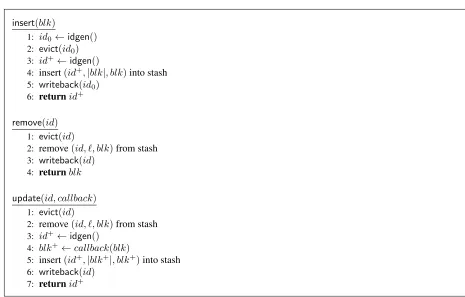
• insert(blk) 7→ id. Inserts the given blockblkof data into the ORAM and returns a new, randomly-generatedidto be used only once at a later time to retrieve the original contents.
• remove(id) 7→ blk. Removes the block corresponding to idand returns the original data blk as a sequence of bytes.
• update(id, callback)7→id+. Givenidand a user-defined functioncallback, performinsert(callback(remove(id)))
in a single step.
Each vORAM operation involves two phases:
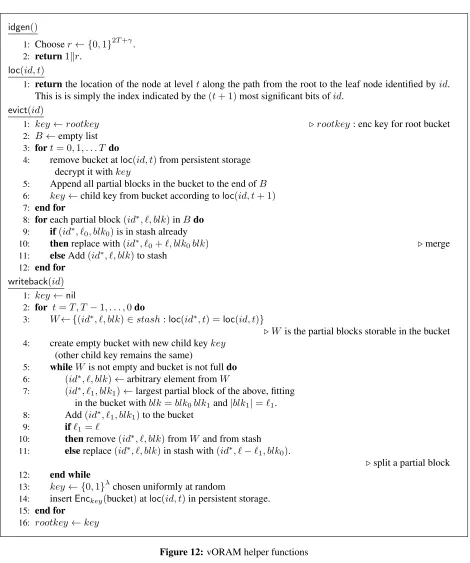
1. evict(id). Decrypt and read the buckets along the path from the root to the leaf encoded in the identifier
id, and remove all the partial blocks along the path, merging partial blocks that share an identifier, and storing them in the stash.
2. writeback(id). Encrypt all blocks along the path encoded byidwith new encryption keys and oppor-tunistically store any partial blocks from stash, dividing blocks as necessary, filling from the leaf to the root.
deleted item. Theupdateoperation evicts the path from the initialid, retrieves the block from stash, passes it to thecallbackfunction, re-inserts the result to the stash with a new randomid+, and finally callswriteback
on the originalid. A full pseudocode description of all these operations is provided in Appendix A.
Security properties. For obliviousness, anyinsert,remove,updateoperation is computationally indistin-guishable based on its access pattern because the identifier of each block is used only once to retrieve that item and then immediately discarded. Eachremoveorupdatetrivially discards the identifier after reading the path, and eachinsertevicts buckets along a bogus, randomly chosen path before returning a freshid+to be used as the new identifier for that block.
Theorem 2. The vORAM provides obliviousness.
Secure deletion is achieved via key management of buckets. Everyevictandwritebackwill result in a path’s worth of buckets to be re-encrypted and re-keyed, including the root bucket. Buckets containing any removed data may persist, but the decryption keys are erased since the root bucket is re-encrypted, rendering the data unrecoverable. Similarly, recovering any previously deleted data reduces to acquiring the old-root key, which was securely deleted from local, erasable memory.
However, eachevictandwritebackwill disclose the vORAM path being accessed, which must be han-dled carefully to ensure no leakage occurs. Fortunately, identifiers (and therefore vORAM paths as well) are uniformly random, independent of the deleted data and revealing no information about them.
Theorem 3. The vORAM provides secure deletion.
Regarding history independence, although any removed items are unrecoverable, the height of each item in the vORAM tree, as well as the history of accesses to each vORAM tree bucket, may reveal some information about theorder, or timing, of when each item was inserted. Intuitively, items appearing closer to the root level of the vORAM are more likely to have been inserted recently, and vice versa. However, if an item is inserted and then later has its path entirelyevicted due to some other item’s insertion or removal, then any history information of the older item is essentially wiped out; it is as if that item had been removed and re-inserted. Because the identifiers used in each operation are chosen at random, after someO(nlogn)
operations it is likely thateverypath in the vORAM has been evicted at least once.
Theorem 4. The vORAM provides history independence with leakage ofO(nlogn+λn)operations.
In fact, we can achieve asymptotically optimal leakage with only a constant-factor blowup in the band-width. Every vORAM operation involves reading and writing a single path. Additionally, after each op-eration, we can evict and then re-write a complete subtreeof size lgn which contains (lgn)/2−1 leaf buckets in a deterministicly chosen dummy operation that simply reads the buckets into stash, then rewrites the buckets with no change in contents but allowing the blocks evicted from the dummy operation and those evicted from the access to all move between levels of the vORAM as usual. The number of nodes evicted will be less than 2 lgn, to encompass the subtree itself as well as the path of buckets to the root of the subtree, and hence the total bandwidth for the operation remainsO(logn).
The benefit of this approach is that if these dummy subtree evictions are performedsequentiallyacross the vORAM tree on each operation, any sequence ofn/lgnoperations is guaranteed to have evicted every bucket in the vORAM at least once. Hence this would achieve history independence with onlyO(n/logn)
leakage, which matches the lower bound of Theorem 1 and is therefore optimal up to constant factors.
Theorem 5. Consider a vORAM with T levels, collision parameter γ, storing at mostn = 2T blocks, where the lengthlof each block is chosen independently from a distribution such thatE[l] =B andPr[l >
mB]< 0.5m. Then, if the bucket sizeZ satisfiesZ ≥20B, for anyR ≥1, and after any single access to the vORAM, we have
Pr[|stash|> R B]<28·(0.883)R.
Note that the constants28and0.883are technical artifacts of the analysis, and do not matter except to say that0.883<1and thus the failure probability decreases exponentially with the size of stash.
As a corollary, for a vORAM storing at mostnblocks, the cloud storage requirement is40Bnbits, and the bandwidth for each operation amounts to40Blgnbits. However, this is a theoretical upper bound, and our experiments in Section 6 show a smaller constants suffice. namely, settingZ = 6BandT =dlgn−1e
stabilizes the stash, so that the actual storage requirement and bandwidth per operation are6Bnand12Blgn
bits, respectively.
Furthermore, to avoid failure due to stash overflow or collisions, the client storage R and collision parameterγshould both grow slightly faster thanlogn, i.e.,R, γ ∈ω(logn).
5
HIRB Tree Data Structure
We now use the vORAM construction described in the previous section to implement a data structure sup-porting the operations of adictionarythat maps labels to values. In this paper, we intentionally use the word “labels” rather than the word “keys” to distinguish from the encryptionkeysthat are stored in the vORAM.
Motivating the HIRB. Before describing the construction and properties of the history independent, ran-domized B-Tree (HIRB), we first wish to motivate the need for the HIRB as it relates to the security and efficiently requirements of storing it within the vORAM:
• The data structure must be easily partitioned into blocks that have expected size bounded by a geo-metric distribution for vORAM storage.
• The data structure must bepointer-based, and the structure of blocks and pointers must form a directed graph that is anarborescence, such that there existsat most onepointer to each block. This is because a non-recursive ORAM uses random identifiers for storage blocks, which must change on every read or write to that block.
• The memory access pattern for an operation (e.g., get, set, or delete) must be bounded by a fix parameter to ensure obliviousness; otherwise the number of vORAM accesses could leak information about the data access.
• Finally, the data structure must be uniquely represented such that the pointer structures and con-tents are determined only by the set of(label,value)pairs stored within, up to some randomization performed during initialization. Recall that strong history independence is provided via a unique representation, a sufficient and necessary condition [17] for the desired security property.
In summary, we require a uniquely-represented, tree-based data structure with bounded height. While a variety of uniquely represented (or strongly history independent) data structures have been proposed in the literature [14, 30], we are not aware of any that satisfy all of the requisite properties.
HIRB tree does use hashing in order to support secure deletion, but this is only to sort the labels within the tree data structure.
Overview of HIRB tree. The closest data structure to the HIRB is the B-Skip List [15]; unfortunately, a skip list does not form a tree. The HIRB is essentially equivalent to a B-Skip List after sorting labels according to a hash function and removing pointers between skip-nodes to impose a top-down tree structure.
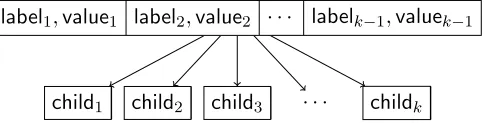
Recall that a typical B-tree consists of large nodes, each with an array of(label,value)pairs and child nodes. A B-tree node has branching factor ofk, and we call it ak-node, if the node containsk−1labels,
k−1 values, and k children (as in Figure 4). In a typical B-tree, the branching factor of each node is allowed to vary in some range[B + 1,2B], whereB is a fixed parameter of the construction that controls the maximum size of any single node.
label1,value1 label2,value2 · · · labelk−1,valuek−1
child1 child2 child3 · · · childk
Figure 4:B-tree node with branching factork
HIRB tree nodes differ from typical B-tree nodes in two ways. First, instead of storing the label in the node a cryptographic hash3 of the label is stored. This is necessary to support secure deletion of vORAM+HIRB even when the nature of vORAM leaks some history of operations; namely, revealing which HIRB node an item was deleted from should not reveal the label that was deleted.
The second difference from a normal B-tree node is that the branching factor of each node, rather than being limited to a fixed range, can take any value k ∈ [1,∞). This branching factor will observe a geometric distribution for storage within the vORAM. In particular, it will be a random variableXdrawn independently from a geometric distribution withexpectedvalueβ, whereβis a parameter of the HIRB tree construction.
The height of a node in the HIRB tree is defined as the length of the path from that node to a leaf node; all leaf nodes are the same distance to the root node for B-trees. The height of a new insertion of
(label,value)in the HIRB is determined by a series of pseudorandom biased coin flips based on the hash of thelabel4. The distribution of selected heights for insertions uniquely determines the structure of the HIRB tree because the process is deterministic, and thus the HIRB is uniquely-represented.
Parameters and preliminaries. Two parameters are fixed at initialization: theexpected branching factor
β, and theheightH. In addition, throughout this section we will writenas the maximum number of distinct labels that may be stored in the HIRB tree, andγ as a parameter that affects the length of hash digests5.
A HIRB tree node with branching factorkconsists ofk−1label hashes,k−1values, andkvORAM identifiers which represent pointers to the child nodes. This is described in Figure 5 where hi indicates
Hash(labeli).
Similar to the vORAM itself, the length of the hash function should be long enough to reduce the probability of collision below2−γ, so define|Hash(label)|= max(2Hlgβ+γ, λ), and definenodesizekto be the size of a HIRB tree node with branching factork, given as
nodesizek= (k+ 1)(2T+γ + 1) +k(|Hash(label)|+|value|),
3We need a random oracle for formal security. In practice, we used a SHA1 initialized with a random string chosen when the
HIRB tree is instantiated.
4
Note that this choice of heights is more or less the same as the randomly-chosen node heights in a skip list.
5The parameterγ for HIRB and vORAM serves the same purpose in avoiding collisions in identifiers so for simplicity we
id0h1 value1 id1 . . . hk valuek idk
Figure 5:HIRB node with branching factork.
where we write|value|as an upper bound on the size of the largest value stored in the HIRB. (Recall that the size of each vORAM identifier is2T+γ+ 1.) Each HIRB treenodewill be stored as a singleblockin the vORAM, so that a HIRB node with branching factorkwill ultimately be a vORAM block with length
nodesizek.
Asβ reflects the expected branching factor of a node, it must be an integer greater than or equal to 1. This parameter controls the efficiency of the tree and should be chosen according to the size of vORAM buckets. In particular, using the results of Theorem 5 in the previous section, and the HIRB node size defined above, one would chooseβ according to the inequality20nodesizeβ ≤ Z, whereZ is the size of each vORAM bucket. According to our experimental results in Section 6, the constant20may be reduced to6.
The heightH must be set so thatH ≥ logβn; otherwise we risk the root node growing too large. We assume thatHis fixed at all times, which is easily handled when an upper boundnis knowna priori.
HIRB tree operations. As previously described, the entries in a HIRB node are sorted by the hash of the labels, and thesearch pathfor a label is also according to the label hashes. A lookup operation for a label requires fetching each HIRB node along the search path from the vORAM and returning the matchingvalue. Initially, an empty HIRB tree of heightH is created, as shown in Figure 6. Each node has a branching factor of 1 and contains only the single vORAM identifier of its child.
.. .
H+ 1nodes
Figure 6:Empty HIRB with heightH.
Modifying the HIRB with a setordeleteoperation on some labelinvolves first computing the height of the label. The height is determined by sampling from a geometric distribution with probability (β −
1)/β, which we derandomize by using a pseudorandom sequence based onHash(label). The distribution guarantees that, in expectation, the number of items at height 0 (i.e., in the leaves) is β−β1n, the number of
items at height 1 is β−β21n, and so on.
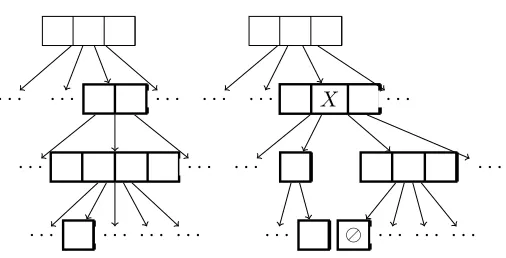
Inserting or removing an element from the HIRB involves (respectively) splitting or merging nodes along the search path from the height of the item down to the leaf. This differs from a typical B-tree in that rather than inserting items at the leaf level and propagating up or down with splitting or merging, the HIRB tree requires that the heights of all items are fixed. As a result, insertions and deletions occur at the selected height within the tree according to the label hash. A demonstration of this process is provided in Figure 7.
In a HIRB tree with height H, each get operation requires reading exactly H + 1 nodes from the vORAM, and eachsetordeleteoperation involves reading and writing at most2H+ 1nodes. To support obliviousness, each operation will require exactly2H+1, accomplished by padding with “dummy” accesses so that every operation has an indistinguishable access pattern.
. . . .
. . .
. . . . . . .
. . . X
. . .
. . . . . . . . . . . . .
Figure 7: HIRB insertion/deletion ofX = (Hash(label),value): On the left is the HIRB without itemX, displaying only the nodes along the search path forX, and on the right is the state of the HIRB withXinserted. Observe that the insertion operation (left to right) involves splitting the nodes belowX in the HIRB, and the deletion operation (right to left) involves merging the nodes belowX.
update. However, properties of the HIRB tree enable better performance because the height of each HIRB tree element is uniquely determined, which means we can perform the updateson the way downin the search path. This only requires 2 HIRB tree nodes to be stored in local memory at any given time.
Facilitating this extra efficiency requires considerable care in the implementation due to the nature of vORAM identifiers; namely, each internal node must be written back to vORAM before its children nodes are fetched. Fetching children nodes willchangetheir vORAM identifiers and invalidate the pointers in the parent node. The solution is topre-generatenew random identifiers of the child nodes before they are even accessed from the vORAM.
The full details of the HIRB operations can be found in Appendix B.
HIRB tree properties. For our analysis of the HIRB tree, we first need to understand the distribution of items among each level in the HIRB tree. We assume a subroutinechooseheight(label)evaluates a random function onlabelto generate random coins, using which it samples from a truncated geometric distribution with maximum valueHand probability(β−1)/β.
Assumption 6. If label1, . . . ,labelnare anyndistinct labels stored in a HIRB, then the heights
chooseheight(label1), . . . ,chooseheight(labeln)
are independent random samples from a truncated geometric distribution over{0,1, . . . , H} with proba-bility(β −1)/β, where the randomness is determined entirely by the the random oracle and the random function upon creation of the HIRB.
In practice, the random coins forchooseheight(label)are prepared by computingcoins= PRG(SHA1(seedklabel)), whereseedis a global random seed, and PRG is a pseudorandom generator. With SHA1 modeled as a
ran-dom oracle, thecoinswill be pseudorandom.
Theorem 7. The HIRB tree is a dictionary data structure that associates arbitrarylabels to values. If it contains nitems, and has heightH ≥ logβn, and the nodes are stored in a vORAM, then the following properties hold:
• The probability of failure in any operation is at most2−γ.
• Each operation requires exactly2H+ 1node accesses, only 2 of which need to be stored in temporary memory at any given time.
The first property follows from the fact that the only way the HIRB tree can fail to work properly is if there is a hash collision. Based on the hash length defined above, the probability that any2 keys collide amongst the n labels in the HIRB is at most 2−γ. The second property follows from the description of the operationsget,set, anddelete, and is crucial not only for the performance of the HIRB but also for the obliviousness property. The third property is a consequence of the fact that the HIRB is uniquely represented up to the pointer values, after the hash function is chosen at initialization.
vORAM+HIRB properties. We are now ready for the main theoretical results of the paper, which have to do with the performance and security guaranteed by the vORAM+HIRB construction. These proofs follow in a straightforward way from the results we have already stated on vORAM and on the HIRB, so we leave their proofs to Appendix B.
Theorem 8. Suppose a HIRB tree withnitems and heightHis stored within a vORAM withLlevels, bucket sizeZ, and stash sizeR. Given choices forZ andγ >0, set the parameters as follows:
T ≥lg(4n+ lgn+γ)
β= max{β|Z ≥20·nodesizeβ}
R≥γ·nodesizeβ
H≥logβn
Then the probability of failure due to stash overflow or collisions after each operation is at most
Pr[vORAM+HIRB failure]≤30·(0.883)γ.
The parameters follow from the discussion above. Again note that the constants 30 and 0.883 are technical artifacts of the analysis.
Theorem 9. Suppose a vORAM+HIRB is constructed with parameters as above. The vORAM+HIRB pro-vides obliviousness, secure deletion, and history independence with leakage ofO(n+nλ/(logn)) opera-tions.
The security properties follow from the previous results on the vORAM and the HIRB. Note that the HIRB structure itself provides history independence with no leakage, but when combined with the vORAM, the pointers may leak information about recent operations. The factorO(logn)difference from the amount of leakage from vORAM in Theorem 4 arises because each HIRB operation entails O(logn) vORAM operations. Following the discussion after Theorem 4, we could also reduce the leakage in vORAM+HIRB toO(n/log2n), with constant-factor increase in bandwidth, which again is optimal according to Theorem 1.
6
Evaluation
We completed two empirical analyses of the vORAM+HIRB system. First, we sought to determine the most effective size for vORAM buckets with respect to the expected block size, i.e., the ratioZ/B. Second, we made a complete implementation of the vORAM+HIRB and measured its performance in storing a realistic dataset of key/value pairs of 22MB in size. The complete source code of our implementation is available upon request.
6.1 Optimizing vORAM parameters
�� ��� ���� ����� ������ ������� ������
�� �� �� �� �� ��� ���
�������������������������������������
������������������������������������������ ����� ������ ������� ��������
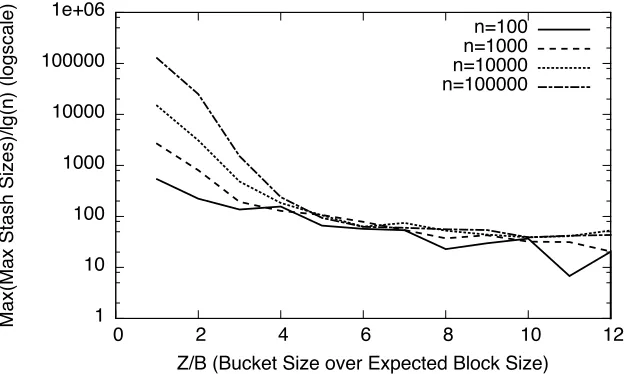
Figure 8:Maximum stash size, scaled bylogn, observed across 50 simulations of a vORAM for variousZ/Bvalues.
the vORAM.) This ratio is a constant factor in the bandwidth of every vORAM operation and has a consid-erable effect on performance. In the Path ORAM, the best corresponding theoretical ratio is5, whereas it has been shown experimentally that a ratio of4will also work, even in the worst case [37].
We performed a similar experimental analysis of the ratioZ/B for the vORAM. Our best theoretical ratio from Theorem 5 is 20, but as in related work, the experimental performance is better. The goal is then to find the optimal, empirical choice for the ratioZ/B: IfZ/B is too large, this will increase the overall communication cost of the vORAM, and if it is too small, there is a risk of stash overflow and loss of data or obliviousness.
For the experiments described below, we implemented a vORAM structure without encryption and inserted a chosen number of variable size blocks whose sizes were randomly sampled from a geometric distribution with expected size 68 bytes. To avoid collisions, we ensured the identifier lengths satisfied
γ ≥40.
Stash size. To analyze the stash size for differentZ/Bratios, we ran a number of experiments and moni-tored the maximum stash size observed at any point throughout the experiment. Recall, while the stash will typically be empty after every operation, the max stash size should grow logarithmically with respect to the number of items inserted in the vORAM. The primary results are presented in Figure 8.
This experiment was conducted by running 50 simulations of a vORAM withninsertions and a height ofT = lgn. TheZ/Bvalue ranged from 1 to 50, and results in the range 1 through 12 are presented in the graph for values ofnranging from102through105. The graph plots the ratioR/lgn, whereRis the largest max stash size at any point in any of the 50 simulations. Observe that betweenZ/B = 4andZ/B = 6the ratio stabilizes for all values ofn, indicating a maximum stash of approximately100 lgn.
In order to measure how much stash would be needed in practice for much larger experimental runs, we fixed Z/B = 6 and for three large database sizes,n = 218,219,220, For each size, we executed 2n
operations, measuring the size of stash after each. In practice, as we would assume from the theoretical results, the stash size is almost always zero. However, the stash does occasionally become non-empty, and it is precisely the frequency and size of these rare events that we wish to measure.
Figure 9 shows the result of our stash overflow experiment. We divided each test run of roughly 2n
24 26 28 210 212 214 216 218 220
0 2 4 6 8 10 12
M e a n N u m . o f O p e r. U n ti l S ta sh S iz e
Stash Size (KB)
218 items, total 2MB 219 items, total 4MB 220 items, total 8MB
Figure 9: Average time until stash overflow, for varying vORAM and stash sizes. Stash size is linear-scale, number of operations in log-scale. Higher is better. For each vORAM sizen, we performed2noperations to gather sufficient experimental data.
—
shows a linear trend in log-scale, meaning that the stash size necessary to ensure low overflow probability afterN operations isO(logN), as expected. Furthermore, in all experiments we never witnessed a stash size larger than roughly 10KB, whereas the theoretical bound of 100 lgn items would be 16KB for the largest test with2208-byte items.
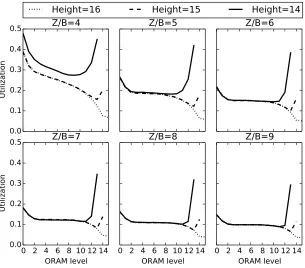
Bucket utilization. Stash size is the most important parameter of vORAM, but it provides a limited view into the optimal bucket size ratio, in particular as the stash overflow is typically zero after every operation, for sufficiently large buckets. We measured the utilization of buckets at different levels of the vORAM with varied heights andZ/B values. The results are presented in Figure 10 and were collected by averaging the final bucket utilization from 10 simulations. The utilization at each level is measured by dividing the total storage capacity of the level by the number of bytes at the level. In all cases,n = 215elements were inserted, and the vORAM height varied between 14, 15, and 16. The graph shows that with heightlgn= 15
or higher andZ/Bis 6 or higher, utilization stabilizes throughout all the levels (with only a small spike at the leaf level).
The results indicate, again, that whenZ/B = 6, the utilization at the interior buckets stabilizes. With smaller ratios, e.g.,Z/B= 4, the utilization of buckets higher in the tree dominates those lower in the tree; essentially, blocks are not able to reach lower levels resulting in higher stash sizes (see previous experiment). With larger ratios, which we measured all the way toZ/B = 13, we observed consistent stabilization.
In addition, our data shows that decreasing the number of levels fromlgntolgn−1(e.g., from 15 to 14 in the figure) increases utilization at the leaf nodes as expected (as depicted in the spike in the tail of the graphs), but whenZ/B≥6the extra blocks in leaf nodes donotpropagate up the tree and affect the stash. It therefore appears that in practice, the number of levelsT could be set to lgn−1, which will result in a factor of 2 savings in the size of persistent (cloud) storage due to high utilization at the leaf nodes. This follows a similar observation about the height of the Path ORAM made by [37].
6.2 Measuring vORAM+HIRB Performance
0.0
0.1
0.2
0.3
0.4
0.5
Utilization
Z/B=4
Z/B=5
Z/B=6
0 2 4 6 8 10 12 14
ORAM level
0.0
0.1
0.2
0.3
0.4
0.5
Utilization
Z/B=7
0 2 4 6 8 10 12 14
ORAM level
Z/B=8
0 2 4 6 8 10 12 14
ORAM level
Z/B=9
Height=16
Height=15
Height=14
Figure 10:Utilization at different levels of ORAM
levels of security and efficiency. All of our implementations used the same client/server setup, with a Python3 implementation and AWS as the cloud provider, in order to give a fair comparison.
Sample dataset. We tested the performance of our implementation on a dataset of 300,000 synthetic key/value pairs where where keys were variable sizes (in the order of bytes 10-20 bytes) and values were fixed at 16 bytes. The total unencrypted data set is 22MB in size. In our experiments, we used some subset of this data dependent on the size of the ORAM, and for each size, we also assumed that the ORAM user would want to allow the database to grow. As such, we built the ORAM to double the size of the initialization.
Optimized vORAM+HIRB implementation. We fully implemented our vORAM+HIRB map data struc-ture using Python3 and Amazon Web Services as the cloud service provider. We used AES256 for encryption in vORAM, and used SHA1 to generate labels for the HIRB. In our setting, we considered a client running on the local machine that maintained the erasable memory, and the server (the cloud) provided the persistent storage with a simple get/set interface to store or retrieve a given (encrypted) vORAM bucket.
For the vORAM buckets, we chooseZ/B= 6based on the prior experiments, and a bucket size of 4K, which is the preferred back-end transfer size for AWS, and was also the bucket size used by [4]. One of the advantages of the vORAM over other ORAMs is that the bucket size can be set to match the storage requirements with high bucket utilization. The settings for the HIRB were then selected based on Theorem 8 and based on that, we calculated aβ = 12for the sample data (labels and values) stored within the HIRB. The label, value, and associated vORAM identifiers total 56 bytes per item.
In our experiments, we found that the round complexity of protocols dominate performance and so we made a number of improvements and optimizations to the vORAM access routines to compensate. The result is an optimized version of the vORAM. In particular:
in parallel to fetch and send ORAM block files, and each maintained a persistentsftpconnection.
• Buffering: A local buffer storing 2T top-most ORAM buckets was used to facilitate asynchronous path reading and writing by our threads. Note the size of the client storage still remains withO(logn)
sinceT = O(logn). This had an added performance benefit beyond the parallelization because the top few levels of the ORAM generally resided in the buffer and did not need to be transferred back and forth to the cloud after every operation.
These optimizations had a considerable effect on the performance. We did not include the cost of the
≈ 2 second setup/teardown time for these SSL connections in our results as these were a one-time cost incurred at initialization. Many similar techniques to these have been used in previous work to achieve similar performance gains (e.g., [25, 41]), although they have not been previously applied to oblivious data structures.
Comparison baselines. We compared our optimized vORAM+HIRB construction with four other alter-native implementations of a remote map data structure, with a wide range of performance and security properties:
• Un-optimized vORAM+HIRB. This is the same as our normal vORAM+HIRB construction, but with-out any buffering of vORAM buckets and with only a single concurrent sftp connection. This com-parison allows us to see what gains are due to the algorithmic improvements in vORAM and HIRB, and which are due to the network optimizations.
• Naive Baseline: We implemented a naive approach that provides all three security properties, oblivi-ousness, secure deletion, and history independence. The method involves maintaining a single, fixed-size encrypted file transferred back and forth between the server and client and re-encrypted on each access. While this solution is cumbersome for large sizes, it is the obvious solution for small databases and thus provides a useful baseline. Furthermore, we are not aware of any other method (other than vORAM+HIRB) to provide obliviousness, secure-deletion, and history independence.
• ORAM+AVL: We implemented the ODS proposed by [40] of an AVL embedded within an non-recursive Path ORAM. Note that ORAM+AVL does not provide secure deletion nor history inde-pendence. We used the same cryptographic settings as our vORAM+HIRB implementation, and used 256 byte blocks for each AVL node, which was the smallest size we could achieve without additional optimizations. As recommended by [37], we storedZ = 4fixed-size blocks in each bucket, for a total of 1K bucket size. Note that this bucket size is less than the 4K transfer size recommended by the cloud storage, which reflects the limitation of ORAM+AVL in that it cannot effectively utilize larger buckets. We add the observation that, when the same experiments were run with 4K size buckets (more wasted bandwidth, but matching the other experiments), the timings did not change by more than 1 second, indicating that the 4K bucket size is a good choice for the AWS back-end.
• SD-B-Tree: As another comparison point, we implemented a remotely stored B-Tree with secure deletion where each node is encrypted with a key stored in the parent with re-keying for each access, much as described by Reardon et al. [34]. While this solution provides secure deletion, and stores all data encrypted, it does not provide obliviousness nor history independence. Again, we used AES256 encryption, withβ = 110for the B-tree max internal node size in order to optimize 4K-size blocks.
����� ���� �� ��� ���� ����� ������
�� ��� ��� ��� ��� ��� ��� ��� ��� ��� ���
���������������������������������
���������������������������� ����������������������
������������������������� �������� ��������� ��������������
Figure 11:Median of 100 access times for different number of entries
In terms of asymptotic performance, the SD-B-Tree is fastest, requiring onlyO(logn)data transfer per operation. The vORAM+HIRB and ORAM+AVL both requireO(log2n) data transfer per operation, al-though as discussed previously the vORAM+HIRB saves a considerable constant factor. The naive baseline requiresO(n)transfer per operation, albeit with the smallest possible constant factor.
Experimental results. The primary result of the experiment is presented in Figure 11 where we compared the cost of a single access time (in seconds) across the back end storage (note, graph is log-log). Unsurpris-ingly, the SD-B-Tree implementation is fastest for sufficiently large database sizes. However, our optimized vORAM+HIRB implementation was competitive to the SD-B-Tree performance, both being less than 1 second across our range of experiments.
Most striking is the access time of ORAM+AVL compared to the vORAM+HIRB implementations. In both the optimized and un-optimized setting, the vORAM+HIRB is orders of magnitude faster than ORAM+AVL, 20X faster un-optimized and 100X faster when optimized. Even for a relatively small number of entries such as211, a single access of ORAM+AVL takes 35 seconds, while it only requires 1.3 seconds of un-optimized vORAM+HIRB and 0.2 second of an optimized implementation. It is not until219entries that ORAM+AVL even outperforms the naiveO(n)baseline solution.
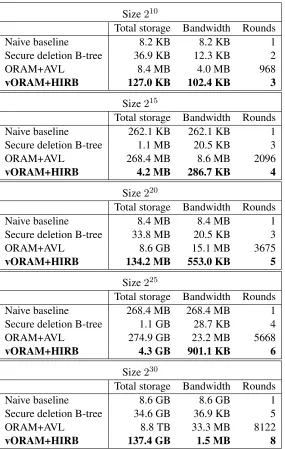
As described previously, we attribute much of the speed to decreasing the round complexity. The HIRB tree requires much smaller height as compared to an AVL tree because each HIRB node containsβitems on average as compared to just a single item for an AVL tree. Additionally, the HIRB’s height is fixed and does not require padding to achieve obliviousness. Each AVL operation entails3·1.44 lgN ORAM operations as compared to just2 logβN vORAM operations for the HIRB. This difference in communication cost is easily observed in Table 1. Overall, we see that the storage and communication costs for vORAM+HIRB are not too much larger than that for a secure deletion B-tree, which does not provide any access pattern hiding as the oblivious alternatives do.
(The values in this table were generated by considering the worst-case costs in all cases, for our actual implementations, but considering only a single operation. Note that, for constructions providing oblivious-ness, every operation mustactuallyfollow this worst case cost, and so the comparison is fair.)
Size210
Total storage Bandwidth Rounds
Naive baseline 8.2 KB 8.2 KB 1
Secure deletion B-tree 36.9 KB 12.3 KB 2
ORAM+AVL 8.4 MB 4.0 MB 968
vORAM+HIRB 127.0 KB 102.4 KB 3 Size215
Total storage Bandwidth Rounds
Naive baseline 262.1 KB 262.1 KB 1
Secure deletion B-tree 1.1 MB 20.5 KB 3
ORAM+AVL 268.4 MB 8.6 MB 2096
vORAM+HIRB 4.2 MB 286.7 KB 4 Size220
Total storage Bandwidth Rounds
Naive baseline 8.4 MB 8.4 MB 1
Secure deletion B-tree 33.8 MB 20.5 KB 3
ORAM+AVL 8.6 GB 15.1 MB 3675
vORAM+HIRB 134.2 MB 553.0 KB 5 Size225
Total storage Bandwidth Rounds
Naive baseline 268.4 MB 268.4 MB 1
Secure deletion B-tree 1.1 GB 28.7 KB 4
ORAM+AVL 274.9 GB 23.2 MB 5668
vORAM+HIRB 4.3 GB 901.1 KB 6 Size230
Total storage Bandwidth Rounds
Naive baseline 8.6 GB 8.6 GB 1
Secure deletion B-tree 34.6 GB 36.9 KB 5
ORAM+AVL 8.8 TB 33.3 MB 8122
vORAM+HIRB 137.4 GB 1.5 MB 8