Advances in Medical Education and Practice
Dove
press
P E r s P E c T i v E s
open access to scientific and medical research
Open Access Full Text Article
innoversity in knowledge-for-action
and adaptation to climate change: the first steps
of an ‘evidence-based climatic health’ transfrontier
training program
véronique Lapaige
1–3Hélène Essiembre
41Department of Psychiatry, University
of Montreal, Montreal, Qc, canada;
2Fernand-seguin research centre,
Montreal, Qc, canada; 3Quebec
National Public Health institute,
4industrial and Organizational
Program, Department of Psychology, University of Montreal, Montreal, Qc, canada
correspondence: véronique Lapaige centre de recherche Fernand-seguin de l’Hôpital Louis-H. Lafontaine (Fonds de recherche en santé du Québec), Université de Montréal and institut national de santé publique du Québec (Unité santé et Environnement, Québec),
OUrANOs-550 sherbrooke Ouest, 19th Floor, Montreal,
Qc H3A 1B9, canada Tel +1 514 282 6464 ext 267; +1 514 366 9854
Fax +1 514 282 7131
Email [email protected]; [email protected]
Abstract: It has become increasingly clear to the international scientific community that climate
change is real and has important consequences for human health. To meet these new challenges, the World Health Organization recommends reinforcing the adaptive capacity of health systems. One of the possible avenues in this respect is to promote awareness and knowledge translation in climatic health, at both the local and global scales. Within such perspective, two major themes have emerged in the field of public health research: 1) the development of advanced training adapted to ‘global environment’ change and to the specific needs of various groups of actors (doctors, nurses, public health practitioners, health care managers, public service managers, local communities, etc) and 2) the development of strategies for implementing research results and applying various types of evidence to the management of public health issues affected by climate change. Progress on these two fronts will depend on maximum innovation in transdis-ciplinary and transsectoral collaborations. The general purpose of this article is to present the program of a new research and learning chair designed for this double set of developmental objectives – a chair that emphasizes ‘innoversity’ (the dynamic relationship between innovation and diversity) and ‘transfrontier ecolearning for adaptive actions’. The Écoapprentissages, santé mentale et climat collaborative research chair (University of Montreal and Quebec National Public Health Institute) based in Montreal is a center for ‘transdisciplinary research’ on the transfrontier knowledge-for-action that can aid adaptation of the public health sector, the public mental health sector, and the public service sector to climate change, as well as a center for complex collaborations on evidence-based climatic health ‘training’. This program-focused article comprises two main sections. The first section presents the ‘general’ and ‘specific contexts’ in which the chair emerged. The ‘general context’ pertains to the health-related challenge of finding ways to integrate, transfer, and implement knowledge, a particularly pointed challenge in Canada. The ‘specific context’ refers to the emerging research field of adaptation of public health to climate change. In the second section, the characteristics of the research chair are more extensively detailed (the vision of ‘innoversity’ and ‘ transfrontier knowledge-for-action,’ the approach of shared responsibility and complex collaboration, objectives, and major axes of research). We conclude with a call for complex collaboration toward knowledge-for-action in public health services/mental health services/public services’ adaptation to climate change: this call is aimed at individual and institutional actors in the North and South/West and East concerned by these issues.
Keywords: global changing environment, climatic health, adaptation to climate change, adaptive capacity, innoversity, diversity, complex collaboration, transdisciplinary knowledge-for-action, transfrontier training, andragogy, continuing education, ecocompetency, public health, mental
Advances in Medical Education and Practice downloaded from https://www.dovepress.com/ by 118.70.13.36 on 19-Aug-2020
For personal use only.
Number of times this article has been viewed
This article was published in the following Dove Press journal: Advances in Medical Education and Practice
Dovepress
Lapaige and Essiembre
health, health professional, public service manager, knowledge translation, implementation science, ecolearning, ecomanagement, eco-decision-making
Introduction
Globalization today constitutes a major challenge
1–4for the
public health sector and its involved professionals (Ciliska
5defines ‘public health professionals’ as ‘first-line’ clinicians
and workers, researchers, managers, and decision makers
in public health). These professionals are collectively
con-cerned with achieving an eco-socio-efficient public health
as well as the steady growth of an equitable public health
system.
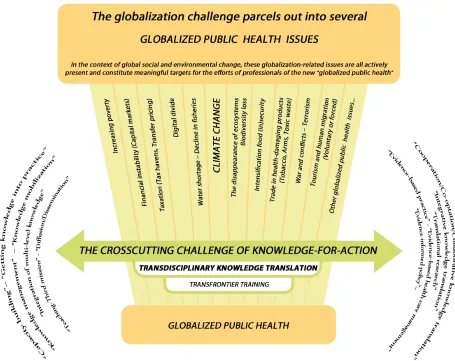
1–3,6–10The globalization challenge parcels out into
several ‘inherently global health issues,’
8such as the struggle
against climate change and drought, the establishment of
international rules for migrant labor, the fight against
pov-erty and for health equity, the management of fallout from
natural catastrophes, and the fight against infectious disease
(Figure 1). In the context of global social and environmental
change, these globalization-related issues are all actively
present and constitute meaningful targets for the efforts of
professionals of the new ‘globalized public health’.
4At another level, we find a second major challenge for
globalized public health: knowledge-for-action or knowledge
translation (KT).
11–13This is a transversal challenge because
it cuts across the issues raised by globalization mentioned
previously (Figure 1).
4,14In an era of hyperconnectivity and the
global economy of knowledge,
15–17this transversal challenge is
inherent in the valorization of knowledge as well as the updating
and transfer of knowledge for each contemporary public health
issue.
14,18This challenge is often referred to in public health
circles as that of the ‘integration’
13,18–29of multilevel
knowl-edge, of the ‘transfer’ of knowledge toward decision makers
or again, of the knowledge-for-action (KT), ie, the ‘practical
implementations’ or ‘exemplary behaviors’.
11,12,30–35The ‘big issue,’ in the Quebec/Canadian context, is
climate change (ie, local Agenda 21).
36,37At a larger scale,
as reported by the UCL-Lancet Commission, ‘climate
change is the biggest global health threat of the 21st
century’.
38Several considerations motivate this priority:
•
Unequivocal recognition of the importance of this
phe-nomenon by the international scientific community
39•
Universal recognition of the unprecedented priority of this
phenomenon by local,
40–48regional, and worldwide
49–53governmental and scientific bodies, given the intensive
(rapid and severe) and extensive (present and projected)
nature of the inherent risks
•
Major health risks resulting from local,
37,54–58regional, and
worldwide
59–66climate change, particularly with respect
•
Repeated calls at various levels
7,41,49,55,56,66–78for reinforcement
of the ‘adaptive capacity’ of the health systems that are
faced with the challenges of climate change
•
The necessity for collaborative and integrated
intersec-toral action that will reinforce transfer of knowledge
toward health professionals and increase awareness in
the general population of current challenges arising from
climate change: these collaborative actions should aim
at ‘adaptive,’ evidence-based, and effective risk
manag-ement.
6,7,40,50,55,66,79–83The struggle against global warming and the efforts to
‘adapt’ to its inevitable escalation require a shared
understand-ing of the problems society will be facunderstand-ing over the comunderstand-ing
decades. However, this understanding must then lead to action
in the form of ecobehaviors
84–88(decision-making,
eco-management) adopted in a responsible and sustainable manner
by a maximum of individuals and groups (ecocompetency).
No one today can escape global warming and its challenges.
89Public health,
66–68,74,80,90–93along with other sectors,
94must
respond to these challenges by continually updating its
data-base and professional competences, as well as developing new
ways of thinking, communicating, and acting.
73Thus, at the dawn of the 21st century, public health
pro-fessionals in Quebec, Canada, and elsewhere in the world
are faced with a double challenge (Figure1):
•
Part 1 – Transdisciplinary KT (the utilization/integration/
transfer/implementation of knowledge)
•
Part 2 – ‘Adaptation’ to climate change
36,37Before proposing a program to meet this crosscutting
challenge, we will examine the specific demands associated
with each of the aforementioned parts (Part 1 and Part 2), which
will in turn allow us to set forth the research chair’s vision
and mission, as well as the objectives of its programmatic
research axes. Again, our working hypothesis concerning KT
is that there is a codependent relationship
95–97between
‘adap-tation’ measures (that seek to reduce the impact of climate
change on nature and human society) and mitigation measures
(that target the causes of climate change and seek to reduce
the greenhouse gas anthropogenic emission).
Some sectors particularly concerned with ‘adaptation’
are health, the environment, and public security. Those
sectors more particularly concerned with ‘mitigation’ are
energy, transportation, municipal government, and
agricul-ture. Although adaptation is a characteristic, even inevitable,
option for public health, this sector must imperatively target
Advances in Medical Education and Practice downloaded from https://www.dovepress.com/ by 118.70.13.36 on 19-Aug-2020
Figure 1 Transdisciplinary knowledge-for-action: A crosscutting challenge in globalized public health.
Dovepress innoversity in knowledge-for-action and adaptation to climate change
This program of KT in the face of climate change has, then,
the global objective of supporting the action
(ecodecision-making, ecointervention, and ecomanagement) of certain
targeted groups (managers, deciders, clinicians, public health
professionals, external partners, community workers, medias,
and general public). As a function of each group’s specific
needs, this support could take many forms: communicating
new knowledge, providing general information, increasing
awareness of other cultural values, promoting change in the
public’s perception of climate change, modifying professional
practice, enlightening decision making, and developing new
professional competencies in climatic health.
Specific and general contextual
determinants of the program
The challenge of KT in Quebec
and canada (general context)
The issue of the diffusion and utilization of research results
as well as the more general question of knowledge transfer
the clinical and management professional community. Some
consider themselves to be ‘doing’ knowledge transfer when
they publish their studies or disseminate practical manuals.
Other professionals such as clinicians or managers attempt
to integrate concepts:
•
Evidence-based medicine, concrete application of
research results (getting research into practice), and ‘best
practice’
98–102•
Clinical governance and improvement of health care
103–105•
‘Integrated’ patient care
106•
‘Shared’ care (shared decision making)
107–109•
Knowledge management
110–114•
Organizational learning and knowledge sharing within
communities of practitioners
115–121Are all of these examples of ‘knowledge transfer?’ And
do concepts such as ‘transfer,’ ‘application,’ ‘diffusion,’
‘dissemination,’ ‘utilization,’ ‘exchange,’ and ‘sharing’ of
knowledge mean the same thing? All of these concepts issue
from the same culture of evidence-based decision making,
but each has a precise meaning as well as a conceptual
Advances in Medical Education and Practice downloaded from https://www.dovepress.com/ by 118.70.13.36 on 19-Aug-2020
Dovepress
Lapaige and Essiembre
this conceptual plurality, which concept should we chose
and which should be the preferred approach in the chair’s
program?
Over the last decade, various actors within Quebec and
Canada have promoted a professional culture of
evidence-based decision making.
127•
Since 1997–1998, the National Forum on Health has
established the development of this culture as one of the
main health sector objectives for the 21st century.
•
At the same time, the Canadian Health Services Research
Foundation (CHSRF) has made a priority of
evidence-based decision making in the organization, management,
and delivery of health services.
•
The same importance was granted to evidence-based
management within the Executive Training for Research
Applications (EXTRA) program, created at the beginning
of this century by the CHSRF in partnership with three
institutions: the Canadian College of Health Services
Directors, the Canadian Medical Association, and the
Canadian Nurses Association. The goal of the EXTRA
program is to acquaint deciders with research within a
culture of evidence-based decision making.
128•
Finally, many professional organizations (nurses, doctors,
and other health professionals) at provincial and national
levels have adopted an evidence-based approach during
this same period.
This ‘evidence-based’ culture includes:
1. ‘Evidence-based medicine,’ appearing in the early 1990s,
but rapidly expanding to ‘evidence-based practice’ across
clinical health sciences (namely, evidence-based nursing,
evidence-based social work, etc)
30,126,129–1322. ‘Evidence-based public health,’ including
‘evidence-based health promotion’ that particularly involves public
health professionals confronted with the development
of complex interventions, implementing, and evaluating
new programs
133–1393. ‘Evidence-based health care management’ that involves
clinical administrators and public health managers
1404. All of these evidence-based components call for an
‘overall evidence-based health care organization’
141,142that will be capable of formulating ‘evidence-informed
policies’
34,143,144Canada’s current position as one of the world
lead-ers in research on KT is no accident.
18,127From the end of the
20th century, the Canadian position has clearly been to apply
research results at all levels of health care and health care
management: micro (clinical), meso (management), and macro
(political).
18,127Since the end of the 1980s, the Canadian health
system, along with many health systems around the developed
world, has entered a deepening structural crisis involving aging
populations, national budget limitations, an exponentially
growing research literature, and the arrival of new, expensive
medical technologies. In spite of this deepening crisis, Canada
has remained faithful to its commitment to apply research
results to decisional processes as a privileged means for
pro-viding equitable health care to her citizens.
145In the context
of a knowledge economy,
146,147the adoption of a knowledge
management strategy followed by research-informed decision
making in clinical, management, and political environments
has been placed at the heart of policies targeting the Canadian
objectives of equity and effectiveness of the health system.
144,148–151
However, in spite of these efforts to promote utilization
of evidence, there is a significant gap between knowledge
produced and made public and expected changes in behavior
and practice on the part of deciders (knowledge users) within
the health system.
152–154This ‘know-do’ gap has been held
responsible for subperformance of health systems and growing
disparities/inequities in health care.
124,150,155–158These negative
consequences are all the more regrettable because they could
have been avoided if the available research results had been
applied.
137,138Unfortunately, there appears to be nothing linear or
auto-matic about the effective utilization of research results that
become available to health system professionals. Instead, we
see a complex, dynamic, and iterative process that involves
various actors with their specific needs, interacting in an
asymmetrical information context that includes the constraints
inherent in the results themselves as well as the specific
con-straints characteristic of the targeted environments.
123,144,159Because of this complexity, effective KT becomes a process
involving a multitude of actors ( producers and users of
knowledge) interacting at several levels. We can begin to
speak of an ‘exchange’ of knowledge and, consequently, of
‘collaborative’ strategies that can initiate or facilitate dynamic
and multidirectional communications between knowledge
producers and potential users. In recent years, these
interac-tions and collaborative strategies have been successively
structured in a series of knowledge use models (science
push, demand, problem solving, enlightenment, strategic, and
deliberative).
30,160–164Depending on the model, research results
could impact through ‘instrumental’ use (ie, the direct impact
of research results on practice and policy), ‘conceptual’ use (ie,
the impact of research results on thinking and understanding),
and ‘symbolic use’ (ie, the use of research results as a political
tool to legitimatize opposition or practice).
164–167Development
of these models has led to the progressive emergence of
Advances in Medical Education and Practice downloaded from https://www.dovepress.com/ by 118.70.13.36 on 19-Aug-2020
Dovepress innoversity in knowledge-for-action and adaptation to climate change
an entire research area, which was first called ‘transfer of
research results’ in Quebec, and later termed ‘transfer of
knowledge,’ then ‘KT’ by the Canadian Institutes of Health
Research (CIHR).
11,123,124,168As for ‘knowledge transfer,’ the
CIHR uses this term to refer to the transformation of tacit
knowledge into explicit knowledge.
123,124Over recent years, KT has evolved from a field of
study
151into a dynamic research area with its own limits,
subdivisions, and challenges.
11,30,38,123,126Today, one speaks
not only of a ‘practice’ of KT comprising the development
of a fundamental knowledge-to-action process,
aalong with
several typical knowledge application ‘activities,’ but also
me speaks of a ‘science’ of KT, characteristic of a major
research area.
123,168KT research concentrates on the scientific
study of the determinants, processes, and outcomes of KT.
The overall goal is to foster the development of a theoretical
foundation and empirical database that can be generalized
to optimize the KT process and its knowledge application
activities. As other worldwide scientists, many Canadian
sci-entists have put KT research on the map as a new domain of
interdisciplinary health research, at the junction of behavioral
sciences (social psychology), clinical sciences (medicine
and nursing), organizational and managerial sciences (health
administration), and research on health services.
172This new domain now includes nine
bsubdivisions.
159,168Each confronts specific challenges
38,168(terminological,
conceptual, methodological, and evaluation challenges), and
can be viewed from two main perspectives.
The first perspective is a process- centered view on the
transfer of technologies
173–178and/or transfer of innovations.
179–184
It permits identification of the successive steps in the
KT process as well as confirmation of its interactive
character.
144,181,185–195Among the various process-centered
conceptual frameworks,
30,194–201the Canadian school
cgenerally favors Graham’s knowledge-to-action process
framework
124,201(this model has been modified in our program
to become transdisciplinary).
The second perspective is a determinants’-oriented
perspective. Studies of organizational determinants have
targeted either public organizations such as administrative
institutions,
202,203research centers, and universities,
144,204or
private organizations such as industries.
205Studies of individual
determinants have targeted actors up- or downstream
from KT: deciders,
206–209managers, professionals,
210,211knowledge brokers,
212researchers,
159,189,212,213and the general
population.
213In our program, we study determinants related to
the following: 1) actors, 2) knowledge, 3) organizational and
contextual
159characteristics, and 4) the 18-odd features that
characterize complex collaborations and ‘transdisciplinary’
KT research and practice.
214The challenge of climate change
in Quebec and Canada (specific context)
For Quebec, Canada, and other societies, today’s indisputable
global warming will bring not only an increase in average
temperatures, but also a rise in sea level, and increased risk
for extreme climatic and meteorological events.
39Although
climatic variability has always been part of our world, a
major, qualitative change has occurred over the last 50 years.
Human activity, notably in the increased use of fossil fuels
and in new techniques of agricultural exploitation, has
gen-erated the major
50contribution to the average temperature
increase observed worldwide.
39,50,215,216Along with other
human-driven global environmental changes, climate change
constitutes a menace for the entire ecosystem, and therefore
for human health.
215–219a Knowledge-to-action (KT) is an interactive, dynamic, and complex
process.123,168,169 It is interactive in the sense that it occurs within a system
of exchanges among producers and users of knowledge, and oftentimes includes other actors. It is dynamic in the sense that it involves a range of actions such as adoption, integration, mobilization, and use of knowledge in order to transform or concretely apply knowledge toward better practice and exemplary actions. Finally, KT is complex, implying as it does: 1) identification of the know-do gap within each problem area, and identification of existing knowledge and knowledge needs for various targeted groups; 2) examination of knowledge in order to adapt it to local needs; 3) acquaintance with all actors involved, and an understanding of their interactions; 4) familiarity with the local context within which knowledge will be used, shared, or transformed; 5) identification of obstacles and facilitating factors to KT; 6) development of strategies as well as professional activities through which knowledge can be assimilated and integrated by concerned local actors, leading ultimately to modified perceptions and practices; and 7) evaluation of the results of the KT process: was the trans-ferred knowledge accessible, understood, and used? Did the targeted group demonstrate changes in understanding, attitudes, and professional practice? Did the KT process demonstrate sustainability, innovation, and did it lead to complex collaboration?170,171
b 1) Knowledge synthesis (to identify the knowledge for KT); 2) Research
into the evolution of and critical discourse around research evidence; 3) Research into knowledge retrieval, evaluation, and knowledge management infrastructure; 4) Identification of knowledge to action gaps; 5) Development of methods to assess barriers and facilitators to KT; 6) Development of methods for optimizing KT strategies; 7) Evaluations of the effectiveness and efficiency of KT strategies; 8) Development of KT theory; and 9) Development of KT research methods.168
c In Canada, today, existing theoretical models are classified into two
general approaches: 1) the ‘classical’ models’ approach often seen today as too descriptive and prescriptive, historically inspired by psychological theories of cognitive change, educational theories, organizational theories, and theories of ‘quality improvement;’ and 2) the ‘planned action’ approach, currently favored in Canada by authors such as Graham and Tetroe201 and
considered as an approach that ‘causes change’.
Advances in Medical Education and Practice downloaded from https://www.dovepress.com/ by 118.70.13.36 on 19-Aug-2020
Dovepress
Lapaige and Essiembre
In spite of geographical and demographic
vulner-abilities, no region on earth escapes this environmental
menace:
38,43,44,46,220–222it is a planetary phenomenon with
com-plex, cascaded impacts on human and ecological systems and
whose effects can be direct and indirect, subtle, or sudden.
These effects act simultaneously on three key elements: social
groups and populations, the built and natural environment,
and socioeconomic activities/sectors (and in particular, the
health services/sector).
40For the public health field, global warming is creating
a complex, critical, and worrisome situation that poses
challenges to the fundamental mission of developing,
promoting, and applying new knowledge and
know-how.
37,38,66–68,74,80,83,90–93It is important that public health
providers begin to take on a leading role in the development
of knowledge, in the transfer of learning, and in training
and education not only for public health professionals
(who must today begin to develop new competencies) but
also for working people, social groups, and populations.
Numerous studies have clearly demonstrated the
nega-tive repercussions of climate change at regional, national,
and global levels.
54–56,61–67Climate, as a macrodeterminant
of health, is itself linked to other macrodeterminants of
health.
223Consequently, climate change influences health
via complex, interrelated pathways that can be direct or
indirect.
216In Quebec and in Canada, researchers have noted six
health risks stemming from climate change; these risks
impact public health through eight types of effects. The six
risks are as follows:
1.
Extreme temperatures (heat waves)
2.
Extreme weather conditions with their concomitant
socioeconomic consequences
3.
Air quality (eg, smog)
4.
Water and food contamination
5.
Infectious disease transmission via insects, ticks, and
rodents
6.
Increased exposure to UV rays
37,55,56,224The eight correlated effects on health are as follows:
1.
Heat-related mortality and morbidity
2.
Consequences of extreme weather conditions (eg,
post-traumatic stress disorder after exposure to climatic
catastrophes)
3.
Effects of atmospheric pollution (eg, asthma, cancer, and
cardiovascular illnesses), particularly apparent in North
America
49,2164.
Consequences of food and water contamination (eg,
diar-rhea and food poisoning)
5.
Zoonotic diseases and vector transmission (the first case
of hantavirus-induced lung infection in Quebec was
reported in 2005
225)
6.
Consequences of increased UV (eg, skin cancer, cataracts,
and weakening of immune systems)
7.
Consequences for particularly vulnerable groups in cities
and rural environments
226,2278.
Socioeconomic consequences (eg, loss of productivity
and revenue)
228All of these effects impact in a differential way, as
individuals with limited resources, in poor health, seniors
and young children are generally more at risk.
43,228,229For
example, Bélanger et al found that certain group
vulnera-bilities exacerbated the impact of heat waves (isolation of
seniors, reduced mobility, poverty, presence of chronic
neurological problems, residence in apartment blocks,
and limited access to recreational facilities during a heat
wave).
230Vulnerabilities to climatic health risks that
threaten different systems ( individuals, populations, and
institutions) induce complex and diversified impacts
depending on: 1) the nature of the ‘external factor’ or
exposure to climate change (ie, heat wave), 2) the ‘internal
sensitivity of the system’ to this exposure’s impacts, and 3)
the internal ‘system’s adaptive capacity’. Although many
studies have described interactions of these three variables,
few have offered the possibility of a real integration,
231because of the daunting challenge of dealing with a concept
like ‘vulnerability,’ whose nature and conceptualization
vary across contexts like climatology, ecology, social
science, and public health.
232,233As for ‘adaptive
capac-ity,’ not only is it difficult to quantify, but the factors
that can improve or diminish adaptive capacity also vary
across time and geographical contexts.
234–236For instance,
‘adaptive capacity’ is considerably affected by access to
technologies, economic resources, renewed learning and
professional ecocompetencies, the state of public health
infrastructures, social networks, and general health status
of the population.
237,238At the individual level, ‘ adaptive
capacity’ is influenced by several determinants such as
individual health, education (information, aptitudes, and
learning), socioeconomic level, available social networks,
and access to resources.
Today, systems such as public health have made a priority
of improving their adaptive capacity.
239Numerous actors
(individuals, organizations, industries, and governments)
work toward improving adaptive capacity, even to the point
of choosing and applying specific measures to this end.
dToday, governments can significantly contribute by providing
Advances in Medical Education and Practice downloaded from https://www.dovepress.com/ by 118.70.13.36 on 19-Aug-2020
Dovepress innoversity in knowledge-for-action and adaptation to climate change
information and tools, as well as by structuring interventions
that can improve adaptive capacity.
240–242The United Nations Framework Convention on Climate
Change
eexplicitly calls for an improvement of adaptive
capacity. However, today in Canada,
44as in other countries,
attention granted to ‘adaptive capacity’ often takes the
form of reactions to specific, urgent situations, given the
socioeconomic burden
243–246already present and anticipated
in the future as well as increasing mortality and morbidity
rates
f(linked with heat waves, skin cancer, cardiovascular,
respiratory, vectorial, renal, hepatic, neurological, and mental
illnesses).
247–250Recent extreme events in Europe (eg, heat
wave of 2003),
251–253the United States (eg, hurricane Katrina
in 2005),
254and Canada (eg, the ice storm of 1998) have
all shown how even modern developed societies can be
overwhelmed, thus emphasizing the critical importance of
assessing vulnerabilities
gas well as selecting effective
adap-tation measures. ‘Adapadap-tation’ programs on climate change
are codependent with ‘mitigation’ policies, and the two
complement each other.
As noted in the last National Canadian Evaluation,
Quebec has not been idle in responding to climate change.
Since 1992, Quebec has respected the principles set forth
in the United Nations Framework Convention on climate
change, and has consequently carried out various
initia-tives, such as the application of the 2006–2012 Action
Plan concerning climate change, as well as passing a law
concerning sustainable development.
41,256This same period
has witnessed the development of the Ouranos
Consor-tium, composed of more than 150 researchers.
36,37,77,257This
consortium is financed by several Canadian ministries, and
is an integral part of Canada/Quebec’s strategy of
adapta-tion to climate change.
258–261Ouranos participates in the
elaboration of a Canadian climate model, high-resolution
regional models to study the impacts of climate change.
37In addition, Ouranos has developed public health programs
in collaboration with Health Canada, the Ministry of Health
and Social Services of Quebec, and the National Public
Health Institute of Quebec.
Quebec, then, already acts proactively with respect to
climate-related health risks, as shown by actions related to
zoonoses, vector-borne illnesses, climatic catastrophes, heat
waves, and air and water pollution.
230,262–270However, despite
Quebec’s vigorous actions in implementing adaptation
mea-sures, Bourque has found the province lacking in the
applica-tion of the strategic priority of “communicating and informing,
in order to increase awareness and change behaviors” (p. 217,
translated).
40Gosselin also calls for efforts to increase
aware-ness of climate change in the general population, as well as a
more effective application of available knowledge – “it is time
that research and development activities, until now confined
to the Ouranos consortium, begin to be more available in the
field” (p. 320, translated).
55characteristics of the proposed program
Quebec, along with the rest of the planet, faces major challenges
in terms of effectively managing climate- associated risks as
well as strengthening the society’s adaptive capacity.
36,37These
challenges are as immense as they are uncertain, but their
complexity should not and cannot prevent the public health
field from acting.
67–70,73–80,91–93,271,272Continuing obstacles to
‘adaptation to climate change’ include lack of awareness of
health risks, unequal access to protective measures, limited
awareness of the best adaptive actions, lack of
collabora-tion between levels of government, lack of integracollabora-tion of
knowledge between sectors concerned by adaptation, and
lack of a general program of preparation for natural
catas-trophes (for both primary and secondary health services).
In addition, serious shortcomings have been identified in
the education of the general public and of future health care
professionals. Several authors have noted lack of efforts at
national and international levels for education and awareness
raising important issues pertaining to climate-related risk
prevention or reduction.
43,55,66,71,264,265Pointing out the multiple
actors that must be reached (individuals, groups, as well as
provincial, national, and international actors), public heath
scientists have stressed the need to develop strategies of KT
adapted to the levels and needs of targeted actors, taking
into account the different levels of knowledge at stake.
71,72,272Application of these strategies must not be ‘security oriented,’
but rather be ‘public health oriented,’ according to these
authors.
272d These measures take many distinct forms, and can include behavioral
changes, operational modifications, technological interventions, legislation, updating of professional practice, and investment planning.233
e In terms of the United Nations Framework Convention on Climate Change,
participating nations must facilitate adaptation by attenuating ongoing impacts, reducing sensitivity and exposure to climate dangers, and increasing resistance to stressful climatic and nonclimatic factors (strengthening adaptive capacity).
f On the basis of the best-known available data, climate change is estimated
to have caused 150,000 deaths and 5.5 million DALY (disability-adjusted life years) in the year 2000.
g There are several types of adaptation.234 Adaptive capacity includes anticipatory or preventive measures (before observed impacts) and reactive
or corrective measures (after impacts). Both can be planned (products of political decision), but reactive measures can also be unplanned, spontaneous, after-the-fact. Planned adaptation consists of four phases: 1) information gathering and awareness raising; 2) conception and planning; 3) putting into practice; and 4) surveillance and evaluation.255
Advances in Medical Education and Practice downloaded from https://www.dovepress.com/ by 118.70.13.36 on 19-Aug-2020
Dovepress
Lapaige and Essiembre
Quebec does not yet have a structured, coherent program
for public health professionals and practitioners addressing
the prevention and/or treatment of the physical, psychosocial,
and psychological effects of climate change. Furthermore,
Quebec does not have a clearly defined process for the
appli-cation/implementation of available knowledge pertinent to
climate change attenuation and the public health system’s
adaptation to climate change (it must be said that no model
for such a ‘ knowledge-for-adaptive-action’ process exists
anywhere today in the international scientific literature).
Returning now to our challenges concerning KT on
climate change, and taking into account what has been
mentioned above, we can now set forth key elements of the
research chair’s program:
•
This program’s major theme will be the ‘science’ and
the ‘practice’ of KT, KT being conceived in the double
perspective of process and determinants; this program
will touch directly or indirectly five of the nine
subdi-visions of KT research, and will attempt to respond to
three of the four challenges faced by this emerging field
today.
•
This program will respond to the need to promote scientific
and traditional climatic health-related knowledge and to
the need to apply this knowledge in an integrated,
cohe-sive manner outside the milieu in which this knowledge
was generated, all the while favoring interactions between
producers and users of this knowledge.
•
This program will respond to the need to train, educate,
and increase awareness in several targeted groups, to
develop their individual and collective competencies
concerning climatic health or to develop the application
of these competencies, while keeping in mind the possible
need to renew public health knowledge in the context of
global climate change.
•
The chair is thus primarily oriented toward the training
of potential key actors in climate change adaptation as
well as to public education, and secondly oriented toward
research on the implementation of knowledge pertinent
to public health systems’ adaptation to climate change.
The chair will be a Quebec partnership/collaborative
hchair
of advanced training, dedicated to the integration and
imple-mentation of knowledge relevant to helping health services
adapt to climate change. The chair will offer strategic support
to Ouranos. In addition, its interventions will be in conformity
with Article 6 of the United Nations Framework Convention on
Climate Change, and also conform with ‘Theme 6’ of Quebec’s
2006–2012 Action Plan for climate changes (local Agenda 21).
With a continuing relevance perspective, the chair’s activities
will abide, at both national and global levels, by the overall
framework of the United Nations convention, and will aim to
promote a strong and fair post-Kyoto agreement that would
foster an objectively equitable and durable healthy climate.
The scientific activities of the chair can be summarized under
the following three headings:
1. Training and education of professionals and practitioners
of public health/mental health, as well as of public service
managers
2. Increasing awareness of the general public (and working
population)
3. Research on the processes and determinants of KT and
on knowledge-integration programs: their results,
sustain-ability, and functional optimization.
A partnership/collaborative research
chair as a leader in training and
communication, and a laboratory
for studying climatic health KT
A ‘transfrontier’ vision
The chair is ‘transfrontier,’ promoting the innoversity
273(the
dynamic relationship between innovation and diversity) and
complex collaboration
170,171essential for establishing
‘trans-frontier KT’ for an evidence-based, equitable, and
sustain-able climatic health.
The ‘transfrontier’ aspect of this vision
259refers to a KT
that would ideally be:
•
Transsectoral – the program seeks to transcend hermetic
sectoral compartmentalization of knowledge among key
actors for adaptation.
•
Transdisciplinary
i– the program seeks to break down
disci-plinary barriers (eg, clinical sciences, public health science,
social sciences (eg, communication sciences, anthropology,
and ecology), cognitive engineering, and climate science)
and exclusionary schools of thought between key actors.
•
Transnational – the program seeks to transcend spatial
boundaries between agents as well as spatiotemporal
boundaries between their knowledge bases.
•
Transinstitutional – the program seeks to transcend
institutional boundaries between agents, in terms of
institutional cultures, silos, practices, as well as divergent
stakes, interests, and programs.
h Université de Montréal (Département de psychiatrie; Centre de recherche Fernand-Seguin de l’Hôpital Louis-H Lafontaine) and Institut national de santé publique du Québec (Canada).
Advances in Medical Education and Practice downloaded from https://www.dovepress.com/ by 118.70.13.36 on 19-Aug-2020
Dovepress innoversity in knowledge-for-action and adaptation to climate change
•
Transcognitive – the program seeks to transcend the
cognitive forms that characterize various disciplines,
which may facilitate work and communication within a
discipline but render it less accessible to other specialists,
as well as to transcend the various supports, media, and
practices related to these disciplines.
•
Trans-knowledge level – the program seeks to
inte-grate the various levels of knowledge (‘micro’ level or
individual level, ‘meso’ level or team level/unit level,
‘macro’ level or organization level/policy level).
•
Transcultural – the program seeks to transcend cultural
and ethnic boundaries by promoting local cultures of
con-tributing agents (eg, traditional knowledge and practices),
mobilizing, and integrating them without excluding their
particularities.
Mission, general objectives,
and programmatic axes
In collaboration with its partners, the research chair’s mission
is to accomplish the following:
•
Contribute to scientific progress of ‘knowledge-for-adaptive
actions,’ and to the practice/science of KT related to the
adaptation of public health and the public sector to climate
change, by developing a ‘transfrontier KT’ approach, which
implies studying KT determinants and KT programs
opti-mization in order to strengthen the public health systems’
adaptive capacities to climate change
•
Support a deeper understanding of the challenges of
adaptive management of climate change by:
Contributing to the development of competencies in
climate-influenced health sciences and/or the
commu-nication of knowledge to public health practitioners
and to public sector managers
Contributing to public awareness of the importance
of climate change for health
Contributing to the updating of existing training
programs in public health and public administration,
in the context of globalization, of changes in the
public health sector, and in the changing learning
approach
275•
Innovate conceptually in studying, developing, and
communicating the concepts of ‘evidence-based climatic
health’ (santé climatique factuelle in French), ‘climatic
stress,’ ‘climatic trauma,’ and ‘climatic mental health’
(santé mentale climatique in French), at a national and
international level
•
Facilitate individual and collective partnerships that cross
geographic, disciplinary, sectoral, and even cognitive
boundaries, in order to favor more effective responses to
climate change and to KT related to the major
contem-porary issues (globalization, sustainable development,
and transfrontier education; ecolearning and
ecocom-petencies in public health; and transdisciplinarity in KT
research)
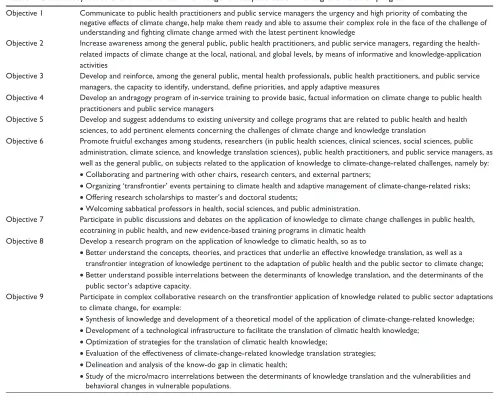
The general objectives of this transfrontier
knowledge-for-adaptive-action program in climatic health are presented
in Table 1.
The chair’s program includes five major themes in training
and programmatic research axes in climatic health, which
are as follows:
1. Extreme weather conditions, biopsychosocial
vulner-abilities, and mental health (in French: Aléas
hydromé-téorologiques, vulnérabilités biopsychosociales et santé
mentale axis)
2. Transfrontier education, collaborative ecolearning,
and collective competences in climatic health (in
French: Éducation transfrontières, écoapprentissages
collaboratifs, compétences collectives en santé
clima-tique axis)
3. North-South/West-East French-speaking world and
Web-hypermedia learning tools in climatic health (in
French: Francophonie Nord-Sud/Est-Ouest,
techno-pégagogies et autoformation Web-hypermédia pour la
globalisation des apprentissages axis)
4. Climate, working people, and mental health (in French:
Climats, travail et santé mentale axis)
5. Innovations, technologies, theories, and models in
evidence-based climatic health (in French: Innovations,
technologies, théories et modèles interactifs en
applica-tion transfrontières des savoirs axis)
Conclusion
This article has presented the transfrontier vision of a training
and research program stressing innoversity and complex
col-laboration. Any reader interested in discussing these issues,
or in collaborating in their study, is invited to communicate
with the first author. Whether you be North or South/West
i Transdisciplinarity as a form of knowledge translation research is driven
by the need to solve problems of the lifeworld. By transcending disciplinary paradigms, transdisciplinary knowledge translation research is challenged by the following requirements: to grasp the complexity of the problems, to take into account the diversity of scientific and societal views of these problems, to link abstract and case-specific knowledge, and to constitute knowledge with a focus on problem solving for what is perceived to be the common good. (p. 19)274
Advances in Medical Education and Practice downloaded from https://www.dovepress.com/ by 118.70.13.36 on 19-Aug-2020
Dovepress
Lapaige and Essiembre
or East, an individual or an institutional actor, and regardless
of your disciplinary affiliation, we hope to share with you
this new vision of a transfrontier KT and education for an
evidence-based, equitable, and sustainable climatic health.
Acknowledgments
Funding has been provided by the Fonds vert du gouvernement
québécois (Ministère de la Santé et des Services sociaux du
Québec: Thème 6 de l’Action 21 du Plan d’action 2006–2012
sur les changements climatiques).
Disclosure
The views expressed in this article are those of the authors
and do not necessarily reflect the position or policy of the
Quebec Ministry of Health and Social Services, the Quebec
National Public Health Institute, the Canadian
Consor-tium OURANOS (ConsorConsor-tium on Regional Climatology
and Adaptation to Climate Change), the Fernand-Seguin
Research Center (and the Fonds de recherche en santé
du Québec), the University of Montreal (Department of
Psychiatry, Faculty of Medicine), or the Laval University
(Faculty of Nursing).
References
1. Lee K. Globalization and Health: An Introduction. Basingstoke, UK: Palgrave Macmillan; 2003.
2. Labonte R, Schrecker T, Packer C, Runnels V, editors. Globalization
and Health: Pathways, Evidence and Policy. London, UK: Routledge;
2009.
3. Organisation des Nations Unies. Objectifs du Millénaire pour le
dével-oppement. New York: ONU. Available from: http://www.un.org/french/
millenniumgoals/index/shtml. Accessed Sep 17 2009.
4. Lapaige V. La santé publique globalisée. Saint-Nicolas, QC: Presses de l’Université Laval; 2009.
5. Ciliska D, Tomas H, Buffet C. Introduction au concept de santé publique
fondée sur les données probantes et recueil d’outils d’évaluation critique pour la pratique en santé publique. Hamilton, ON: National Collaborating
Centre for Methods and Tools (NCCMT); 2008.
6. World Health Organization. Ecosystems and Human Well-being: Health
Synthesis. Report of the Millennium Ecosystem Assessment. Geneva,
Switzerland: WHO; 2005.
Table 1 General objectives of the transfrontier knowledge-for-adaptive-action training and research program
Objective 1 communicate to public health practitioners and public service managers the urgency and high priority of combating the negative effects of climate change, help make them ready and able to assume their complex role in the face of the challenge of
understanding and fighting climate change armed with the latest pertinent knowledge
Objective 2 increase awareness among the general public, public health practitioners, and public service managers, regarding the health-related impacts of climate change at the local, national, and global levels, by means of informative and knowledge-application activities
Objective 3 Develop and reinforce, among the general public, mental health professionals, public health practitioners, and public service
managers, the capacity to identify, understand, define priorities, and apply adaptive measures
Objective 4 Develop an andragogy program of in-service training to provide basic, factual information on climate change to public health practitioners and public service managers
Objective 5 Develop and suggest addendums to existing university and college programs that are related to public health and health sciences, to add pertinent elements concerning the challenges of climate change and knowledge translation
Objective 6 Promote fruitful exchanges among students, researchers (in public health sciences, clinical sciences, social sciences, public administration, climate science, and knowledge translation sciences), public health practitioners, and public service managers, as well as the general public, on subjects related to the application of knowledge to climate-change-related challenges, namely by: • collaborating and partnering with other chairs, research centers, and external partners;
• Organizing ‘transfrontier’ events pertaining to climate health and adaptive management of climate-change-related risks; • Offering research scholarships to master’s and doctoral students;
• Welcoming sabbatical professors in health, social sciences, and public administration.
Objective 7 Participate in public discussions and debates on the application of knowledge to climate change challenges in public health, ecotraining in public health, and new evidence-based training programs in climatic health
Objective 8 Develop a research program on the application of knowledge to climatic health, so as to
• Better understand the concepts, theories, and practices that underlie an effective knowledge translation, as well as a transfrontier integration of knowledge pertinent to the adaptation of public health and the public sector to climate change; • Better understand possible interrelations between the determinants of knowledge translation, and the determinants of the
public sector’s adaptive capacity.
Objective 9 Participate in complex collaborative research on the transfrontier application of knowledge related to public sector adaptations to climate change, for example:
• synthesis of knowledge and development of a theoretical model of the application of climate-change-related knowledge; • Development of a technological infrastructure to facilitate the translation of climatic health knowledge;
• Optimization of strategies for the translation of climatic health knowledge;
• Evaluation of the effectiveness of climate-change-related knowledge translation strategies; • Delineation and analysis of the know-do gap in climatic health;
• study of the micro/macro interrelations between the determinants of knowledge translation and the vulnerabilities and behavioral changes in vulnerable populations.
Advances in Medical Education and Practice downloaded from https://www.dovepress.com/ by 118.70.13.36 on 19-Aug-2020
Dovepress innoversity in knowledge-for-action and adaptation to climate change
7. Stone D. Sustainable development: convergence of public health and natural environment agendas, nationally and locally. Public Health. 2006;120(12):1110–1113.
8. Labonte R, Torgerson R. A Critical Review of Frameworks
Link-ing Globalization and Health. Geneva, Switzerland: World Health
Organization; 2003.
9. Lee K. Health Impacts of Globalization: Towards a Global Governance. Basingstoke, UK: Palgrave Macmillan; 2003.
10. Commission on Social Determinants of Health. Closing the Gap in a
Generation: Health Equity Through Action on the Social Determinants of Health. Final Report of the CSHH. Geneva, Switzerland: World
Health Organization; 2008.
11. Straus SE, Tetroe J, Graham ID. Knowledge to action: what it is and what it isn’t. In: Straus S, Tetroe J, Graham ID, editors.
Knowledge Translation in Health Care. Moving from Evidence to Practice. Chichester, UK: John Wiley and Sons, Wiley-Blackwell;
2009:3–9.
12. Ottoson JM, Hawe P, editors. Knowledge Utilization, Diffusion,
Imple-mentation, Transfer, and Translation: Implications for Evaluation. New Directions for Evaluation. Vol. 124. Hoboken, NJ: John Wiley
and Sons; 2010.
13. Bammer G. Integration and implementation sciences: building a new specialization. Ecol Soc. 2005;10(2):6. Available from: http://www. ecologyandsociety.org/vo/vol10/iss2/art6/. Accessed Jan 10 2010. 14. Lapaige V. Le Québec face au défi croisé de l’application des savoirs
en santé climatique. Glob Health Promot. 2010;17(4).
15. Lauder H, Brown P, Dillabough J-A, Halsey AH. Education,
Global-ization, and Social Change. New York, NY: Oxford University Press;
2006.
16. Carré P. L’apprenance: vers un nouveau rapport au savoir. Paris: Dunod; 2005.
17. Lüdeke MKB, Petschel-Held G, Kemp R. Syndromes of global change. The first panoramic view. GAIA. 2004;13(1):42–49.
18. Lomas J, Culyer T, McCutcheon C, McAuley L, Law S. Rapport
final–Conceptualiser et regrouper les données probantes pour guider le système de santé. Ottawa, ON: Fondation canadienne de la recherche
sur les services de santé (FCRSS); 2005.
19. Loibl MC. Integrating perspectives in the practice of transdisciplinary research. In: Voß J-P, Bauknecht D, Kemp R, editors. Reflexive
Gover-nance for Sustainable Development. Cheltenham, UK: Edward Elgar;
2006:294–309.
20. Ramagnino N, Verges P. Épistémologie des sciences sociales, le problème des disciplines et l’interdisciplinarité (Enseignements fonda-mentaux, DEA de Sociologie, Université de Provence). Anthropologie
1997–1987. 1998:7.
21. Wilson EO. Consilience. The Unity of Knowledge. London, UK: Aba-cus; 1998.
22. Giri AK. The calling of a creative transdisciplinarity. Futures. 2002; 34(1):103–115.
23. Bammer G. LWA Integration Symposium Participants. Guiding principles for integration in natural resource management (NRM) as a contribution to sustainability. Australas J Environ Manage. 2005;12 Suppl:S5–S7.
24. van Kerkhoff L. Integrated research: concepts of connection in environmental science and policy. Environ Sci Policy. 2005;8(5): 452–463.
25. Pohl C, van Kerkhoff L, Hirsch Hadorn G, Bammer G. Integration. In: Hirsch Hadorn G, Hoffmann-Riem H, Biber-Klemm S, et al, editors.
Handbook of Transdisciplinary Research. Bern, Switzerland: Springer;
2008:411–424.
26. Higginbotham N, Albrecht G, Connor L. Health Social Science. A
Transdisciplinary and Complexity Perspective. Melbourne, Australia:
Oxford University Press; 2003.
27. Star SL, Griesemer JR. Institutional ecology, ‘translations’ and boundary objects: amateurs and professionals in Berkeley’s Museum of Vertebrate Zoology, 1907–1939. Soc Stud Sci. 1989;19(3): 387–420.
28. Kessel F, Rosenfield PL, Anderson NB, editors. Expanding the
Boundaries of Health and Social Sciences. Case Studies in Interdisci-plinary Innovation. New York, NY: Oxford University Press; 2003.
29. Clark W, Holliday L. Linking Knowledge with Action for Sustainable
Development: The Role of Program Management – Summary of a Workshop. Washington, DC: The National Academies Press; 2006.
30. Rycroft-Malone J, Bucknall T, editors. Models and Frameworks for
Implementing Evidence-Based Practice. Linking Evidence to Practice.
Chichester, UK: Wiley-Blackwell and Sigma Theta Tau International; 2010.
31. Francis JJ, Eccles MP, Johnston M, et al. Constructing Questionnaires
Based on the Theory of Planned Behaviour: A Manual for Health Services Researchers. Newcastle, UK: Centre for Health Services
Research, University of Newcastle; 2004.
32. Réseau de recherche en santé des populations du Québec. Des repères
pour la recherche sur le partage des connaissances en santé des populations. Carnet-synthèse préparé par et avec la collaboration de
Dagenais C, Laurendeau MC, Souffez K, Axe Partage et Utilisation des Connaissances du RRSPQ (Bergeron P, Laurendeau MC, Joubert P, Lévy J, Souffez K). Montreal, QC: Réseau de recherche en santé des populations du Québec; 2007.
33. Graham ID, Tetroe J. Whither knowledge translation: an international research agenda. Nurs Res. 2007;56 Suppl 4:S86–S88.
34. Glanz K, Rimer BK, Viswanath K, editors. Health Behavior and Health
Education: Theory, Research and Practice. San Francisco, CA:
Jossey-Bass; 2002.
35. Michie S, Johnston M, Abraham C, Lawton R, Parker D, Walker A; ‘Psychological Theory’ Group. Making psychological theory useful for implementing evidence based practice: a consensus approach. Qual Saf
Health Care. 2005;14(1):26–33.
36. Gosselin P, Bélanger D. Recherche, impacts et adaptations de santé publique au nouveau climat du Québec. Santé Publique. 2010;22(3): 281–302.
37. Desjarlais C, Allard M, Blondot A, et al. Savoir s’adapter aux
change-ments climatiques. Montreal, QC: Ouranos; 2010.
38. Costello A, Abbas M, Allen A, et al. Managing the health effects of climate change: Lancet and University College London Insti-tute for Global Health Commission. Lancet. 2009;373(9676): 1693–1733.
39. Solomon S, Qin D, Manning M, et al. Climate Change 2007: The
Physical Science Basis. Working Group I Contribution to the Inter-governmental Panel on Climate Change Fourth Assessment Report.
Cambridge, UK: Cambridge University Press; 2007.
40. Bourque A, Simonet G. Québec. In: Lemmen DS, Warren FJ, Lac-roix J, Bush E, editors. Vivre avec les changements climatiques au
Canada: édition 2007. Ottawa, ON: Gouvernement du Canada; 2008:
171–226.
41. Gouvernement du Québec, Ministère du Développement durable, de l’Environnement et des Parcs. Le Québec et les changements
cli-matiques – Un défi pour l’avenir. Plan d’action 2006–2012. Québec
(QC): Author; 2008. Available from: http://www.mddep.gouv.qc.ca/ changements/plan_action/2006-2012_fr.pdf. Accessed Aug 4 2009. 42. Gouvernement du Québec, Ministère du Développement durable, de
l’Environnement et des Parcs. Troisième bilan de la mise en en œuvre
du plan d’action 2006–2012 sur les changements climatiques. Québec,
QC: Author; 2009.
43. Lemmen DS, Warren FJ, Lacroix J, Bush E. Vivre avec les changements
climatiques au Canada: édition 2007. Ottawa, ON: Gouvernement du
Canada; 2008.
44. Gouvernement du Canada. Quatrième rapport national du Canada sur
les changements climatiques: mesures prises en vertu de la Convention-cadre des Nations Unies sur les changements climatiques. Ottawa, ON:
Author; 2006.
45. German Advisory Council on Global Change. Climate Protection
Strategies for the 21st Century: Kyoto and Beyond–Special Report.
Available from: http://www.wbgu.de/wbgu_sn2003_voll_engl.html. Accessed Sep 19 2009.
Advances in Medical Education and Practice downloaded from https://www.dovepress.com/ by 118.70.13.36 on 19-Aug-2020