Search for New Physics in Photon-Lepton Events in
pp
Collisions at
p
p
p
s
5
1
.
8 TeV
D. Acosta,1 T. Affolder,2H. Akimoto,3 M. G. Albrow,4 D. Ambrose,5D. Amidei,6K. Anikeev,7J. Antos,8 G. Apollinari,4T. Arisawa,3A. Artikov,9T. Asakawa,10 W. Ashmanskas,11 F. Azfar,12P. Azzi-Bacchetta,13 N. Bacchetta,13H. Bachacou,2W. Badgett,4S. Bailey,14P. de Barbaro,15 A. Barbaro-Galtieri,2V. E. Barnes,16 B. A. Barnett,17S. Baroiant,18 M. Barone,19G. Bauer,7F. Bedeschi,20 S. Belforte,21W. H. Bell,22 G. Bellettini,20
J. Bellinger,23 D. Benjamin,24J. Bensinger,25 A. Beretvas,4J. P. Berge,4J. Berryhill,11A. Bhatti,26M. Binkley,4 M. Bishai,4D. Bisello,13 R. E. Blair,27 C. Blocker,25 K. Bloom,6B. Blumenfeld,17 S. R. Blusk,15 A. Bocci,26
A. Bodek,15 G. Bolla,16 Y. Bonushkin,28 D. Bortoletto,16 J. Boudreau,29 A. Brandl,30 S. van den Brink,17 C. Bromberg,31 M. Brozovic,24 E. Brubaker,2N. Bruner,30 J. Budagov,9H. S. Budd,15 K. Burkett,14 G. Busetto,13 A. Byon-Wagner,4K. L. Byrum,27S. Cabrera,24P. Calafiura,2M. Campbell,6W. Carithers,2D. Carlsmith,23J. Carlson,6
W. Caskey,18 A. Castro,32D. Cauz,21 A. Cerri,20A. W. Chan,8P. S. Chang,8P. T. Chang,8J. Chapman,6C. Chen,5 Y. C. Chen,8 M.-T. Cheng,8M. Chertok,18G. Chiarelli,20 I. Chirikov-Zorin,9G. Chlachidze,9F. Chlebana,4 L. Christofek,33 M. L. Chu,8J. Y. Chung,34 W.-H. Chung,23Y. S. Chung,15 C. I. Ciobanu,34A. G. Clark,35 A. P. Colijn,4 A. Connolly,2M. Convery,26 J. Conway,36M. Cordelli,19J. Cranshaw,37 R. Culbertson,4D. Dagenhart,38S. D’Auria,22
S. Dell’Agnello,19 M. Dell’Orso,20 L. Demortier,26M. Deninno,32 F. DeJongh,4S. Demers,15 P. F. Derwent,4 T. Devlin,36 J. R. Dittmann,4A. Dominguez,2S. Donati,20J. Done,39M. D’Onofrio,20 T. Dorigo,14 I. Dunietz,4
N. Eddy,33K. Einsweiler,2J. E. Elias,4E. Engels Jr.,29 R. Erbacher,4D. Errede,33 S. Errede,33 Q. Fan,15 H.-C. Fang,2R. G. Feild,40 J. P. Fernandez,4C. Ferretti,20 R. D. Field,1I. Fiori,32 B. Flaugher,4G. W. Foster,4
M. Franklin,14J. Freeman,4J. Friedman,7H. J. Frisch,11Y. Fukui,41I. Furic,7S. Galeotti,20 A. Gallas,42 M. Gallinaro,26T. Gao,5M. Garcia-Sciveres,2A. F. Garfinkel,16 P. Gatti,13 C. Gay,40D. W. Gerdes,6E. Gerstein,43
P. Giannetti,20K. Giolo,16 V. Glagolev,9 D. Glenzinski,4M. Gold,30 J. Goldstein,4I. Gorelov,30 A. T. Goshaw,24 Y. Gotra,29 K. Goulianos,26 C. Green,16G. Grim,18 P. Gris,4C. Grosso-Pilcher,11 M. Guenther,16 G. Guillian,6 J. Guimaraes da Costa,14 R. M. Haas,1 C. Haber,2S. R. Hahn,4C. Hall,14 T. Handa,44 R. Handler,23F. Happacher,19
K. Hara,10 A. D. Hardman,16R. M. Harris,4F. Hartmann,45 K. Hatakeyama,26 J. Hauser,28J. Heinrich,5A. Heiss,45 M. Herndon,17 C. Hill,18A. Hocker,15 K. D. Hoffman,11 R. Hollebeek,5L. Holloway,33B. T. Huffman,12R. Hughes,34 J. Huston,31J. Huth,14 H. Ikeda,10 J. Incandela,4G. Introzzi,20A. Ivanov,15 J. Iwai,3Y. Iwata,44E. James,6M. Jones,5 U. Joshi,4H. Kambara,35T. Kamon,39T. Kaneko,10 M. Karagoz Unel,42 K. Karr,38 S. Kartal,4H. Kasha,40Y. Kato,46 T. A. Keaffaber,16 K. Kelley,7M. Kelly,6 R. D. Kennedy,4D. Khazins,24 T. Kikuchi,10B. Kilminster,15 B. J. Kim,47
D. H. Kim,47 H. S. Kim,33 M. J. Kim,43S. B. Kim,47 S. H. Kim,10Y. K. Kim,2M. Kirby,24 M. Kirk,25L. Kirsch,25 S. Klimenko,1P. Koehn,34K. Kondo,3J. Kongisberg,1A. Korn,7A. Korytov,1E. Kovacs,27 J. Kroll,5M. Kruse,24 V. Krutelyov,39S. E. Kuhlmann,27K. Kurino,44 T. Kuwabara,10A. T. Laasanen,16 N. Lai,11S. Lami,26 S. Lammel,4 J. Lancaster,24 M. Lancaster,2R. Lander,18 A. Lath,36 G. Latino,30T. LeCompte,27K. Lee,37 S. W. Lee,39 S. Leone,20 J. D. Lewis,4M. Lindgren,28T. M. Liss,33 D. O. Litvintsev,4J. B. Liu,15T. Liu,4Y. C. Liu,8O. Lobban,37N. S. Lockyer,5
J. Loken,12 M. Loreti,13D. Lucchesi,13P. Lukens,4S. Lusin,23 L. Lyons,12J. Lys,2P. McIntyre,39 R. Madrak,14 K. Maeshima,4P. Maksimovic,14 L. Malferrari,32G. Manca,12M. Mangano,20 M. Mariotti,13 G. Martignon,13 A. Martin,40V. Martin,42J. A. J. Matthews,30P. Mazzanti,32 K. S. McFarland,15 M. Menguzzato,13 A. Menzione,20 P. Merkel,4C. Mesropian,26 A. Meyer,4T. Miao,4J. S. Miller,6R. Miller,31 H. Minato,10 S. Miscetti,19 M. Mishina,41
G. Mitselmakher,1Y. Miyazaki,46 N. Moggi,32 E. Moore,30 R. Moore,6Y. Morita,41T. Moulik,16 A. Mukherjee,4 M. Mulhearn,7T. Muller,45 A. Munar,20P. Murat,4S. Murgia,31 J. Nachtman,28 V. Nagaslaev,37 S. Nahn,40 H. Nakada,10I. Nakano,44 C. Nelson,4T. Nelson,4C. Neu,34D. Neuberger,45 C. Newman-Holmes,4C.-Y. P. Ngan,7 H. Niu,25L. Nodulman,27A. Nomerotski,1S. H. Oh,24 Y. D. Oh,47 T. Ohmoto,44 T. Ohsugi,44R. Oishi,10 T. Okusawa,46
J. Olsen,23 W. Orejudos,2C. Pagliarone,20F. Palmonari,20R. Paoletti,20V. Papadimitriou,37D. Partos,25 J. Patrick,4 G. Pauletta,21 C. Paus,7M. Paulini,43 D. Pellett,18L. Pescara,13 T. J. Phillips,24G. Piacentino,20 K. T. Pitts,33 A. Pompos,16G. Pope,29T. Pratt,12F. Prokoshin,9J. Proudfoot,27F. Ptohos,19O. Pukhov,9G. Punzi,20 A. Rakitine,7
F. Ratnikov,36 D. Reher,2A. Reichold,12 P. Renton,12A. Ribon,13W. Riegler,14 F. Rimondi,32 L. Ristori,20 M. Riveline,48 W. J. Robertson,24T. Rodrigo,49 S. Rolli,38L. Rosenson,7R. Roser,4R. Rossin,13 C. Rott,16A. Roy,16
A. Ruiz,49A. Safonov,18 R. St. Denis,22W. K. Sakumoto,15D. Saltzberg,28C. Sanchez,34A. Sansoni,19L. Santi,21 H. Sato,10 P. Savard,48 A. Savoy-Navarro,4P. Schlabach,4E. E. Schmidt,4M. P. Schmidt,40 M. Schmitt,42 L. Scodellaro,13 A. Scott,28 A. Scribano,20 A. Sedov,16S. Segler,4 S. Seidel,30 Y. Seiya,10A. Semenov,9F. Semeria,32
A. Sill,37P. Sinervo,48 P. Singh,33 A. J. Slaughter,40 K. Sliwa,38C. Smith,17 F. D. Snider,4A. Solodsky,26 J. Spalding,4 T. Speer,35M. Spezziga,37P. Sphicas,7L. Spiegel,4F. Spinella,20 M. Spiropulu,11J. Steele,23 A. Stefanini,20 J. Strologas,33F. Strumia,35D. Stuart,4K. Sumorok,7T. Suzuki,10T. Takano,46 R. Takashima,44 K. Takikawa,10 P. Tamburello,24 M. Tanaka,10 B. Tannenbaum,28 M. Tecchio,6P. K. Teng,8K. Terashi,26 R. J. Tesarek,4S. Tether,7
A. S. Thompson,22E. Thomson,34R. Thurman-Keup,27 P. Tipton,15 S. Tkaczyk,4D. Toback,39K. Tollefson,15 A. Tollestrup,4D. Tonelli,20 M. Tonnesmann,31 H. Toyoda,46 W. Trischuk,48J. F. de Troconiz,14 J. Tseng,7
D. Tsybychev,1N. Turini,20 F. Ukegawa,10 T. Vaiciulis,15J. Valls,36 E. Vataga,20S. Vejcik III,4G. Velev,4 G. Veramendi,2R. Vidal,4I. Vila,49 R. Vilar,49 I. Volobouev,2M. von der Mey,28 D. Vucinic,7R. G. Wagner,27
R. L. Wagner,4W. Wagner,45N. B. Wallace,36 Z. Wan,36C. Wang,24 M. J. Wang,8S. M. Wang,1B. Ward,22 S. Waschke,22T. Watanabe,10D. Waters,12 T. Watts,36 R. Webb,39M. Webber,2 H. Wenzel,45W. C. Wester III,4 A. B. Wicklund,27 E. Wicklund,4T. Wilkes,18 H. H. Williams,5P. Wilson,4B. L. Winer,34D. Winn,6S. Wolbers,4
D. Wolinski,6J. Wolinski,31S. Wolinski,6S. Worm,36X. Wu,35 J. Wyss,20U. K. Yang,11W. Yao,2G. P. Yeh,4 P. Yeh,8J. Yoh,4C. Yosef,31 T. Yoshida,46I. Yu,47 S. Yu,5Z. Yu,40 J. C. Yun,4A. Zanetti,21and F. Zetti2
(CDF Collaboration)
1University of Florida, Gainesville, Florida 32611
2Ernest Orlando Lawrence Berkeley National Laboratory, Berkeley, California 94720 3Waseda University, Tokyo 169, Japan
4Fermi National Accelerator Laboratory, Batavia, Illinois 60510 5University of Pennsylvania, Philadelphia, Pennsylvania 19104
6University of Michigan, Ann Arbor, Michigan 48109
7Massachusetts Institute of Technology, Cambridge, Massachusetts 02139 8Institute of Physics, Academia Sinica, Taipei, Taiwan 11529, Republic of China
9Joint Institute for Nuclear Research, RU-141980 Dubna, Russia 10University of Tsukuba, Tsukuba, Ibaraki 305, Japan
11Enrico Fermi Institute, University of Chicago, Chicago, Illinois 60637 12University of Oxford, Oxford OX1 3RH, United Kingdom
13Universita di Padova, Istituto Nazionale di Fisica Nucleare, Sezione di Padova, I-35131 Padova, Italy 14Harvard University, Cambridge, Massachusetts 02138
15University of Rochester, Rochester, New York 14627 16Purdue University, West Lafayette, Indiana 47907 17The Johns Hopkins University, Baltimore, Maryland 21218 18University of California at Davis, Davis, California 95616
19Laboratori Nazionali di Frascati, Istituto Nazionale di Fisica Nucleare, I-00044 Frascati, Italy 20Istituto Nazionale di Fisica Nucleare, University and Scuola Normale Superiore of Pisa, I-56100 Pisa, Italy
21Istituto Nazionale di Fisica Nucleare, University of Trieste/Udine, Italy 22Glasgow University, Glasgow G12 8QQ, United Kingdom
23University of Wisconsin, Madison, Wisconsin 53706 24Duke University, Durham, North Carolina 27708 25Brandeis University, Waltham, Massachusetts 02254
26Rockefeller University, New York, New York 10021 27Argonne National Laboratory, Argonne, Illinois 60439
28University of California at Los Angeles, Los Angeles, California 90024 29University of Pittsburgh, Pittsburgh, Pennsylvania 15260 30University of New Mexico, Albuquerque, New Mexico 87131
31Michigan State University, East Lansing, Michigan 48824
32Istituto Nazionale di Fisica Nucleare, University of Bologna, I-40127 Bologna, Italy 33University of Illinois, Urbana, Illinois 61801
34The Ohio State University, Columbus, Ohio 43210 35University of Geneva, CH-1211 Geneva 4, Switzerland
36Rutgers University, Piscataway, New Jersey 08855 37Texas Tech University, Lubbock, Texas 79409 38Tufts University, Medford, Massachusetts 02155 39Texas A&M University, College Station, Texas 77843
40Yale University, New Haven, Connecticut 06520
41High Energy Accelerator Research Organization (KEK), Tsukuba, Ibaraki 305, Japan 42Northwestern University, Evanston, Illinois 60208
45Institut für Experimentelle Kernphysik, Universität Karlsruhe, 76128 Karlsruhe, Germany 46Osaka City University, Osaka 588, Japan
47Center for High Energy Physics: Kyungpook National University, Taegu 702-701,
Seoul National University, Seoul 151-742, and SungKyunKwan University, Suwon 440-746, Korea
48Institute of Particle Physics, University of Toronto, Toronto M5S 1A7, Canada 49Instituto de Fisica de Cantabria, CSIC-University of Cantabria, 39005 Santander, Spain
(Received 25 February 2002; published 9 July 2002)
We present the results of a search in pp collisions at ps 苷1.8TeV for anomalous production of events containing a photon and a lepton (eorm), both with large transverse energy, using 86pb21 of
data collected with the Collider Detector at Fermilab during the 1994 –1995 collider run at the Fermilab Tevatron. The presence of large missing transverse energy (E兾T), additional photons, or additional leptons
in these events is also analyzed. The results are consistent with standard model expectations, with the possible exception of photon-lepton events with largeE兾T, for which the observed total is 16 events and
the expected mean total is7.660.7events.
DOI: 10.1103/PhysRevLett.89.041802 PACS numbers: 13.85.Rm, 12.60.Jv, 13.85.Qk, 14.80.Ly
An important test of the standard model (SM) of particle physics [1] is to measure and understand the properties of the highest-energy particle collisions. The observation of an anomalous production rate of any combination of the fundamental particles of the SM would be a clear indica-tion of a new physical process. This Letter summarizes an analysis of the inclusive production of a photon and a lep-ton (e orm 1 g 1X), including searches for additional photons, leptons, and large missing transverse energy, us-ing86pb21of data from proton-antiproton collisions col-lected with the Collider Detector at Fermilab (CDF) during the 1994 –1995 run of the Fermilab Tevatron [2].
Production of these particular combinations of particles is of interest for several reasons. Events with photons and leptons are potentially related to the puzzling “eeggE兾T”
event recorded by CDF [3]. A supersymmetric model [4] designed to explain the eeggE兾T event predicts the
pro-duction of photons from the radiative decay of the x˜20 neutralino, and leptons through the decay of charginos, indicatingᐉgE兾T events as a signal for the production of a
chargino-neutralino pair. Other hypothetical, massive par-ticles could subsequently decay to SM electroweak gauge bosons, one of which could be a photon and the other aW orZ0boson that decays leptonically. In addition, photon-lepton studies complement similarly motivated inclusive searches for new physics in diphoton [3,5], photon-jet [6], and photon-b-quark events [7].
The CDF detector [8] is a cylindrically symmetric spec-trometer designed to studypp collisions at the Fermilab Tevatron. A superconducting solenoid of length 4.8 m and radius 1.5 m generates a magnetic field of 1.4 T and con-tains tracking chambers used to measure the momenta of charged particles. A set of vertex time projection chambers is used to find thezposition [9] of theppinteraction. The 3.5-m-long central tracking chamber (CTC) is a wire drift chamber which provides up to 84 measurements between the radii of 31.0 and 132.5 cm in the region jhj,1.0. Sampling calorimeters, used to measure the electromag-netic and hadronic energy deposited by electrons, photons,
and jets of hadrons, surround the solenoid. Each tower of the central (jhj, 1.1) electromagnetic calorimeter (CEM) has an embedded strip chamber for the measurement of the 2D transverse profile of electromagnetic showers. Muons are detected with three systems of muon chambers, each consisting of four layers of drift chambers. The central muon (CMU) system is located directly outside the central hadronic calorimeter, and coversjhj,0.6. Outside of the CMU is 0.6 m of steel shielding, followed by the central muon upgrade system. The central muon extension system provides muon detection for0.6, jhj,1.0.
Events with a high-transverse momentum共pT兲[10]
pho-ton or leppho-ton are selected by a three-level trigger [2], which requires an event to have either a high-ET photon or a
high-pT lepton (e orm) within the central region, jhj,
1.0. Photon and electron candidates are chosen from clus-ters of energy in adjacent CEM towers; electrons are then further separated from photons by requiring the presence of a CTC track pointing at the cluster. Muons are identified by requiring CTC tracks to extrapolate to a reconstructed track segment in the muon drift chambers.
To reduce background from the decays of hadrons pro-duced in jets, both the photon and the lepton in each event are required to be “isolated.” The ET deposited in the
calorimeters in a cone inh 2 fspace of radiusR 苷0.4 around the photon or lepton position is summed, and the ET due to the photon or lepton is subtracted. The
remain-ingETin the cone,Eisocone, is required to be less than 2 GeV for a photon, or less than 10% of the lepton transverse mo-mentum. In addition, for photons the sum of thepT of all
tracks in the cone must be less than 5 GeV.
Inclusive photon-lepton events are selected by requir-ing an isolated central photon with ETg . 25GeV and
an isolated central lepton (e or m) with ETᐉ .25GeV.
The production of pairs of new heavy states that decay via cascade decays can lead to final states with multiple photons or leptons; in contrast, the dominant SM back-ground processes lead to signatures with only one photon and one lepton observed in the detector, as discussed in detail below. The inclusive sample is consequently ana-lyzed as two subsamples: a “two-body inclusive photon-lepton sample” typical of a two-particle final state, and a “multibody inclusive photon-lepton sample” typical of three or more particles in the final state. The two-body sample selection requires exactly one photon and exactly one lepton, with an azimuthal separation Dwᐉg .150±,
but excludes those events for which the invariant mass of the photon and electron,Meg, is within 5 GeV of the mass
of the Z boson, MZ (these events are used as a control
sample, as described below). The multibody sample is composed of the remaining inclusive photon-lepton events. The multibody sample is then further analyzed for the pres-ence of largeE兾T, and additional isolated leptons and
pho-tons. TheE兾Tthreshold of 25 GeV was determineda priori
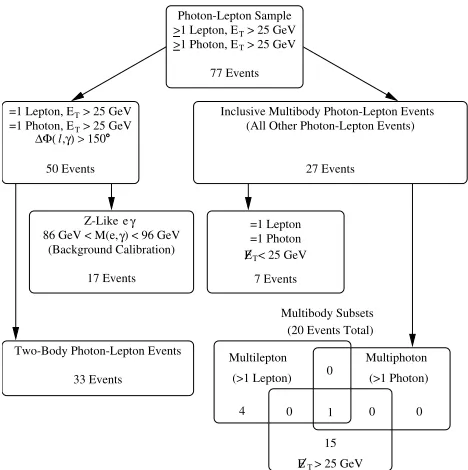
in previous analyses [13] as a significant indicator of a neu-trino arising from leptonic decays of theW boson. Fig-ure 1 shows the breakdown of the inclusive sample into the final categories.
The dominant source of photon-lepton events at the Tevatron is electroweak diboson production, in which a W orZ0 boson decays leptonically (ᐉn orᐉᐉ) and a pho-ton is radiated from either an initial-state quark, a W, or a charged final-state lepton. The number of such events is estimated using leading-order matrix element calculations [14] for which the computational code [15] was then
em-4
15 Two-Body Photon-Lepton Events
33 Events
0 Multilepton Multiphoton
(>1 Lepton) (>1 Photon)
0 0
0
T
E < 25 GeV
(All Other Photon-Lepton Events)
27 Events
Inclusive Multibody Photon-Lepton Events
Multibody Subsets (20 Events Total) =1 Photon
=1 Lepton
7 Events
1
T
=1 Lepton, E > 25 GeV =1 Photon, E > 25 GeV
50 Events ∆Φ( ,γ) > 150
T
Photon-Lepton Sample >1 Lepton, E > 25 GeV >1 Photon, E > 25 GeV
77 Events
l
γ
E > 25 GeVT
γ
T T
86 GeV < M(e, ) < 96 GeV e Z-Like
17 Events (Background Calibration)
FIG. 1. The subsets of inclusive photon-lepton events. The multibody photon-lepton subcategories of ᐉgE兾T, multilepton,
and multiphoton events are not mutually exclusive.
bedded into the general-purpose event generator program PYTHIA[16], followed by a full simulation of the detector. The uncertainty in this number has roughly equal contribu-tions from higher-order processes, simulation systematics, luminosity, proton structure, and generator statistics.
A jet can contain mesons such as thep0orhthat decay to photons, which then may satisfy the photon selection cri-teria. The number of lepton-plus-misidentified-jet events is determined by counting the number of jets in a sample of events with a lepton and then multiplying by the proba-bility of a jet being misidentified as a photon, Pgjet. The factorPgjetis determined from samples of jets and photons in events with a lepton trigger, using the distribution in Eisocone. By fitting to a sum of the expected distribution for prompt photons and that measured for jets, the misidentifi-cation rate is found to bePjet
g 苷共3.86 0.7兲 31024[2].
The dominant source of misidentified photon-electron events is Z0!e1e2 production, where one of the
electrons undergoes hard photon bremsstrahlung or a track fails to be reconstructed. We assume that photon-electron events consistent withZ0production are not a significant source of new physics, and use them to estimate the proba-bility Pge that an electron is reconstructed as a photon. The number of misidentified photon-electron events in the control sample divided by the number of electron-electron events with the same kinematics gives Pge 苷
共1.286 0.35兲%. For any other subset of central electron pairs, the contribution to the corresponding photon-electron sample is the product of Pge and the number of
central electron pairs.
Other, smaller, backgrounds are due to hadrons faking muons and to leptons from the decay of bottom and charm quarks. Charged hadrons may penetrate the calorimeters into the muon chambers, or may decay to a muon before reaching the calorimeters. These contributions are deter-mined by identifying isolated, high-momentum tracks in the inclusive photon sample, applying the probability of each track being misidentified as a muon, and summing this probability over all tracks in the sample [2]. The con-tribution to photon-lepton candidates from heavy-flavor produced in association with a prompt photon is estimated using Monte Carlo event generation [16] and detector simulation, and found to be negligible.
total is used to randomly generate a Poisson-distributed outcomeN. The fraction of calculations in the ensemble with outcomesN $ N0givesP共N $ N0jmSM兲.
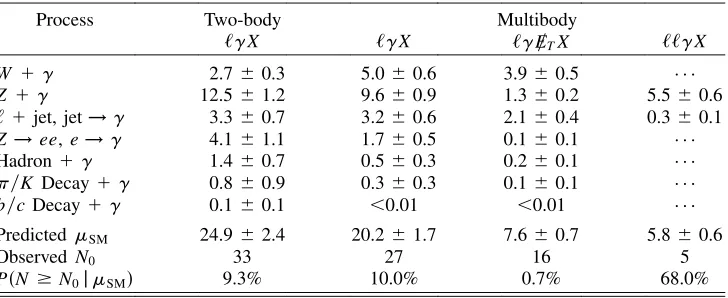
The predicted and observed totals for two-body photon-lepton events are compared in Table I. Half of the pre-dicted total originates fromZ0gproduction, where one of the charged leptons has escaped identification; the other half originates from roughly equal contributions of Wg production, misidentified jets, misidentified electrons, and misidentified charged hadrons. The likelihood of the ob-served total is 9.3%.
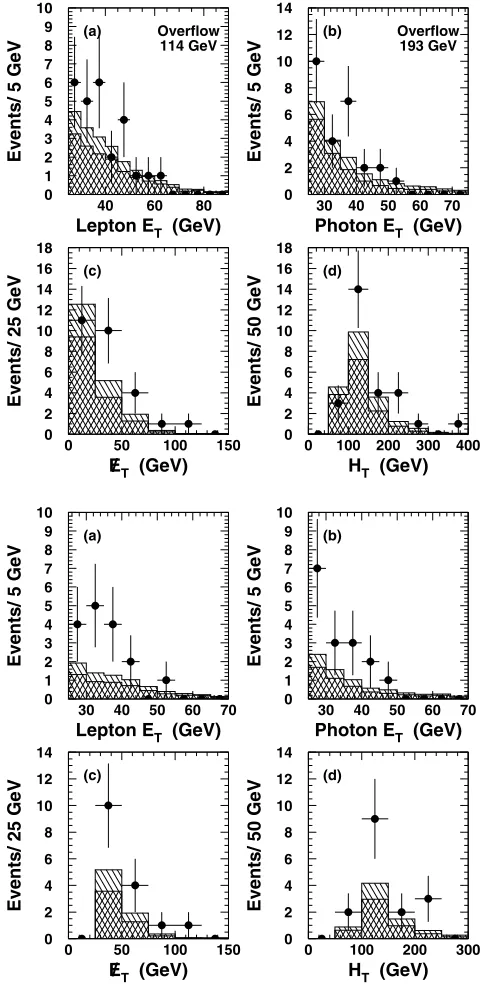
The predicted and observed totals for inclusive multi-body photon-lepton events are also compared in Table I. About half of the predicted total originates fromZ0g pro-duction, a quarter fromWgproduction, and the remaining quarter from particles misidentified as photons or leptons. The likelihood of the observed inclusive multibody total is 10%. The predicted and observed kinematic distribu-tions for these events are compared in Fig. 2. The dif-ference between the observed and predicted totals can be entirely attributed to events withE兾T .25GeV. Figure 2
also shows the distribution in HT, the scalar sum of the
ET of all objects in the event plus the magnitude ofE兾T,
a variable correlated with the production of massive par-ticles [2].
The predicted and observed totals for multibodyᐉgE兾T
events are also compared in Table I. For photon-electron events, requiring E兾T .25GeV suppresses the
con-tributions from Z0g production and from electrons misidentified as photons, which have no intrinsic E兾T,
while preserving the contribution from Wg production. As a result, 57% of the predictedegE兾T total arises from
Wg production, 31% from jets misidentified as photons, only 3% from Z0g production, and the remaining 9% from other particles misidentified as photons. The ob-served egE兾T total agrees with the predicted total, with
a 25% probability that the predicted mean of 3.4 events yields 5 observed events. One of these 5 is the eeggE兾T
event [3].
For photon-muon events, requiringE兾T .25GeV does
not completely eliminate the contribution from Z0g, for a second muon with jhj.1.2 and pT . 25GeV can
escape detection and induce the necessary amount of E兾T. The rate at which this occurs is modeled well by
the Z0g event simulation, however, since it is largely a function of the CDF detector geometric acceptance. Of the 4.6 multibody events predicted to originate from Z0g production, 2.2 events are predicted to contain a second visible muon, 1.0 events are predicted to have less than 25 GeV of E兾T, and only 1.0 events are predicted to pass
the 25 GeV E兾T selection. One event is observed with a
second muon, in agreement with theZ0g prediction. The predicted total for multibody mgE兾T events consists of
47% Wg production, 24% events with jets misidentified as photons, 23% Z0g production, and the remaining 7% from particles misidentified as muons.
The mgE兾T event total is higher than predicted (11
ob-served vs 4 expected), with an observation likelihood of 0.54%; the observation likelihood of the ᐉgE兾T total is
only slightly higher at 0.72% [18]. The predicted and ob-served distributions of the kinematic properties of multi-body ᐉgE兾T events are compared in Fig. 2. The observed
photonET, leptonET,E兾T, andHT distributions are within
the range expected from the SM [19].
The predicted and observed totals of multilepton events are compared in Table I. Nearly all of the predicted total is expected from Z0g production. Approximately 6 events are expected; 5 events are observed, including the eeggE兾T event. No emg events were expected, and
none were observed.
The predicted number of multiphoton events is domi-nated by Zg production, for which only 0.01 events are expected. The single event observed is theeeggE兾T event,
whose (un)likelihood is described in Ref. [3].
In conclusion, we have made an a priori search for inclusive photon1lepton production. We find that sub-samples of this data set agree well with their SM pre-diction, with the possible exception of gᐉE兾T. However,
TABLE I. The mean numbersmSMof two-body and inclusive multibody events predicted by
the SM, the numberN0observed, and the observation likelihoodP共N $N0jmSM兲. Correlated
uncertainties have been taken into account.
Process Two-body Multibody
ᐉgX ᐉgX ᐉgE兾TX ᐉᐉgX
W 1 g 2.760.3 5.060.6 3.960.5 · · ·
Z 1 g 12.561.2 9.660.9 1.360.2 5.560.6
ᐉ1jet, jet!g 3.360.7 3.260.6 2.160.4 0.360.1 Z !ee,e!g 4.161.1 1.760.5 0.160.1 · · ·
Hadron1 g 1.460.7 0.560.3 0.260.1 · · ·
p兾K Decay1 g 0.860.9 0.360.3 0.160.1 · · · b兾cDecay1 g 0.160.1 ,0.01 ,0.01 · · ·
PredictedmSM 24.962.4 20.261.7 7.660.7 5.860.6
Observed N0 33 27 16 5
0 1 2 3 4 5 6 7 8 9 10
40 60 80
Lepton ET (GeV)
Events/ 5 GeV
Overflow 114 GeV (a) 0 2 4 6 8 10 12 14
30 40 50 60 70
Photon ET (GeV)
Events/ 5 GeV
Overflow 193 GeV (b) 0 2 4 6 8 10 12 14 16 18
0 50 100 150
E/T (GeV)
Events/ 25 GeV
(c) 0 2 4 6 8 10 12 14 16 18
0 100 200 300 400
HT (GeV)
Events/ 50 GeV
(d) 0 1 2 3 4 5 6 7 8 9 10
30 40 50 60 70
Lepton ET (GeV)
Events/ 5 GeV
(a) 0 1 2 3 4 5 6 7 8 9 10
30 40 50 60 70
Photon ET (GeV)
Events/ 5 GeV
(b) 0 2 4 6 8 10 12 14
0 50 100 150
E/T (GeV)
Events/ 25 GeV
(c) 0 2 4 6 8 10 12 14
0 100 200 300
HT (GeV)
Events/ 50 GeV
(d)
FIG. 2. Upper panel: the lepton ET, photon ET, E兾T, and
HT of inclusive multibody photon-lepton candidates (points)
compared to SM predictions (single-hatched histograms). The cross-hatched histograms show the contribution from SMWg
and Zg production. There is one event in the overflow bin at 114 GeV in (a) and one at 193 GeV in (b). Lower panel: the same distributions for the subset of these events that have
E兾T .25GeV.
an excess of events with 0.7% likelihood (equivalent to 2.7 standard deviations for a Gaussian distribution) in one subsample among the five studied is an interesting result, but is not a compelling observation of new physics. We look forward to more data in the upcoming run of the Fer-milab Tevatron.
We thank the Fermilab staff and the technical staffs of the participating institutions for their contributions. We thank U. Baur and S. Mrenna for their critical calculations of the SMWgandZgbackgrounds used in this analysis. This work was supported by the U.S. Department of En-ergy and National Science Foundation; the Italian Istituto Nazionale di Fisica Nucleare; the Ministry of Education, Culture, Sports, Science, and Technology of Japan; the Natural Sciences and Engineering Research Council of Canada; the National Science Council of the Republic of China; the Swiss National Science Foundation; the A. P. Sloan Foundation; the Bundesministerium fuer Bildung und Forschung, Germany; the Korea Science and Engi-neering Foundation (KoSEF); the Korea Research Foun-dation; and the Comision Interministerial de Ciencia y Tecnologia, Spain.
[1] S. L. Glashow, Nucl. Phys.22,588 (1961); S. Weinberg, Phys. Rev. Lett. 19, 1264 (1967); A. Salam, in Pro-ceedings of the 8th Nobel Symposium, Stockholm, 1979 (unpublished).
[2] A longer description of this analysis is available in D. Acostaet al.(to be published), hep-ex/0110015. [3] F. Abe et al., Phys. Rev. D 59, 092002 (1999); see also
D. Toback, Ph.D. thesis, University of Chicago, 1997. [4] See, for example, S. Ambrosanio, G. L. Kane, G. D. Kribs,
S. P. Martin, and S. Mrenna, Phys. Rev. D 55, 1372 (1997); for a recent (post-Ref. [2]) interpretation, see B. C. Allanach, S. Lola, and K. Sridhar, Report No. CERN-TH-2001-360.
[5] T. Affolderet al.,Phys. Rev. D64,092002 (2001); F. Abe
et al.,Phys. Rev. Lett.81,1791 (1998); see also P. Achard
et al., Phys. Lett. B 527, 29 (2002); G. Abbiendi et al.,
Eur. Phys. J. C18,253 (2000); P. Abreuet al.,Eur. Phys. J. C17,53 (2000); R. Barateet al.,Eur. Phys. J. C16,71 (2000); B. Abbottet al.,Phys. Rev. Lett.82,2244 (1999); B. Abbottet al.,Phys. Rev. Lett.81,524 (1998); B. Abbott
et al., Phys. Rev. Lett. 80,442 (1998); S. Abachi et al.,
Phys. Rev. Lett.78,2070 (1997).
[6] B. Abbottet al.,Phys. Rev. Lett.82,29 (1999); for a next-generation signature-based search, see B. Abbott et al.,
Phys. Rev. D64,012004 (2001).
[7] F. Abeet al., Phys. Rev. Lett.83,3124 (1999).
[8] A detailed description can be found in F. Abeet al.,Nucl. Instrum. Methods Phys. Res., Sect. A271,387 (1988). [9] The CDF coordinate system ofr,w, andzis cylindrical,
with thezaxis along the proton beam. The pseudorapidity is h苷2ln关tan共u兾2兲兴.
[10] The transverse momentum is defined aspT 苷psinu; the
transverse energy is defined as ET 苷Esinu. Missing
transverse energy is defined as the vector opposite to the vector sum of the transverse energies of all objects in an event, E兾T 苷2
P
ET. We use the convention that
“mo-mentum” refers topcand “mass” to mc2, so that energy, momentum, and mass are all measured in GeV.
[11] T. Affolderet al.,Phys. Rev. D63,032003 (2001); F. Abe
[12] J. Berryhill, Ph.D. thesis, University of Chicago, 2000. [13] F. Abeet al.,Phys. Rev. D52,2624 (1995).
[14] U. Baur and E. L. Berger, Phys. Rev. D47,4889 (1993); 41,1476 (1990).
[15] U. Baur and S. Mrenna (private communication). [16] T. Sjostrand, Comput. Phys. Commun. 82, 74 (1994);
S. Mrenna, Comput. Phys. Commun.101,232 (1997). [17] The uncertainty inmSMis the standard deviation of a large
ensemble of calculations, and takes into account correlated uncertainties.
[18] The observed muon-electron difference is statistically
in-significant; the probability that 16 events divide up into two categories as asymmetrically as 11 to 5 or higher is greater than 8%.
[19] Although the single distributions are not statistically in conflict with the SM, several events have unusual topolo-gies. One of the 16 events is theeeggE兾T event [3]; the
inclusive sample also includes a candidateZ01 g event
with an invariant mass of 400 GeV [12] and a candidate