ISSN(Online): 2320-9801
ISSN (Print) : 2320-9798
I
nternational
J
ournal of
I
nnovative
R
esearch in
C
omputer
and
C
ommunication
E
ngineering
(A High Impact Factor, Monthly, Peer Reviewed Journal)
Website: www.ijircce.com
Vol. 7, Issue 3, March 2019
Automatic Textual Summary Generation
Using Multi-Modal Summarization
Framework
Prasanna Vidhate, Amar Pawar, Jai Golande, Rushikesh Dalvi, Girish Navale
AISSMS Institute of Information Technology, Pune, Maharashtra, India
ABSTRACT: In recent years, much work has been performed to summarize meeting recordings, sport videos, movies, pictorial storylines and social multimedia. Automatic text summarization is an essential natural language processing (NLP) application that goals to summarize a given textual content into a shorter model. The fast growth in multimedia information transmission over the Internet demands multi-modal summarization (MMS) from asynchronous combination of text, image, audio and video. This paper represents an MMS framework that utilizes the techniques of NLP, speech processing and OCR watermarking technique to examine the elaborative information contained in multi-modal statistics and to enhance the aspects of multimedia news summarization. The basic concept is to bridge the semantic gaps among multi-modal content. For audio scheme, convert the audio signals into textual format. For visual scheme, extracts text from images using OCR technique. After, the generated summary for important visual information through content-picture matching or multi-modal topic modeling. Finally, all the multi-modal factors are considered to generate a textual summary by maximizing the importance, non-redundancy, credibility and scope through the allocated accumulation of submodular features. The contribution work is to identify theme of visual scheme. The experimental result shows that Multi-Modal Summarization framework outperforms other competitive techniques.
KEYWORDS: Summarization, Multimedia, Multi-Modal, Cross-Modal, Natural Language Processing, Computer Vision, OCR Technique
I. INTRODUCTION
ISSN(Online): 2320-9801
ISSN (Print) : 2320-9798
I
nternational
J
ournal of
I
nnovative
R
esearch in
C
omputer
and
C
ommunication
E
ngineering
(A High Impact Factor, Monthly, Peer Reviewed Journal)
Website: www.ijircce.com
Vol. 7, Issue 3, March 2019
summaries to help to acquire the gist of asynchronous multimedia data in a short time without reading documents or watching videos from beginning to end. The purpose of this work is to unite the NLP, ASR and CV techniques to explore a new framework for mining the rich information contained in multi-modal data to improve the quality of multimedia news summarization.
Motivation
The Multi-modal Topic Modeling is that textual descriptions of images often provide important information about semantic aspects (topics), and image features are often correlated with semantic topics.
Automatically generate a fixed-length textual summary to represent the principle content of the multi-modal data.
II. RELATED WORK
The paper [1] proposes an extractive multi-modal summarization method that can automatically generate a textual summary given a set of documents, images, audios and videos related to a specific topic. The key idea is to bridge the semantic gaps between multi-modal content. Advantages are: It avoids redundant information. It provides good readability. Disadvantages are: This works only limited dataset.
The paper [2] proposes a multimedia microblog summarization framework to automatically generate visualized summaries for trending topics. Specifically, a novel generative probabilistic model, termed multimodal-LDA (MMLDA) is proposed to discover subtopics from microblogs by exploring the correlations among different media types. Advantages are: Well organized the messy microblogs into structured subtopics. Generates high quality textual summary at subtopic level. Selects images relevant to subtopic that can best represent the textual contents. Disadvantages are: Only focus on summarizing synchronous multi-modal content.
The paper [3] Proposes a multimedia social event summarization framework to automatically generate visualized summaries from the microblog stream of multiple media types. Specifically, the proposed framework comprises three stages: 1) A noise removal approach is first devised to eliminate potentially noisy images. 2) A novel cross-media probabilistic model, termed Cross-Media-LDA (CMLDA), is proposed to jointly discover subevents from microblogs of multiple media types. 3) Finally, based on the cross-media knowledge of all the discovered subevents. Advantages are: Eliminates the potentially noisy images from raw microblog image collection. Generates multimedia summary for social events utilizing the cross-media distribution knowledge of all the discovered subevents. Disadvantages are: Need to extend the cross-media framework for automatically detecting social events and retrieving related candidate microblogs. Need to personalized microblog summarization based on user profile.
The paper [4] proposes a novel matrix factorization approach for extractive summarization, leveraging the success of collaborative filtering. First to consider representation learning of a joint embedding for text and images in timeline summarization. Advantages are: It is easy for developers to deploy the system in real-world applications. Scalable approach for learning low-dimensional embedding’s of news stories and images. Disadvantages are: Only work on summarizing synchronous multi-modal content.
The paper [5] proposes the novel idea of using the context sensitive document indexing to improve the sentence extraction-based document summarization task. In this paper, proposes a context sensitive document indexing model based on the Bernoulli model of randomness. Advantages are: The new context-based word indexing gives better performance than the baseline models. Disadvantages are: Need to calculate the lexical association over a large corpus.
III. OPEN ISSUES
The existing applications related to MMS include meeting record summarization, sport video summarization, movie summarization, pictorial storyline summarization, timeline summarization and social multimedia summarization etc. Meeting recordings, sport videos and movies consist of synchronized voice, visual and captions and pictorial storylines consist of a set of images with textual descriptions. Most of the existing applications focus on synchronous multimodal content, in which images are paired with textual descriptions and videos, are paired with subtitles.
ISSN(Online): 2320-9801
ISSN (Print) : 2320-9798
I
nternational
J
ournal of
I
nnovative
R
esearch in
C
omputer
and
C
ommunication
E
ngineering
(A High Impact Factor, Monthly, Peer Reviewed Journal)
Website: www.ijircce.com
Vol. 7, Issue 3, March 2019
1. The existing applications focus on only synchronous multimodal content. 2. MMS discovers the semantic gap between different modalities.
3. MMS shows less quality of generated summaries.
IV. SYSTEM OVERVIEW
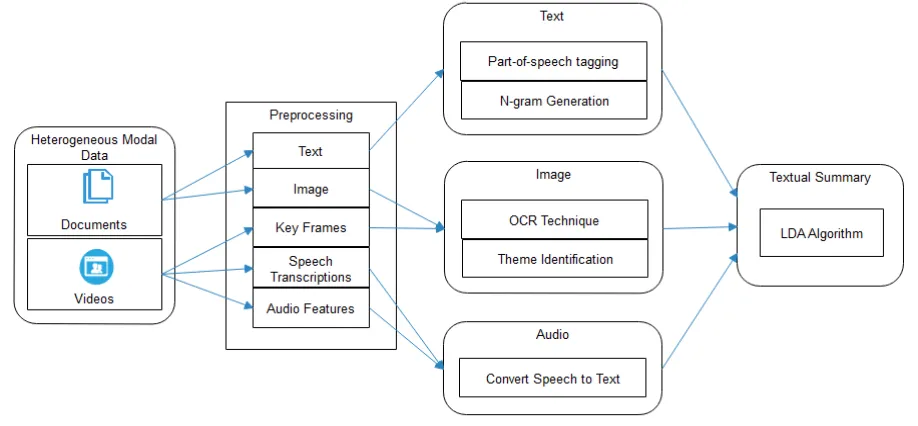
This paper proposes an approach to generate a textual summary from a set of asynchronous documents, images, audios and videos on the same news event, as shown in Fig. 1. Because multimedia data are heterogeneous and contain more complex information than that contained in pure text. The MMS framework shows in Fig. 1. For the audio information contained in videos, obtain speech transcriptions through ASR and design a method to selectively use these transcriptions. For visual information, including the key frames extracted from videos and the images that appear in documents learn the joint representations of text and images with a neural network; then identify the text that is relevant to the image based on text-image matching or multi-modal topic modeling. In this way, audio and visual information can be integrated into a textual summary by joint optimization. Contribution work is, to design an MMS method that can automatically generate a textual summary from a set of asynchronous documents, images, audios and videos related to a specific event. Consider four criteria like, salience, non-redundancy, readability and coverage for visual information that are jointly optimized by the budgeted maximization of submodular functions to select the representative sentences. Bridge the semantic gap between the textual and visual data.
A. Architecture
Fig. 1 System Architecture
Advantages are:
1. Provides users with textual summaries to help to acquire the gist of asynchronous multimedia data in a short time without reading documents or watching videos from beginning to end.
ISSN(Online): 2320-9801
ISSN (Print) : 2320-9798
I
nternational
J
ournal of
I
nnovative
R
esearch in
C
omputer
and
C
ommunication
E
ngineering
(A High Impact Factor, Monthly, Peer Reviewed Journal)
Website: www.ijircce.com
Vol. 7, Issue 3, March 2019
B. Mathematical Model
The input is a collection of multi-modal data = { , … , | |, , … , | |}related to a news event T, where each news document = { , }consists of text and image (there may be no image for some documents). denotes a news video and | . |denotes the cardinality of a set. The objective of our work is to automatically generate a fixed-length textual summary to represent the principle content of the multi-modal data .
An extractive summarization method in which all these aspects can be jointly optimized through the budgeted maximization of submodular functions defined as follows:
max ⊆ { ( ):
∈
≤ }
(1)
where T is a set of sentences, S is a summary, is the length (number of words) of sentence s, L is budget, i.e., length constraint for the summary, and submodular function F(S) is the summary score.
Text Salience of Summarization
The text salience of summary S by a diversity-aware objective:
( ) =
∈ ∩
(2)
where , = 1, … , is a disjoint partition of the set of all the sentences and speech transcriptions V into separate clusters, and the salience scores ( )are normalized to [0,1] by dividing by the maximum value among all the sentences.
Matching-based Image Coverage of Summarization
We model the summary S coverage for the image set I as follows:
( ) = ( ). ( , ) ∈
(3)
where the ( )is the weight for image pi. For keyframe , ( )is the average salience score of the speech transcriptions within the shot to which belongs. For document image , ( )is the average salience score of the sentences in the document in which is embedded. is a sentence or a sentence segment obtained based on semantic framing, chunking or word tokenizing.
C. Algorithms
1. Text Summary Generator Algorithm
Step 1 - It takes a text as input.
Step 2 - Splits it into one or more paragraph(s).
Step 3 - Splits each paragraph into one or more sentence(s). Step 4 - Splits each sentence into one or more words.
Step 5 - Gives each sentence weight-age (a floating point value) by comparing its words to a pre-defined dictionary called "stopWords.txt“.
If some word of a sentence matches to any word with the pre-defined Dictionary, then the word is considered as Low weighted.
Step 6 - An ordered list of weighted sentences is then prepared (Relatively High weighted sentences comes first and low weighted sentences comes At last position).
ISSN(Online): 2320-9801
ISSN (Print) : 2320-9798
I
nternational
J
ournal of
I
nnovative
R
esearch in
C
omputer
and
C
ommunication
E
ngineering
(A High Impact Factor, Monthly, Peer Reviewed Journal)
Website: www.ijircce.com
Vol. 7, Issue 3, March 2019
Step 8 - The output list is then returned summary.
2. OCR Algorithm
Process 1: Generating the edge image
Image generateEdgeImage(Image grayImg) //Create an × output image edgeImg
//grayImg is the × result image created in step 1
Step 1: ←0; ←0; ←0; ←0; ℎ ←0;
Step 2: for all , ∈ do
Step 3: if (0 < < −1) (0 < < )then
Step 4: ←| , − , | Step 5: ←| , − , |
Step 6: ℎ ←| , − , |
Step 6: , ←max ( , , ℎ ) Step 7: else
Step 8: , ←0 Step 9: end if
Step 10: end for
Step 11: , ← ℎ ( )
Step 12: return( )
Process 2: Localizing text candidates
textRegion[] detectTextRegions(Image edgeImg) // edgeImg is created using process 1
//textRegion is a data structure with 4 fields: , , ,
//determineYCoordinates uses the process 3
// determineXCoordinates uses the process 4
Step 1: [] ← ( )
Step 2: [] ← ( )
Step 3: ← ( , )
Step 4: return( )
Process 3: Determining the Y-coordinates of text regions
[] ( [] )
//H is the line histogram, see step 3
Step 1: ;
Step 2: [] ; ←1, ←0; ← ;
Step 3: for ∈ do
Step 4: if > − > then
Step 5: if not then
Step 6: . 0←
Step 7: ←
Step 8: end if
Step 9: else if then
ISSN(Online): 2320-9801
ISSN (Print) : 2320-9798
I
nternational
J
ournal of
I
nnovative
R
esearch in
C
omputer
and
C
ommunication
E
ngineering
(A High Impact Factor, Monthly, Peer Reviewed Journal)
Website: www.ijircce.com
Vol. 7, Issue 3, March 2019
Step 11: if (( . 1− . 0) > )then
Step 12: [ ]← Step 13: ← + 1
Step 14: end if
Step 15: ←
Step 16: end if
Step 17: end for
Step 18: return( )
Process 4:Determining the X-coordinates of text regions
[]
( , [] )
Step 1: ← , ℎ ← −1;
Step 2: for ∈ do
Step 3: for all , ∈ do Step 4: if ( , ≠0)then
Step 5: if ( > )then
Step 6: ← Step 7: end if
Step 8: if ( ℎ < )then
Step 9: ℎ ← Step 10: end if
Step 11: end if
Step 12: end for
Step 13: . 0← Step 14: . 1← ℎ Step 15: end for
Step 16: return( )
Process 5:Generating the text image
Image
( , [] )
// is created with Alg. generating the edge image
//TC is the array returned from Alg. of text regions
Step 1: Image ← ( , )
Step 2: Image ← ( )
Step 3: Image ← ( )
Step 4: ←
( , , )
Step 5: Image text ← ( , )
Step 6: text ← ℎ ( )
Step 7: return(text )
3. Hidden Markov Model (HMM) algorithm for speech recognition:
A HMM is characterized by 3 matrices viz., A, B and PI. A - Transition Probability matrix ( × )
B - Observation symbol Probability Distribution matrix ( × )
ISSN(Online): 2320-9801
ISSN (Print) : 2320-9798
I
nternational
J
ournal of
I
nnovative
R
esearch in
C
omputer
and
C
ommunication
E
ngineering
(A High Impact Factor, Monthly, Peer Reviewed Journal)
Website: www.ijircce.com
Vol. 7, Issue 3, March 2019
Where, N =Number of states in the HMM M = Number of Observation symbols
After can apply HMM for speech recognition by using following steps:
1. Recursive procedures like Forward and Backward Procedures exist which can compute P (O|L), probability of observation sequence.
Forward Procedure: Initialization:
( ) = , 1≤ ≤ Induction
( ) = ( ) ( ), 1≤ ≤ −1, 1≤ ≤
Termination
( | ) ( )
Backward Procedure: Initialization:
( ) = 1, 1≤ ≤ Induction
( ) = ( ) ( ), −1≤ ≤1, 1≤ ≤
Termination
( | ) ( )
2. The state occupation probability ( ) is the probability of occupying state at time given the sequence of observations
, , … , . 3.Baum-welch algorithm for parameter re-estimation.
V. RESULT AND DISCUSSIONS
Experiments are done by a personal computer with a configuration: Intel (R) Core (TM) i3-2120 CPU @ 3.30GHz, 4GB memory, Windows 7, MySQL 5.1 backend database and jdk 1.8. The application is dynamic web application for design code in Eclipse tool and execute on Tomcat server. Some functions used in the algorithm are provided by list of jars like standford core NLP jar for keywords extraction using POS tagger method. TalkingJavaSDK jar uses for speech to text conversion and imageio jar uses for image read and write.
ISSN(Online): 2320-9801
ISSN (Print) : 2320-9798
I
nternational
J
ournal of
I
nnovative
R
esearch in
C
omputer
and
C
ommunication
E
ngineering
(A High Impact Factor, Monthly, Peer Reviewed Journal)
Website: www.ijircce.com
Vol. 7, Issue 3, March 2019
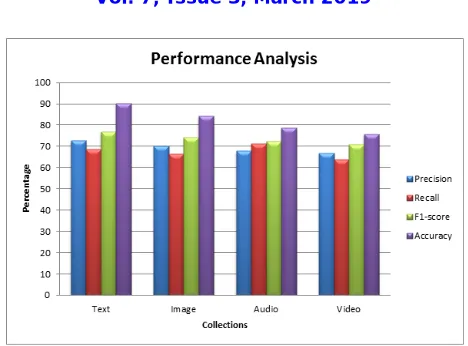
Fig. 2 Performance graph for MMS framework
VI. CONCLUSION
This paper addresses an asynchronous MMS task, namely, how to use related text, audio and video information to generate a textual summary. We formulate the MMS task as an optimization problem with a budgeted maximization of submodular functions. We address readability by selectively using the transcription of audio through guidance strategies. The experimental results shows that giving input any combination like, .txt, .docx, .jpg, .mp3, .mp4, .avi etc. file and output is automatic generated textual summary showing within time.
REFERENCES
[1] H. Li, J. Zhu, C. Ma, J. Zhang, and C. Zong, “Multi-modal summarization for asynchronous collection of text, image, audio and video.” in EMNLP, 2017, pp. 1092–1102.
[2] J. Bian, Y. Yang, and T.-S. Chua, “Multimedia summarization for trending topics in microblogs,” in CIKM. ACM, 2013, pp. 1807–1812.
[3] J. Bian, Y. Yang, H. Zhang, and T.-S. Chua, “Multimedia summarization for social events in microblog stream,” IEEE Transactions on
Multimedia, vol. 17, no. 2, pp. 216–228, 2015.
[4] W. Y. Wang, Y. Mehdad, D. R. Radev, and A. Stent, “A low-rank approximation approach to learning joint embeddings of news stories and
images for timeline summarization,” in NAACL-HLT, 2016, pp. 58–68.
[5] P. Goyal, L. Behera, and T. M. Mcginnity, “A context-based word indexing model for document summarization,” IEEE Transactions on