University of Windsor University of Windsor
Scholarship at UWindsor
Scholarship at UWindsor
Electronic Theses and Dissertations Theses, Dissertations, and Major Papers
2014
Modular Product Platform Configuration and Co-Design of
Modular Product Platform Configuration and Co-Design of
Assembly Line
Assembly Line
Mohmmad Hanafy University of Windsor
Follow this and additional works at: https://scholar.uwindsor.ca/etd
Part of the Systems Engineering Commons
Recommended Citation Recommended Citation
Hanafy, Mohmmad, "Modular Product Platform Configuration and Co-Design of Assembly Line" (2014). Electronic Theses and Dissertations. 5074.
https://scholar.uwindsor.ca/etd/5074
This online database contains the full-text of PhD dissertations and Masters’ theses of University of Windsor students from 1954 forward. These documents are made available for personal study and research purposes only, in accordance with the Canadian Copyright Act and the Creative Commons license—CC BY-NC-ND (Attribution, Non-Commercial, No Derivative Works). Under this license, works must always be attributed to the copyright holder (original author), cannot be used for any commercial purposes, and may not be altered. Any other use would require the permission of the copyright holder. Students may inquire about withdrawing their dissertation and/or thesis from this database. For additional inquiries, please contact the repository administrator via email
Modular Product Platform Configuration and Co-Design of Assembly Line
By
Mohmmad Mahmoud Abdu Hanafy
A Dissertation
Submitted to the Faculty of Graduate Studies through Industrial and Manufacturing Systems Engineering
in Partial Fulfillment of the Requirements for The Degree of Doctor of Philosophy at the
University of Windsor
Windsor, Ontario, Canada
2014
Modular Product Platform Configuration and Co-Design of Assembly Line
by
Mohmmad Mahmoud Abdu Hanafy
APPROVED BY:
__________________________________________________ R. Jiao, External Examiner
Georgia Institute of Technology
__________________________________________________ R. Gras
School of Computer Science
__________________________________________________ A. Azab
Industrial & Manufacturing Systems Engineering
__________________________________________________ Z. Pasek
Industrial & Manufacturing Systems Engineering
__________________________________________________ H. ElMaraghy, Advisor
Industrial & Manufacturing Systems Engineering
III
Declaration of Co-Authorship / Previous Publication
I. Co-Authorship Declaration
I hereby declare that this dissertation incorporates material that is result of joint research of the author and his supervisor Prof. Hoda ElMaraghy. This joint research has been submitted to journals and conferences that are listed below.
I am aware of the University of Windsor Senate Policy on Authorship and I certify that I have properly acknowledged the contribution of other researchers to my dissertation, and have obtained written permission from Prof. Hoda ElMaraghy to include that material(s) in my thesis.
I certify that, with the above qualification, this dissertation, and the research to which it refers, is the product of my own work.
II. Declaration of Previous Publication
This dissertation includes [5] original papers that have been previously published/submitted for publication in peer reviewed journals and conferences as follows:
Dissertation
Chapter Publication Title/Full Citation
2
Hanafy, M. and ElMaraghy, H., 2014. Developing of an Assembly Line Layout for Delayed Product Differentiation Using Phylogenetic
Networks. International Journal of Production Research. (submitted)
3
Hanafy, M. and ElMaraghy, H., 2014. Modular Product Multi-Platform Configuration Model. International Journal of Intelligent
Manufacturing. (Submitted)
3
Hanafy, M. and ElMaraghy, H., 2012. A Modular Dynamic Products Platforms Design Model. 23rd CIRP Design Conference 2013. Bochum, Germany: pp: 553-562.
4
Hanafy, M. and ElMaraghy, H. A., 2014. A Multi-Period Changeable Modular Product Assembly Model. Enabling Manufacturing
Competitiveness and Economic Sustainability, Springer: 137-142.
5
IV
I certify that I have authorization from the copyright owner(s) to include the above published material(s) in my dissertation. I certify that the above material describes work completed during my registration as graduate student at the University of Windsor.
V
ABSTRACT
In this dissertation, the main hypothesis is that formation of products families and platforms can be simultaneously achieved with their corresponding assembly lines using a holistic mathematical model to increase the effectiveness of mass customization and decrease development and assembly costs. A Phylogenetic Network algorithm, four different mathematical models, and postponement effectiveness metric have been developed and implemented to prove this hypothesis. The results of this research are applicable to many modular products such as consumer goods such as computers, laptops, tablets, power tools, home appliances and laboratory weighing scales which have multiple variants. The research provides a hybrid approach balancing between platforms production using make-to-stock strategy, then further customization using make-to-order strategy.
The Median-Joining Phylogenetic Network (MJPN) is used to model a delayed differentiation assembly line for a product family. The MJPN is capable of increasing commonality across the product platforms using the Median Vector concept. A Postponement Effectiveness metric was developed and showed that the determined assembly line strategy postponed the products delayed differentiation point more than other found in literature. A Modular Product Multi-Platform Configuration Model is introduced to design optimal products platforms which allow assembly and disassembly of components to form new product variants. A new model of Hierarchic Changeable Modular Product Platforms which defines the optimum hierarchy of the platform components is introduced, to enable delayed product differentiation. A Multi-Period Multi-Platform Configuration Model which accounts for demand fluctuation by including the cost and quantity of inventory of product platforms required for implementing the assembly/disassembly platforms customization was developed. Finally, a global product families and platforms formation mathematical model which fully integrates assembly task assignments, precedence relations, assembly cost was introduced. A family of touch screen tablets was used for illustrating the application and advantages of the newly developed product platform models.
VI
To my father, who had enlighten my life
To my mother, the helper and the supporter
To my wife, who filled my life with hope and passion
VII
ACKNOWLEDGEMENT
The author expresses his gratitude to his supervisor Professor Hoda ElMaraghy. Her great efforts, support, knowledge and encouragement greatly inspired and driven the research to the right direction. Professor Hoda provided tremendous time, follow-ups, and dedication to research, which have been a great boost to solidify and materialize the scope and the thesis core.
The author also acknowledges the important role of the supervising committee. The committee members: Dr. Azab, Dr. Pasek and Dr. Gras have helped the author in clarifying his thoughts, ideas and results. They provided deep, sincere guidance and comments from the very beginning point of the comprehensive exam‘s topics. The author acknowledges the supportive and educational role of Dr. Waguih ElMaraghy. His discussions and knowledge about complexity and design methodologies have been of great value to the research. I also would thank all members of Intelligent Manufacturing Systems Centre (IMSC) for their great help and fruitful discussions through the course of this thesis.
VIII
TABLE OF CONTENTS
ABSTRACT V
ACKNOWLEDGEMENT VII
LIST OF FIGURES XI
LIST OF TABLES XIII
Chapter 1 1
Co-Design of Modular Product Platforms and Assembly Lines 1
1 Introduction 1
1.1 Background 1
1.2 Motivation 1
1.3 Engineering Problem Statement 2
1.4 Objectives 2
1.5 Research Scope 3
1.6 General Useful Guidelines 5
1.7 Definitions Used 5
1.8 Research Gaps 5
1.9 Research Plan 6
1.10 Thesis Statement 8
Chapter 2 9
Developing of an Assembly Line Layout for Delayed Product Differentiation Using Phylogenetic
Networks 9
2 Introduction 9
2.1 Product Platform Concept 10
2.2 Assembly Lines 12
2.3 Literature Review 14
2.4 Problem Formulation 21
2.5 Case Study 23
2.6 Postponement Effectiveness Metric 26
IX
Chapter 3 35
Modular Product Multi-Platform Configuration Model 35
3 Introduction 35
3.1 Motivation 35
3.2 Combined Assembly and Disassembly Concept in Forming Platforms 35
3.3 Model Development 37
3.4 Non-Linear Modular Product Multi-Platform Configuration Model 39 3.5 Initial Comparison between MPMP Model and Ben Arieh‘s Model 42
3.6 Illustrating Example 42
3.7 Results 43
3.8 Case Study 47
3.9 Performance Evaluation 50
3.10 Contributions 53
3.11 Conclusions 53
3.12 A Hierarchic Model of Changeable Modular Product Platforms (Model 3) 54
Chapter 4 63
A Multi-Period Multi-Platform Configuration Model 63
4 Introduction 63
4.1 Literature Review 63
4.2 Problem Statement 64
4.3 Mathematical Model 65
4.4 Model decision variables 66
4.5 Mathematical model formulation 67
4.6 Illustrative Example 69
4.7 Results and Discussion 70
4.8 Contributions 72
4.9 Conclusions 72
Chapter 5 73
Modular Product Platform Configuration and Co-Design of Assembly Line Model (MPCA) 73
5 Introduction 73
5.1 Literature Review 73
5.2 Model Development 75
5.3 The Assembly Line Design Variables 77
X
5.5 Linearized Product Platform Assembly Line Model 81
5.6 Example 84
5.7 Results of Scenario A 84
5.8 Results of Scenario B 86
5.9 Model Verification 88
5.10 Contributions 89
5.11 Conclusions 89
Chapter 6 91
Conclusions and Future work 91
6 Discussion 91
6.1 Achievements 91
6.2 Conclusions 92
6.3 Significance 94
6.4 Limitations 94
6.5 Future Work 94
REFERENCES 96
APPENDIX A 101
XI
LIST OF FIGURES
Figure 1.1 Product platform research positioning ... 4
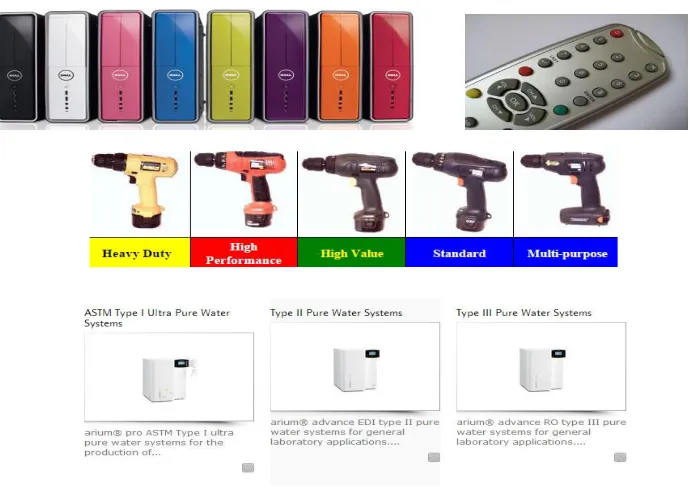
Figure 1.2 Other modular products that can make use of the proposed research ... 4
Figure 1.3 Models and metric developed through this research………..7
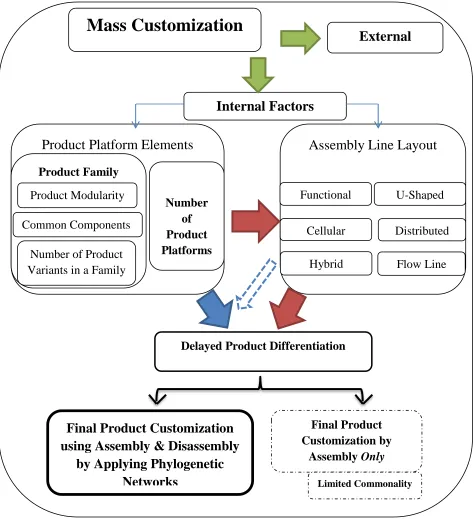
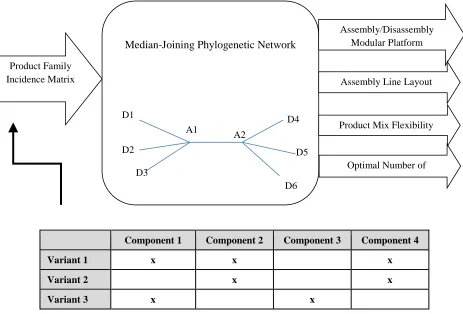
Figure 2.1 Framework of assembly/disassembly product platform customization ... 14
Figure 2.2 Illustration of Assembly / Disassembly Modular Platforms (ADMP) ... 18
Figure 2.3 Taxonomy of different types of phylogenetic networks (Huson and Scornavacca (2011) ... 19
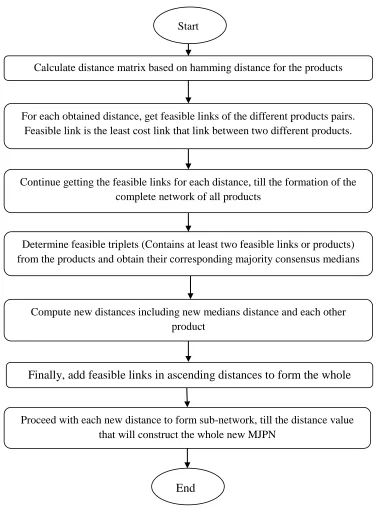
Figure 2.4 Flow chart of MJPN algorithm (adapted from Bandelt et al. 1999) ... 20
Figure 2.5 Median vector concept adapted from (Bandelt et al. 1999) ... 21
Figure 2.6 Delayed product differentiation modular platform network model ... 22
Figure 2.7 The studied kettle‘s product family (AlGeddawy and ElMaraghy 2010a) ... 23
Figure 2.8 Parts used in the kettle product family (AlGeddawy and ElMaraghy 2010a) ... 23
Figure 2.9 A Cladogram showing delayed product differentiation layout (adapted from AlGeddawy and ElMaraghy 2010a) ... 24
Figure 2.10 Delayed product differentiation modular platform network model results for the family of Kettles assembly system layout ... 25
Figure 2.11 Assembly line layouts comparisons regarding postponement effectiveness ... 27
Figure 2.12 Posteponement Effectiveness (PE) metric illustration ... 29
Figure 3.1 Product platform customization by assembly and disassembly of components/modules ... 37
Figure 3.2 IDEF0 of Modular Product Multi-Platform Model (MPMP) ... 37
Figure 3.3 Precedence of Product Components (Adopted from Ben-Arieh et al. 2009) ... 43
Figure 3.4 Different locations for a duplicate component ... 44
Figure 3.5 Touch Screen 7‘‘ tablet ... 47
XII
Figure 3.7 (a-c) Different comparisons between cost of assembling, cost of disassembling and cost
of platform ratios to the total cost ... 52
Figure 3.8 IDEF0 of the Hierarchic Changeable Modular Product Platforms model ... 57
Figure 3.9 Dummy component explanation... 58
Figure 3.10 Precedence Diagram of the tablets family showing speaker assembly positions ... 61
Figure 4.1 Multi-period Multi-Platform configuration model ... 65
Figure 5.1 Manual assembly line representation ... 75
Figure 5.2 Modular product platform configuration and co-design of assembly line model ... 75
Figure 5.3 IDEF0 of modular product platform configuration model and co-design of assembly line ... 76
Figure 5.4 Piece-wise linearization scheme ... 83
Figure 5.5 Model output containing products and platforms assignments for the first scenario (i.e. mass assembly and customization by disassembly)... 85
XIII
LIST OF TABLES
Table 1.1 Literature matrix showing gaps in modular product families and platform design ... 6
Table 2.1 Incidence matrix of the kettles product family ... 24
Table 2.2 Comparison between different assembly line layouts including the newly proposed layout... 32
Table 3.1 Comparison between MPMP model and Ben Arieh‘s model ... 42
Table 3.2 The comparison between the results of Ben Arieh‘s model and the MPMP model ... 45
Table 3.3 Results of the MPMP model using multiple platforms... 46
Table 3.4 Costs and composition of each tablet ... 48
Table 3.5 Optimal multiple platforms and product families ... 50
Table 3.6 Model performance evaluation with varying number of products and components ... 53
Table 3.7 Comparison between model 2 and model 3 using the illustrative example (single platform) ... 58
Table 3.8 Comparison between model 2 and model 3 using the illustrative example (multiple platform) ... 59
Table 3.9 Costs and composition of each tablet ... 60
Table 3.10 Single and Multi Platform Optimum Hierarchy ... 61
Table 4.1 Results of the multi-period multi-platform model ... 70
Table 4.2 Model Performance... 71
Table 5.1 Effect of days allowed for assembly (ND) on platform composition ... 88
Table 5.2 Effect of customization by disassembly time ( ) on platform composition ... 88
1
Chapter 1
Co-Design of Modular Product Platforms and Assembly Lines
1 Introduction
1.1 Background
In these days, products variety becomes a necessity. The customers are always asking for more new products with very fluctuating and uncertain demands and needs. These demands necessitate the development of different concepts that enhance Mass Customization. The competition to acquire new markets and even to preserve the existing one requires efficient production methods. Efficient methods mean decreasing the costs, while keeping the quality and prevent loss of functionality of the products. Most of the time the main strategy used to attain this type of competitive edge is called Mass Customization. Research in this field contains many different domains like: product families, product platforms and portfolios, assembly line design, production flexibility, delayed product differentiation. Ulrich (1995) discussed the product architecture concept impact on industrial corporations. He differentiated clearly between different product architecture: modular and integral. Also, he further divided the modular concept to: slot, bus, and sectional types. Erens and Verhulst (1997) extended the product architecture concept to product families, and suggested that there are three models that govern the product realization: function, technology, and physical.
1.2 Motivation
The modern industrial engineering research always cares for fulfilling fluctuating markets demand with a customer-focused perspective. Balanced and economical variations in products coupled with mass customization techniques increase the corporations‘ competitiveness. The assembly costs contribute for more than 20% of the final product price. Therefore, decreasing assembly costs become more crucial in the recent research. Many of the Original Equipment Manufacturers (OEMs) are now concentrating on the assembly of their products rather than totally manufacturing them. Hence, the field of product assembly has received much attention in industrial research. Product platform is considered one of the prominent and promising ways to decrease assembly costs. Normally, the product platform is being produced on a mass production scale, and then based on customer demand, the product platform is customized to fulfill different needs and create different products. The product platform concept embraces the concept of delayed product differentiation.
2
In big corporations, the product platform is first designed then the design of the assembly line follows. This creates a gap between product platform design and assembly/manufacturing systems design. The results could be more time and costs, and the presence of a subjective feedback loop that must be mitigated by trial and error. An urgent need is rising now to develop different product platform and assembly system models that can efficiently deal with changeable and evolving product families and platforms along with utilizing the concept of delayed product differentiation, while reducing the costs for the whole process at the same time.
1.3 Engineering Problem Statement
The problem is how to integrate the design of product families (members of each family), product platforms (number of platforms, components composition and hierarchy), delayed product differentiation, and assembly system design (assembly assignment, number of stations) in one holistic mathematical model. The mathematical model(s) should minimize total assembly costs associated with products assembly and line design.
1.4 Objectives
Based on engineering problem statement, this research will be accomplished by working on three main objectives:
- First, it is required to develop a model that can integrate delayed product differentiation and products platforms concepts and avoid the drawbacks that will be discussed extensively in the literature. The Median Joining Phylogenetic Network (MJPN) algorithm that is used heavily in biology to identify ancestries of different species will be used to design product platforms and families. The algorithm avoids the determination of number of platforms a priori. The algorithm employs an assembly/disassembly strategy to form product platforms. It depends on forming a product platform that most of the products share, and then customizes it by adding or removing components in a well-defined way.
- Second, a more flexible mathematical model approach will be developed to target the same problem. The reason is that the algorithm of the MJPN cannot deal with some perspectives of product platforms including costs of assembly. Therefore, the mathematical model can tackle more aspects of product platform and assembly line formation.
3
- Fourth, a new Multi-Period Multi-Platform Model will be proposed to test the effect of for products and platforms‘ inventories using combined assembly and disassembly of components to derive products from their platforms.
- Fifth, a holistic model that combines and obtain product families, product platforms, assembly costs, employs delayed differentiation, and assembly line design will be proposed. This will be the first time to introduce such integrated model that is based on well-established solid mathematical foundations.
1.5 Research Scope
In Figure 1.1, the field of product families and platforms includes different classifications (physical (Erens and Verhulst 1997), functional (Kumar and Allada 2007), modular, and scalable (Simpson et al. 2001)), metrics, and frameworks. The main emphasis of the research is the modular product platforms configuration problem. These types of platforms depend on the formation of the optimum groups, modules, and platforms of different types of interchangeable components across product families. These platforms are assembled in a Make-To-Stock (MTS) model based on demand forecasting, in which the manufacturer is able to mass assemble the common platform of different products. Then different products can be derived from these platforms according to arriving customers‘ orders or Make-To-Order (MTO) model. The research is based on simultaneous assembly and disassembly of components of a mass assembled platforms to obtain different products. The proposed research utilizes both of MTS and MTO in a hybrid model of producing platforms with maximum number of shared components, then derives different products by assembling and disassembling components. Using the developed models would help in increasing market share due to adaptive responsiveness of corporations to uncertain customer demands.
4
Figure 1.1 Product platform research positioning
Figure 1.2 Other modular products that can make use of the proposed research Technologies to Satisfy Maximum Number of Functions
Components Selection
Product Platform Types
Scalable
Components Parameters Determination
5
1.6 General Useful Guidelines
Generally, the developed mathematical models are able to determine when to use the disassembly concept to customize platforms to derive products. However, some guidelines can be followed to maximize the benefits of using combined assembly and disassembly to derive new product variants. It is assumed through the whole dissertation that each component in a product has three different assembly times or costs for: mass produced platform assembly, customization by assembly and customization by disassembly:
Platform mass production times or costs should be smaller than platform customization to derive new components by assembly costs and times.
Customization by assembly costs or times should be larger than customization by disassembly costs or times.
Parts can be disassembled without damage to the part or surrounding parts (e.g. welding is not used).
The maximum number of possible platforms is the number of products.
1.7 Definitions Used
Many concepts and definitions have been mentioned throughout the dissertation. These are listed below to clearly define their meaning as used in this research:
Co-Design of Product Platforms and Systems: it means that the design of both of product platforms and their assembly lines are included in one mathematical model. Sometimes co-design is used to describe the collaboration of two or more individual in a certain project, but this is not the case here.
Modular Product Platform: A set of sub-systems and interfaces which form a common structure, from which a stream of derivative products can be efficiently produced and developed (Meyer and Lehnerd 1997).
Customization of platforms by assembly and disassembly: the manufacturer should mass assemble the product platforms, and then customize it later to derive different products by assembling or disassembling of components. This customization process takes place during manufacturing and, hence, is not considered rework or repair (Similar to Dell business model).
1.8 Research Gaps
6
simultaneously integrate (or combine) the design of product platform with their corresponding assembly lines. Research gaps are summarized in Table 1.1.
Table 1.1 Literature matrix showing gaps in modular product families and platform design
References Problem formulation technique Several families /platforms? (Y,N, P) Is Platform Hierarchy predetermined?
(Y, N, NC)
Market demand included?
Manufacturing/Assembly costs? (Y, N)
Assembly line design (Y, N) Huang et al. (2003) Graph
theory N N N N N
Huang et al. (2005)
Math model, Genetic Algorithm
N Y Y Y N
Rai and Allada (2006)
Agent-based
pareto N Y N N N
Zacharias and Yassine
(2008)
Math model Y, P Y N Y N
Ben-Arieh et al. (2009) Math model, Genetic Algorithm
Y NC Y Y N
AlGeddawy and ElMaraghy
(2010a)
Cladistics
algorithm Y NC N N Y
NC: Not Complete P: Predetermined
Y: Yes
N: No
1.9 Research Plan
In Figure 1.3, my research plan is based on several models and a metric:
7
- Developing a Postponement Effectiveness metric to evaluate the newly used Phylogenetic Network efficiency in producing product platforms and families.
- As an extension to the Phylogenetic concept, a new mathematical model is proposed to form both of product families and product platforms of modular products; the target is minimizing number of platforms and costs associated with its assembly, postpone differentiation point by increasing commonality through assembly and disassembly concept. The model should be able to solve real life large-components scenarios. The model should be able to avoid possible previous instabilities and inefficiencies in literatures‘ models. - A Hierarchic Model of Changeable Modular Product Platforms based on assembly costs is
proposed to increase the capabilities of the previous model. The new model should be able to identify clearly the hierarchy of components inside each platform.
- A Multi-Period Multi-Platform Configuration Model is proposed to include inventory costs and quantities to the product platform formation. The model should identify product families and platforms and the expected inventories for multiple periods of production. - A complete mathematical holistic model is proposed to co-design modular product
platforms and families with assembly line design. This is the first time to provide full model that link product platforms design with assembly line design.
Chapter
Chapter 3
Chapter 4 Chapter 3
Developing of an Assembly Line Layout
for Delayed Product Differentiation Using Phylogenetic Networks Postponement Effectiveness Metric A Multi-Period Multi-Platform Modular Product Model Modular Product Multi-Platform Configuration Model
A Hierarchic Model of Changeable Modular Product Platforms Model Modular Product Platform Configuration and Co-Design of Assembly Line Chapter 2 + Platform number flexibility and
costs + Pl at fo rm hi er ar chy
8
Figure 1.3 Models and metric developed through this research
1.10 Thesis Statement
The presented research based on the following thesis:
9
Chapter 2
Developing of an Assembly Line Layout for Delayed Product Differentiation Using Phylogenetic Networks
2 Introduction
Market changes and increased variety make accurately prediction of future demands for products and their variants difficult. Effective formation of products platforms helps mitigate this uncertainty and decrease time-to-market and lead-time. Product platform entails grouping of core elements of product family members into common modules which are used to form different variants by combining different components. High commonality between product variants is achieved by maximizing similarity between grouped parts. A new Delayed Product Differentiation Modular Platform model, which applies Median-Joining Phylogenetic Networks (MJPN), is proposed. It is used for forming products platforms and determining the assembly line layout of modular product families. The MJPN is traditionally used for DNA sequences‘ mapping, analysis, clustering and for tracing evolutionary trends. The concept of Assembly/Disassembly Modular Platforms (ADMP), where both assembly and disassembly of components are used to derive the final product variants from the platform, is used. The proposed model determines the required number and composition of common platforms and defines the delayed product differentiation points. The developed dynamic assembly/disassembly platforms enhance routing and product mix flexibility due to the presence of different platforms that can be used to produce the same product variant. A family of household kettles is used to demonstrate the application of the proposed model. A metric is presented for determining the effectiveness of a given platform in delaying the product differentiation which increases the efficiency of mass customization. The proposed metric, applied to the case study, demonstrated that the proposed platform formation model using MJPN is better capable of postponing the product differentiation point.
10
In Figure 2.1, Mass Customization is affected by external and internal factors. External factors are related to uncertain customer demands and different user preferences in customizing products. While, internal factors are strongly linked to the company‘s design features, assembly and production management (Blecker and Friedrich 2006). Product Platform concept is considered an internal factor which has been used practically by a number of known corporations such as Sony (Sanderson and Uzumeri 1995), HP (Meyer 1997), Volkswagen (Wilhelm 1997), and Black and Decker‘s (Meyer and Lehnerd (1997). Approaches to produce product platforms are divided into different branches: quantitative (Fujita et al. 1999), (Simpson et al. 2001), (Messac et al. 2002), and (Hernandez et al. (2003)) and qualitative (Martin and Ishii 2002), (Maier and Fadel 2001), and (Park and Simpson 2005)). Forming a product platform means determining two main aspects: product family composition and number of product platforms. Furthermore, a product family depends on several factors including: components commonality, product modularity, and number of product variants. Product platform formation research utilizes commonality measures and indices as well as optimization using different criteria such as maximum commonality or minimum functionality loss.
2.1 Product Platform Concept
Platforms have been categorized according to: modularity, scalability and functionality. Meyer and Lehnerd (1997) defined Product Platform as a: set of sub-systems and interfaces that form a common structure, from which a stream of derivative products can be efficiently produced and developed.Erens and Verhulst (1997) discussed the main concept of product platforms, but called it Product Families Architecture. The authors clearly defined the concept of ―Modular Product
Platforms‖, which can produce different products by varying some modular components. Lee and
Tang (1997) discussed the implication of applying kits to postpone the differentiation of a large family of three-phase squirrel cage induction motor in MarelliMotori company. Kits refer to a set of components or processes that are represented as one item in the master assembly plan, which corresponds to a catalogue option. Applying kits decreased the time needed to customize motors according to customers‘ requirements by 85 % than without using kits. Despite that reduction, forming those kits depended only on experience rather than quantitative models. Jiao and Tseng (1999) developed a new approach to design Product Platform Architecture (PFA). That approach is an adaptable version of axiomatic design that depends on Functional Requirements (FR) and Design Variables (DP). Simpson et al. (2001) described another platform type: the Scalable Platform. They proposed a Compromise Design Support Problem Formulation; to design a product family of a universal electric motor by scaling up and down some parameters to produce motors with very similar structures but with variable performance.
Martin and Ishii (2002) developed metrics to assess the generational variety of a certain platform, which is an estimate of the effort needed to convert a platform to a future one. In addition, they
described an index which determines the degree of coupling between different components. Jose
11
Graph and Matrix Partitioning methods and Mathematical Programming methods were used to produce specific platforms for a group of products. The objective of the product platform research is to increase the common components in platforms, and increase distinctiveness between the derived products at the same time. This necessitates finding new methods to increase product components commonality in platforms while supporting product variety. Jiao et al. (2007) presented a literature survey that discusses and provide futuristic insights on many product platforms attributes: families, architectures, frameworks, product variety…etc.
Tian-Li et al. (2007) applied the Design Structure Matrix (DSM) with a partitioning algorithm using genetic algorithm to produce common platforms for complex products and groups interactions (e.g. a gas turbine platform required 22 cross-functional teams communication within GM corporation). Jiao (2012) formulated a model to integrate marketing, design and manufacturing decisions of product platform planning as a bi-level optimization problem. Jiao‘s model seeks to maximize the expected profits (first level) while satisfying capacity constraints (second level). Al-Salim and Choobineh (2009) proposed two optimization models (profit maximisation and option-value) to postpone the differentiation of a group of products. They used exhaustive search to solve small-sized problems and Tabu-constrained randomized search to solve large size problems. Their model depends on the assumption of negative correlation between the number of common processing stages of the products family and their market share. In other words, as the number of common processes increases, products become more similar and customers will not want to pay extra money for seemingly similar products.
Ben-Arieh et al. (2009) dealt with the multiple platforms configuration problem and proposed a mathematical formulation to configure single and multiple platforms by adding or removing components to the platform to form the final product. Their model requires specifying the expected number of platforms a priori and it fails to form effective platforms when demand for all products is equal. Furthermore, their model is not scalable and requires a genetic algorithm formulation to solve problems with large numbers of products and components. Lu et al. (2011) devised a cost model including operation delay cost and penalty delay cost, to compare costs of a normally differentiated and a postponed differentiated production of copper strips. The model was only used to compare available redesigned production lines not to obtain new ones. Rojas Arciniegas and Kim (2011) used Design Structure Matrix (DSM), Functional Structure Matrix (FSM) and Genetic Algorithms and proposed an Impact Metric (IM) to determine the optimal set of components to be shared among a group of products. The drawback of these methods is that they are all used in the functional domain. If a capacitor function is shared between products of the same platform it does not necessarily mean that an identical capacitor is used. However, if two products have a capacitor, then they belong to the same family.
12
which may produce suboptimal clustering of products. This assumption can undermine delaying the product differentiation which is one of the most important motivations when forming product platforms. Moreover, experience is used heavily is literature to form product platforms. Jose and Tollenaere (2005) suggested that more models and methods must be devised to increase common shared components in a platform, while providing distinctive products that entice customers to pay extra money for product variants. These shortcomings provide grounds for defining new methods and algorithms to deal with the complex issue of product families and platforms design.
2.2 Assembly Lines
The other internal factor is the assembly line layout and the associated incurred costs (Figure 2.1). The cost of assembly is important in determining the final product cost. It accounts for 20% of production costs, 50 % of total production time, and 30 to 50% of labour costs (Nof et al. 1997). In addition to decreasing assembly cost, platforms contribute to: 1) short lead time (Muffatto 1999), 2) customer satisfaction and 3) agility of response to the markets with demand uncertainties and unreliable forecasting (Suh et al. 2007). Assembly line is the group of successive stations used to perform certain assembly tasks to produce the final products. Henry Ford is considered the father of the assembly line concept (Alizon et al. 2009). Salveson (1955) was the first researcher to model assembly lines using linear mathematical programming. Companies are interested in concepts of assembly layouts that are robust in facing changing products and short life cycles. However, conventional assembly layout strategies like: flow line (Burbidge (1963), functional ((Flynn and Robert Jacobs (1986) , Montreuil (1999)), and cellular (Saghiri (2011) cannot deal efficiently with product demand uncertainties. To promote layout and material handling efficiencies, hybrid layout strategies have been developed such as distributed (Montreuil and Venkatadri 1991), Benjaafar and Sheikhzadeh (2000) and Lahmar and Benjaafar (2005)), modular (Irani and Huang 2000)) and agile (Kochhar and Heragu (1999) , Benjaafar (2002)) layouts. These layouts can improve operational performance and encourage the application of delayed product differentiation. Delayed Product Differentiation, if optimally applied, would lead to robust hybrid layout that can robustly respond to customers‘ requirements (Feitzinger and Lee 1997).
13
(Figure 2.1). To avoid this limitation, the principle of assembly/disassembly modular platform first proposed by Ben-Arieh et al. (2009) is used in the proposed model. The assembly/disassembly modular platform formation is analogous to the ancestry estimation in the field of biological and living organisms, which is used to trace their possible evolutionary paths. One of the famous techniques in ancestry estimation is Median-Joining Phylogenetic Network (MJPN) (Bandelt et al. 1999). Examining the literature, although product platform is used to produce multiple products, the authors believe that there is no contradiction when a platform also in the extreme represents one product variant provided that its production volume warrants it. As an example: in the minivan assembly plant in Windsor, Ontario, Canada, there is one platform to serve two models (Chrysler Town & Country and Dodge Grand Caravan). This means that it is economically beneficial to mass produce this platform to get these two models later by customization. Meanwhile, the Bugatti Veyron –for example - has a very special structure that cannot be shared with other cars; hence, it is its own platform. Therefore, the better definition for product platform is that it is the common shared components across a product family that can be economically mass-produced. However, in this chapter, the platform is used to produce different product not only one product.
14
Figure 2.1 Framework of assembly/disassembly product platform customization
2.3 Literature Review
2.3.1 Delayed Product Differentiation
Delayed Product Differentiation (DPD) aims at postponing the final product assembly differentiation point as much as possible (He et al. 1998). Shin and Min (1991) divided
Product Platform Elements
Final Product Customization
using Assembly & Disassembly
by Applying Phylogenetic
Networks
Assembly Line Layout
Delayed Product Differentiation Product Family
Final Product Customization by
Assembly Only
Common Components
Number of Product Variants in a Family
Mass Customization
Number of Product Platforms
Limited Commonality Functional U-Shaped
Cellular Distributed
Hybrid Flow Line
Internal Factors
External
Factors
15
postponement into form postponement (labeling, packaging, assembly, and manufacturing) and time postponement (delaying product distribution until customer orders arrive). A cost model was developed to determine the percentage of postponed production according to the four form postponement aspects. Form Postponement is also defined as a concept which describes activities (components assembly, cloth dyeing) initiated after the arrival of customer orders (Blecker and Abdelkafi 2006). The application of these techniques allows assembly processes standardization, decreases the required workforce, and minimizes the number of working stations. Ulrich and Tung (1991) conceptually discussed one of the most important factors contributing to product variety in general which is Product Modularity. Lee and Billington (1994) discussed and enumerated different direct and hidden cost drivers and strategies that affect design for postponement for product variety. They also classified postponement into time and form types. They discussed the product variety postponement related to initial conceptual design, but did not apply it to producing actual products.
Garg and Tang (1997) proposed a time-correlation statistical model to study the effect of choosing the point of delayed differentiation in three different examples (Watches manufacturing, PC and Macintosh compatible printers and different market segments for a certain hypothetical product) on inventory levels. Their model only discussed two very broad and general factors: product lead time, mean and variance of product demand, and finally inventory level with little attention to differentiating product features; and no assembly line layouts were derived. Lee and Tang (1997) proposed a discrete time event model that captures costs associated with delayed product differentiation and discussed three main specific cases: Product Modularity, Standardization, and Process re-structuring. Their model considers only limited number of parts and processes; any further considerations of more features would greatly complicate the model. This analytical model does not synthesize but rather examines existing or proposed platform solutions. Sparling (1998) proposed a binary decision model to improve a European-based wine supply chain. The decision model helped in choosing the appropriate postponement strategy (e.g. deferred assembly, bundled manufacturing, uni-centric manufacturing, or deferred packaging) using different operational characteristic (e.g. process, technological, or market characteristics, and product differentiation). He et al. (1998) developed a mathematical model to select the optimized sub-assembly in a delayed differentiated product and proposed an equation to test those differential designs against the makespan time of the assembly system. No synthesis is performed by this model; only selection from a pre-determined group of integrated and modular sub-assemblies is carried out.
16
Scholl and Becker (2006) developed a managerial Postponement/Speculation matrix (P/S matrix) which enlists four generic P/S strategies. Those strategies help in identifying the best actions to achieve economies of scale, scope or both in manufacturing and logistics. Swaminathan and Tayur (1999) improved their previous model by incorporating operations, design, assembly sequences, and life cycle costs. However, this model leads to resources duplications since complete similarity (i.e. every component is in every product) rather than major consensus similarity (i.e. most of components should be shared) is assumed.
Scholl and Becker (2005) surveyed 19 publications on postponement. He identified possible challenges and future research directions which include: postponement as a supply chain concept, integration of supply chain related concepts (JIT, vendor-managed inventory...etc.), postponement on the global supply chain scale (between countries rather than companies), postponement in the customized supply chain, postponement methodological upgrading. Shin and Min (1991) discussed design for postponement enablers: process standardization, process re-sequence, component standardization. They concluded that there is a need to adopt and develop large-scale models, algorithms, and new postponement methodologies that can be integrated in decision support systems. These models will instil the philosophy of product postponement in large corporations. Sparling (1998) used modularization characteristic curve to theoretically analyze the relation between interface constraints and the opportunity for components/systems modularization. The interface constraints represent the combined effect of added-value input, interface compatibility issues, degree of component customization, and mutual supplier-buyer interdependence. Scholl and Becker (2005) noticed apparently conflicting findings in the literature concerning the effect of form postponement on some operational measurements like inventory costs. Therefore, the later authors further classified form postponement into three according to the location of Product Differentiation
Activity (PDA) with respect to the order point and the product delivery point. Ko and Jack Hu
(2008) proposed a binary integer mathematical programming model; to solve the balancing problem for asymmetrical manufacturing configurations for a product family which shares common initial tasks.
Scholl and Becker (2006) used queuing theory to model six different manufacturing configurations which differ in the position of the delayed differentiation point (before or after order arrival) and the stocking policy (make-to-stock, make-to-order). They tested different queuing parameters (arrival rates, service rates, number of products…etc.) to determine best configuration, stocking policy, and the optimum place of differentiation point. As a drawback, the configurations were previously assumed and the details of the products were on the macro scale not on the
components level. Jewkes and Alfa (2009) used a queuing Markov Chain model to test different
17
adaptation of Cladistics classification commonly used in biology to identify possible evolution trends for living organisms, by constructing a tree-like structure that groups species by the level of shared characters (ElMaraghy and AlGeddawy 2013). The model identified the expected asymmetric products assembly system layout that uses shared products characters. The resulting cladogram identifies the points of delayed product differentiation and resembles the physical assembly system layout for a set of kettle variants. AlGeddawy and ElMaraghy (2010b) extended this Cladistics model by adding product assembly line balancing constraints to the classification algorithm which resulted in a balanced tree-like system layout; and demonstrated it for the assembly of a set of automobile engine accessories. ElMaraghy and AlGeddawy (2014) proposed a new method combining liaison graphs, design structure matrix and Cladistics, to co-develop master process plan of a product family with different market segment and domains. Song and Kusiak (2010) proposed an evolutionary algorithm to mine historical data of a multi-attribute product demand to minimize the number of assembly operations and costs but did not mention arrangements or the exact combination of the components and modules or consider their assembly layouts. Urban and Wen-Chyuan (2006) provided decision makers with an operational procedure that contains two indices, to discover opportunities of form postponement without large processes re-design. These two indices depend on different times (time of customer order, time of product differentiation activity, maximum time to prepare MPS plan...etc.). The indices do not propose how the product families and platforms will be formed.
Although the research in delayed product differentiation is rich, some research gaps remain. First, most of the statistical and mathematical models used describe macro details (number of products, production rates, general costs, inventories), and they seldom describe the constituent modules of each products. Second, they examine and analyze scenarios instead of selecting the location of the point of delayed differentiation. Third, they do not suggest an assembly line layout rather they assume or use predefined layouts. Fourth, the use of both assembly and disassembly to arrive at the final product variant, which can increase the number of components shared across a product family, is rarely utilized. The concept of assembly/disassembly of components to form product platform is further discussed in the following section.
2.3.2 Assembly / Disassembly Product Platform Concept
18
when following the assembly/disassembly technique, the platform is expanded to include region Y, W and Z. For example, all components in Z region are disassembled from the produced platform, and the four remaining components needed for product A are assembled to obtain product A. All W region components are disassembled, and extra six components must be assembled to form product B. For product C, region Y components would be disassembled and additional three components would be assembled. The platforms formed using the modular assembly / disassembly platform strategy tend to include more components compared with the common additive only platform concept. A larger platform means further delaying of product differentiation, which enables mass production of a larger product portion (platform) and, hence, benefiting from both economy of scale for the product platform as well as economy of scope leading to multiple product variants. Dis-assembled components would be re-used in other product variants. Therefore, this approach is applicable to those components whose assembly is not permanent and can be disassembled safely, which excludes permanent joining methods such as welding, brazing, or riveting. In addition, the total assembly and disassembly time and cost should all be considered when justifying this approach. Many product families can make use of this technique such as: computers, tablets and home appliances, electronic goods, power tools, weighing scales…etc. where the components are modular and easy to assemble and disassemble. The assembly/disassembly of components from a platform to obtain product variant is very similar to the concept of evolution, acquiring and losing characteristics in biological organisms. To trace this kind of evolution, Phylogenetic Networks are used to predict living species‘ ancestry by linking between them and their descendants through gaining and losing of genes. In section 4, one of the well-known algorithms that construct the phylogenetic network which will be used in this research is discussed.
Figure 2.2 Illustration of Assembly / Disassembly Modular Platforms (ADMP)
2.3.3 Median-Joining Phylogenetic Network Algorithm
19
type of networks used to depict possible evolutionary paths in any type of sequences (e.g. Mitochondrial DNA). As shown in figure 2.3, there are two main categories: un-rooted and rooted networks. Research has been conducted on constructing the network and inferring some useful and specific relations from its outputs (Bandelt et al. (1999), Polzin and Daneshmand (2003), and Forster et al. (2001)). A comprehensive and useful literature on Phylogenetic Networks can be found in (Huson and Bryant (2006) and Huson and Scornavacca (2011)). Cladistics is a branch of rooted recombination phylogenetic networks. The most related research on assembly system layout design using cladistics is by AlGeddawy and ElMaraghy (2010a) and AlGeddawy and ElMaraghy (2010b).
Figure 2.3 Taxonomy of different types of phylogenetic networks (Huson and Scornavacca (2011) The Median Joining Phylogenetic Network (MJPN) is a branch of un-rooted phylogenetic networks used to trace and classify DNA sequences according to their relation to hypothetical ancestral nodes (median vectors) (Bandelt et al. 1999). Figure 2.4 represents the flow chart used to construct MJPNs; more information and an extra example are included in the appendix. It is worth noting that the flow chart of the MJPN is not mentioned in (Bandelt et al. 1999), but it is explained in wording. By looking at figure 2.5, the used network algorithm produces a network that relates DNA sequences – or products – to each other by Median Vector (MV). It is described in biology as: the ancestral node of a group of sequences (i.e. product variants in chapter 2) by the concept of majority consensus.
Phylogenetic Networks
Unrooted
Split Networks
Split Decomposition
Neighbour Net
Consensus (Super) Network
Median Networks
Quasi Median Network
Median Joining
Median Networks Others
Rooted
Cluster Networks
Explicit
Recombination Networks
Hybridization Networks
20
Figure 2.4 Flow chart of MJPN algorithm (adapted from Bandelt et al. 1999)
Majority Consensus median: is the median point that links the three products by a point representing all common parts between products (i.e. the normal family platform) as well as the components that the majority of products possess. Figure 2.5 discusses the relevance of MJPN to platform formation by showing three industrial products (similar to biological descendants) each of which is composed of a binary combination of assembling (adding) or disassembling (removing) a component (gene) from the defining binary string. The platform (M) – the ancestor - is considered the nearest to every product. After the assembly of platform (M), it can be easily used in the
Calculate distance matrix based on hamming distance for the products
For each obtained distance, get feasible links of the different products pairs. Feasible link is the least cost link that link between two different products.
Continue getting the feasible links for each distance, till the formation of the complete network of all products
Determine feasible triplets (Contains at least two feasible links or products) from the products and obtain their corresponding majority consensus medians
Compute new distances including new medians distance and each other product
Proceed with each new distance to form sub-network, till the distance value that will construct the whole new MJPN
Finally, add feasible links in ascending distances to form the whole network
Start
21
assembly of product (J) by adding the first component, and the assembly of product (L) by adding the third component. Finally, it can produce product (K) by assembling the fifth component and disassembling the second one.
The only common component, using the basic platform definitions in (Meyer and Lehnerd 1997), is the fourth one, which is not enough to be called a platform. Several factors must be considered when using this method for forming product variants:
- Modularity of components
- Standard Interfaces between components - Assembly / disassembly time ratio
- Presence of demand uncertainty for certain product variants
Figure 2.5 Median vector concept adapted from (Bandelt et al. 1999)
Each one of the previous factors influences the feasibility and applicability of the Delayed Product Differentiation Modular Platform Network model. Modularity of parts/components with standard interfaces, which can be easily assembled and disassembled, is essential for the success of the proposed method. A high (or at least equal) ratio of assembly/disassembly time and the time needed to assemble the main product platform is desirable since small assembly to disassembly time ratio diminishes the advantage of the proposed assembly/disassembly product platforms. If the products share many similar components, the majority consensus method will not use the disassembly when customizing the platform (M) – it would favor only assembly.
2.4 Problem Formulation
It is required to find an assembly line layout that is capable of effectively Delaying Product Differentiation for a modular product family using an Assembly/Disassembly Modular Platform (ADMP) derived from majority consensus medians used in MJPN as illustrated in Figure 2.6. The ADMP forms common platforms for different products not only by adding common components
0101 0
1101 0
0001 0111
0 K (Product Variant)
J (Product Variant)
22
that will be shared by every product, but also by adding components that may have to be disassembled if not needed in a certain product. The objective is to increase the commonality between members of product families, increase manufactures responsiveness and decrease products time-to-market. The components in each product are known but the number of platforms to be formed is not specified a priori – they are determined by the presented algorithm. The field of MJPN is well established with many available software packages. An algorithm adopted from (Bandelt et al. 1999) is utilized through Network 4.6.1 software (Fluxus-engineering.com 2012a) and Bandelt et al. (1999). A small schematic MJPN is shown in Figure 2.6 main block. A1 and A2 nodes refer to the species predicted ancestors (i.e. platforms), while the nodes D1 to D6 represent descendants (i.e. products).
The Network software is used in biology to construct phylogenetic networks, infer potential ancestral points for living species, and estimate time needed for species evolution. Examples may include: amino acids, virus RNA, mtDNA, and also linguistic data. Two main types of algorithms are implemented in the program: First, Median-Joining algorithm which is used to construct a full joined network of species and its inferred ancestry (i.e. products platforms in chapter 2). Second, Reduced-Median algorithm is used to infer the same network but only in case of difficulties in interpreting the full Median-Joining network (Fluxus-engineering.com (2012b)).
Component 1 Component 2 Component 3 Component 4
Variant 1 x x x
Variant 2 x x
Variant 3 x x
Figure 2.6 Delayed product differentiation modular platform network model
Median-Joining Phylogenetic Network
Product Family Incidence Matrix
Assembly/Disassembly Modular Platform
Assembly Line Layout
Optimal Number of Platforms Product Mix Flexibility A1
D4 D1
D2
A2
D3
D5
23
2.5 Case Study
To illustrate the benefits of using Median-Joining Phylogenetic Networks in Product platform formation, assembly line design, and delayed product differentiation, the following group of home appliances is used. Figures 2.7 and 2.8 illustrate a Kettle family which consists of five products; each of which is composed of a combination of 15 differentiating components. The family components incidence matrix describes in detail the constituents of each product. The incidence matrix in Figure 2.6 is the input to the MJPN algorithm for constructing the network. The output is the fully connected network which describes the relations between different product variants in the family and the intermediate majority consensus vectors joining/relating them.
Figure 2.7 The studied kettle‘s product family (AlGeddawy and ElMaraghy 2010a)
24 Table 2.1 Incidence matrix of the kettles product family
Component Number
Product
A B C D E
1 Plastic Body 1 1 1 0 0
2 Metal Body 0 0 0 1 0
3 Plastic Handle 1 1 1 0 0
4 Metal Handle 0 0 0 1 0
5 Boiling Checker 1 1 0 0 0
6 On-Off Switch 1 1 0 0 0
7 Temperature Control Unit 0 0 1 0 1
8 Side Coil Unit 1 0 0 0 0
9 Bottom Coil Unit 0 1 1 1 1
10 Door Unit 1 1 1 0 0
11 Steam Valve 0 0 0 1 0
12 Burner Surface 0 0 0 0 1
13 Detachable Base 0 1 0 1 0
14 Base Plug 1 0 0 0 0
15 Body Plug 0 1 1 0 0
Figure 2.9 A Cladogram showing delayed product differentiation layout (adapted from AlGeddawy and ElMaraghy 2010a)
Boiling Checker [5], On-off Switch [6], Door Unit [10]
Bottom Coil Unit [9], Temperature Control Unit [7], Burner Surface
[12] Metal Body [2], Metal Handle [4], Steam Valve [11], Bottom Coil Unit [9], Detachable Base [13]
D C
B A
E
Plastic Body [1]
Bottom Coil Unit [9], Door Unit [10], Body Plug [15], Plastic Handle [3], Temperature Control Unit [7]
Plastic Handle [3], Base Plug [14], Side Coil Unit [8]
Bottom Coil Unit [9], Body Plug [15], Plastic Handle [3], Detachable Base [13]
25
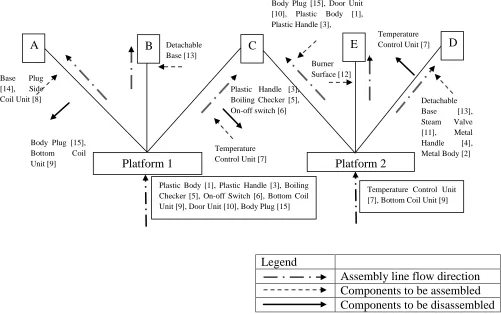
The Median Joining Phylogenetic Network (MJPN) was used to map the relations between products and their corresponding medians/platforms and the layout. In figure 2.10, two majority consensus medians/platforms were created. The first is the platform and differentiating point for products A, B, and C, and the second platform is used for products C, E, and D. The dash-dot lines represent the direction of assembly, the dashed lines refer to a component assembly, and the thick solid lines refer to component disassembly. After the assembly of the seven components of platform 1, two components (Base Plug and Side Coil Unit) would be assembled / added and both of Body Plug and Bottom Control Unit would be disassembled in order to produce product A.
Figure 2.10 Delayed product differentiation modular platform network model results for the family of Kettles assembly system layout
Only the Detachable Base would be added to platform 1 to obtain product B. Product C requires the disassembly of 3 components (Plastic Handle, Boiling Checker and On-off switch) from the platform 1 and the assembly of the Temperature Control Unit. Product C can be produced using platform 2 (Temperature Control Unit, Bottom Control Unit) by adding three components - Body Plug, Door Unit, and Plastic Body.
Similarly, product E is produced by assembling the Burner Surface to platform 2. Product D is obtained by removing the Temperature Control Unit and assembling the Detachable Base, Steam
Legend
Assembly line flow direction Components to be assembled Components to be disassembled
Base Plug [14], Side Coil Unit [8]
Body Plug [15], Bottom Coil Unit [9]
Detachable Base [13]
Plastic Handle [3], Boiling Checker [5], On-off switch [6]
Temperature Control Unit [7]
Detachable Base [13], Steam Valve [11], Metal Handle [4], Metal Body [2] Temperature
Control Unit [7] Burner
Surface [12] Body Plug [15], Door Unit [10], Plastic Body [1], Plastic Handle [3],
Platform 1 Platform 2
Plastic Body [1], Plastic Handle [3], Boiling Checker [5], On-off Switch [6], Bottom Coil Unit [9], Door Unit [10], Body Plug [15]
Temperature Control Unit [7], Bottom Coil Unit [9]
26
Valve, Metal Handle and Metal Body to Platform 2. It should be noted that product D needs more assembly and disassembly work since it has the least number of components shared with the rest of the kettle variants even after using the majority consensus median vector approach. Product C has components which are present in the two families of products (A, B, and C) and (C, E, and D). Therefore, product C may be produced using two different platforms as a base. This offers more flexibility in choosing the platform to use based on the production status and inventory consideration on the shop floor.
Two platforms were created by the MJPN that can be further customized to produce product C. This leads to Product Mix Flexibility - if the demand for product C increases, one or both platforms can be utilized in varying proportions to produce the required quantity of product C at any time. In addition to the economic benefits, this flexibility also contributes to decreasing job boredom on the assembly line and increasing workers‘ self-satisfaction.
It is informative to compare the results obtained using Cladistics and Delayed Product Differentiation Modular Platform Network model for the same case study. The Cladistics classification approach in figure 2.9 formed only one common platform for products A and B, and a single shared component between products A, B, and C (AlGeddawy and ElMaraghy (2010a) as it tends to share only common parts across different products. In the Delayed Product Differentiation Modular Platform Network model, the network tends to favour the major consensus components and more flexible platforms. Two platforms were identified, the first supports Products A, B and C, and the second supports Products C and E, and share a component with product D. It also provides a natural foundation for applying the assembly/disassembly concept of platform formation. In addition, Cladistics provides different possible cladograms that represent the suggested assembly layout strategies (Jenner (2004) , while MJPN produces a single network that represents the optimal delayed differentiation layout.
To provide a solid basis to assess the quality of the phylogenetic network against other layouts, a metric is devised to measure the ability of three layouts that are capable of delayed differentiation. From the case study, the Delayed Product Differentiation Modular Platform Network model produces more platforms than Cladistics and the other layouts. This increases the Delayed Product Differentiation Modular Platform Network model effectiveness to respond to customers and markets demands by quickly switching between different platforms to produce the required final products.
2.6 Postponement Effectiveness Metric
27
decreasing the number of different platforms. In addition, the number of components to be assembled or disassembled to obtain a product variant should be minimized.
Figure 2.11 Assembly line layouts comparisons regarding postponement effectiveness
The proposed postponement effectiveness metric is a function of multiple factors: 1) Number of components in each platform, 2) Total number of components to be assembled in all platforms, 3) Total number of components to be disassembled from all platforms, 4) Assembly / disassembly times, 5) Number and Quantity of products that exists in a platform, and 6) Number of products that do not have a platform. The metric value is proportional to the number of products not contained in a platform and the total number of assembled and disassembled components after the point of differentiation. The metric is inversely proportional to the total quantity of components in each product, considering the total quantity of the products. Equation 2.1 expresses the delayed differentiation metric as a function of the previously mentioned variables. All other factors are kept constant and represented with constant w in Equation 2.2. This constant w can be used in the future to account for other factors that were not taken into consideration in this research. It is assumed to be constant across all examined layouts; hence, it will not affect the PE values. The metric is used to compare the layouts resulting from applying the various assembly strategies in Table 2.2 and test their effectiveness in postponing product differentiation. It is assumed that the minimum number of components to form a platform is two.
( ) ( ∑ )∑ ∑ ∑ ( )
(∑ )(∑ ∑ ∑
) (2.1)
( ∑ ) ∑ ∑ ( ∑ )
(∑ )(∑ ∑ ∑
) (2.2)
Postponement
Effectiveness
Mixed model assembly line
Cladistics model
Delayed Product Differentiation Modular Platform Network model