Cochran).
I argue that, at the convergence of rhetoric, software studies, and critical code studies,
there is a space for an approach to scholarly inquiry best described as “rhetorical code
studies.” While there have been efforts by critics in each of the aforementioned fields to
approach the questions asked by the others, there has of yet been no explicit attempt to
articulate how rhetoric's interest in persuasive action could be located in software and code as
objects of study, nor has there been an effort to express how that study could be explicitly
dealt with in rhetoric. In Chapter 1, I locate rhetorical code studies in the midst of recent
engagements with cultural investigations of code and with rhetorical inquiry into
digitally-mediated forms of communication and I outline how rhetorical code studies would be
valuable to rhetoricians, software scholars, and critics of code alike.
Drawing connections between rhetoric and algorithmic computation back to classical
Greece, in Chapter 2 I position the enthymeme as a rhetorically-oriented algorithm computed by a given audience, and I demonstrate how contemporary software developers use
enthymematic reasoning to persuade their colleagues to engage in particular types of
development practices. As discussed in Chapter 3, there are certainly conventional forms of
discourse surrounding the composition of code texts wherein developers attempt to influence
one another about their means of development—using methods that only rarely focus on
on more heavily implied enthymemes than in natural language discourse, but they offer no
less intriguing ways of understanding how computational logic can be used to persuade both
developer (in terms of continuing to build a given program) and user (in terms of how those
computational activities will be executed in the compiled program).
Ultimately, I offer several potential trajectories for the nascent field of rhetorical code
studies, connecting those possibilities to current trends in scholarship on procedural rhetoric,
genre studies, and activity theory. Given the range of perspectives already available for
inquiry in rhetorical code studies via rhetoric, software studies, and critical code studies,
these proposed trajectories can only benefit our understanding of the numerous, varied, and
by
Kevin Michael Brock
A dissertation submitted to the Graduate Faculty of North Carolina State University
in partial fulfillment of the requirements for the degree of
Doctor of Philosophy
Communication, Rhetoric, and Digital Media
Raleigh, North Carolina
2013
APPROVED BY:
_______________________________ ______________________________
David Rieder Susan Miller-Cochran
Co-chair of Advisory Committee Co-chair of Advisory Committee
________________________________ ________________________________
DEDICATION
To my best friend and partner, Erin Anderson. I love you. Thank you for always being there
BIOGRAPHY
Kevin Brock was born in Mansfield, Ohio in 1981. He graduated with a Bachelor of
Arts in English from East Carolina University in 2003 and pursued graduate studies at North
Carolina State University, achieving a Master of Arts in English in 2007. During that time,
his research interests turned to rhetoric and composition, with a focus on the role played by
digital technology on composing practices. After several years as a lecturer in the
Department of English at North Carolina State University, he enrolled in the institution's
Communication, Rhetoric, and Digital Media program, where he studied software code
languages as forms of rhetorical communication. He has published articles and reviews in
journals such as Enculturation, Technoculture, and Kairos and presented at major conferences including the Conference on College Composition and Communication, the
annual convention of the National Communication Association, and the Computers and
Writing conference. With David Rieder, he has displayed interactive digital media projects at
the Contemporary Art Museum in Raleigh, NC; Duke University in Durham, NC; and the
ACKNOWLEDGMENTS
The number of people that I could, and should, acknowledge here for their support
and friendship is far higher and would take up more room than I have available. I apologize
for not being able to thank everyone individually who has helped and guided me to, and
through, this project.
Let me begin by thanking the members of my committee, whose input and guidance
have been invaluable. To Jason Swarts and Ken Zagacki, I offer my gratitude for their patient
feedback as well as their advice on preparing to join the profession. Susan Miller-Cochran
has been a mentor and friend for six years, and I dearly cherish that relationship. Her counsel
as a scholar and an administrator has been extremely helpful to me in seeking out new
directions for research and balancing my various duties in the process. I am proud to call
David Rieder a friend as well as a collaborator, and I have learned much from my time as his
student and colleague that I suspect I would not have learned elsewhere. I am indebted to his
willingness to help me work through numerous projects that tested my capabilities as an
emerging scholar.
I want to acknowledge the role that Nancy Penrose played in the development of my
career; as the individual who trained me to be a teacher, I cannot overstate the influence she
has had on my pedagogy—to say nothing of my interest in rhetoric as a discipline.
My thanks are also offered to the many colleagues I have worked with as a master's
and doctoral student and whom I have come to consider as close friends. Dawn Shepherd,
research and teaching have influenced my own, while Matthew Davis and Casey Boyle have
served in exceptional capacities as both friends and exemplars.
In addition, I want to recognize the Communication, Rhetoric, and Digital Media
students currently pushing the bounds of research in rhetoric and digital media in novel and
exciting ways. I cannot wait to see the directions in which Ashley Kelly, Kate Maddalena,
and Fernanda Duarte take their emerging careers, and I am thankful for the conversations that
I have shared with each. I look forward to sharing many more with them in the future, and I
hope that the CRDM program continues its tradition of developing and training the finest
junior scholars studying communication and rhetoric.
Finally, I want to celebrate the impact that my family has had on my work and life.
My parents, Jim and Cindy, have both been tremendously supportive of me in everything I've
done in life, and I love and thank them dearly for it. My brothers David and Patrick have
always been on hand to offer relief and sympathy when needed. Erin, my partner, has been
my best, closest, and dearest friend as well as my resolve whenever I have been unsure of
TABLE OF CONTENTS
LIST OF TABLES...viii
LIST OF FIGURES...ix
CHAPTER 1: INTRODUCTION TO RHETORICAL CODE STUDIES...1
1.1: Rhetorical Code Studies...8
1.2: Software Studies...13
1.2.1: Cultural analytics...17
1.2.2: Expressive processing...20
1.3: Critical Code Studies...22
1.3.1: Codework...25
1.4: Digital Rhetoric...27
1.5: Locating and Occupying a Space for Rhetorical Code Studies...33
CHAPTER 2: ALGORITHMIC PROCEDURE AND THE HUMANITIES...40
2.1: From Algorithm to Algorithmic Culture...41
2.2: Algorithmic Criticism in the Humanities...47
2.2.1: Humanistic algorithms before, or without, computers...48
2.2.1.1: Enthymeme as algorithm...48
2.2.1.2: Bitzer's rhetorical situation...52
2.2.1.3: The Oulipo...56
2.2.1.4: Magic as algorithm...58
2.2.2: Humanistic algorithms with, or since the advent of, computers...60
2.2.2.1: Algorithmic criticism...61
2.2.2.2: Critical code studies: algorithm as communication...64
2.3: Algorithmic Persuasion...69
2.3.1: Procedural rhetoric...71
2.3.2: Algorithms we live by: Recognizing persuasive algorithms...74
2.3.2.1: Case 1: FizzBuzz...75
2.3.2.2: Case 2: Quine...80
2.3.2.3: Case 3: HashMap concordance...84
2.4: Conclusions...93
CHAPTER 3: RHETORICAL PRACTICES SURROUNDING CODE DEVELOPMENT..95
3.1: Rhetorical Scholarship Regarding Online Discourse Communities...96
3.2: The Rhetorical and Social Makeup of Software Development Communities...101
3.2.1: Open source software development communities...103
3.2.1.1: Rhetorical influences on OSS development social structures...106
3.2.2: Goals of OSS developers...113
3.2.2.1: Standardizing practices...114
3.2.2.2: Self-promotion and experimentation...117
3.2.2.3: Evaluation of contributions...120
3.3.1: Rhetorical appeals used in community discussions...126
3.3.1.1: Ethos...127
3.3.1.2: Pathos...129
3.3.2: Non-traditional rhetorical activities surrounding code...133
3.3.2.1: Forking...133
3.3.2.2: Pushing and pulling...137
3.3.2.3: Patching...141
3.4: Conclusions...147
CHAPTER 4: EXPLORING CODE FROM A RHETORICALLY CRITICAL PERSPECTIVE: THE CASE OF MOZILLA FIREFOX...149
4.1: Mozilla Firefox: A Code Study...155
4.1.1: A brief history of Mozilla...156
4.1.2: The turn to open source software: Ramifications on Firefox's development.. 159
4.1.2.1: Software versioning systems and persuasion...160
4.1.3: Genres in code...165
4.1.3.1: Demonstrations of innovation...168
4.1.3.2: Normalizations of code practices...175
4.1.4: Rhetorical devices in code...180
4.1.4.1: Anaphora, epistrophe, climax...181
4.1.4.2: Exergasia...186
4.2: Conclusions...192
CHAPTER 5: CONCLUSIONS...194
5.1: Rhetorical Code Studies So Far...195
5.2: Assessing Computational Action...199
5.3: A Future for Rhetorical Code Studies...205
LIST OF TABLES
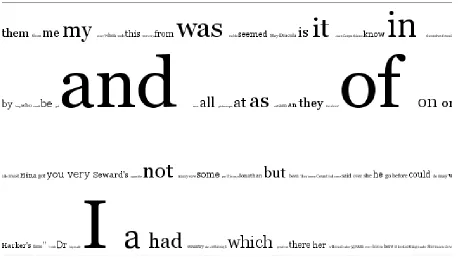
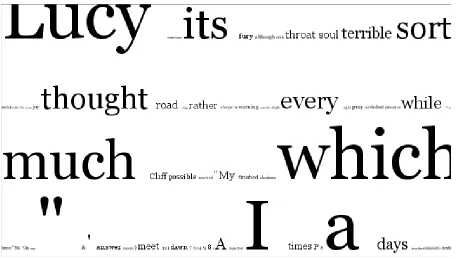
Table 2.1: Lists of term frequency from Woolf's The Waves, compiled by Ramsay (2011). .62
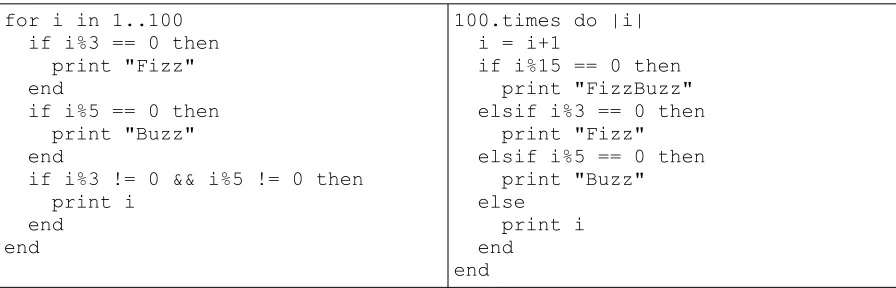
Table 2.2: Two example FizzBuzz loops in Javascript...77
Table 2.3: Two example FizzBuzz loops in Ruby...78
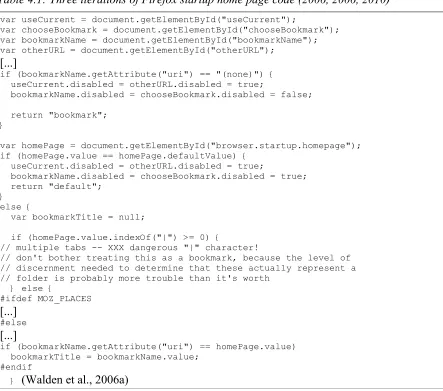
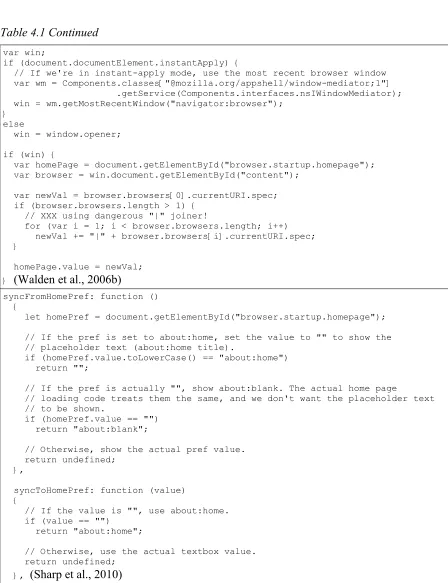
Table 4.1: Three iterations of Firefox startup home page code (2006, 2006, 2010)...172
LIST OF FIGURES
Figure 1.1: Comments within code for Mozilla Firefox. Comments are on the grayed-out lines beginning with //...10 Figure 1.2: Graph comparisons of the works of Mondrian and Rothko performed by
CHAPTER 1: INTRODUCTION TO RHETORICAL CODE STUDIES
At the intersection of the disciplines of digital rhetoric, software studies, and critical
code studies, there exists a blind spot in which focused critical inquiry could and should be
developed. This blind spot is defined by a lack of focused engagement with one of two
approaches to the study of digital software, the code that it comprises, and the procedural
logic that powers computer technologies. The first approach relates to rhetoric, and the
second involves software and critical code studies. Regarding the first, rhetoricians have
tended to ignore or eschew the computational qualities of digital media, preferring instead to
focus on the end-user interfaces with which the technology-using populace most regularly
interacts. Regarding the second, critics of software and code have generally overlooked the
rhetorical qualities of the software programs and the logical processes that make up code;
instead, they primarily apply cultural and literary lenses of inquiry to their objects of study.
The blind spot at the convergence of these fields can and should be explored so that it can
serve as a focal point for critical scholarship on the rhetoric of computation and the code that
facilitations computational activity.
Concerning the lack of focused engagement with computation by rhetoricians, current
practices related to the rhetorical study of digital media center on increasingly ubiquitous
software applications. There are several approaches to multimodal and multimedia text
production and criticism to which rhetorical scholars contribute. First, there is a considerable
the primarily visual nature of web-based documents (Fleckenstein, 2003; Kress & van
Leeuwen, 2006; Sorapure, 2010). Kress & van Leeuwen (2006) emphasized rhetorical
arrangement in particular as a significant mode of communication, focusing their efforts on
rhetorical decisions related to visual arrangement and document design. A second group of
scholars, of whom Shipka (2005; 2011) and Wysocki (2005) are among the most prominent
members, has explored the boundaries of multimodality through physical as well as
design-based components of texts. For example, Wysocki (2005) examined the implicit constraints
always exerted upon rhetors, extrapolating her conclusions from an example situation in
which crayons might be considered acceptable writing tools for students' academic
coursework. Yet another initiative focuses on multimodality as it relates to particular
rhetorical situations and rhetors' needs; Yancey (2004) observed that regular, day-to-day
writing involves far more modes of communication and technologies than are generally
addressed in writing courses and research and called for an embrace of broader definitions of
“writing.”
This set of approaches is limited because attention has inadequately been paid to the
myriad influences of particular software tools on rhetors' inventive processes. Until very
recently, the closest that many scholars (including Bruce & Hogan, 1997; Blythe, 2001;
Fleckenstein, 2005; Payne, 2005) had come to addressing these concerns was by offloading
critical inquiry to Selfe & Selfe's 1994 examination of the sociopolitics of technological
interfaces. Selfe & Selfe observed that interfaces in electronic environments communicated
Through an examination of these assumptions, it became possible get a sense of those whom
developers perceived as the expected user populations of those interfaces and what sorts of
knowledge, technical proficiency, or other forms of awareness the users were expected to
possess (or that were implicitly demanded of them) when using those interfaces (Selfe &
Selfe, 1994). Grabill (2003) articulated the difficulty possessed by most rhetoricians in
regards to undertaking the work of identifying rhetorical activity in and through interfaces,
pointing out the distinction between interface and conventional writing or speaking as a site
of rhetorical communication:
[I]nterfaces are difficult to talk about. They seem natural and inevitable to most
people. They are often transparent. Students in my classes can't imagine computers
being any other way—and most of the time, neither can I. Interfaces are what
programmers write. (pp. 465-466)
In essence, rhetoricians have often avoided overtly technological concerns simply because
those concerns are perceived to be outside the bounds of their disciplinary study. For Grabill (and, implicitly, for many others), interface construction, and programming in general, are
clearly forms of “writing”—and thus a form of making meaning rhetorically—but they are
not the sort of writing that could be easily addressed in a course on rhetoric.
Despite this general difficulty in incorporating technological interfaces into rhetorical
study, in the past several years a small number of rhetoricians (among them Carpenter, 2009;
Arola, 2010) has attempted to address the cultural and ideological value systems inscribed
programs. There is one notable exception to this group. Haefner (1999) made what might
have been the first substantial attempt to move beyond Selfe & Selfe's work, when he argued
that computer code possessed as significant a set of politics as the interface(s) engaged
directly by users. As a result of this increasing set of technologically focused investigations,
the broadly-defined population of contemporary rhetorical critics have made the argument
that emerging technologies, as a general category (often simplified as “new media” or
“digital media”), enable new forms of meaning-making, especially for citizen populations
communicating via end-user interfaces. However, this same population often overlooks that
specific technologies themselves (e.g., individual operating systems, word processors, or programming languages) are similarly nuanced components of meaningful construction
within the fundamental category of technological mediation.
Meaning, in this set of contexts, is geared towards developers of those technologies and interfaces rather than the broader set of users whose activity is constrained by developers'
actions. If rhetoric is, as noted by Aristotle, the “ability […] to see the available means of
persuasion” (2007, I.ii.1), then rhetoricians would benefit by recognizing the limitations in
their work, the possibilities of which are being explored by scholars in software studies and
critical code studies. A rhetorical code studies can potentially incorporate within its fold
multiple types of rhetorical activity and interaction, including developer-to-developer
persuasion, technology-to-developer persuasion, technology-to-user persuasion, and
developer-to-user persuasion. Much of current studies related to digital rhetoric focus on
explained in more detail in Chapters 2 and 3, I emphasize the rhetoric of
developer-to-developer persuasion since the rhetorical activity in that sort of interaction has a significant
impact on subsequently-triggered sites of activity (such as technology-to-user forms of
persuasion).
The second relevant approach to the study of software for a rhetorical code studies
represents a lack of focused engagement with the rhetorical qualities of software and code by
scholars associated with the fields of software and critical code studies. Despite a relatively
superficial acknowledgment of the role of rhetoric in software development and the use of
computer technologies, software and code critics generally fall into one of two camps. The
members of the first seem unaware of the acknowledgment(s) of rhetoric they make in
relation to their objects of study. The members of the second seem uninterested in exploring
the connections between rhetoric and software even as they discuss, sometimes explicitly,
how meaning is constructed for developers and other practitioners of software in and through code—especially given the domain-specific context of meaning in and through the activity of
software development. A number of scholars studying software and code have implicitly
noted interest in rhetorically significant qualities of software and computer technologies, but
none of these researchers has explored those rhetorical qualities to any extent. Wardrip-Fruin
(2009), for example, suggested that computer logic has rhetorical value in his description of
digital media processes as “humanly meaningful” (p. 156). Wardrip-Fruin illustrated this
argument by observing how the procedural logic powering the generative fiction program
Dodge (2011) identified multiple levels of software activity that held significance for
networked systems of humans and technologies alike: coded objects, coded infrastructures,
coded processes, and coded assemblages. Each of these levels, they argued, affect
contemporary life in interrelated ways. For example, coded objects, which necessitate
software in order to function (from cell phones to DVDs) facilitate particular activities to
which we attribute meaning, and these activities are linked together by a number of coded
infrastructures (which partially or fully make use of software to run), including
transportation, financial transactions, and the use of sewer systems (Kitchin & Dodge, 2011,
pp. 5-7). In an analysis of the Microsoft Word mascot and help utility “Clippy,” Fuller (2003)
focused much of his critique on the interface-oriented appeals made by Microsoft to its users
about how to use the program properly. For Fuller, “Clippy” epitomized a failure on
Microsoft's part to recognize the nuanced, contextual activities for which users would write
or otherwise use Word. Instead, Microsoft exerted its own sense of proper use through the
Word interface and through the “Clippy” tool, which guessed at the intent of—and implicitly
judged—users and their efforts.
While the focus thus far has been centered on the individual failings of rhetoric,
software studies, and critical code studies, there are two scholars whose work has addressed —albeit implicitly—the goals of, and thus set the stage for the emergence of, rhetorical code
studies as a convergence of all three of those fields. The first scholar to approach a rhetorical
code studies is Ramsay (2011), whose “algorithmic criticism” will be addressed later in this
explores the possibilities of invention facilitated by computational procedures for both
creative and critical practice. These possibilities for are especially exciting in that they can
lead scholars to generate entirely new texts and forms of communication as well as
reconceptualizing existing texts.
The second scholar to be noted here, and the critic who has come closest to
illuminating this point of convergence between rhetoric and the study of software, is Bogost
(2007), whose concept of procedural rhetoric has articulated a means of persuasive influence demonstrated through particular media—such as video games—as a way of teaching
audiences how to use those media. Procedural rhetoric, according to Bogost (2007), is “the practice of using processes persuasively” (p. 28). This definition is most commonly
considered in regards to the expressive outcomes of processes (i.e., software interfaces), but
procedural construction is itself persuasive as well, setting up how processes can potentially be used by skilled rhetors. The procedural workflow of accomplishing certain tasks is and
can be used as a persuasive medium, and a rhetor can construct a complex argument in code which unfolds through the expression of relevant processes. Bogost noted that, for procedure,
“arguments are made not through the construction of words or images, but through the
authorship of rules of behavior, the construction of dynamic models. In computation, those
rules are authored in code, through the practice of programming” (p. 29). By focusing on the
potentiality of dynamic computation—when an audience attempts to explore the procedures
and types of, action to be influenced by suasion are drastically altered by user and computer
system alike.
In summary, over the past decade there have been significant critical forays into the
cultural and critical implications of software and code as well as into the rhetorical qualities
of digital media. However, there has been little scholarship yet that explicitly bridges the gap
between these types of approach. The proposed means of connecting together the study of
rhetoric and software is through a rhetorical code studies, in which computer software and the code that makes it up are understood as rhetorically powerful forms of making and
communicating meaning.
1.1: Rhetorical Code Studies
Rhetorical code studies combines multiple aspects of the study of rhetoric (in
particular, rhetoric as meaningful communication) and of software and whose focus of
inquiry centers on the following two characteristics of code and its discursive contexts. The
first is the rhetorical qualities and capacities of software code, which include both source
code and executable programs. Source code is the readable set of operational commands
written in any number of existing computer languages. Today, most source code is written in
a “high-level” language, meaning that it is immediately more accessible to humans than to
machines: high-level source code must be compiled (that is, translated) into a lower-level
language in order to be executed by a given machine. High-level languages, such as C, Java,
English, while low-level languages like assembly languages and machine code specify far
less human-readable instructions to the machine(s) executing their commands. The second
characteristic to be addressed is the discourse surrounding the development and use of code,
which includes code-level comments and meta-commentary. Developers regularly
communicate with one another inside lines of code in statements called comments, or
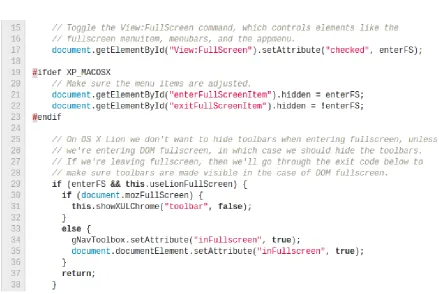
non-interpretable, non-executing natural language statements. For example, see Figure 1.1,
below; in this excerpt from code for the Mozilla Firefox browser that renders the program
when in fullscreen mode, lines beginning with // are comments from one developer to
another. Specifically, the commenter has articulated what his or her goals were in
The comments exist among, but “outside,” the lines that comprise the compilable software
program. In addition to intra-code commentary, developers actively engage each other just as
often in more conventional avenues of discourse outside the code, such as via email lists,
bulletin boards, and the like. As will be demonstrated in Chapter 3, code files can serve as
fascinating and significant sites of rhetorical action (primarily focused on practices of
software development) both in and “between” code operations.
It is important to engage the possibilities for rhetorical code studies at the present
software. However, the significance of code and code-related discourse, as meaningful forms
of communication in addition to influential agents of culture and sociopolitics, has not been
appropriately acknowledged and examined by the groups that should be most critically
interested and invested in how code and code-related discourse operate. In addition to providing an avenue for focused critical inquiry of unexplored objects of study, rhetorical
code studies would offer new means of engaging in the creative and rhetorically informed
production of meaningful code and software. This is not to suggest that existing software is not already meaningful, but instead I posit that software whose code has been composed with
as much rhetorical awareness as its intended execution and output could herald novel and
valuable ways of approaching computer use in general and code composition in particular.
This project seeks to shine a light on this point of convergence so that the emerging
field of rhetorical code studies might be more fully scrutinized, as software and code can help
us understand more accurately how we attempt to communicate meaningfully with one
another across digital contexts. For rhetoric in particular, a field in which scholars seek out
knowledge of and proficiency with the available means of persuasion for a given situation, it
is alarming that there exists a general lack of interest in the broader possibilities of
meaning-making in and through digital technologies. Further, given the increasingly significant role
that software plays in the daily activities of all manner of individuals and populations, it is
imperative that critics of rhetoric and software alike understand how software and its code
software developers, and the general public—can make more effective and aware use of
these code-based forms of meaning-making.
In the chapters that follow, this potential field of rhetorical code studies will be
developed through a focus on a set of interrelated concepts emphasizing the rhetorical means
and goals of code. The first of these is action as understood through Burke's (1969) term symbolic action. For Burke, symbolic action refers to any communicative effort whose meaning extends beyond the specific set of acts that makes up the transmission of a particular
message. The second concept central to my argument is persuasion, the attempt by one or more rhetors to influence an audience to act in response to a particular message. The third
and final major concept to be discussed here is agency, the quality of both rhetor and audience to engage themselves in a rhetorical act; Miller (2007) referred to the quality of
agency as “the kinetic energy of rhetorical performance” (p. 147). Ultimately, an examination of these concepts will serve as the basis for a critical analysis of the Mozilla Firefox web
browser, whose long-term, open source development provides an accessible point for a
rhetorical inquiry into its code.
From the initial point of convergence identified above, rhetoricians and scholars of
code alike can move forward along a number of trajectories that would provide insight into
the meaningful, rhetorical, and critical values of computational objects of study. In order to
demonstrate how a rhetorical code studies is derived from the convergent disciplines of
rhetoric, software, and critical code studies, the remainder of this chapter continues with an
1.2: Software Studies
The field of software studies is focused primarily on the social and cultural
significances of, and influences upon, the processes of software programs and the logic that
facilitates their use. There are several major initiatives that are currently being developed by
software scholars beyond the set of varied approaches to the study of software by critics who
affiliate themselves with the general discipline. The first of these is cultural analytics, which
focuses on studying how software can be used to explore the cultural significance of massive
bodies of data. The second is expressive processing, an approach to software studies
interested primarily in the logic of software as it is expressed for particular purposes, from
video games to electronic literature to corporate accounting. In addition, platform studies is a
field closely related to software studies but emphasizes the critical value of systems of
software and hardware as ecological objects that illuminate how decisions related to software
programs are constrained by these interrelated components.
On a large scale, software as an object of inquiry involves global networks like
Google's search mechanisms and cloud-based information storage or cell phone network
infrastructures; on a smaller but no less significant scale, software studies is concerned with
computer functionality like that of the loop, in which elements of a data set are iteratively manipulated by a set of operations for a particular set of purposes. Manovich (2008b) defined
the goal of software studies as “investigat[ing] both the role of software in forming
contemporary culture, and cultural, social, and conomic forces that are shaping development
the creation of a field whose critical study was the developing body of computer technologies
and the software programs they ran. Fuller led the first workshop, in 2004, toward this end,
and it resulted in the field's first edited collection on the subject and the first publication
making use of the term “software studies.” The collection was separated into micro-essays on
specific concepts related to software, such as elegance, function, loop, and variable.
Manovich organized a follow-up conference in 2008; this second workshop provided a forum
for many current points of interest in software studies to establish themselves across a
number of disciplines, from art (Crandall, 2008) and design (Lunenfeld, 2008; Sack, 2008) to
science and technology studies (Bowker, 2008) and literary studies (Douglass, 2008). In
addition, several scholars presented the initial grounds for the emerging software studies
sub-fields of expressive processing (Wardrip-Fruin, 2008) and cultural analytics (Manovich,
2008a). Marino (2008) was present to discuss the still-nascent field of critical code studies
(about which more is discussed later in the chapter). Further, Bogost (2008) introduced
platform studies as a means of studying video games as ecologies of hardware and software
systems.
Platform studies deserves special note as a field closely related to software studies
due to its focus on the ecologies of software and hardware technologies which serve as the
basis for software activity. For example, where a software scholar might be interested in the
cultural values enabled by a particular programming language, a platform scholar would
focus on how a given hardware system (like a desktop computer with a 32-bit processor
processes, that could be created or disseminated through that hardware system. Unlike
software studies' emergence from a general call for the study of digital media, platform
studies was formed as a means for video game scholars to draw attention to the technologies
that enabled the play of specific games. The most notable studies in this regard include
Bogost (2008), Montfort & Bogost (2009), and Sample (2011); each has pushed the
traditional bounds of game studies as interactive forms of narrative in order to highlight the
roles of game systems in the development of games as meaningful texts. Platform studies demonstrates the potential for rhetorical code studies in its goal of critical investigation into
the relationship between game creation, play, and technological infrastructure. However,
where platform studies is dedicated to the application of its criticism towards video games,
rhetorical code studies holds within its scope the universe of software and code that software
studies attempts to address.
Most scholars who associate their goals with those of software studies do so in a
relatively unrestricted fashion, noting interest in some particular political, social, or other
cultural study of software at one or more levels of technology, e.g., the graphical user
interface, high-level programming languages, or even the low-level assembly languages that
translate readable code into executable operations to be run by a machine. For example,
Parikka (2008) examined the ability to copy through digital software as both a new means of high-fidelity reproduction (as a command and as a tool embedded in various software
programs) and as cultural technique that follows a tradition of quotation and recycling for the
software scholarship are built upon the qualities of new media outlined by Manovich (2001),
which he argued were requisite for any scholarly understanding of how digital technologies
worked:
1. new media objects are composed of digital code, which is the numerical
(binary) representation of data;
2. the structural elements of new media objects are fundamentally modular;
3. automation is prevalent enough in new media systems that human presence or
intervention is unnecessary;
4. new media are infinitely variable;
5. new media, as computer data, can be transcoded into a potentially infinite
variety of formats. (Manovich, 2001, pp. 27-45)
Based on these principles, Manovich and other software scholars have explored the
possibilities of digital technologies and data as means and forms of cultural construction and
transmission. While not all software critics are interested in the technical qualities of digital
media included in Manovich's list, these concerns nevertheless inform the vast majority of
relevant scholarship, such as Cramer's (2005) analysis of algorithm as “magic,” in which he
broke down the ways that various cultures have attempted to comprehend computation.
Hayles' (2004; 2005) comparison of natural and code languages for meaningful purposes is
also grounded in Manovich's principles of new media; Hayles suggested that code, despite its
mutable, transcodable nature (which suggests a flexible or shifting potential meaning
liquid manner that natural language can and does. Fuller & Matos (2011), meanwhile, have
extrapolated the possibilities of “feral” computing systems and the potential for wild,
illogical designs that already emerge from the inherently logical nature of new media as data
and code languages.
The general field of software studies includes within its fold a varied set of critiques,
including Fuller's (2003) analysis of the infamous “Clippy” utility in Microsoft Word;
Kittler's (2008) more general analysis of code as meaningful sub-systems of language; and
Kitchin & Dodge's (2011) exploration of the multiple levels of activity of daily life into
which software are incorporated, as objects, processes, infrastructures, and assemblages (p.
5). For many software scholars, there are several major components of a software program
that indicate the systems of control and knowledge that its developers assume of, and impose
upon, user bases, including the user interface, the language(s) in which the developers wrote
the program, the systems in/on which the program runs, and even the potential uses for the
software anticipated by the developers. By demonstrating the range of possible texts that
could, and do, provide significant insight into how software and culture exert their reflexive
influences upon one another, these software scholars have implicitly nudged the field as a
whole towards the conventional domain of rhetoric.
1.2.1: Cultural analytics.
Turning away from the theoretical bent of general software studies is the more
capabilities of computer technologies in order to map out culturally-insightful patterns from
massive bodies of digital data. Manovich (2008b) made the initial push in this direction,
arguing that the age of new media had been replaced by the age of “more” media, referring to
the sheer amount of information that an individual could access easily with a computer.
Cultural analytics shares a number of qualities with initiatives in the digital humanities,
whose practitioners seek to develop tools for humanistic purposes. The primary difference
between digital humanities and cultural analytics is that digital humanists focus on
experimenting with the potential value that digital tools and software can bring to
humanities-focused lines of inquiry. Moretti's (2005) visualizations of data from “distant
reading” approaches to literary study, in which he looks at trends in literature across specific
ranges of time, geography, and genre, fall under this mantle of digital humanities scholarship.
In contrast, Manovich and the other cultural analysts are far less interested in the inherent
humanities nature of the data being analyzed than the multiple ways that such data can be
processed for potentially interesting ends. That is, cultural analytics emphasizes how digital
tools can illuminate ways to identify and “read” value within a body of data; it does not
articulate whether particular bodies of data are inherently valuable for cultural study. Instead,
the data already exists, and it is only through analysis that interesting significance might be
clearly determined.
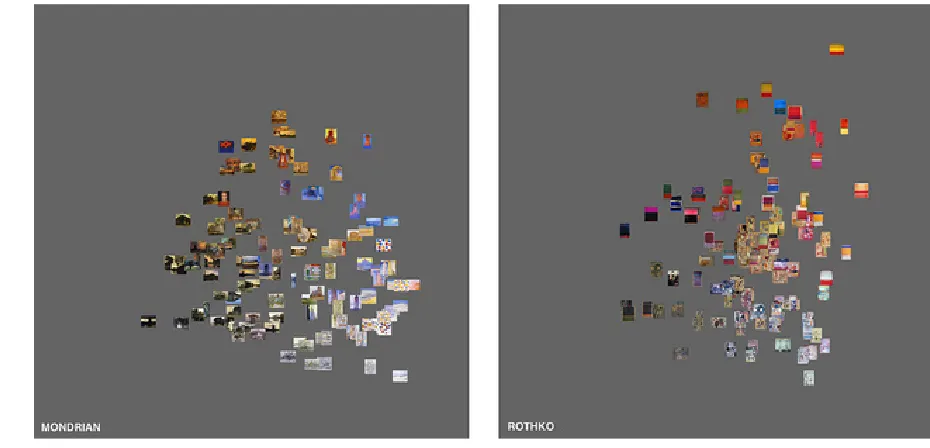
For example, Manovich (2011) has experimented with “media visualization” as a way
to scrutinize distinctions between elements of data sets, plotting out on a quadrant graph over
each artist's oeuvre (see Figure 1.2, below). By transforming each painting into an (x,y)
coordinate on the graph, Manovich was able to examine how each artist used particular hue
sets and ranges of color within those sets, and he connected that data to broader cultural
trends related to contemporary imitation of paintings (specifically, that since it was not
expected by audiences the way it might have been several centuries prior, it was unlikely
either artist would have a number of paintings that closely resembled one another). While
this project has a clear object of humanistic interest, the artistic quality of the data is less
valuable to Manovich than the sheer amount of numerate, transcodable data it offers: the
paintings are transformed into sets of numbers which then are transformed into spatial points
1.2.2: Expressive processing.
Other scholars of software focus primarily on the types of processes whose logic fuels
the use of software programs, such as the calculations that provide Google search results or
the behaviors of computer-controlled video game characters. This approach is distinct from
cultural analytics in that, for individuals studying the logic of computer processes, the ways
of computing data, and what sort of meaningful results those computations generate, are of
greater interest and value than what a particular set of data might offer for particular
approaches to computation. For these critics, including Wardrip-Fruin (2009) who coined the
term, the object of study is “expressive processing.” Because of its focus on how relevant Figure 1.2: Graph comparisons of the works of Mondrian and Rothko performed by
technologies enable and constrain software and user behavior, his field has much in common
with the related field of platform studies explored by critics such as Bogost & Montfort
(2009). Scholars involved in this sub-field of software studies approach software as a way of
“reading what processes express” and how processes “operate both on and in terms of
humanly meaningful elements and structures” (Fruin, 2009, p. 156). For
Wardrip-Fruin, video games and works of digital fiction provide an ample supply of texts (i.e.,
processes and narrative experiences) to explore, Bogost & Montfort (2009) explicitly
specified that the discipline is not constrained to games as objects of inquiry, noting that even
programming languages are types of platforms with underlying logic systems to be expressed
through their use.
While there are some divergences between scholars in regards to the specific focal
points of the field, there is one common line of agreement. No scholar involved in expressive
processing has argued that technical knowledge of computer systems is necessary to perform successful inquiries into software processes, but almost all suggest that such a skill set is
crucial to pursuing most fully questions of the sub-field. Wardrip-Fruin (2009) has described
the problem as follows: “Trying to interpret a work of digital media by looking only at the
output is like interpreting a model solar system by looking only at the planets” (p. 158). For
many not familiar with how computers work, this statement may seem odd, but the point to
take away is that a solar system has at its center a star rather than a planet, and it is the star that enables the entire set of planets to revolve around it and maintain their various ecological
framework provided by hardware and software alike in order for individuals to enjoy the
interfaces they most often use.
1.3: Critical Code Studies
Where software studies employs the logic of computer processes as a means of
studying both technology and culture, the more recently emergent field of critical code
studies examines software code as meaningful text in its own right. Many critical code scholars are interested in exploring how particular code languages facilitate certain habits of
mind as well as means of communication through the construction of code programs. There
admittedly exists a significant overlap in research foci between software and critical code
scholars; the latter sprung from the former as a directed effort to explore computer code as
something more (i.e., more meaningful and significant) than its output, which early critical
code scholars argued made up the majority of new media scholarship (Cayley, 2002; Marino,
2006). There are, as of yet, no distinct initiatives focusing on particular qualities or
applications of code in the sense of cultural analytics and expressive processing as sub-fields
of software studies. However, there do exist two broad camps of code critics: the first,
epitomized by Marino, have focused thus far on reading code (and debating how to read code) as a type of literature. The other camp, led by Hayles, has primarily debated the
potential distinctions between code, software, and natural language. A third direction of
Many critics of code view the field as an extension of literary criticism, with code
texts providing insight into numerous conventional questions of scholarship, including
authorial intent, contemporary trends in writing (programming) style and genre, or
considerations of meaning within a particular body of code (Marino, 2006). Ramsay (2011)
made use of code for such ends, performing an approach to criticism that enabled him to
transform sets of literary texts into code-mediated expressions (referred to by literary critics
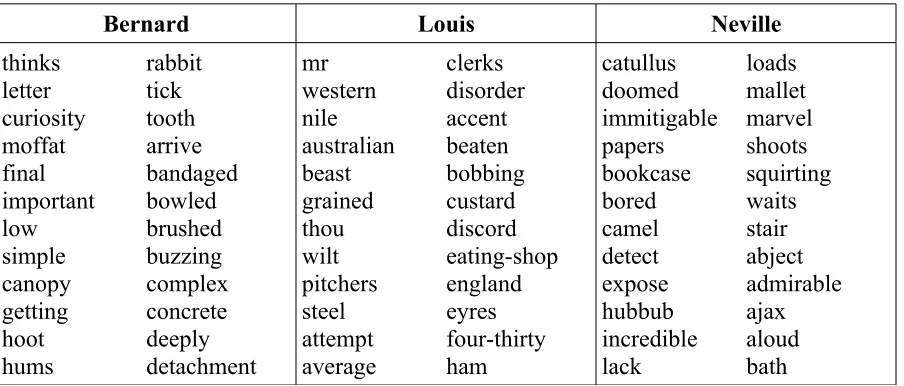
as paratexts) so as to highlight novel means of interpreting those initial texts. For example, Ramsay compared the main characters of Woolf's The Waves by calculating the most frequently-used words in the vocabulary of each. By using these lists to shine light on the
concepts most important to each character (correlating frequency with significance), Ramsay
was able to outline a new act of critical reading. For Ramsay, algorithmic code serves as a
novel means of engaging in scholarship by making familiar texts strange so as to generate
new questions and avenues for critical research. Douglass (2011) has approached code
somewhat more traditionally as a textual object of inquiry, questioning how code is currently read as a counter to studying how code should be read. That is, rather than suggest a “best practice” of code-related interpretation, Douglass has emphasized how we tend to evaluate
and value code as a familiar or unfamiliar form of meaningful communication and what these
existing practices mean for our ability to work with code in new and significant ways.
Other scholars, however, have begun approaching conventionally rhetorical, as well
as literary, concerns, although they rarely explicitly associate their critical code work with
discovering what meaningful code texts can signify through their content, as well as through
the processes they describe, for a variety of audiences. Burgess (2010) examined how the
PHP script language changes the act of reading web pages and markup language, since PHP
is interpreted by a web server and transformed into HTML before a user has the chance to
see what it does when looking at a particular web page. Jerz (2007) explored both the source
code for the late 1970s text-based video game “Adventure” and the physical location
(Kentucky's Mammoth Cave) that inspired its creation. Jerz's analysis incorporated into its
scope not just how the game attempted to replicate the author's experience of traveling
through Mammoth Cave but how specific lines of code communicated significant meaning to
the game player about how he or she should explore the possibilities for game play made
possible by the author and his choice of code language. In addition, by visiting the physical
site of Mammoth Cave, Jerz “played” by tracing out a path that someone in the video game
might have virtually taken, observing the rhetorical failures in his physical performance in
Kentucky to achieve particular types of action that, in “Adventure,” facilitated new situations
and activities for the game player.
Yet another group of scholars straddles the boundary between software and critical
code studies, emphasizing through their work how code and software are often as radically
different objects of study as they are similar to one another. Chun (2011) has led this
particular charge, pointing out that executing code—the compiled software that one runs in
order to use specific programs on a computer—is distinct from its comparatively static
hints at the possibility of what a program can do since the act of using the software cannot be replicated by reading its code. Hayles (2005) argued for a similar distinction, which she positioned between natural language and executable code language (which, for Hayles,
comprised both compiled programs and their source code). Hayles' position focused on the
ability of natural language communication to signify more than it literally suggests, while
code merely described the computational operations that its compiled program would execute
—although it must be noted that the majority of code critics ultimately disagreed with this
distinction (Cayley, 2002; Cramer, 2005; Marino, 2006). For scholars like Chun and Hayles,
the critical study of code offers an important avenue for engaging with digital technologies as
means of creative invention that, nonetheless, reflect systems of constraint and control upon
the ranges of potential outcomes (texts, performances, and other acts) that could be expressed
through specific code texts.
1.3.1: Codework.
Not entirely distinct from critical code studies, but neither always focused on critical
inquiry to the same degree that critical code scholars operate, is the critically artistic field of
“codework.” Codework examines the explicit and implicit values and meanings that might be
communicated through code composed specifically as readable texts for both human and
technological audiences. The most well-known example of codework would be the genre of
Perl poetry, the creation of lyric poems written in the Perl computer language that double as
equilibrium in this sense; instead, they are generally either primarily compilation-friendly,
executable code texts that approach possessing meaning to human readers or natural language texts whose appearance approximates the syntax and vocabulary of software code.
Scholars and artists who create and critique codework often emphasize the unique
qualities of code as a form of writing, with all the nuances of meaning, stylistic concerns, and questions of audience that accompany it. Raley (2002) and Sondheim (2001) each praised the
artistic possibilities in experimenting with code-based forms of writing that extend beyond
conventional constraints of alphabetic writing. The mezangelle work of Mary-Ann Breeze (as
“mez”) has provided one clear style of codework in which code-like punctuation and syntax
serve to imitate the meaningful construction of code but do not reflect how code actually
functions. In contrast, Cayley (2002) has cautioned against criticisms of code-like texts that
do not focus explicitly on code and its properties; specifically, he noted that the “code” in
most codework “has ceased to function as code” that possesses only a “pretended ambiguity
of address” to human and technological audiences. As a result, the focus on non-code
codework texts shifts from code to something that only tangentially reflects what code is and
does. Instead of looking at artificial code texts, Cayley's argument—which certainly
influenced the works of Marino and Jerz—suggested an emphasized engagement with code in order to understand code, a perspective that reflects traditional literary studies (reading
1.4: Digital Rhetoric
Unlike the more recently established fields of software and critical code studies,
rhetorical criticism has been challenged for several decades by the increasingly shifting,
amorphous nature of its disciplinary bounds. This challenge has been most prominent in
recent years in regards to rhetoric's collective scholarly ability to properly and fully
comprehend and explain the types of discourse present and possible in and through emerging
media, many of which brought into question traditional methods of rhetorical scrutiny on the
public rhetor and notable oration. This challenge is most visible in regards to the
development of increasingly ubiquitous digital technologies, which caused a sort of
disciplinary fragmentation as scholars either sought ways to incorporate classical models of
criticism into the study of new media or assumed perspectives focusing on these new media
that were distinct from traditional approaches to rhetoric.
The initial exigence in maneuvering rhetorical criticism into its current trajectory
toward establishing a clear understanding of “digital rhetoric” was a need to incorporate into
its folds the study of public discourse as democratic action. That is, rhetoric has developed
beyond its classical focus on the single rhetor (usually a noteworthy public figure) speaking
to a public audience to advocate civic change. Among the earliest significant and relevant
arguments providing this influence is that of Perelman & Olbrechts-Tyteca (1969), who
argued that speech and writing do not require radically different critical approaches to either form of communication. At roughly the same time, Burke (1969) located rhetoric “in an
cooperation in beings that by nature respond to symbols” (43). By conceptualizing the
production of meaning through symbols, Burke presaged the later shift for rhetorical critics
to incorporate multiple modes and media through which rhetors could persuade audiences.
Several years later, rhetorical considerations begin getting mapped onto emerging
technologies, most especially in regards to the computer and networks of computer
technologies. McKeon (1971) argued for the promotion of rhetoric as an “architectonic
art”—that is, an art producing action rather than knowledge, and which affects the
performance of other arts. McKeon noted that an architectonic approach to rhetoric in a
technological era was “technology itself given a rhetorical formation” (1971, p. 53). Turkle
(1984) meanwhile argued that computers should be viewed as agents in their own right (pp.
271-2). These readings of rhetoric and its connection to technology offer a blurred
understanding of the relationship between human rhetor and the medium through which an
argument is delivered: is the computer merely a medium for discourse, or is it a separate
rhetor collaborating with a human to communicate with others, humans and computers alike?
A number of rhetorical critics have explored how conventional approaches to rhetoric
could effectively provide insight to communication taking place through electronic and
digital media. In an effort both to distinguish “technological rhetoric” from “the rhetoric of
science,” to which the former is often connected and to connect criticism of
technologically-focused discourse to that of civic discourse, Miller (1994) argued that there was “no
conceptual vocabulary other than that of classical rhetoric [that] makes it possible to attend to
Gurak (1997) examined ethos and delivery in on-line communities and how their interactions
via media capable of instantaneous communication—which Gurak referred to as
“unprecedented rhetorical forum[s]” thanks to their novel means of interactivity, speed of
discourse, and broad scope of the base of potential participants—needed to be more clearly
understood by rhetorical critics (16). For Gurak, as for Miller, the existing vocabulary of
rhetorical criticism must inform further study of emerging, and especially digital,
technologies.
More recently, there has been an effort by several rhetorical scholars to expand the
language employed by critics so as to more fully explain and contextualize discursive
practices mediated by digital technologies. For example, Fagerjord (2003) argued that
rhetoric itself needs to be redefined to incorporate more successfully newer discursive media:
“[rhetoric] also embraces still and moving images, visual aspects of typography (typefaces,
sizes, colors, layout, etc.), and programmed procedures in computer texts. In the wide sense,
then, I use rhetoric to describe how media messages are made to appear” (p. 313). This
critical approach has been mostly successful through the related field of composition and
rhetoric, in which scholars have experimented with the possibilities of creating and
communicating meaning through digitally-produced multimodal and multimedia texts, from
Kress & van Leeuwen's (2006) work with images and document layout to Johnson-Eilola's
(2004) experimentation with databases and hypertexts and Carnegie's (2009) work
However, many scholars have simply transferred conventional lines of inquiry to
emerging environments. Warnick (2002) provided the most notable such focus by examining
online texts used in the 2000 presidential campaign and ideological declarations presented in
magazines about technologies. For Warnick, this was a recognizable and conventional way to
learn about the ways in which particular interests are promoted, suppressed, or ignored across
populations. Warnick (2007) later reemphasized the applicability of classical rhetoric to
online environments, although she noted that in many ways, rhetoric as a discipline must
move away from notions of single authors and works as its objects of study and toward the
distinct concepts of collaborative authorships and interlinked hypertexts (p. 122). An entirely
different approach was taken by Brooke (2009), who restructured the rhetorical canons in
order to more clearly and directly define them in relation to the variety of new media
emerging as part of developments in digital technology.
A number of scholars have offered similar approaches to reconciling traditions of
rhetorical criticism with the means and ends available through digital technologies. Porter
(2009) examined delivery as a means of revising existing rhetorical theory or producing new
theoretical perspective, and he argued that “[t]he real value in developing a robust rhetorical
theory for digital delivery lies in [productive action]” (p. 221). Porter offered a reading of
data entry, transmission, and retrieval as a type of Ciceronian oratory with a specific goal,
using as an example the increased availability of a patient's medical records to healthcare
employees as part of their efforts to treat that patient. Zappen (2005) posited that it is
specific types of inquiry and discourse, and specifically “the characteristics and [...] strategies
of self-expression, participation, and collaboration that we now associate with [digital]
spaces” (323). Zappen's argument offered rhetoric, as a field, a way to shift from a focus on
modifying the vocabulary of rhetoric toward a focus on recognizing how persuasion in
specific situations, for specific audiences, is fundamentally altered by the use of digital
technologies. However, there have been very few publications that have attempted to identify
and articulate just how persuasion could be recognized and utilized through particular
technologies and media; Miller (2012) has suggested that digital rhetoric remains merely a
“hypothesis—or maybe a hope” rather than an established and recognizable field of
rhetorical study.
The closest that any particular initiative has come to addressing these concerns of
digitally-mediated and productive rhetorical action is in the sub-field of computers and
writing. Stemming from the field of composition, scholars in computers and writing have
made as their focus the intersection of rhetorical invention and digital technologies,
experimenting with the range of relevant possibilities available to scholars and students alike.
Yancey (2004) observed that most students of writing are likely to engage regularly in types
and modes of digital communication that are not addressed, either adequately or at all, by
scholars and instructors of writing and rhetoric. Rieder (2010) has suggested that potential
merit exists in examining particular types of code processes as rhetorical strategies for new
forms of writing. McCorkle (2012) argued that rhetorical delivery operates as a form of
technology but also the body of systems that facilitate a text's distribution. A small group of
other scholars (Cummings, 2006; Carpenter, 2009) have observed that there is rhetorical
value to be found in code as a form of writing, although there is little agreement on how best
to engage it—some suggest it should complement conventional forms of writing (like a kind
of frame to facilitate novel means of interaction with that conventional writing), while others
question whether it might be a distinct method of communication worthy of examination and
experimentation separate from other writing studies. Brooke (2009) outlined a new trivium of
study for contemporary education that incorporates an “ecology of code” and its productive
resources as one of the trivium's components (p. 48). Mateas (2005), Vee (2010), and Berry
(2011) each outlined a computationally-oriented literacy that would describe the sets of
knowledge and technical skill informing one's ability to practice code-based writing from a
rhetorically aware perspective—for Mateas, this was a “procedural literacy;” for Vee, it was
best dubbed “proceduracy;” for Berry, it was “iteracy.” While each of these approaches
acknowledges the current problems with rhetorical scholarship of digital modes of
communication, none assumes as its focus the critical examination of just how rhetorically
significant meaning-making occurs in and through code.
Despite the fact that there is a significant sense of anxiety possessed by many
rhetorical critics when it comes to engaging digital media beyond the scope of user-level
interfaces, rhetoric as a field is nonetheless ripe for extension into the space I propose for a
rhetorical code studies. Rhetorical critics are clearly interested and involved in work relating
concentrated engagement with how the technologies underlying those contexts enable,
augment, and constrain meaning-making with and through digital technologies.
1.5: Locating and Occupying a Space for Rhetorical Code Studies
The field of rhetorical code studies exists within the territory I have begun to locate
above. It can be recognized more clearly by outlining the foci of these related and
aforementioned disciplines. Where rhetorical code studies would be most valuable to
rhetoric, software studies, and critical code studies alike is in its emphasis on the rhetorical
qualities and goals of computation, the underlying logic of digital technologies, at multiple
levels of activity. These levels of rhetorical activity involve communication geared towards
technological execution (the computation itself) and what sorts of expression that execution
results in. However, the arguably most important site of activity is how computational
operations are composed: the persuasive arguments suggested through procedures by
developers in order to convince others that such procedures are not only useful but optimal in order to anticipate particular computational and expressive activities.
While meaningful communication has been addressed to some degree by software
and critical code studies, and while the mechanisms and logics of digital technologies have
been incorporated superficially by rhetoricians, there has not yet been a satisfactory attempt
to explore the specific relationship between technological activity and development-related
meaning-making at and around levels of software code. Rhetorical code studies would serve
find a focus for their work in the points of intersection that connect inquiry into
meaning-making, persuasion, software processes, and code-as-text.
Software scholars provide rhetorical code studies with a set of critical lenses through
which to scrutinize the relationships between culture, society, and software as a guided path
towards the rhetorical scrutiny of software. Of special interest are the cultural influences and
constraints upon computational logic, as expressed in particular software paradigms and programs, that are emphasized by recent work in software studies. Cultural analysts bring to
rhetorical code studies an emphasis upon the malleable, computable, and inherently
meaningful nature of digital data separated, in many cases, from the specific situational concerns that initially generated that data. While this may initially sound alarming to
rhetoricians, I argue that cultural analytics' withdrawal of data from its initial situation
facilitates critical engagement with data and what it has the potential to mean, rather than a focus on what the data has already meant in specific contexts. Critics involved in the study of
expressive processing have similarly primed the space for rhetorical code studies by drawing
attention to the performative and meaningful qualities of software designed for specific ends.
Just as rhetorical code studies demands an engagement with data, so too does it require an
engagement with the processes that facilitate data distribution, manipulation, and analysis.
Critical code studies and codework are valuable to a rhetorical code studies through
their focus on exploring the meaningful qualities of software code as meaningful text. Just as
software logic can help one understand how code-based persuasion and action could occur,
forms and means of invention and rhetorical action that are currently attempted, and that
could be attempted, by programmers for specific audiences. Critical engagement with code
serves as a way to explore not just what has the potential to be created but as a way to reflect
on, and to move beyond, the traditions of existing historical and contemporary code
practices. For rhetorical code studies, this is significant as it aids scholars in recognizing and
addressing efforts toward constructing and communicating meaning through various types of
code texts.
Rhetoric, and digital rhetoric in particular, offers rhetorical code studies an
established grounding in the study of meaning-making and persuasion. While software and
critical code studies bring to rhetorical code studies a focused inquiry into software, code,
and the logic thereof, digital rhetoric introduces into the mix a set of critical lenses and tools
for investigating how individuals communicate with one another. Special attention should be
paid to rhetoric's tradition of focusing on the means by which rhetorical agents attempt to
persuade specific audiences for particular ends. This is a crucial quality for rhetorical code
studies as it clarifies both a set of goals that developers, software users, or even technological
systems work toward and the types of meaning-making they engage in in order to achieve
those goals.
In order to pursue this set of amalgamated disciplinary ends appropriated from
rhetoric and the critical study of software and code, this project articulates several concerns
key to realizing a rhetorical code studies. First, Chapter 2 serves as an inquiry into the
processes and practices of programming within the realms of rhetoric as well as within those
of the studies of software and code. While it is often viewed as existing outside the realm of
persuasive influence, software development is a highly rhetorical act, and this chapter will
highlight some of the fundamentally rhetorical concepts of code and how it facilitates and
constrains action within, and without, the bounds of human activity. Beginning with an
examination of algorithm as rhetorical procedure, the chapter connects together humanistic
practices that use algorithmic logic to engage with significant objects of inquiry, both before
and after the advent of the computer. Ultimately, Chapter 2 leads to an articulation of
algorithmic persuasion, the use of computation in order to facilitate meaning-making in and
through technological systems and interfaces.
Chapter 3 focuses on the more conventional forms of discourse that pervade and
surround software code. Just as it would be inaccurate to claim that code as a form of
communication is devoid of rhetorical action, it is also inaccurate to suggest that code is
entirely separate from other types of rhetorical communication. Instead, code is infused with all manner of discourse: comments between lines of code offer insight from one developer to
others about how to deal (whether productively or critically) with improvement of a
particular program; email listservs highlight the social nuances of particular communities of
developers, bug testers, and other users; even the websites promoting particular software
programs suggest certain ways of using, reading, and writing code. Chapter 3 builds upon the
previous chapter in order to demonstrate how practitioners of code acknowledge, and make