__________________________________________
* Corresponding author: Tel.: (6019) 3862305; Fax: (603) 90745545; E-mail: [email protected]
Injection Moulding (MIM) Compacts
*K. R. Jamaludin
1,2, N. Muhamad
1, M. N. Ab. Rahman
1, S. Y. M. Amin
3, S. Ahmad
1,3,
M.H.I. Ibrahim
1,31. Precision Process Research Group Dept. of Mechanical and Materials Engineering
Faculty of Engineering National University of Malaysia
43600 Bangi.
Selangor Darul Ehsan. Malaysia
2. College of Science and Technology University of Technology Malaysia International Campus Kuala Lumpur
54100 Kuala Lumpur. Malaysia
3. Faculty of Mechanical & Manufacturing Eng. University Tun Hussein Onn, 86400 Batu Pahat, Johor, Malaysia
ABSTRACT
Sintering parameters of the SS316L water atomized injection moulded compact has been optimized for its best sintered density. The L9 (34) Taguchi orthogonal array is used in the experiment while sintering temperature, sintering time, heating
rate and cooling rate was selected as factors that influenced the sintered density. The sintering environment was in the vacuum and four replications were done for each trial. The analysis of variance shows that the confident level for the experiment was 99.5 % (α = 0.005) and all factors are highly significant at α = 0.005 to the sintered density. The study concluded that the heating rate has the highest influence to the sintered density (41.29 %) followed by sintering temperature (31.60 %), sintering time (11.13 %) and cooling rate (11.10%). The optimum sintered density obtained is 98.48 % of the theoretical density and the optimum parameter has been verified that the sintered density obtained is in a range of confident interval.
Key words: Sintering; Stainless steel; Taguchi method; Metal injection moulding; Powder injection moulding
1. INTRODUCTION
Metal injection moulding (MIM) is a relatively new processing technology used in powder metallurgy processing industries. This process is especially cost-effective and beneficial for manufacturing small and complex components in large quantities. Metal injection moulding is used in an increasing range of different fields, including automotive, medical and telecommunications industries. It includes four basic steps consisting of mixing the powders and binders, injection moulding, debinding and finally sintering. Both injection moulding and sintering are the most important steps related to forming the green part and the final part respectively.
DOE for the injection parameter has been studied by author of reference [6-8] and the results obtained a significant optimum injection parameter for MIM feedstock. As a consequence to the injection parameter optimisation which has been published, this paper presents a sintering parameter optimisation which utilises the published optimised injection parameter. In addition, reference [9] has shown the significance of sintering variables such as heating rate, dwell time, sintering temperature and sintering atmosphere. Reference [9] found that the vacuum environment is best for sintering SS316L and thus, this study attempts to continue the study by using a high vacuum environment in the experiment. Despite cooling rate is replacing the sintering environment in the orthogonal array, heating rate, dwell time and sintering temperature remains as sintering variables for the optimisation. These variables can influence the microstructure, pore size and shape and final density of the sintered parts.
2. EXPERIMENTAL
A MPIF 50 standard tensile bar is used as a specimen. A water atomised 316L stainless steel powder with D50 of 7.157 µm, pycnometer density of 7.90 g/cm3 is mixed with 73 % PEG weight of polyethylene glycol
(PEG) and with a 25 % weight of polymethyl methacrylate (PMMA). In addition about 2 % weight of stearic acid (SA) is used as a surfactant.
Prior to the moulding, compositions are mixed in a sigma blade mixer for 95 minutes at a temperature of 70oC. The greens are prepared by the Battenfeld, BA 250 CDC injection moulding machine while a high vacuum
furnace Korea VAC-TEC, VTC 500HTSF with the vacuum pressure of up to 9.5 × 10 -6 mbar is used for
sintering.
3. DESIGN OF EXPERIMENT
There are many sintering parameters that have some effects on the properties of the sintered density. Therefore, a Design of Experiment (DOE) method is necessary for the experimental work involving a variety of input. The most frequently used methods are partial or full factorial design and the Taguchi approach. With an appropriate DOE, one can quickly and with fewer attempts be able to find out whether these variables have any effects on the quality of the output. The Taguchi approach is mostly used in the industrial environment, but it can also be used for scientific research. The method is based on balanced orthogonal arrays [10]. In this paper, a L9
(34) orthogonal array consisting of nine experiment trials and four columns is used as a DOE and then followed
up by the ANOVA to determine the significant levels and contributions of each variable to the sintered density. The main variables involved in this study are as shown in Table 1. Three levels for each variable refer to the maximum and minimum limit that influences sintered density.
Table 1: Factor level (variables) in the experiment
Factor 0 1 2 Level
A Sintering Temperature (°C) 1340 1360 1380
B dwell time (minute) 60 120 240
C Heating rate (°C/min) 6 8 10
D Cooling rate (°C/min) 6 8 10
4. RESULTS & DISCUSSION
The density of the sintered part is measured by the Archimedes immersion method in accordance to the MPIF 42. Four replications are recorded for each experiment as shown in Table 2. The theoretical density shown in Table 2 is calculated from the average of the replication. As shown in Table 2, a combination of A1 B2 C0 D1
results in the maximum sintered density (98.48 % of the theoretical density) while, a combination of A2 B0 C2 D1
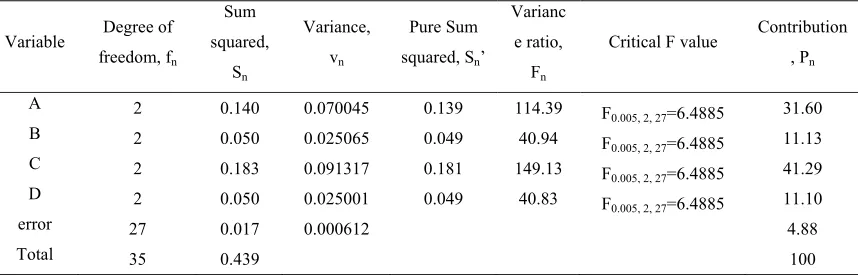
Besides that, the analysis of variance (ANOVA), demonstrates the significant levels of the variables as well as the effects of the sintering variables on the sintered density as shown in Table 3. Generally, all the sintering variables have significant effects on the sintered density at a 99.5 % significant level. The significant level obtained by this experiment is higher than reported by reference [9]. The ANOVA in Table 3 displays the relative significance of the variables as well as the contributions of the variables assigned to the orthogonal array shown in Table 2. The ANOVA in Table 3 depicts a very significant level (α = 0.005) of each variable. Heating rate (C) is most influential (41.29 %) on the sintered density, followed by the sintering temperature (A), then by the dwell time and finally by the cooling rate. However, reference [9] reported that the sintering atmosphere had been the most significant variable on the sintered density as it demonstrated a much higher variance ratio, F. The sintering atmosphere was the most influential variable (76.685 %) followed by the heating rate (7.377 %), the sintering temperature (5.538%) and finally the dwell time (5.168 %). Thus, based on his study, a high vacuum sintering environment has been considered. Besides that, the influence of the cooling rate on the sintered density is investigated as this variable has not been studied by reference [9] in his DOE. This is due to the fact that the cooling rate is another sintering variable [11]. Although the cooling rate is one of the sintering variables, it has demonstrated to be the lowest in the percentage of contribution. Despite the contribution being low, the high significant level, α as shown by Table 3, still indicates the importance of this variable. This is as important as the dwell time which has been reported to be less influential on the sintered density by reference [9].
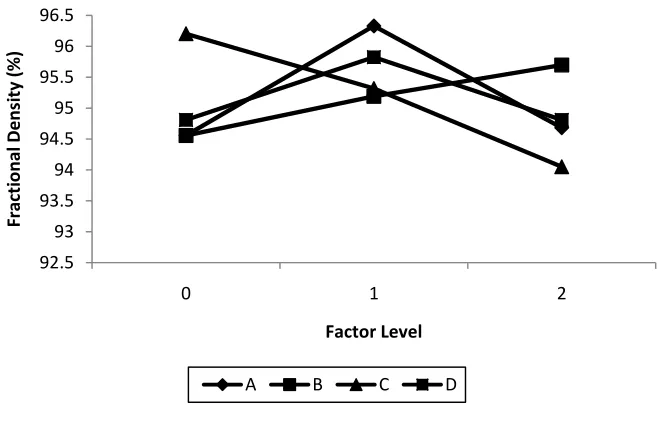
With reference to the ANOVA, the main effects of the experiment are calculated by basing on the highest average values as shown in Figure 1. The response plot in Figure 1, shows a combination of A1, B2, C0, and D1 as
the highest yield, i.e., where the sintering temperature is at 1360 °C, the dwell time of 240 minutes, the heating rate of 6 °C/minutes and the cooling rate of 8 °C/minutes. On the other hand, a faster heating rate (20 °C/minutes) for the sintering temperature of 1250 °C and a dwell time of 90 minutes has been reported as the optimum sintering parameter by reference [9].
Table 2: Orthogonal array and sintered density
Replication (density(g/cm3))
Trial A B C D 1 2 3 4 Y % Theoretical
density
E
xperiment
1 0 0 0 0 7.5078 7.4329 7.4704 7.4704 7.4704 94.56
2 0 1 1 1 7.5780 7.5008 7.5394 7.5394 7.5394 95.44
3 0 2 2 2 7.3972 7.3929 7.3950 7.3950 7.3950 93.61
4 1 0 1 2 7.5846 7.5058 7.5452 7.5452 7.5452 95.51
5 1 1 2 0 7.5279 7.4515 7.4897 7.4897 7.4897 94.81
6 1 2 0 1 7.7387 7.8218 7.7803 7.7803 7.7803 98.48
7 2 0 2 1 7.3886 7.3894 7.3890 7.3890 7.3890 93.53
8 2 1 0 2 7.5452 7.5410 7.5431 7.5431 7.5431 95.48
9 2 2 1 0 7.4760 7.5262 7.5011 7.5011 7.5011 94.95
Average 7.5170 95.15
Max 7.7803 98.48
Min 7.3890 93.53
Table 3: ANOVA for the sintered part at α = 0.005
Variable Degree of freedom, fn
Sum squared,
Sn
Variance, vn
Pure Sum squared, Sn’
Varianc e ratio,
Fn
Critical F value Contribution , Pn
A 2 0.140 0.070045 0.139 114.39 F0.005, 2, 27=6.4885 31.60
B 2 0.050 0.025065 0.049 40.94 F0.005, 2, 27=6.4885 11.13
C 2 0.183 0.091317 0.181 149.13 F0.005, 2, 27=6.4885 41.29
D 2 0.050 0.025001 0.049 40.83 F0.005, 2, 27=6.4885 11.10
error 27 0.017 0.000612 4.88
Figure 1: Response plot of fractional density against sintering variables
The ANOVA shown in Table 3 demonstrates that the effects of the variables are significant at 99.5 % significance level. Hence the expected results of optimum performance are as shown in Table 4. The expected optimum performance is as high as 98.48 % of theoretical density while the range of the optimum performance based on 90 % confidence level is 98.22 < µ < 98.75 % of the theoretical density. The optimum parameter has been proven in the confirmation experiment that is conducted at the combined setting of A1, B2, C0, and D1 and
the results fall within the predicted 90 % confidence interval as shown in Table 4. A density of optimum performance reported by reference [9] is 7.592 g/cm3, which is lower than that achieved by this study as shown
in Table 4.
Table 4: Optimum sintering parameter, optimum performance and confirmation experiment.
Optimum parameter: A1 B2 C0 D1
(Sintering Temperature, 1360 °C; dwell time, 240 minute; Heating rate, 6 °C/minute; Cooling rate, 8 °C/minute)
Optimum performance: 7.7803 g/cm3 or 98.48 % theoretical density Confident interval: ± 0.02 at 90 % confident level (α = 0.1)
Range of optimum performance : 7.7592 g/cm3 < µ < 7.8013 g/cm3 or 98.22 % theoretical density < µ < 98.75 % theoretical density
Confirmation experiment
Repeat 1 2 3 4 Average
g/cm3
7.8377 7.8365 7.7296 7.7296 7.7834
% theoretical
density 99.21 99.20 97.84 97.84 98.52
92.5 93 93.5 94 94.5 95 95.5 96 96.5
0 1 2
Fract
io
n
al
Dens
ity
(%
)
Factor Level
5. CONCLUSIONS
Sintered density of the water atomised SS316L MIM part is optimised by using the Taguchi method. An L9
orthogonal array is used to vary the experiment variables. ANOVA shows that all the four sintering variables: sintering temperature, dwell time, heating rate and cooling rate, affect the sintered density significantly. The optimum sintering parameter is found to be A1, B2, C0, and D1, corresponding to the sintering temperature of
1360 °C, a dwell time of 240 minutes, a heating rate of 6 °C/minute and a cooling rate of 8 °C/minute. Confirmation experiments indicate that when sintering SS316L at an optimum condition, a high theoretical density of 98.52 % can be achieved.
REFERENCES
[1] Fu, G., Loh, N.H., Tor, S.B., Tay, B.Y., Murakoshi, Y. and Maeda, R: “Injection molding, debinding and sintering of 316L stainless steel microstructures”, Applied Physics A: Materials Science and Processing, Vol. 81, pp. 495-500, 2005.
[2] Berginc, B., Kampuš, Z. and Šuštaršič, B: “The influence of MIM and sintering process parameters on the mechanical properties of 316L SS”, Materiali in Tehnologije, Vol. 40, No. 5, pp. 193-198, 2006.
[3] Koseski, R.P., Suri, P., Earhardt, N.B., German, R.M. and Kwon, Y.S: “Microstructure evolution of injection moulded gas and water atomized 316L stainless steel powder during sintering”, Materials Science and Engineering, Vol. A390, pp. 171-177, 2005.
[4] Li, S., Huang, B., Li, D., Li, Y. Liang, S. and Zhou, H: “Influence of sintering atmosphere on densification process of injection moulded gas atomised 316L stainless steel”, Powder Metallurgy, Vol. 46, No. 3, pp. 241-245, 2003.
[5] Suri, P., Koseski, R.P. and German, R.M: “Microstructural evolution of injection molded gas and water atomized 316L stainless steel powder during sintering”, Materials Science and Engineering, Vol. A402, pp. 341-348, 2005.
[6] Khairur Rijal Jamaludin, Norhamidi Muhamad, Mohd Nizam Ab. Rahman, Sri Yulis M. Amin and Murtadhahadi: “Molding parameter optimization for reducing a green defects for Metal Injection Moulding green part”, (in Malay) The Journal of The Institution of Engineers, Malaysia, Vol. 69, No. 2, pp 40-46, 2008.
[7] Jamaludin, K.R., Muhamad, N., Amin, S.Y.M., Ab. Rahman, M.N., Ismail, M.H. and Murtadhahadi, I: “Injection Molding Parameter Optimization Using Taguchi Method For Highest Green Strength For Bimodal Powder Mixture with SS316L in PEG, and PMMA”, Advances in Powder Metallurgy & Particulate Materials, Vol.1, pp. 186-194, 2008.
[8] Khairur Rijal Jamaludin, Norhamidi Muhamad, Mohd Nizam Ab. Rahman, Sri Yulis M. Amin and Murtadhahadi: “Analysis of Variance on the Metal Injection molding parameters using a bimodal particle size distribution feedstock”, Proceeding of International Conference of Mechanical and Manufacturing Engineering (ICME), pp 1-5, Johor Bahru, Malaysia, 2008. [9] Ji, C.H., Loh, N.H., Khor, K.A. and Tor, S.B: “Sintering study of 316L stainless steel Metal Injection Molding parts using
Taguchi method: final density”, Materials Science and Engineering, Vol. A311, pp. 74-82, 2001. [10] Park, S.H: “Robust design and analysis for quality engineering”, UK: Chapman & Hall, 1996.