An Efficient Dynamic Bandwidth Allotment
Mechanism for Passive Optical Network using Optical
Line Terminal
Renu Kuntal1, Renu Singla2,
M.Tech Student, Department of CSE & Shri Ram College of Engg. & Mgmt, Palwal, Haryana, India1
Asst. Professor, Department of CSE & Shri Ram College of Engg. & Mgmt, Palwal, Haryana, India2
ABSTRACT: A Passive Optical Network (PON) combines multiple service providers’ in a ubiquitous city (u-City) without suffering from a bandwidth bottleneck. Multiple optical line terminals (multi-OLT) PON-based hybrid network effectively reduces the computational complexity of data packet processing of multiple service providers having different packet lengths and data rates. However, in the future u-Cities huge number of service providers, e.g., fiber to the home, wireless sensor network, femto networks, and video on demand, will be installed to provide several services. In this regards, only addition of multiple OLTs for multiple service providers are not enough to get the optimum performance from this hybrid network. In this paper, we propose a new dynamic bandwidth allocation (DBA) algorithm for improving the bandwidth sharing efficiency and reducing the time jitter in the upstream channel. Performance of this new DBA algorithm also analyzes for a multi-OLT PON based hybrid networks where a group of service providers will be connected to an optical network unit (ONU) with individual uplink wavelengths. In contrast, the other groups of service providers will be connected to the other ONUs with different wavelengths and every ONU will be shared by the multiple service providers. We have proposed the major passive optical networks in usage nowadays and have briefly explained the market status of PON technology.
KEYWORDS: DBA, EPON, GPON, ONU, PON, OLT.
I. INTRODUCTION
We can widely categorize today’s fiber-based access networks into two camps: Wavelength Division Multiplexing-based passive optical network (WDM-PON) and Time Division Multiple-Multiplexing-based passive optical network (TDM-PON). The current EPON/10GEPON, APON/BPON and GPON related to TDM-PON which often implements time division multiple accesses (TDMA/TDM) technology on downlink and uplink transmission to obtain bandwidth sharing, and the OLT signals which will be assigned to every distribution ONU have to go through the passive optical splitter. WDMPON [13] surely has the wavelength division multiplexing technique in its system of which passive optical splitter will assign signals to every ONU by determining a variety of optical wavelengths from the OLT. Because of WDMPON still un-standardized, this paper will not assume it further.
II. APON/GPON
APON (ATM Passive Optical Network) [14]/BPON is an optical access technology that combines the physical layer and ATM data link layer. It was assumed as the best PON technology when first formulated (1997 was the ATM golden age) [14]. Due to Broadband PON (BPON) only updating or strengthening a tiny part of APON standards, it will not be proposed further in this paper. APON transfers continuous ATM cell streams. Every cell consist 53 bytes. For the down-link direction, APON employs a flooding Time-Division Multiplexing (TDM). Every Optical Networking Unit (ONU) will obtain all cells, and is capable to extract its own cells from the suitable time gap with respect to the targeted address of cells. For the uplink direction APON transfers ATM cells in burst mode. For the objective of conflict free and efficient uplink access, and for ensuring that all uplink signals for every ONU will fully reach at OLT, G.983 suggested Time-Division Multiple Access (TDMA) as the uplink access control technology. Thus, APON has to evaluate the transmissions for every ONU and coordinate signaling depending on the time delay. For achieving synchronization, every ATM uplink frame consist 3 overhead bytes. Plus the actual 53 bytes, there are 56 bytes in total. The overhead bytes roles are as follows:
a. Time protection: to prevent destructions to signal from small phase shift; b. Prefix: to achieve bytes synchronously;
c. Delimiter: the only targeted ATM cell and the starting of micro-slots. It can also be synchronized as a byte. GPON
EPON and APON both have static encapsulation formats: Ethernet encapsulation format for EPON and ATM encapsulation for APON. GPON [15] does not targeted a static encapsulation format and employs GEM (GPON Encapsulation Mechanism), which depends on the original format of subscriber signals and is also known as the “Native Mode PON” [15]. Due to its particular encapsulation format, GPON can keep high efficiency when it transfers multi service data, involving Ethernet, voice, leased lines, ATM and other service data. The efficiency can arrive above 90%. Meanwhile, GPON retains several characteristics of G.983 which are not directly concerned to PON protocol, i.e. Operation, administration and maintenance (OAM) and DBA. There are a various GPON transmission mechanisms i.e. Synchronous Digital Hierarchy (SDH)/ Synchronous Optical Network (SONET) and ITU-TG.7O9. By utilizing standard 8 kHz (125s) frames, GPON is capable to support TDM facilities directly.
III. SIMULATION METHODOLOGY
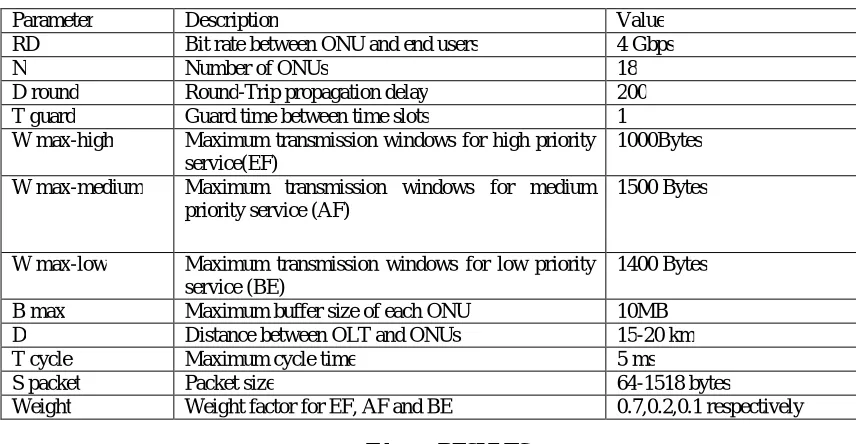
In the simulation model, the distance between the OLT and those 16 ONUs is evenly distributed within the range of 10km and 20km (D=10+1016× ( =1,2,…16), so that different ONUs will have different RTTi in order to model the more realistic network environment. Two independent wavelength channels bit rate of the uplink and downlink can be set to 1Gbps. The transmission delay of fiber is round 5ns/m, the maximum polling cycle time normally is 2ms, and the guard time of ONU is 5μs. In order to reflect the different priorities of different ONUs, and to provide differentiated
priority service based on SLA. The weight coefficient of EF, AF and BE service are 0.7, 0.2 and 0.1 respectively. Weight factor multiplied by the maximum window can be the maximum transmission window of each service queue which are described as , . In order to verify the prediction algorithm performance (do not consider lost packet rate of this network model), we can set the infinite queue length for each ONU which implements the First In First Out (FIFO) mechanism to adjust or buffer packets. In order to better simulating AF and BE service which are normally burst, this simulation choose to use Pareto distribution with multiple ON/OFF source of which the self-similarity coefficient is 0.8 so that it can generate the real data source of AF and BE. The length of packets which has been used is 64-1518 bytes and subjects to the uniform distribution. Usually the high priority EF service can be presented by any voice service, so we use Poisson model to simulate the voice source of which the length is set up the fixed 70 bytes. The traffic flow range which will be generated within 0 to 120Mbps and the distribution ratio of these three services will be 2 EF: 3 AF: 5BE.
Table 1 Simulation Parameters (KI-DBA experiment)
Parameter Description Value
RD Bit rate between ONU and end users 4 Gbps
N Number of ONUs 18
D round Round-Trip propagation delay 200
T guard Guard time between time slots 1
W max-high Maximum transmission windows for high priority service(EF)
1000Bytes
W max-medium Maximum transmission windows for medium priority service (AF)
1500 Bytes
W max-low Maximum transmission windows for low priority service (BE)
1400 Bytes
B max Maximum buffer size of each ONU 10MB
D Distance between OLT and ONUs 15-20 km
T cycle Maximum cycle time 5 ms
S packet Packet size 64-1518 bytes
Weight Weight factor for EF, AF and BE 0.7,0.2,0.1 respectively
IV. RESULTS
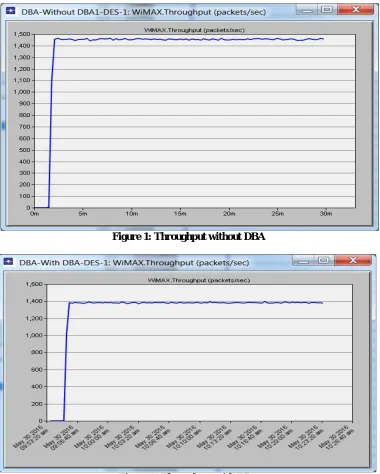
Figure 1: Throughput without DBA
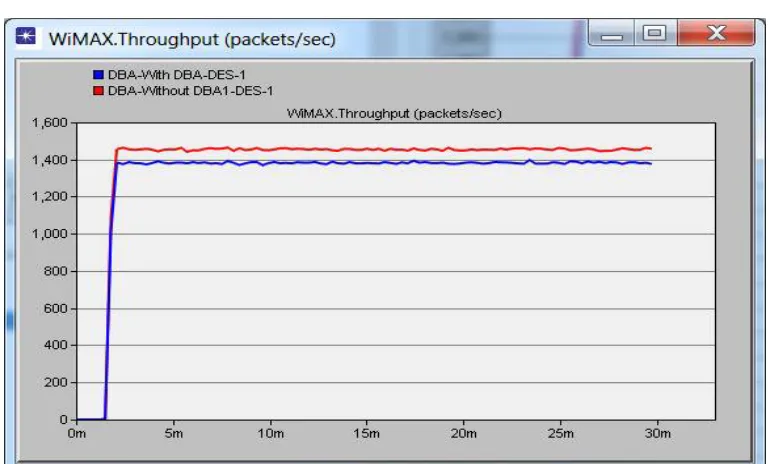
Figure 3: comparisons between without DBA and with DBA throughput
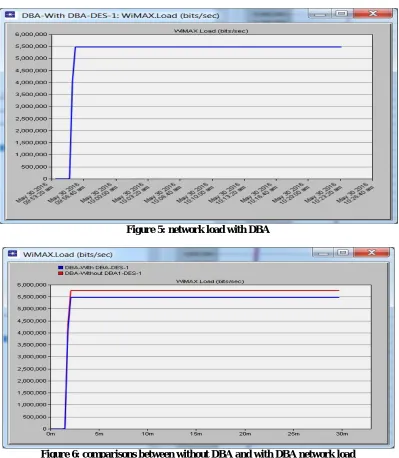
Figure 5: network load with DBA
Figure 6: comparisons between without DBA and with DBA network load
V. CONCLUSION
The significant results of this paper involve the following:
(1)At first, a Kolmogorov prediction network has been proposed to EPON service prediction utilizing three layers of Kolmogorov prediction network single-step prediction structure. KI-DBA prediction algorithm is enhanced by decreasing the idle time through the prediction mechanism, hence queuing delay of the prediction algorithm is decreased and the prediction accuracy is increased during the prediction mechanism. Consequently, the adaptive prediction of EPON service is observed and prediction accuracy of burst data service is enhanced.
(2) A novel technology design, The OLT adjusts ONUs polling sequence according to the burst during the polling process, and postpones forwarding REPORT message for contracting the prediction region, hence the prediction accuracy of burst ONUs service is enhanced. The bandwidth allotment and time slot authentication is performed in advance before ending of polling cycle. As a result, the idle time is more completely used and the upstream bandwidth usage is increased.
(3) An EPON simulation platform depending on Riverbed and KI-DBA algorithm is formulated and verified. The related protocol and scheduling algorithm are enforced by designing optical network unit (ONU), optical line terminal (OLT) and passive optical splitter (POS) and their interior processor modules. According to the results of simulation, it shows that KI-DBA algorithm is proposed by this dissertation has the higher bandwidth usage and lower average packet delay in comparison of IPACT and classic prediction based DBA. QoS of low priority facilities is substantially enhanced under the precondition of guaranteeing QoS of high priority facilities when network load is very high.
REFERENCES
[1] A.-D. Mady and A. Tonini, "A vhdl implementation of onu auto-discovery process for epon," in Networking and Media Convergence, 2009. ICNM 2009. International, pp. 36-40, 2013
[2] Asm Delowar Hossain, H. Erkan, Mohamed A Ali,” A Distributed control plane architecture for EPON: simulation study and feasibility experiment”, Second International Conference on Innovations in Information Technology, 24 May 2016
[3]Asm Delowar Hossain, M A Ali,” Efficient Dynamic Bandwidth Allocation For Epon”, The Second International Conference on Innovations in Information Technology (IIT’05),pp.1-8, 2011
[4] Banerjee, G. Kramer, B. Mukherjee, "Fair sharing using dual service-level agreements to achieve open access in a passive optical network," Selected Areas in Communications, IEEE Journal on , vol.24, no.8, pp.32-44,
[5] “Broadband Optical Access Systems Based on Passive Optical Networks (PON),” ITU-T recommendation G.983.1.
[6] B. Chen, J. Chen, and S. He, “Efficient and fine scheduling algorithm for bandwidth allocation in Ethernet passive optical networks,” IEEE J. Sel. Top. Quantum Electron, vol. 12, pp. 653–660, 2012
[7] C. Assi, Y. Ye, S. Dixit, and M. Ali, “Dynamic bandwidth allocation for quality-of-service over Ethernet PONs,” IEEE J. Sel. Areas Commun., vol. 21, pp. 1467–1477, 2013
[8] C. Assi, M. Maier, and A. Shami, “Toward Quality of Service Protection in Ethernet Passive Optical Networks: Challenges and Solutions,” IEEE Network, vol. 21, no. 5, pp. 12–19, 2013
[9] F. Effenberger, D. Clearly, O. Haran, G. Kramer, R. D. Li, M. Oron, and T. Pfeiffer, “An introduction to PON technologies,” IEEE Commun. Mag., vol. 45, no. 3, pp. S17–S25, 2009
[10] Feng Cao, Deming Liu, Minming Zhang, Kang Yang & Yinbo Qian,” A Distributed Dynamic Bandwidth Allocation Algorithm in EPON” Modern Applied Science Vol. 4, No. 7,p.p-20-24, July 2010
[11]Fu Zi-yi, Lv Suo-zhu,” A EPON Dynamic Bandwidth Assignment Algorithm Share-based the Multiple Traffic Prediction”, ISECS 29-31, pp. 112-115, July 2010
[12] G. kramer, B. Mukherjee, and G. Pesavento, “IPACT: a dynamic protocol for an Ethernet PON (EPON),” IEEE Commun. Mag., vol. 40, pp.74-80, 2011
[13] G. Kramer, B. Mukherjee, and G. Pesavento, “Interleaved polling with adaptive cycle time (IPACT): a dynamic bandwidth distribution scheme in an optical access network,” Photonic Network Commun., vol. 4, pp. 89–107.
[14] G. Kramer, B. Mukherjee, and G. Pesavento, “Ethernet PON (ePON): design and analysis of an optical access network,” Photonic Network Commun., vol. 3, no. 3, pp. 307–319.
[15] G. Kramer, B. Mukherjee, and A. Maislos, Ethernet Passive Optical Networks, 1st ed., McGraw-Hill, 2005.
[16] G. Kramer and G. Pesavento, "Ethernet passive optical network (EPON): building a next-generation optical access network," Communications Magazine, IEEE, vol. 40, pp. 66-73.
[17] G. Kramer, B. Mukherjee, S. Dixit, Y. Ye, and R. Hirth, “Supporting differentiated classes of service in Ethernet passive optical networks,” J. Opt. Netw., vol. 1, pp. 280–298, 2011
[18] Glen Kramer and Biswanath Mukherjee,” IPACT: A Dynamic Protocol for an Ethernet PON (EPON)”in proceeding IEEE Communications Magazine, pp. 74-80, 2002
[19] H. Mukai, T. Yokotani, T. Kida, "Rapid Growth of FTTH by Use of PON in Japan," IEEE Globecom Workshops, pp.1-3, 26-30 Nov. 2007 [20] Huang, L.Shan, W. Li, A. Xu, L. Xie, "Solutions to Challenges of FTTH Deployment in China," IEEE Globecom Workshops, pp.1-3, 26-30 Nov. 2007.
[21] H. Miyoshi, T. Inoue, K. Yamashita, "QoS-aware dynamic bandwidth allocation scheme in Gigabit-Ethernet passive optical networks," IEEE International Conference on Communications, vol.1, no., pp. 90- 94.