Survey on Interesting Pattern Classification
Satyani Manthale, Prof. K. P. Moholkar
Student, Department of Computer Engineering, Rajashri Shahu College of Engineering, Savitribai Phule Pune
University, Pune, India
Professor, Department of Computer Engineering, Rajashri Shahu College of Engineering, Savitribai Phule Pune
University, Pune, India
ABSTRACT: Sequence classification used in several applications such as retrieval of data, genomic analysis, health informatics and so on. Unlike the process of classification on feature vectors, sequences don’t have explicit features. Indeed, even with refined feature selection methods, the dimensionality of potential features may in any case be high and the sequential nature of features is difficult to catch. Because of this, sequence classification is very hard task as compared with the classification on feature vectors. This paper solves the issue of sequence classification by making use of rules generated by interesting patterns or item sets found in a labeled sequences dataset as well as having class labels. In this study, we will go through some of the present work by different researchers on sequence classification. This paper also presents the solution of pattern generation by using FP-Growth algorithm, and proves that it outperforms Apriori algorithm. Also convert these patterns into classification rules. Finally SVM classifier is used for rule classification with efficient and stable results.
KEYWORDS: Sequence Classification, Interesting Patterns, Classification Rules, Feature Vectors, Text Mining, Sequential Patterns, FP Growth, SVM.
I. INTRODUCTION
Real word datasets is collections of texts, videos, speech signals, biological structures and web usage logs; those are composed of sequential events or elements. Because of wide range of applications, the important problem in statistical machine learning and data mining is sequence classification. The sequence classification task is described as assigning class labels to new sequences based on the knowledge gained in the training stage. Classification based on association rules, sequential pattern based sequence classifier, and many others [1]. These combined methods can give good outcomes as well as provide users with information useful for understanding the characteristic of the datasets.
Sequential pattern mining is locating statistically relevant patterns among data examples where the values are delivered in a sequence [4] [10]. It is a part of data mining. It is also includes presumed that the values are discrete, and thus time series mining is closely related, but usually considered a different activity. A special case of structured data mining is sequential pattern mining. There are a number of key traditional computational problems inside this field. These consist of building efficient databases and indexes for sequence information. Extracting the frequently occurring patterns and comparing the sequences for similarity.Recovering missing sequence members. Sequence mining problems can be classified as string mining. String mining is based on string processing algorithms and item set mining; it is based on association rule learning [4].
II. RELATEDWORK
Zhou et al. [1] have developed a technique which combines both low and high-level data classification techniques. The low-level term can be implemented by any classification technique, while the high-level term is realized by means of the extraction of the underlying network’s features (graph) constructed from the input data, which measures the compliance of the test instances with the pattern formation of the training data. They have made use of the dynamical features that are generated from a tourist walker in a networked environment.
K. W. Chang et al. [2] authors have addressed this issue by redesigning the algorithm for implementation on highly parallel Graphics Process Units (GPUs). Computation requirements restrict the algorithm from dealing with large data sets and may limit its application in many domains. They have investigated several concepts of GPU programming and developed a dynamic programming algorithm, which is suitable for implementation on GPUs.
M. A. Salama et al [3] have proposed model, which handles most of the requirements of data classification techniques in a single model. The developed model uses pattern based clustering concept to perform the classification of the data. At last, the developed model is compared with the six other models for performance check.
M. A. Salama et al. [4] have presented a model of a supervised machine learning approach for classification of a dataset. The model extracts a set of patterns common in a single class from the training dataset according to the rules of the pattern-based subspace clustering technique. These extracted patterns are used to classify the objects of that class in the testing dataset. The user-defined threshold dependence problem in this clustering technique has been addressed in the proposed model.
G. Chicco et al. [5] have developed two approaches for customer classification—a modified follow-the-leader algorithm and the self-organizing maps. They include an overview of basic theory for these methods and discuss the performance of the customer classification on the real case of a set of customers supplied by a distribution company.
C. Zhou et al. [6] have proposed a sequence classification method based on interesting item sets named SCII with two variations. In given paper authors also address the issues of sequence classification by making use of rules composed of interesting item sets found in a dataset of labelled sequences and accompanying class labels.
Exarchos et al. [7] have developed technique for sequence classification, which employs sequential pattern mining and optimization, in a two-stage process. The methodology provides high classification results in the sequence classification problem, comparable or better with previously reported works.
P. Holat et al. [8] have analyzed a type of patterns in sequential data, the δ-free sequential patterns. These patterns are the shortest sequences of equivalence classes on the support with respect to the δ threshold. After that, they have proposed pruning properties depending on the projected databases of the sequence.
R. Nopsuwanchai et al. [9] has developed a new approach to assess arousal states based on the analysis of eye-blink patterns. The concentration is to introduce a non-intrusive and driver-independent system that can identify the struggling state, or the state where drivers spend a large effort to overcome drowsiness. The contributions of this paper are three folds.
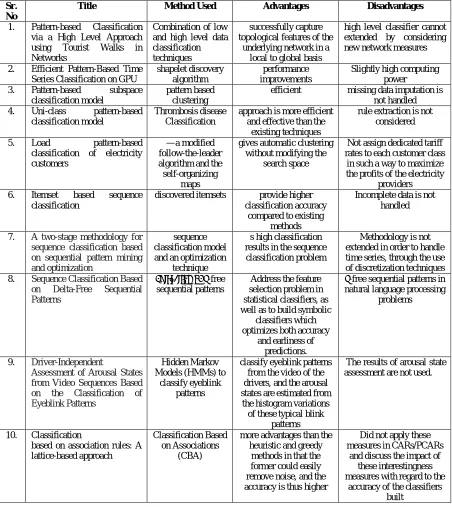
Table 1: Survey Table
Sr. No
Title Method Used Advantages Disadvantages
1. Pattern-based Classification via a High Level Approach using Tourist Walks in Networks
Combination of low and high level data classification techniques
successfully capture topological features of the
underlying network in a local to global basis
high level classifier cannot extended by considering new network measures
2. Efficient Pattern-Based Time Series Classification on GPU
shapelet discovery algorithm
performance improvements
Slightly high computing power 3. Pattern-based subspace
classification model
pattern based clustering
efficient missing data imputation is not handled 4. Uni-class pattern-based
classification model
Thrombosis disease Classification
approach is more efficient and effective than the
existing techniques
rule extraction is not considered
5. Load pattern-based classification of electricity customers
—a modified follow-the-leader algorithm and the self-organizing
maps
gives automatic clustering without modifying the
search space
Not assign dedicated tariff rates to each customer class
in such a way to maximize the profits of the electricity
providers 6. Itemset based sequence
classification
discovered itemsets provide higher classification accuracy
compared to existing methods
Incomplete data is not handled
7. A two-stage methodology for sequence classification based on sequential pattern mining and optimization
sequence classification model and an optimization
technique
s high classification results in the sequence
classification problem
Methodology is not extended in order to handle time series, through the use of discretization techniques 8. Sequence Classification Based
on Delta-Free Sequential Patterns
extraction of δ-free sequential patterns
Address the feature selection problem in statistical classifiers, as well as to build symbolic
classifiers which optimizes both accuracy
and earliness of predictions.
δ-free sequential patterns in natural language processing
problems
9. Driver-Independent
Assessment of Arousal States from Video Sequences Based on the Classification of Eyeblink Patterns
Hidden Markov Models (HMMs) to
classify eyeblink patterns
classify eyeblink patterns from the video of the drivers, and the arousal states are estimated from
the histogram variations of these typical blink
patterns
The results of arousal state assessment are not used.
10. Classification
based on association rules: A lattice-based approach
Classification Based on Associations
(CBA)
more advantages than the heuristic and greedy
methods in that the former could easily remove noise, and the accuracy is thus higher
Did not apply these measures in CARs/PCARs
and discuss the impact of these interestingness measures with regard to the
III.PROPOSEDSYSTEM
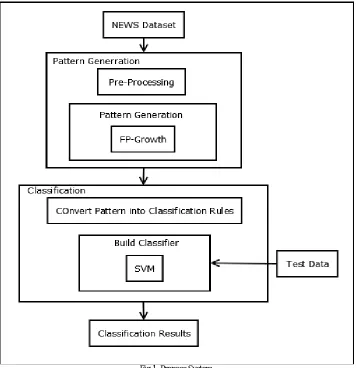
The proposed system solve the problem of sequence classificationusing rules composed of interesting patterns or itemsets found in a dataset of labeled sequences and accompanyingclass labels. For pattern generation we will use FPGrowthAlgorithm, and will prove that it is better than Apriorialgorithm. Interesting patterns from class of sequences aregenerated by combining the cohesion and the support of thepattern. Discovered patterns are converted into classificationrules which will be further classified by using SVM classifier.Proposed system is tested on NEWS dataset and experimentalresults prove that the rule based classifier (SVM) is better thanexisting classifier in terms of accuracy and stability.
Fig 1. Propose System
System works as per following modules: 1. Input Dataset
3. Pattern Generation
A text document is converted into a feature vector format. In this feature vector format, the pattern must be identified and analyzed to extract hidden information. For pattern generation FP-Growth algorithm is used
IV.CONCLUSION
This paper provides a brief survey on sequence classification. Sequential classification achieves more accuracy and stability. Paper describes details description of some recent technologies along with comparative analysis. We compare recent sequence classification methods on the basis of methodology used, and respective advantages and disadvantages. By providing solution to the previous limitations, we also prove that FP growth outperforms Appriori for pattern generation. And for classification task, SVM provides more accurate and stable solution among all classification algorithms.
REFERENCES
[1] T. C. Silva and L. Zhao, "Pattern-Based Classification via a High Level Approach Using Tourist Walks in Networks," 2013 BRICS Congress on Computational Intelligence and 11th Brazilian Congress on Computational Intelligence, Ipojuca, 2013, pp. 284-289.
[2] K. W. Chang, B. Deka, W. M. W. Hwu and D. Roth, "Efficient Pattern-Based Time Series Classification on GPU," 2012 IEEE 12th International Conference on Data Mining, Brussels, 2012, pp. 131-140.
[3] M. A. Salama, A. E. Hassanien and A. A. Fahmy, "Pattern-based subspace classification model," Nature and Biologically Inspired Computing (NaBIC), 2010 Second World Congress on, Fukuoka, 2010, pp. 357-362.
[4] M. A. Salama, A. E. Hassanien and A. A. Fahmy, "Uni-class pattern-based classification model," 2010 10th International Conference on Intelligent Systems Design and Applications, Cairo, 2010, pp. 1293-1297.
[5] G. Chicco, R. Napoli, F. Piglione, P. Postolache, M. Scutariu and C. Toader, "Load pattern-based classification of electricity customers," in IEEE Transactions on Power Systems, vol. 19, no. 2, pp. 1232-1239, May 2004.
[6] C. Zhou, B. Cule, and B. Goethals, “Itemset based sequence classification,” in Machine Learning and Knowledge Discovery in Databases. New York, NY, USA: Springer, 2013, pp. 353–368.
[7] Exarchos, Themis P., et al. "A two-stage methodology for sequence classification based on sequential pattern mining and optimization." Data & Knowledge Engineering 66.3 (2008): 467-487.
[8] P. Holat, M. Plantevit, C. Raïssi, N. Tomeh, T. Charnois and B. Crémilleux, "Sequence Classification Based on Delta-Free Sequential Patterns," 2014 IEEE International Conference on Data Mining, Shenzhen, 2014, pp. 170-179.
[9] R. Nopsuwanchai, Y. Noguchi, M. Ohsuga, Y. Kamakura and Y. Inoue, "Driver-Independent Assessment of Arousal States from Video Sequences Based on the Classification of Eyeblink Patterns," 2008 11th International IEEE Conference on Intelligent Transportation Systems, Beijing, 2008, pp. 917-924.