
Scholarship at UWindsor
Scholarship at UWindsor
Electronic Theses and Dissertations Theses, Dissertations, and Major Papers
2016
Improved Real Time Predictive Speed Analysis for High Speed Rail
Improved Real Time Predictive Speed Analysis for High Speed Rail
Collision Test
Collision Test
Bo Yu
University of Windsor
Follow this and additional works at: https://scholar.uwindsor.ca/etd
Recommended Citation Recommended Citation
Yu, Bo, "Improved Real Time Predictive Speed Analysis for High Speed Rail Collision Test" (2016). Electronic Theses and Dissertations. 5922.
https://scholar.uwindsor.ca/etd/5922
This online database contains the full-text of PhD dissertations and Masters’ theses of University of Windsor students from 1954 forward. These documents are made available for personal study and research purposes only, in accordance with the Canadian Copyright Act and the Creative Commons license—CC BY-NC-ND (Attribution, Non-Commercial, No Derivative Works). Under this license, works must always be attributed to the copyright holder (original author), cannot be used for any commercial purposes, and may not be altered. Any other use would require the permission of the copyright holder. Students may inquire about withdrawing their dissertation and/or thesis from this database. For additional inquiries, please contact the repository administrator via email
Analysis for High Speed Rail Collision
Test
By
Bo Yu
A Thesis
Submitted to the Faculty of Graduate Studies through the School of Computer Science in Partial Fulfillment of the Requirements for
the Degree of Master of Science at the University of Windsor
Windsor, Ontario, Canada
2016
c
by
Bo Yu
APPROVED BY:
Dr. Chunhong Chen
Department of Electrical and Computer Engineering
Dr. Arunita Jaekel School of Computer Science
Dr. Dan Wu, Advisor School of Computer Science
I hereby certify that I am the sole author of this thesis and that no part of this
thesis has been published or submitted for publication.
I certify that, to the best of my knowledge, my thesis does not infringe upon
anyones copyright nor violate any proprietary rights and that any ideas, techniques,
quotations, or any other material from the work of other people included in my
thesis, published or otherwise, are fully acknowledged in accordance with the standard
referencing practices. Furthermore, to the extent that I have included copyrighted
material that surpasses the bounds of fair dealing within the meaning of the Canada
Copyright Act, I certify that I have obtained a written permission from the copyright
owner(s) to include such material(s) in my thesis and have included copies of such
copyright clearances to my appendix.
I declare that this is a true copy of my thesis, including any final revisions, as
approved by my thesis committee and the Graduate Studies office, and that this thesis
In real train collision test, the test train cabin is required to be propelled on a
straight rail, accelerated to a certain velocity, released at a calculated location and
finally crash into a barrier with a desired crash velocity, in order to observe the safety
performance. Recently, a Real Time Predictive Speed Analysis (RTPSA) method was
developed to simulate the whole collision test behavior and calculates the released
velocity and location. However, in this method, the train has to be released at the
exact calculated velocity when the train is still in acceleration which is very difficult
in real test. Moreover, the RTPSA method does not provide a warning mechanism
in case the test has to be aborted. In this thesis, two improvements of the RTPSA
method are proposed. One is employing the PI controller to force the train operating
with an uniform velocity before release, in order to reduce the difficulty of release
in real test. The other one is early safety warning which provide upper bound of
velocity, before the test, indicating the last chances to abort the test with least losses
I would like to present my gratitude to my supervisor Dr. Dan Wu for his valuable
assistance and support.
I also would like to express my appreciation to Dr. Chunhong Chen and Dr.
Arunita Jaekel. Thank you all for your valuable comments and suggestions to this
thesis.
Meanwhile, I want to thank my lab-mates for helpful discussions and advice.
Finally, I thank my parents, my girlfriend and my friends who give me consistent
DECLARATION OF ORIGINALITY III
ABSTRACT IV
AKNOWLEDGEMENTS V
LIST OF TABLES VIII
LIST OF FIGURES IX
I Introduction 1
1 Introduction of High Speed Rail . . . 1
2 History of HSR . . . 2
3 Safety Issues and Solutions . . . 3
4 Motivation . . . 4
5 Contributions . . . 5
6 Guide to the Thesis . . . 6
II Background Knowledge 7 1 Real Collision Test . . . 7
1.1 Test Process . . . 7
1.2 Test Facility . . . 8
2 RTPSA . . . 10
2.1 Data Source . . . 10
2.2 Coefficients Calculation Module . . . 12
2.3 Coast-Down Simulation Module . . . 14
2.4 Propulsion Simulation Module . . . 16
2.5 Control/Release Module . . . 17
2.6 Summary . . . 18
3 PID Controller . . . 19
3.1 Proportional Term . . . 20
3.2 Integral Term . . . 21
3.3 Derivative term . . . 22
3.4 Tuning Coefficients . . . 22
3.5 Summary . . . 22
III Limitation of RTPSA 24 1 Early Safety Warning . . . 24
1.1 Necessary Simulation Before Real Test . . . 29
1.2 Feasibility of the Calculation Based on Simulated Data . . . . 32
2 Software Structure . . . 33
3 Early Safety Warning Module . . . 35
3.1 Principle and Design . . . 35
3.2 Program Logic . . . 44
4 PID Controller Module . . . 46
4.1 Principle and Design . . . 46
4.2 Program Logic . . . 50
5 Summary . . . 51
V Experiment Results 52 1 The Demonstration . . . 52
2 Experimental Results of LCAand LCR . . . 55
2.1 Different Crash Velocities . . . 55
2.2 Different Barrier Locations . . . 55
2.3 Different Safety Distance . . . 56
3 Comparison of Different PID Configuration . . . 57
3.1 Different Sets of Coefficients . . . 57
3.2 Different Sampling Frequency . . . 60
4 Results of the Improved RTPSA in Different Situations . . . 61
4.1 Real Crash Velocity . . . 61
4.2 Results of Different Crash Velocity . . . 63
4.3 Result of Different Barrier location . . . 64
4.4 Result of Different Safety Distance . . . 65
VI Conclusion 66
REFERENCES 67
1 The results of LCAand LCR based on different crash velocities. . . . 55
2 The results of LCAand LCR based on different barrier locations. . 56
3 The results of LCAand LCR based on different safety distances. . . 56
4 The results of different PID coefficients. The unit of velocity is kmph. 58 5 The results based on different sampling frequency. . . 60
6 The results based on different crash velocities. . . 64
7 The results based on different barrier locations. . . 64
1 Three phases of the collision test. . . 8
2 Test facility one[18]. . . 8
3 Test facility two[18]. . . 9
4 Test facility three[18]. . . 9
5 Data for simulation[18]. . . 11
6 Coefficient module, from A to C[18]. . . 13
7 Coast-down module, from B to D[18]. . . 15
8 Propulsion module, from C to B[18]. . . 17
9 Safety warning information, schematic diagram. . . 25
10 Deviation of simulated release point from real release point, schematic diagram. . . 27
11 The behaviour of the test train in improved RTPSA, schematic dia-gram. . . 28
12 Effect of proportional gain, schematic diagram[5]. . . 30
13 Structure of original RTPSA[18]. . . 33
14 Structure of improved RTPSA. . . 34
15 Parameters in LCA, schematic diagram. . . 36
16 Same image as Figure 15. . . 39
17 Parameters in the second part of early safety warning module, schematic diagram. . . 41
18 Uniform motion in original RTPSA, schematic diagram. . . 44
19 Flow chart of safety warning module. . . 45
20 The simulation model in Simulink, Matlab. . . 48
21 The structure of tuning module. . . 49
22 Parameters for PID module in simulink. . . 49
25 Important information in improved RTPSA. . . 54
26 Response time and transient behaviour in the tuning module. . . 58
27 Performance of different combination of PID coefficients. . . 59
28 Performance of different sampling frequency. . . 61
Introduction
1
Introduction of High Speed Rail
The High Speed Rail(HSR) is a rail transport technology which provides
signifi-cantly faster speed than the traditional rail transport. As the definition of the HSR
is not rigid, the lines operating from 160 km/h to, even more that, 250 km/h can be
regarded as HSR[4].
Japan is the first country opening the HSR system to the public in 1964, in other
words,this HSR system is in operation for around 50 years and carries more than
9 billion people in total[17][28]. Nowadays, HSR is operating in more than twenty
countries (including the UK, France, Germany, Belgium, Spain, Italy, Japan, China,
Korea, and Taiwan), while other around 20 countries are developing and constructing
it(such as Turkey, Qatar, Morocco, Russia, Poland,etc.)[6][18].
In terms of the benefits, HSR offers a convenient, comfortable, affordable and
safety choice to travel without delays. Other than this, it relieves the congestion on
local traffics while delivers punctual and fast service to the passengers. Further more,
it is powered by electricity,which as a result significantly reduces the budget on oil
purchase for countries. And it creates plenty of job opportunities constructing the
2
History of HSR
The development of the railway is the development of the speed. In 1829, George
Stephenson created a locomotive reaching 50km/h which represented the high speed
standard of the train at that time[8][15]. However, this record was broken by many
other higher speed at the beginning of the 20th Century.
Although the speed is satisfiying at that time, the development of other transport
modes push the train producers to strengthen the performance of the existing trains.
After a huge speed improvement in Europe, in 1964, Japan impressed the world by
the operation of a fully new standard gauge line, the Tokaido Shinkansen[17]. It was
designed to operate at 210 km/h, with broad loading gauge, electric motor units,
Au-tomatic Train Control (ATC), Centralised Traffic Control (CTC) and other modern
improvements.
After the huge success of Japanese HSR, the European HSR was born in France
between Paris and Lyons in 1981, at a maximum speed of 260 km/h[8]. In addition
to its high speed, the compatibility with the original rail system was considered as
the most important contribution, due to its influence on the future upgrade of the
old railway system.
Based on the experience of HSR in France, many other European countries such as
Germany(in 1988), Spain(in 1992), Belgium(in 1997), the United Kingdom(in 2003)
developed their own high speed railway system[30]. At the same time, China built
the HSR in 2003. Chinese HSR was operating at the average speed of 200kp/h or
even higher[22].
A new step forward for HSR started in China on 1 August 2008, when the 120 km
long high speed rail between Beijing to Tianjin was build[14]. After 2008, China
con-ventional railways and newly built high-speed passenger designated lines (PDLs)[16].
The HSR system in China carries at least 800 million passengers per year ( from 2014
and growing), more than half of the total high speed traffic in the world[3].
3
Safety Issues and Solutions
Because of the increasing speed of HSR, the safety issues turns out to be more
important. On 23 July 2011, a deadly crash happened between two high-speed trains
travelling through Wenzhou, China. Fourty people were killed, and at least 192 were
injured. Based on the official investigation, the accident was blamed for the faulty
signal systems which failed to warn the second train that the first train was on the
same rail[2].
Another serious HSR accident happened in Santiago, Spain, on 24 July 2013. The
train derailed at high speed when turning around on a bend, killing 79 people while
other 140 were injured. The reason was the train exceeded the speed limit(80 km/h)
twice when passing the bend[1].
Many other HSR accidents have not been mentioned here, and due to these
un-expected collisions, a large amount of researchers in the area of HSR focus on safety
issues. Some of the research topics refer to minimizing the human body injury when
train accident occurs.
Due to the danger of high speed train accident, many countries have developed
safety guidelines for the train in the designing phase to improve crashworthiness[26][23][13][29].
In order to test these designs, the real train collision test is required. In a real train
collision test, a test train is accelerated by a propulsion system. After reaching a
cer-tain speed, it will be released and hit the barrier with a desired speed to observe the
crashworthiness. Obviously, the test facilities require massive expense. As a result,
which simulate the entire collision test based on theoretical data[21][20][19].
However, the existing simulation methods process only with the theoretical data
and past experience, which can not completely study the behaviour of the test train
in real test[24][27]. Thus, a recent method called Real Time Predictive Speed
Anal-ysis(RTPSA) will be discussed in this thesis. Different from previous simulation
methods, RTPSA is a real time method implemented in a real collision test. RTPSA
can analyse the effects of the factors which are difficult to be included by the
tradi-tional simulation methods as they are changing all the time and can not be predicted,
such as the resistance of the air[18].
RTPSA firstly applies a regression analysis model to study the real time
perfor-mance of the testing train, consisting of forces, velocity and location, which can be
collected by the sensors. After some calculation, the relation between resistance and
velocity is found and represented by an expression. Later on, this relation is used
to predict the movement of the train, in order to find out the release velocity and
location before the test train reaches this release point. And then, the test train can
crash into the barrier with the desired velocity, if it is released at this release point.
More details of RTPSA will be introduced in chapter 2.
4
Motivation
For study purpose, RTPSA is only implemented with simulated data. Although
RTPSA operates as expected with simulated data set, there are still two important
disadvantages.
The first disadvantage is lack of early safety warning for aborting the test.
Ex-ception may happen during the test and sometimes it is necessary to abort the test.
Once the train is propelled by the propulsion cart, both the propulsion cart and the
so that the test vehicle can brake successfully and the barrier is not damaged, the
current RTPSA method has to be augmented with a module that can decide if
abort-ing the test is doable by given the velocity of the train, and the distance travelled so
far.
Another disadvantage is the difference between the predicted release point
ob-tained by RTPSA and the real release point. This difference is caused by the
unsuffi-cient simulated method utilized by RTPSA when predicting the behaviour of the test
train, which will be mentioned in detail in chapter 3. Due to this reason, the train
can not be released precisely, therefore required to be improved. And the improved
method will be simply mentioned in next section and discussed in detail in chapter 4.
5
Contributions
The thesis focuses on solving the two disadvantages mentioned in the previous
section.
The first contribution is a new additional functionality providing last chances to
abort the test with least money losses in two different conditions. One is before
re-lease, in other words, the test train is connected with the propulsion cart. In this
scenario, the system will offer a solution for stopping the test train and propulsion
cart safely before they strike the barrier. The other condition is the test train has
already been released. Thus, it can not be prevented to hit the barrier, when only
the propulsion cart can be protected. In other words, this condition decides when is
the last chance to release, otherwise the propulsion cart is not safe.
The other contribution, which is also the primary one, is forcing the test train
to do the uniform motion before release, in order to reduce the negative influence
velocity and location) and the “last chance” information from previous contribution,
the new release velocity is obtained and applied as the input of the PID method. PID
method controls the velocity of the propulsion cart, forces it doing uniform motion
with the new release velocity until the test train disconnects with the propulsion
system. More details of the PID method and the system’s design will be introduced
in chapter 2 and 4.
6
Guide to the Thesis
This thesis is organized as following.
In chapter 2, the background knowledge underlying the proposed method will be
reviewed. The chapter 3 presents the drawbacks of the current RTPSA. To solve
these problems, the new method is introduced and broke down into details in chapter
4. And then, the comparisons and improvements can be observed from the running
Background Knowledge
This chapter reviews the background knowledge of the proposed method in this
thesis. Typical setup in real collision test will be briefly reviewed. After that, the
RTPSA method will be broken down into five sections and introduced. And finally,
the PID controller will be discussed.
1
Real Collision Test
1.1
Test Process
Generally, the real collision test has three phases, which are propulsion phase,
release phase, and coast-down phase. In Figure 1, from top to the bottom, the
first subfigure describes the propulsion phase where the test train is propelled by a
propulsion cart and accelerated from velocity zero. And when reaching the release
velocity/location, the test train will be released immediately in the second subfigure
- release phase. From this time on, in the third subfigure, the test train will be only
affected by the resistance force, thus, coast down towards the barrier, and finally
crash into it. In order to obtain a desired crash velocity, the release velocity/location
is one of the most important factors to be controlled in this test, as the test train can
FIGURE 1: Three phases of the collision test.
1.2
Test Facility
The basic test facility is shown in the following images.
FIGURE 2: Test facility one[18].
In Figure 2, the test train is connected with the propulsion system, located on a
straight guide rail and preparing to be accelerated.
In Figure 3, a rigid wall is located at the end of the rail. And in Figure 4, the
FIGURE 3: Test facility two[18].
2
RTPSA
The previous simulation methods are based on theoretical and historical data.
However, in a real test, resistance forces vary all the time and are subjected to the
velocity of test vehicle, wind speed and direction, temperature and humidity, which
are different in every test. When the collision test is simulated by historical data or
parameters, it brings about less accuracy of the release velocity and location, and
inac-curate crash velocity as well, due to the unpredictable resistance forces. RTPSA(Real
Time Predictive Speed Analysis)is a real-time method (can also process the
simula-tion data) improving the previous ones, which can achieve a more accurate crash
velocity by precisely controlling the release process. The advantage of RTPSA is that
the most up-to-date calibration information can be derived from real-time propulsion
behaviour during the real test[18].
The RTPSA consists of four modules.
• coefficients calculation module
• coast-down simulation module
• propulsion simulation module
• control/release module
At the beginning of the test, RTPSA will collect required data from sensors
de-scribing the behaviour of the test train. And then, the data will feed into coefficients
calculation module for some calculations in order to predict the resistance. Based on
the predicted resistance, the future behaviour of the train can be estimated, and the
release velocity is calculated before the train reaches the release point. More details
are in the following subsections.
2.1
Data Source
In an ideal condition, RTPSA should be implemented in a real test and collect
high expense of a real test .
FIGURE 5: Data for simulation[18].
Figure 5 shows part of the data used for simulation, which is given by Anemoi
Technologies Inc. This dataset is applied in the design stage for studying and
de-bugging purpose. It simulates the beginning propulsion phase by providing the
in-formation of velocity, force, and acceleration based on historical data, which will be
measured by the sensors in a real collision test. At the meantime, the RTPSA is
collecting all these data for the further calculation and simulation in order to predict
the release velocity/location.
In the line “8” of Figure 5, there are three kinds of subscription, which are “a”,
“m” and “c”, indicating three kinds of corresponding data - actual data, measured
data and calculated data. Actual data simulates the real and theoretically
perfor-mance of the system during the propulsion phase. However, due to the mechanical
deviations of the hardware and sensors, the data appeared on the sensors will not be
the actual data exactly, thus, is represented by the so-called measured data. Finally,
In addition, actual data will not be applied, as in real test the available data only
comes from sensors, which is described by the measured data in this dataset. And
later on, this dataset will be collected by RTPSA to predict the behaviour of the test
train.
2.2
Coefficients Calculation Module
This module is a real-time calculating module, in other words, this module will
continuously gather the data from sensors and do calculation while the test train is
propelled. Although, in this research, simulation data replaces the real-time data,
the data will still feed into the module in the same way as in a real test.
This module calculates the necessary coefficients which will be utilized in
predic-tion of the future behaviour of the test train. As introduced previously, the changing
resistance is the reason why most simulation methods can not work accurately. In
principle, the resistance is the combination of two parts, which are friction and
aero-dynamic resistance. Based on the physics of friction and aeroaero-dynamic, the relation
between R and v can be expressed by the following equation,
R =b0v2+b1v +b2 (1)
where b0, b1, b2 are constants, b0v2 +b1v represents the aerodynamic force, b2
cor-responds to the friction. If given a set of data (R, v), the three coefficients can be calculated, and then this relationship can be applied to predict the future behaviour
of the train. The value of v is able to be collected from the sensors, so next question is how to obtain the corresponded resistanceR. Actually, the whole behaviour of the train follows the laws of motion,
F −R=m∗A (2)
Ris calculated and then combined with the corresponded velocityvmeasured at same moments. Thus, a dataset SETRv is gained,
SETRv :{(Rt, vt) :t = 1,2, ..., n}
where R is resistance, v is velocity, and t is the timepoint when sensors do one measurement. With the knowledge of multiple linear regression model and dataset
SETRv, the coefficients b0, b1, b2 are obtained.
FIGURE 6: Coefficient module, from A to C[18].
In Figure 6, from point A to point C, the test train is accelerated from velocity zero,
and in the same period RTPSA is collecting the data and calculating the coefficients
following the ideas just introduced. Between point A and point C, there are intervals
described by different colours. At the end of each interval, RTPSA will calculate the
coefficients once, and evaluate the results based on the current collected data. By
experiments, the first interval starting from point A, coloured by black, is proved
unqualified for the further calculation, due to the instability of the data, while the
combination of the other intervals are the most qualified[18]. Finally, before point C
2.3
Coast-Down Simulation Module
The Coast-down simulation module is implemented right after the relation
tween resistance and velocity is obtained, contributing to accurately predict the
be-haviour of the test train during the coast-down phase.
Same as the propulsion phase, the coast-down behaviour also obeys the equation
as following.
−R=m∗A (3)
where R is resistance, m is mass, and A is acceleration. The force F is disappeared, as there is no more force coming from the propulsion system. The resistance is
the only influence on the train, which can be defined by equation (3). Since mass
is predefined, the acceleration of the train after release is ready for further calculation.
Given the resistance changing with the velocity, the acceleration is also affected
by the velocity. Further more, as the resistance is the only force, the acceleration will
continuously decrease, so will the velocity. In other words, the coast-down phase is
a variable acceleration motion. In order to study the relation between location and
velocity, the whole process will be divided into small pieces and each piece is regarded
as uniform acceleration motion, which is defined by the following expressions.
v =v0+At
S =S0+v0t+
1 2At
2
wherev is the ending velocity of each piece,v0 is the starting velocity of each piece, t
is the time which divides the whole process and gives the size for each piece, Ais the acceleration, and finally S0 is the start location while S is the end location for each
interval.
The acceleration is given by velocity, and the time is predefined. As each piece’s
is acquired, the whole process can be calculated based on this velocity. The
coast-down behaviour starts from the moment when the test train is released and ends
when the train crashes into the barrier. It is impossible to obtain the release
infor-mation which is the result of RTPSA and will be gained at the very end. But the
crash velocity/location is predefined, included the velocity and the location. Thus,
instead of calculating forwardly, the calculation starts from the end point and
pro-cesses backward to the start point, eventually gains a set of data SETBD describing the coast-down motion,
SETBD :{(locationt, velocityt) :t= 1,2, ..., n}
where t is the time of each small piece of uniform acceleration motion.
FIGURE 7: Coast-down module, from B to D[18].
In the Figure 7, the crash velocity is defined as 80 kmph, and the barrier is placed
30 meters away from the rail’s end point. After the data collection and coefficients
generation from point A to point C, RTPSA will immediately start to simulate the
movement after release from B to D. Calculation proceeds from the point D,
back-wards to point B, and ends until a large enough size of dataset is obtained. After this
module, the next mission is the prediction of the last propulsion phase described by
2.4
Propulsion Simulation Module
The propulsion simulation module is invoked after the coast-down simulation
mod-ule, and simulates the behaviour of the train after the data collection process and
before release.
Theoretically, the test train is propelled from start point A to point B, but
sepa-rated into two parts, the real running part AC and the predicted part CB simulated
by RTPSA. The train is actually accelerated until enough data has been collected
to obtain the coefficients(in the second module), after that, in order to predict the
release point, RTPSA simulates the coming propulsion phase(last propulsion phase).
The math model underlying the last propulsion phase is same as previous one when
collecting data.
F −R=m∗A
where the propulsion force F is controlled, mass m is constant, and resistanceR can be retrieved by given the corresponded velocity based on the equation (1) from second
module. Then acceleration is the only unknown parameter, and can be obtained. The
last propulsion phase is variable acceleration motion, as acceleration is also changing
on resistance which is varying on velocity. And it is continuous from the former
propulsion phase, so the end point C of the collection process is the head of this
phase. The velocity and location of point C can be measured, and by following the
same idea in the previous module, the relation between the location and velocity is
known. Finally, the last propulsion phase is predicted by a set of data SETCB,
SETCB :{(locationt, velocityt) :t = 1,2, ..., n}
FIGURE 8: Propulsion module, from C to B[18].
Observing the Figure 8, the length of the curve CB is short, which indicate the time
between release and the end of data collect does not last long. As introduced, during
this period of time, the train is still accelerating and at meantime the calculation is
proceeding. Thus, the actual time for the system to prepare for the release(which is
called leading time) is defined by the following equation.
LeadingT ime=TCB −Tcalculation
TCB is the time that testing train spends in travelling from C to B. Tcalculation is the time for calculation by RTPSA. If the leading time is too small, the system can not
complete the task. Usually, leading time should be 1 to 2 second, which decides the
position of point C can not be too closed to point B, so generally the velocity of point
C is given by the value of crash velocity[18].
2.5
Control/Release Module
After the coast-down simulation module and propulsion simulation module
com-plete, the control/release module is implemented with the data sets from these two
For the purpose of seeking for the release point, the behaviour of the coast-down
process and the propulsion process is required. Because the point of intersection
be-tween this two phases on the (location, velocity) coordinate system is the solution.
However, these two phases are described by discrete data points, which results in the
impossibility to find their intersection by simply search the same point in the two
datasets. Even if there is one overlap point, the reason is just coincidence. In order
to solve the problem, two approximated functions describe the data sets are required
and the new goal is to find the intersection of these two functions. Thus simple linear
regression model is qualified to discover the approximated functions, and then the
release point will be obtained.
The reason why simple linear model is practical is from the observations on several
times of experiments. First, by repeated experiments, the dataset SETBD of coast-down phase is very closed to the fitted function of this phase calculated based on
simple linear model[18]. Secondly, the time spent on the propulsion phase predicted
by propulsion simulation module is very short, generally 1 to 2 seconds, leading to
small error between the fitted function of propulsion phase and SETCB[18]. Last, as the method will be deployed on real time test, the calculation time should be as short
as possible and simple linear regression model can save time.
2.6
Summary
In RTPSA, the necessary data is collected during the first propulsion phase while
the test train is propelled by the propulsion cart. After the software obtains
suffi-cient data, it will invoke the coeffisuffi-cient calculation module to discover the relation
between resistance and velocity. And this relation will be utilized in the prediction of
the coast-down phase and the following propulsion phase by coast-down simulation
module and propulsion simulation module. Therefore, their point of intersection is
regarded as the expected release point where the test train will be released and hit
the barrier with the desired crash velocity. As the entire calculation process operates
train reach this velocity although the test is still in processing during the calculation.
3
PID Controller
PID controller is short for proportional-integral-derivative controller, which is a
control loop feedback mechanism. PID controller aims to make a system keep stable
at an expected status which is also named as setvalue/setpoint, such as controlling a
car to keep a certain velocity. In order to achieve this goal, PID controller will moniter
the status of the system frequently, and this frequency is called sampling frequency.
After the sampling frequency is decided, at every time points, PID controller
contin-uously generates outputs based on error values indicating the difference between a
desired setpoint and a measured process value. And then, this output will be applied
by the system in order to update its status. The measured process value is the
feed-back status of the system after the system applies the output from last time point[20].
The PID controller attempts to minimize this error value at next time point unless
the difference equals to zero, and eventually, the system will maintain homeostasis
at the setpoint. The error value occurring during the homeostasis is difficult to be
erased, but can be controlled within a certain range.
Here is the expression for PID,
u(t) = Kpe(t) +Ki Z t
0
e(τ)dτ +Kd
de(t)
dt (4)
whereKp,Ki, andKdare all non-negative values, representing the coefficients for the proportional, integral, and derivative terms which correspond to the three parts on
the right side of the equal sign. They are significantly important for PID controller,
which will affect the performance of the system, including stability and settling time.
The settling time represents how much time the system spends in reaching the stable
The advantage of PID controller is it only relies on the measured process value,
in other words, the underlying math model is not necessarily to be known[12].
Mean-while, by tuning the three coefficients, the performance can be controlled within an
acceptable range. But this method does not guarantee the best control[5].
3.1
Proportional Term
Proportional term is defined by the expression,
P =Kpe(t) (5) where Kp is a non-negative number, called proportional gain. And e(t) is the error value on time t.
This term provides an output P which is proportional to the error value, by mul-tiplying the error with a non-negative coefficient Kp.
The output P of this term is the principle part of the controller, while the other two terms plays an regulatory role. The value of the output should depend on the
real requirements, not be too large or too small, which can be controlled by the
pro-portional gain. An overly large gain cause a huge change in the output when the error
is provided, and an over sensitive system[25]. On the other hand, if the gain value is
too low, the system will become less sensitive even with a large input error[25]. Thus,
for an ideal system, the output should be large enough to accelerate the pace to the
setpoint when the error is high, and small enough when the error is low in order to
avoid fluctuation.
However, sometimes the system can not be stable just at the setpoint. The error
value between stable status and setpoint is named as steady-state error, generally
proportional term[32][5]. The so-called non-zero error system is the one that
contin-uously lose energy, such as a car with constant velocity. Because of the resistance,
the velocity can not reach the one when the resistance is not existing. A part of
the propulsion power from the engine will be spent to offset the resistance and then
the car will lose a certain amount of speed. This amount losing speed is defined as
steady-state error.
3.2
Integral Term
This term is given by the following expression.
I =Ki Z t
0
e(τ)dτ (6) where Ki is the non-negative number called integral gain, and
Rt
0e(τ)dτ is the
accu-mulation of the past error over time.
The output I of the integral term is related with both the magnitude and the duration of the error. It accumulates the instantaneous error over time, and such
accumulation is just the sum of errors that should have been neutralized previously.
Then, this sum is multiplied by the integral gain, indicating the relationship between
the input error value and the output I, and added to the PID controller outputu(t).
The value of Ki should not be too large, otherwise will result in overshooting problem which means the status of the system will exceed the setpoint[9]. And a
proper Ki can velocity up the movement of the system status towards setpoint and offset the steady state-error. As introduced in last section, the steady-state error
is the loses of a system, which are collected, accumulated,then brought back to the
3.3
Derivative term
Derivative term is defined by,
D=Kd
de(t)
dt (7)
where Kd is non-negative derivative gain. dedt(t) is the slope of the error over time.
This term estimates the trend of the system behaviour, and controls this trend
to be stable by calculating the slope of the error, multiplying the derivative gain
and then adding them to the PID controller output. It predicts the error for the next
control loop and adds this future error in the current loop[10], which will decrease the
error in the next loop, thus boost the settling time and stability[25][31]. Derivative
term is rarely implemented in practice - by one estimate in only 25 percent deployed
controllers, as its unstable impact on the stability of the real-world system[9].
3.4
Tuning Coefficients
As mentioned, the three coefficients significantly affect the performance of the
system, as they describe the relationship between the input and the output. The
contribution of the tuning process is the adjustment of the coefficients to an
satisfy-ing status for the expected system feedback, which not only brsatisfy-ings about satisfysatisfy-ing
stability, but also desired settling time.
3.5
Summary
The PID controller will moniter and adjust the velocity of the uniform motion
phase which will be appended to the existing RTPSA so as to obtain a more accurate
release velocity. After the sampling frequency is determined, the setvalue of PID will
be assigned by the desired velocity of uniform motion. The input is the difference
between the velocity of the train at every time point and the setvalue. Then, the PID
at each time point in order to keep the test train doing uniform motion. The PID
controller keep processing until the test train is released.
So far, the mechanism of the RTPSA and PID controller are introduced. And in
Limitation of RTPSA
In this chapter, the limitation of the current RTPSA is discussed in details. The
limitations are the lack of early safety warning mechanism which indicates the last
chance to abort the test and last chance to release the test train, and the deviation
of the simulated release point from real release point.
1
Early Safety Warning
One limitation is lack of early safety warning mechanism. The early safety
warn-ing includes two situations. As exception may happen durwarn-ing the test and sometimes
it is necessary to abort the test, in the first situation, once the train is propelled
during the test by the propulsion cart, both the propulsion cart and the test train
move extremely fast in a very short time. In order to abort the test safely so that the
propulsion cart and the test train can brake successfully and the barrier stays safe,
the current RTPSA has to be augmented with a module that can decide if aborting
the test is possible given the velocity of the train, the distance travelled so far, and the
brake distance of the propulsion cart and the train. The improved RTPSA method has
to decide whether it is safe to abort the test when the propulsion cart is still attached
to the train so that both can come to a complete stop before hitting the barrier. In
other words, improved RTPSA should find out where is the last chance to abort the
test(LCA). In the second situation, the test train reaches the calculated release veloc-ity and then is released by the propulsion cart. The test train will coasts down to the
the propulsion cart safely comes to a complete stop without hitting anything, the last
chance to release the test train(LCR) should be decided by the improved RTPSA as well. During the test, there must be critical velocity/distance at which test has to be
aborted or the test train need to be released before it is too late to make the decisions.
FIGURE 9: Safety warning information, schematic diagram.
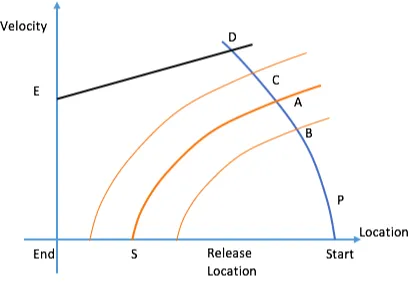
For example, Figure 9 shows a location-velocity coordinate system. On this plane,
the blue curve P represents the behaviour of the test train when it is propelled by the propulsion cart. The black line DE is the coast-down phase of the test train. The other three orange curves with similar shape describe the brake behaviour of the
test train decelerated with the propulsion cart. The collision test starts at the Start
the test needs to be aborted, after the brake phase, the test train and propulsion cart
should finally stop between S and point Start in order to be safe. Otherwise, they will be too close to the barrier and may not stop safely. Point A is the last chance to abort a test. If the test is aborted at this point, the test train and propulsion cart
will just stop at pointS. Thus, when the test is aborted before pointA, such as point
B, the test train and propulsion cart can stop safely. However, if pointA is unknown and the test is still aborted at pointC, the test train and the propulsion cart will not be safe.
2
Deviation of Simulated Release Point from Real
Release Point
The RTPSA method could calculate precisely the release velocity and location in
simulation. Once the release velocity is reached, the train is right away released in
simulation. The simulation also demonstrates that the train will then hit the barrier
at the exact desired crash velocity. This positive result proves in principle that the
idea behind the RTPSA method works as expected, at least in simulation.
However, the inaccuracy occurs in simulating the last propulsion phase(mentioned
in chapter 2) with simple linear model introduced in the control/release module of
RTPSA. The motion of the test train in the last propulsion phase should be described
by a curve on a velocity-location coordinate system. However, this motion is simply
simulated by a straight line in the control/release module, which is an inaccurate
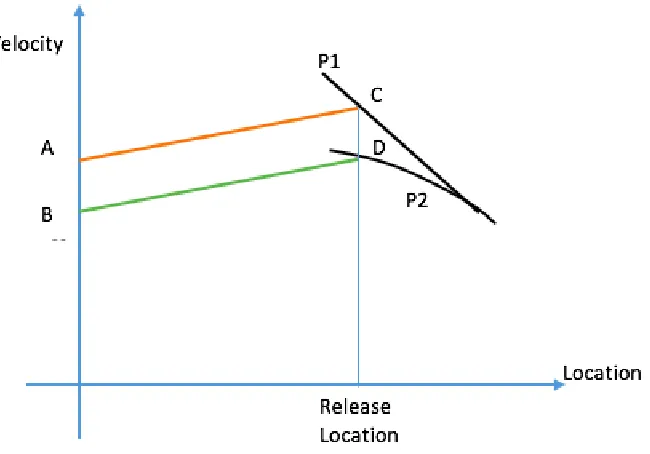
simulation. This inaccuracy has influence on releasing precisely. Figure 10 shows the
deviation of simulated release point from real release point. The X-axis is location,
FIGURE 10: Deviation of simulated release point from real release point, schematic
diagram.
real release point will be point D. As a result, the orange line AC represents the coast-down phase of the test train calculated by RTPSA, and the green line BD
describes the coast-down phase in a real test. Point A is the required crash point, and pointB is the real crash point. Obviously, there is deviation of real release point from caculated release point. This deviation will finally result in the inaccurate crash
velocity.
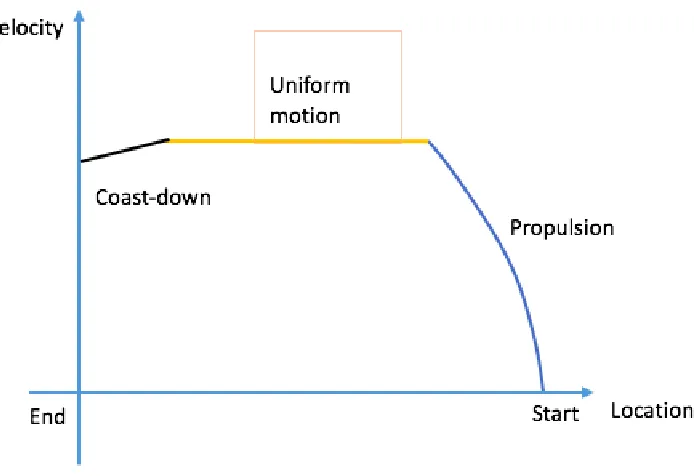
However, if the train can maintain the release velocity for a short time before
release(in other words, do uniform motion), it is easier to release the train and the
deviation of real release point and calculated release point can be minimized. As
shown in Figure 11, after accelerated by the propulsion cart, the test train will do
uniform motion before release. After this motion, the test train will coast down and
crash into the barrier with the desired velocity.
chap-FIGURE 11: The behaviour of the test train in improved RTPSA, schematic diagram.
ter. And in the next chapter, the proposed method, improved RTPSA, is introduced
Improved RTPSA
In order to solve the problem raised in the previous chapter, a new safety warning
module is combined with the original RTPSA. Moreover, the test train will move with
a uniform velocity before release, and the PID controller module is implemented to
monitor and control this uniform motion phase in order to minimize the deviation
between real release point and calculated release point. This chapter discusses the
design principle, software structure and the details of these two new modules.
1
Design Principles
1.1
Necessary Simulation Before Real Test
Improved RTPSA will be deployed in real time collision test, where the test train
will connect with the propulsion cart and be accelerated to a calculated release
ve-locity, and then, instead of being released right away at this veve-locity, the train will
move with this release velocity for a while and then disconnect with the propulsion
cart at a calculated release location, in order to minimize the deviation of real release
point from calculated( or called predicted) release point. Compared with the original
RTPSA, there are two new modules, safety warning module and PID controller
mod-ule, in improved RTPSA. In these two modules, there are some important parameters
which consists of the outputs of early safety warning module and the coefficients of
the PID controller. However, these important parameters are required to be decided
The outputs of early safety warning module is a set of early safety warning
in-formation. The early safety warning information includes two parts which are LCA
and LCR mentioned in chapter 3. It may not be proper if the safety warning infor-mation is calculated during the real test. Assuming the train is running and RTPSA
is calculating where is the release velocity/location and where is the last chance to
abort the test. However, this last chance may have already been missed during the
calculation before the result comes out. Then, even if the train is decelerated
imme-diately, the test still can not be aborted safely. This kind of situation occurs when
the length of the rail is too short or the propulsion force is too strong. To circumvent
this circumstance, the safety warning information should be obtained in a simulation
before the real test by studying simulated data.
FIGURE 12: Effect of proportional gain, schematic diagram[5].
The PID controller will detect and adjust the velocity during the uniform
mo-tion. As introduced in chapter 2 section 3, there are three important coefficients
KP, KI, KD, affecting the performance of the PID controller system. In Figure 12, the X-axis represents the time, while Y-axis is the status of the object controlled
by PID. The blue curve with two right angles indicates the ideal performance of the
The differentK in the right-top corner represents the different value of proportional gain KP, while KI and KD are fixed in this case. The performances of the object varying on different K is showed by different coloured curves. Moreover, the settling time is how much time the PID controller takes to adjust the object from one initial
status to an stable status. And the stability represents how smooth the performance
is. Obviously, in this figure, the stability and the settling time are significantly
influ-enced by the proportional gain. Although this figure only shows the effect ofKP, the other two coefficientsKI and KD also affect the performance of the controlled object. Moreover, these three coefficients are required to be tuned based on the performance
of the controller, and can not be simply calculated by any expression. Different PID
system may have different values of the coefficients to achieve expected performance,
such as expected settling time and stability. Even for the same system but different
setvalues, the best fitting coefficients might be different.
Generally, there are two ways to tune the coefficients. One is self-learning method[11]
in which the system implemented with a machine learning method can adjust the
co-efficients of PID controller itself by studying the performance of the controlled system.
This first way does not need human intervention and is normally used in the situation
when the requirement of the system(setpoint) always changes or is not predefined.
However, the machine learning process takes normally long time that cannot be
tol-erated in real time applications, thus is not selected in this project. In the second
way, the three coefficients of PID are tuned by the people with their experience or
software tools before PID controller is deployed. The drawback of the second way
is it always requires a person to update the PID coefficients when the requirement
varies. In this project the uniform motion velocity, which is also the setvalue of PID
controller, is not predefined before RTPSA is deployed. But time is precious in a real
time system, the first way is not proper in this project. As a result, the coefficients
1.2
Feasibility of the Calculation Based on Simulated Data
As introduced, some parameters of the safety warning module and PID controller
module is required to be calculated in a simulation test with simulated data. This
subsection will discusses the feasibility of this calculation which is based on simulated
data, in order to make sure if they are feasible in a real test.
The main drawback of the simulated data of a collision test is that the resistance
force(all the resistance mentioned in below only consists friction and aerodynamic
re-sistance) cannot be predicted precisely. Apart from the resistance, the other data(such
as propulsion force, brake force and so on) of a real test can be simulated with very
small deviation.
The purpose of the safety warning module is obtainingLCAandLCR(mentioned in chapter 3). The correctness of LCAand LCR is the most important requirement. If the test is aborted at or before LCA, the test train and the propulsion cart must definitely stop safely. However, as introducted, LCA and LCR are all calculated based on simulated data where the resistance can not be simulated precisely. If the
inaccurate resistance is still considered, the correctness of LCA and LCR cannot be guaranteed. However, as a conservative strategy, if the resistance is not considered
when calculating LCA and LCR, the test train must travel less distance in a real test where resistance exists, which can make sure the test train and propulsion cart
stop within the safety distance. The feasibility and details of this strategy will be
explained in the section “Early Safety Warning Module”.
In terms of the PID controller module, as introduced in chapter 2, it will control
the system to be dynamically equilibrium at the setvalue. In other words, the status
of the system will be controlled within a certain range, but not definitely just stay
coefficients can be found to satisfy a certain system, and at the same time one certain
set of PID coefficients may be qualified in different systems, as long as the status of
the systems are limited within an expected range. Thus, although the simulated data
may be different from the real test data, the PID coefficientsKp,Ki, andKdtuned in a simulation test can still be theoratically qualified in the corresponded real test. The
experiment results is satisfied as well. However, more experiments, especially real test
experiments, are still required in the future, since the current experiments are still
based on simulated data introduced in chapter 2 section 2. Although this simulated
data have already considered the deviation of real tests from simulations and try to
eliminate this deviation with compensatory values[18], it is still a compromise to test
the result of real data based on simulated data.
2
Software Structure
The original RPTSA is implemented and generates result as expected, however
there are still limitations which are discussed in chapter 3. The improved RTPSA
does not modify the original RTPSA but adding modules on it in order to obtain a
better result. Improved RTPSA has three parts, early safety warning module, original
RTPSA, and PID Controller Module.
FIGURE 13: Structure of original RTPSA[18].
The structure of the existing RTPSA is shown in Figure 13. The input of original
sensors in real test and is historicaland theoretical data in simulation tests which is
introduced in chapter 2 section 2. This data stream comes from the propulsion
sys-tem on the right side of the figure, and then feeds into coefficients calulation module
through the interface. The output coming from control/release module consists of two
parts. One of them is the release point consisting of the release velocity and location.
The other one is a demonstration video to demonstrate the whole test process. As
shown in this figure, RTPSA collects the data stream of the propulsion phase from
the hardware as the input of the coefficient calculation module. After calculation,
a set of coefficients b0, b1, b2(mentioned in chapter 2) indicating the relation between
resistance and velocity will be saved and passed to the coast-down simulation module
as the input. Based on this relation, the resistance of the coast-down motion can be
calculated and thus the whole performance of the coast-down phase can be predicted
bySETBDintroduced in chapter 2. Then, the stored coefficients will feed into propul-sion simulation module and another set of points SETCB(introduced in chapter 2) are generated to predict the last propulsion phase before release. Eventually, this two
sets of points will be treated as the input of the control/release module. The simple
linear regression model is applied to build the math models of coast-down phase and
propulsion phase. Then their intersection points is calculated and regarded as the
output - release velocity/location. This information will be sent back to the
hard-ware(FCS is short for facility control system) to physically release the test train.
In the improved RTPSA, two new modules, safety warning module and PID
con-troller module, are augmented to the previous system as shown in Figure 14.
The early safety warning module is firstly implemented. In this module, the early
safety warning information includingLCA and LCR is calculated before a real test. Then, this information will feed into the original RTPSA.
After safety warning information is transferred, the original RTPSA will still
op-erate in the almost same way as described in Figure 13. However, the only difference
occurs in the last step - control/release module. The release velocity and location
will be re-calculated. The details of the calculation will be discussed in the following
sections. Then, the new release velocity is transferred to PID controller module as
the setvalue to control the release process. When the test train reaches the release
velocity, PID controller will communicate with propulsion system to force the test
train to do uniform motion until it reaches the release location. After that, the test
train will be disconnected from propulsion system, and then hit the barrier with the
desired crash velocity.
3
Early Safety Warning Module
The early safety warning module focuses on two parts. The first part is the last
chance to abort the test train(LCA), when test train connects with propulsion system. The second part is the last chance to release the test train(LCR) in order to keep the propulsion cart safe.
3.1
Principle and Design
In this module,LCAandLCRwill be calculated. More specificly,LCAandLCR
will be represented by two certain locations called safety locations. In other words,
in terms of LCA, the test should be aborted before a safety location, and for LCR
In terms of LCA, the train is connected with propulsion cart. In this situation, firstly, the test train will be propelled by the propulsion cart to a safety location.
This process is called propulsion stage. Then the test train and propulsion cart is
decelerated to velocity zero and stops at or before the safety distance which is the
last location for the test train and the propulsion cart to stop safely. This process is
brake stage.
FIGURE 15: Parameters in LCA, schematic diagram.
As introduced, LCA will be calculated in a simulation before a real test is de-ployed. The resistance can not be simulated the same as the one in a real test.
calculating LCA(and LCR). The LCA calculated by this strategy may not be the best solution but will be completely correct.
Figure 15 shows the performance of the test train aboutLCAin a location-velocity coordinate system. The test train is propelled by the propulsion cart from the point
Start, and the barrier is located at the point End. The distance between End and
S is the safety distance introduced in chapter 3. The location of pointStart is zero. Assume that FP is the propulsion force in both of simulation and real test,FB is the brake force in both of simulation and real tests,m is the mass of propulsion cart and test train, R is the resistance force in real test. Lsl is the safety location of LCA calculated without resistance. If resistance is not in consideration, when the test is
aborted at Lsl the test train and the propulsion cart will finally stop completely at point S just as shown in Figure 15. On the other hand, in a real test,if the test is aborted at Lsl as well, the test train and the propulsion cart will finally stop at loca-tionLstop. Because of the influence of the resistance, Lstopmust be smaller thanS. As a result, the LCA calculated without R can guarantee the test train and propulsion cart stop safely.
So far, the correctness of Lsl is explained. In other words, if the test train and propulsion cart start to decelerate at or before Lsl, they will never reach S, thus can stop safely. Then the next goal is calculating where is Lsl.
As illustrated, the safety locationLsl should be calculated in the simulation with-out considering resistance. By observing Figure 15, Lsl is the intersection of the propulsion stage withoutR and the brake stage without R. The brake stage without
R can be described by the following equation,
−FB =m∗as2 (1)
where as2 is deceleration, FB >0. Thus as2 is calculated,
as2 = −FB
And the relation between location and velocity is shown by the following equations,
L=L0+
1 2as2t
2 (3)
v =v0+as2t (4)
where t is time, L is the location corresponded to the time,v0 and L0 are initial
velocity and intial location, and v is velocity. As the brake stage without R goes through the point where velocity is 0 and location is S, then, if the brake stage is calculated backwards from this point, v0 equals to 0 and L0 equals S. By solving the
equations (3) and (4), the relation between location and velocity can be calculated,
v =p2(L−S)as2 (5)
whereas2 is given by equation (2). LocationS, mass and brake forceFB are provided before a test. Based on these information, the value of as2 can be calculated.
In a similar way, the relation between location and velocity during the propulsion
stage withoutRcan also be calculated. The force of propulsion stage can be described by the following equation,
FP =m∗as1 (6)
where as1 is the acceleration. As the propulsion stage without R goes through the
Startpoint where location and velocity are both 0, the relation betweenv andL can be described,
v =p2Las1 (7)
where the value of as1 is obtained based on equation (6) and the information of mass
and propulsion force are provided as well.
The location of the solution of equation (5) and equation (7) is the safety location
Lsl. By solving these two equations,
Lsl =L=
as2+S
as2−as1
where as2, S, and as1 are known, thus Lsl can be calculated.
FIGURE 16: Same image as Figure 15.
So far, the calculation completes, if the train is propelled to a certain release
velocity and is released without doing any uniform motion. However, if there is an
uniform motion when the test train is propelled, the behaviour of the test train will
differ from the one without uniform motion. In Figure 16, the yellow line represents
the behaviour of uniform motion, where vunif orm is the velocity of uniform motion. So the test train and propulsion cart will first move as described by the propulsion
curve and then follow the uniform motion line, instead of moving on the propulsion
curve throughout. In this situation, if vs1 is the corresponding velocity of Lsl while resistance is not considered, then vs1 > vunif orm. By observing Figure 16, when
Lnsl is calculated by solving the equations (5) where v =vunif orm ,
Lnsl =L=
v2
unif orm 2as2
+S
. Thus, when vs1 < vunif orm, the value of Lsl is the safety location for LCA. On the other hand, while vs1 > vunif orm, the safety location is Lnsl. However, without the knowledge of vunif orm, it is impossible to determine which one is the safety location. Thus, the next goal is determining the value of vunif orm.
In terms of LCR, the safety location Lrsl for release will be calculated. Together with the safety location, the corresponding velocity vrsv is also calculated. If the propulsion cart releases the test train at or greater than vrsv and decelerates imme-diately, the propulsion cart can stop safely. In improved RTPSA, as the test train
will do uniform motion before being released, the release veloctiy just equals to the
velocity of uniform motion. Thus, the velocity of uniform motionvunif orm must equal to or be greater than the safety velocity vrsv. The goal of LCR is determining a proper velocity for the uniform motion in order to keep the propulsion cart safe after
release.
The configurations of the test in Figure 17 are same as Figure 15. But in this figure,
the test train will first be propelled to the velocity vunif orm, and do uniform motion with this velocity. The test train will be released at location Lrsl, and coast down to the barrier. Meanwhile, the propulsion cart(short for PC cart) will immediately
decelerate after release. Moreover, the location of point Start is zero as well in this figure.
FIGURE 17: Parameters in the second part of early safety warning module, schematic
release at Lrsl.
As vunif orm will not be affected by the resistance and vunif orm equals tovrsl when calculating LCR, Lrsl and vrsl will be same in both of the real test and the situa-tion without resistance. In other words, in both situasitua-tions, the propulsion cart will
release the test train at the same location and velocity. Because of the resistance,
the inequalityLrstop < S is gained. In other words, althoughLrsl is obtained without considering the resistance, if the test train is released atvrsl in a real test, the propul-sion cart can still stop safely. Then, next goal is to calculate the value ofvrsv andLrsl.
The brake stage of propulsion cart for LCR starts from the time when test train is just released, and ends at the time when the propulsion cart completely stops. The
relation between location L and velocity v of the brake stage of propulsion cart can be described by the following equation,
v =p2(L−S)ar (9)
wherearis the deceleration of the propulsion cart, and can be defined by the following equation,
ar =
−FB
mpc
whereFB is the brake force, andmpc is the mass of the propulsion cart. And all these information can be obtained before simulation.
In improved RTPSA, the release location/velocity is the intersection of uniform
motion and coast-down motion. The safety location of LCR - the last chance to release the propulsion cart - is also one of the possible release locotions. Thus, location
Lrsl and velocityvrsv must be on the coast-down phase. In other words, this location and velocity is the intersection of the brake stage of propulsion cart and coast-down
phase. In order to obtain the coast-down phase, RTPSA is required to be applied
then, the coast-down phase is calculated and described by the following equtaion,
v =aL+b (10)
where coefficientsaandb are calculated by RTPSA. By sovling the equations (9) and (10), the values ofLrsl and vrsv are obtained.
As shown in Figure 17, the brake stage of the propulsion cart is almost vertical to
the location-axis, reflecting that the brake time of the propulsion cart is short, since
the mass of propulsion cart is small while the brake force is huge. Apart from extreme
cases( such as the rail is too short or the crash velocity is too large), the propulsion
cart is generally safe in the original RTPSA where the uniform motion is excluded,
because the time for the coast-down phase is way greater than the time for the brake
stage of propulsion cart. However, after uniform motion is included, the time of the
coast-down process is critically cut down. As shown in Figure 18, assuming segment
HI indicates the uniform motion, the test train will be detached at pointI instead of the original release pointB, which leads to the significant reduction of the coast-down phase, from BD to ID. If point J represents the intersection of the brake stage of propulsion cart and coast-down phase, the propulsion cart is dangerous after release
when the velocity of pointI is smaller than the velocity of point J. In order to avoid this situation, the velocity for the uniform motion vunif orm should be greater than the velocity of point J which is the safety velocity vrsv. And vunif orm should also be smaller than the velocity of point B. As a result, the velocity of the uniform motion is calculated as following,
vunif orm =b
vrsv +vorv
2 c
where vorv is the orignal release velocity calculated by RTPSA which is also the ve-locity of point B.
Moreover, the uniform motion velocity is also the release velocity. And the release
velocity and location must be on the coast-down phase. In a real test, improved
but with different value ofaandb. By solving this equation with the value ofvunif orm, the new release location is obtained.
FIGURE 18: Uniform motion in original RTPSA, schematic diagram.
3.2
Program Logic
In Figure 19, the flow chart for the early safety warning module describes the
program logic in the improved RTPSA.
First, the data stream, consisting of the mass, force, safety distance and other basic
information, is transferred to this module. And then, the math models indicating each
phase of motion are built. One of them, the model for brake stage of propulsion cart
is prepared to feed into RTPSA for simulation. In terms of other two models, the
propulsion phase for the test cart and the propulsion cart and the brake process of
these two objects, the location of their intersection will be regarded as the initial
version of the last chance to abort a test. Both of this safety location and the math
model of the brake phase for the two objects will be collected by the RTPSA as well.
![FIGURE 2: Test facility one[18].](https://thumb-us.123doks.com/thumbv2/123dok_us/1392321.1171930/19.612.156.500.74.275/figure-test-facility-one.webp)
![FIGURE 4: Test facility three[18].](https://thumb-us.123doks.com/thumbv2/123dok_us/1392321.1171930/20.612.109.588.153.266/figure-test-facility-three.webp)
![FIGURE 5: Data for simulation[18].](https://thumb-us.123doks.com/thumbv2/123dok_us/1392321.1171930/22.612.164.488.119.337/figure-data-for-simulation.webp)
![FIGURE 6: Coefficient module, from A to C[18].](https://thumb-us.123doks.com/thumbv2/123dok_us/1392321.1171930/24.612.208.445.253.453/figure-coecient-module-from-a-to-c.webp)
![FIGURE 7: Coast-down module, from B to D[18].](https://thumb-us.123doks.com/thumbv2/123dok_us/1392321.1171930/26.612.229.417.339.501/figure-coast-down-module-from-b-to-d.webp)
![FIGURE 8: Propulsion module, from C to B[18].](https://thumb-us.123doks.com/thumbv2/123dok_us/1392321.1171930/28.612.208.444.73.273/figure-propulsion-module-from-c-to-b.webp)
![FIGURE 12: Effect of proportional gain, schematic diagram[5].](https://thumb-us.123doks.com/thumbv2/123dok_us/1392321.1171930/41.612.193.451.334.542/figure-eect-of-proportional-gain-schematic-diagram.webp)
