A Study on Working of Surface Computing
and Its Impact on Social Life
Dr. Ranjit D. Patil 1, Sujata P. Patil2, Vidya H. Bankar3
Assistant Professor, Dept. of Computer Science, Dr. D. Y. Patil A.C.S College, Pimpri, Pune, India1
Assistant Professor, Dept. of Computer Science, Dr. D. Y. Patil A.C.S College, Pimpri, Pune, India2
Assistant Professor, Dept. of Computer Science, Dr. D. Y. Patil A.C.S College, Pimpri, Pune, India3
ABSTRACT: With the advancement and popularity of mobile computing and mobile based applications the new field of sensor technology, touch screen, plasma screen and surface computing have evolved as new field of research and more number of advancement took place in this field.
Surface is a platform, or combination of hardware and software technologies, designed to work as a collaborative touch screen interface for multiple simultaneous users. Surface computing is a new way of working with computers that moves beyond the traditional mouse and keyboard experience, touch based graphical user interface, recognizes real world objects.
It uses a blend of wireless protocols, special machine-readable tags and shape recognition to seamlessly merge the real and the virtual world.
This paper presents basics of surface computing, design and its working, features and various applications where it makes peoples everyday tasks entertaining and enjoyable. It also describes how it break down traditional barriers between people and technology and beneficial to users in various application areas.
KEYWORDS: Surface Computing, Microsoft Surface, Natural User Interface, Multi-user experience, Object recognition.
I.INTRODUCTION
India is country with vibrant and most rapid development phase because of which India is most demanded market in the world. Being in a techno revolution, lot of businesses switched from manual to automated.
In the field of computer science and computer application there are advancements in the each and every field such as web technology, data technology, network technology, fuzzy systems, artificial intelligence, cloud computing, grid computing, mobile computing and surface computing etc. From many years computer technicians are looking for a better way for people to communicate with their computers. The most recent solution and one that seems likely to stick is that of surface computing.
Surface computing is the term for the use of a specialized computer in which traditional GUI elements are replaced by intuitive, everyday objects. Surface computer was created by Microsoft with surface. The Surface is a horizontal 30-inch display like a table that small groups can use at the same time. A surface computer is computer that interacts with the user through the surface of an ordinary object, rather than through a monitor and keyboard. Surface computing is predicted to break down traditional barriers to technology.
II. RELATED WORK
Microsoft Corp.’s first commercially available surface computer breaks down the traditional barriers between people and technology. The user interface works without a traditional mouse or keyboard, allowing people to interact with content and information by using their hands and natural movements.
In [1] some researchers conclude that design, development and evaluation of a surface computing application can support in collaborative decision making. They also reported on the functionality and user experience while interacting with the application which was designed and developed using a user-centered approach.
Although surface computing is anew experience for users, over time Microsoft believes therewill be a whole range of surface computing devices and the technology will become pervasivein people’s life in a variety of ways.
III. DESIGN LAYOUT
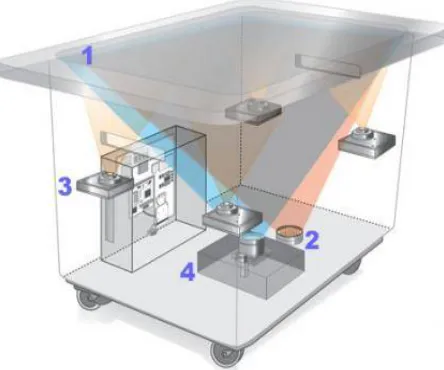
For design of any smart board or smart surface there is need to arrange various components in a proper manner to make multi touch screen. Components needed are:
1)Screen:A diffuser turns the Surface's acrylic tabletop into a large horizontal "multitouch" screen, capable of processing multiple inputs from multiple users for the display of output at any angle.
2)Infrared: LED light source, multiple infrared cameras with net resolution 1280x960 for transfer of data.
3)CPU:A Core 2 Duo processor, 2GB of RAM and a 256MB graphics card, Wi-Fi and Bluetooth, which acts as a brain of the system.
4)Projector:DLP-Digital Light Processing Engine Resolution1024x768 Pixels, to display the results to all the people present during experiment.
To make or design these Screen we need to arrange these components as per following layout
Fig. 1: Surface Computing Design Layout Technology:
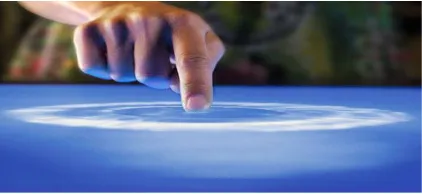
Fig. 2: Surface Computer
Microsoft surface is an example of successful surface which uses cameras to sense objects, hand gestures and touch. This user input is then processed and displayed using rear projection.
Microsoft surface uses a rear projection system which displays an image on to the underside of a thin diffuser. An image processing system processes the camera images to detect fingers, custom tags and any other objects such as paint brush etc. when touching the display.The object recognized with this system are reported to application running in the computer so that they can react to object shapes, 2D tags movements and touch.
IV.WORKING OF SURFACE COMPUTING
Surface computing is a platform that responds to natural hand gestures and real world objects. It has a 360-degree user interface, a 30-inch reflective surface with a DLP projector underneath the surface which projects an image, while five cameras in the machine's housing record reflections of infrared light from objects and fingertips on the surface.
The surface can be built with a variety of wireless transceivers, including Bluetooth, Wi-Fi and is designed to sync instantly with any device that touches it. Since there is no keyboard or no mouse, all interactions with the computer are done by touching the surface of the computer's screen with hands or brushes, or via wireless interaction with devices such as Smartphone, digital cameras or Microsoft's Zune music player.
Because of the cameras, the device can also recognize physical objects; for instance, credit cards or hotel "loyalty" cards. For instance, a user could set a digital camera down on the surface and wirelessly transfer pictures into folders on Surface's hard drive. Or setting a music player down would let a user drag songs from its home music collection directly into the player, using a finger It can transfer mapping information for the location of a restaurant where you just made reservations through a Surface over to a Smartphone.
The surface is capable of object recognition, object or finger tracking, multi-touch and is multi-user. Users can interact with the machine by touching or dragging their fingertips and objects such as paintbrushes across the screen, or by placing and moving placed objects. This way of interaction with computers is known as a natural user interface (NUI).
V.FEATURES OF SURFACE COMPUTING
2)Multi-touch contact: surface computing recognizes many points of contact simultaneously not just from one finger like a typical touch screen but more than one item at once.
3)Multi-user experience: the horizontal form factor makes it easy for several people to gather around surface computers together providing collaborative face to face computing experience. Each user can interact individually.
4)Object recognition:users can place physical objects on the surface to trigger different types of digital responses, including the transfer of digital content.
Advantages:
Quick and easy to use.
Large surface area to view different windows and applications
No wires or USB port is required that is wireless communication between two objects is possible.
More than one user – several people can orient themselves on different sides of the surface to interact with an application simultaneously (Max 52 points of touch).
Users have more control of technology.
Data Manipulation – selecting, moving, rotating and resizing (manipulating objects on the screen is similar to manipulating them in the manual world).
Time saving by eliminating more processes.
Disadvantages:
Currently designed only in some areas.
Loss of privacy – open for many to view so it is insecure system. Tailored to high end clients.
Objects need to be tagged similar to barcode.
Have to be very careful of table surface to not damage it. Fat fingers are not accurate as mouse.
VI.APPLICATION AREAS 1)Restaurant:
In restaurant Surface computing allows customers to see a virtual menu on screen. Items can be dragged into a central “ordering area” order right from the table beverages and food selections then split the bill and pay electronically at the same time by putting customer’s card on the surface.
2)Games:
Surface computing games have the potential to actively engage players in a way that could get them moving with the same level of skill and concentration as any outdoor sport, especially if the game is spread across multiple surface computers.
Several games are designed and created with regards to how well they fit the surface’s way of user interaction. All games created can be played by several players at the same time and they also all uses the interactions provided by the surface.
3)Shopping:
For online shopping using surface computing customers should place cell phones on the Surface; product features and prices plans appear automatically then features can be compared and Payment can be done by dropping a credit card on the Surface.
4)Navigation
The locations in the Map can be viewed easily by touching the location entire details about the specified country or information about the capitals etc. can be displayed. It provides the updated information regarding different places.
5)Agriculture:
With advancement in technology as India is being most agricultural land, number of technological advancements along with agricultural advancements in the form of new tools, techniques are integrated with technological uplifted applications such as automatic switch for water pumps, water level sensors, weather forecasting sensors etc.
With hi-tech agriculture usage of surface computing can play an important role. In case of hi-tech agriculture new concept of community agriculture, group agriculture, mutual exclusive agriculture has evolved. For e.g. there are some villages wherein they do water consumption audit every year & they check the water table level & as per this commutatively it is decided what type of crops to be produced and how much water consumption is needed for each crop and as per the requirement, the distribution of available water is done among the farmers. Even the automatic watering to various crops is done with help of sensors which ultimately saves lot of water and whole agriculture land becomes fertile land which avoids the situations of drought etc. which also increases per capita income.
As well as with the help of technology of developing countries even more advancements are prone to come and centralized water collection and distribution mechanisms will be implemented and unavoidable consumption and overflooding watering mechanisms will be avoided and balance of natural resources and ecosystems will be automatically maintained.
6)Automobile:
evolution in electronic signaling, sensoring, GPS and GPRS technology and with successful implementation of navigator’s high speed navigation systems are also integrated.
With advancement in surface computing the new vehicles with non-digital dashboards will be evolved and with surface computing technology any non-digital hard code dashboard can be converted to a dashboard of vehicle and automatic mechanism such as auto start, auto switch, automatic location detections, automatic positioning and other signaling facilities such as Bluetooth ,voice over commands will soon be incorporated and with integration of computing nearly all computing facilities can be incorporated which may help to keep the history of vehicles with routing information, congestion information and can keep updates of all usage and non-usage of services which further may lead to auto generation of messages, mails and alerts. This will definitely give rise to high end, high tech savvy and most advanced vehicle which will avoid more consumption of fuel, traffic and congestion.
7)Music:
Surface computer allows displaying the music arranged byalbum and allowing the user to flip over albums, select songs, and drag them to the "NowPlaying" section.
8)Photos:
Photos are arranged into albums and it looks like pile. If the usertaps the pile once spreads it aroundthe screen and from there user can drag, rotate, and resize the pictures. Since Surface can detect many touches at the same time, multiple people can sort and resize images simultaneously.
VII.OBSERVATION AND CONCLUSION
As per our study and observation of certain parameters, we have come on following conclusions: 1) India is growing and developing country and is exploring in each field specially technology.
2) To be a Global competent player India is adapting accepting, implementing and developing itself and is in the phase of having our own brand and is concentrating on branding.
3) Surface computing is the future of computing.
4) Surface computing takes existing technology and present it in new way.
5) Surface computing is not the same as touch screen but more of touch-grab-move-slide-resize-and-place-objects-on-top-of screen and it also opens up new possibilities in various fields.
6) Surface computing is taking its own pace and now days exploring in all fields such as Hotel industry, Restaurants, Automobiles, telephone, mechanical and so many.
7) As there is growth in hardware industry there will be many more changes and updating in the field of surface computing.
8) Any non-digital solid plane can be converted to smart surface by incorporating various components whichlead to portable, mobile and electronic zone.
REFERENCES
1)Panayiotis Zaphiris, AndriIoannou, Fernando Loizides, Christina Vasiliou,Ideas Mapping, Surface Computing and User Experience 2)Chandra Vivek Singh, Suresh Angadi, Latest Technologies in Surface Computing, International Journal of Science and Research (IJSR), 3)http://www.scribd.com/
4)https://en.wikipedia.org/wiki/Microsoft_Surface 5)https://www.slideshare.net/tejalc/surface-computer-ppt
6)Hemant Yadav, IIBhawna Madan, Surface Computing, International Journal of Advanced Research in Computer Science & TechnologyVol. 2, Issue 2
7)https://www.slideshare.net/krishnamutthoju/surface-computer-12889766
8)https://www.google.co.in/?gfe_rd=cr&ei=SGT_WNzKHOKK8Qeuy7PIBQ#q=surface+computing+ppt
BIOGRAPHY
from SavitribaiPhule Pune University, MS, India. He has cleared the NET Examination held by UGC in 2006.He has also received M.Phil. (Computer Science) degree in 2013 from AlagappaUniversity, Tamilnadu, India. His research interests are E-Commerce, Information Security and Information Technology etc.
Ms. Sujata P. Patil is an Assistant Professor in the Computer Science Department, Dr. D. Y. Patil Arts, Commerce and Science College Pimpri, SavitribaiPhule Pune University. She received M.C.S degree in 2004 from SavitribaiPhule Pune University, MS, India and M.Phil. (Computer Science) degree in 2010 from AlagappaUniversity, Tamilnadu, India. Her research interests are E-Commerce, Information Security etc.