University of Windsor University of Windsor
Scholarship at UWindsor
Scholarship at UWindsor
Electronic Theses and Dissertations Theses, Dissertations, and Major Papers
1-1-1981
The development of measures of ego regression in the study of
The development of measures of ego regression in the study of
creativity in university art students.
creativity in university art students.
Sharon Anne Verniero University of Windsor
Follow this and additional works at: https://scholar.uwindsor.ca/etd
Recommended Citation Recommended Citation
Verniero, Sharon Anne, "The development of measures of ego regression in the study of creativity in university art students." (1981). Electronic Theses and Dissertations. 6127.
https://scholar.uwindsor.ca/etd/6127
This online database contains the full-text of PhD dissertations and Masters’ theses of University of Windsor students from 1954 forward. These documents are made available for personal study and research purposes only, in accordance with the Canadian Copyright Act and the Creative Commons license—CC BY-NC-ND (Attribution, Non-Commercial, No Derivative Works). Under this license, works must always be attributed to the copyright holder (original author), cannot be used for any commercial purposes, and may not be altered. Any other use would require the permission of the copyright holder. Students may inquire about withdrawing their dissertation and/or thesis from this database. For additional inquiries, please contact the repository administrator via email
NOTE T O USERS
This reproduction is the best copy available.
THE DEVELOPMENT OF MEASURES OF EGO
REGRESSION IN THE STUDY OF CREATIVITY IN UNIVERSITY
ART STUDENTS
by
Sharon Anne Verniero
M.A. University of Notre Dame, 1973
A thesis
submitted to the Faculty of Graduate Studies through the Department of Psychology
in partial fulfillment
of the requirements for the degree of Doctor of Philosophy at The University of Windsor
UM I Number: D C 532 23
INFO RM ATIO N TO USERS
The quality of this reproduction is dependent upon the quality of the copy
submitted. Broken or indistinct print, colored or poor quality illustrations
and photographs, print bleed-through, substandard margins, and improper
alignment can adversely affect reproduction.
In the unlikely event that the author did not send a complete manuscript
and there are missing pages, these will be noted. Also, if unauthorized
copyright material had to be removed, a note will indicate the deletion.
UMI Microform D C 5 3 2 2 3 Copyright 2009 by ProQuest LLC
All rights reserved. This microform edition is protected against unauthorized copying under Title 17, United States Code.
ProQuest LLC
789 East Eisenhower Parkway P.O. Box 1346
VEPNIERO/ Sharon Anne
The development of measures of ego...
LEAF 71 MISSING. COULD THERE EE COPYRIGHT PROBLEMS CN LEAF 53?
(s> Sharon Anne Verniero All Rights Reserved
ABSTRACT
In order to study whether adaptive regression in the service of
the ego is characteristic of university art students judged by their
teachers to be more creative, and at the same time to develop improved
methods of measuring the capacity for adaptive ego regression, the
author gave 71 students in university art classes four tests that give
an opportunity for adaptive regression. The tests used were (a) the
Thought Disorder (TD), Anti-Social (AS), and Impulsivity (I) scales
of the Picture-Preference Test (PPT), (b) the Remote Associates Test
(RAT), (c) the Pictorial Puns Test (PUNS), and (d) the Whitaker Index
of Schizophrenic Thinking— forms A and B (Wist A, Wist B ) .
To control for variables which may prove misleading regarding
the relationship between adaptive ego regression and creativity (i.e.,
about the relationship between measures of ego regression and the
criterion ratings of creativity), the author also obtained information
about the students' age, sex, year in school, academic major, and
socio-economic status (Hollingshead's two-factor index). Each student
was rated by members of the Fine Arts Faculty at the University of
Waterloo who had taught him or her in at least one course prior to
this study. (Not all faculty members rated all students but each
student was rated by at least two faculty members.)
Of the four tests given only the RAT and the PUNS were predictive
of the criterion ratings at statistically significant levels. The
demographic variables were not significantly correlated with any of the
tests given, nor with the criterion measures in ways that would obscure
tests of the main hypothesis. The PUNS and RAT were significantly
correlated with each other and negatively correlated with both forms
of the WIST.
Although none of the three PPT scales used was predictive of the
criterion/ these scales were highly correlated with each other. The
mean score for the TD scale for this sample of university art
students was nearly twice as high as the mean for another
previously-tested group of university students, higher than the mean for a
previously-tested group of hospitalized non-thought-disordered
patients, and nearly equal to the mean of a previously-tested group
of hospitalized thought-disordered patients (Rudzinski, 1980).
These data, coupled with the art students' performance on the
PUNS, RAT and WIST,indicate that creative persons have an ability to
regress which they use when the contextual cues indicate it is
appropriate to do so and do not use when it is inappropriate to do so.
This finding suggests that regression is not overwhelming to them
but is used in service of the ego. It also suggests that creativity,
as judged by the art faculty and as measured by the RAT and PUNS,
involves a two-phase, discontinuous process, viz., a process making use
of the capacity for regression involving primary-process thought and
of the capacity for objective, critical analysis, involving
secondary-process thought.
FOR John
Ricky and Rebecca
ACKNOWLEDGEMENTS
This volume of work has taken a year to complete from the
inception of the idea to the final defense. During that year, much
of the actual work was completed while I was living a considerable
distance from the City of Windsor and the University's network of
support. This distance complicated and sometimes threatened the
completion of the dissertation. Several people unselfishly gave of
their time and energy to help me bridge the gap. I would like to
take this opportunity to sincerely thank those individuals.
I would like to thank Dr. Nancy Paterson and her staff at
the University of W a t e r l o o 's Fine Arts Department for sharing their
ideas and experiences and for their participation in this study.
They greatly deepened my understanding of creative work from the
artist's viewpoint.
I would like to thank my two committee members, Dr. Jerry Cohen
and Dr. Roland Engelhart,for their valuable assistance. Their
suggestions were always positive and constructive, and they greatly
added to my understanding of the research p r o c e s s . I would
especially like to thank my chairman, Dr. Frank Auld. He generously
gave of his time whenever I needed academic council, support or a
firm push. He shared with me not only his knowledge but also his
wisdom, and he did so with enthusiasm and a touch of humor. For
this year of learning and personal enrichment, I will remember him
wi th fondne s s .
I would also like to thank m y friends Peter and Anke Naus for
their inspiration to work with honor and with joy; and my friends
Susan Silk, Janet Fulgenzi and Trish Graham for being there when I
needed them.
To my family, I would like to say a special word of gratitude.
They understood when I needed time away from them to work and
sometimes to worry. They supported me with love and without
hesitation in my moments of despair and celebration. I want to
remember my children, Ricky and Rebecca for their smiles which
sustained me; and I want to thank my husband, John, for loving this
work because it was important to me and for his caring and remarkable
TABLE OF CONTENTS
Page
A B S T R A C T --- (iii)
D E D I C A T I O N --- (v)
ACKNOWLEDGEMENTS --- (vi)
LIST OF T A B L E S --- (x )
Chapter I THE NATURE OF CREATIVITY --- 1
Some Empirical Research Related to Creativity --- 12
Purpose of the S t u d y --- 16
H y p o t h e s e s --- 17
Strategy for Testing the Hypotheses --- 18
Tests Used in this S t u d y --- 18
The Puns Test (PUNS) --- 18
The Remote Associates Test (RAT) --- 18
The Picture Preference Test - Thought Disorder Scale (PPT-TD) --- 19
The Whitaker Index of Schizophrenic Thinking (WIST) --- 19
Reasons For Not Using Standard Projective Tests --- 20
Reformulated Hypotheses --- 20
II M E T H O D --- 21
S u b j e c t s --- 21
The Preliminary Study --- 21
The Main S t u d y --- 21
Tests And Criterion S c a l e --- 22
Picture-Preference Test --- 22
Remote Associates Test --- 24
PUNS T e s t --- 24
Whitaker Index of Schizophrenic Thinking --- 25
Creativity Rating Scale --- 26
TABLE OF CONTENTS (continued)
Chapter II (cont.) Page
P r o c e d u r e s --- 27
The preliminary study --- 27
The Main S t u d y --- 28
Demographics --- 28
T e s t i n g --- 30
Collating subjects' answer sheets and rating s h e e t s --- 31
III R E S U L T S --- 32
Development of PUNS T e s t --- 32
Reliability of the Criterion Ratings --- 32
Relationship of Covariates to Predictors and Criterion — 35 Examination of the H y p o t h e s e s --- 37
Hypothesis Concerning the PUNS T e s t --- 40
Hypothesis About the R A T --- 40
Hypothesis About the P P T --- 43
Hypothesis About the W I S T --- 44
Multiple-Regression Analysis --- 44
IV D I S C U S S I O N --- 46
Relations of the Test Measures to the C R S --- 46
Support for the Two Factor Theory of C r e a t i v i t y --- 49
S u m m a r y --- 51
a p p e n d i c e s Appendix I - Demographic Questionnaire --- 52
Appendix II - Scoring Criteria for Hollingshead Two-Factor Index for Social P o s i t i o n --- 53
Appendix III - creativity Rating Scale --- 54
Appendix IV - Titles of Picture Cards Used in PUNS Test ---- 58
Appendix V - Listing of Picture Preference Items and Scoring Key for S c a l e s --- 59
B I B L I O G R A P H Y --- 68
VITA A U C T O R I S --- 75
LIST OF TABLES
Table No. Title Page
1 Description of Sample of Fine Arts S t u d e n t s --- 29
2 Item Statistics for PUNS T e s t --- 33
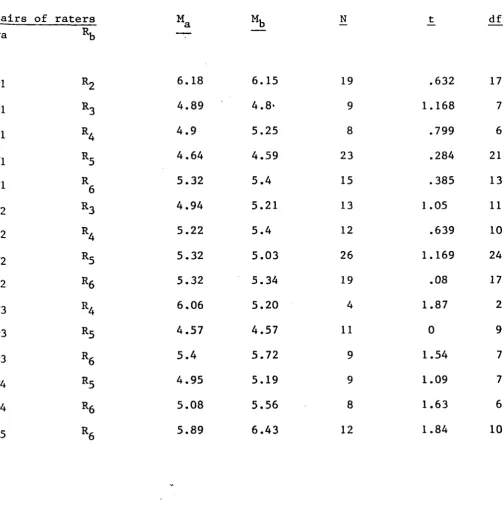
3 Table of T-values for Difference Between Mean Scores
for Pairs of Rater Rating Same S u b j e c t s --- 34
4 Statistics for Criterion Ratings --- 36
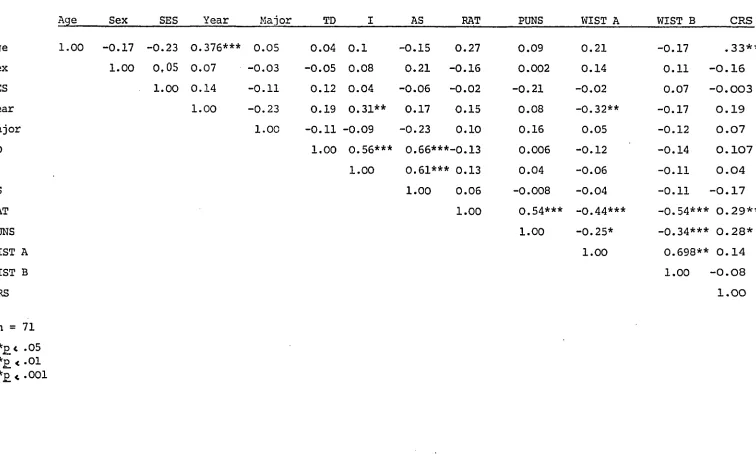
5 Intercorrelation of all Variables --- 38
6 Summary Stati s t i c s : Tredictor Variables and
C r i t e r i o n --- 39
7 Comparison of Means of Samples: on TD Scale,
on W I S T --- 41
8 Correlation of Individual Questions of CRS with
PUNS and R A T --- 42
CHAPTER I
THE NATURE OF CREATIVITY
The question of creativity has been debated for centuries. The
ability to fashion into existence something which is new and
different fascinates us all. Yet for all the attention this ability
might have received over time, pinpointing the source of creativity
and its psychological dimensions has been elusive. Creativity has
been studied from the point of view of creative products, cognitive
traits, personality traits, creative process; by the approach of
experimental psychology and of psychodynamic psychology. Each of
these positions has added another dimension to the kaleidoscope,
shedding more light on this aspect of man. It seems that no one
theory explains this process adequately; creativity is multi
faceted, deriving its strength from many sources (both internal and
external). It is a process that involves both simultaneous and
sequential phases.
I will not discuss the creative-products aspect of creativity;
for this the reader should consult Taylor (1959); Taylor, Smith,
Ghiselin & Ellison (1961); Chambers (1964); Hoyt (1965); and Taylor
and Ellis (1967). I will briefly discuss creativity from the point
of view of the "creative person," i.e., in terms of cognitive theory
and of personality-trait theory. I will concentrate in this text on
the psychological process involved in creativity.
Personal experiences of highly creative individuals shed some
light on specific aspects of the creative process. Albert Einstein
suggested, "the psychical entities which seem to serve as elements in
thought are certain signs and more or less clear images which can be
combined. . . . This combinatory play seems to be an essential feature
in productive thought." (quoted by Mednick, 1962) Poincare (1913)
described the discovery of his Fuchsian group theory in mathematics
in this way, "Ideas rose in crowds; I felt them collide until pairs
interlocked, so to speak, making a stable combination."
The following perspective is attributed to the poet Samuel
Coleridge: "Facts which sank at intervals out of conscious recollect
ions drew together beneath the surface through the almost chemical
affinities of common elements." (in Mednick, 1962) Andre Breton,
a psychiatrist turned poet, described an artwork of Ernst in a way
illuminating his own experience with creative endeavors: "[the work
has a] marvelous capacity to grasp two mutually distant realities
without going beyond the field of our own experience and draw a spark
from the juxtaposition." (also in Mednick, 1962)
These four examples of personal insight from creative individuals
suggest that creativity involves (1) an ability to bring together
elements not usually thought of as similar, (2) unconscious activity,
in that the disparate elements are. often derived from unconscious content
(3) combinations that are startling and original, but— for truly lasting
creative contributions— never bizarre. I will discuss (2) and (3)
a. bit later on in the text and will consider (1) at this point.
We are all fascinated by the sudden flash of thought in creative
endeavors— the "eureka" in our own experiences and in those of creative
giants. Thus, much of the initial literature about creativity concerns
suggested vitalistic notions in connection with the sources of
creativity. They thought the creative moment is the result of some
divine inspiration in which the creative person was little more than
a. passive recipient of "the magic flash." Theorists such as Galton
(1870) and Kretschmer (1931) suggested a genetic explanation of
creativity. This explanation conceived creativity as less mysterious
than vitalism did, but still regarded the creative person as passive
in the creative process and as merely gifted. The hereditary theories
also shed no light on what occurs during the creative process, itself,
i.e., what occurs between the remembrance of the old thought and the
budding of new modes of thought.
Helmholtz (1896) changed the direction of thinking about
creativity, suggesting that innovation had to originate to some
extent from pre-existing ideas. Theorists then took a descriptive
approach to studying creativity. They tried to analyze what led to
the birth of new ideas, suggesting a stepwise process involving the
association of ideas or "combinatory play" as Einstein describes it.
Most familiar of these theorists is Joseph Wallas (1925) who
conceptualized creativity as a four-stage process: (1) preparation—
a gathering of related information about the problem to be solved;
incubation— a period of time in which no externally measurable
work seems to be carried out, but a time in which the individual is
processing internally; (3) illumination— the time when an illumination
seems to suddenly appear; and (4) verification— a time when the
creative individual critically evaluates his/her work.
Joseph Rossmann (1931) and A. F. Osborn (1953) elaborated on
ideas— and important for this study— is the notion that creativity may
involve a measurable, understandable sequence; and that some parts of
the sequence involve unconscious content or unconscious processing.
The two-factor theories of creativity, which hypothesize some type of
shifting from one process to another, proposed by Hitt (1965),
Mednick (1962), McMullan (1977), Arieti (1968, 1975) and others 30
and 40 years after Wallas, have their roots in his ideas. Edgar
Vinacke (1952) added to this hypothesis about creativity, the proposal
that while phases in the creative process can be delineated and
defined, they were not necessarily in a linear sequence. He suggested
that there may be several loops and repetitions in the sequence.
That is, an author, musician, artist, or scientist may go back and
refine an initial creation— critically shaping insights over time.
Wertheimer (1945) saw the creative process as a stepwise movement
from a less stable, problematic situation to a more stable situation
which suggests a solution. He proposed that an old gestalt is
dissolved by dividing it into parts and studying their interrelationship
and that a new gestalt is formed by recombining the elements in
different ways. Koestler (1964) proposed a "bisociation" theory of
creativity, defining creativity as "any mental occurrence simult
aneously associated with two habitually incompatible contexts." Thus
Wertheimer and Koestler added to the body of theory about creativity
an understanding of the importance of an analysis and reworking of
the relationship between elements commonly associated, and of the
subsequent reassociation of elements formerly seen as different, in a
new relationship. So incubation and illumination need not just be
5
process that can be experimentally studied.
The theories mentioned thus far contributed to the general know
ledge about creativity and what the creative process involves. However,
the previous discussion leaves a gap in not accounting for how it is
that certain individuals can perceive new relationships between elements
while others can not. The creative insight is still an unexplained
"eureka" phenomenon, until we take psychodynamic theory into account.
Freud's concepts relating to unconscious processes are essential to
a fuller understanding of the creative process.
Originally Freud believed that creativity was the result of the
sublimation of fundamental conflicts which originate in biological
drives. He proposed (1938) that in creative persons the energy tied
up with unacceptable impulses was diverted, under pressure from the
ego and the superego, into more neutralized, more acceptable and
productive work. The neurotic individual, on the other hand, repressed
these impulses or expressed them in disguised form through neurotic
symptoms. While neurosis and creativity may not be as closely linked
as Freud proposed or linked in the way Freud proposed, it is fair to
say that Freud recognized that the essence of the creative individual
was not his neurotic motives, but in the work which he/she produced
which followed from the conflicts. Most people have unresolved
conflicts in their personality structure, but only a few people can
push beyond their own frailties to produce a new synthesis of lasting
value.
Frailberg (1961) suggests that contrary to the popularly held
even psychotic symptoms as a result of their "creative gift,"
creative individuals have strong and resilient and not weak egos. The
ego is called upon to adapt to frequent psychic shifts: from
unconscious processing to highly complex cognitive processing; from
internal, fantasy content material to conscious material; from
subjective, vague, and emotional modes of expression to objective,
specific and multi-channeled modes of expression that have meaning
beyond the personal scope of the creator. Frailberg proposed that
"the composition of the psychic apparatus especially suited to
facilitating creative artists is extraordinarily flexible and capable
of absorbing a broad range of stimulation for use in varied
combinations." (1961, p. 47) The ego must take raw material from past
experiences in combination with a current stimulus situation and shape
it into a useful and pleasing form. Kubie (1961) takes the same
position.
Arieti (1976) suggests that "Freud was almost exclusively
concerned with the importance and relevance of motivation in creativity
and not with the essence of creativity itself." While this may be
true, it is also true that Freud in Jokes and Their Relation to the
Unconscious (1905) shows his awareness that the unconscious provides
n°t just conflicts to be dealt with but a wealth of ideas and insights
useful in the creative process. Thus even though Freud's
drive-reduction model is not a completely valid explanation of human
function-ln9, his genius lies in the fact that he recognized the wealth of
material potentially available in the unconscious and the ability of
bhe creative individual allow for ego regression so that this
Kris (1953) and Kubie (1961) suggested that the preconscious
rather than the unconscious was involved in creative thought. Thus
they removed the stigma of a connection between creativity and id
impulses and neurotic conflicts. Implied in this revision of Freudian
concepts were two important corollaries: (1) that the rigidity of
both rational symbolic thought and internal projections are dissolved
ln order for fresh images and relationships among images to emerge;
(2) that the process involved in the loosing of rigid boundaries was
temporary, adaptive and controlled, i.e., "regression in service of
the ego," as opposed to uncontrolled psychotic regression. Kris
explains (1953, p. 60), "Inspiration— the 'divine release from the
ordinary ways of man,' a state of 'creative madness' (Plato), in which
the ego controls the primary process and puts it into service— need
be contrasted with the opposite, the psychotic condition, in which the
ego is overwhelmed by primary process."
I believe that many writers in the area of creativity have
misunderstood Kris's and Kubie's use of the term "regression." They
characterized it as (Dayton, 1976) "immature, childish regression"
ln bbe face of anxiety and suggest that it is in opposition to an
II
openness to encounter" (Schactel, 1959) and receptive awareness of
bhe environment more characteristic of creative thought. I believe
these authors do Kris and Kubie a grave injustice as Arieti (1976,
P* 24) notes,
manifestation of regression but as an emerging
accessibility or availability, which is connected with
regression only occasionally. However, this
difference between my view and that of Kris may be secondary and semantic in nature, based on a
difference in our use of the word, regression.
Schafer (1958) suggested that .this regression Kris referred to
is a temporary and controlled lowering of cognitive and selective
functioning. When this occurs, boundaries of figure, ground, time,
space and relationships are momentarily obliterated to allow new
information from the preconscious to be drawn into focus. Beliak
(1958, 1973) and Giovacchini (1960) further suggest that while certain
ego functions regress to allow for the emergence of new relationships
among elements, other ego functions remain intact and in fact may rise
to new heights. "A topological regression of the adaptive, cognitive
processes takes place which involves simultaneously a temporal
regression to primary process levels; the synthetic function does not
regress at all but remains, or rises in fact to optimal levels."
(Beliak, 1958, p. 368)
Jung added another dimension to the consideration of creativity.
He did not account for the emergence of new ideas or combinatory
process of creativity, but he did suggest that the creative individual
in the arts is not simply bound by his own experiential history. The
creative gift involves the ability to start with a common human
stimulus event and code it or organize it in such a way that the
resulting creative product transcends the moment and touches an aspect
of universal human significance. In Jungian terms, the creative
person taps the "collective unconscious" by employing "archetypes" in
significance.
Thus far I have concentrated on the "illuminatory" aspect of the
creative process, suggesting that it involves the combination of
elements in such a way as to bring about a new synthesis; and that the
ability to recombine ideas in a new way is the result of a capacity
to "let go," to "regress" or loosen the usual category boundaries to
allow for new modes of thought to emerge. Equally important to the
creative process is the ability to critically analyze the worth of
the new synthesis. As I suggested earlier, creativity does not equal
originality. What is creative, is not just the unusual, and certainly
not the bizarre.
Hasefus and Magaro (1976) directly addressed the question of
psychosis and creativity as being two aspects of the same process.
After reviewing the empirical literature on direct comparisons of
creative and psychotic people, they conclude that schizophrenics and
creative people have several qualities in common:
1. a preference for complex, assymetrical and ambiguous stimuli;
2. a tendency to overinclude (multiple response production);
3. a tendency for unusual and novel associations.
However, the two groups differ on the important dimensions of critical
judgment and ability to synthesize the unusual associations or
ambiguous stimuli into coordinated wholes. Creativity, then, requires
the ability to fit the new synthesis into a useful and productive
structure.
Creativity seems to be, as Hitt (1965) suggests, a two-factor
Arieti (1976), and many others give support to the conception of
creativity as involving two phases— originality and reality-testing.
Kris presents this concept very clearly (1953, p. 59):
Schematically speaking we may view the process of artistic creation as composed of two phases which may be sharply demarcated from each other, may merge into each other, may follow each other in slow or rapid succession, or may be interwoven with each
other in various ways. In designating them as
inspiration and elaboration, we may refer to extreme conditions: one type is characterized by the feeling of being driven . . . in the other type, the
experience of purposeful organization. . . . The
first has features in common with regression processes. Impulses and drives, otherwise hidden, emerge. The subjective experience is that of flow of thought and images driving toward expression. The second has many features in common with what characterizes
"work"— dedication and concentration.
Implicit in Kris's statement about the two phases of creativity
and their relationship to each other, is the capacity of the creative
individual to shift sets to move from a primitive, image, sensation
free-flow level of thought to a more logic-bound, rigorous, and
critical mode. Kris comments, "we may now supplement the distinction
of inspiration and elaboration as extreme phases of a creative activity
in stressing that they are characterized by shifts in psychic levels,
in the degree of ego control and by shifts in the catharsis of the
self." (Kris, 1953, p. 61) This capacity to shift sets successfully
so that the ego is not overwhelmed but continues to be productive,
necessarily implies that the creative individual has a strong and
flexible ego structure as suggested by Barron (1963, 1972).
McMullan (1976) provides a conceptual framework for under
standing psychic shifts. He writes of the creative individual as
11
soul but as a complex individual who has been described in the
literature in what seems to be "paradoxical combinations of concepts."
McMullan describes the paradox as the complementary intertwining of
a set of flexible characteristics and a set of persistent character
istics. "Each creative set is constituted from one half of the
creative gestalt. As such, a single, paradoxically perplexing gestalt
is transformed into straightforward mental sets, the flexibility set
and the persistence set. The creative problem-solver is seen oscillating
between the two creative sets sequentially, emphasizing first one polar
set, then the other in his progression toward a creative solution."
(McMullan, 1976, p. 274)
The "flexibility set" seems to correspond to the ability to
regress as noted by Kris; and the "persistence set" seems to correspond
to Kris' idea that regression occurs in service of--under the guidance
and direction of— the reality-centered ego.
Golann (1963) suggests a motive for the cultivation of creative
modes of thinking as a preference for experiences which ". . . maximize
. . . changes of self expression and . . . allow for personal ways
of dealing with them." He suggests that there is a
"symbolic-affective" component to stimuli and experience in the environment
to which the creative individual is responding in innovative and
productive ways. It is the symbolic-affective pull of the stimulus
plus the preference for self-expression of this pull that motivates
the creative person. It might be further suggested, then, that
because an individual has developed strong yet resilient ego boundaries
he/she can allow a stimulus to have a symbolic-affective pull. Such
an individual can allow for an ego regression which lets the pull
into a constructive production.
The data provided by the research of Stein and Meer (1954) and
of Barron (1972) support the hypothesis that ego regression is an
important aspect of creativity. Stein and Meer (1954, p. 42)
write " . . . the real difference between our high- and low-creative
individual may turn out to be a function of defensiveness or over
criticalness which inhibits the generative and communication of
hypotheses. . . . Those persons rated creative . . . show a greater
freedom in the offering of perpetual hypotheses and in the level of
organization of their responses than do their colleagues who are
rated 'less creative.'"
Some Empirical Research
Related to Creativity
Guilford's work (1957, 1959) was probably the earliest, systematic
inquiry into the creative thinking process, and ways of measuring
this process objectively. He developed a series of tests which were
related to criterion measures of creativity. From these measures, he
analyzed a series of cognitive factors which could account for creative
thinking. He focused on two broad processing factors he called
(1) divergent thinking, i.e., a searching for possible relations among
disparate elements and (2) convergent thinking, i.e., thinking
directed toward a single specific solution. These broad factors seem
to correspond to the two ph'ases of creative thought theorists mentioned
earlier in this text have hypothesized.
Guilford was particularly interested in divergent thinking
analyzing his objective tests. Four of these components were related
to the flow of thought, which Guilford called fluency factors, three
of these components were related to flexibility of thought and one with
novelty of thought. Barron (1955, 1957, 1963), Thorndike (1963)
and Wallach and Kogan (1965) reanalyzed Guilford's data searching for
a component of thinking that was statistically different from an
intelligence or problem-solving factor and which would account for
the very distinguishable aspects of creative thought. Their studies
suggest that the one cognitive dimension that shares substantially
less variance with other components of divergent thinking and with
convergent thinking is ideational fluency. Ideational fluency seems to
involve a high productivity of output, and is related to a large
number of responses put forth, a number of novel responses.
Having isolated this psychological dimension of creative thought,
we are still left with a descriptive label and not much understanding
of the psychological process to account for the ability to be highly
productive in terms of ideas. In addition we are left with few methods
of measuring ideational fluency. Wallach's (1970) extensive review
of the literature suggests that neither Guilford's, Torrence's, nor
Getzels and Jackson's creativity test batteries measure this ability
very specifically. But in fact ". . . w e have not found any evidence
of greater coherence among the tasks in question than the degree to
which they correlate with measures of intelligence." (p. 1239)
Keillor's research (1967) is supportive of Wallach's position, as he
failed to find a significant positive correlation between art students'
scores on four of Guilford's tests and creativity ratings given
14
Wallach carries on to define in objective cognitive terms related
to creativity, Kris' concept of regression in service of the ego.
He writes (1970, p. 1240):
The type of cognitive talent in question seems to concern a person's ability to produce a large number of ideas in response to a given task constraint, where the ideational content that is generated
is reasonably appropriate to the task at hand and, at least partly by virtue of its quantity, includes a goodly amount that is unique or unusually . . . We are referring . . . to fluency in generating cognitive units whatever their category membership.
. . . Whatever may be at the root of fluency and uniqueness therefore is one's disposition to produce ideational possibilities under circumstances where evaluational activities are at a minimum. One is referring here to a person's disposition to 'ride associative currents,' as it were.
How might one measure the ability to "ride associative currents?"
Maltzman et al. (1958, 1960, 1964) have researched this aspect and
suggest that it refers to the ability to use more remote associations
to a given stimulus. They refer to a "flattened" gradient of
response inclusion— or broad category inclusion— and "steep" gradients
of responses— or strict category inclusion. They are indicating that
a highly creative individual is one whose thought processes or cognitive
strategies involve broadly formulated categories or categories with
loosely woven boundaries which can be stretched for the greater
inclusion of elements as the situation suggests. What Kris pointed
to as adaptive regression is the intrapsychic process which underlies
and allows for the cognitive process Maltzman outlined.
Mednick (1962) adopted Maltzman's category inclusion approach
in developing his measure of creative thinking,— the Remote Associates
Test. The RAT is made up of a list of groups of three seemingly
the other three words. Mednick assumed that the RAT would distinguish
between the creative and non-creative thinker because it draws on
the ability to generate many responses and the ability to organize
these in broad categories in order to "see" the linking relationship.
It seems, then, that the RAT would provide a useful tool for
researching the cognitive aspect of adaptive regression. The
question remains how one measures directly emotional aspects of
adaptive regression?
Pine and Holt (1960) attempted to measure the involvement of ego
regression in creative endeavors. Specifically, they were interested
in exploring the effect of the (1) tendency to express primary
process material; (2) tendency toward the control of the primary
process material, and (3) tendency toward adaptive vs. maladaptive
regression on the quality of creative productions. Using Rorschach
productions for samples of primary process material, these
productions were scored for creativity (Holt, 1959), amount of primary
process (Holt, 1956; Holt & Havel, 1960); control of primary process
(Holt & Havel, 1960) and type of regression (Goldberger, 1968;
Holt & Havel, 1960). Using the TAT, The Science Test, The Humor Test,
The Animal Drawing Test, The Brick Uses Test, and the Consequences
Test for measuring quality of creative productions, Holt & Havel
(1960) found that (p. 378) "quality scores on tests of imagination
[were] unrelated to the amount of primary process expression and
positively related to the effectiveness with which such expression is
controlled." This study suffers from some problems of construct
validity of the Rorschach measure of Creativity. There is also a
question whether the factor-analytically derived tests of creativity
Keillor (1967)).
Wild's study (1965) also provides evidence for the role of ego
regression in creativity. She used the Word Association Test and
Object Sorting Tests under regulated and unregulated conditions to
measure ability to shift from more to less regulated modes of thought
(a corollary of the adaptive regression in service of the ego model); s h e
used faculty members' ratings of art students as a crterion measure
of creativity. She found a tendency for art students to be more
original and to shift their thinking in a more unregulated direction
than eiter a group of normals or schizophrenics. There was also a
suggestion (p. 168) "that within the art student sample shifting is
positively related to creativity."
Purpose of the Study
The aim of this study is to research an aspect of the psycho
logical root of the creative process. It seems that writers from a
variety of theoretical backgrounds, as well as acknowledged creative
individuals themselves, have suggested that a component of creative
thought is an openness to stimulation from the environment and an
openness to the processing of this stimulation in new combinations.
It is important for research to provide data which will either support
or disconfirm this position, and if this position is supportable,
to delineate specifically the psychological components of the openness
and the processing.
Accepting as a working assumption Kris' hypothesis that regression
in service of the ego is central to the creative process, I will
creative individuals. I propose that persons who can allow themselves
a greater degree of ego regression will be able to produce works
that are judged by experts to be more creative.
Hypotheses
In short, it is proposed that creative persons are able to allow
themselves a temporary and reversible ego-regression. As Lesser
(1957, p. 161) points out, "In all artistic achievement there is an
intricate interplay between two elements— free, spontaneous creativity
ind cool, critical reflection." Thus the creative person is able to
use the regression in a controlled way.
These considerations lead me to the following hypotheses:
I. In a task in which it is clear that ego-regression is
necessary, but in which the product of the regression needs to be
evaluated critically, art students who are judged to be more creative
should do better than those who are less creative, because the
requirements of the task parallel the requirements of the criterion
situation.
II. In a task in which ego-regression is acceptable but not
required, art students who are creative will be able to allow
themselves regression.
III. In a task in which ego-regression is possible, but the task
requirements discouraged it, art students who are creative will be
1 8
Strategy for Testing the Hypotheses
Having arrived at the predictions stated in the three hypotheses,
I was faced with the task of selecting, or inventing, tasks that
would match the descriptions in the hypotheses. For the task in
Hypothesis I, I devised a test which requires the subjects, in each
item of the test, to invent a pun that is appropriate to a picture.
I also adopted Mednick's Remote Associates test as another task
requiring this combination of activities. For the task in Hypothesis
II/ I chose Rudzinski's thought-disorder scale of the
Picture-Preference Test (see Rudzinski, 1975). For the task of Hypothesis III,
I chose Whitaker's Index of Schizophrenic Thinking (WIST for short),
developed by L. Whitaker in his 1963 doctoral dissertation and since
revised and improved (Whitaker, 1980).
Testa Used in this Study
The Puns Test (PUNS) . The PUNS test, developed as a way of
measuring adaptive regression, requires the subject to extend his/her
category boundaries by finding a solution to each item. The item is
a picture to which the subject must discover the verbal pun that has
been represented visually.
The Remote Associates Test (RAT) was developed by Sarnoff
Mednick (1961, 1962) and Martha Mednick (1961, 1963) using the
associative process as a means of measuring creative thinking in terms
°f finding a word solution to a given problem. As with the PUNS, the
HAT requires the subject to broaden his/her ordinary category boundaries
words for which the subject must find an associated linking word.
The Picture Preference Test - Thought Disorder Scale (PPT-TD).
Cowan (1967) developed the PPT as a pictorial, non
psychiatrically-oriented counterpart to the MMPI. Rudzinksi (1979) developed a
scale for this test, the thought-disorder (TD) scale, which is
intended to measure the difference in concept choices between a
schizophrenic and a non-schizophrenic sample (see Rudzinski and Auld,
1980). In this study the TD scale will be used as a measure of
ego-regression in that the directions for the administration of the PPT are
sufficiently vague to allow an individual the permission to choose
whichever picture (of two) he/she prefers or finds of interest— even
though one picture might ordinarily be considered the more
"thought-disordered" choice.
The Whitaker Index of Schizophrenic Thinking (WIST). The WIST is,
like the PPT, a measure of thought disorder. However, unlike the PPT,
the directions of the WIST specifically ask the individual to choose
the most appropriate answer for each item. Therefore, the WIST can
be used as a measure of the individual's ability to refrain from
regression when it is inappropriate to allow oneself to regress, i.e.,
when situational cues strongly suggest traditional appropriate
responses. The WIST items are presented as one word, pairs of words
°r sentences for which the subject must choose the most appropriate
Reasons For Not Using Standard Projective Tests
Other studies attempted to show a link between adaptive regression
and creativity, but often the dependent measures were projective tests.
Although these studies have provided valuable information and insights
into the creative process, they have the disadvantage that they use
subjective scoring criteria. In this study I hope to provide a more
objective measure of adaptive ego regression as well as to investigate
whether adaptive regression is a component in the process of creative
thought.
Reformulated Hypotheses
The hypotheses stated in general terms above may now be given
a more specific form in terms of measures that I have selected,
la. There will be a positive correlation between scores on PUNS
and the criterion ratings of creativity of Fine Arts students.
Ib. There will be a positive correlation between scores on the RAT
and criterion ratings of the creativity of Fine Arts students.
H a . Fine Arts students will score higher than other university
students on the PPT thought-disorder scale.
H b . There will be a positive correlation between scores on the PPT
thought-disorder scale and criterion ratings of creativity of Fine
Arts students. (This prediction relies on the assumption that the
capacity for regression is a necessary component of creativity.)
III. Fine Arts students will not score differently from other
CHAPTER II
METHOD
Subjects
The Preliminary Study
Sixty-two undergraduate students from the University of Waterloo
were used in the preliminary study to test the feasibility of the
PUNS test as a research tool. These students were volunteer subjects
enrolled in the 1st, 2nd, 3rd and 4th year of study. They were
non-fine arts majors and were not presently enrolled in any non-fine arts
courses at the University.
The Main Study
The 71 subjects in this study were students enrolled at the
University of Waterloo at the 1st, 2nd and 4th year level. The students
who volunteered to be part of this study were all fine arts majors or
potential majors enrolled in fine arts studies classes at the University
of Waterloo. Ninety-five students out of 123 in the classes
volunteered. Out of the 95 original volunteers, I was able to contact
and work with 71 students. Consequently, the sample is not represent
ative of art students in general.
The mean age for the subjects was 22.8 years. The mean for year
in school was 2.45. The subjects were not given an I.Q. test. I
assumed an above-average I.Q. by virtue of the fact that they had
already been selected as university students. The literature suggests
that for people with I.Q.'s above 120, I.Q. has no significant impact
Tests And Criterion Scale
Picture-Preference Test
Cowan (1967) devised a picture-preference test to measure the
trait of addictiveness in personality. It is in a sense a pictorial
version of the MMPI. Pictures were used to avoid some of the pitfalls
in the MMPI, such as the need for a certain level of reading skill,
nuances and connotations of language, social desirability influences
and a lack of vagueness in the test items which would allow for
greater personal projection. The test consisted of 106 pairs of
pictures and the subjects were asked to choose which picture (A or B)
of each pair he or she preferred. Cowan's test is composed of ten
trait scales which he believed more descriptive of the addictive
personality. Cowan predicted that addictive people would score
higher than normals on each trait scale. In his study, alcoholics
and other addicted persons had significantly higher scores than
normal but did not get significantly higher scores than neurotics.
Begin (1970) and Morrison (1973) revised Cowan's original test
by dropping items which when analyzed for homogeneity correlated
poorly with their scales and by adding items which they found to be
better correlated with the total score for the scale. Morrison's
revised version of the PPT consisted of 144 items grouped into seven
trait-scales. A trait-scale measuring impulsiveness (I) and anti
social impulses (AS) were included in Morrison's revised test. I
included these scales because it has been suggested by some (Drevdahl
and Cattel, 1958; Lindner, 1953; Barron, 1972) that creative people
tend to be somewhat anti-social and impulsive. I used 17 of Morrison's
Only part of the AS and I scales were used because the 210 item PPT
had to be shortened to 140 items because the total length of the
testing needed to be no longer than two hours. The 17 items of the
I scale and 16 items of the AS scale were among the items in the
first 140 items of the PPT.
Donald Rudzinski (1980) developed a thought-disorder scale for
the PPT. His scale consisted of 31 items. Each picture-pair had one
picture which represented regressive, illogical, or dissociative
thinking, while the other picture of the pair represented more
logical, better integrated thinking. As with the other PPT items on
various scales, the TD scale requires the subject to choose which
picture of the pair he/she prefers. A typical item in the scale
depicts Picture A, a girl watching a TV screen from which an arm is
extended, and Picture B, the same picture without an arm extended out
of the TV. The prediction, of course, is that people exhibiting
thought disorder symptoms will more typically choose Picture A.
Rudzinski's standardization sample included 70 acutely disturbed,
hospitalized individuals and 151 non-patient adults. An analysis
of the internal consistency of the TD scale yielded a K-R20 for the
patient group of 0.72 and for the non-patient group of 0.75.
Rudzinski found that the TD scale could significantly distinguish
the non-patient group from the patient group, and distinguish the
thought-disordered patients from non-thought-disordered patients. He
was also able to show that patients' TD scores correlated with those
parts of Overall and Gorham's (1962) Brief Psychiatric Rating Scale
that measures thought disorder. I used all 31 items of Rudzinski's
24
within 140 items of the PPT; thus 76 filler items were used. The 140
items, the scale they represent, and the scoring key, are found in
Appendix V.
Remote Associates Test
Mednick (1961, 1962) developed a measure of the creative thinking
process using the associative approach, calling this measure the
Remote Associates Test (RAT). The RAT is composed of 30 word-triads.
For each of these the subject is asked to find a word which would be
a mediating link between them. For example, a word-triad would be
presented to the subject:
rat blue cottage
and the subject would be asked to supply the mediational linking word,
which in this example would be the word "cheese." Mednick (1962)
reports that the RAT is positively related to a creativity
rating-scale developed by D. W. Taylor (r_ = .55, £ <. .005) used to rate
psychology students on research creativity; it is also positively
correlated with faculty ratings of the creativity in design of archi
tecture students Cr = .70, £ <.01). Mednick (1962) also reported a
Spearman-Brown reliability for the RAT of .92 in a sample of 289 women
and .91 in a sample of 215 men.
PUNS Test
The PUNS test is a test I devised from two books edited by B.
McMillan. These books, entitled Punography I and Punography I I ,
contain on each page a series of four pictures. Each series of pictures
when provided with the appropriate title forms a visual/verbal humorous
pun, with a play on both words and pictures to support the humor and
genre of the pun. This test is difficult to describe in words alone
25
titles used in the PUNS test will be found in Appendix IV.
Whitaker Index of Schizophrenic Thinking
Whitaker first developed this test as part of an unpublished
doctoral dissertation at Wayne State University. The test was published
in final form in 1973 by Western Psychological Services. The WIST has
two forms, A and B, distinguished by the degree of affect aroused by
connotations of the target words of the test-items. Form A contains
stimulus words such as k i l l , stink, cruel, and rape, which evoke strong,
emotionally significant connotations. Form B, on the other hand,
contains stimulus-words which are more vague and less emotionally
provocative, such as talk, m e l t , w i d e , and small. Each form contains
items divided into three parts. The first part contains stimulus
words, the second, pairs of words, the third, sentences. The directions
for each part suggest that the test-taker find the most appropriate
answer, i.e., the most similar in meaning from five choices provided.
The five choices consisted of a logical response, a related but
not-most-appropriate response, a personalized response, a clang association,
and a nonsense-word response. The most logical response was given
a score of zero, and the others a 1, 2,3jOr 4 score. In the present
study a subject's WIST score is the sum of the points given for the
25 items of each form. The higher scores are in the direction of
greater thought disorder.
Whitaker's normative sample consisted of 18 subjects for Form A
and 17 for Form B in his normal college sample; 22 chronic schizoph
renic subjects and 25 acute schizophrenic subjects. He reported
that the WIST significantly distinguished between the normal college
26
Creativity Rating Scale
After consulting the literature on the creative process and
reviewing rating scales by Taylor (1957) and others, and after inter
viewing the fine arts faculty at the University of Waterloo, I
devised a 7-item Creativity Rating Scale- The C R S , it was hoped,
would serve as an external criterion for validating the other,
purported measures of creativity. The rating scale included items
pertaining to various aspects of the creative process. These
aspects are: (1) technical, artistic skill, i.e., craftsmanship;
(2) the ability to understand the core of the artistic problem as
such a problem is presented to the art class; (3) the ability to
express ideas in visual form through an art medium; (4) the ability
to become personally involved in the artistic project; (5) the ability
to express ideas in novel ways, to be risky in experimenting with
art medians; (6) the ability to integrate ideas and techniques to
produce a synthetic whole in the artistic productions; (7)
perseverence. Each of these items was presented on a 7-point visual
scale on which the raters (six fine arts faculty members) were asked
to rate the students. For each of the 7 points of the scale, there
was given a short, descriptive phrase to help the rater anchor his/her
judgment. Four of the seven items were actually used in the criterion
analysis, because they pertained most particularly to what I had come
to determine was germane to the creative process. They were questions
3, 4, 5, 6 of the rating'scale (see Appendix III). The remaining
items (1, 2, 7) of the rating scale were included so that they would be
27
creativity score, i . e . , I wanted technical skill to be excluded. The
lowest score for each question in the CRS was 1 and the highest score
for each question was 7; the lowest possible score on the CRS for
each subject was 4 and the highest was 28. A subject's score on the
CRS as given by one rater was taken as the sum of the ratings for
Questions 3, 4, 5 and 6 of the CRS. A subject's overall creativity
score was the average of the CRS ratings he/she received from all raters
who rated that subject.
A copy of the CRS can be found in Appendix III.
Procedures
The Preliminary Study
The PUNS test was given to 62 undergraduate students in 3 classes
to determine whether the test could produce a range of correct scores
for the 62 students, and to distinguish pictures all students titled
correctly and those which no student titled correctly.
Each picture card was presented separately on an opaque projector.
The students viewed each picture card for 30 seconds. The students
were asked to title each picture card in such a way that the title
would form a humorous pun when coupled with the picture. The subjects
were given 3 practice items before the actual test items were given.
They were provided with the correct titles to these 3 preliminary
picture cards, and then the 26 test picture cards were given with no
correct titles provided. Each subject's score was the number of