Credit Card Transaction Using Face
Recognition Authentication
Akshay Prakash
1, G Mahesh
2, Maram Gowri
3, Muzameel Ahmed
4B.E. Student, Dept. of Information Science and Engineering, Dayananda Sagar College of Engineering, Karnataka,
India1
B.E. Student, Dept. of Information Science and Engineering, Dayananda Sagar College of Engineering, Karnataka,
India2
B.E. Student, Dept. of Information Science and Engineering, Dayananda Sagar College of Engineering, Karnataka,
India3
Associate Professor, Dept. of Information Science and Engineering, Dayananda Sagar College of Engineering,
Karnataka, India4
Research Scholar, Jain University, Karnataka, India4
ABSTRACT: This paper proposes a method for credit card transaction system which will integrate with the face detection and face recognition technology using Haar Cascade and GLCM algorithms, respectively. The problem faced by credit card users is vulnerability to lot of privacy issues such as credit card. This may commonly occur when users give their credit card numbers to unfamiliar individuals or when cards are lost. Our solution proposes a technique by which the features extracted from the image clicked during the payment made by user on ecommerce portal will be compared to the features from the training dataset of the respective user. Features extracted from the Images stored in administrator database acts as the training data set for authentication purpose.
KEYWORDS
:
Face detection, Haar cascade algorithm, Face recognition, GLCM (Gray Level Co-Occurrence Matrix), Ecommerce.I.
I
NTRODUCTIONA business can no longer afford not to offer its customers multiple payment options. Credit and debit cards are fast becoming the most common payment mode of big purchasers; pushing more and more businesses towards credit card processing services. A credit card transaction starts with a swipe at a credit card terminal or by the entry of the card details (card-less transaction) into a billing system. Before the amount moves from the card holder's account into your business account, certain validations, checks and deductions are made. All these tasks are managed by the credit card processor.
Credit card processing companies make sure credit card transactions are processed accurately and on time, for a fee.As more and more customers get comfortable with cashless transactions, businesses are pulling all the stops to make credit card transactions secure and painless. Cashless transactions benefit your business. Funds are transferred into your merchant account on time with hardly any effort from your side.The fundamental problem faced by the credit card users is to have a secure online transaction using credit cards. Credit card fraud is the biggest risk in credit card transactions. Credit cards are stolen and used to make large purchases, often leading to heavy losses for the credit card processing service and the business.
II.
R
ELATED WORKThe credit card transaction is an application where the data given by the user can be traced and accessed over the network which is a major problem. As the problems stated above motivated us to use the digital Image processing that can secure the overall credit card system by using face recognition of the user. Face recognition is a both challenging [1] and important recognition technique. Among all the biometric techniques, face recognition approach possesses one great advantage, which is its user-friendliness (or non-intrusiveness).
A generic framework for face recognition, factors that may affect the performance of the recognizer, and several state-of-the-art face recognition algorithms have been explained. Face recognition is one of the few biometric methods that possess the merits of both high accuracy and low intrusiveness.
The survey made also explains the easy of using the proposed algorithm and the benefits of face recognition technique [2].It recognised Face recognition as a challenging problem in the field of image analysis and computer vision, and as such has received a great deal of attention over the last few years because of its many applications in various domains. The meaning of face recognition system, human face features that use to identify the face, face recognition types including two- dimensional system (2D) and three-dimensional system (3D) and the explanation of three-dimensional recognition procedures are explained.
III.
P
ROPOSED ALGORITHMThe goal of the current project is to implement a system which uses face recognition technique to authenticate a user to perform a successful transaction in an efficient and reliable manner.The proposed Credit Card Transaction system with Face Recognition has been envisioned for the purpose of reducing the credit card frauds that may occur during an online payment process.
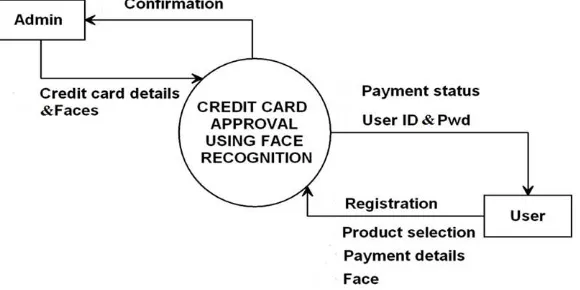
The aim is to automate and make a system that provides a reliable and efficient mode of online transaction process. The system has the authority to authenticate or restrict a user. It should be flexible enough so that people can easily use it without any hesitation.Face recognition is one of the few biometric methods that possess the merits of both high accuracy and low intrusiveness. It has the accuracy of a physiological approach without being intrusive.The diagram below showing the overall system and division of modules:
Fig 3.1: Overall System
data needed by the View. The View then uses the data prepared by the Controller to generate a final presentable response. Using the Model View Controller (MVC) concepts we divide our modules accordingly.
We divide our system into two modules:
Module 1: ADMINISTRATOR Module
It handles the Application Logic of the system. Administrators register to our system using its administrator login and gets authenticated by comparing the password provided by the administrator to the password stored in the system. It is the one responsible to make changes to make our system and get users registered to our system. This could be anyone from bank, as our application will be running in coordination with bank database.The dashboard provided to the admin has the functionalities that administrator can use such as feature extraction of the images stored in the system. The features that we consider here are texture of the user face.
Fig 3.2: The flow for Admin Module
Texture is a property that represents the surface and structure of an image. It characterizes, spatial variation of image pattern and extract information from it. Face is detected and cropped from the given input image and then using GLCM Algorithm the features are extracted and stored on the Database. Once the user does any transaction, its captured image features will be compared to the stored features in our database.
Texture analysis characterizes the spatial variation of image pattern based on some mathematical procedures and models to extract information from it. One of the methods used for texture feature extraction was proposed by Haralick et al. known as Gray-Level Co-occurrence Matrix (GLCM).
GLCM estimates image properties related to second-order statistics which considers the relationship among pixels or groups of pixels (usually two). A simple one-dimensional histogram may not be useful in characterizing texture features as it is a spatial property. Hence, this two-dimensional GLCM matrix is extensively used in texture analysis. The GLCM, which is a square matrix, can reveal certain properties about the spatial distribution of the gray-levels in the texture image.
Module 2: USER Module
Fig 3.3: The Flow for User Module
Once they move on to the credit card detail page and provide the system with legitimate credentials, the system will directly drive them to our application where the user image will me clicked and the texture features extracted from the image will be compared to the features stored in the administrator module database with respect to the user.Once the comparison value fits inside the threshold value, the user gets authenticated by our system and he or she can continue with the payment.The account database will provide with the money getting deducted from the user bank balance.
IV.
S
IMULATIONR
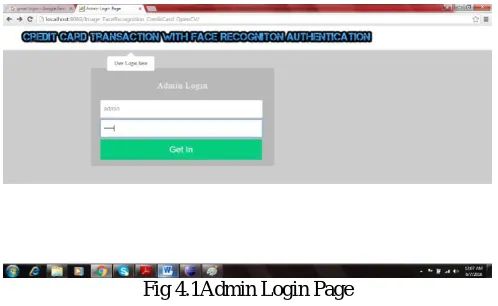
ESULTSA. The given screenshot displays the web page where the admin can login to the system. Only authorised users are allowed to login. Once the admin logs in to the system, he/she will be able to enter the Credit Card details for a particular user along with the images of the user that have to be loaded into the database.
Fig 4.1Admin Login Page
Fig 4.2 Image upload and Face Detection
C. Here the user of the system has to login into the system using the credentials and the password which was given during the registration process on the Ecommerce portal. Then any product can be purchased from a list of products from the portal. Different categories of products are available for the user to choose from.
Fig 4.3 Shopping Cart
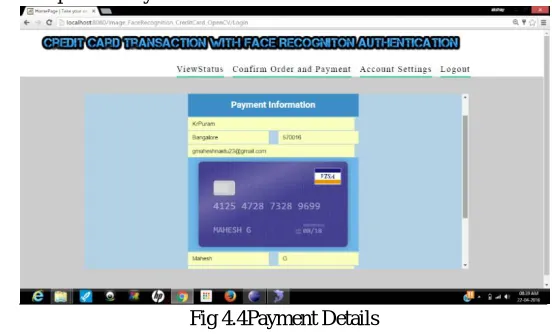
D. This screenshot shows us the credit card details that the user has to enter after selecting the product. Once the user confirms the items and the quantities of each item then an order is placed. After this the user’s credit card details are taken along with the CVV number and expire date of the card. These details are matched with the database to check if the correct information is provided by the user.
Fig 4.4Payment Details
finally it is compared with the training set in the database. If the image is similar to the image that is stored in the database for the particular user then the authentication of the user is successful.
Fig 4.5 Face Detection
F. Once the image authentication process of the user is successful the payment for the order that has been placed is made and the balance of the user is debited from his account as per the order. And a confirmation message is given back to the user stating that the payment process is successful. The payment is only done when the authentication is successful.
Fig4.6 Payment Confirmation
V.
C
ONCLUSION ANDF
UTUREW
ORKOur proposed project-Credit Card Transaction with Face Recognition Authentication has been envisioned for the purpose of reducing the credit card frauds that may occur during an online payment process. The aim is to automate and make a system that provides a reliable and efficient mode of online transaction process. The system has the authority to authenticate or restrict a user. It should be flexible enough so that people can easily use it without any hesitation. The camera plays a crucial role in the working of the system hence the image quality and performance of the camera in real-time scenario must be tested thoroughly before actual implementation. This method is secure enough, reliable and available for use. No need for specialized hardware for installing the system in a bank software. It can be constructed using a camera and computer.
REFERENCES
[1] Shang-Hung Lin, ‘An Introduction to Face Recognition Technology’, Informing Science Special Issue on Multimedia Informing Technologies – Part 2, Vol.3, No.1, (2000).
[2] Dr.Pramod Kumar, Mrs. Monika Agarwal, Miss. Stuti Nagar, ‘A Survey on Face Recognition System - A Challenge’,International Journal of Advanced Research in Computer and Communication Engineering Vol. 2, Issue 5, (2013).
[3] P. Mohanaiah, P. Sathyanarayana, L. GuruKumar, ‘Image Texture Feature Extraction Using GLCM Approach’, International Journal of Scientific and Research Publications, Volume 3, Issue 5, (2013)
[4] AlaaEleyan, Hasan Demirel, ‘Co-occurrence matrix and its statistical features as a new approach for face recognition’, Turk J ElecEng& Comp Sci, Vol.19, No.1, (2011).
[5] M.Harshavardhan and S.Visweswara Rao, ‘GLCM Architecture for Image Extraction’, International Journal of Advanced Research in Electronics and Communication Engineering (IJARECE) Volume 3, Issue 1, (2014)
[6] ShervinEmami, Valentin PetrutSuciu, ‘Facial Recognition using OpenCV’, Journal of Mobile, Embedded and Distributed Systems, vol. IV, no. 10, (2012)
BIOGRAPHY