A Novel Approach for TCP for Regression
Testing in Web Application
Priyanka P Deshmukh, Prof. Vina M Lomte
Department of Computer Engineering, RMD Sinhgad School of Engineering Pune, India
ABSTRACT: For increase rate of fault detection test case prioritization is needed, which shows how fast bugs are identified during the testing phase. In test case prioritization follow way to use the information of previously executed test cases, such as coverage information, resulting in an iterative prioritization algorithm. Real fact of using coverage information can improve the rate of fault detection in prioritization algorithms. But performance of such iterative prioritization schemes degrade as the number of ties occurred in prioritization steps increases. In test case prioritization using lexicographical ordering and extended diagraph, we propose a new heuristic for breaking ties in coverage based techniques. Performance of the proposed technique in terms of the rate of fault detection is comparatively evaluated using a wide range of programs. Results indicate that the proposed technique can resolve ties and in turn noticeably increases the rate of fault detection.
KEYWORDS: Additional statement coverage, Fault-based test case prioritization, GUI testing, HMM, model-based testing (MBT), random prioritization, reinforcement learning.
I. INTRODUCTION
The complexity and size of software systems are growing, along with the increasing importance of testing and verifying these systems. As a result, many test suites produced during development are reused in a regression testing mode, especially during software maintenance or evolution. Decreasing regression testing costs while increasing fault detection power is an important goal in software testing; this challenge can potentially be addressed by model-based testing (MBT) techniques [El-Far and Whittaker 2002; Legeard and Utting 2006]. MBT has two phases: (1) the generation of executable test cases; and (2) the execution and evaluation of test cases [Hemmati 2011].
III. REVIEW OF LITERATURE
1. A Novel Approach for Test Caseprioritization
Refer Points-
This paper proposed an approach for test case prioritization in order to improve regression testing. Analysis is done for prioritized and non-prioritized cases with the help of APFD (average Percentage fault detection) metric.
2.An Approach for Test Case PrioritizationBased Upon Varying Requirements
Refer Points-
In this paper we describe requirement based test case prioritization technique. This proposed Technique is highly useful to identity and evaluate various issues arises while working with varying requirement environment.
3. Model-Based Test Case Prioritization UsingNeural Network Classification
Refer Points-
This paper deals with ESG model based test case prioritization problem for a large number of test cases. Improving our previous study, new model-event based TCP approach where instead of ordering indirectly test cases according to their preference degree they are automatically divided into the five groups (classes).
It is provided thanks to representing prioritization group label of each test case as output depending on two attributes: important index weighted by membership degree and frequency of occurrence of all events belonging to given group.
4.- Prioritization Techniques Based On Regression Testing
Refer Points-
Our algorithm is based on analysis of the percentage of test cases performed to find the faults and on APFD metric’s results. Abiding by the percentage of executing test cases in earlier fault detection is important as sometimes regression testing ends without executing all test instances. Outcomes demonstrate that our algorithms can also achieve better execution in this event.
For instance, in the first project if only 75% test cases could be melt down due to resource constraint, random strategy could find more or less 66% faults; while our proposed algorithm detects about88% faults. In a second project if we consume 30% test cases to accomplish; then random strategy could find more or less 27% faults; while our proposed algorithm detects about 40% faults.
5.A New Effective Test Case Prioritization for Regression Testing Based On Prioritization Algorithm
Refer
Points-In this paper, we proposed a new prioritization technique for prioritizing system level test cases to improve the rate of fault detection for regression testing. Here we propose new practical set of weight factors used in the test case prioritization process. The new set of are tested for the regression test cases.
The proposed prioritization algorithm is validated by using APFD metric. Experimental Results shows that proposed technique leads to improve the rate of fault detection in comparison with random ordered test cases and reserves the large number of high priority test with least total time during a prioritization process.
6.Test Case Prioritization for Regression Testing Based On Severity of Fault
Refer
Points-In this paper a new prioritization technique to improve the rate of fault detection of severe faults for Regression testing is proposed. Here, two factors rate of fault detection and fault impact for prioritizing test cases are proposed. The proposed algorithm is validated by analyzing two sets of industrial projects. Results indicate that the proposed technique lead to improved rate of detection of severe faults in comparison to random ordering of test cases. And also it is tested experimentally that the number of test cases runs to find the entire fault is less in case of proposed prioritization technique.The results prove that the proposed prioritization technique is effective. In future, test case prioritization over requirement analysis will be tried.
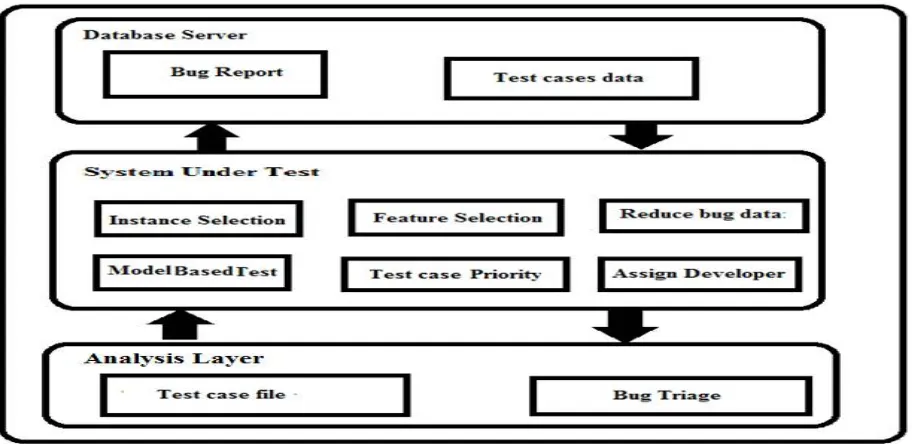
III. SYSTEM OVERVIEW
re-estimate the Markov model efficiently. Utilizing RL, we are able to estimate anappropriate HMM and then use it to compute each test case’s forward probability, thatis, the likelihood of executing a specific test case based upon the SUT’s gathered HMM.
Advantages of Proposed System:
1. They calculate the fault detection rate of everystrategyand discoveredtheir proposed methodsare able to improve the rate.
2. It delineatesthat considering GUI states and activitiesplays acrucial role in improving the fault detection rate.
3. We can reduce the time required to execute test cases and improvethe likelihood of consume testing time more beneficially in the case of an unexpected termination of regression testing activities.
IV. SYSTEM ANALYSIS
Our dynamic test case prioritization utilizes an MBT-based approach. It accept that anMBT-based front-end (automatic test case generator) exists and, in essence, “extends”this front-end model and system to complete the testing procedure. In MBT, the testmodeler creates an abstract model (state machine) of the SUT and aftergenerates aset of test cases by walking (traversing) through the model [Dev et al. 2012].So, MBT is about the automatic generation of effectivetests using models of theSUT [Arlt et al. 2012]. This model is a depiction of SUT behavior, including inputsequences (actions, conditions, output logic, and dataflow) through modules and routines[Hemmati 2011]. The most significant feature of MBT is automating both thetest generation and execution processes along with the capability of generating testcases. For instance, Lindlar et al. [2010] joinMBT with Evolutionary FunctionalTesting (EFT) to accomplisha completelyautomatic test case design and evaluation framework.Meanwhile, Endo and Simao [2011] represent a new approach to apply model-basedtesting in service-oriented applications’ testing process.
Table: The Statistical Analysis for RL-Based HMM Techniquevs. Other Techniques in Calculator
RL-based HMM
Technique Vs. Others
t-statistic p-value (one-tail)
RL-based HMM vs. Statement Coverage RL-based HMM vs. Untreated RL-based HMM vs. Best
3.81329
4.12466
−2.99924
8.93385E-4
4.12614E-4
0.00899
Untreated vs. fault-prone weight (L1) Untreated vs. adjusted weight (L1)
Coverage vs. fault-prone weight (L1) Coverage vs. fault-prone weight (L1)
−3.3235 −3.8280
−2.4221
−3.2269
0.0013
0.0003
0.0113
0.0016
V. CONCLUSION
In this research, we propose a novel fault-based technique, the extended digraph. It is argued that the extended digraph provides a richer explanation of program behavior than a regular digraph. This digraph is generated by using an RL-based HMM approach to prioritize test cases. We present an approach to initialize an appropriate HMM RL-based on a Q-learning algorithm that leads to a final HMM with the maximum likelihood estimate of parameters after applying an EM algorithm. Then we use the estimated model to compute the likelihood (forward probability) of the generated test these forward probabilities. In addition, we propose another technique which uses the summation of each test case’s Q-value in order to sort them in a descending order. Thus, test cases with higher amount of accumulated Q-Q-value get higher priority in the sorted list. Although the results of this research improve the effectiveness of test case prioritization, the RL-based HMM approach still has room for improvement. First, we intend to perform additional studies on more applications such as Web-based. Second, in this study we only consider GUI applications. We want to evaluate this method further; we are working on presenting a generic approach to generate an RL-based weighted model for every type of application. Thomas et al. [2012] represented a static approach to prioritizing Junit test cases by defining the distance between pairs of test cases based upon topic modeling. Such techniques can be utilized to compute the reward function and Q-values in non-GUI-based applications. Third, we need the best sequence of GUI states contributing to the most appropriate prioritized test suite. In this situation, we can address the second HMM problem using a Viterbi algorithm to find the most suitable ordering which maximizes the HMM’s likelihood of estimated parameters.
VI. ACKNOWLEDGEMENT
The authors wish to thank all the referees involved in the above mentioned work of this survey. Finally, an honorable mention goes to the entire staff of Dept. of Computer, RMD Sinhgad School of Engineering, Warje, Pune and for their understandings and supports on this survey.
REFERENCES
[1] Sahil Gupta1, Himanshi Raperia2, Eshan Kapur3, Harshpreet Singh4 and Aseem Kumar5,” a novel approach for test caseprioritization”, Department of Computer Engineering, LPU, Jalandhar, India.
[2] Aseem Kumar1, Sahil Gupta2, Himanshi Reparia3, Harshpreet Singh4 ,“An Approach For Test Case Prioritization Based Upon Varying Requirements”, 1Research scholar, Department of Computer Engineering, Lovely ProfessionalUniversity, Phagwara, India.
[3] Nida Gökçe1, Mübariz Eminli2.” Model-Based Test Case Prioritization UsingNeural Network Classification”, 1Department of Statistics, MuğlaSıtkıKoçman University, Muğla, TURKEY 2Department of Computer Engineering, Halic University, İstanbul, TURKEY.
[4] Thillaikarasi Muthusamy1 and Dr. Seetharaman.K2, “Effectiveness Of Test CasePrioritization Techniques Based On Regression Testing”, 1Department of computer science, Annamalai University, Annamalai Nagar,Tamilnadu, India.
[5] Thillaikarasi Muthusamy1 , Seetharaman.K2, Ph.D,”A New Effective Test Case Prioritization for Regression Testing based on Prioritization Algorithm “,1(Assistant Professor) Department of computer science and Engineering,Faculty of Engineering and technology Annamalai University,Annamalai Nagar, Tamilnadu,India-608002.