Lambda-Lambda Correlation in Relativistic Heavy Ion Collisions
Kenji Morita1,2,a, Takenori Furumoto3, and Akira Ohnishi1,b
1Yukawa Institute for Theoretical Physics, Kyoto University, Kyoto 606-8502, Japan 2Institute of Theoretical Physics, University of Wroclaw, PL-50204 Wrocaw, Poland 3National Institute of Technology, Ichinoseki College, Ichinoseki, Iwate 021-8511, Japan
Abstract.We investigateΛ−Λcorrelation function in relativistic heavy ion collisions to extract their interaction. Using an expanding source model for heavy ion collisions, we disentangle effects of collective expansion and those of the interaction at low relative momenta. Then, we discuss the inuence of the feed-down correction forΣ0decay and
indicate the possible existence of a residual correlation at high relative momenta. Conse-quently, the present STAR data suggest a weakly attractive interaction for theΛΛpairs which is represented by the scattering length, 1/a0<−0.8 fm−1.
1 Introduction
TheΛ−Λinteraction plays an important role in various aspects of modern nuclear physics. For in-stance, it is expected that hyperons can emerge at already at moderate baryon densities within neutron star cores [1]. One needs more information on the interaction among hyperons to understand whether this picture is consistent with recently observed massive neutron stars [2] or not. Also in hadron physics, the existence of theHparticle Jaffe pointed out in 1977 [3] depends on whetherΛΛcan be deeply bound or not.
While an observation of a double hypernucleus 6
ΛΛHe and its weak decay (Nagara event)[4] ruled out the possibility of the deeply bound state, the bond energy ofΛΛ,BΛΛ, extracted from theΛΛ6He indicates a weakly attractiveΛΛinteraction, characterized by the scattering length and the effective range in the1S0channel as (a0,reff)=(−0.77fm,6.59fm) [5] or (a0,reff)=(−0.575fm,6.45fm) [6] as extracted from structure calculations. Nevertheless, a single numberBΛΛis not sufficient to determine the interaction characterized by the scattering length and the effective range. Recently, an alternative possibility has been explored in relativistic heavy ion collisions at Relativistic Heavy Ion Collider (RHIC). The STAR collaboration measuredΛ−Λmomentum correlationC(Q) in Au+Au collisions at √sNN =200GeV, as a function of relative momentumQ=|p1−p2|[7]. In high energy heavy ion collisions, the momentum intensity correlation functions have been measured for various particles to access the space-time extent of the hot matter via Hanbury-Brown Twiss (HBT) effect. It has been pointed out that one may also extract information on interaction between particles when the source size and the effective range of the interaction are comparable [8–11].
ae-mail: [email protected] be-mail: [email protected] DOI: 10.1051/
C
Owned by the authors, published by EDP Sciences, 2015 /201
epjconf 5970 0 0
7KLVLVDQ2SHQ$FFHVVDUWLFOHGLVWULEXWHGXQGHUWKHWHUPVRIWKH&UHDWLYH&RPPRQV$WWULEXWLRQ/LFHQVHZKLFKSHUPLWV XQUHVWULFWHGXVHGLVWULEXWLRQDQGUHSURGXFWLRQLQDQ\PHGLXPSURYLGHGWKHRULJLQDOZRUNLVSURSHUO\FLWHG
The goal of this work is to determineΛΛinteraction from the measured data at RHIC. For this purpose, we need to understand several effects on theΛΛcorrelation function other than interaction. In this proceeding, we highlight results from our recent work [12].
2
ΛΛ
correlation from an expanding source
We compute theΛΛcorrelation functionC(Q,K) as a function of relative momentumQ=p1−p2
and average oneK=(k1+k2)/2 using a formula [13]:
C(Q,K)=
d4x
1d4x2S(x1,K)S(x2,K)|Ψ12(Q,x1−x2−(t2−t1)K/m)|2
d4x
1d4x2S(x1,k1)S(x2,k2) .
(1)
There are two ingredients affecting the behavior of the correlation function in Eq. (1). Information on theΛΛinteraction is encoded in the relative wave functionΨ12. In the second argument of Eq. (1), −(t2−t1)K/mwithmbeing the mass of Λ, accounts for possible differences in the emission time of the twoΛ particles. Considering only the s-wave interaction, one can write down the relative spatial wave function of the spin-singlet state, which is symmetric with respect to the exchange of the particles (thus totally antisymmetric), as
Ψs= √
2[cos(Q·r/2)+χQ(r)−j0(Qr/2)] (2)
whereχQ is thes-wave solution of the Schrödinger equation with a givenΛΛinteraction potential
V(r) and the spherical Bessel functionj0(Qr/2) stands for the frees-wave function withQ=|Q|. The spin-averaged total wave function is then given by:
|Ψ12|2= 1 4|Ψs|
2+3 4|Ψt|
2
=1−1
2cos(Q·r)+[χQ(r)−j0(Qr/2)] cos(Q·r/2)+ 1
2[χQ(r)−j0(Qr/2)]
2 (3)
For the free wave function, only the rst and second terms remain to giveC(Q = 0) = 1/2. The correlation below unity reects the effective repulsion due to Pauli principle for fermions. One notes thatC(Q=0) =2 for pions, according to the Bose statistics. Thus, one expects that repulsive and attractive interaction giveC(Q0) < 1/2 andC(Q 0) >1/2, respectively. The behavior of the correlation function in the presence of interaction can be systematically studied by employing a simple source functionS(x,K) in Eq. (1), which is the other ingredient representing the emission probability ofΛwith momentumKfrom a space-time pointx.
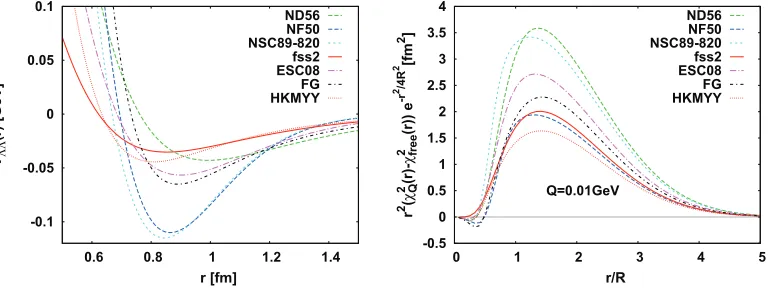
We examined various interaction potentials used in structure calculations of hypernuclei. See Ref. [12] for a tabulated list. Figure 1 displays some of the potentials in the left panel and the corre-sponding relative spatial wave functions weighted by the source function in the right panel. One sees the difference among the potentials is reected onto wave function particularly for distances close to the source radius. The difference in the wave function inr Ris suppressed by the weight factor. As we shall show below, the correlation function provides a constraint on scattering parameters rather than the detailed form of the potential. The scattering lengtha0and the effective ranger0are related to the scattering phase shiftδthrough the shape-independent form:
kcotδ=−1
a0 + 1 2reffk
2+O(
-0.1 -0.05 0 0.05 0.1
0.6 0.8 1 1.2 1.4
VΛΛ
(r) [GeV]
r [fm]
ND56 NF50 NSC89-820 fss2 ESC08 FG HKMYY
-0.5 0 0.5 1 1.5 2 2.5 3 3.5 4
0 1 2 3 4 5
r
2(χ 2(r)-Q
χ
2 free
(r)) e
-r
2/4R
2 [fm
2]
r/R Q=0.01GeV
ND56 NF50 NSC89-820 fss2 ESC08 FG HKMYY
Figure 1.Left:ΛΛinteraction potentials. Right: difference of relative wave functions from the free one weighted with the static source function atQ=0.01GeV.
In this denition, the interaction is attractive fora0<0 and a bound state exists fora0>0. Applying a spherically symmetric static source function, one obtains the constraints:−1.2 fm<a0 <−0.8 fm and 3.2 fm<reff<6.5 fm from aχ2t to the STAR data [12]. While this result is consistent with the ndings from the Nagara event, one needs to investigate the inuences from source properties in heavy ion collisions. In particular, the hot matter created in high energy heavy ion collisions exhibits rapid hydrodynamic expansion. At the RHIC energy, the matter consists of deconned quarks and gluons in the early stage of the collision process. Hydrodynamics indicates the matter undergoes transition into hadronic matter around 5 fm/cafter the impact. We assume thatΛparticles are produced at the hadronization process. Since single particle levels ofΛincluding those of deep s-states are clearly observed [14], one expects the interaction ofΛwith pionic environment is weak, in contrast to the πand proton cases. Thus we assume that effects of interaction with surrounding particles on the correlation function can be neglected. One needs to invoke dynamical simulations to check the validity of the assumption. Nevertheless, one needs to consider an appropriate source function which takes into account the collective expansion and the relevant geometry. We employ a cylindrically symmetric source model with a longitudinal boost invariant and transverse Hubble-type expansions and is used for studyingππHBT correlation in [15]. Then the source functionS(x,K) reads:
S(x,K)=mTcosh(y−YL)
(2π)32π(Δτ)2nf(u·k,T) exp
−(τ−τ0)2 2(Δτ)2 −
x2+y2
2R2
. (5)
withy=ln(Ek+pz)/(Ek−pz) andmT =
p2
t +m2 being rapidity and transverse momentum of
Λparticles, respectively. The expansion velocityuμis parameterized in terms of longitudinal rapidity
YLand transverse oneYT asuμ=(coshYTcoshYL,sinhYTcosφ,sinhYTsinφ,coshYTsinhYL). The boost invariant expansion is then realized byYL =η =ln
√
(t+z)/(t−z) [16]. The transverse ow is given byYT = ηfr/Rwhere ηf is a strength parameter. Considering the emission of Λ at the hadronization, we x the freeze-out temperatureT =160MeV, freeze-out proper timeτ0 =5 fm and emission durationΔτ=2 fm. Then through the invariant single particle distribution
EdN d3k =
0.5 0.6 0.7 0.8 0.9 1
0 0.1 0.2 0.3 0.4 0.5
C(Q)
Q [GeV/c] R=1.2fm
Free Spherical
ηf=0.0, Free Cylindrical
ηf=0.33, Free Cylindrical
fss2,ηf=0.0, Cylindrical
fss2,ηf=0.33, Cylindrical 0.7
0.8 0.9 1
0 0.1 0.2 0.3 0.4 0.5
C(Q)
Q [GeV/c] fss2, Optimized
ηf=0.0, Cylindrical, R=0.6fm
ηf=0.33, Cylindrical, R=0.7fm
STAR 0-80%
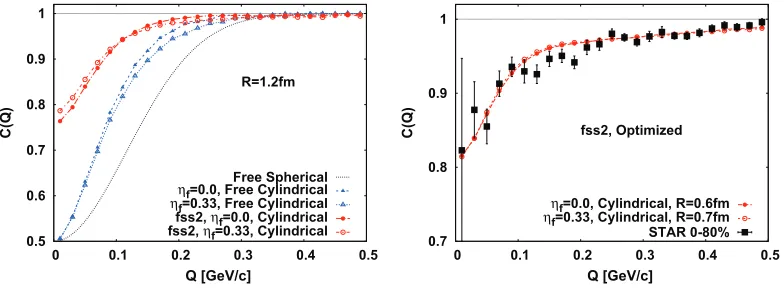
Figure 2.ΛΛcorrelation function forR=1.2 fm. Left: Comparison of the free cases and interacting cases with and without ow. Right:Ris optimized for the STAR data.
we can determineηf =0.33 by tting toptspectrum [17].
Figure 2-left illustrates the effects of the collective expansion onC(Q) and its interplay with the interaction. The dotted line shows the correlation function from the spherically symmetric Gaussian source withR = 1.2 fm. Filled triangles denotes the results from the source function (5) with the same transverse sizeR, but without transverse ow (i.e,ηf =0) and interaction. One notes that the width ofC(Q) is reduced, because the source has a large longitudinal extent due to the boost-invariant expansion along the collision axis. If the transverse ow is turned on, the width is decreased as seen in the open triangles, but the effect is not signicant. See Refs. [15, 18] for detailed discussion on the effects of collective expansion on the pion HBT correlation. Closed and open circles plotC(Q) with fss2 interaction, which exhibits weak attraction characterized bya0 =−0.81 fm andreff =3.99 fm. One sees an enhancement of the correlation as expected for an attractive interaction, but the enhancement is found to be stronger in the presence of transverse ow, because of the effectively smaller source size caused by the transverse expansion. To extract the interaction from the measured ΛΛcorrelation function data by the STAR collaboration, we perform aχ2 analysis withRbeing a free parameter. In Fig. 2-right, theC(Q) obtained using the fss2 interaction and corresponding to the optimized value ofRare shown. One nds that bothC(Q), with and without transverse ow, do not differ after optimization. The minimization ofχ2leads to slightly smaller sizeRin the presence of the transverse ow. Thus, we conclude that the effect of the transverse ow is absorbed into the size parameter through the tting procedure.
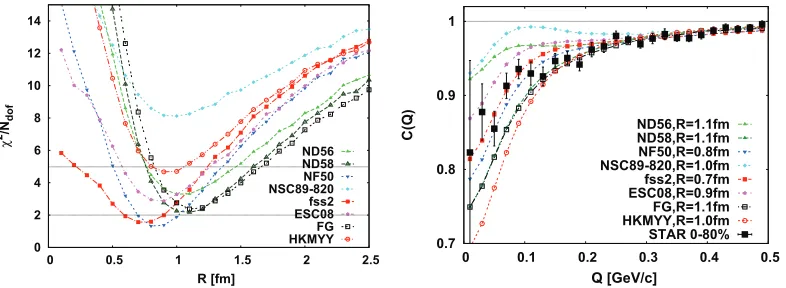
Figure 3 summarizes the results from the source model (5). Although the optimized size parameter is decreased and the value ofχ2/N
dofchanges in each of potentials, we nd that the favored potentials are the same as those in the static source model. Even in the presence of collective ow, the low
Qbehavior ofC(Q) fairly reects differences among the interactions. The stronger the attraction becomes, the closer to unityC(Q) is. This shows feasibility ofΛΛcorrelation in heavy ion collisions to discriminate the nature of the interaction.
3 Feed-down correction
0 2 4 6 8 10 12 14
0 0.5 1 1.5 2 2.5
χ
2/N
dof
R [fm]
ND56 ND58 NF50 NSC89-820 fss2 ESC08 FG
HKMYY 0.7
0.8 0.9 1
0 0.1 0.2 0.3 0.4 0.5
C(Q)
Q [GeV/c]
ND56,R=1.1fm ND58,R=1.1fm NF50,R=0.8fm NSC89-820,R=1.0fm fss2,R=0.7fm ESC08,R=0.9fm FG,R=1.1fm HKMYY,R=1.0fm STAR 0-80%
Figure 3.χ2/
Ndofas functions ofR(left) and resultantΛΛcorrelation function (right) for the optimized source
sizes, for various potentials.
Since this situation also applies to pion production in heavy ion collisions, effects of resonances have been studied inππcorrelations [19]. Since the source function for daughter particles are extended by the decay length, short-lived decay parents affect the shape of the correlation function at lowQ. Long-lived ones effectively reduce the intercept parameterλwhich is dened byC(Q=0) because too long relative distance of pairs causes a strong correlation at too smallQvalues to be resolved. While the long-lived parents can be neglected when one focuses on the source size, one needs to consider the effects in order to study the interaction. As discussed above, the nature ofΛΛinteraction is encoded inC(Q0), thus the reduction ofλdue to long-lived resonances may affect the interpretation of the data.
For the totalΛyieldNtotand the yields stemming from long-lived parentsNp, the reduced intercept
λis given by [20]:
λ=
1− N
p
Ntot 2
. (7)
The dominant contribution to theΛyield comes fromΣ(1385),Σ0andΞas well as primordialΛ. Since the decay width of theΣ(1385) resonance is 36-40 MeV, it can be treated as short-lived resonances contributing toNtotonly. We nd that theΩcontribution is negligible, thus we considerΣ0andΞas the main contribution when evaluatingNp.
Σ0contributes to Λsamples throughΣ0 → Λγ, which is not easy to reconstruct. We make use of an experimental results ofΣ0yields, NΣ0/NΛ=0.278 in p+Be collisions atplab=28.5GeV [21].
In spite of intrinsic differences of p+A collisions from A+A, we note that this ratio is consistent with thermal model calculations. Ξyields have been found to be 15% ofΛin Au+Au collisions at √
sNN=200 GeV [17]. According to their decay length, we assume that part ofΞdecay contribution is excluded by theΛsample selection (DCT<0.4cm) in the STAR measurement [7]. Thus, taking into account only theΣ0contribution toNp, we ndλ=(0.67)2. If we also includeΞ,λ=(0.572)2. Since the selection might not reject all theΞdecay contribution toΛ, these numbers can be regarded as possible upper and lower limits. In the following, we present results only forλ=(0.67)2, but we also conrm that the conclusion does not change if one adoptsλ=(0.572)2. Then, theΛΛcorrelation function can be corrected for the feed-down contribution as:
0 5 10 15 20
0 0.5 1 1.5 2 2.5
χ
2/N
dof
R [fm] Cylindrical,λ=(0.67)2
Data : STAR 0-80% ND58
NF52 NSC89-1020 NSC97a
NSC97b NSC97c NSC97e NSC97f
fss2 ESC08 FG HKMYY
0.7 0.8 0.9 1
0 0.1 0.2 0.3 0.4 0.5
C(Q)
Q [GeV/c]
Cylindrical,λ=(0.67)2
ND58,R=0.2fm NF52,R=0.4fm NSC89-1020,R=0.4fm NSC97a,R=0.4fm NSC97b,R=0.4fm NSC97c,R=0.4fm NSC97e,R=0.4fm NSC97f,R=0.5fm fss2,R=0.1fm ESC08,R=0.1fm FG,R=0.5fm HKMYY, R=0.1fm STAR 0-80%
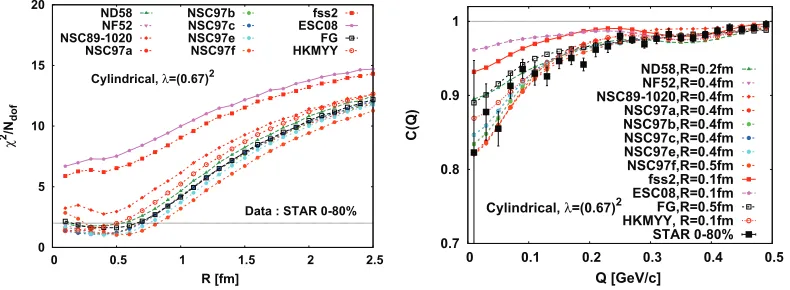
Figure 4.Same as Fig. 3, but with feed-down correction forΣ0decay (8).
whereCbaredenotes the bare correlation function calculated from Eq. (1) with the wave function (3) and the source function (5).
Figure 4 showsχ2/N
dofandC(Q) with the optimized value ofR, similar to Fig. 3. One sees that good ts can be achieved only for unphysically smallR. The reason is clearly seen if one looks into
C(Q) at highQ. Since the data has a long tail, smaller size is favored to t the tail. On the other hand, such smaller size enhances the effect of attractive interaction. As feed-down correction introduces a larger intercept,C(Q =0) =0.776 forλ =(0.67)2, strong attraction leads to overshooting the data at lowQ. Consequently, the data can be tted only with the small size and very weak interaction potential which was excluded in the analyses without feed-down correction. There seems to exist an additional source of the correlation which produces the long tail at highQ.
Here we try to subtract this residual correlation in the data by employing an additional Gaussian term
Cres(Q)=arese−r
2
resQ2, (9)
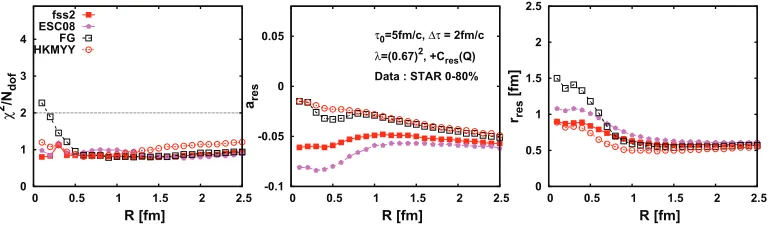
such that the total correlation function is given byC(Q) =Ccorr(Q)+Cres(Q). This term was also introduced in the analysis by the STAR collaboration and found to improve the quality of the t [7], but the two quantities (ares,rres) were treated as additional tting parameters. Because the origin of this correlation is not known, we rst investigate systematics of the t against the variation of these parameters.
We evaluate the minimum ofχ2/Ndofagainst the parameters (ares,rres) for a xedRand repeated it for a variation ofRbetween 0 and 2.5 fm. Figure 5-left displays the values ofχ2/Ndof. For shown potentials, one seesχ2/Ndof 1 forR > 0.5fm. Although one may think this insensitivity could indicate no information on the interaction due to the connection between the size and the attraction discussed above, one can see the inuence of the interaction on the behavior ofaresandrres. For small
0 1 2 3 4
0 0.5 1 1.5 2 2.5
χ
2 /N
dof
R [fm] fss2
ESC08 FG HKMYY
-0.1 -0.05 0 0.05
0 0.5 1 1.5 2 2.5
ares
R [fm]
τ0=5fm/c,Δτ = 2fm/c
λ=(0.67)2
, +Cres(Q)
Data : STAR 0-80%
0 0.5 1 1.5 2 2.5
0 0.5 1 1.5 2 2.5
rres
[fm]
R [fm]
Figure 5.Left: Minima ofχ2/
Ndofagainst (ares,rres) for eachRand selectedΛΛpotentials. Center and right:ares
andrresat the minimum ofχ2/Ndof, respectively.
existence of the residual correlation which cannot be explained by conventional effects which are examined in this work.
Repeating the same analysis with other potentials, we nd that all the potential favored in Sec. 2 is still favored after taking into account the residual correlation as well as the feed-down correction. The reduction ofC(Q = 0) due to the feed-down correction, however, makes the correlation less sensitive to the interaction. In particular, we cannot nd any constraints on the effective rangereffbut the scattering length as 1/a0<−0.8 fm−1.
4 Concluding remarks
We have studiedΛ−Λcorrelation functionC(Q) as a function of relative momentumQ=|p1−p2| in relativistic heavy ion collisions by employing various type of interaction potential models and a source function for cylindrically expanding source. Assuming direct production ofΛfrom the hot source, we obtain a constraint on the interaction by tting calculations to the data. Comparison of the calculated correlation functions with the STAR data indicates potential feasibility of discriminating the interaction potential even after taking into account expansion of the source in relativistic heavy ion collisions. The sensitivity of the correlation function to the interaction, however, is reduced by feed-down contribution fromΣ0decay. Moreover, the long tail in the data at highQseems to indicate existence of additional source of the correlation. By including the additional correlation, we nd that the data nevertheless favor weakly attractingΛΛinteraction characterized by 1/a0<−0.8fm−1.
Acknowledgements
References
[1] N. K. Glendenning, Astrophys. J.293, 470 (1985).
[2] P. Demorest, T. Pennucci, S. Ransom, M. Roberts and J. Hessels, Nature467, 1081 (2010). [3] R. L. Jaffe, Phys. Rev. Lett.38, 195 (1977).
[4] H. Takahashi et al., Phys. Rev. Lett.87, 212502 (2001). [5] I. N. Filikhin and A. Gal, Nucl. Phys.A707, 491 (2002).
[6] E. Hiyama, M. Kamimura, T. Motoba, T. Yamada and Y. Yamamoto, Phys. Rev. C66, 024007 (2002).
[7] L. Adamczyk et al., (STAR Collaboration), Phys. Rev. Lett.114, 022301 (2015). [8] R. Lednicky and V. L. Lyuboshits, Sov. J. Nucl. Phys.35, 770 (1982).
[9] W. Bauer, C. K. Gelbke and S. Pratt, Annu. Rev. Nucl. Part. Sci.42, 77 (1992). [10] C. Greiner and B. Müller, Phys. Lett. B219, 199 (1989).
[11] A. Ohnishi, Y. Hirata, Y. Nara, S. Shinmura and Y. Akaishi, Nucl. Phys.A670, 297 (2000). [12] K. Morita, T. Furumoto and A. Ohnishi, Phys Rev. C91, 024916 (2015).
[13] S. E. Koonin, Phys. Lett.70B, 43 (1977); W. G. Gong, W. Bauer, C. K. Gelbke and S. Pratt, Phys. Rev. C43, 781 (1991).
[14] O. Hashimoto and H. Tamura, Prog. Part. Nucl. Phys.57, 564 (2006). [15] S. Chapman, P. Scotto and U. Heinz, Heavy Ion Phys.1, 1 (1995). [16] J. D. Bjorken, Phys. Rev. D27, 140 (1983).
[17] G. Agakishiev et al., (STAR Collaboration), Phys. Rev. Lett.108, 072301 (2012).
[18] N. Makhlin and Yu. M. Sinyukov, Z. Phys. C39, 69 (1988); K. Morita, S. Muroya, C. Nonaka and T. Hirano, Phys. Rev. C66, 054904 (2002).
[19] U. Wiedemann and U. Heinz, Phy. Rev. C56, 3265 (1997).
[20] P. Grassberger, Nucl. Phys.B120, 231 (1977); T. Csörgo, B. Lörstad and J. Zimányi, Z. Phys. C
71, 491 (1996).