ISSN 2286-4822 www.euacademic.org
Impact Factor: 3.1 (UIF) DRJI Value: 5.9 (B+)
PESA (Pachayat Extension to Scheduled Area)
Governance Implementation & Planning Process in
Chhattisgarh, INDIA
DR ASHOK KUMAR JAISWAL
Faculty Member (Panchayat Raj) Thakur Payralal Institute for Panchayat & Rural Development
Nimora, Raipur, Chhattisgarh India
Abstract:
Panchyat extension to Scheduled Areas (PESA) Act 1996 has been hailed as progressive legislation to benefit tribal communities in their quest for self governance trough participation in Gram Sabha and Panchyats in Schedule Five areas of India. Among the nine states benefitting form PESA ACT implementation, Chhattisgarh areas before being a part of the state as well as after being in the state have taken several advantages of the legislation.
Key words: PESA ACT ,Gram Sabha, Tribal communities, Local plans, Tribal Sub-Plan, Land alienation, Land acquisition, Formulations.
1. Introduction-
The Provisions of the Panchayats (Extension to Scheduled Areas) Act, 1996 is regarded as a corrective legal measure to the 73rd amendment in form of extension of panchayat governance to the Scheduled and Tribal areas falling under the Fifth Schedule of Indian Constitution.
The Panchayat Raj legislation applicable in erstwhile and unified Madhya Pradesh was adopted in Chhattisgarh after the formation of State in 2000. A new chapter was added to Chhattisgarh Panchayat Raj Adhiniyam, 1993 (CPRA) to extend the special provisions for Panchayats in Scheduled areas of the State.
Provisions of the Panchayats (Extension to the Scheduled Areas) Act, 1996 were added in Section A to 129-F of Panchayati Raj Act, 1993 as per Second Amendment to the Act in 1997.
Powers given to the Gram Sabhas and Panchayats at appropriate levels vis-à-vis governance in scheduled area are as follows:
1) Mandatory Powers of Gram Sabha
a. Management of community resources
b. Approve all plans / projects c. Identification of beneficiaries
d. Issue certificate of utilization of funds
2) Discretionary Powers to Gram Sabha or the Panchayat at appropriate level
f. Prior mandatory recommendation for grant of prospective license or lease for mining minor minerals
g. Prior mandatory recommendation for grant of concession for exploitation of minor minerals by auction.
3) Mandatory Powers to Panchayat at appropriate level
h. Planning and management of minor water bodies
4) Powers to Gram Sabha and Panchayat at appropriate level
i. Ownership of minor forest produce j. Control over money lending
k. Manage and regulate village markets
l. Control over manufacture, sale and consumption of intoxicants
m. Prevent land alienation and restore alienated lands
n. Control over institutions and functionaries in all social sectors
o. Control local plans and resources for such plans including tribal sub plans
PESA in Chhattisgarh
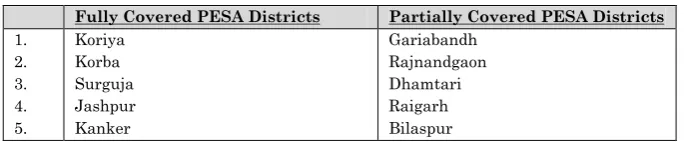
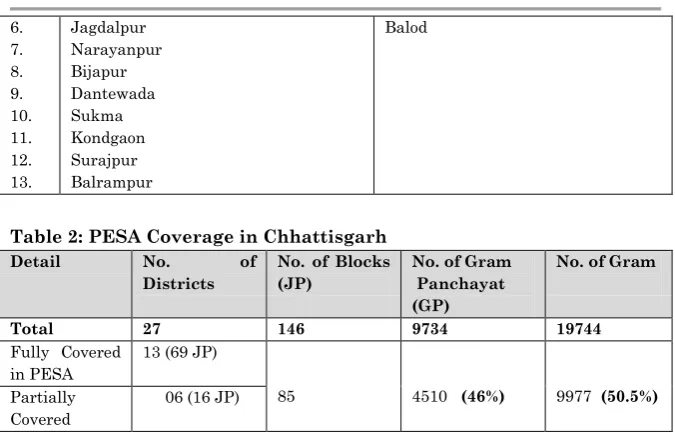
13 districts, out of 27 districts of Chhattisgarh are fully covered under PESA while 6 districts are partially covered under PESA with a few blocks being tribal dominated. A total of 85 blocks comes under PESA area.
Table 1: Districts covered under PESA
Fully Covered PESA Districts Partially Covered PESA Districts 1.
2. 3. 4. 5.
Koriya Korba Surguja Jashpur Kanker
6. 7. 8. 9. 10. 11. 12. 13.
Jagdalpur Narayanpur Bijapur Dantewada Sukma Kondgaon Surajpur Balrampur
Balod
Table 2: PESA Coverage in Chhattisgarh
Detail No. of Districts
No. of Blocks (JP)
No. of Gram Panchayat (GP)
No. of Gram
Total 27 146 9734 19744
Fully Covered in PESA
13 (69 JP)
85 4510 (46%) 9977 (50.5%) Partially
Covered
06 (16 JP)
Particularly Vulnerable Tribal Groups (PVTGs)
Chhattisgarh has 5 tribes recognized as Particularly Vulnerable Tribal Groups (PVTGs), formerly known as Primitive Tribal Gorups (PTGs) viz. :-
Baiga, Kamar, Pahadi Korba, Birhor and Abujhmariya.
Accordingly, 6 special Backward Tribes Development Authorities are constituted in the State. In addition to the above, to give impetus to development in tribal dominated Surguja and Bastar areas, Surguja Development Authority and Bastar Development Authority have been constituted.
Devolution of Funds, Function and Functionaries
Table 1: Status of devolution of departments/subjects with Funds, Functions and Functionaries to the Panchayati Raj Institutions in State with Scheduled Area
No. and names of the Departments/subjects Transferred to Panchayats with respect to
GP is authorized to collect various types of taxes. Funds for 12 departments have been devolved.
Activity Mapping of 27 matters has been undertaken.
Panchayat make recruitments for 9 departments.
Table 2: Status of Devolution of Departments/Subjects with Funds, Functions and Functionaries to Panchayati Raj Institutions in PESA States
No. of Departments/Subjects Transferred to Panchayats with
No.of Departments/Subjects Yet to be Transferred to Panchayats with Fund Function Functionary Fund Function Functionary 10 23 (out of 29) 09 19 06 20
The Government of India, Ministry of Panchayati Raj, in its office memorandum dated 2nd December 2013 observed that:-
a. Six out of nine states have not framed appropriate rules under PESA attisgarh State is in process of framing the Model PESA Rules for the State. Initial consultation has been done between Directorate of Panchayat and the legal cell. Further consultation is in process.
b. State Subject laws relating to mines and minerals, forests, land acquisition etc are not PESA compliant.
To prevent alienation of tribal land in the Scheduled areas, adequate provisions have been made in the Land Revenue Code in
Chhattisgarh. Voluntary or non-voluntary
transfer of land by Scheduled tribes to non-tribals in the Scheduled Areas has been prohibited under provisions of Section 165 of the Chhattisgarh Land Revenue Code, 1959 whereas, in non-Scheduled Areas, such transfer can be effected with the specific permission of the District Collector.
transection of tribal land in favour of non-tribal. Under this provision, lands occupied by Scheduled Tribes before 1980, and which is transferred to non- tribals, the non- tribal shall inform the SDO about such transfers. If on enquiry, the SDO finds that the transfer is not bonafide, he/she shall cancel the transfer and the said land is to be returned to the
original tribal owner. It is also provided that in case
the non-tribal does not inform the SDO about such transfer, this transfer shall suo motu be considered non-bonafide.
Under the PESA the power to cancel a non-bonafide transfer has been vested upon the Gram Sabha. Details of cases enquired under this provision are as under:
No of cases registered in the State
Total Disposed Cases
Balance Cases
Cases disposed in favor of STs
Area of Land returned to STs (Ha.)
Cases Yet to be returned
Area of Land yet to be returned to STs (Ha.)
44464 44093 571 18307 12212.147 81 100.183
Status of compliance in other state subject laws is mentioned in the following section:-
2. Status of Compliance of PESA Provisions in Chhattisgarh Panchayat Act and State Subject Laws (With Reference to Chhattisgarh Panchayat Raj Act, 1993 and State Subject Laws)
adopted the process which is envisaged to be most effective in safeguarding the interests of the tribal communities.
Laws in Chhattisgarh are PESA Compliant. Work is in progress to align State legislations on land acquisition, money lending and Minor Forest Produce (MFP) with PESA provisions and fully implement the same in letter and spirit.
Clause (j-ii) of Section 7 of Chhattisgarh Panchayat Raj Act, wherein Powers and functions and Annual Meeting of Gram Sabha include –
“to manage natural resources including land, water, forests within the area of the village in accordance with provisions of the Constitution and other relevant laws for the time being in force”
The above Clause broadly, yet clearly, states the provisions that the Gram Sabhas have the power to manage the natural resources, thus making it an overarching and all encompassing provision, critical for welfare of tribal communities in the state. The above provision covers land, water and forest resources which are also the focal areas in section 4 of PESA.
Section wise PESA compliance
Section 4
4(a) “…a State legislation on the Panchayats that may be made shall be in consonance with the customary law, social and religious practices and traditional management practices of community resources;
4(b) a village shall ordinarily consist of a habitation or a group of habitations or a hamlet or a group of hamlets comprising a community and managing its affairs in accordance with traditions and customs;
Compliance:- Special provisions made under Section 129-A(b), Chapter XIV-A of Chhattisgarh Panchayat Raj (2nd Amendment) Act, 1997 for Panchayats in Scheduled Areas as follows –
129-A(b) – “Village” means a village in Scheduled Areas which shall ordinarily consist of a habitation or a group of habitations or a hamlet or a group of hamlets comprising a community and managing its affairs in accordance with traditions and customs. Following Chhattisgarh Panchayat Raj (2nd Amendment) Act, 1997, Section 129A and B, the above provisions are under implementation in the State.
4 (c) Every village shall have a Gram Sabha consisting of persons whose names are included in the electoral rolls for the Panchayat at the village level;
Compliance:- Special provisions have been made under Section 129-A and B, Chapter XIV-A of Chhattisgarh Panchayat Raj (2nd Amendment) Act, 1997 for Panchayats in Scheduled Areas as follows –
129-A(a) - “Gram Sabha” means a body consisting of persons whose names are included in the electoral rolls relating to the area of a Panchayat at the village level, or part thereof, for which it is constituted.
129-B – (1) The Governor shall by public notification specify a “village”.
129-B-(2) Ordinarily, there shall be a Gram Sabha for a “village” as defined in sub-section (1):
hamlet or a group of hamlets comprising a community and managing its affairs in accordance with traditions and customs. 129-B-(3) – Not less than one-third of total number of members of “Gram Sabha” shall form a quorum for meeting of the Gram Sabha, out of which not less than one-third shall be women members.
129-B-(4) – The meeting of “Gram Sabha” shall be presided over by a member of the Gram Sabha belonging to Scheduled Tribes not being the Sarpanch or the Upsarpanch or any member of the Panchayat, to be elected for the purpose of by the majority of the members present in that meeting.
4(d) every Gram Sabha shall be competent to safeguard and preserve the traditions and customs of the people, their cultural identity, community resources and the customary mode of dispute resolution;
Compliance:- Special provisions have been made under Section 129-C of Chapter XIV-A of Chhattisgarh Panchayat Raj (2nd Amendment) Act 1997 and 1999 as mentioned in the Powers and Functions of Gram Sabha (which are in addition to Powers and Functions delineated in Section -7 of the Act): To safeguard and preserve the traditions and customs of the people, their cultural identity and community resources and the customary mode of dispute resolution.
4(e) every Gram Sabha shall –
(i) approve of the plans, programmes and projects for social and economic development before such plans, programmes and projects are taken up for implementation by the Panchayat at the village level; Compliance:- Section 7 (b) of Chhattisgarh Panchayat Act empowers the Gram Sabha:
- To approve all plans including Annual Plans,
projects are taken up for implementation by the Gram Panchayat.
Section 49-A(x) makes provisions for Gram Panchayats “to carry out the recommendations made and decisions taken by the Gram Sabha.
(ii) Be responsible for the identification or selection of persons as beneficiaries under the poverty alleviation and other programmes;
Section 7(f) of Chhattisgarh Panchayat Raj Act empowers the Gram Sabha:
- to identify and select persons as beneficiaries
while Section 49-A(iii) of Chhattisgarh Panchayat Raj Act also makes provisions for Powers and Functions of Gram Panchayats to:
- select beneficiaries under various programmes with
approval of Gram Sabha.
-
4(f) every Panchayat at the village level shall be required to obtain from the Gram Sabha a certification of utilisation of funds by that Panchayat for the plans, programmes and projects referred to in clause (e);
Section 7(e) of Chhattisgarh Panchayat Raj Act enables the Gram Sabhas with powers “to ascertain and certify the proper utilization by the Gram Panchayat of the fund for plans, programmes and projects referred to in Section 7(b);
Section 7(g) provides for ensuring proper utilization and disbursement of funds and assets to the beneficiaries.
Under implementation following Section 7(e) and Section 7(g) of the Chhattisgarh Panchayat Raj Act.
Compliance of other provisions
Compliance:- Revenue Department of the State Government vide (a) circular no. – F12 -46/97/SEVEN-9 Dated 31/01/2000 (b) Chhattisgarh Land Revenue Code, 1959, Section 170-B provides that the Gram Sabha be consulted before land acquisition in Scheduled V Areas and is being complied with.
(ii) Section 4(k) of PESA -License or Mining Lease
Compliance:- Chhattisgarh Minor Mineral Rule, 1996, Chapter -3. 18(2) is in consonance with PESA wherein provision for taking recommendation of Gram Panchayat is made mandatory.
(iii) Section 4(l) of PESA - Minor minerals by auction
Compliance:- Provisions made under Chhattisgarh Minor Mineral Rule, 1996, Chapter -3, 18(2).
(iv) Section 4(m)(ii) of PESA -Minor Forest Produce Compliance:- Trade of Tendu leaves is regulated under Tendupatta (Vyapar Viniyaman) Act 1969 and trade of other Minor Forest Produce (MFP) is regulated under Chhattisgarh Minor Forest Produce (Vyapar Viniyaman) Act, 1969. Currently, trade of MFPs is done through three-tier structure of Chhattisgarh MFP Cooperative Federation, District Unions, Primary Forest Produce Cooperative Societies. Members of the Primary Society are also members of Gram Sabhas/ Panchayats. Remuneration is paid to primary collectors (villagers) in presence of Sarpanch and Panch. Provisions is also made under Scheduled Tribe and other Traditional Forest Dwellers (Recognition of Forest Rights) Act, 2007.
The Stats is also in receipt of Letter from Government of India, Ministry of Panchayati Raj, No. N-11012/2/2012-PESA
Dated 7th November 2013 regarding the ‘Scheme of
The Department of Panchayat has sent a copy of the letter to Minor Forest Produce Federation, Chhattisgarh seeking its views and requirement for support with regard to capacity building of Gram Sabhas; accounting skill development / training activities and account maintenance as part of 3Fs; Creating awareness about the Scheme in general and intended direct benefit flow to MFP collectors/ gatherers; sharing of information by procurement agencies with Gram Sabhas; Promote sustainable / scientific harvesting best practices.
These would also be taken up in development of training modules under RGPSA.
(v) Section 4(m)(iv) of PESA - Village Market
Compliance:- Necessary Provisions have been incorporated in Sec. 49(18), 49A(x) of the Chhattisgarh Panchayat Raj Act, 1993. This is also incorporated in Panchayat (Regulation of Markets and Melas within Gram Panchayat Area) Rules, 1994.
(vi) Section 4(m)(v) of PESA - Money Lending
Compliance:- Amendment has been made vide the Chhattisgarh Money Lending (Amendment) Act, 2010.
3. Status of Implementation of PESA Provisions in Chhattisgarh
Apart from compliance and integration of Central PESA provisions in the State legislation, the State Government has laid emphasis on strengthening of the PRI structures in Schedule V (PESA) areas through following initiatives.
a. Promoting Resource generation of Panchayats
Revised rates for Kanji House
Rates for mobile phone towers have been fixed –
(Samjhauta Shulk) 15 to 50 times. In Scheduled areas, the rates would not be less than half
Minor minerals royalty distributed to Gram
Panchayats and Janpad Panchayats and the proportion distributed to Gram Panchayats have been revised from Rs. 2.50 Lakhs to Rs. 10 Lakhs
Sand is completely managed by the Gram
Panchayats
Water bodies (for Nistari) managed by
Panchayats
Rs. 146 Cr (per block 1 cr.) as untied fund allocated to Janpad Panchayats to make them more functional and provide support to Gram Panchayats
Gram Panchayats empowered to carry out works
worth upto Rs. 12 Lakhs
b. Initiatives by State Government
Second Finance Commission submitted its recommendations on 31st March 2012. Complying with
recommendation of the 2nd FC, the State has made the
following provisions:
a. 6.15% of the State Own Tax Revenue (SOTR) to go directly to the Rural Bodies.
As per the above provision, 6.15% of the SOTR, the State has provisioned Rs. 761 Crores for the year 2013-14.
Out of Rs. 761 Cr., Rs. 300 Cr goes directly to Gram Panchayat.
Out of this Rs. 300 Crores, the 4507 Gram Panchayats in the Scheduled (PESA) Areas are provided with Rs. 2 lakhs each. In this way, a total of Rs. 90.14 Cr provisioned for 4507 GPs. Balance amount released on population basis to
all the Gram Panchayats including PESA GPs.
Appointment of teachers
Monitoring of teacher’s attendance
Social Security Pensions – distributed through
Panchyats
Appointment of Panchayat Secretaries & Tax collection officers (Cluster level) to be done by Gram Panchayats on the recommendation of Gram Sabha.
Cadre of Internal Audit and Taxation Officers developed. At Cluster
Statutory support to Panchayats to invite 2 subject specialists in 5 Standing Committees to improve Planning
District Planning and Monitoring Units established in all districts
Resource Envelope is informed to the districts and blocks well in advance and efforts are being to go upto Gram Panchayat level
State has provided technical and financial support to the non-BRGF districts along the line of BRGF for promoting decentralized planning
‘Bharat Mata Vahini’ for promoting health awareness - 208 Gram Panchayats
Health insurance to all 108 mobile services
Strong presence of Mitanin (ASHA)
a. Reduction of IMR (53) and MMR (275)
3 months Certificate Course on Decentralized
Planning launched with support of UNDP by CGSIRD
Forest Titled Deed: 2.44 lakhs to individuals and 1413 community rights provided
110 Panchayat Resource Centre at Block levels established and connected through SATCOM. Hostel facility for men women.
Preference to local tribal people in recruitments
done by Panchayats.
Strengthening of Standing Committees done by merging existing parallel odies at GP level into 5 Standing Committees.
The secretaries of the Standing Committees are as follows:
S.no Standing Committee Secretary of Standing Committee 1. General administration
Committee
Secretary, Gram Panchayat
2. Construction and Development Committee
Secretary, Gram Panchayat
3. Education, Health and Social Welfare Committee
Anganwadi worker/ANM/ ADEO of Rural Development Department 4. Agriculture, Animal
Husbandry and Fisheries Committee
Rural Agriculture Extension Officer / Veterinary Field Officer under the jurisdiction of Gram Panchayat 5. Revenue and Forest
Committee
Patwari / Forest Guard under the jurisdiction of Gram Panchayat
c. Other initiatives taken by Government of Chhattisgarh for Scheduled Areas
Schedule V provides the Governors with special powers to make rules for the effective administration of the Scheduled Areas. Exercising this provision, the following specials steps have been initiated in the State:
Relaxed Departmental Service Recruitment rules
for all the vacancies of Class III and Class IV posts,
of direct recruitment of the district cadres in the Naxal affected districts of Bastar Division (Bastar, Kanker, Dantewada, Narayanpur and Bijapur) and districts of Surguja Division (Sarguja, Jashpur and Koria), so that these posts are filled up from amongst the local residents of the respective reservation roster. Thus this
initiative provides a greater employment
2,218 youths have been provided direct recruitment to Class IV posts.
Orders were issued to cover up 20% of vacancies
arising in each recruitment year among the posts reserved for Scheduled Tribes in the districts coming under Scheduled Area of the State, for being filed up
from applications of candidates belonging to
Particularly Vulnerable Tribal Group (PVTGs) like Pahadi Korba, Baiga, Kamar, Abujmadia and Bhujia and Panda Tribes, without following procedures prescribed for concerned Service Recruitment Rules. Relaxation of the condition of passing Teachers’
Eligibility Test (TET) has been provided to candidates
belonging to Particularly Vulnerable Tribal Groups
(PVTGs).
20% of total seats reserved for PVTGs in TET. Section 6(2) of Forest Rights Act 2006 has been
amended to consider rejected applications for suo-moto revision under which 1,21,901 rejected applications have been considered as appeals and 7,085 title deeds have been distributed so far, while the rest are under process.
Section 4 of the Mines and Minerals (Development and Regulation) Act, 1957 has been amended as
- “Tin Ore” has been replaced with ‘Tin Ore,
Niobium Ore and Tantalum Ore’. Likewise,
- “Co-operative Society which is under Scheduled
Tribes” has been replaced with “Co-operative Society in which only persons of local Scheduled Tribes are members”.
A sub-section added under section 16 of the
consumption within Scheduled Area by the members of the Scheduled Tribes. Another sub-section was added
under Section 59-A of this act to make the offences
relating to these drinks bailable if committed by a member of ST.
MGNREGA guarantees, 100 days employment to
unskilled workers of a household. TAC in its meeting dated July 13, 2012 recommended to the Government
that under Section 3(10) of MGNREGA Act 2005, the
ceiling providing not less than 100 days employment
guarantee should be increased to 150 days in
Scheduled Areas.
Although the State Government finally decided to extend, this provisions to whole of the State, utilizing the State’s own budgetary resources from April 1, 2013. Besides this TAC also
decided to recommend 1 month additional wages to the
pregnant women registered the MGNREGA so that they can enjoy motherhood without losing their ware earning. Thus Chhattisgarh has taken proactive steps for the development of local people (150 days provision of labour, maternity benefits under MGNREGA).
4. Future Plans and Activities in the Pipeline
Develop PESA Operational Rules based on consultation
with concerned stakeholders
Mass awareness campaign for communities & capacity building programme for functionaries
Development of awareness generation material in local dialects and promotion through local cultural squads
Intensive and extensive use of IEC and ICT media (TV,
Radio, community radio, literature) etc.
In Scheduled Areas, Special PESA Development Support (SPDS) in the form of human and financial resource be created with support from UN and Government of India. Need for performance based evaluation and monitoring
of programmes and personnel
Need for creating incentive and disincentive
mechanisms in case violation of PESA provisions
Establishment of PESA Facilitation and Monitoring
Cell at State level for which support to be given by Planning Commission, UN, GoI.
BIBLIOGRAPHY
Aiyar, Mani Shankar, 1995 Rural Properties’: What do the poor Want? Sunday,Vol. 22(21), 16-18.
Aiyar, Mani Shankar, 2002 “Panchayati Raj: The Way Forward” Economic and Political Weekly, Agust 3:3293-3297.
Aiyar Mani Shankar, 2012 “Inclusive Growth through Inclusive Governance” , http:/www.inclusion.in, February 3.
Alagh, Y.K. 2005 Panchayti Raj and Planning in India:
Participatory Institutions and Rural Roads, Mimeo.
Alok, V.N. 2006 “Local Government Organization and Finance: Rural India”, in Anwar Shah (ed.), Local Governance in
Developing Countries, Washington, The Word Bank.
Alok,VN. 2008 “The Role of State Finance Commission in
Fiscal Decentralization in India”, in M A Oommen (ed.),
Fiscal Decentralization to Local Governments in India,
Newcastle upon Tyne, Cambridge Scholars Publishing. Behar, Amitabh 2001 “Gram Swaraj : Experiment in Direct
Democracy”, Economic and Political Weekly, 36(10): 823-26.
Behar, Amitabh and Yogesh Kumar 2002 “Decentralization in
Swaraj”, (1995 to 2001), Working Paper, 170, London, Overseas Development Institute.
Government of India. 2001 Report of the Task Force on
Panchayati Raj Institutions, New Delhi, Planning
Commission.
Jena, P.R.and M. Gupta. 2008 “Revenue Efforts of Panchayats: Evidence from four States”, Economic and Political Weekly, pp. 125-130, July.
Oates, W.E. 1969, “Effect of Property Taxes and Local Public Spending on Property Value: An Empirical Study of Tax Capitalization and Tiebout Hypothesis”. Journal of
Political Economy, Vol. 77 pp. 957-971.
Sivaramkrishnan, K.C. 2000. “Power to the People: The Politics
and Progress of Decentralization”, New Delhi, Konark
Publishers.
Verma,B.M. 2002. “Social justice and Panchayati Raj”, Mittal Publication , New Delhi.
Vijayanand, S.M. 2001. “Issues Related to Administrative Decentralization and Administering Decentralization:
Lessons from the Kerala Experience”, Paper Presented at
the Workshop on Decentralization, Institute for Social and Economic Change, Bangalore, May 31-June1.
Vora, Rajendra. 1996. “Shift of Power from Rural & Urban Sector”,Economic and Political Weekly, 31(2&3): 171-73.
World Bank. 2006 “India Inclusive Growth and Service