INTRODUCING COMPUTERS INTO EDUCATION:
A CASE STUDY OF THE GREEK SITUATION
Evgenia — Agapi Vavouraki
Mathematical Sciences Academic Group
Institute of Education, University of London
Thesis submitted for the degree of
Doctor of Philosophy (PhD)
In Educational Technology
educational innovation.
The thesis distinguishes two fundamental categories of computer use in schools (IT and ITE), and identifies the different rationales for their initiation at a national level, and the different objectives they reflect at the school level. It also provides a conceptual framework to explore the process of the innovation. It identifies the value that the computer use represents and the complexity it involves as the main factors that influence its initiation into education. Moreover, it explores the ways in which the meaning of the computer use as well as the context of its implementation influence the computer use. The cases of England and Germany illustrate the theoretical considerations of the thesis.
The case study of the introduction of computers into Greek general education attempts to capture the complexity of the process as shaped by the characteristics of computer use and by the specific Greek context. The Greek case study confirms that the value and the complexity of computer use influence its initiation. However, it shows that their codification depends on the specific characteristics of an educational system, the priorities of a country, and its infrastructure. It indicates that the interrelations of these factors at particular points in time, is more important than the factors themselves. It stresses the high levels of technical complexity of the particular innovation. It indicates, however, that a highly centralised bureaucratic educational system can not easily cope with this issue, while more flexible schemata are needed to combine local initiatives with centralised support.
Next, it shows that the meaning of computer use is perceived differently by participants and is shaped in the transition from policy to implementation. It demonstrates how policy documents are often contradictory to each other, creating a lack of clarity about the meaning of the attempted computer use. Additionally, the study illustrates that the proposed computer use is not always implemented the way its initiators envisaged it. It suggests that the reasons for discrepancies may differ among educational systems. In the Greek case study discrepancies were due to a lack of clarity in meaning, as well as to a lack of resources. Moreover, the infrastructure provided by the Greek prescriptive educational system to support the implementation of IT did not encourage initiatives on behalf of the teachers.
Once, I was asked to write about my experience from my PhD. I wrote that it was not only the destination that was important, but also the trip. I still believe so. My trip was difficult but I came out stronger, more knowledgeable about my topic and about research, about myself and about the people who surround me.
First, I would like to thank my supervisor, Pr. Celia Hoyles who stood by me all these years providing invaluable guidance and assistance. Next, I would like to express my appreciation to the State Scholarships Foundation of Greece (IKY) for supporting me financially and for giving me the opportunity to reach my destination. I could have never made it here without their help.
Thank you, to all the people who participated in the research. Policy makers, Teachers, PLINETs. Special thanks to Mr Tzimopoulos and the IT teachers in the Cyclades, who returned all the questionnaires; to Mr. Kotsiopoulos, Dr Adamopoulos and Dr Papadopoulos who helped me locate the archives for the historical research.
I would also like to thank all the people who stood by me and helped me get through this process. My husband for his patience and his support, especially during the last stage of my studies. I would like to express my deepest acknowledgments to my family, Nikos, Helen, Yiannis and Kristallia, who encouraged me, each one in their own way.
Thanks to all my friends, Irini, Manolis, Jenny, Mary, Paul, Stella and Noel, for their selfless support, continuous encouragement, but also for their friendship.
TABLE OF CONTENTS
page
Abstract ii
Acknowledgements iii
Table of contents
List of appendices xi
List of figures xiii
List of tables xvi
CHAPTER 1 INTRODUCTION
1.1 The introduction of computers into education 2
1.2 The study 3
1.2.1 The introduction of computers into education as an educational 3
innovation
1.2.2 The results of the empirical research and the implications drawn 5
from the study
CHAPTER 2
EDUCATIONAL INNOVATION
2.1 Studies on educational innovation: the shift of focus from 7
"product" towards "process".
2.2 The initiation of an innovation: a matter for policy makers 11
2.3 The implementation of an innovation: a matter for the teachers 17
2.4 Summary 21
CHAPTER 3
THE INTRODUCTION OF COMPUTERS INTO EDUCATION
3.1 The use of computers in schools: expectations and implications 23
3.1.1 "Education in Information Technology" (IT) and "Information 25
Technology in Education" (ITE)
3.1.2 The value of computer use: expectations at the national 30
3.1.3 The complexity of computer use: implications at the school level 32
3.2 Policies for the introduction of computers into education 37
3.2.1 Restricted and comprehensive policies 37
3.2.1.1 Germany: a paradigm illustrating the restricted policy for 38
computer use in schools
3.2.1.2 England: a paradigm illustrating the comprehensive 39
policy for computer use in schools
3.2.2 Policy rationales 42
3.2.2.1 Germany: a national policy focusing on IT 44
3.2.2.2 England: a national policy promoting IT and ITE 46
3.3 Implementation Strategies 48
3.3.1 Comprehensive policies: developing the infrastructure 48
3.3.2 Restricted policies: from IT towards ITE 53
3.4 Summary 56
CHAPTER 4
GENERAL EDUCATION IN GREECE:
THE CONTEXT FOR THE INTRODUCTION OF COMPUTERS INTO SCHOOLS
4.1 Structure and educational aims of the Greek general education 59
4.2 Administration and management of the Greek educational system 61
4.3 The realisation of the objectives 64
4.3.1 The triangle of the National Curriculum, the student textbook and 64
the teacher book
4.3.2 The secondary teachers 66
4.4 Trends for education and intentions by the Ministry of Education 67
and Religious Affairs in the mid-nineties
4.5 Summary 69
CHAPTER 5
METHODOLOGY OF THE RESEARCH
5.1 The Historical Research 72
5.1.1 The aim of the historical research 74
5.1.3 The process and difficulties 75
5.2.1 The aim of the questionnaires 76
5.2.2 The development of the questionnaires 76
5.2.2.1 The pilot study 77
5.2.2.2 The organisation of the main questionnaires 78
5.2.2.3 The sample, the process of distribution and collection of 79
the questionnaires
The Teacher-Questionnaire 79
The Plinet-Questionnaire 80
5.2.2.4 Coding of the questionnaires 80
5.3 The interviews 81
5.3.1 Interviews with decision-makers 82
5.3.1.1 The aim and the design of the interviews with decision 82
makers
5.3.1.2 The selection of the interviewees and the process of the 83
interviews
5.3.2 Interviews with IT teachers 83
5.3.2.1 The aim of the interviews with IT teachers 83
5.3.2.2 The development of the interview schedule with IT 84
teachers
The pilot study 84
The schedule of the main interview 85
5.3.2.3 The selection of the interviewees 85
5.3.2.4 The interviewees and the process of the main study 87
5.4 Summary 88
CHAPTER 6
POLICIES FOR THE INTRODUCTION OF COMPUTERS INTO GYMNASIUMS DURING THE PERIOD 1985-1997
6.1 The introduction of the subject, IT during the years 1985-1990 90
6.1.1 The first steps: IT and ITE on the scene 90
6.1.2 A restricted, two-step approach 93
6.1.3 The establishment of IT in gymnasiums 96
6.1.3.1 The IT 96
6.2 Expansion of IT and the development of a strategy for ITE (1991- 102
1993)
6.2.1 Discussions about the introduction of the ITE 102
6.2.1.1 Astrolavos: A Catalytic objective for introducing 103
corn puters
6.2.1.2 The IT Committee: expanding IT and introducing ITE 106
aiming at the pedagogic objective
6.2.2 Realised policy 110
6.2.2.1 The development of a new IT curriculum 111
6.2.2.2 Support structures 114
6.3 The introduction of ITE aiming at the Catalytic objective (1994- 117
1997)
6.3.1 Discussions about the introduction of ITE: towards an 117
intervention to educational practice
6.3.2 Odyssey: a small scale model for introducing a comprehensive 121
paradigm of the computer use in schools
6.4 Summary 124
CHAPTER 7
FROM POLICY TO IMPLEMENTATION:
THE INTRODUCTION OF IT INTO GYMNASIUMS IN 1995
7.1 The Proposed IT Curriculum 128
7.1.1 Perceptions of the Policy Makers of IT 128
7.1.2 The Draft Proposal for the IT Curriculum 131
7.2 The policy documents 135
7.2.1 The published IT Curriculum 138
7.2.2 The student textbooks 139
7.2.3 The teacher book 143
7.3 Structures put in place for the implementation of IT 145
7.3.1 The context of implementation 145
7.3.2 IT teachers 146
7.3.3 Provision of books and resources for IT 148
7.3.3.1 Distribution of books 148
7.3.3.3 Provision of software 151
7.3.4 Support structures developed for the implementation of IT 152
7.3.4.1 The Heads of "Computer Science and New 153
Technologies"
7.3.4.2 Teacher Training and Support 156
7.4 Summary 157
CHAPTER 8
THE IMPLEMENTED IT CURRICULUM: THE PERCEPTIONS OF IT TEACHERS
8.1 The implementation of the IT Curriculum as reported by IT 160
teachers
8.2 The IT curriculum as perceived by IT teachers 166
8.3 The context of implementation of IT 169
8.3.1 The problems reported by IT teachers 169
8.3.2 Support and training as perceived by IT teachers 172
8.4 Teachers' perceptions of IT and of their role 179
8.5 Summary 182
CHAPTER 9 DISCUSSION
9.1 The use of Computers in education: the distinction between IT 186
and ITE
9.2 The initiation of computer use into education 187
9.2.1 The initiation of computer use into Greek general education 189
9.3 The shaping of meanings in the transition from policy to 195
implementation
9.3.1 The shaping of meanings in the transition from policy to 197
implementation in the Greek situation
9.3.1.1 The intentions of the policy makers 198
The meaning of the IT subject: the IT curriculum 198
The development of the Infrastructure to support the 200
implementation of the subject
9.3.1.2 The implementation of the IT subject 203
9.5 Limitations of the study and suggestions for further research 210
9.6 Concluding remarks 213
REFERENCES 214
page
Appendix 5.1 The pilot PLINET-Questionnaire 225
Appendix 5.2 The pilot Teacher-Questionnaire 229
Appendix 5.3 Alterations in the Teacher-Questionnaire 235 Appendix 5.4 Alterations in the PLINET-Questionnaire 238
Appendix 5.5 The main Teacher-Questionnaire 240
Appendix 5.6 The main PLINET-Questionnaire 246
Appendix 5.7 Response and follow up process of the Teacher 250 Questionnaire
Appendix 5.8 Covering letter for the Teacher-Questionnaire 252 Appendix 5.9 Follow up letter for the Teacher-Questionnaire 253 Appendix 5.10 Covering letter for the Plinet Questionnaire 254 Appendix 5.11 Follow up letter for the Plinet Questionnaire 255 Appendix 5.12 Response of the Plinet-Questionnaire 256 Appendix 5.13 Variables developed to code information from the Teacher- 258
Questionnaire
Appendix 5.14 Variables developed to code information from the PLINET- 264 Questionnaire
Appendix 5.15 List of interviewees involved in the initiation phase of the 266 introduction of computers into Greek schools
Appendix 5.16 Regions selected for the interviews to take place 267
Appendix 5.17 Sample of interviewed IT teachers 268
Appendix 5.18 A first insight to the teaching of IT: an exploratory study 269 Appendix 5.19 Interview questions for the policy makers
_UA
Appendix 7.0 The Organisation of the IT Curriculum 275 Appendix 7.1 Draft Proposal for the IT Curriculum 278 Appendix 7.2 Draft Proposal for the IT Curriculum 279 Appendix 7.3 Teaching Units and General Attainment Targets for 281Gymnasium
Appendix 7.4 Word Processing in Grade A 282
Appendix 7.5 Investigations through symbolic expression within a 284 programming environment
Appendix 7.6 Applications 286
Appendix 7.7 Contents of the student textbook for the chapter word 287 processing
Appendix 8.1
Appendix 8.2
Appendix 8.3
Appendix 8.4
Appendix 8.5
Appendix 8.6
Appendix 8.7
Appendix 8.8
Appendix 8.9
Appendix 8.10 Appendix 8.11 Appendix 8.12
Appendix 8.13
Appendix 8.14
Appendix 8.15
Appendix 8.16
Cross-tabulation between covering teaching units beyond 291 IT curriculum and acquisition of a first degree in Computer
Science
Cross-tabulation between covering teaching units beyond 292 IT curriculum and equipment installed in the computer lab
Coding of the question number 10 on the Teacher 293 Questionnaire
Cross-tabulation between computer Science objective 295 proposed by the IT teachers and acquisition of a first
degree in Computer Science
Coding of the question number 11 on the Teacher 296 Questionnaire
Coding of the question number 42 on the Teacher 298 Questionnaire
Cross-tabulation between hardware acquisition and 300 problems related to technical issues
Cross-tabulation between problems reported and need for 301 help
Cross-tabulation between problems reported and need for 302 training
Reliability Analysis — Scale (ALPHA) 303
Reliability Analysis — Scale (ALPHA) 303
Cross-tabulation between problems reported relating to 304 educational issues and the usefulness of the National
Curriculum on such issues
Cross-tabulation between problems reported relating to 305 educational issues and help by the student textbook on the
organisation of teaching
Cross-tabulation between problems reported relating to 306 educational issues and help provided by the Plinet
Cross-tabulation between problems reported relating to 307 technical issues and help provided by the Computer
Company
page Table 3.1 IT and ITE: two broad categories of computer use 29 Table 4.1 Administrative Control and Territorial Levels 63 Table 5.1 Issues investigated, Research Questions and Research 70
Methods
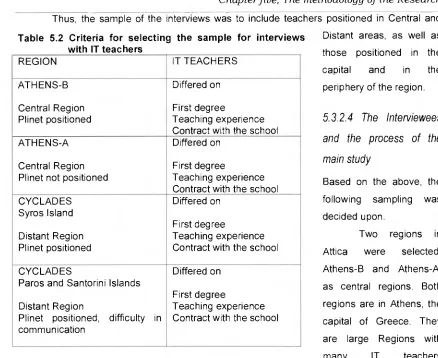
Table 5.2 Criteria for selecting the sample for interviews with IT teachers 87 Table 6.1 The process of introduction of IT and ITE in gymnasiums 97
between 1985 and 1998
Table 6.2 Rationales promoted and objectives proposed in the policy 100 documents for the introduction of computers into gymnasiums
between 1986 and 1997
Table 7.1 Objectives proposed and rationales promoted in the Draft 136 Proposal for the IT Curriculum in 1995
Table 7.2 Objectives proposed and rationales promoted in the IT 137 Curriculum in 1995
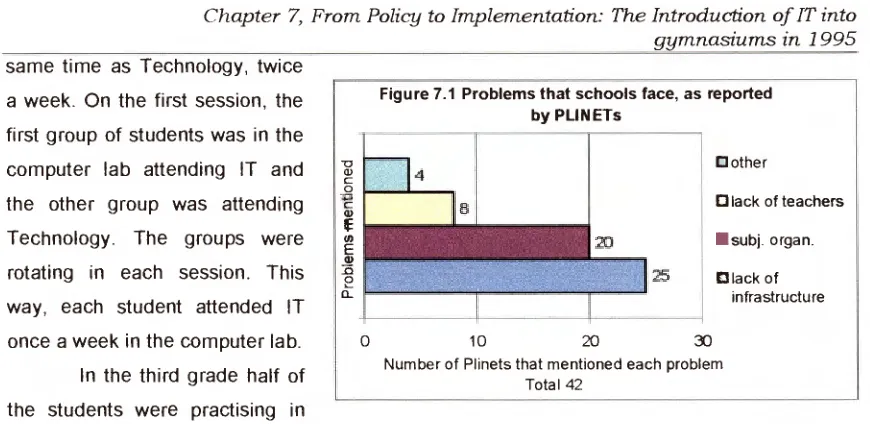
page Figure 7.1 Problems that schools face, as reported by Plinets 146 Figure 7.2 Percentage of IT teachers according to their working 147
contract
Figure 7.3 Percentage of teachers according to their first degree 147 Figure 7.4 Percentage of teachers according to their IT teaching 147
experience
Figure 7.5 Reasons why schools did not introduce IT, as reported by 148 Plinets
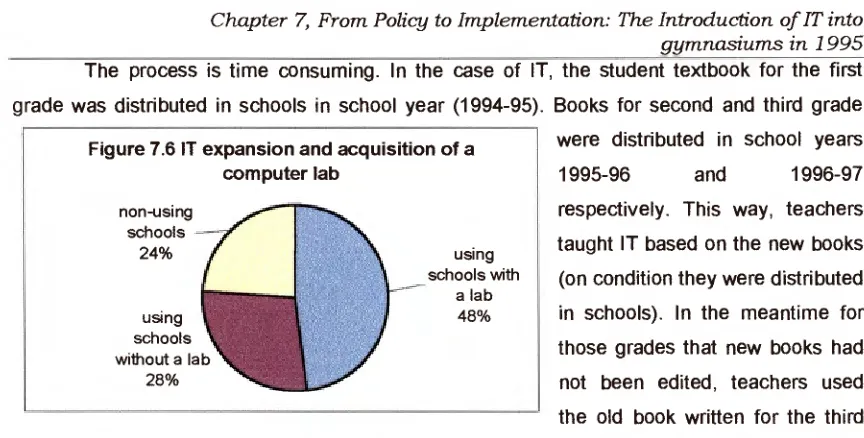
Figure 7.6 IT expansion and acquisition of a computer lab 149 Figure 7.7 Availability of resources across Regions, as reported by 150
Plinets
Figure 7.8 Percentage of Regions where local authorities or parents 150 helped on the provision of equipment
Figure 7.9 Percentage of schools according to their equipment, as 151 reported by teachers
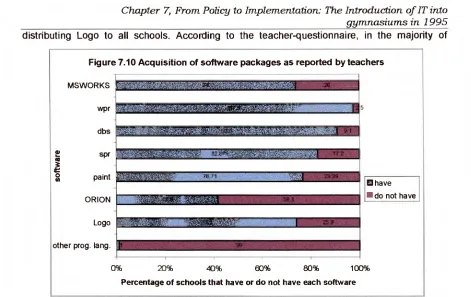
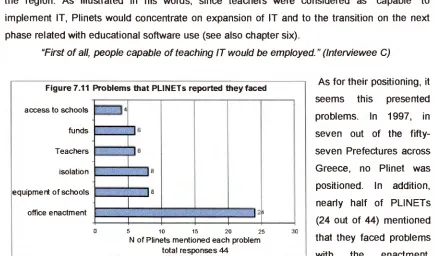
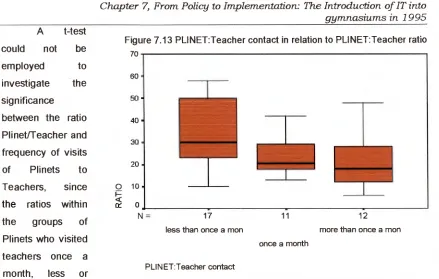
Figure 7.10 Acquisition of software packages as reported by teachers 152 Figure 7.11 Problems that PLINETs reported they face 154 Figure 7.12 Frequency in which PLINETs contact teachers 154 Figure 7.13 PLINET:Teacher contact in relation to PLINET:Teacher 155
ratio
Figure 7.14 Issues that PLINETs discussed with teachers 155 Figure 7.15 Help related with teaching or technical issues that 156
teachers asked from the PLINETs
Figure 7.16 Content of in-service training seminars organised by 156 PLINETs
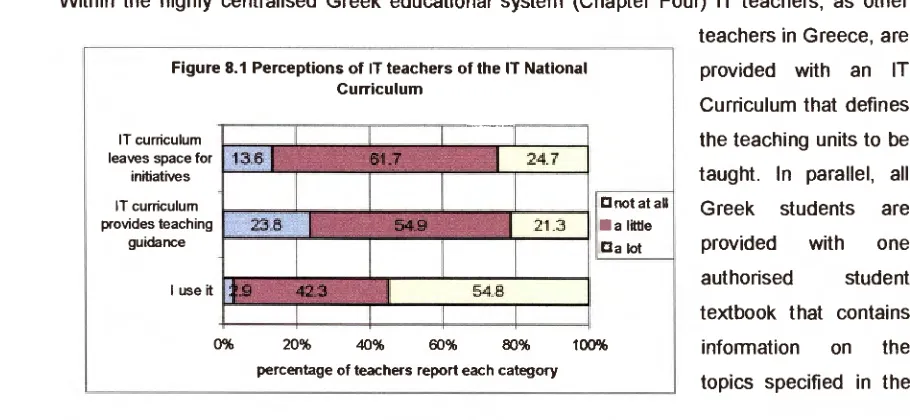
Figure 8.1 Perceptions of IT teachers of the IT National Curriculum 160 Figure 8.2 Perceptions of IT teachers of the IT student textbook 161 Figure 8.3 Type of resources that some of IT teachers used other 161
than the student textbook
Figure 8.4 Software that IT teachers who taught in all grades of 162 gymnasium used in their teaching
Figure 8.5 Teaching units beyond IT Curriculum that the IT teachers 163 mentioned that they taught
Figure 8.7 Reasons that teachers reported for not realising their 164 initiatives
Figure 8.8 Computer use outside of IT sessions 165
Figure 8.9 Most important Objectives/Rationales for IT subject as 167 perceived by the IT teachers
Figure 8.10 IT Teachers' need of training and of help in relation to 169 problems they reported
Figure 8.11 Type of problems that IT teachers reported 170 Figure 8.12 Hardware acquisition in teachers' schools 170 Figure 8.13 Hardware acquisition with respect to technical problems 170
mentioned by IT teachers
Figure 8.14 Need for training and for help in relation to whether 172 teachers reported problems
Figure 8.15 Teachers' need for help and training in relation to 173 problems they faced
Figure 8.16 Teacher training needs in relation to training opportunities 173 they had
Figure 8.17 Acquisition of official documents and books and 175 opportunity for provision of help by the Plinet and of other
source
Figure 8.18 Teaching support and guidance provided to IT teachers 175 from different sources
Figure 8.19 Teaching guidance and support provided to teachers in 176 relation to problems on educational issues they reported
Figure 8.20 Number of different sources to which teachers tend for 177 help
Figure 8.21 Technical support provided to IT teachers from different 177 sources
Figure 8.22 Technical support provided to IT teachers in relation to 178 technical problems they reported
Figure 8.23 Objectives that an IT subject should reflect as reported 179 by the teachers
Figure 8.24 Organisation of an IT subject as proposed by the 180 teachers
Figure 8.25 Teaching location of an IT subject as proposed by 180 teachers
Figure 8.26 Teachers' perceptions on advising decision makers and 180 on flexibility in the teaching units to teach and in the
reported by teachers
Figure 8.28 Appropriate aims for a NC as reported by teachers 181 supporting a NC
Figure 8.29 Appropriate aims for a student textbook as reported by 182 teachers supporting it
"... it (the introduction of computers into education) is both a policy phenomenon (in the sense that school districts and states/provinces advocate/require the use of new technologies) and an innovation problem (in the sense that various groups are genuinely attempting to implement more effective uses of microcomputers)"
(Fullan 1989: p.28).
Over the last three decades, the introduction of computers into education has received considerable attention internationally. The role of computers and of new technologies in education has been strengthened, providing the means not only for economic development but also for educational improvement.
Indeed, the use of computers in education may improve curriculum content. The familiarisation of students with computer applications and Information Technology needs to be a part of schooling, since modern institutions require technology-literate citizens, who will be able to participate dynamically in the digital world. In parallel, computer use may also improve the methods for the realisation of existing educational objectives. It may enhance the teaching and learning of school subjects, providing teachers and students with multi-dynamic tools. Finally, computer use may alter education, proposing new educational aims and practices.
Nations all over the world have already made large investments in hardware, software development and services in order to introduce computers into their educational systems through large-scale initiatives. As discussed in Chapter Three, national policies, during early efforts, focused on the introduction of Information Technology as a curriculum subject, while in the early nineties international interest shifted towards introducing computers into educational practice as media of teaching and learning within existing subjects.
over the slow progress in achieving these goals has been expressed. (Becker 1986, Duguet 1990, Pelgrum & Plomp 1993, Plomp 1994, Plomp et al 1996)
As a result, pessimistic reports have argued that what computers have to offer is not worth the cost, since they offer nothing exceptional or different to the present educational practices. On the other hand, reports and studies by computer enthusiasts have argued that it was not the computer that had nothing to offer to education. It was those who used it who did not know how to exploit the potential of the computer in the interests of improving their practice and their students' learning. Many examples have been described of students interacting with computers to alter their own learning and meta-cognition. The problem is that these have been isolated cases, which have not been widely diffused.
1.1 The introduction of computers into education
Many reasons have been cited for the failure of the diffusion of computer use in schools. Discrepancies were found between policy and practice in relation to computer use in schools. Different reasons have been cited from different countries, accounting for these discrepancies including the following: A lack of equipment; insufficient quality of software; a lack of funding; location of computers in computer labs, which inhibited their use in classroom teaching; entrance examinations to upper secondary schools; a lack of interest, motivation and computer competence in teachers; the slow pace at which teaching methods adapt; the brain-drain in education, in the sense that qualified persons were employed outside the educational sector (Plomp et al 1996).
In parallel, it was argued that computers come to support different school, classroom and teacher cultures. This way, intended philosophy of software by initiators or designers is many times distorted when it is used in a classroom (Olson 1982, Watson 1992, Hoyles 1992). The teachers' subjective meanings and philosophies about computer use, the resources available and the support provided have influenced computer use in schools and classrooms.
Research focusing on policies related to the introduction of computers in schools, showed that these policies succeeded, either in cases where computers were introduced within a compulsory subject, or in cases where computer use as a tool within existing subjects had become a part of an examination program (Plomp et al 1996, Brummelhuis 1995). Moreover, policies introducing computers in education succeeded when, external support (financial support, training, hardware and software provision) was combined with bottom-up approaches (accepted relevance of computer use by teachers, positive school policy, monitoring and problem-solving approach) (Brummelhuis 1995).
more research is needed to understand the process of the introduction of computers into education.
1.2 The study
The aim of the research is to explore the process of the introduction of computers into education considered in a framework of educational innovation.
1.2.1 The introduction of computers into education as an educational innovation
Studies on educational innovation (Chapter Two) have pointed out that education is a system comprising many parts, which cannot be isolated from each other. Schools are socially but also locally constructed. Educational innovations are -or, at least, should be - a means to an end. This end is shaped by moral, social, educational, pedagogical, political and economic trends and priorities at the national level, as well as by beliefs of individuals, and schools at the local level. In parallel, they have pointed out that the implementation of an educational innovation is a complex process, involving many interrelated factors at the initiation and implementation levels. Innovations are rarely, if ever, implemented exactly as envisaged by their initiators, since they are influenced by the beliefs of participants in the innovation, as well as by the context of implementation. Considering the above, in order to understand the process of the introduction of computers into education, it becomes necessary to explore the process of initiation of computer use into education, as well as its implementation. Thus, the main research question of the thesis is:
♦ What are the implications for the initiation and implementation of computers into education as an educational innovation?
This main research question is broken into three main questions that guide the literature review as well as the empirical research as follows.
1. In what way can the introduction of computer use into education be conceptualised as an educational innovation?
computers into schools, however, presents specific characteristics due to its technical complexity. The introduction of computers requires a massive investment in hardware provision, software development and teacher training. This investment has to be sustained over time and teachers' in-service training becomes an issue of great importance, since the field is continuously evolving.
The value that the computer use presents and the complexity its introduction into schools involves are influenced by the nature of computer use. Thus, the thesis distinguishes two broad categories of computer use (IT and ITE). It presents the different values that these categories reflect, and discusses how their promotion fits (or not) the context of the innovation with respect to a country's priorities. Moreover, it discusses the level of complexity their introduction into schools involves, as influenced by the nature of the category of computer use, and the context of the innovation - the technical and human resources at hand and their compatibility with existing educational objectives and structures.
2. In what way are the two categories of computer use (IT and ITE), as well as the process of their introduction into education, illustrated in the international experience?
The study draws on international experience and discusses approaches, policy rationales as well as implementation strategies for the introduction of computers in education. The cases of the early efforts in England and Germany to introduce computers into education, serve to illustrate these different categories of computer use, the different policy rationales for their initiation, and the way these policy rationales were influenced by the characteristics of the computer use and by the context of the country. The cases of the two countries (Chapter Three) indicate that many interrelated factors at the policy and the school levels, throughout the initiation and implementation phases of an innovation, influence this process. Moreover, the importance of these factors differs according not only to the characteristics of the computer use, but also to the context within which the innovation is introduced. The latter accounts for differences between a country's needs and priorities, their educational aims and objectives, as well as their innovation policies. The above indications are further explored and analysed in an empirical in depth study of the effort of one country to introduce computers into education. The empirical study focuses on the introduction of computers into general education in Greece, and the final research question was phrased as follows:
3. What was the process of the initiation and implementation of computers into Greek gymnasiums?
a. What category of computer use was introduced into Greek gymnasiums over time and for what reasons?
In order to answer this question, the thesis explores the factors that influenced the initiation of computer use into Greek schools. It focuses on the policy level, and investigates the way the value of computer use, as accorded in relation to the country's priorities, influenced its initiation. Moreover, it investigates the way the complexity that the computer use presented for its introduction into schools, in relation to the particular educational system, available infrastructure and innovation policy, also influenced its initiation. Specifically, it investigates the following:
• In what way did the proposed objectives for computer use in general education change over time?
• In what way did the policy rationale for the introduction of computers in general education change over time?
b. In what way was the initiated computer use implemented in schools and what influenced this implementation?
In order to answer the above question, the thesis focuses on a specific phase of the innovation (1994-97), and explores the way a specific computer use (IT) was shaped in the transition from policy to implementation level. It investigates the way IT as a subject was perceived by initiators and by IT teachers. Specifically, it investigates:
• In what way did policy makers perceive the objectives of the IT curriculum in gymnasiums?
• In what way were the objectives of the IT curriculum reflected in policy documents? • In what way did IT teachers perceive the objectives of the IT curriculum?
• In what way did IT teachers perceive the implementation of the IT curriculum? • What was the context of implementation of the IT curriculum?
Greece was not chosen to stand as a representative case. By contrast, its specificity was acknowledged. It was expected though to promote an understanding of the process, empowering the reader to identify common or uncommon issues and relate it to his/her situation. Chapter Four presents the case study of Greece and describes the context for the introduction of computers into schools. It identifies the educational paradigm that the innovation follows, the main actors at the initiation stage and at the implementation stage. It also presents the educational context of the country in terms of the prevailing pedagogical orientation and structures that might influence decisions about the initiation of the innovation.
The methodology of the empirical research is presented in Chapter Five.
1.2.2 The results of the empirical research and the implications drawn from the study
discusses policy rationales and implementation strategies over this time based on the theoretical framework developed in Chapter Three. The discussion in the chapter focuses on the way the value of the computer use as accorded in relation to country's priorities and needs, in combination with the complexity that the computer use presented in relation to the Greek context influenced the policy approaches taken. Moreover, the way external factors, such as funding from the European Community, influenced the policy approaches taken at specific times is also discussed.
Chapters Seven and Eight focus on the introduction of IT into Greek schools at a specific time and explore the way IT was shaped in the transition from policy to implementation levels. Chapter Seven discusses the way IT was perceived by policy makers and how these views shaped implementation strategies. It identifies different perceptions of IT among the policy makers and discusses the way these differences were reflected in policy documents, either in terms of generalities or even contradictions between the documents or within the documents themselves. The role of the Ministry of Education and the chosen implementation approach for the introduction of computers into education are discussed, and infrastructure put in place to support the implementation of IT is presented.
Chapter Eight discusses the implementation of IT as perceived by IT teachers. The way IT teachers perceived their role in the implementation of IT and the way they perceived its objectives and implementation are discussed. Finally, the context that the Ministry had put in place to support the implementation of IT, as perceived by IT teachers is presented.
Chapter Nine attempts to pull together all the issues discussed in the earlier chapters concerning the introduction of computers intro education as an educational innovation. First it revisits the theoretical considerations of the thesis. Further, it discusses the findings of the empirical research documented earlier (chapters Six, Seven and Eight), concerning the introduction of computers into Greek general education, in the light of the theoretical considerations.
In this chapter I discuss educational innovation. I review the literature on educational innovation to stand as a base from which the introduction of computers in schools is explored.
In the first section, the chapter briefly presents different paradigms of studies on educational innovation and the shift of their focus from the innovation towards the context of the innovation and to the process of the innovation. The second section of the chapter explores the initiation phase of an innovation. Discussion is based on the issues of who decides for what innovation based on which criteria. It also discusses the way the decisions of the policy makers may influence the accommodation of the innovation by teachers. The third and final section of the chapter discusses the way that teachers may perceive an innovation proposed by policy makers and the way they may react to it.
2.1 Studies on educational Innovation: the shift of focus from "product"
towards "process".
Educational innovations flourished in the 60s and 70s. Their failure to bring about fundamental changes and improvement in schools created the need to study innovation and its process. As discussed below, studies on educational innovation changed their focus of interest over time, under three main perspectives: the technological, the political and the cultural (House 1979).
Earlier studies under the technological perspective focus on the innovation itself. They view the innovation process separated into functions and components, based on rational analysis and empirical research. The most dominant model of innovation within the technological perspective was Research, Development and Diffusion (R, D & D) paradigm. According to the RD&D model, first, knowledge is advanced in the research stage, which is the first stage of the innovation. Next, a solution is invented and built during the developmental stage, which presents the second stage of innovation. Third, the innovation is introduced to practitioners in the diffusion stage, and finally, it is incorporated into school systems in the adoption stage. This approach assumes a rational sequence of activities, massive planning, a division of labour, high development costs and a passive consumer at the end of the chain (House 1979). After failure of many innovations, the inadequacy of the "Research, Development and Diffusion" model of innovation was highlighted. As stated by Hurst (1983), "... planned
and one-way oriented, since adopters had just to accept "the" innovation made for them. It treated practitioners as passive elements, and also, it created a large-scale hierarchical division of labour (House 1974). Moreover, it assumed considerable consensus between developers and users. It suggested that curriculum users accept and implement change without objection, provided that they fully understand this change. It also assumed that schools are objective structures, rational organisations organised to achieve certain goals. "The more 'rational' the
organisation, the more effective it becomes" (Elliot 2000 p.204). In this sense, teachers needed
to be convinced of the rationality of the program, irrespective of their subjective preferences and desires. Diverse practices and conflict would be interpreted as a failure of communication or bad techniques of persuasion (Elliot 2000).
The political perspective offered an alternative explanation to the problem of educational innovation, focusing on the innovation in context. It focused on conflicts and compromises between participants of innovation, assuming that an innovation is not perceived the same way by all participants (House 1979, Hurst 1983). It was pointed out, that teachers and policy makers have differential access to the rewards of an innovation and thus, different incentives. It was argued that the higher the position of someone in the hierarchy, the higher their benefits and the lower their costs (House 1974).
MacDonald and Walker (1976) proposed another way to understand the issue of conflict and compromise between participants; this was the negotiation of the meaning of innovation. They argued that basic conflicts in values are camouflaged by a common rhetoric to which all subscribe. The gap between project intent and classroom practice is the consequence of a trade-off in meaning, that is negotiated between developers and teachers and also between developers and academic critics. Developers negotiate an idealised product image with academics. Hence the gap between practitioners and critics is not the result of miscommunication but of negotiations that the developers must conduct in order to survive.
However, the political perspective assumes that compromise and consensus may be achieved (House 1979). The issue of "advocacy groups" was raised as a major factor in the success of the innovation. Advocacy groups were important to negotiate meaning and secure resources and rewards with the participants in an innovation. Fullan (1991), discussing the role of the participants of an innovation argues that as innovation becomes more complex, the role of change facilitator becomes crucial. Effective internal and external consultants must facilitate the development of individual and organisational meaning of a particular change, interacting with school and district personnel. Hall, Putnam and Hord (1985)1, however, pointed out that the role of local change facilitators varies between districts in terms of authority they have, time spent in schools, and activities they are involved with2. They also argued that facilitators often do not have specialised training for their role, while it is very difficult to describe what they do.
2
In the case of the introduction of computers into Greek education, PLINETs were appointed in order to help teachers and support the diffusion of IT. Their role is discussed in detail in chapter seven, section 7.3.4.1.
1
Moreover, they argued that their role is not always clear between the participants of the innovation. Facilitators often have little clarity about the scope and primary purposes of their role, while there is little congruency between what they say they do and what others perceive they do. Additionally, teachers view them as being remote from the classroom, and they have little understanding of what facilitators really do. Finally, they argued that although facilitators provide the impetus for many innovations, they are in crossfire of demands and expectations.
While, however, little is known about their role, more is known about effective and ineffective facilitators. As Fullan (1991) argues, if facilitators work on a one-to-one basis they will have limited impact because they will reach only a small percentage of teachers. If they work without a co-ordinated plan for managing change, it will be extremely difficult for them to set up activities involving assistance to support the change. Effective facilitators have to access and balance expertise in both the content of change and the process of change, while they must take into account each school and each classroom context with which they wish to work. Finally, they must develop working relationships with other change leaders.
In parallel with the political perspective, another perspective began to emerge; the
cultural perspective. This emphasised the importance of the school culture (Smith 1968,
Sarason 1971). The school was viewed as a set of structured interacting roles in a tradition-dominated social setting. These roles shaped the behaviour of the participants, creating conflict. According to the cultural perspective, conflict is a clash between two distinct cultures: the researchers and the teachers.
Recent studies in the cultural perspective emphasise the importance of the culture of the school and point out that innovation is a process and not an outcome. As Fullan (1993) argues, "...change is a journey and not a blueprint." (p.24) It is non-linear and loaded with uncertainty. However, anxiety comes along with the creativity that is viewed as valuable for educational change (Fullan 1999). Hargreaves and Evans (1997) also argue that educational change in our post-industrial age must be viewed as shared journeys and not destinations, always open to revision and review.
innovation, but also to develop a problem solving approach, which means that they would feel the need for the change.
It has been extensively argued that teachers need to be involved in the process of educational change. This last aspect would allow for the development of commitment, which is a strong motive for change. (Rudduck 1991;. Hargreaves 1994; Sarason 1996; Hargreaves & Evans 1997; Fullan & Hargreaves 1998; Sarason 1998; Fullan 1999). In this line of argument, empowerment of the school and of the teacher is needed. Schools within "low structured situations" (Posch 2000) should take the responsibility of the curriculum as best matched to the diverse needs of students.
Within this process, a learning attitude and a structure of problem solving needs also to be developed. Effective responses to complex situations can not be developed, unless problems are seen as things to be solved, and not as occasions for blame. Moreover, conflict needs to be seen as collaborative diversity, a necessary part of change (Fullan 1993; Hargreaves & Evans 1997; Fullan & Hargreaves 1998; Fullan 1999). These kinds of interactions within and across schools flourish within collaborative structures of help and support, "where
teachers work together, become less autonomous and isolated, more open at risk taking, better
skilled through continous development, and ultimately empowered in accomplishing what they
set to do" (Fullan & Hargreaves 1998).
Hargreaves (1994) argues that a meaningful and realistic analysis of educational change requires us to examine the purpose and context of its development. This requires us to look at the interrelationships between the different parts of the context as a whole. By dealing only with issues of knowledge, skill and compliance in trying to make teachers more effective, we fail to deal with other vital influences on the nature and quality of teachers' work. As asserted by Hargreaves: "These are the teacher's purpose, which drives what the teacher does; the kind
of person the teacher is, in their life as well as their work, and how this affects their teaching; the
context in which teachers work, which limits or liberates them in terms of what they can achieve;
and the culture of the teaching community and how teachers' relationships (or lack of them) with
their colleagues can support or subvert them in their efforts to improve the quality of what they
offer to their students." (Hargreaves 1994: p. xiv)
Sarason 1998; Brennan & Noffke 2000). Ball (1993), looking at the role of the teacher in English educational system, argues that after the educational reform in the late eighties, the teacher becomes absent in the discourse of educational policy. At the same time, elements of control shift from the teacher to the parents via open enrolments, parental choice and per-capita funding (Ball 1993, Maguire & Ball 1994). Within this framework, which Kickert (1991)3 calls "steering at a distance", constrains are replaced by incentives, while prescription is replaced by ex-post accountability based upon quality or outcome assessments. Teachers become resources. They are visible as the focus of appraisal, accountability, comparison and review. However, they are invisible as expert professional actors and decision-makers. They are to be managed. The key points of control are over the discourse and over the indicators of performance, rather than on practice. (Ball 1993)
Turning to the case of Greece, as will be presented in chapter four, the initiation of an innovation is the responsibility of the Ministry of Education. The Ministry of Education is at the top of administration and control of education. It is responsible for the development of the National Curriculum and its implementation by means of providing the necessary resources, the employment of necessary teaching staff, and provision of in-service training. Although the need for participation at all levels of decision-making was recognised in the mid-eighties, the different advisory bodies that had been established to consult the Ministry of Education, are not allowed to take decisions and to exercise power over the administration. Within this framework, school directors and intermediaries such as school advisors are not influential, since they only monitor and support the implementation of the authorised National Curriculum. In parallel, teachers are not involved in decision-making, while they are called to implement the authorised curriculum. There is little autonomy at the level of schools, while teachers' practice is ruled by the "single" textbook and controlled by school advisors appointed by the Ministry of Education (see also chapter four).
The next section focuses on the initiation of an innovation as can be seen within a centralised educational system.
2.2 The initiation of an innovation: a matter for policy makers
"...what we are striving for is the actual implementation of a good quality program that
we value" (Fullan 1991: p.18)
A very important issue that has come up in the recent literature about educational innovation, is the issue of value. As argued by Fullan (1991), the meaning of the process of an innovation is to implement a "good" innovation, to bring into the school a new and "good" idea and put it into practice. He points out though, that different innovations and changes "exist" expressing a wide range of values. The main point that arises, as a question rather than an argument is, "Who judges the quality of an innovation, based on which criteria?"
Fullan (1991), suggests that advocacy from the central administrator presents an influential factor for the promotion of an innovation. That is because the central administrator can combine access to information, internal authority and resources to support the initiation of the innovation. In parallel, teachers can be very influential through teachers associations, as well as working together and disseminating the innovation. It has to be considered here that the power and influence they may have on the decision phase of a certain educational system is dependent on the innovation policy. Bowe and Ball (1992) as well as Sarason (1990) rightly emphasised that schools remain mostly marginal to the policy-making process; the voices of heads, classroom teachers and students are either excluded or underrepresented, i.e. via teachers' unions. Shaeffer (1991) pointed out that centralised top-down systems do not allow local-level action.
Within centralised educational systems, it is the policy-makers in high levels of the hierarchy of education that decide for or against an innovation. This is true in the case of Greece. As briefly presented before (p.11) and will be presented in chapter four, in the case of Greece, school administrators, school advisors and teachers may report their views, although, they do not participate in decision making.
Interestingly, Sarason (1990) made the point that many of those who participate in the commissions set up for deciding on educational reform, have been chosen to a great extent, "for
the clout their names and status lend to [reform] reports".
It was pointed out that a basic feature of these external reformers is that they have no
first hand experience of school systems, apart from having worked there or having been
students, several or many years ago, that is - given the great speed of change - in a very different context. Lack of familiarity with something one wants to change usually results in a misconception of it and the handling of it in ways that do not suit it and may also harm it. To provide an example, in Silberman's 4 review of education in 1970, it was concluded that the failure of the reform movement to bring about change was due to the fact that "its prime movers
were distinguished university scholars". He argued that these people, despite their good
intentions and intelligence, came up with abstract theories and ideas not related or relatable to real school practice.
Turning to the criteria on which an innovation may be promoted or not, Fullan (1991) argues that the innovations that are considered needed, and thus chosen for promotion, are innovations that their values and their objectives are congruent with what is perceived as the priority needs for education. It is argued that education reform all over the world nowadays, although justified by educational need, indirectly or even directly, stems from current economic, political and social demands. More specifically, the new international economy is affecting more than business. The competition of economic forces, the fear of economic depression as well as the reality of it, demand, across national boundaries, the reshaping of schooling according to
the economic needs (House 2000). The preparation of students for the future society becomes an issue of great importance and their education receives a great deal of attention. In addition, education is blamed to a great extent for many crises such as economic, social and moral (Guthrie & Pierce 1990).
In this context, politicians and administrators often claim that something drastic has to be done in order to improve the education offered. This has become very common in the 1980s and the 1990s, in the context of the post-modern world, where educational change has become frenetic, being marked by "recurring waves of reform" that are developed in short-term patterns. As change accelerates the sense of overload and fatigue among teachers becomes stronger. Teachers feel very tired of the system itself and, possibly, are less willing to co-operate with the multiple reform efforts imposed on them. In addition, the waves of reform are often found to be incoherent and inconsistent with each other (Stronach & Morris 1994). This results in confusion and high levels of resistance by teachers. It is not to say that innovations cannot be introduced in parallel, but they need to fit in the broader context of the school and the education system's objectives. As stated by Hargreaves, "in education, as in other walks of life, things go together" (Hargreaves 1994: p.8).
Innovations have to be a means to an end, and not an end by themselves (Hurst 1983; Fullan 1999). Fullan, in his earlier writing (1991), talks about 'opportunistic innovations', that turn out to be meaningless. He argues that the community often influences decisions. The more highly educated communities create more pressure for the adoption of desired innovations or react strongly to unwanted innovations. Yet, an indirect way that a community can influence the promotion of an innovation is the political desire of governments to satisfy their voters, which leads to opportunistic approaches to innovation with no clear educational objectives. The combination of social-economic reasons and desire to ease community pressure often leads top-down changes to become symbolic in nature; namely, they are prescribed for reasons other than educational. As discussed, such reasons are to offer a political response, to appease community pressure, to gain more resources, to appear innovative and to impress rather than to offer real solutions to educational problems. Politicians need to be seen to do something for the good of education (Fullan 1991). Given that policy makers have poor knowledge and are distant from the complex school systems (as discussed next), they offer simplistic and unrealistic versions both of the problems they address and the "solutions" they propose.
those efforts. Thus the reformers impose an impossible task on teachers, especially when they are distinguished by an urge to bring about a "quick fix". The issue of time has been widely discussed (Sarason 1996; Rudduck 1991; Hargreaves 1994) and it is discussed more extensively in the next section, in terms of the way it is seen from the perspective of the teacher.
Another aspect of the symbolic nature of top-down changes, is that when they lose their political "glamour", after the first problems of implementation appear, they become supplemented or replaced by new (usually optimistic and impressionistic) reform directives. These new additional features may not fit in with them, or even more, they may propose a totally new perspective. This inconsistency must become more evident in circumstances of political turnover, where politicians do not need only to be seen to do something for education but also to be seen to do something better than the opposite political group (House 1974).
Additionally, external reformers inadequate knowledge of the system, as was detected by Sarason (1990; 1998), concerns the lack of a holistic vision of and approach to the education system, namely, the way the groups and the problems in the system are interrelated. As he explained, the partial view results to conceiving problems and attacking them separately, while the stance "who is the villain" is often adopted. Hargreaves (1994) provided a distinctive example of it by referring to the common assertion that educational standards are low and the young are failing because the practices of many teachers, or the teachers themselves, are deficient and misdirected. However, as Sarason (1998), argues "there are no villains. There is a
system" (p.141), made up of the practices and attitudes of colleges, universities, boards of
education, school administrators, political leaders.
Indeed, fragmented approaches may be convenient, but they are also simplistic and misguided and fail to bring about change, because problems and groups in the education system do not exist and develop in isolation from the others. Moreover, we could not say that in education there are villains in the sense that a group has deliberately sought to create problems. Thus, although some partial changes may appear to be beneficial, they are unsuccessful because they do not fit in well with the whole context.
Moreover, it is argued that successful paradigms have not been diffused into the system (Sarason 1998). The issue of transferability of successful paradigms was highlighted (Fullan 1999) and system's diversity was highlighted. Another problem that has been found in centrally imposed innovations, and especially within broad scale implementation, is that they overlook the system's diversity, the fact that the education system of a country includes thousands or hundreds of schools that happen to differ "widely and wildly" in many respects.
What is more, as Bowe and Ball (1992) emphasised, schools are not equally able and
prepared to respond to the reform directives. Firstly, the school staff might lack the capacity,
namely the experience and skills, to respond satisfactorily to change. Secondly, there are
contingencies such as staffing (recruitment, experience, innovative spirit, quality of
collaboration), student recruitment and existent facilities/resources that may advance or inhibit significantly the possibilities of change. Finally, they said, the history of the school, especially in attempting innovations, as well as its commitment to pedagogical principles also influence the treatment of any top-down changes.
Similarly, Finnan & Levin (2000) talked about basic beliefs and assumptions that underpin school cultures, that are locally constructed. These include beliefs about a school's expectations for students, students' expectations for school experience, expectations for adult members of school communities, acceptable educational practice, as well as desirability for educational change. At this point, we should add that the wider socio-economic context of the school must play a very important role, because it influences the above four dimensions.
Planning and prescribing changes for a great variety of schools requires the belief that one can create educational "products" that can be easily diffused and used in many different educational settings. As House (1978) argued, it requires a "doctrine of transferability", while the great diversity makes such transitions infeasible and utopian. Thus, transferability must be conceived as not just dissemination, but also as figuring out how to replicate the conditions that resulted in successful change in the first place (Fullan 1999).
Countries with comparatively high standards of student achievement (i.e. Japan, Korea and Taiwan) have powerful, centralised national programs and policies (Sarason 1990). Their devices include, usually at a nation-wide level, the introduction and imposition of teacher-proof curriculum guidelines, official textbooks, standardised testing (to monitor teaching) and new teaching methods that are said to have proven their effectiveness (Hargreaves 1994).
However, the policy texts that accompany and represent them usually have meanings that are neither fixed nor clear, which makes the "carry over" of meanings from policy level to education practice subject to personal interpretation, contention and distortion (Bowe & Ball 1992).
At this point, it is helpful to refer to Roland Barthes's classification of texts into "readerly" and "writerly" ones.5 He suggested that in readerly texts there is the minimum of opportunity for creative interpretation of the content by the reader, who has either to accept it or to reject it. By contrast, he claimed, in writerly texts there is a great deal of such opportunity and readers can "translate" the text, give critical responses to it, go beyond it and transform its meanings in a progressive or radical way. With regard to the official policy texts and their commentaries (that usually accompany them to make them more accessible), it has been found that they can be very often characterised as "writerly" texts. Moreover, it has been found that the series of texts
5
that correspond to a prescribed piece of reform may be not only unclear but also incoherent or contradictory to each other (Bowe & Ball 1992).
Both points mean that there is a lot of space for personal interpretation and manoeuvre on behalf of the teachers. This space must be enlarged when teachers know how to view the policy texts critically and from different perspectives. Teachers, as readers of educational reform texts, are neither uncritical nor naïve. The fact that they have their biographies, their values, their aspirations and their vested interests in policy, impacts seriously on how they interpret and treat the given mandates for change. In this way, there are a great number of interpretations and in turn various responses in practice to what appears to be the same prescription for all teachers and all schools. Consequently, new cycles of policy-making begin at the level of each school and classroom. These cycles must be unique, because unique are the persons who form and implement them in accordance with their needs, problems, desires and aspirations. What is more, the various outcomes of the reform directives may well be very different from those that the policy-makers have planned and expect.
At this point, the issue of "painful unclarity" that Fullan (1991) introduced needs to be pointed out. In this situation, teachers experience a lot of discomfort, loss and anxiety when faced with an innovation the terms of which are abstract, ambiguous and confusing. This, results in anxiety on behalf of the teachers, which increases when teachers are under pressure by mandates, especially in highly controlled, "strict" systems. Within this context, openness of policy texts may result in confusion and uncertainty.
Whatever the innovation means for policy makers, and whatever approach they follow to put forward to schools, it is impossible for any external reformers and inspectors to "have total
surveillance of every teacher in every classroom", namely to "every classroom every minute of
the day" (Acker 1997). Thus it seems that teachers have the possibility of doing quite a lot in
2.3.The implementation of an innovation: a matter for teachers
"It is what teachers think, what teachers believe and what teachers do in the level of the
classroom that ultimately shapes the kind of learning that young people get"
(Hargreaves 1994, p. ix)
What has been highlighted in recent literature on educational innovation is that the teacher is the ultimate key to the implementation of any innovation. Many teachers are not passive to the prescribed changes and provide creative or resistant responses to change, shaping them in accordance with their own realities. As discussed before, policy makers often overlook the school context. First, they may overlook the diversity between schools and uniqueness of situation in each school, in terms of existed contingencies (Bow and Ball 1992). Secondly, they may underestimate or overlook schools as "political institutions" in the sense that they present complex interrelations and subjective teacher values and beliefs (Sarason 1982).
Much has been written on the issue of stronger or weaker versions of teachers' reactions to imposed changes. It is significant to note that no matter how weak or strong the filtering of the policy by teachers is, the fact is that this filtering seems to be almost always present. Interestingly, research evidence has shown that the filtering and shaping of mandated changes is a feature of teachers' work that is met in different countries and cultures, even in rigid and highly controlled education systems. (Osborn 1997)
A first issue of consideration is the issue of the practicality of innovation, especially in the case of the centrally imposed changes. Judging changes on the basis of their practicality is for most teachers at the heart of educational change; as Hargreaves tellingly put it, teachers have an "ethic of practicality". When a reform is presented or imposed on them, what they firstly do is to examine the extent to which it fits in with their reality. Huberman and Miles (1984) investigating twelve efforts to improve schools in USA, reported that target users seemed to view innovations as complex, unclear, and hard to do. They felt that innovations would demand substantial changes. On the other hand, administrators viewed the practice as relatively simple, straightforward and manageable, and they tended to put more weight on the merits and to minimise the drawbacks. The problem that has been detected in the case of many top-down reforms is that they often appear with timetables and expectations that are so impressive and high that their failure is easily predicted (Sarason 1990, Hargreaves 1994).
Fullan (1991) suggested that the rational assumptions and descriptions of proposed changes may appear irrational and nonsensical in the eyes of teachers because they do not address the serious issues of boundedness, psychic rewards and time and efforts management on behalf of them.
investment by them. This is by no means easy because, as it is widely accepted, teachers feel overloaded, tired and pressed for time, which certainly discourages them from attempting to innovate.
Sarason (1996) highlights the issue of time as of great importance, in the sense that time is needed to allow for internalisation of and reflection to the innovation. When an individual or a small group are asked to implement an innovation, they need time to locate and develop resources consistent with goals. As he explains, Any attempt to change regularities in the
classroom places the teacher in an unlearning and learning process, a fact that has obvious
implications for the time perspective of those seeking the change"(Sarason, 1982: 286).
Huberman and Miles (1984) also found that innovations needed time to be implemented and institutionalised. More time was needed for complex projects (eighteen months), while down-sized projects needed much less time (around six months). Teachers worked their way through to a more differentiated and integrated understanding of the innovation by making it behave consistently. The most common path was through "technical mastery" of the practice. When the assistance was either less frequent, or not sustained, or of a single type, there were markedly lower levels of commitment and "practice mastery". They reported that enforcing fidelity for substantial, good quality innovations really paid off, provided it was supported with
effective assistance.
This issue turns the discussion to the issue of support, which has been pointed out to present another influential factor for the implementation of innovation in schools. Support was strongly underlined, especially in relation to large-scale innovations. "Large-scale
change-bearing innovations lived or died by the amount and quality of assistance that their
users received once the change process was under way" (Huberman and Miles, 1984: p. 273).
The forms of assistance provided were various: conferences, in-service training, committee structures, team meetings (high-assistance), peer consultation, materials, external consultants, access to central office personnel. Moreover, although strong assistance did not smooth the implementation, it did increase the level of commitment and practice mastery.
Similarly, Fullan (1991) argued that teachers may modify the innovation in their classroom because of lack of understanding of its basic features and objectives. Specifically, teachers may twist the central prescriptions for reform into familiar conceptual frameworks and practices. Possibly, this attitude is also related to people's general tendency to keep as much as possible from their established patterns of thinking and working, which they feel to be threatened by changes, especially when these are imposed from above. In this case they think that they innovate while they do so only very superficially.
exchange ideas, and be empowered (Hargreaves 1994; Fullan & Hargreaves 1998; Fullan 1999).
Hargreaves (1994) pointed out that trying new things always means that an additional burden of work has to be undertaken. Teachers must feel this burden to be heavier and more disagreeable when they are directed to implement change and have not been given any voice during the policy-making process. In this way, they are alienated from the reform enterprise and are, in turn, less willing to spare the time and energy required for its success. Thus, the introduction of top-down changes fail if teacher development strategies do not accompany them. In parallel though, he warned about controlled collaborative models that make "safe
simulations of co-operation and collaboration from which the dangers of spontaneity, sensuality
and creativity have been removed' (Hargreaves 1994: p.13).
In addition to the supportive context or not within which the innovation takes place, the way teachers perceive the value of the innovation influences its shaping in the classroom. Teachers may resist the innovation, and be unwilling to abandon familiar and existing practices that have been proven to be effective in the eyes of teachers. As Marris6 explained, teachers want to preserve their "occupational identity", that is, the wisdom they have accumulated through their own experience and that of their colleagues. Both Marris and Schon7 rightly related the occupational identity of teachers to the context to which they belong. As they explained, this context provides teachers with a framework of theory, values and practices, gradually shaped and shared, through which they make sense of their lives and their context. They discussed this phenomenon, which is both individual and social, as "dynamic
conservatism". Clearly, it forms a serious obstacle to the success of top-down changes, which
must become more serious and powerful when the teachers are unified and act not simply in common but also in collective ways.
In the same line of argument, Osborn et al (1997) who studied educational change in the context of English primary education argued that many teachers assimilate a change in ways that suit their beliefs and allow them to preserve what they consider to be good for their practice and their children. Thus, despite working within a framework of prescribed changes, teachers can become very creative and alter the direction of the top-down changes8'
6
Marris, P. (1975) Loss and Change quoted in Fullan, M. (1993) op. cit., p. 36. Ibid., p. 32.
8