Exotica in CMS
Claudia-Elisabeth Wulz1,a, on behalf of the CMS Collaboration
1Institute of High Energy Physics of the Austrian Academy of Sciences,
Nikolsdorfergasse 18, A-1050 Vienna, Austria
Abstract.Selected results on exotica searches with the CMS detector are presented. The
main topics are dark matter, boosted objects, long-lived particles and classic narrow res-onance searches. Most of the analyses were performed with data recorded at at centre-of-mass energy of 8 TeV, but first results obtained at 13 TeV are also shown.
1 Introduction
At the Large Hadron Collider (LHC) a Higgs boson compatible with the minimal standard model has been discovered. Extensions of this model predict additional Higgs bosons and a wealth of other exotic particles. Searches for new phenomena, however, have been inconclusive so far. The increase of the LHC’s centre-of-mass energy from 8 to 13 TeV has opened up new areas of phase space to find or to exclude new particles. In this report we will concentrate on a few captivating recent topics in the field of exotica, including dark matter, boosted objects, long-lived particles and classic narrow resonance searches. Results from proton-proton data recorded with the CMS experiment [1] are presented. An overview of relevant current beyond-standard-model physics results is available on dedicated web pages [2], in particular under "Exotica" and "Beyond 2 Generations".
2 Dark matter searches
One of the biggest puzzles today is the nature of dark matter. Beside axions, weakly interacting massive particles (WIMP) are well-motivated candidates. A large range of experiments is currently searching for them in space, underground, or at the surface of the earth. Direct detection is based
on the scattering of WIMP dark matter offatomic nuclei, whereas indirect detection makes use of
secondary radiation emitted in their pair annihilation. At the LHC one can also search for dark matter particles emerging in collisions of protons. The methods are based on the detection of particles pro-duced in association with the dark matter. They are are complementary to the ones used in direct or indirect searches and are particularly well suited to low-mass WIMPs and spin-dependent couplings.
Two scenarios for producing dark matter particles (DM,χ) are possible (Fig. 1). The first one assumes
a contact interaction, in the framework of an effective field theory. In the second, a mediator, light
enough to be produced at the LHC, is exchanged. Since dark matter is known to interact only weakly with standard model particles it can only be detected indirectly, through an imbalance of the total mo-mentum of all particles reconstructed in the plane transverse to the LHC beams. Its magnitude is often
¯ q q DM DM ¯ q q DM DM
Figure 1.Feynman diagrams for the pair production of dark matter particles for the case of a contact interaction
(left) and the exchange of a mediator (right).
denoted as missing transverse energy (ETmiss). We focus on the search for single objects (mono-jet,
mono-Z, mono-photon) as well as dijets, accompanied byETmiss.
In the mono-jet search [3] the event selection requires eitherETmiss>120 GeV calculated from
calorimeter information, or a jet reconstructed with the particle-flow technique [4, 5] with transverse momentumpT>80 GeV, andETmiss>105 GeV, whereETmissis also reconstructed with the
particle-flow algorithm, but excludes muons. As signal events typically contain jets from initial-state radiation, a second jet is allowed only if its distance in azimuth (ϕ) from the jet with the highest pT is within
2.5 radians, thus suppressing the dijet QCD background. Events with more than two jets withpT >
30 GeV and pseudorapidity|η|<4.5 are discarded, thereby significantly reducing backgrounds from t¯t and multijet events. The dominant backgrounds come from Z(→ νν)+jets and W(→ ν)+jets events, and are estimated from data samples of Z(→ μμ) and W(→ μν) events, respectively. We studied scalar, vector, axial-vector and tensor interactions for a Dirac DM particle. Fig. 2 (left) shows CMS upper limits for the DM-nucleon cross sections for spin-independent couplings as a function of the mass Mχ, derived from the mono-jet search. Curves from other experiments are overlaid, as well as an area with a possible signal seen by CDMS [6]. Should an effective theory not be valid at LHC energies, we considered the case of an s-channel mediator with vector interactions. The resonant enhancement in the production cross section, once the mass of the mediator (M) is within the kinematic range and can be produced on-shell, can be clearly seen in Fig. 2 (centre), which shows results for two dark matter masses and different mediator widthsΓ.
[GeV]
χ
M
1 10 102 103
]
2
-Nucleon Cross Section [cm
χ -46 10 -45 10 -44 10 -43 10 -42 10 -41 10 -40 10 -39 10 -38 10 -37 10 -36 10 -1
CMS, 90% CL, 8 TeV, 19.7 fb
-1
CMS, 90% CL, 7 TeV, 5.0 fb
LUX 2013
superCDMS CDMSlite
XENON100 COUPP 2012
SIMPLE 2012 CoGeNT 2011 CDMS II CMS Spin Independent 2 Λ q) μ γ q )( χ μ γ χ ( Vector 3 Λ 4 2 ) ν μ a (G s α χ χ Scalar -1
CMS, 90% CL, 8 TeV, 19.7 fb
Mediator Mass M [GeV] 2
10 103 104
[GeV]q gχ
g
90% CL
limit on M/
0 1000 2000 3000 4000 = M/3 Γ
= 50 GeV,
χ
M = M/10
Γ
= 50 GeV,
χ
M
π
= M/8
Γ
= 50 GeV,
χ
M = M/3
Γ
= 500 GeV,
χ
M = M/10
Γ
= 500 GeV,
χ
M
π
= M/8
Γ
= 500 GeV,
χ M contours q g χ g CMS (8 TeV) -1 19.7 fb
Spin Independent, Vector
2 Λ q) μ γ q )( χ μ γ χ ( 0.1
0.2 0.5 1 2 5 10
[GeV]
χ
m
WIMP mass
1 10 102 103
]
2
WIMP-nucleon cross section [cm
43 − 10 42 − 10 41 − 10 40 − 10 39 − 10 38 − 10 37 − 10 36 − 10 χ χ -l + l → χ χ Z → pp -1
= 8.0 TeV, L = 19.7 fb s
Preliminary
CMS
Spin Dependent CMS mono-Z (D8)
CMS mono-Z (D9) = 1 q = g χ truncated, g = 1 q = g χ truncated, g COUPP 2012 SIMPLE 2011 PICASSO IceCube (WW) (D8) γ CMS
mono-CMS mono-jet (D8)
Figure 2.Upper limits on theχ-nucleon cross section, at 90% confidence level, plotted against the dark matter
Other searches for DM have been performed in the mono-Z [7] and mono-photon [8] channels. Fig. 2 (right) shows CMS limits for spin-dependent interactions obtained in these channels, together with mono-jet results and those of other experiments. D8 and D9 denote specific axial-vector and tensor couplings, respectively.
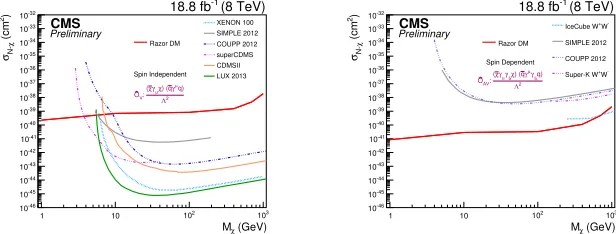
An innovative DM search using the razor technique in the dijet channel has also been performed,
which in particular sheds light on the range of validity of effective field theories [9]. Razor
vari-ables, computed from the jet transverse momenta andETmiss, quantify the balance of the jet momenta.
They have been developed in particular to suppress backgrounds from QCD. It has been shown that these variables are also sensitive to direct DM production [10]. The event selection is looser than that used in the mono-jet searches. However, a comparable sensitivity is achieved, as can be seen from Fig. 3, which shows spin-independent (left) and spin-dependent (right) upper limits on the DM-nucleon scattering cross section obtained with the dijet razor analysis, together with results from other experiments.
(GeV) χ M
1 10 102 103
)
2
(cmχ
N-σ
-46
10
-45
10
-44
10
-43
10
-42
10
-41
10
-40
10
-39
10
-38
10
-37
10
-36
10
-35
10
-34
10
-33
10
-32
10
2 Λ
q)
μ
γ q ) ( χ
μ
γ χ ( : V O
Spin Independent Razor DM
XENON 100 SIMPLE 2012 COUPP 2012 superCDMS CDMSII LUX 2013 (8 TeV)
-1
18.8 fb
CMS
Preliminary
(GeV) χ M
1 10 102 103
)
2
(cmχ
N-σ
-46
10
-45
10
-44
10
-43
10
-42
10
-41
10
-40
10
-39
10
-38
10
-37
10
-36
10
-35
10
-34
10
-33
10
-32
10
2 Λ
q) 5 γ
μ
γ q ) ( χ 5 γ
μ
γ χ ( : AV O
Spin Dependent Razor DM
-W
+
IceCube W SIMPLE 2012 COUPP 2012
-W
+
Super-K W (8 TeV)
-1
18.8 fb
CMS
Preliminary
Figure 3.Upper limits at 90% confidence level on the DM-nucleon scattering cross section as a function of the
DM mass in the case of spin-independent vector- (left) and spin-dependent axial-vector currents (right).
As mentioned before, DM production below a cut-offenergy scaleΛcan be described as a contact
interaction between two quarks and two DM particles. In the case ofs-channel production through a
heavy mediator,Λis identified with M/geff, wheregeff = √gχgqis an effective coupling, determined
by the couplings of the mediator to quark and DM fields. Lower limits on the cut-offscale are shown
in Fig. 4. Following studies presented in Refs. [11–13], we use the variable RΛto define the range
of validity of an effective field theory. RΛwas computed as a function of the effective couplinggeff
in the range 0<geff <4π. The contours corresponding to RΛ=80% for different values ofgeff are
also outlined in Fig. 4. For values ofgeff2, the limits set by the analysis lie above the RΛ=80%
contours.
3 Long-lived particles
(GeV) χ M
1 10 2
10 3
10
(GeV)
Λ
0 500 1000 1500 2000 2500 3000 3500 4000 4500 5000
90% CL limit: AV EFT operator
μ
Razor-0 Expected limit
expected limit
σ
1
±
Observed limit
χ
< 2m
Λ π
/2
χ
< m
Λ
= 80%
Λ
R = 1
eff
g = 2
eff
g = 4
eff
g
π
= 4
eff
g
(8 TeV) -1 18.8 fb
CMS
Preliminary
(GeV) χ M
1 10 2
10 3
10
(GeV)
Λ
0 500 1000 1500 2000 2500 3000 3500 4000 4500 5000
90% CL limit: V EFT operator
μ
Razor-0 Expected limit
expected limit
σ
1
±
Observed limit
χ
< 2m
Λ π
/2
χ
< m
Λ
= 80%
Λ
R = 1
eff
g = 2
eff
g = 4
eff
g
π
= 4
eff
g
(8 TeV) -1 18.8 fb
CMS
Preliminary
Figure 4.Lower limits at 90% CL on the cutoffscaleΛas a function of the DM mass in the case of axial-vector
(left), and vector currents (right). The validity of the effective field theory for different values of the effective
couplinggeffis quantified by RΛ=80% contours.
penetrate the detector and have decay lengths in excess of O(1) m. Other possible signatures, such as lepton jets, are not discussed in this report. We focus on neutral particles decaying to photons [14] or muons [15], and on a reinterpretation of results on heavy charged particles [16].
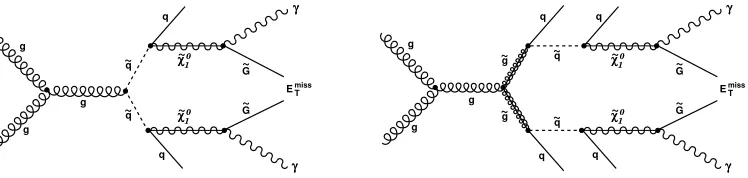
In models with gauge-mediated SUSY breaking (GMSB) the long-lived lightest neutralino ( ˜χ0
1)
decays to a gravitino ( ˜G) and a photon (γ), represented in Fig. 5 by two possible diagrams of squark
and gluino pair-production processes that result in a diphoton final state.
γγ
γγ χχ1
0
χχ1 0
q
~
q
~
G
~
G
~
EmissT
~
~
g
g g
q
q
γγ
γγ χχ1
0
χχ1 0
g
~
g
~
G
~
G
~
EmissT
~
~
q
~
q
~
g
g g
q
q q
q
Figure 5. Feynman diagrams for the squark (left) and gluino (right) pair production processes of long-lived
lightest neutralinos decaying to gravitinos and photons, resulting in diphoton final states.
The event selection for this decay channel required two photons with at least one converted to
an e+e- pair, two or more jets, and E
Tmiss. The latter will exhibit a long tail if it originates from
gravitons, whereas it will quickly fall offfor standard model and instrumental backgrounds.
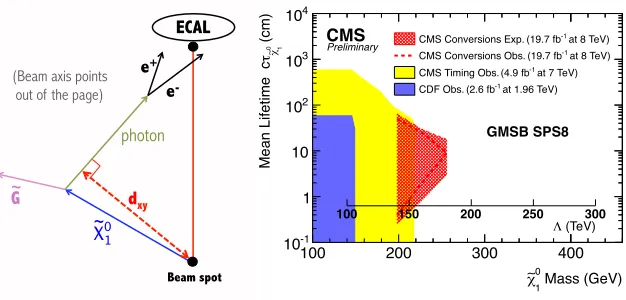
Requir-ing at least one conversion allows reconstructRequir-ing the photon direction from the momentum of the
electron/positron track pair. By extrapolating the photon direction back to the beam axis the impact
parameter of the photon|dxy|can be measured as shown in Fig. 6 (left). A scenario with neutralino
decay lengths cτbetween 0.4 and 100 cm has been considered. We obtain an exclusion region as
a function of both the neutralino mass and its mean lifetime in the context of the SPS8 [17] GMSB
scenario, shown in Fig. 6 (right). The mass of the lightest neutralino is restricted to values m( ˜χ01)
>250 GeV, for a mean neutralino decay length of 10 cm. It can also be seen that the mean decay
length must be greater than 11 cm, for m( ˜χ0
1)=160 GeV. We have obtained roughly a factor of ten
Mass (GeV) 1
0
χ∼
100 200 300 400
(cm)0χ∼1
τ
Mean Lifetime c
-1
10 1 10
2
10
3
10
4
10
GMSB SPS8
at 8 TeV)
-1
(19.7 fb CMS Conversions Exp.
at 8 TeV)
-1
(19.7 fb CMS Conversions Obs.
at 7 TeV)
-1
(4.9 fb CMS Timing Obs.
at 1.96 TeV)
-1
(2.6 fb CDF Obs.
(TeV)
Λ
100 150 200 250 300
CMS
Preliminary
dxy
χ0
χ1
~
G ~
photon
e+ e-
ECAL
Beam spot (Beam axis points
out of the page)
Figure 6. χ˜0
1decay toγ+G˜ in the plane transverse to the LHC beams, with the photon converting to an e+e
-pair and the subsequent reconstruction of the transverse impact parameter in the electromagnetic calorimeter (left); Exclusion plot in the plane defined by the ˜χ0
1mass and its mean lifetime in the context of the SPS8 GMSB
scenario. The scaleΛis also shown.
Two models have been considered in a study of long-lived particles decaying to muons [15], with a topology requiring two muons originating from a displaced vertex, detected in the muon chambers
only and not in the inner tracker of CMS. The muon reconstruction and selection efficiencies evaluated
by Monte Carlo simulations have been cross-checked with cosmics data. Limits have been derived for a non-standard-model Higgs boson H decaying to two long-lived spin-0 bosons X), and for a squark pair, where each squark decays to a quark and a long-lived neutralino, which in turn decays to two muons and a neutrino in an R-parity-violating scenario. The study is orthogonal to a previous one that used only the tracker [19]. It improves sensitivity to particles that are particularly long-lived. The two analyses have been combined. The example plots of Fig. 7 show limits on the cross sections multiplied by the branching fractions into dimuons for the long-lived particles in the two models, with
various combinations of masses for X bosons and squark/neutralino mass ratios.
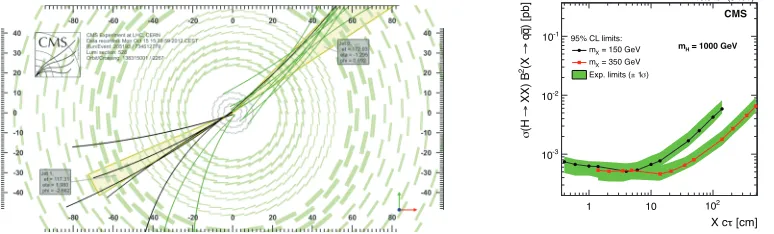
A hidden-valley benchmark model has been assumed in a search for displaced jets [20]. Decays of particles from the hidden valley occur via a hidden-sector mediator as they do not couple directly
to standard-model particles. A long-lived, spinless, neutral exotic particle X0 which decays toqq¯
is assumed. In this model, the X0 is pair-produced in the decay of a non-standard-model Higgs
boson, i.e. H0 →2X0, X0→ qq¯, where the Higgs boson is produced through gluon-gluon fusion.
This model predicts up to two displaced dijet vertices within the volume of the CMS tracker per event. The topology requirement was therefore two jets originating from the same displaced vertex. An event with this topology is shown in Fig.8 (left). The yellow cones represent the jet pair. The displaced vertex, with a transverse distance from the primary vertex of 5 cm, is defined by the five black tracks belonging to Jet 0 and one black track belonging to Jet 1. Fig.8 (right) illustrates expected
and observed upper limits for the cross section times branching fraction for H0→2X0with X0→qq¯,
at 95% confidence level, for a Higgs boson mass of 1000 GeV and two X0 boson masses, 150 and
350 GeV, as a function of decay length.
[cm] τ c -2
10 -1
10 1 10 2
10 3
10 4
10
) [pb]
-μ
+
μ
→
B(X
XX)
→
(H
σ
-4 10
-3 10
-2 10
-1 10
1 10 2 10
2 = 400 GeV/c H m
(8 TeV) -1 20.5 fb
CMS Preliminary
Observed limits
2
= 20 GeV/c
X
m
2
= 50 GeV/c
X
m
2
= 150 GeV/c
X
m
) σ 1 ± Expected limits (
2
= 20 GeV/c
X
m
[cm] τ c -1
10 1 10 2
10 3
10
) [pb]
ν
-μ
+
μ
→
0
χ∼
,
0 χ∼
q
→
q
~
B( )
q
~q ~+
q
~q ~ (σ
-4 10
-3 10
-2 10
-1 10
1
(8 TeV) -1 20.5 fb
CMS Preliminary
Observed limits
2
= 120 / 48 GeV/c χ∼
/ m
q ~
m
2
= 350 / 148 GeV/c χ∼
/ m
q ~
m
2
= 1000 / 148 GeV/c χ∼
/ m
q ~
m
2
= 1500 / 494 GeV/c χ∼
/ m
q ~
m
) σ 1 ± Expected limits (
2
= 120 / 48 GeV/c χ∼
/ m
q ~
m
Figure 7.95% confidence level upper limits onσ(H→XX)B(X→μ+μ−) for mH=400 GeV with various X
mass points (left). The shaded band shows the±1σrange of variation of the expected limits for the case of a 20 GeV X boson mass. Corresponding bands for the other X boson masses show a similar level of agreement and are omitted for clarity; 95% CL upper limits onσ( ˜qq¯˜+q˜q˜)B( ˜q→qχ˜0,χ˜0→μμν) as a function of the neutralino
lifetime. Shaded bands show the±1σrange of variation of the expected limits for the case of a 120 GeV squark and a 48 GeV neutralino mass. Corresponding bands for the other squark and neutralino masses show a similar level of agreement and are omitted for clarity.
CMS
(8 TeV)
-1
18.5 fb
[cm]
τ
X c
1 10 102
) [pb]
q
q
→
(X
2
XX) B
→
(H
σ
-3 10
-2 10
-1 10 95% CL limits:
= 150 GeV
X
m = 350 GeV
X
m ) σ 1 ± Exp. limits (
= 1000 GeV
H
m
Figure 8. Candidate event with displaced jets (left); Expected and observed upper limits for the cross section
times branching fraction for H0→2X0, X0→qq¯(right).
greater than O(1) ns could be observed as high-momentum tracks with anomalously large energy losses through ionization (dE/dx). These particles could also be highly penetrating such that the fraction reaching the muon chambers would be sizable. The muon system could therefore be used to help with identification and with the measurement of the long time-of-flight of the particles. Nuclear interactions may also lead to charge exchange, such that the HSCP becomes neutral and can therefore no longer be detected in parts of the tracker or the muon chambers.
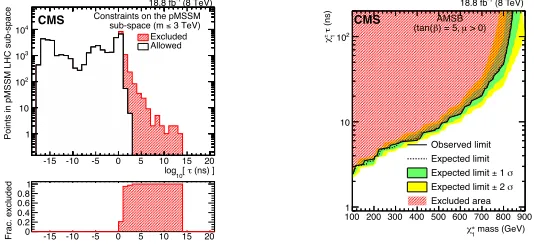
points predicting long-lived charginos are excluded. The results represent the first constraints on the pMSSM obtained at the LHC.
(ns) ]
τ
[ 10 log
-15 -10 -5 0 5 10 15 20
Points in pMSSM LHC sub-space 1
10 2 10
3 10
4 10
Constraints on the pMSSM 3 TeV)
≤
sub-space (m Excluded Allowed
-15 -10 -5 0 5 10 15 20
Frac. excluded 0
0.2 0.4 0.6 0.8 1
(8 TeV) -1 18.8 fb
CMS
mass (GeV) ± 1
χ
100 200 300 400 500 600 700 800 900
(ns)
τ
± 1
χ
1 10 2 10
(8 TeV) -1 18.8 fb
CMS AMSB
> 0)
μ
) = 5,
β
(tan(
Observed limit Expected limit
σ
1
±
Expected limit
σ
2
±
Expected limit Excluded area
Figure 9.Number of pMSSM parameter points excluded or allowed as a function of the chargino lifetime (left);
Observed and expected excluded and allowed regions in the chargino mass and lifetime parameter space in the
context of the AMSB model with tanβ=5 andμ >0 (right).
In the AMSB model, the small mass difference between the lightest chargino ˜χ±1and the lightest
neutralino ˜χ0
1 can lead to a long chargino lifetime, expected to be of the order of a nanosecond or
longer. It is determined by the mass splitting between the two particles. Charginos with lifetimes
100 ns (3 ns) and masses up to about 800 GeV (100 GeV) are excluded at 95% confidence level, as
can be seen from Fig. 9 (right).
4 Boosted objects
Particles with a high Lorentz boost have been recognized as tools for discovery already in 1994 [22]. Only recently, however, have the reconstruction techniques become sophisticated enough to exploit them. If a boosted particle disintegrates, the decay products will be emitted close together in space. Jets, in particular, may overlap to a point where they merge into a single “fat” jet. The internal structure of these jets is a key signature to identify boosted objects among the abundant jet production at the LHC. Many searches use a variety of recently proposed substructure observables and techniques such as jet grooming to remove noise and pile-up, or pruning to remove soft, large-angle particles, as well as tagging of b and t quarks, or W and Z in jets. These new analysis methods led to improvements in sensitivity for high-mass objects up to a factor of about ten.
In the following we describe searches for boosted objects X decaying to WH, ZH or VV, where V denotes a vector boson W or Z. We have performed the first search for a resonance decaying to WH,
with W→νand H→b¯b [23]. The search strategy is close to the one for high-mass WW resonances,
additional b tagging requirements. The main backgrounds come from W+jets, WW/ZZ and t¯t. A
narrow resonance W is assumed. Fig. 10 (left) shows expected and observed upper limits on the
product of the Wproduction cross section and the branching fraction of W→WH→μνb¯b at 95%
confidence level. The cross section for the production of a Win the Little Higgs model [24] and a
recently proposed model of a Heavy Vector Triplet [25] HVT, in a specific incarnation called scenario B, multiplied by its branching fraction for the relevant process, is overlaid. The number of events as a function of the reconstructed WH mass for the electron channel and the associated backgrounds are depicted in Fig. 10 (centre). As can also been seen in the right plot of the figure, which shows
(GeV)
W'
M
1000 1500 2000
WH) (pb)
→
*BR(W'
95%
σ
-3
10
-2
10
-1
10 1 10
800
Observed S Full CL
σ 1 ± Expected S Full CL
σ 2 ± Expected S Full CL
WH) → * BR(W' W' HVT B(gv=3):xsec
WH) → * BR(W' W' LH model:xsec
(8 TeV) -1 19.7 fb CMSPreliminary W→μν
(GeV)
WH
M 800 1000 1200 1400 1600 1800 2000 2200 2400
Events / ( 100 GeV )
-2 10
-1 10 1 10 2 10
)
ν
Data (e W+jets W' HVT B(gv=3) WW/WZ Top Uncertainty
(8 TeV) -1 19.7 fb
CMS Preliminary
W' mass (GeV) 800 1000 1200 1400 1600 1800 2000 2200 2400
p-value
-5
10
-4
10
-3
10
-2
10
-1
10
(8 TeV) -1 19.7 fb CMSPreliminary
combined μ obs signif, e+
σ 1
σ 2
σ 3
σ 4
Figure 10.Observed and expected 95% confidence level upper limits on the product of the Wproduction cross
section and the branching fraction of W→WH for the muon channel (left); Distributions in MWHfor data and
expected backgrounds for the electron channel (centre); Local significance of the combined electron and muon data probing a narrow WH resonance (right).
insignificant excess around 1900 GeV is visible. Overall, in the context of the Little Higgs model, we
set a lower limit on the Wmass of 1.4 TeV. In the HVT model with scenario B we set a lower limit
on the Wmass of 1.5 TeV when combining the electron and muon channels.
Another novel analysis usingτpairs in the boosted regime for the process X→ZH→qqττwas
performed [26]. Sixτdecay channels were considered, the purely leptonic (τeτe,τeτμ, τμτμ), the
semi-leptonic (τeτh,τμτh) and the all-hadronic (τhτh), where the subscripts denote the characterising decay
products of theτ. The main backgrounds differ according to the decay categories. For the leptonic
ones they are Z/γ+jets, for the semi-leptonic t¯t and W+jets, and for the hadronic one they come
from QCD. The on-line event selection required a single jet reconstructed by the anti-kT algorithm
with a distance parameter of 0.5 andpT >320 GeV, orHT >650 GeV, whereHT is the scalar sum
of the transverse energy of all the jets in the event. Fig. 11 (left) shows the ZH mass distribution
together with background estimates in theτμτhcategory. A signal for a Zwith mass MZ =1.5 TeV
is superimposed. From a combination of all possible decay modes of theτleptons, production cross
[GeV] ZH m
0 500 1000 1500 2000 2500 3000
Events / bin
2 4 6 8 10 12 14 16
Background estimation Observed
+jets
γ
Z/
and single-top t
t
VV (V = Z or W) W+jets
5)
× σ
= 1.5 TeV,
Z'
Signal (M
(8 TeV) -1 19.7 fb
CMS
category h
τ
μ
τ
[GeV]
ZH
m
1000 1500 2000 2500
) [fb]
-τ +τ
→
B(H
×
)
q
q
→
B(Z
×
ZH)
→
Z'
→
(pp
σ10-2 -1 10
1 10 2 10
= 3)
V
HVT Model B (g
σ 1 ± Expected
σ 2 ± Expected
Observed
(8 TeV) -1 19.7 fb
CMS
Figure 11. Observed ZH mass distribution for theτμτh category along with the corresponding Monte Carlo
expectations for signal and background, as well as a background estimation derived from data in red (left);
Expected and observed upper limits on the Z cross section times branching fraction for Z →ZH for the six
sections in a range between 0.9 and 27.8 fb, depending on the resonance mass in the range 0.8 to 2.5 TeV, are excluded at a 95% confidence level, as can be seen from Fig. 11 (right).
Fig. 12 is a summary plot of several searches for narrow spin-1 resonances decaying to a pair of
bosons VV or VH. The curves represent the comparison of the results obtained in different final states
and based on data corresponding to an integrated luminosity of 19.7 fb-1recorded in proton-proton
collisions at √s=8 TeV. The black dashed curve represents the theoretical prediction for the sum
of the production cross sections of the three spin-1 resonances degenerate in mass in the HVT model scenario B. In certain channels there appears to be a slight excess around 1.8 to 1.9 TeV resonance mass.
Resonance mass [TeV]
1 1.5 2 2.5 3
X) [pb]
→
(pp
95%
σ
-2
10
-1
10 1
(EXO-12-025)
ν
lll
→
WZ
→
X
qqqq (EXO-12-024)
→
WV
→
X
qq (EXO-13-009)
ν
l
→
WV
→
X
qqll (EXO-13-009)
→
WZ
→
X
bb (EXO-14-010)
ν
l
→
WH
→
X
(EXO-13-007)
τ τ
→
VH
→
X
qqbb,6q (EXO-14-009)
→
VH
→
X
)
0
X
→
(pp
TH σ
)+
X
→
(pp
TH σ
)+
+
X
→
(pp
TH σ
= 3)
V
HVT Model B (g
WH)
→
BR(X
≈
WZ)
→
BR(X
ZH)
→
BR(X
≈
WW)
→
BR(X
≈
, V = W / Z
0
/ X ± X = X
(8 TeV)
-1
19.7 fb
CMS
PreliminaryFigure 12. Observed 95% confidence level upper limits on the production cross sections of neutral (X0) and
charged (X±) narrow spin-1 resonances decaying into a pair of bosons VV or VH. The black dashed curve
represents the theoretical prediction for the sum of the production cross sections of the three spin-1 resonances degenerate in mass in the HVT model scenario B.
5 Narrow resonances
CMS has also performed classic narrow-resonance searches. Interpretations are possible for many
exotica scenarios. A first glimpse of √s=13 TeV data is shown in the dijet spectrum in Fig.13 (left)
[27]. The background is estimated from data and parameterized by a smooth function indicated by the red curve. A QCD Monte Carlo prediction, which agrees well with the data, is superimposed in blue. The highest-energy jet pair recorded so far has an invariant mass of 5.4 TeV.
With the new data at √s=13 TeV CMS is already sensitive beyond the √s =8 TeV reach
for resonances with masses larger than about 5 TeV, as can be seen from Fig.13 (right), which shows upper limits on cross section times branching fraction times acceptance for dijet resonances of the type gluon-gluon, quark-gluon, and quark-quark, compared to theoretical predictions for string resonances,
scalar diquarks, excited quarks, axigluons, colorons, color octet scalars S8, new gauge bosons Wand
Resonance mass (GeV) 1000 2000 3000 4000 5000
(pb)
A
×
B
×
σ
-5 10 -4 10 -3 10 -2 10 -1 10 1 10 2 10 3 10 4 10
CMS
(8 TeV) -1 19.7 fb
95% CL upper limits
gluon-gluon
quark-gluon
quark-quark
String Excited quark Axigluon/coloron Scalar diquark S8 W' SSM Z' SSM RS graviton (k/M=0.1)
Figure 13. Dijet spectrum for √s=13 TeV data (left); The observed 95% confidence level upper limits on
σ× B ×Afor dijet resonances of the type gluon-gluon, quark-gluon, and quark-quark, compared to theoretical
predictions for several kinds of exotic particles (right).
References
[1] CMS Collaboration, JINST3, S08004 (2008)
[2] http://cms-results.web.cern.ch/cms-results/public-results/publications/ [3] CMS Collaboration, EPJC75, 235 (2015)
[4] CMS Collaboration, CMS-PAS PFT-09-001 (2009) [5] CMS Collaboration, CMS-PAS PFT-10-001 (2010) [6] CDMS Collaboration, PRL111, 251301 (2013) [7] CMS Collaboration, CMS-PAS EXO-12-054 (2015) [8] CMS Collaboration, CMS-PAS EXO-12-047 (2014) [9] CMS Collaboration, CMS-PAS EXO-14-004 (2015)
[10] P. J. Fox, R. Harnik, R. Primulando, and C.-T. Yu, PRD86, 015010 (2012) [11] G. Busoni, A. De Simone, E. Morgante, and A. Riotto, PLB728, 412 (2014) [12] G. Busoni et al., JCAP06, 060 (2014)
[13] G. Busoni et al., JCAP09, 022 (2014)
[14] CMS Collaboration, CMS-PAS EXO-14-017 (2015) [15] CMS Collaboration, CMS-PAS EXO-14-012 (2015) [16] CMS Collaboration, EPJC75, 325 (2015)
[17] C. Allanach et al., EPJC25, 113 (2002) [18] CMS Collaboration, JHEP1211, 172 (2012) [19] CMS Collaboration,PRD91, 052012 (2015) [20] CMS Collaboration, PRD91, 012007 (2015) [21] CMS Collaboration,JHEP07, 122 (2013) [22] M. Seymour, Z. Phys. C62,127 (1994)
[23] CMS Collaboration, CMS-PAS EXO-14-010 (2015)
[24] T. Han, H. E. Logan, B. McElrath, and L.-T. Wang, PRD67, 095004 (2003) [25] D. Pappadopulo, A. Thamm, R. Torre, and A.Wulzer, JHEP09, 060 (2014) [26] CMS Collaboration, PLB748, 255 (2015)