Phases and phase transitions in the algebraic microscopic shell model
A. I. Georgieva1,aand K. P. Drumev2
1Institute of Solid State Physics, Bulgarian Academy of Sciences, Sofia 1784, Bulgaria
2Institute for Nuclear Research and Nuclear Energy, Bulgarian Academy of Sciences, Sofia 1784, Bulgaria
Abstract.We explore the dynamical symmetries of the shell model number conserving algebra, which define three types of pairing and quadrupole phases, with the aim to obtain the prevailing phase or phase transition for the real nuclear systems in a single shell. This is achieved by establishing a correspondence between each of the pairing bases with the Elliott’s SU(3) basis that describes collective rotation of nuclear systems. This allows for a complete classification of the basis states of different number of particles in all the limiting cases. The probability distribution of the SU(3) basis states within theirs corresponding pairing states is also obtained. The relative strengths of dynamically symmetric quadrupole-quadrupole interaction in respect to the isoscalar, isovector and total pairing interactions define a control parameter, which estimates the importance of each term of the Hamiltonian in the correct reproduction of the experimental data for the considered nuclei.
1 Introduction
The present-day microscopic approaches for the descrip-tion of the complex nuclear spectra are based either on mean-field methods or on shell model [1]. Both are em-ploying complicated computer intensive algorithms and consequently are rather cumbersome, time consuming and difficult for direct application to the interpretation of the experimental results.
In such cases it is most reasonable to introduce sym-metry ruled limiting cases or dynamical symmetries, that are exactly solvable and can serve as reference cases for specific nuclear properties. In this paper we outline such dynamical symmetries that can be identified in the num-ber conserving shell model algebra. They introduce the two most important residual interactions of the many-body nuclear system - the pairing and quadrupole-quadrupole interaction, which are the fundamental terms in the mi-croscopic version of the Pairing plus Quadrupole Model (PQM) [2–4]. Of cause these limiting cases are rather schematic and describe the spectra of a restricted num-ber of real nuclei, but they can be considered as different phases of the complex interactions acting, between the nu-clear constituents. Consequently it is our further aim to establish possible relations between the subalgebras in the chains of the dynamical symmetries and to employ them in evaluating the importance of each interaction in the for-mation of the nuclear spectra.
In this talk we shortly outline the theoretical back-ground of our approach. First we identify the reduction schemes of the shell model number-conserving algebra
U(Ω), which are governed by the Wigner’s supermultiplet model (theLST-scheme) [5], and practically separates the
ae-mail: [email protected]
shell-model space to spatial and spin-isospin part. Then, we investigate the dynamical symmetries that reduce the spatial part to the angular momentum L algebra SO(3). These reductions are predetermined by the residual inter-actions, which we would like to consider, namely the pair-ing and quadrupole-quadrupole ones. As a result, we es-tablish a correspondence between some of the subgroups in the reduction chains that define the considered dynam-ical symmetries, which allows for the investigation of the competing and complementarity features of the considered interactions. The later is achieved by evaluation of the control parameter defining the phase transitions between the considered symmetries. These results are obtained in the applications of the theory, which are presented in an separate contribution to the proceedings.
2 Reduction schemes in the microscopic
shell model
The many-particle shell model wave functions are con-structed by filling the single-particle orbitals of the va-lence shells with nucleons, taking into account the Pauli principle [6]. As a result an antisymmetrization of the to-tal wave function, containing the product of the spatial, spin and isospin parts,is required as dictated by theLST
coupling scheme. Consequently, the antisymmetric irre-ducible representations ofU(4Ω) form−particles, labeled by the Young diagrams [1m] is reduced in the following
way:
U(4Ω)⊃US T(4)⊗U(Ω) (1) [1m] {f˜} {f}
The labels of the respective representations are given be-low the group symbols. Further, according to the Wigner’s
supermultiplet model [6, 7], the reduction
SUS T(4)⊃ SUS(2)⊗ SUT(2),
{f˜} S T (2)
gives the total spin S = isi and isospin T =
iti (i
enumerates the considered particles) values of the states wave functions, which together with the orbital angular momentumL = ili ofSOL(3) are good quantum
num-bers in this case. Further, L andS are coupled to total angular momentumJ=L+S. Using the isomorphism of the algebrasSUS T(4) ∼ SOS T(6),SUS(2) ∼ SOS(3) and SUT(2) ∼ SOT(3), another shell-model-reduction chain
equivalent to the chain (2) can be identified [8]
SUS T(6)⊃ SOS(3)⊗ SOT(3)
[P1,P2,P3] S T (3)
2.1 Reductions of the spatial part
While in this way the spinS and the isospinT of the sys-tem are specified, there is no general rule for obtaining the values of the orbital angular momentumL, contained in the irreps{f}, since the reductionU(Ω)⊃SOL(3) is not a
canonical one.
Elliott’sSU(3) model [9] provides an elegant and an-alytically solvable way for obtaining the missing labels in the reduction of the spatial part to the orbital angular mo-mentumL, by introducing the reduction [10]
U(Ω)⊃ SU(3)⊃ SO(3)
{f} α (λ, μ) K L (4) whereαindicates the multiplicity of theSU(3) representa-tion (λ, μ) in theU(Ω) representation{f}. Elliott’s model presupposes that the residual interaction has a quadrupole character and can be written as
Vrot=H0+1
2χQ·Q, (5) where Q·Q = 4C2
S U(3)−3L2 and the eigenvalue of the
second invariant ofSU(3) isC2
SU(3)=λ2+λμ+μ2+3(λ+μ).
Obviously (5) gives rise to a rotational spectra of the type
L(L+1). In this way the rotational states are labeled by the quantum numbers of the representations of the algebras in the chain (4):
|ΨR ≡ |{f}, α(λ, μ)KLM ≡ |m, α(λ, μ)KLM. (6)
Since the microscopicSU(3) model based on the three di-mensional harmonic oscillator has a well developed the-ory, including the Wigner-Racah algebra for the calcula-tion of matrix elements [11, 12] in the SU(3)−basis and various successful applications in real nuclei [13], we choose to investigate the short range pairing interactions in conjunction with the quadrupole-quadrupole long range interaction introduced by (5). For this purpose we need to introduce in the shell model space dynamical symme-tries that account for the pairing correlations in the nu-clear structure. In general the eigenvalue problem for the pairing interaction can be solved analytically [14, 15] for
the three dynamical symmetries contained in the quasispin
SO(8) algebra
SO(8)
↓
SO(6) SOT(5)⊗SOS(3) SOS(5)⊗SOT(3)
↓
SOT(3)⊗SOS(3)
(7)
which are used to obtain analytical solutions for the total pairing (Pt) interaction containing isoscalar and isovector pairing with equal strengths from the first chain on the left. The middle and righthand side chains of (7) lead to exact solutions for the isoscalar (Pisc) or isovector (Piv) pairings correspondingly. Hence these tree cases are determined by the following three types of residual interactions:
VPt=G{S†μ.Sμ+P†μ.Pμ} (8) for "total" pairing;
VPisc≡V0=G0S†μ.Sμ (9)
for isoscalar pairing and
VPiv≡V1=G1P†μ.Pμ (10) for the isovector pairing. The above interactions (8), (9) and (10) are expressed in terms of the isoscalar
S†μ= l
βl
2l+1 2 (a
†
l1 212×a˜
†
l1 2 1 2
)(010)
(0μ0) (11)
and isovector
P†μ= l
βl
2l+1 2 (a
†
l1 212×a˜
†
l1 2 1 2
)(001)
(00μ), (12)
microscopic tensor pairing operators, since the operators
a† l1
2 1 2
(al1 2 1
2) are creation (annihilation) operators of a
nu-cleon on an orbitl, with spins=1/2 and isospint=1/2. The later are part of the generators of theSO(Ω) and the
SO(8) algebras and their second order Casimir invariants are related. Obviously both algebras are part of the reduc-tion of the spatial partU(4Ω) to theSO(3) algebra of the angular momentumL. Something more they are comple-mentary in the sense of Moshinsky and Quesne [16], as established in [17]. Because of this their representations are labeled by related quantum numbers:ν,[p1,p2,p3] or [μ] = [μ1, μ2, μ3, μ4] with μ1 ≥ μ2 ≥ μ3 ≥ μ4 ≥ 0,
where ν = iμi is the seniority quantum number for SO(Ω) and SO(8). Using the complementarity of U(Ω) and SUS T(4) ∼ SOS T(6) (1), (3) andSO(Ω) and SO(8)
the basis states in the reduction to the angular momentum subgroupSOL(3) could be labeled as
|ΨPt ≡ |{f} ≡m, ν,[p1,p2,p3], βLM;S T, (13)
reduction U(Ω) ⊃ SO(Ω) ⊃ SOL(3) can easily be re-alized using the basic assumption that the fundamental representation{1}U(Ω) is composed by the representations
(l1,l2, . . .lr) ofSOL(3) for nucleons occupying the orbits l1,l2, . . .lr.
Obviously the interaction (8) is diagonal in the basis (13) with eigenvalues given in [17] as well as the reduction rules for obtaining the quantum numbers of the labeling irreps.
Now, we will present another two chains of the num-ber conserving shell model withinU(4Ω) that correspond to the middle and right chains in (7) describing the pure isoscalar (9) and isovector (10) pairing. As shown in [17], since in these cases one has to start with the U(4Ω) ⊃
U(2Ω)⊗SUσ(2) andU(2Ω) also containsSO(Ω)⊗SUσ(2), whereσ=S ∨T, for completing the group chain the al-gebra Sp(2Ω) has to be included in U(2Ω) and then re-duced toSO(Ω)⊗SUσ(2). Therefore the group-subgroup chain equivalent to the middle and right chains in (7) and contained in the number preserving shell model symmetry algebraU(4Ω) are
[U(2Ω)⊃ Sp(2Ω)⊃ SO(Ω)⊗SUS(2)]
{fs} μS;υS tS ν[p] S. (14)
and
[U(2Ω)⊃ Sp(2Ω)⊃ SO(Ω)⊗SUT(2)]
{fs} μT;υT tT ν[p] T. (15)
Respectively each of the algebras in (14) and (15) is in di-rect product with theSUT(2) for the isoscalar andSUS(2) for the isovector pairing respectively. The quantum num-bers given below the subgroup of the chain (14) and (15) are easy to be obtained from the representation {1m} of U(4Ω) at fixed T = 0 orS = 0 with the help of the re-duction rules, based on the pletism and given in [17]. The equivalence of the reduction chains (14) and (15) and the middle and right chains in (7) describing the pure isoscalar (9) and isovector (10) pairing respectively, as established in [17] is due to the complementarity [16] in this case of
Sp(2Ω) toSO(8) andSO(Ω)⊗SUσ(2) toSO(5)⊗SOσ(3)]. Than the basis states for the HamiltoniansV0(9) andV1
(10) in the reductions (14) and (15) to the angular momen-tum algebraSO(3) are labeled as
|ΨPisc ≡ |m,S, υS,tS,T, ν,[p]βLM, (16)
and
|ΨPiv ≡ |m,T, υT,tT,S, ν,[p]βLM, (17)
and the interactions given by (9) and (10) are diagonal in the isoscalar (16) and isovector (17) pairing bases with eigenvalues given in [17]. Therefore, the isovector chain (15) generates rotationsT(T+1) in the isospin space and in this way differs from the chain (14). Due to relations between the Casimir invariants of the subgroups in the chains (14), (15) [17] the eigenenergies of (9) and (10) do not explicitly depend on the quantum numbersν,[p] of the representationsSO(Ω)∼SO(8), but instead depend on the quantum numbersυS,tS andυT,tTrespectively, which
define the representations ofSp(2Ω) ⊃SO(Ω) in each of
the considered cases. Then by using the standard methods for the decompositionO(n) ⊃ O(n−1) [18] one obtains the values of the angular momentum operatorsLand their multiplicityβ. Hence this reduction explicitly depends on the thel−orbits appropriate for the nucleus under consid-eration and could be applied in one or several orbits.
2.2 Unified reductions schemes of shell-model
U(4Ω)algebra
Summarizing the reductions of the shell model algebra
U(4Ω) (1) into the spatial and spin-isospin branches and their complementarity and taking into account that the re-duction of the spatial partU(Ω) to theSO(3) algebra of the angular momentum can be realized in addition to the one through the SU(3) algebra (4) [6] introducing rotations, in three other ways introducing the three types of pairing interactions (8), (9) and (10) all complementary to the re-duction of the Wigner’s supermultiplet model (2) [5], we can unify the considered above chains into a generalized reduction schemes. Each of them introduces one of the pairing chains, corresponding to the to the tree limiting cases of theSO(8) pairing algebra (7) in conjunction with the chain (4), since we would like to consider the influ-ence of the pairing interactions on the development of the collective rotational spectrum in the real nuclear systems. The first case that we considered in [19] is related to the introduction of the total pairing interaction (8)and is pre-sented in Fig. 1.
[ȝ] = [ȝ1, ȝ2, ȝ3,ȝ4]
§
§
§
§ §
LJĂ
!"! #$
[p]=Ȟ[p1, p2, p3]
6 7
6 7
Figure 1. (Color online) Unified reduction scheme for the total pairing chain and theSU(3) chain.
The next scheme presents the case of considering the pure isoscalar pairing obtained through the chain (14) that includes the symplectic algebraSp(2Ω) and then go-ing down to angular momentum algebra trough the di-rect productSO(Ω)⊗SUS(2). It is presented in Fig. 2. Analogical scheme is obtained for the isovector case by exchange of the labels S and T in the respective
SU(2)−algebras and their representations.
ȝȝȝȝȝ
§
§
§
§
§
!""#
$"%
§
§
§
§
Ȟ
Figure 2. (Color online) Unified reduction scheme for the isoscalar pairing chain and theSU(3) chain.
distinct dynamical symmetries defined by the reduction chains of the pairing interactions and middle branch cor-responding to the quadrupole-quadrupole interaction (4). Each of them is complementary to the Wigner’s supermul-tiplet (2) (Fig.1) or the respectiveSUσ(2) on the right-hand side of the reduction scheme (Fig.2).
3 Implications of the unified reduction
schemes
The unified reduction schemes, obtained in the previous subsection lead to the possibility to apply the presented approach in the description of real nuclear systems. These possibilities are based on the following results that are corollaries of the established correspondence between the respective subalgebras in the complementary chains, out-lined by the oval shapes in Figs. 1 and 2.
3.1 Relation between the basis states in the pairing and quadrupole limits
From the above generalized reduction schemes it could be seen that the chains defining the reductions in them in Figs. 1 and 2 determine full-basis sets in which the basis states could be classified and the correspondence between the representations labeling them in the pairing and rota-tional bases could be explicitly obtained.
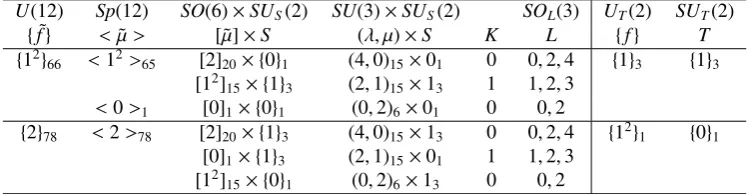
We present for illustration in Tables 1 and 2 the com-plete classification of the states in the simplest case of two particles along the reduction chains of the two reduction schemes in Figs. 1 and 2.
As we choose to expand the states of the pairing bases |ΨPt(13),|ΨPisc(16) and|ΨPiv(17), labeled by the set of numbers{i}, denoting the specific pairing labels{ν[p], β}, {υS,tS, β}and{υT,tT, β}correspondingly through the set
of rotational basis states (6) with the quantum numbers {α(λ, μ)K}denoted as the set{j}:
|ΨPi≡ |{f},i,LM=
j
Ci j|{f},j,LM. (18)
As a result of the dynamical symmetry, the pairing inter-actions (8), (9) and (10) are diagonal in the pairing basises
(13), (16) and (17) with eigenvalues given in [17]. Using the expansions (18) in theSU(3) basis states and the diag-onalization procedure for its matrix in theSU(3) basis
<ΨP|Hpair|ΨP>=Epair(m,i,[P],(S T))= (19)
jk
C∗kiCi j.δk j.k<ΨR|Hpair|ΨR>j,
we obtain numerically the probability|Ci j|2with which the
states of theSU(3) basis enter into the expansion of each of the pairing bases. In this way we actually calculate the transformation brackets between the two chains [20], which is of great use when calculating the matrix elements of different operators in each of the chains. Also, this ex-pansion could help to evaluate the importance (weight) of the differentSU(3) - states, when we need to impose re-strictions on the basis because of computational diffi cul-ties. The known relations of theSU3 labels (λ, μ) and the
β, γshape variables of the geometrical model can be used for the analysis of the deformations of the pairing states, expressed through the respectiveSU(3) ones.
3.2 Phases and phase transitions in the microscopic PQM
As stated in the Introduction, the dynamical symmetries unified in the reduction schemes presented in Figs. 1 and 2 can be considered as different phases, corresponding to the different types of residual interactions [21], that are included in the microscopic PQM. The phase transitions according to this definition involve actually a change of the symmetry from one to another of the exact limits of the model. The degree of this change is measured in prac-tice by introducing one or more control parameter(s) that give the weight of each of the limits’ interactions in the correct description of the energy spectra of a given nu-cleus. In the case of considering only two interactions in the nuclear Hamiltonian we need only one control param-eter−1<x<1, that is introduced in the following way:
Vres= 1
2(1−x)V1+ 1
2(1+x)V2, (20) where atx=−1 we have pureV1interaction and atx=1
the limiting case of pure V2 interaction is realized. At x=0 we have both interactions mixed with their respec-tive strengths. This allows us to investigate the influence of these residual interactions on the spectra in real nu-clear systems, which will be presented in the talk of Dr. K.P. Drumev [22]. In it we consider as V2 always the quadrupole-quadrupole interactionV2=χQ·Q.
In the case when only one of the pairing modes is in-volved then we have asV1 one of the three pairing
Table 1.The classification of the states of 2 particles in thedsshell (Ω =6) according to the reduction scheme (1)
U(6) SO(6) SOp(6) SU(3) SOL(3) US T(4) SOP(6) SUS(2)×SUT(2)
{f˜} [μ] ν[p] (λ, μ) K L {f} [P] (S T) {12}
15 [12]15 2[1] (2,1)15 1 1,2,3 {2}10 [13]10 (0,0)1
(1,1)9
{2}21 [0]1 0[0] (4,0)15 0 0,2,4 {12}6 [1]6 (1,0)3
[2]20 2[13] (0,2)6 0 0,2 (0,1)3
Table 2.The classification of the states of 2 particles in thedsshell (Ω =6) according to the reduction scheme in Fig. 2 for the isovector pairing only. In the case of the isoscalar pairing only, one should exchange the place of theS andT labels in the Table.
U(12) Sp(12) SO(6)×SUS(2) SU(3)×SUS(2) SOL(3) UT(2) SUT(2)
{f˜} <μ >˜ [ ˜μ]×S (λ, μ)×S K L {f} T {12}
66 <12>65 [2]20× {0}1 (4,0)15×01 0 0,2,4 {1}3 {1}3
[12]
15× {1}3 (2,1)15×13 1 1,2,3
<0>1 [0]1× {0}1 (0,2)6×01 0 0,2
{2}78 <2>78 [2]20× {1}3 (4,0)15×13 0 0,2,4 {12}1 {0}1
[0]1× {1}3 (2,1)15×01 1 1,2,3
[12]15× {0}1 (0,2)6×13 0 0,2
phenomenological parametersG0,G1andχ- their
respec-tive strengths. The later are evaluated trough a minimiza-tion procedure in the comparison of the theoretical spec-trum of a given nucleus to the experimental energies. In order to study the influence of each of them on the repro-duction of the experimental data, we need to introduce the two control parametersy,zand a scaling parameterc
y= χ+χ G1
, z= χ+G1
χ+G0+G1
, c=χ+G0+G1. (21)
In terms of these control parameters the phase diagram of the PQM Hamiltonian
Vres=yz Q·Q−(1−z)yS†·S −(1−y)z P†·P (22)
is a triangle, where the three limiting cases at its vertices are defined by the conditions: y = z = 1 for theSU(3) limit,y =1,z =0 for the isoscalar case andy =0,z=1 for the isovector one. By means of their values we can evaluate the role of each of the three interactions in the description of the realistic nuclear spectra in each nucleus.
4 Conclusions
The algebraic structure of the shell-model algebraU(4Ω) is investigated to obtain its reductions through the micro-scopic pairing algebras, containing isoscalar (T =0,S =
1), isovector (T =1,S =0) total pairing operators and El-liott’s SU(3) algebra. The four reduction chains appear as distinct dynamical symmetries of the shell-model al-gebra, which allows the classification of the basis states of the system along each of them. Relations between these chains are established on the basis of their com-plementarity to the Wigner’s spin-isospin US T(4) sym-metry or S UT(2) ∼ S OT(3), SUS(2) ∼ SOS(3). The later allow for obtaining the transformation brackets with which the states of theSU(3) basis enter into the expansion of the pairing bases. The obtained results elucidate the
phases – dynamical symmetries of an extended Pairing-plus-Quadrupole Model, realized in the framework of the Elliott’s SU(3)−scheme. The phase transitions between all these limits are studied by evaluating the weights of the different interactions in the PQM Hamiltonian for a particular nuclear system. The theory allows for a lot of applications to the real nuclear systems and can be used for interpretation of the experimental data and a system-atic investigation of the development of nuclear collectiv-ity trough the nuclear chart.
Acknowledgements
AIG is grateful for the support of the BLTP of JINR, Dubna, which made possible her participation in this conference. This work was also partially supported by the Bulgarian National Foundation for Scientific Research under Grant Number DFNI-E02/6/12.12.2014.
References
[1] P.V. Isacker, Rep.Prog. Phys.62, 1661 (1999); P. Van Isacker and K. Heyde,Exactly solvable models of nu-clei, arXiv:1401.7512v1[nucl-th]
[2] S.T. Belyaev, Mat. Fys. Medd. Dan. Vid. Selsk.31, 11 (1959)
[3] L.S. Kisslinger and R.A. Sorensen, Rev. Mod. Phys.
35, 853 (1963)
[4] M. Baranger and K. Kumar, Nucl. Phys. 62, 113 (1965)
[5] E.P. Wigner Phys. Rev.51, 106 (1937)
[6] J.P. Draayer, in Algebraic Approaches to Nuclear Structure: Interacting Boson and Fermion Mod-els,423, Contemporary Concepts in Physics VI, ed. R.F. Casten (Harwood Academic, Chur, Switzerland, 1993)
[8] V.K.B. Kota, Symmetries in Science XI, 265, eds. B. Gruber, G. Marmo, N. Yoshinaga, (Kluwer Aca-demic Publishers, Dordrecht, 2004)
[9] J.P. Elliott, Proc. Roy. Soc. London, Ser.A245, 128 (1958);A245, 562 (1958)
[10] J.P. Draayer, Y. Leschber, S.C. Park, and R. Lopez, Comput. Phys. Commun.56, 279 (1989)
[11] Y. Akiyama and J.P. Draayer, Comput. Phys. Com-mun.5, 405 (1973)
[12] C. Bahri and J.P. Draayer, Comput. Phys. Commun.
83, 59 (1994)
[13] J.P. Draayer, Y. Leschber, S.C. Park, and R. Lopez, Comput. Phys. Commun.56, 279 (1989)
[14] B.H. Flowers and S. Szpikowski, Proc. Phys. Soc.
84, 673 (1964)
[15] S.C. Pang, Nucl. Phys. A128, 497 (1969)
[16] M. Moshinsky, C. Quesne, Phys. Lett. B 29, 482 (1969)
[17] V.K.B. Kota, Nucl. Phys. A90, 321 (2006)
[18] V.V. Vanagas,Algebraic foundations of microscopic nuclear theory(Nauka, Moscow, 1988), (in russian) [19] K.P. Drumev, A.I. Georgieva, NUCLEAR
THE-ORY, 32, eds. A. Georgieva, N. Minkov (Heron Press, Sofia, 2013) p.151; Proceedings of the 32 Intern. Workshop on Nuclear Theory, (Rila Mountains, Bulgaria, June 24-29, 2013); http://ntl.inrne.bas.bg/workshop/2013/contributions/ [20] E. Santopinto, R. Bijker, and F. Iachello, J. Math.
Phys.37, 2674 (1996)
[21] J. Cseh, J. Phys.: Conf. Ser.205, 012021 (2010) [22] K.P. Drumev and A.I. Georgieva, “Interrelations