University of South Carolina
Scholar Commons
Theses and Dissertations
2018
South Carolina Preschool Teachers’ Perceptions
And Experiences Implementing Critical Literacy In
The Preschool Classroom
Rebecca Weissman
University of South Carolina
Follow this and additional works at:https://scholarcommons.sc.edu/etd Part of theCurriculum and Instruction Commons
This Open Access Dissertation is brought to you by Scholar Commons. It has been accepted for inclusion in Theses and Dissertations by an authorized administrator of Scholar Commons. For more information, please [email protected].
Recommended Citation
SOUTHCAROLINAPRESCHOOLTEACHERS’PERCEPTIONSAND
EXPERIENCESIMPLEMENTINGCRITICALLITERACYINTHEPRESCHOOL
CLASSROOM
by
Rebecca Weissman
Bachelor of Arts
New Mexico State University, 2006
Master of Education Lesley University, 2008
Submitted in Partial Fulfillment of the Requirements
For the Degree of Doctor of Education in
Curriculum and Instruction
College of Education
University of South Carolina
2018
Accepted by:
Rhonda Jeffries, Major Professor
Gloria Boutte, Committee Member
Julia López-Robertson, Committee Member
ABSTRACT
Critical literacy situated within a critical theoretical and pedagogical paradigm focuses
specifically on exploring the sociopolitical implications of texts and challenging
information rather than taking it at face value. The present study constitutes a case study
that describes the perceptions and experiences of seven preschool teachers who employ
critical literacy in their early childhood classroom and how their pedagogy fits within the
existing themes seen in the early childhood literature. Specifically, this case study is an
instrumental collective study, consisting of in-depth interviews. Through qualitative
analysis of these interviews a variety of specific pedagogical methods for implementing
critical literacy are explored. These include critical questioning: (including questions
based on children’s experiences as culturally relevant pedagogy, bibliotherapy, and the
children’s interests/questions), critical literacy to explore multiple perspectives (such as
within: common children’s stories/fairytales, social justice/diversity books, and historical/
non-fiction texts), and taking direct social action. Additionally, the participant’s
responses regarding other methods of teaching for social justice, the developmental
appropriateness of various social justice topics, and the challenges of implementing
critical pedagogy with young children are also described and analyzed. Additionally, this
research provides insight as to how critical literacy can be progressivist/constructivist
TABLEOFCONTENTS
ABSTRACT...iv
CHAPTER I: INTRODUCTION...1
CHAPTER II: REVIEW OF THE LITERATURE...23
CHAPTER III: METHODS OF RESEARCH...39
CHAPTER IV: RESEARCH FINDINGS AND ANAYLSIS...58
CHAPTER V: DISCUSSION AND CONCLUSION...140
REFERENCES...168
APPENDIX A: INTERVIEW PROTOCOL………...…………....183
CHAPTER I: INTRODUCTION
BACKGROUND
Within K-12 education in the United States in 2018, the dominant philosophy of
schooling continues to remain theoretically essentialist, placing the bulk of emphasis on
accountability mandates for teachers and students, standardized tests, and science,
technology, engineering & mathematics (STEM). Essentialism (Bagley, 1941) is
grounded in the idea that curriculum should be centered on the fundamentals such as
Reading, Writing, and Arithmetic and should prepare students for the workplace. Today
this also includes Science, American History, and Geography. Mastery of these essential
skills is often promoted through memorization of facts.
Social reconstructionists such as Rugg (1929) and Counts (1934) sought to
construct curriculum and pedagogy around issues of social justice and to enable students
to examine social problems such as racism, sexism, poverty, and worker exploitation, in
American society. Social reconstructionist educators argue that the root of the present
focus on standardized curriculum, instruction, and testing in K-12 public schooling is due
to essentialism (Spring, 2015). On the other hand, Counts (1938) argued that the school
should be involved in educating students about racial and class discrimination, poverty
and unemployment issues. The social issues today are similar, although the list is even
more expansive and issues such as computers and technology; political oppression and
In addition to criticizing “teaching to the test,” critical educational theorists have
highlighted many of the other reasons why teachers may not employ critical pedagogy or
social justice related curricula. These reasons include factors such as fear generated
within the hierarchical confines of the school institution (Apple, 2013; Giroux 1978;
1984; 1988; Kincheloe & McLaren, 2002; Lankshear & McLaren, 1993; McLaren 1989;
2005; McLaren & Giarelli, 1995). Multicultural education scholars also argue that the
lack of pre-service teacher preparation does not prepare white female middle class
teachers to teach children of color or white children about controversial or multicultural
topics (Banks, 2008; Lewis-Charp, 2003; Nieto, 2010). Additionally, many educators
steer away from social justice curricula to avoid opposition from other staff and parents
(Lewis-Charp, 2003). Educators who embrace a social reconstructionist philosophy strive
to find successful pedagogy and curricula that can be utilized to teach for social justice
(McLaren, 2007).
Social reconstructionists or critical education theorists (i.e. Freire, 1970; Apple,
2013; Giroux 1978; 1984; 1988; Kincheloe & McLaren, 2002; Lankshear & McLaren,
1993; McLaren 1989; 2005; McLaren & Giarelli,1995) have continued to build upon the
body of knowledge of Counts (1934) and Rugg (1929) further developing the field of
critical pedagogy. Through critical pedagogy, educators seek to challenge the unfair
existing sociopolitical factors that govern their world and nation while creating a
language of hope, resistance, and possibility through theory, practice, reflection, and
action (Freire, 1970; Giroux 1978; 1984; 1988; Kincheloe & McLaren, 2002; Lankshear
One type of critical pedagogy, critical literacy, is frequently cited throughout the
educational literature as a viable way to teach students about social justice issues
(Comber, 1994; 2003, 2015; Lankshear & McLaren, 1993; Lewison, Flint & Van Sluys,
2002; Luke & Freebody, 1997; 1999; Shor, 1999). Critical Literacy has many definitions.
According to Luke & Freebody, (1997), “The term critical literacy has come to refer to
such a wide range of educational philosophies and curriculum interventions that their
family resemblances and shared characteristics would be hard to pick” (p.1.) However,
the definition I am drawing from is grounded in the idea that students should learn
simultaneously how to ‘read’ texts as they learn to question text and images for unfair
and harmful representation and ideas (Freire & Macedo, 1987). As Freire and Macedo
(1987) explain we must be able to read both the “word and the world.” This is supported
by Multicultural educators (i.e. Ladson-Billings,1992, Nieto,1994, Banks, 2008) who
expound on the fact that literacy development happens in social, historical, and political
contexts and needs to include a re-framing of how knowledge and text is constructed.
One of the most common definitions of Critical Literacy includes the act of
exploring the sociopolitical implications of texts (Lankshear & McLaren, 1993; Lewison,
Flint & Van Sluys, 2002; Freebody & Luke, 1990; Luke & Freebody, 1997; Shor, 1999).
This dissertation focuses on critical literacy specifically through the exploration of text
and pictures in children’s books. In this sense, critical literacy encourages students to
explore multiple viewpoints through different texts and question the sociopolitical
implication of texts and pictures rather than taking everything they read at face value
(Comber, 1994; 2003, 2015; Lewison, Flint & Van Sluys, 2002; Lankshear & McLaren,
decipher and interrogate what they read and relate this to larger themes within their
everyday lives and society. Specifically, this often includes teaching about diversity (i.e.,
racism, classism, sexism, heterosexism, ableism, etc.).
Comber (1994) defines critical literacy as a process where students become
researchers of language, and where teachers respect student’s resistance while exploring
minority constructions of literacy and language, and problematizing classroom and public
texts. Lewison, Flint, and Van Sluys (2002) synthesized the definitions of critical literacy
from the past thirty years within the existing literature and categorized them into the
following four elements, “1) disrupting the commonplace, 2) interrogating multiple-view
points, 3) focusing on sociopolitical issues, and 4) taking action and promoting social
justice” (p. 382).This dissertation explores critical literacy contexts by focusing most
specifically on how the sociopolitical implications of text can be explored (Lankshear &
McLaren, 1993; Lewison, Flint & Van Sluys, 2002; Freebody & Luke, 1990; Luke &
Freebody,1997; Shor, 1999) and by employing Lewison, Flint, and Van Sluys (2002)
definition of critical literacy.
According to some critical literacy theorists (i.e., Casher and Stotler, 2015;
Cervetti, Pardales, and Damico, 2001; Freebody & Luke, 1990; Luke and Freebody,
1997; Mclaughlin and DeVoogd, 2004), such critical literacy questions could include but
are not limited to:
• What viewpoints or voices are being left out (Freebody & Luke, 1990; Luke and
Freebody, 1997; Mclaughlin and DeVoogd, 2004)?
• Are there other perspectives?
• Which groups may be benefitting from this view and who may be marginalized?
• What meaning is assigned to certain people or events in a text (Cervetti, Pardales,
& Damico, 2001)?
• How are different groups positioned within the text? Are they positioned within a
power hierarchy?
• Are there hidden messages within the text (Casher & Stotler, 2015)?
• In which cultures/places would you find this text (Casher & Stotler, 2015)?
• Whose voices are being heard/unheard (Freebody & Luke 1990; Luke and
Freebody, 1997; Mclaughlin & DeVoogd, 2004)?
• Whose values are being perpetuated (Freebody & Luke 1990; Luke & Freebody,
1997)?
• What does the author want us to think (Mclaughlin & DeVoogd, 2004)?
• How might alternative perspectives be represented (Mclaughlin & DeVoogd,
2004)?
• What action might you take based on what you have learned (Mclaughlin &
DeVoogd, 2004)?
BACKGROUND: EARLY CHILDHOOD CONTEXT
While progressivist and constructivist techniques are popular in preschool
learning models (Morrison, 2014), these progressivist and constructivist approaches
remain focused on inquiry, exploration, and children’s interests in general rather than
being in-tuned to social justice issues. Beginning in kindergarten and elementary and
secondary education, essentialism remains the predominant paradigm. Additionally, with
more visible with preschool classrooms as well. For example, in South Carolina such as
through the first steps initiative (firststeps.com), and pre-set standards, children in public
preschools are expected to be able to master more traditional literacy skills at a younger
and younger age (see: Chapter five). As a former preschool teacher, including having
worked within the state of South Carolina I found this topic to be particularly important.
As I identify not only as a constructivist and progressivist educator, but also as a social
reconstructionist, I undertook this study pertaining to critical literacy and teaching for
social justice.
While many early childhood education theorists focus on how preschool children
should be learning pre-literacy skills including phonological awareness (Machado, 2016;
Copple & Bredekamp, 2009), there is an increasing demand to focus on literacy rather
than pre-literacy. This is evident with the rising development of public preschools.
Additionally, even for many educators who embrace constructivist, and
progressivist approaches to learning who wish to focus on age appropriate pre-literacy or
early-literacy skills, there is a lack of attention given to including critical literacy and
thinking critically about reading during this time. For example, Martinez-Roldán and
López-Robertson (1999) highlight the unfortunate fact that many wrongfully believe
children should learn to read first because they think are too young to embrace critical
practices. Such a traditional essentialist literacy teaching focus has been the predominant
paradigm in literacy programs that focus on decoding and basic comprehension, without
a critical reflection of the social context and does not accomplish enough in terms of
As this research draws from Lewison, Flint, and Van Sluys’ (2002) definition of
critical literacy that includes analyzing texts and “1) disrupting the commonplace, 2)
interrogating multiple-view points, 3) focusing on sociopolitical issues, and 4) taking
action and promoting social justice” (p. 382), a focus is how can this practice take place
for emergent readers who are not yet able to read by themselves. One example is that
with emergent reader’s critical literacy might take the form of children first listening to
teacher read-alouds or looking at the illustrations in the story and then partaking in a
teacher-initiated critical dialogue/critical questioning about what they are reading or
seeing in the pictures and the sociopolitical implications (Quintero, 2009; Vasquez, 2004;
2010).
RATIONALE
I argue that while much of the literature on early childhood development supports
young children learning in a largely constructivist and progressivist classroom (Morrison,
2014). In terms of equity, and closing the opportunity gap, all young children need to
have the option to learn pre-literacy skills such as phonological awareness. However,
many early childhood teachers often steer away from social reconstructionism and
multicultural education (Banks, 1985; 1995; Husband, 2012). This is problematic since if
young children are not provided with opportunities for anti-racist and anti-bias education,
they can develop prejudice, stereotypes, and bigotry at a young age (Aina & Cameron,
2011; Boutte 2008; Derman-Sparks 2008; Earick 2008; Husband, 2012; Zaman, 2007).
Such harmful prejudices and stereotypes are learned in places such at home, with peers,
Derman-Sparks, 2001; Gopaul-McNicol, 1998; Husband, 2012; Leaper, 2000; Morrow,
2006). Such learning can take place through live and symbolic models (Bandura, 1986).
Doctors Kenneth and Mamie Clark investigated how children develop racism at a
young age through many studies including the work of children’s development on racial
awareness and attitudes. Beginning in 1939 and continuing into the 1940’s their work
included presenting children with drawings and asking them about race and their "The
Doll Test" experiments, where children viewed a white and black doll and responded on
perceived positive and negative characteristics. This test demonstrated that these young
children already held immensely racist thinking as they were biased to the lighter skinned
doll, as they often assigned it positive characteristics (Clark & Clark, 1947). Such tests
have been recently repeated with similar results (Jordan and Hernandez-Reif, 2009;
NBCnews.com, 2016). In addition, other tests and studies have also generated similar
findings as well, such as Goodman’s (1964) research concluding that by age three
children notice racial difference and between ages four and five, children express positive
and negative attitudes about specific races. Hirschfeld (1995) found children begin to
express preferences for races by the time they are four and five–years-olds.
Early childhood researchers also show how the first few years of a child’s life is
the time where they develop attitudes about differences in gender roles between boys and
girls and develop stereotypes such as the specific behaviors and toys that should be used
by each gender (Aina & Cameron; 2011; Kim, 2016; Klein et al., 2007). Rubble (2004)
highlighted the impact of these stereotypes and roles by ages five through seven.
Additional studies also point to how preschoolers can also demonstrate
and more likeable that those who of lower economic status (Derman-Sparks, 2007;
Naimark, 1983; Ramsey, 1991).
These studies suggest that the early years are not only a time to lessen the chances
that children develop harmful prejudices and stereotypes, to interrupt them when they
occur, and a key time for children to learn about social injustice and its realities in the
world around them. Thinking critically about the symbolic models in books can be a
viable way to counter this.
Books provide an avenue for young children to learn and question social norms
(Jackson, 2007). However, books are not always used in this fashion and instead may be
where children view stereotypical and hegemonic images and portrayals of race, class,
gender, sexual orientation, etc. and may internalize them. Although critical literacy
appears frequently in the educational literature as a successful tool for social justice
curricular implementation at the mid Elementary- Secondary education level (Lewison,
Flint & Van Sluys, 2002; Lankshear & McLaren, 1993; Shor, 1999). Researchers and
educational leaders also believe that critical literacy would be a successful way to teach
young learners about social justice as well (Comber, 1999; 2003; Fisher, 2008; Harwood,
2008; James & McVay, 2008; Kuby, 2013; Labadie, Wetzel, and Rogers, 2012; Labadie,
Pole, & Rogers, 2013; Mankiw & Strasser, 2013; Norris, Lucas, & Prudhoe, 2012;
Silvers, Shorey, & Crafton, 2010; Vasquez, 2004; Vasquez 2007). However, research is
limited on how to implement critical literacy with such young children (Comber, 2003;
Harwood, 2008; Kim, 2016; Kim & Cho, 2017; Kuby, 2013; Mankiw and Strasser, 2013;
Quintero, 2009; Vasquez, 2004). I, along with other advocates of critical literacy, argue
down harmful or inaccurate ideas (Lewison, Flint & Van Sluys, 2002; Lankshear &
McLaren, 1993; Luke & Freebody, 1999; Shor, 1999). Within the classroom, critical
literacy opens up the floor to insightful dialogue and inquiry, allowing students to
question and critique texts and society rather than becoming mere recipients of
information (including inaccurate information) about the “other.” As close examination
of apparently innocuous texts often reveals inherent bias.
In a society bombarded with overt and covert bigotry, teaching for social justice is
crucial and early childhood educators can help eradicate such bigotry within children
before it develops. Research also shows that it is often easier for young children to be
non-complicit to injustice than older children (Derman-Sparks and Phillip, 1997; Tatum,
1992; Kalin, 2002). To combat this racist, classist, sexist, and homophobic slant, there are
many ways young, emergent readers can engage in critical literacy. Some of these
methods include listening to read aloud stories, looking at the illustrations, and engaging
in critical dialogue through the help of a teacher about what they are hearing/seeing and
taking action to challenge these stereotypical or harmful notions (Quintero, 2009;
Vasquez, 2004; 2010). By engaging in the critical literacy process, young children can
ideally develop a recognition of and strong foundation of social justice issues. This
research focuses on critical literacy as a viable way to help create a social justice mind
frame within young children by reducing prejudice, building their own self-esteem,
learning to question dominant narratives, and develop critiques of the sociopolitical
implications of the books and pictures they view/read.
Since there is limited literature on critical literacy curriculum and pedagogy in
Kuby, 2013; Mankiw and Strasser, 2013; Quintero, 2009; Vasquez, 2004), I broadened
my search to include other pedagogical methods, many of which share key critical
literacy components for teaching for social justice with young children. Although not
outlining implications specifically for critical literacy, these articles and books help to
strengthen my rationale that social justice issues are important to explore with young
children. The most commonly found pedagogical methods include but are not limited to:
1) The art educational areas of drama and theatre (Cathers & Schniedwind, 2008; Dishy
& Naumer, 2010; Hyland, 2010; Tabone, 2003; Wohlwend, 2009); 2) Interviews, field
trips, and activism (Cowhey, 2006; Souto-Manning, 2013); 3) Guest speakers (Aina &
Cameron, 2011; Kohler & Christensen, 2012); 4) Digital photography (Serriere, 2010); 5)
Storytelling (Phillips, 2012); 6) Creating drawings about bigotry and intolerance as well a
way to counter such bigotry (Boutte, López-Robertson, & Powers-Costello, 2011;
Cowhey, 2008; Harcourt & Mazzoni, 2012; Kuby, 2012); 7) Teacher facilitated
discussions/questions (Bentley, 2011; Boutte, 2008; Hyland, 2010); and 8) Story time
(Aina & Cameron, 2011; Cunningham, Egan, & Enriquez, 2013; Kelly, 2012; Martin et
al., 2012; Murphy, 2009). A more detailed description of the above literature pertaining
to critical literacy and other methods of teaching for social justice in early childhood is
provided in Chapter two of this dissertation.
JUSTIFICATION FOR THE STUDY
The empirical literature on critical literacy in the early childhood classroom,
specifically for preschool aged children remains scarce (Comber, 2003; Harwood, 2008;
Kim, 2016; Kim & Cho, 2017; Kuby, 2013; Mankiw & Strasser, 2013; Quintero, 2009;
I feel graduate students in education who have taught preschool and implemented
critical pedagogy are an ideal participant set since they have both classroom experience,
may have in-depth knowledge, and may be able to better name their practices.
Additionally, since one of my goals is to add to the literature on how teacher education
on critical literacy could be improved, gaining insight into the teacher preparation these
teachers had had during their various degrees was also important.
PROBLEM STATEMENT
Since there is a relatively limited amount of scholarly resources available for early
childhood educators at the preschool level, upon a search for “critical literacy”
(Comber, 2003; Harwood, 2008; Kim, 2016; Kim & Cho, 2017; Kuby, 2013; Mankiw
and Strasser, 2013; Quintero, 2009; Vasquez,2004), this presents a great challenge to
early childhood educators who would like to be effective or grow as critical pedagogues.
Early childhood educators need more resources to be able to implement such pedagogy
with young learners. Drawing from the rather limited research available in and scholarly
books, journals, and interviews with critical pedagogues, this study offers insight into
solutions for early childhood curriculum and pedagogy in relation to teaching young
children about social justice issues and implementing critical literacy.
Although education programs have evolved over the last several decades to
include social reconstructionist curriculum and pedagogy aimed at enabling young
children to grapple with social injustice, much more work needs to be done to design
productive and practical strategies for early childhood educators to implement such
practices. In particular, this research emphasizes the value of social reconstructionist
This study provides insight for practitioners (current preschool teachers) as well
as for social justice researchers and college educators as to how they can improve their
pre-service teacher training programs so that future educators can feel prepared to
implement such critical pedagogy once in the classroom.
PURPOSE OF THE STUDY
The purpose of this study was to describe the perceptions and experiences of
South Carolina educators who are working toward or have already obtained a doctorate in
education and who consider themselves social justice educators for preschool aged
children. A detailed look at how those familiar with critical literacy have utilized such
pedagogy at the early childhood level will buttress the current literature. Additionally, it
can introduce or strengthen the critical literacy practices of early childhood educators for
all grades. It can also improve future college courses in education, specifically pertaining
to social justice curriculum and pedagogy for young learners.
RESEARCH QUESTION:
The overarching research question that guided my study was: What are the
perceptions and experiences of social justice preschool educators who have or are
working toward a doctorate degree in education in implementing critical literacy with
four-year-old preschoolers?
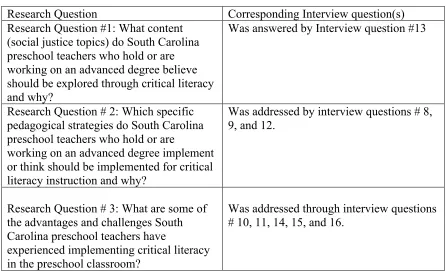
Sub-questions included:
1) What social justice topics do these preschool teachers/ believe should be
2) Which specific pedagogical strategies do these preschool teachers implement
or think should be implemented for critical literacy instruction with four-year-old
children and why?
3) What are some of the advantages and challenges that these preschool teachers
have experienced implementing critical literacy in the preschool classroom?
THEORETICAL FRAMEWORK FOR THE STUDY
Critical Literacy practices are grounded in Freirean liberatory praxis (1970) which
includes teaching children to read both the world and word (Freire & Macedo, 1987). As
a form of resistance to challenging the status quo and disrupting hatred and bigotry such
as racism, sexism, classism, and heterosexism within early childhood text for preschool
children this study fits a wide theoretical frame that encompasses many theories that all
fit within what Joseph et. al (2000) calls “Confronting the dominant order.” More
specifically this work draws from critical education theory (Apple, 2013; Giroux 1978;
Giroux 1984; 1988; Kincheloe & McLaren, 2002; Lankshear & McLaren, 1993;
McLaren 1989; 2005; McLaren & Giarelli, 1995), multicultural education, culturally
relevant pedagogy, and anti-bias education (Banks,1985;1995; 2008; Derman-Sparks,
2008; Gay, 2000; Howard, 2003; Husband, 2012; Ladson-Billings,1992, 1995;1997;
Nieto, 1994; 2010), and critical race theory (Brayboy, 2005; Ladson-Billings, 1998;
Solórzano & Yosso 2002). As Luke (2012) points out “Freire’s (1970) educational
projects in Brazil, approaches to critical literacy have been developed through feminist,
postcolonial, poststructuralist, and critical race theory; critical linguistics and cultural
In addition to confronting the dominant order (Joseph et al., 2000) this study also
draws from progressivist and constructivist learning models for young children (Dewey,
1938; Morrison, 2014; Piaget, 1963; Vygotsky, 1987). Others who have studied critical
literacy practices in early childhood such as Beach and Cleovoulou (2014) have also
combined critical theory with Piaget’s constructivist learning theories. Although critical
theory is situated in a confronting the dominant order framework (Joseph et. al, 2000) this
research draws eclectically from the two to make it fit best for the early childhood
context.
METHODS: CASE STUDY
This case constituted a group of bounded individuals (Hatch, 2002), in this sense,
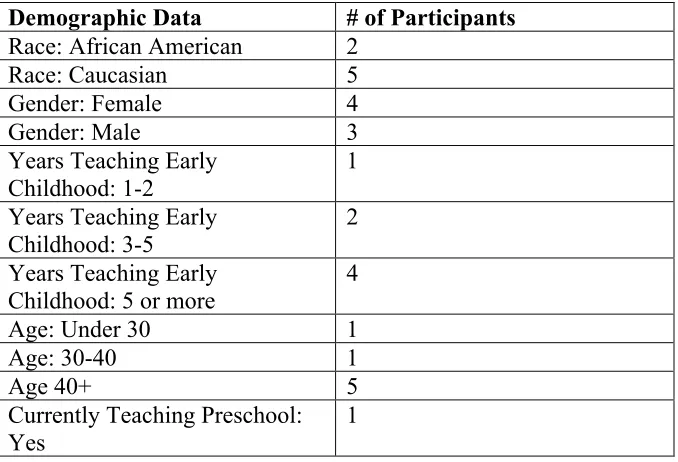
the “case” consisted of seven South Carolina educators who have implemented critical
literacy with four-year-olds and who have or are working towards and advanced degree
in education. Through semi-structured interviews, participants were asked to share their
stories and reflections of their critical literacy and other social justice teaching practices.
PARTICIPANTS
Participants in the present study were selected via Purposive sampling (Chen,
1981; Merriam 1998; Singleton & Straits, 2010) also known as purposeful (Creswell,
1994; Patton, 1990; Maxwell, 2013; Merriam, 1998) or criterion based sampling
(LeCompte & Preissle, 1993; Merriam, 1998) for those who met the criteria of teaching
or having taught preschool to four-year-old classrooms, who hold or are working
towards an advanced degree in education, who consider themselves social justice
SC (South Carolina) teachers who had taught between 2-10+ years at both private and
public schools and preschools.
DATA COLLECTION
Data collection consisted of semi-structured face-to-face, phone interviews, and
follow up e-mails with each participant to member check. This included at least an
hour-long interview with each of the seven participants. I choose interviews as a way to gain
in-depth knowledge of the experiences and perceptions of early childhood critical
pedagogues regarding critical literacy practices with young children.
ETHICAL CONSIDERATIONS
As a critical research endeavor, I strove to consider liberation on all levels of the
research process, included treating my participants with respect and not a means to an
end. With this, I have taken into account that the research process itself can be
exploitative to the participants (Sapsford, 1999). Additionally, the Internal Review Board
(IRB) at the researcher’s university approved this research.
INFORMED CONSENT
A written consent form (See Appendix) was provided to all participants in the
research in order to guarantee anonymity. This written consent also notified the
participants of their right to stop the interview at any time.
OPERATIONAL DEFINITIONS
The key terms utilized in this study and their definitions include the following.
Constructivist- A progressivist curricular orientation that is child- centered and
focuses on learning through the senses, with emphasis on curricula based on children
Critical Pedagogy- A practice made popular by Brazilian social justice educator,
Paulo Freire (1970). According to Wink, critical pedagogy is teaching students “to name,
to reflect critically, to act” (2004, p.123).
Critical Literacy-Paulo Freire (1970) known for planting the seeds for critical
pedagogy can also be credited for planting the seeds of critical literacy (McLaren, 2011).
One of the most common definitions involves exploring the sociopolitical implications of
the text (Lankshear & McLaren, 1993; Lewison, Flint & Van Sluys, 2002; Shor, 1999).
According to Lewison, Flint, and Van Sluys (2002) critical literacy specifically involves
“1) disrupting the commonplace, 2) interrogating multiple-view points, 3) focusing on
sociopolitical issues, and 4) taking action and promoting social justice” (p. 382).
Early Childhood Classrooms- Classrooms for children ages 0-9 years (Morrison,
2014)
Elementary School- Including Grades P-5, 4K-5, K-5 or K-6, some early
childhood years are included within this (P-3, 4K-3, or K-3).
Essentialist- The curricular orientation that focuses on reading, writing, and
arithmetic; the basics of learning made popular by William Bagley (1941).
Preschool: Preschool is defined as ages 3-5 (Morrison, 2014).
Progressivist- Based on the educational philosophy of John Dewey (1938). A
curricular orientation that is child-centered, based on children’s interest’s areas compared
to traditional rote learning methods. It should however include a balance between
teacher/child-initiated activities.
Social justice issues- Is defined building off of Adams et al. (2013) text as
the intersection of race, class, gender, sexuality and the multiple layers of
power/oppression (Crenshaw, 1989).
Social Reconstructionist- A curricular orientation made popular by Harold Rugg
(1929) and George Counts (1934) that focuses on teaching about social justice issues. A
more radical form of progressivism.
Teaching for Social Justice- The aim of a Social Reconstructionist curricular
orientation that has evolved over time to include teaching about and helping to eradicate
racism, sexism, classism, heterosexism, etc.
Text- This paper focuses on texts in the form of literacy works, including both
written text and visual texts within picture books.
SIGNIFICANCE OF THE STUDY
Knowledge Generation
The interview description and analysis of the seven participants provides much
insight into critical literacy pedagogy implications for young children. These take aways
can be helpful to practitioners, researchers, media specialists, and curriculum developers.
Additionally, it provides a look into what challenges preschool teachers face with this
method of social reconstructionist pedagogy and curricula, while also showing how these
teachers assessed its effectiveness in helping to create a social justice mindset and reduce
prejudice. Through coding and analysis various factors that influence preschool teachers’
uses of a social justice pedagogy, specifically within the state of South Carolina is
explored. Finally, this research has added to the existing body of literature pertaining to
critical literacy and other methods of teaching for social justice in an early childhood
Professional Application
The interviews questions served to detail the experiences and perceptions of
educators who implement social justice and critical literacy pedagogy for preschool as
well as their teacher preparation. Therefore, the information collected could be a helpful
resource for early childhood educators who want to implement critical literacy practices.
For example, this included questions such as, “Tell me about your pre-service teacher
preparation (if any) that explored teaching for social justice in the early childhood
classroom” and, “Tell me about employing methods of teaching for social justice in your
preschool classroom?” Additionally, the insight uncovered can help teachers better
understand the advantages, limitations, considerations, and drawbacks of this strategy for
teaching for social justice issues in a preschool classroom. Through the responses and
analysis provided within this dissertation, educators reading this may also be more
inclined to engage in critical self-reflection, which is crucial for facilitating social change
in the classroom (Howard, 2003).
College professors of pre-service teachers, social justice enthusiasts, as well as the
public may also gain insight from this study. By understanding teacher’s views, this may
be a step towards additional teacher preparation or support staff for critical pedagogy and
social justice curricula development. In addition, the insights generated from this study
could also contribute to a positive shift of attitudes amongst teachers regarding their
curriculum design and implementation.
ASSUMPTIONS, LIMITATIONS, SCOPE AND DELIMITATIONS
The present study operated under the assumption that teaching for social justice
the field of preschool teaching. Additionally, it acknowledges that those interviewed
responded to their best ability and the information collected was valid and reliable in
describing their ideas and insights. One way I helped to make this study reliable was by
triangulating the data; in this case by conducting interviews, follow up e-mails, and
requesting formal lesson plans. This allowed me to gain an in-depth understanding of
each participant’s views and perspectives. Other methods such as member checking
helped to increase the credibility of the data.
Delimitations of this study included the scope of those who were preschool
teachers, employ critical literacy, and are seeking or have obtained an advanced degree in
education. Specifically, I selected those who teach in four-year-old classrooms. With this
it is important to note that the data collected may not have external generalizability and
internal generalizability in various ways. According to Maxwell (2013), external
generalizability involves the data being relevant beyond the case studied while internal
generalizability refers to its significance within the case itself. Since the scope of the data
is limited to SC, and SC is a case study for a state with a very specific conservative
political climate, the data may not have external generalizability within or beyond the
U.S. Therefore, the research may not offer significant insight into teacher’s attitudes
about social justice pedagogy for geographical areas with different sociopolitical climates
and orientations.
However, as previously specified, the goal of this research was by no means to
claim generalizability. As the main concern with a case study, the purpose resides, “not
with generalizability, but with developing an adequate description, interpretation, and
through interviews is not used to generalize SC preschool teacher’s experiences
implementing critical literacy as a whole, it does help to provide valuable insight and
description about the thoughts, lesson plan implementation, and teaching practices of SC
preschool teachers working towards graduate degrees with four-year-old students from a
potentially wide variety of backgrounds.
Limitations of this study included that it only consisted of SC preschool teachers
who wished to be interview participants for the study. Additionally, this research was
situated within a specific time in history and may not be relevant to reflect teacher’s
attitudes on the subject in the far future.
TRANSITION AND SUMMARY OF KEY POINTS
Although critical literacy is a somewhat frequently cited way to teach for social
justice in the upper grades, there remains scarce literature pertaining to its usage with
young learners. The literature that does exist on the topic remains with both vague and
scarce theoretical and applied implications for uses with preschoolers. Very little of this
literature examines teachers’ perceptions and experiences implementing this strategy and
the advantages and drawbacks. Since critical literacy remains vastly underexplored in
early childhood this research uncovers what some of the possibilities and limitations of
critical literacy are for young learners. It also details how it can be a successful tool for
exploring social justice with young children.
By partaking in an instrumental collective case study of SC preschool teachers
who self-reported aligning themselves with critical pedagogy and who have or are
working towards an advanced degree, insight was gained as to how they incorporated
critical educators could utilize such strategies as well as the challenges they may
encounter.
Chapter one provides an introduction to this topic, including the background, a
brief overview and history of the topic and the related literature both in the general and
early childhood context, a rationale, justification for the study, statement of the problem,
purpose of the study, the overarching research questions, the theoretical framework of the
study, a brief overview of the research method, the participants, data collection, ethical
considerations, Informed consent, operational definitions, the significance, assumptions,
limitations, delimitations, and scope of the proposed study.
Chapter two includes a review of the literature related to the
philosophical/historical underpinnings of teaching for social justice and critical literacy,
key theoretical implications, and the existing empirical research pertaining to critical
literacy and other methods of teaching for social in early childhood settings. Chapter
three details the case study methodology employed in the study. Chapter four details the
research findings. Chapter five provides a further discussion of the analysis and the
CHAPTER II: REVIEW OF THE LITERATURE
INTRODUCTION
While there is a plethora of literature that explores teaching for social justice, its
application in early childhood, in particular with four-year-olds and in relation to critical
literacy is limited (e.g. Comber, 2003; Harwood, 2008; Kim, 2016; Kim & Cho, 2017;
Kuby, 2013; Mankiw & Strasser, 2013; Quintero,2009; Vasquez,2004). Those that do
examine this often do not provide rich empirical data as to how these methods were
implemented by the researcher or teacher-researcher. Broadening the literature search so
that it includes all early childhood classrooms (as defined as Prek-3rd grade or Prek-2nd)
as well as books and chapters, provides additional studies to draw from. In addition to
critical literacy, some of the frequent themes/pedagogical methods found in the literature
for teaching for social justice include: drama and theatre, interviews and field trips, guest
speakers, digital photography, storytelling, creating drawings about racism, teacher
facilitated discussion/questions, and story time/picture books/read-alouds.
This literature review is organized into three major sections: Part one:
philosophical/historical underpinnings of teaching for social justice (which is the
philosophy of all critical pedagogy including critical literacy), Part two: key theoretical
underpinnings of teaching for social justice and critical literacy, and Part three: the
empirical research on teaching for social justice in early childhood settings (which
Childhood Classroom, with the sub categories: interviews and field trips, guest speakers,
digital photography, storytelling, creating drawings about racism, Group discussion/
teachers asking questions, story time/picture books/read-alouds).
For part two of the literature: empirical literature on pedagogical models utilize to
teach for social justice in early childhood classrooms, the following search terms were
used for the first round of searching: “teaching for social justice” or “social justice
education” or “social justice”, and “preschool” or “early childhood” or “first grade” or
“second grade” or “third grade”, and “pedagogy” or “pedagogical strategies” or
“teaching methods” or “critical literacy” or “art" or "painting" or "drawing" or
"photography" or "drama" or "puppets" or "discussion" or “conversation” or “children’s
literature” or “read alongs” or “story time”. For the second round of researching I
utilized the following search terms: “critical literacy” and “preschool” or “pre-k” or
“kindergarten” or “first grade” or “second grade” or “third grade” or “two-year-old” or
“three-year-old” or “four-year-old” or “five-year-old” or “six-year-old” or
“seven-year-old” or “eight-year-“seven-year-old” or “early childhood”. The primary search engines I used were
“Education source and Eric” and “Academic Search Complete, Education Source, ERIC
and PsycINFO.” Other search engines were used as well. My lit review focused on
articles from the past ten years, with the exception of a few key works from years prior.
Additionally, research on critical literacy that utilized the term critical literacy was by
default mostly from the last ten years, as there was information on critical literacy and
PHILOSOPHICAL/HISTORICAL: LITERATURE OVERVIEW
Teaching for Social Justice
John Dewey is known as one of the first to advocate for a progressive approach to
education. In his groundbreaking work, Democracy and Education (1916) he supported
an approach different to the traditional route learning and the dominant essentialist
paradigm. In addition to learning being directed by teachers as well as based on subject
matter that is interesting to the students, Dewey's Progressivist approach advocated for
the school institution as a place for students to develop a social consciousness. Building
off Dewey’s ideas of Progressivism, Howard Rugg (1929)’s Man and his Changing
Society, developed the first widely used textbook series for junior high students that
taught about social justice issues. These books were highly controversial, criticized for
preaching socialist and communist ideologies, and were soon banned by schools. This
social reconstructionist movement, also referred to as the teaching for justice curricular
orientation, continued to grow as a more radical form to Dewey's progressivism. George
Counts (1932) with his pertinent essay, Dare the School Build a New Social Order,
explored how the classroom should be a place for students, with the guidance of the
teacher to critique and challenge exploitative and oppressive societal structures.
Additionally, the philosophical roots of critical pedagogy and the critical literacy
problem-posing method goes back to the Frankfurt school of critical theory during the
1920’s.
THEORETICAL: LITERATURE OVERVIEW
In additional to the historical and philosophical underpinnings of teaching for
Rugg (1929), and Counts (1934) have theoretically grounded the teaching for social
justice curricular paradigm. Of these key educational theorists are Freire (1970) who is
most well- known for outlining, “problem posing”, “critical pedagogy” and “critical
literacy”, Giroux (1988), and McLaren (1989), amongst many other critical educational
theorists and critical multicultural theorists. In his revolutionary look at education,
Pedagogy of the Oppressed, Freire (1970), is known for planting the seeds of critical
pedagogy. According to Freire (1970), critical pedagogy involves understanding,
critiquing, and transforming oppressive power structures in the classroom and society at
large and involves Conscientização (critical consciousness or consciousness raising).
With this is the need for teachers to be change agents and for the experience of education
to involve liberatory pedagogy, which to Freire involves “acts of cognition, not
transferals of information. (p.67).” Freire juxtaposes this next to what he calls “The
banking concept of educating” which to him is an oppressive education, which involves
rote memorization and repetition, and students are treated as mere receptacles for teacher
is to deposit information into. Key critical educational theorists and critical pedagogues
such as Giroux (1988) built off the theoretical ideals of Freire, further conceptualizing
what this type of transformative education could entail. With this Giroux explores the
teacher’s job to work as intellectuals, help students critique the existing social order, and
strive for transformation. McLaren’s (1989) Life in Schools developed this notion set
forth by Freire and Giroux by exploring the additional theoretical implications of critical
pedagogy and teaching for social justice in the classroom setting.
Freire and Macedo (1987) also developed the field of critical literacy, in
understand how to read the words. Or, as they explain it they must be able to read both
the “word and the world.” According to Giroux (1993) critical literacy, “points to
pedagogical practices which offer students the knowledge, skills, and values they will
need to critically negotiate and transform the world in which they find themselves.” (p.
376). Luke and Freebody (1999) highlighted specific ways teachers can help students
critique text. Such critical literacy includes students practicing code breaking and creating
a space to make meaning and critique. Shor (1999) also further expounds upon the notion
of critical literacy. With this Shor explains how no pedagogy is neutral and educators
therefore need to help students critique and challenge society through text. Gathering
definitions of critical literacy within the literature over the past thirty years, Lewison,
Flint and Van Sluys (2002) have summarized critical literacy as “1) disrupting the
commonplace, 2) interrogating multiple-view points, 3) focusing on sociopolitical issues,
and 4) taking action and promoting social justice” (p. 382).
EMPIRICAL: LITERATURE OVERVIEW
Critical literacy with Preschool Children
There is an extremely scarce amount of empirical literature on critical literacy in
preschool classrooms that currently exists that utilizes the term “critical literacy”
(Comber, 2003; Harwood, 2008; Kim, 2016; Kim & Cho, 2017; Kuby, 2013; Mankiw &
Strasser, 2013; Quintero, 2009; Vasquez,2004). Even amongst these, many such as
Comber (2003) Harwood (2008) And Mankiw & Strasser (2013) still include many
theoretical applications, while others remain almost entirely theoretical (Kuby, 2013;
However, none of these involve elaborate empirical studies involving many
details of teacher’s views or classroom observations. Additionally, a limited amount is
both empirical and focused on four-year-old children (Kim, 2016; Kim & Cho, 2017).
Kim and Cho (2017) provide of the most in-depth empirical studies I could locate that
involves an empirical study of critical literacy implications with four-year-old
preschoolers. With this study, Kim and Cho observed and interviewed teachers in a
four-year-old preschool classroom in Korea, which involved documenting the critical literacy
practice of a teacher, including the books and pedagogy and the children’s reactions and
responses. The specific critical literacy pedagogy described by Kim and Cho involved a
multi-modal approach, which involved the teacher’s engaging the students in problem
posing during read-alouds. This was followed by the opportunity for the children to draw
or write a different interpretation of a popular fairytale from the perspective of a character
in the book, other than the narrator. For example, this included telling the story/ or
drawing a picture of the Three Little Pigs from the Perspective of the Big Bad Wolf, or
Cinderella, from the perspective of the evil Stepmother. Children’s drawings, verbal, and
written responses were collected to show how these children engaged in the critical
literacy process. Additionally, in this study, Kim and Cho intentionally made critical
literacy a multi-modal activity by including drawing and writing as an extension activity
to the problem posing and critical inquiry.
Critical literacy in K-3 or unspecified Early Childhood Classroom
Since there was limited literature on critical literacy in preschool, critical literacy
in grades K-3 or unspecified early childhood classrooms was also explored within the
implications include: within kindergarten (May et al., 2014; Rogers, Labadie, and Pole,
2016), first grade (Leland, Harste, & Huber, 2005; McVay & James, 2009;
Souto-Manning, 2009), second grade (Beach & Cleovoulou, 2014), third grade (Cooper &
White, 2012), first-third grade (Jones, 2012; Gove & Still, 2014), and first- second grade
(Fain, 2008) classrooms. Others such as (Norris, Lucas, & Prudhoe, 2012) include
un-specified classes within early childhood settings.
Books and book chapters that explore the theoretical or applied implications of
critical literacy in the early childhood classroom or in grades K-3 include were included
due to the lack of scholarly and empirical articles on the topic (Norris, Lucas, & Prudhoe,
2012; Quintero, 2009; Vasquez 2004; 2010). These books and book chapters serve as a
rationale as to why critical literacy can be implemented in early childhood classrooms.
In addition to focusing on different early childhood age groups these studies,
involve teachers and teacher-researchers who employ various specific methods of
implementing critical literacy. In some of these studies/articles the teacher or
teacher-researcher utilized or outlines how social justice themed books can or should be used
critical literacy lessons (Beach & Cleovoulou, 2014; Gove & Still, 2014; Leland, Harste,
& Huber, 2005; Meller et al., 2009). Meller et al. (2009) in particular highlights
importance of using “High Quality Social Justice Books” when teaching early childhood
students critical literacy. For her selecting the appropriate book is of the upmost
importance. Before implementing a critical literacy lesson, she first previews the book,
develops critical literacy questions that she will pose to the class and posts this on sticky
notes within the book. Then before the actual lesson begins she conducts a brief
topic, them she goes a picture walk. This picture walk includes looking through the
photos with her students and discussing them before reading the actual story. Then she
reads the story aloud to the children and stops throughout to ask the questions she
prepared. McVay and James’s (2009) critical literacy involved young children exploring
critical literacy history books; for example, students were encouraged to examine the
story of Christopher Columbus and the first Thanksgiving with a critical eye.
Many of the existing articles highlighted teacher guided critical literacy questions,
such as Souto-Manning (2009), while others focused on questions posed both to and by
students themselves (Gove & Still, 2014). Gove & Still (2014) as well as other studies
(Rogers, Labadie, and Pole, 2016; Stribling, 2014) also had the students explore the
critical literacy component through drawing what they read, or learned, often with guided
or extension questions. For example, in Stribling’s (2014) study, the teacher observed had
students create reflective and creative portraits of their own skin colors. Additionally
their classmates were asked to describe their behavior and to reflect on racial differences
after reading a book about skin color. While some, such as with older children, Jones’
(2012) study of third graders, first involved teachers modeling critical literacy during
class read alouds, then being assessed on their critical literacy during silent reading time,
followed by further scaffolding of critical literacy during the next circle time.
Fain’s (2008) demonstrated how critical literacy can be incorporated by reading
through literature circles in the class and at home as homework and provided the students
with critical literacy questions to explore themes of social justice/injustice present within
the text. Through discussion, children expressed their personal experiences with various
Stribling’s (2014) implementation of critical literacy spans what she calls creating
an entire “critical literacy milieu” in a kindergarten classroom. In this study, the teacher
Stribling observed tried to incorporate critical literacy within all facets of the classroom
including student/teacher interactions, encouraging open and at times confrontational
dialogue between students. Similar projects like this we're attempted by the teacher as
well as talking to students in their everyday interactions to incorporate the principles of
critical literacy including explain multiple perspectives, exploring the sociopolitical, and
working toward social justice.
Beach and Cleovoulou’s (2014) study shows critical literacy can be implemented
within a constructivist inquiry based setting (inquiry pedagogy). To facilitate an
environment that was both Inquiry based and critical literacy derivative the educator
selected social justice themed textbooks and then focused learning on the children’s
questions. This included encouraging student dialogue through these texts. In order for
this text to be effective for both inquiry and critical literacy practices the stories must
allow for student age appropriate social justice related dialogue and allow the children to
make connections with it. These texts must then be connected to the student’s life as an
ongoing practice. Specifically the second grade instructor did this by reading a book
about skin color and then having the children construct autobiographies as self-ologies..
These self-ologies included: bringing forward a question or idea, hypothesizing possible
solutions or developing understandings, Discussing and analyzing the information, and
Refining initial understandings and beliefs to incorporate the new evidence. This study
also concludes that critical literacy involves careful planning and is an ongoing reflective
teacher needs to focus on the children’s curiosities, interests, and what questions they
have in relation to social justice.
To access if such critical literacy methods were effective the teachers within the
studies utilized various methods. Souto-Manning (2009) accessed her critical literacy
lessons as teacher-researcher via observations, audio recordings, notes, fields, coding,
and analyzing field notes of classroom observation/ conversations/ and student artifacts
were utilized. In addition to transcripts and dialogues, Souto-Manning also notes student
activism such as discussing social justice issues with the school principle as a sign of
measuring if these critical literacy activities were effective in teaching for social justice.
Leland, Harste, and Huber (2005) also utilized informal assessment such as listening to
see if they have been impacted by the text read. Observation of student engagement from
class discussions and drama learning activities were utilized to evaluate if this method
was successful in teaching students about social justice issues.
Other studies highlighted aspects such as May et al.’s (2014) study outline some
of the issues pre-service teachers had implementing critical literacy with kindergartens,
such as the unease teachers experienced talking about politics. While, Cooper and
White’s (2012) focused on critical with students who were considered “at risk.”
Other Pedagogical Strategies for Teaching for Social Justice in the Early Childhood
Classroom
The empirical research mentioned in the following section, includes studies of
teaching for social justice employing pedagogical strategies other than critical literacy. In
addition, little research is available regarding teacher or teacher-researcher perceptions on
strategies found in the literature for teaching for social justice in early childhood
classrooms include drama and theatre, interviews and field trips, guest speakers,
photography, storytelling, and creating drawings about racism, teacher facilitated
discussion/questions, and story time/picture books/read-alouds.
Drama and Theatre
Drama and Theatre are found throughout the literature as a way to teach early
childhood learners about social justice (Cathers & Schniedwind, 2008; Dishy & Naumer,
2010; Hyland, 2010; Tabone, 2003; Wohlwend, 2009). These studies range in their
definition of drama and theatre, and seem to encompass a wide range from process
drama, to dramatic play, to formal scripted theatre.
Cathers and Schniedwind (2008) empirical study comprises a third grade
classroom, examining if dramatizing stories will increase student’s diversity awareness.
A similar study was done by Wohlwend (2009), examines how child directed literacy
play and play/book writing can be utilized to explore social justice issues in a
kindergarten classroom. Specifically, gender stereotypes and inequities were explored
through the use of Disney literature, discussion, dramatic re-enactments, and then critical
re-envisioning- by the re-enactments to offer an alternative interpretation of the story.
In Hyland's (2010) quasi-empirical study, brief examples are given for using
drama and dress up with early childhood students as a method of teaching for social
justice, while Boutte (2008) focuses on dramatic role-play and mock trials. With this
Boutte states, “Children should be involved in projects, role plays, simulations, mock
implementing social justice pedagogy such as making it relevant to the lives of students,
being culturally sensitive, academically rigorous, and participatory and experimental.
Guest Speakers and Interviews
Guest speakers are mentioned in the literature as a way to teach for social justice
in early childhood settings. For example, student’s parents /family members as well as
members from the community being invited to speak to the classroom. The literature
implies this could include speakers discussing social justice issues directly with the
children, or as a way for children to explore diversity indirectly by seeing and hearing
about the diverse lives of various adults.
This includes children’s family members (Aina & Cameron, 2011; Kohler &
Christensen, 2012) and the benefit of learning from diverse families. However, these
articles too remain highly theoretical with little attention or empirical data given. They do
not make a definitive as to whether guest speakers are a sufficient way in teaching young
students about social justice issues.
Field Trips, Community Service, and Food Drives
In addition to young children interviewing others from diverse backgrounds, and
having guess speakers come to class, partaking in field trips to explore diverse
communities is also found in the literature as a way to teach young children about social
justice issues. In her book, Multicultural Teaching in the Early Childhood Classroom,
Souto-Manning (2013) details a study of a first/second grade teacher who used student
facilitated interviews and field trips as a way for young children to learn about social
justice issues. Methods to access if interviews were a successful way to teach students
interview/thank you letters from the students. However, the quasi-empirical nature of this
study, the lack of multiple teachers’ perspectives, and reference to the first/second grade
age demographic limit this study.
While Cowhey (2006) has had her students engage in activism, such as feeding
the homeless and organizing can food drives. As she explains, “Food drives can be a
developmentally appropriate activity for children when used as a vehicle to challenge
stereotypes, teach about the complex causes of poverty, introduce local activists who are
meeting needs and working on long-term solutions. It can also empower children to take
responsibility in their community and remove the stigma of poverty (p. 23).”
Photography
Digital photography is also referenced in the literature as a route to teaching
young children about social justice issues. In Serriere (2010), Digital photos were taken
of Kindergarten students during free playtime and then presented during circle time as
conversation starters for exploring social justice issues, specifically issues present within
the classroom and between the students themselves. This also included a discussion
envisioning a better classroom and a better self and teacher prompted comments
regarding fairness and equality in the classroom and during play with peers. The concept
of imagining a better reality and acting it out is grounded in the work of Boal’s (1995)
Rainbow of Desire. The implications for this method with early childhood students is also
seen in the work of Cathers and Schniedwind (2008) and Wohlwend (2009), particularly
Storytelling
Storytelling in this sense differs from read alouds or story time in the sense that it
does not involve a book, but rather a personal story told by a teacher or student. (Phillips,
2012) looked directly at the level of activism (active citizenship) children partook in after
taking place in social justice storytelling in the classroom.
Creating drawings about bigotry
Child created drawings about racism and other forms of bigotry as well as
positive images to counteract this are also commonly found in the literature as a way to
teach for social justice with young learners (Boutte, López-Robertson, &
Powers-Costello, 2011; Cowhey, 2008; Kuby, 2012). In a study done by Boutte,
López-Robertson, & Powers-Costello (2011), second graders explored racism through drawings
and discussions after reading social justice picture books as a class. Children also
described their pictures to the teacher-researchers and a caption of their response was
included as empirical data. This valuable study incorporates evidence that the children
learned about social justice issues through reading of social justice texts, discussion, and
then drawing pictures.
Kuby’s (2012) research also encompasses a multi-modal teaching method used by
teacher-researchers to teach and access five and six-year-old students understanding of
social justice issues. This included stories pertaining to civil rights and social justice
issues as read to the class by teacher-researchers followed by student participation in
drama, classroom discussion, and creating paintings.
Cowhey’s (2008) work highlights how early childhood students can use drawing
Read-alouds/ Story time
Teacher facilitated read-alouds or story time are a commonly referenced method
of teaching for social justice in the early childhood classroom (Aina & Cameron, 2011;
Cunningham, Egan, & Enriquez, 2011; Hawkins, 2014a; Hawkins, 2014b; Kelly, 2012;
Mackey & Vocht-van Alphen 2016; Martin et al., 2012; Murphy, 2009). These could
involve just reading the story and/or the teacher making social justice related comments
or the teacher using the books as a springboard for social justice discussions. Although
some of these existing studies incorporate read-alouds and story time with questioning,
these are not referred to specifically as “critical literary” and they often involve utilizing
text to explore specific social justice issues (Hawkins, 2014a; Hawkins, 2014b; Mackey
& Vocht-van Alphen, 2016), rather than exploring the overt or covert sociopolitical
implications of the text itself in the critical literacy sense. Although both utilizing text to
explore specific social justice issues is sometimes referred to by theorists as “critical
literacy”, I have separated these two definitions for the purpose of this literature review.
Teacher Facilitated Group Discussions/Questions
Although teacher facilitated group discussions/questions can be a component of
critical literacy, it is not always part of the critical literacy process. Specifically, if it does
not involve teachers engaging students in a discussion of the sociopolitical implications
of text/pictures in storybooks, it is not described as critical literacy. This early childhood
literature focuses on general teacher facilitated group discussions/questions pertaining to
social justice (Bentley, 2011; Boutte, 2008; Hyland, 2010; Sánchez-Blanco, 2015). For
the early childhood classroom, specifically through discussion but also through reading
books and allowing children to do research.
SUMMARY
Chapter two explored the literature pertaining to teaching for social justice in
early childhood classrooms, this includes the philosophical/historical underpinnings of
teaching for social justice and the theoretical backing of teaching for social justice and in
particular critical literacy. Although some empirical data is offered within existing
articles on the topic, many remain mostly theoretical or serve as teachers how to guide in
implementing such methods. Although some of these articles include the researcher or
teacher/researchers perceptions and experiences regarding implementing critical literacy
with young children, thus is not the central focus of these articles. More importantly,
almost none of these articles specifically look at teacher’s perceptions implementing
critical literacy with four-year-old children.
My study expands upon the existing body of literature pertaining to methods of
teaching for social justice in an early childhood classroom. Specifically, teacher’s
perceptions and experiences implementing critical literacy with four-year-old preschool
students are gathering, discussed, and analyzed. Chapter three provides an overview of